Courtney Barnett Debuts Video For “Elevator Operator”
“Elevator Operator” tells the story a protagonist who dreams of leaving a boring office job- one where he’s “idling insignificantly”- for what he considers to be a more fulfilling life as an elevator operator. In the video, Courtney Barnett plays a bored elevator attendant who encounters a wide variety of characters during her work day: Sleater-Kinney, Jeff Tweedy, dancing nuns, vampires, wacky scientists and more. It ends with a rooftop concert à la The Beatles. Check it out:
The Pixies Announce New Album, Single
The Pixies have announced a new 12 song album, Head Carrier, and released its first single, “Um Chagga Lagga.” The sound is a little darker than what you expect from their previous work, but still full of the same frantic energy. After parting with Kim Deal in 2013, and then Kim Shattuck(The Muffs), the Pixies’ current bassist is Paz Lenchantin (A Perfect Circle, Zwan, and the Entrance Band). What is an Um Chagga Lagga? Why is it on the side of the road? Listen below to find out.
Do Cell Phones & Live Music Mix?
You’re one of two people in this world: Person A, who spends every second of a concert taking selfies, filming the band that, snapping pictures and only interacting with their environment if it’s filtered through an iPhone lens. Or, you’re Person B, who is cursing Person A, because Person A insists on blocking their view by raising their phone-cradling arms above their head to capture every moment. I guess there’s also a Person C, who might snap a picture or two during crucial moments but isn’t as obsessed, but they probably don’t care about the current cell phone controversy: do artists, or others, have the right to force you to put the phone away during their performance?
As NPR notes, Apple was granted a patent to create technology to “use infrared signals to forcibly disable cell phone cameras at specific locations, ie. concert venues and theaters.” Yondr is also developing a method, in the form of a pouch that would restrict access to phones for the duration of a performance. Good idea, or bad idea? Cast your vote here.
Though the message comes in the form of a lush song, Marissa Nadler shows the dark side of love in the video she directed and animated for her song “Janie In Love.”
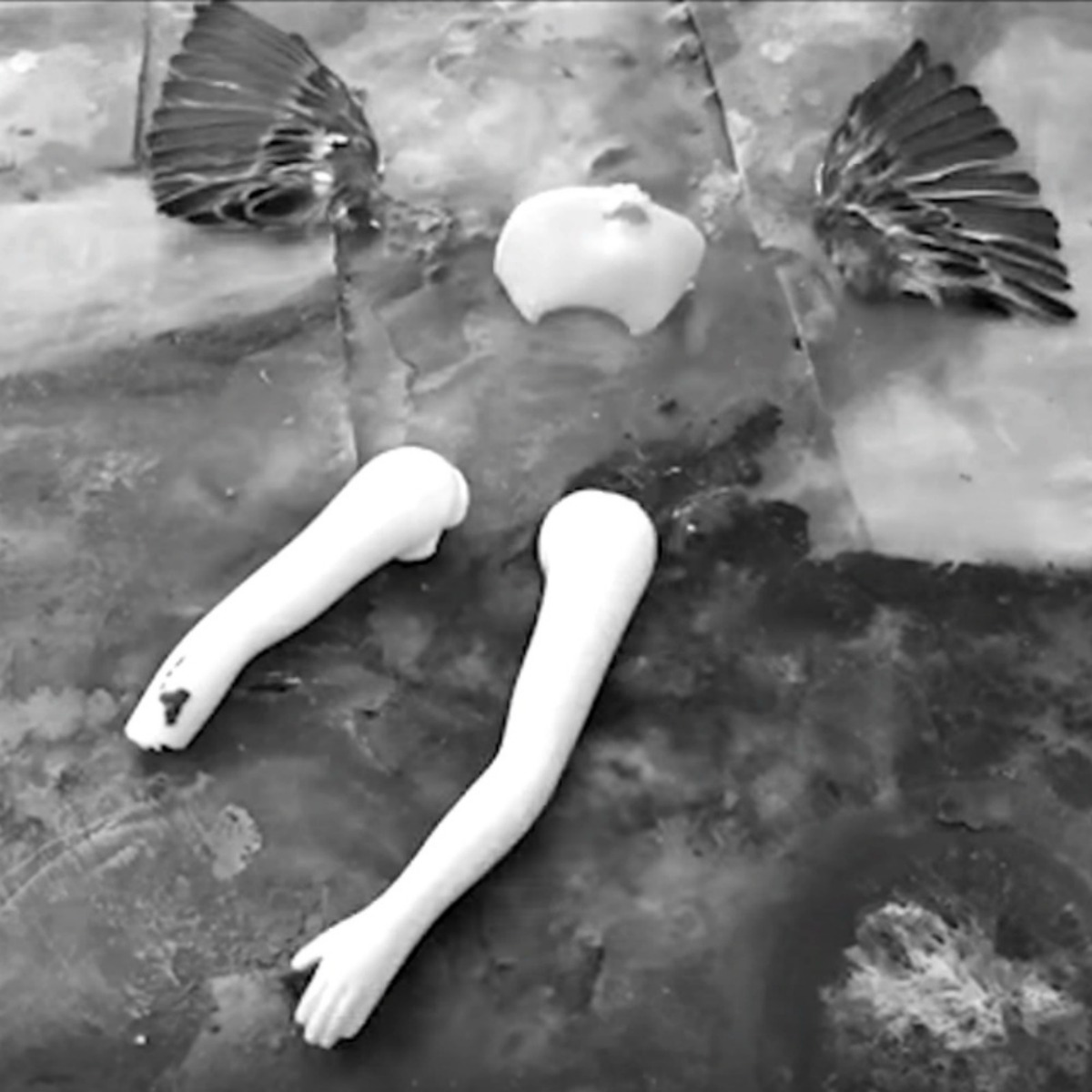
Nadler turns the concept of love into an unnatural force, one that breaks its target into pieces. “You’re a natural disaster,” she croons. “You touch and the earth will crumble/ You speak and hurricanes attack.” The black and white video includes stop-motion footage that is both beautiful and unnerving: a winged doll with its parts scattered across the ground, faces of sand and dirt that appear and dissolve, a snake-like creature made of clay that pulses and changes shape. We see clips of the singer walking in a desolate forest, but her face is mostly obscured by shadows, or blocked by her arms. Animated leaves fall and collect at the bottom of the screen, and the video ends with snow falling in the forest. The love referenced in “Janie In Love” does not end with flowers blossoming or the sun shining, but cold and darkness, making her message clear: This love was doomed from the beginning.
Marissa Nadler’s Strangers is out now via Sacred Bones. Order the album here and listen to “Janie In Love” below.
Catch her on her North American tour, dates below:
July 8 – Salt Lake City, UT – Kilby Court ^* (tickets)
July 9 – Denver, CO – Lost Lake Lounge ^* (tickets)
July 10 – Omaha, NE – Reverb Lounge ^* (tickets)
July 11 – Minneapolis, MN – 7th St Entry ^* (tickets)
July 12 – Chicago, IL – Empty Bottle ^* (tickets)
July 13 – Detroit, MI – El Club ^* (tickets)
July 14 – Toronto, ON – Drake Hotel ^* (tickets)
July 15 – Montreal, QC – La Sala Rossa ^* (tickets)
July 16 – Hudson, NY – The Half Moon ^*
July 19 – Boston, MA – Great Scott ^* (tickets)
July 20 – Providence, RI – Aurora ^* (tickets)
July 21 – NYC – Bowery Ballroom ^* (tickets)
July 22 – Philadelphia, PA – Johnny Brenda’s ^* (tickets)
July 24 – Washington, D.C. – DC9 ^* (tickets)
July 25 – Raleigh, NC – Cat’s Cradle Back Room
July 26 – Atlanta, GA – The EARL ^* (tickets)
July 27 – New Orleans, LA – Gasa Gasa ^* (tickets)
July 29 – Austin, TX – The Sidewinder ^* (tickets)
It is likely that whenever the Specials sang “pick it up, pick it up, pick it up!” they were not talking about your disposition. Maybe they meant the beat or your beer or the change on the ground…but why not your ‘tude while you’re at it?
It is a gross understatement to say that music makes you feel things. Composers know this well. Score writers know just when to cue in the strings to make a little tear fall, and massage therapists know which new age selection makes you relaaaaaaxxx.
But what about the other end of the emotional spectrum? What if the conductor of life’s cruel symphony is already making you cry, facilitating your craving for Duncan Hines easy-bake cake, and keeping you stuffed under innumerable layers of blankets with nothing but a bottle of Shiraz on your nightstand? How do you ‘pick it up’ then?
I’ve searched high and low for what some call a “good day record,” but often to no avail. Songs are too tied up in life events, too burdened by association to bleach away the sad or effectively spike endorphins. The C major scale can sound ecstatic on an on day, and cataclysmic on an off one. But wouldn’t a music writer have an entire fleet of mood-altering records at her disposal? 12-inch, black wax happy pills to make everything better?
No.
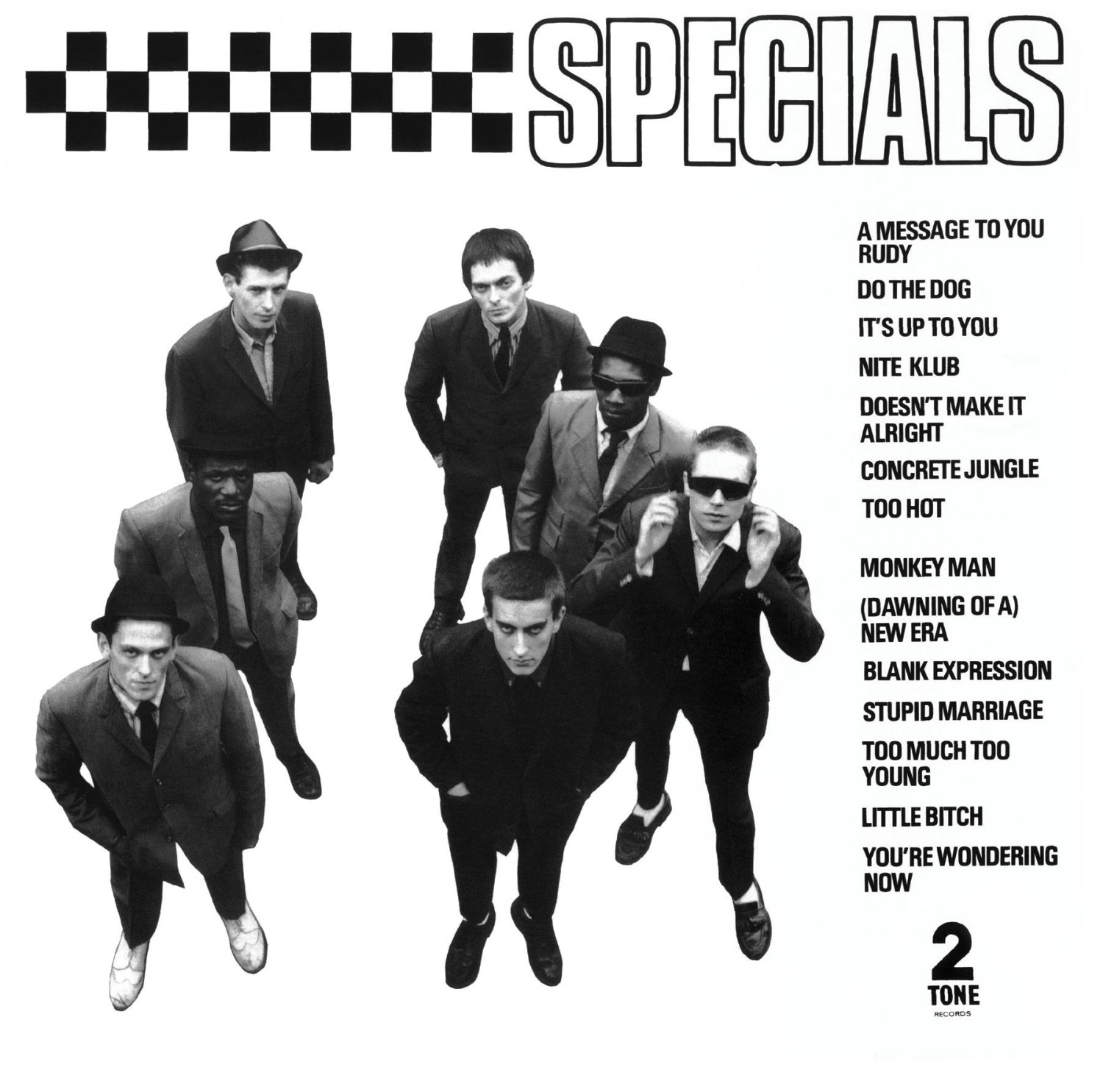
Both sad and true, there is only one album I’ve found in all my searching, that pinches me awake from the downward swirling hellhole of a bad mood. It’s the Specials’ 1979 self-titled debut that does it. It is my only hope, and I toss it back like a shot of bourbon after a long workday.
I’ve spoken at length about my parents’ respective record collections and the gratis therapy they have provided over the years. But of all the sleeves I’ve removed from those shelves The Specials is somehow the only album I’ve ever found that can snap me out of a bad day with Pavlovian accuracy…though I am currently taking submissions for more!
With its initial wheezes of harmonica and organ, it is a record that elicits instantaneous joy, a little cloud of dopamine in my limbic system. There are moments throughout its 14 songs that require tiny rituals of an obsessive quality. I will urgently drop a sandwich or press the phone between my ear and shoulder to catch that little snare fill in the beginning of “A Message To You Rudy.” Don’t try to stop me.
The effect this album has on me goes deeper than a “happy” sound or lyrical content. It isn’t as though the Specials only sang about the good life; there are tracks in their catalogue about everything from drunken bar brawls, to adulterous girlfriends, depressing clubs, a wasted London, and being an overall useless human being. Perhaps had I caught the 2 Tone bug later in life, that first record wouldn’t have the same beatific effect on me, but as it stands I pop it like a mood stabilizer.
I don’t focus so much on the lyrics, but rather the beat, the bounce, that crazy organ player Jerry Dammers who makes Shane Macgowan look like he has a nice set of teeth. I picture all seven members bobbing around like dancing ants in their little matching suits, black and white just like the musicians themselves. I think of horn sections, and shiny shoes, and the rhythmic absurdity that is skanking. I think of being in the kitchen as a 13-year-old, making failed attempts at baking and zine-making. Or of the time I gave my mother (partially at her request, and 100% to her boyfriend’s dismay) a Chelsea haircut. Bitch bangs and all. The Specials seemed to be a record to play amongst loved ones, or at a party, and it was never an album met with dissent.
The fact that this record came out almost 40 years ago is baffling to me. Of course it was born of a very specific, genre-heavy era in the British music scene, but it somehow remains fresh sounding-as crisp as the pleats in vocalist Terry Hall’s trousers. A lot of the credit for such timelessness can no doubt be paid to the record’s producer, the sire of cool Elvis Costello, who teamed up with the band to get everything tight in the studio.
For all of the depths I wade in the name of musical discovery, this is an album that persists with its importance. On the (very) rare occasion that I am asked what band I would be in if time wasn’t an object, I say the Specials. Are they my favorite band? No. But I can’t imagine a more fun group to be in. I turned to fellow music critics for answers; why won’t this record erode? Why, despite its birth in the nightmare of Thatcherite Britain, is it brimming with joy? Do others find it as timeless as I do?
Jo-Ann Greene of AllMusic made an interesting point: that the group’s debut LP was “a perfect moment in time captured on vinyl forever.” The website went on to say that it captured the spirit of “Britain in late 1979, an unhappy island about to explode,” and “managed to distill all the anger, disenchantment, and bitterness of the day straight into their music.”
That almost solves it for me, because what the Specials were doing on a grander, more socio-cultural level as the 1970s spilled into the ‘80s, I am attempting to do in my own mind; to take “all the anger, disenchantment, and bitterness of the day” and channel it into something more worthwhile. To “pick it up” and put it somewhere useful, like on the dance floor.
I’m not trying to write a self-help text here (though if I did it might be called Dance The Death Away). But I am trying to give credence to a phenomenon that endlessly fascinates me: that these little vibrations in our cochleae can so violently shift our emotional tide in ways that other stimuli cannot. The power of sound has been honed to such an extent that it has been weaponized for god sake, which admittedly is more to the credit of frequency than emotional response, but it certainly doesn’t undercut the impact of the aural.
A few years ago I reviewed a documentary for Film Forward called Alive Inside that discussed the effect of music on the memory of Alzheimer’s victims. The results, though perhaps not representative of a large enough study group, were pretty astonishing. It seemed that when the Alzheimer’s patients at a nursing home were played the music of their youth they were overcome with detailed memories and emotion.
Yet another study from 2011 dealt with the (proven) direct link between music and mood, citing that when subjects played their own selections of songs, they experienced “chills,” a scientific term summarizing the enormous amounts of dopamine the brain releases with such stimulation. The same reaction occurs during (good) sex, eating sweets, and injecting certain drugs.
But you don’t have to have bad sex, or spike your glycemic index, or shoot heroin. Music surely doesn’t solve all of the world’s problems, or even all of one’s own problems, but it’s a crutch I’m happy to lean on. As Morrissey once sang: “the world is full of crashing bores,” and that is true. Yet we bores are humans, and we humans have only so many things to count as true victories…is not one of them music?
We’ve figured out how to make instruments out of everything from gourds to pure vibrations in air. So in all this chaos, and mayhem, I will try to remember that in bleak Thatcher London in 1979, when people were rioting and on the dole, and race tensions were taut, this glimmering little record by The Specials burst through and made a handful of people dance. I hope we can pick it up from there.
Sometimes America is late to the game. Such is the case with AARADHNA, the Adele of the South Pacific. With her new album Brown Girl, AARADHNA is set to to continue her world domination in the U.S. And with our current political and cultural landscape – we need her. She’s already dropped the single and video for the stunning “Welcome to the Jungle,” which if you read on, you’ll get a chance to experience. As the July 22 release date for Brown Girl inches closer, AudioFemme go the chance to chat with AARADHNA about race, breaking into the American music scene, and those gorgeous tattoos.
AudioFemme: So you’re already established in New Zealand and Australia. How has your experience been moving towards a US audience with your latest project?
AARADHNA: The reception with ‘Welcome to the Jungle’ is positive but at this stage it’s too soon to say – time will tell.
I read that Brown Girlis about “people trying to put you in a box” – will you elaborate?
Growing up, I’ve seen and witnessed others including myself being ‘labeled’, stereotyped, put in box for what I looked like, what color my skin was, and it’s frustrating because I know who I am as a person. The song “Brown Girl” talks about racism and the feeling of being judged, this song tells the listener that there are layers to me. It goes deeper than skin color. It’s soul – “I am more than the color of my skin, I’m a girl that likes to sing, I’m somebody that has dreams, I’m smart, I’m goofy, I’m proud of my cultural roots, I like to cook, I like to read, I love animals, I have a caring heart, I’m sensitive, I come from a big loving family, I love horror movies, all kinds of music, etc. There’s more to me than what you think see that’s what I’m saying. Don’t put me in a box, a box is restricting and limited. I don’t belong there.
Your new album is very personal. What are your inspirations for the album?
Love, heartbreak, and life in general.
How does it deviate from your earlier work?
Each album is a different stage of my life and with this album it represents how far I’ve come – my growth from a young girl to a woman.
In 2016 the world is such a bonkers place politically – both in the US and abroad. How did politics and race relations play a role in the album?
I always wanted to write a song to express how I’ve felt growing up about being labelled and as previously mentioned the song “Brown Girl” talks about racism and being judged. I’m sure that everyone at some point in their life can relate as these things happen every day.
Tell me about the video for “Welcome to the Jungle.” What were the inspirations behind it?
“Welcome to the Jungle” is about change. You have to go through it, and there is no way around it.
What artists have you been listening to these days?
I’ve been listening to a lot of Shuggie Otis, Freedom Flight always takes me to another place.
Because they’re so beautiful I have to ask – will you tell me about your tattoos?
Thank you – I got these tattoos to represent my Samoan and Indian heritage and that’s just me taking pride in my culture and me saying this is what runs in my blood. My dude Andy Tauafiafi at Taupou Tatau is the awesome artist behind these tats. I don’t go to no one else but to him; he is a great artist.
What advice would you give to a young woman trying break into the music industry?
Perseverance is key. Learn how to say no when you WANT to say no. I used to always consider the person first when it came to my craft, but through time I realized that I need to be selfish, especially when it comes to my craft, ’cause at the end of the day it’s got my name it and I’m responsible for what I put out there, and you have to be 100% happy with what you put out there. Always put you first because no one has your back better than you do.
Watch the video below for “Welcome to the Jungle.” For more AARADHNA, click here to download the title track “Brown Girl.”
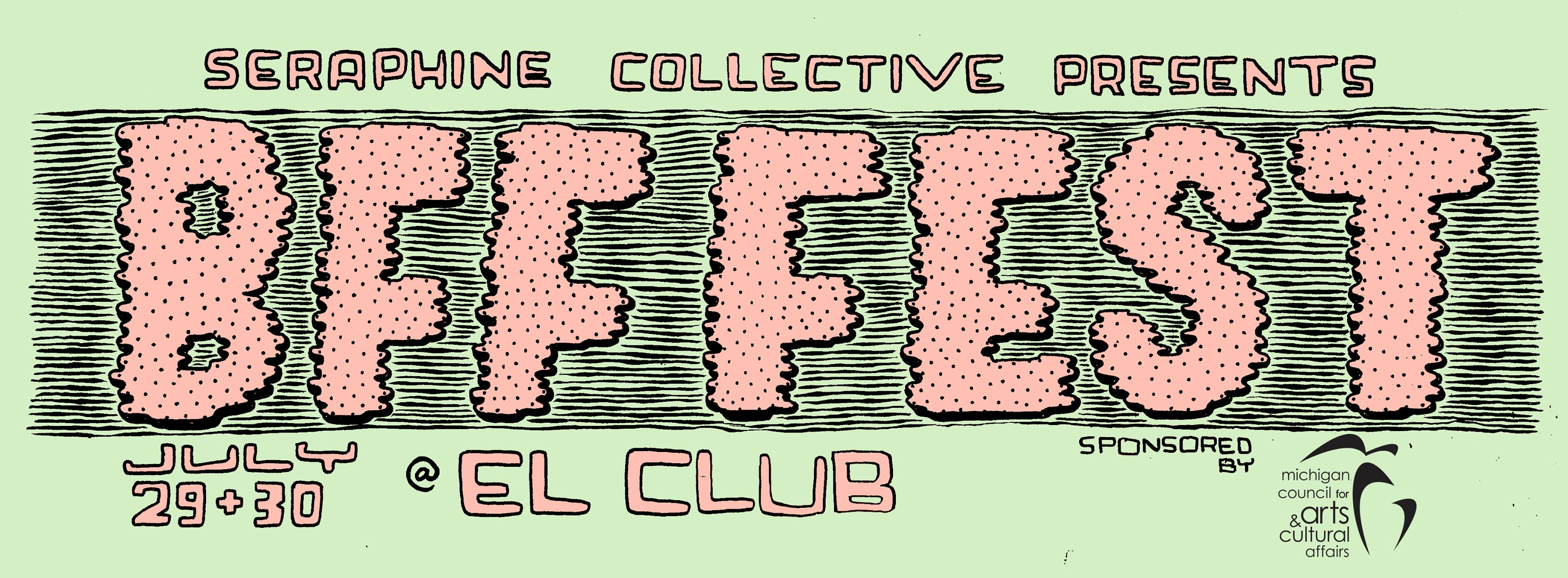
Tis’ the season for the summer festival! Hosted by Detroit’s own Seraphine Collective, BFF Fest is an inclusive safe space and special slice of summer love created to celebrate the diverse talents of Detroit’s creative community. With an inspired curation of artists and a consciousness aimed to build a more supportive music scene, BFF Fest is a progressive and inviting celebration that strives to make connections between the underrepresented individuals, music and identities. And just as important as the mad posi vibes, the lineup is bursting with the perfect sounds for an eternal Detroit summer! Not in Detroit? No problem! Rally your besties, spark up the barbecue and soak into summer with our BFF Fest playlist!
1. Best Exes: “Blessing”
The concept of having a best ex is pleasantly perplexing and the threesome Best Exes is a shimmery reflection of a love that lingers past the expiration date.
2.Junk Food Junkies: “Takeout Chinese”
Kitschy, cute and nihilistic lo-fi babes, Junk Food Junkies, write songs about the sweet, the savory and the bullshit of daily life. For a band with songs about pizza bagels, Chinese takeout and Faygo soda there is a depth that speaks volumes of the plight of the millennial, just with more pizza. Lots of pizza.
3. The Freebleeders: “Problematic Faves”
Remember the things you loved as a kid/teenager/adult? Well, they’re probably rooted in misogyny , racism, sexism and other examples of unethical evil and The Freebleeders are here to remind you and struggle with you by sharing their “Problematic Faves.” Dark, yes. But this brutally thoughtful track is still summer ready with a biting tongue.
4. Bonny Doon: “Summertime Friends”
Moody and sedated, “Summertime Friends” echoes and climbs with a melancholic malaise that is treated with medications of the party variety. Take a midday beach nap on a lovers lap to this track and let the sun burn the space around your stolen sunglasses.
5. Deadbeat Beat: “When the Sun Soaks in”
This retro, surf-punk track is reminiscent of The Kinks with its jutting pop bounciness and droning vocal timbre. Suited for beach ball tossing or post-breakup flirtation, Deadbeat Beat has their pulse on your summer feels.
6. Jes Kramer: “Something”
Grand Rapids (near the pinky of our lovely Michigan Mitten) based singer-songwriter babe Jes Kramer creates deeply personal, emotive tracks that will make summer folks ask you if you’re sweating or crying. Intricately layered with raw lyrical power, Kramer lovingly takes us back to the day where we listened to The Postal Service and day dreamt through closed windows.
Following the release of last year’s energetic single “Silver Streets”, Thomas Killian McPhillips VII, Derek Tramont, and Ryan Colt Levy of BRAEVES zealously uprooted themselves from the familiarity of New York to explore how the band could flourish with a little change in scenery.
“When the prospect of moving to LA came up,” said Tramont, “It was a lightning bolt that hit us so hard, we just picked up and drove across the country together, practically no questions asked.”
And “Bitter Sea” makes it clear: California sun sure suits them well.
Equal parts love letter and break-up song, the track illustrates a bittersweet goodbye to a personified New York City.
“We were kind of at odds with the New York music scene, partly because we have been living and playing in New York all our lives,” recounts Tramont. “It could have been Chicago, London, or Portland. I’m sure you would grow tired of your hometown; that’s just natural. But we felt a bit of a disconnect. Whether it was some of the bands we played with, the venues, or the real lack of a music ‘scene,’ something just felt like it was holding us back from truly expressing ourselves.”
It’s a new kind of relationship they’re developing with LA, as the band “really needed something that would make us feel like we were growing and not just stagnating…something drastic needed to change to get us to the place we want to be.” But while BRAEVES may be based on the West Coast now, lyrics such as, “And the more my body tells me I’m entranced/The deeper in your quicksand I’ll descend” show that even if you leave New York, it never quite leaves you.
Recorded at Red Rockets Glare with Raymond Richards (known for his work with Local Natives, whom the band often cite as a key influence), “Bitter Sea” illustrates a fresh vivacity and prowess that were never lacking in older songs, but rather, have been elegantly refined. It has BRAEVES sounding refreshed without straying from the soulful and shimmering echoes that define their ethereal sound, and it has us eager for their forthcoming sophomore EP.
Stream the track below, and if you’re on the West Coast, catch them live, where you certainly won’t be disappointed. Plus, you might just be lucky enough to hear even more new songs:
During a benefit concert on Tuesday, St. Vincent performed several songs dressed as a toilet. (There’s probably a great potential for puns here, but we’ll let you take care of that). The benefit was for the song of Annie Clark’s drummer, Jasper Johnson, who is recovering from a severe seizure. Father John Misty,Rufus Wainwright, Martha Wainwright, Elysian Fields, Joan As Police Woman, Nina Persson also performed. Check out footage of “Bring Me Your Loves” below:
ICYMI: Led Zeppelin Is Innocent
Rock legends Led Zeppelin were dragged into a lawsuit claiming that “Stairway to Heaven”’s signature guitar riff was actually a ripoff of Spirit’s “Taurus,” an instrumental song from 1968. Though Led Zeppelin had performed with Spirit before, they denied their song, written in 1970, was based off of “Taurus.” Now, the lawyer on Spirit’s side, Francis Malofiy, is being suspended from practicing law for 3 months. Apparently, Malofiy violated a bunch of rules of conduct during a previous copyright infringement lawsuit, involving Usher’s “Bad Girls.” Read more here.
https://www.youtube.com/watch?v=9Q7Vr3yQYWQ
Watch Angel Olsen’s “Shut Up Kiss Me”
Angel Olsen dons a sparkly, silver wig once again in the video she self-directed for “Shut Up Kiss Me.” She also gets pretty wild on a roller skating rink. Check out the video below, and pre-order her upcoming album MY WOMAN here.
Support Phil Elverum’s Crowdfunding Campaign
Phil Elverum, of the Microphones and Mount Eerie is currently raising money for his wife Geneviève, who was diagnosed with stage 4 pancreatic cancer soon after the couple had a daughter. Other musicians are currently helping the cause by auctioning merchandise; Neutral Milk Hotel is offering a signed box set, and Fugazi and Bikini Kill are auctioning several things. Check out the crowdfunding campaign and auction.
Freud called it ambivalence. I call it Cher. And not just “old stuff”, niche, “Half Breed” Cher. I’m talkin’ “Believe” Cher too. The good with the bad, which could be a crude definition of ambivalence itself. This week, I’m thinking a lot about ambivalence, and my favorite iteration of it: the Guilty Pleasure.
I recently came across a piece of clickbait that The Daily Mail ran last summer called “The Science of Guilty Pleasures: Study uncovers how feeling bad can boost your happiness.” Evidently, Professor Ravi Dahr of Yale University got the notion to conduct such a study as he sat next to a colleague one day, watching him munch on a chocolate bar as if it was some sort of dilemma. Dahr was taken aback by his coworker’s simultaneous display of enjoyment and self-loathing while eating the chocolate. Thus spawned the idea to research the merit of the Guilty Pleasure.
The article goes on to site stimuli such as “alcohol and shopping sprees” as arbiters of this shame/pleasure model, the driving point stating that “guilt and pleasure are often tightly coupled in people’s minds, so activating one of these concepts can draw out the other.” Hence: forbidden fruit, the five-finger-discount, ice cream, and Phil Collins. Dahr’s intended application of the study was market research (which is all a bit too Edward Bernays for me), but what happens when we apply this idea to the ultimate Guilty Pleasure: the Musical Guilty Pleasure (MGP)?
Is shame the true catalyst for the immense joy I feel while listening to “You Can Call Me Al” and picturing the entire city dancing in unison? Do I feel just the right amount of “naughty” when I, in all sincerity, have to fight back tears upon hearing “In The Air Tonight”? No. This isn’t a fucking Dove chocolate commercial. I may not be a professor at Yale, but I can’t help but wonder if the MGP functions on a different level than a sumptuous dinner for one at Dallas BBQ. Because unlike the handbag that cost more than your rent, or the 3am Seamless order, the MGP has no real repercussions. You aren’t poorer for listening to, say, every record the Wallflowers ever recorded, on repeat, for a year. Cranking Bette Midler’s The Divine Miss M to 11 when no one’s home doesn’t raise your cholesterol. So why feel guilty in the first place?
One consistent feeling I recognize when accessing my secret song library is discomfort. There is always that lingering question: is this good? Or bad? Or very bad? My favorite example of a band that elicits such confusion is Paul Weller’s schmaltz project The Style Council. Their music is…I don’t know. It could be compositionally brilliant, and merely stamped with that 1980s seal of production quality that seems to doom and date so much of the era’s oeuvre. Or, it could be horrendous. I will never know, because loving The Style Council is like having a stupefying crush: you’re so smitten you fail to notice how ugly his shoes are. Or his crippling video game habit.
For instance, The Style Council have a song called “You’re the Best Thing” off of their 1984 debut LP Café Bleu. It is kind of my MGP poster song, if you will. No song has ever toyed with my emotions so deeply, and I don’t expect another ever will. It makes me rage with cognitive dissonance. It is so gauchely over the top, so sappy, so wrong; and I love every minute of it. This is a track that legitimately makes me squirm with unease. While preparing for this week’s rant, I was going through all of the music that I classify as MGPs. Upon listening to “You’re the Best Thing” I jotted a sprawling note on my legal pad, which read: “isn’t good art supposed to make you feel uncomfortable?” I don’t know what Ravi Dahr would have to say about that.
I suppose that aside from causing discomfort, the MGP stokes the fear of being found out. That somehow your love of U2’s “Sunday Bloody Sunday” (just that ONE song, ok?) will potentially negate your enormous Tom Waits collection. Like U2 has the power to cause chemical equilibrium and suddenly disable all of your good taste. There is a wonderful scene in the recent movie Green Room in which an interviewer is asking members of a punk band what their desert island band would be. They respond with understated cool: “Poison Idea,” “Sabbath” and the like. Towards the end of the film, as the main characters are getting killed off one by one in the most gruesome ways, the band’s guitarist poses the same question as a sort of rallying distraction, but the answers have shifted rather drastically. “Prince.” “Madonna…and Slayer.” “Simon and Garfunkel.”
The funny thing about these two scenes is that while the characters weren’t discussing MGPs, the same principle of embarrassment applies: that fear of being revealed as a charlatan, of being, god forbid, not punk enough, or at all. Last year I was conducting an interview at the Four Knots festival here in New York, and brushed up against a similar phenomenon. The band was fairly new to the scene, so I asked them that old question I find so endlessly amusing: what were their MGPs? “The Strokes.” “Grizzly Bear.” “Guns n’ Roses.” It was the Green Room effect before I even knew what that was. I wanted real humiliation. I wanted Enya, or Yanni, or Godsmack. I pressed them to think harder, and finally got something deeper. “Alkaline Trio.” There it is.
I don’t believe people when they say: “none of my pleasures are guilty.” Or maybe I am simply jealous of their carefree life, in which they can host a dinner party and put their itunes library on shuffle, walking away free from the clutching fear that one of several Rancid songs could come on at ANY MOMENT. That must be a nice feeling. But until I can liberate myself from discomfort and shame, I will brandish my guilt in the most Catholic of ways, reserving it a seat next to me at the bar, doing its laundry; hell, my guilt and I could even open a joint checking account. Guilt is a lubricant for dry food; she is the one thing separating bad taste from eccentric taste.
This is the closest we will ever get to Bill Callahan’s living room, or…porch. The stage at Baby’s All Right has been set with a sturdy wooden chair and four handsome plants, two flanking each side to make up some kind of homey throne. A long-haired gentleman places ashtrays smoking with incense behind the stage monitors. “I want to be the incense roadie,” chirps a nearby voice, just before Callahan takes his seat in a blue button-up and well-worn boots. He does so without a word, easing into a simplified rendition of “Feather By Feather,” a song from his Smog days.
You could say that all of the evening’s songs were simplified, seeing as they were born of only six strings, a foot tambourine, and occasional harmonica. But one thing to learn from stripping a song to bare-bones is: how well does it hold up that naked? We were given the substructure of Callahan’s melodies throughout the set, and found they can still support the heft of his baritone beautifully; maybe this is no surprise. By force of habit, my ears still cued in the synth strings on “Jim Cain” and the distortion on “Dress Sexy At My Funeral,” but I didn’t want for any of it. The truth at the core of Bill’s sparse delivery is that his songs are bulletproof. They’d be as memorable tinkling out of a hurdy gurdy as they would set to a 30-piece orchestra.
Callahan has said in many interviews, perhaps weary of the ever-present question regarding his retreat from “the Smog moniker,” that he sees Smog and Bill Callahan as one and the same, merely on different points of a continuum. True to that philosophy, he doled out generous helpings of his catalogue old and new, playing everything from “Prince Alone In The Studio,” to “Too Many Birds” and his cover of Kath Bloom’s “The Breeze.” Upon strumming the first chord of “Riding For The Feeling” the crowd nearly fainted with excitement.
“You recognize that song from the first chord?” he said, looking bemused. “That’s the coolest thing. I never thought I’d get there.”
The audience continues to go wild with anticipation.
“I hope it’s the song you think it is.”
There is an austerity about Bill Callahan that I haven’t seen in too many performers…a kind of steely fortitude that makes me wonder if he’s not a man, but maybe a mountain, or a barquentine. He was there to do one thing, and it sure as hell wasn’t chitchat. Callahan doesn’t pander, just delivers. And yet despite the weight of his music, despite this being a rare moment to be earnest, and split open, and to feel something…there will always be a drunken idiot shouting safely from the back of the room.
“I fucking hate you Bill!” barks a fool who has been yelling quite the opposite up until now.
Callahan, who seems as though he could win any argument with the sting of his silence, looks up at the ceiling, a smirk slowly spreading across his lips. “I’m used to it,” he quips.
Anyone who has read a handful of interviews with Bill will pick up on his bone-dry sense of humor, but on the page you won’t get a sense of his comedic timing – the deadly delay he administers between minimal remarks. It’s a joy to see a few soft-spoken words slay a drunken monologue. Perhaps that speaks to the power in Callahan’s lyrics as well: nothing superfluous, everything purposeful, quality over quantity.
It would have been easy for Callahan to call it an early night, but he played a real stew of a set, clocking in at around an hour and a half, and giving us the chance to choose his last song.
“Well, that’s about all I got time for, goodnight,” he says after closing with “Say Valley Maker.”
The drunken fans persist: “To Be Of Use!” they scream.
Leave it to my favorite electro-pop duo to release a dance track contemplating the turmoil of running the rat race that challenges the suffocation of creative freedom by means of societal survival. Valley Hush debuted “Iced Cream” earlier this week, a mesmeric track that encapsulates Alex Kaye and Lianna Vanicelli’s fluid aesthetic of dancing the line between struggle and release with an undeniable melancholic pop magnetism. Although there is no mention of the beloved confectionery treat, the songs message is the equivalent to the sticky sweetness of a melted cone between your fingers; a life that is satisfying but not without the perpetual stickiness to make you wish you had a napkin, or rather, make you wish you didn’t care about the mess. Following the same sensational trajectory of their last single “Iris”, “Iced Cream” picks up with the similar jutting, well-traveled mash-up of worldly tones and beats but this time delves deeper into self-induced sadness.
The most marveling element of “Iced Cream” is the marriage between lyrics and Vanicelli’s vocals. Opening with the line “I’m a human being/not a machine/I will eventually tire/of this silly maze” we are lead through a poetic display of personal disappointments and misappropriated life goals: how it feels vs. how it should feel. Vanicelli insinuates traditional accomplishments (“a college degree/a job with a salary”) act as life altering barriers between exploring the truer parts of self and feeling successful; an internal melting and re-freezing, only to melt again. These vulnerable truths through airy and choppy vocals feel like a privately shared secret discovery, though not confessional or dangerous. Valley Hush invites us to share a spoon and indulge in their existential crisis sundae that wakes our inner demons with a sensual tenderness that is usually reserved for licking our fingers clean, as not to leave a trail of sweet cream behind.
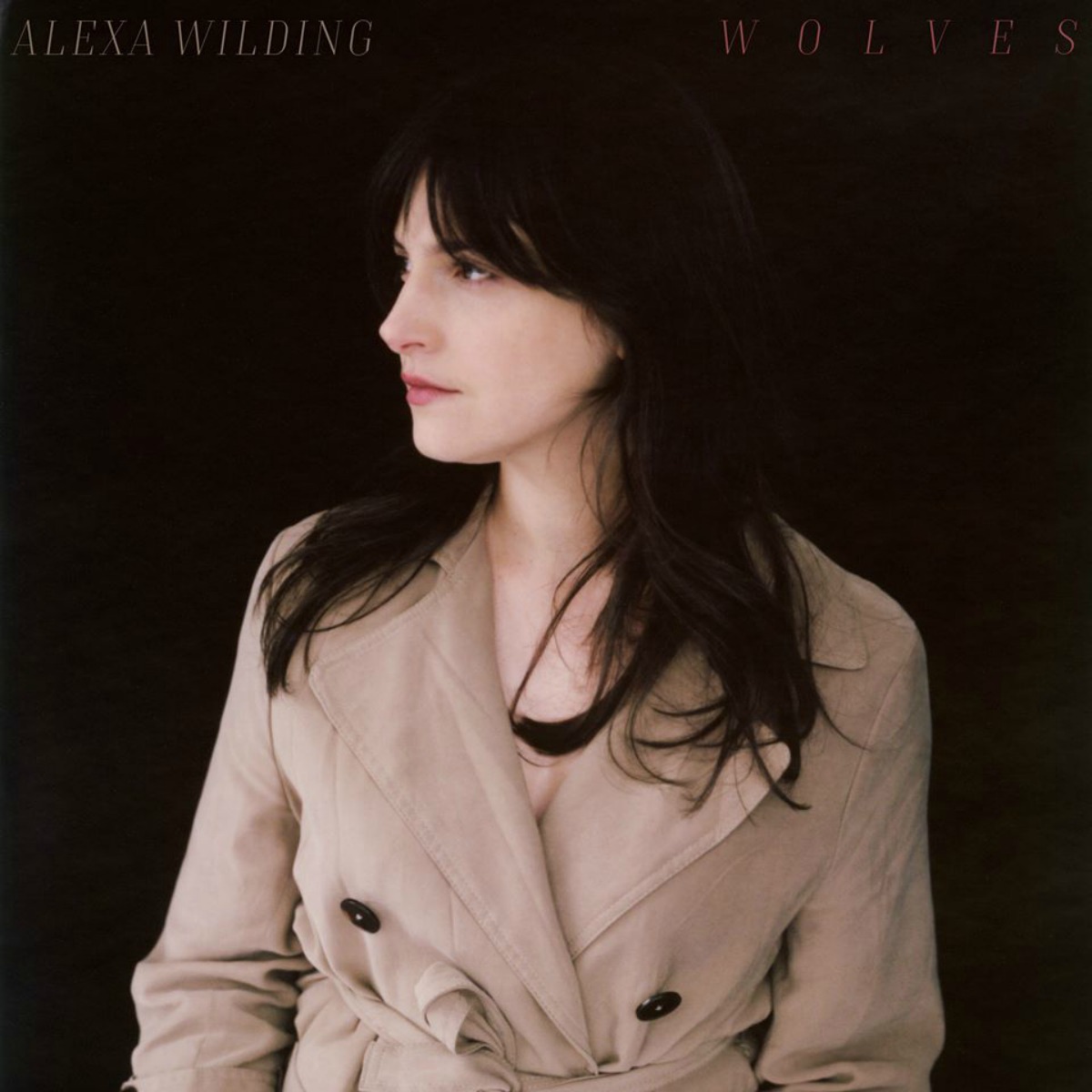
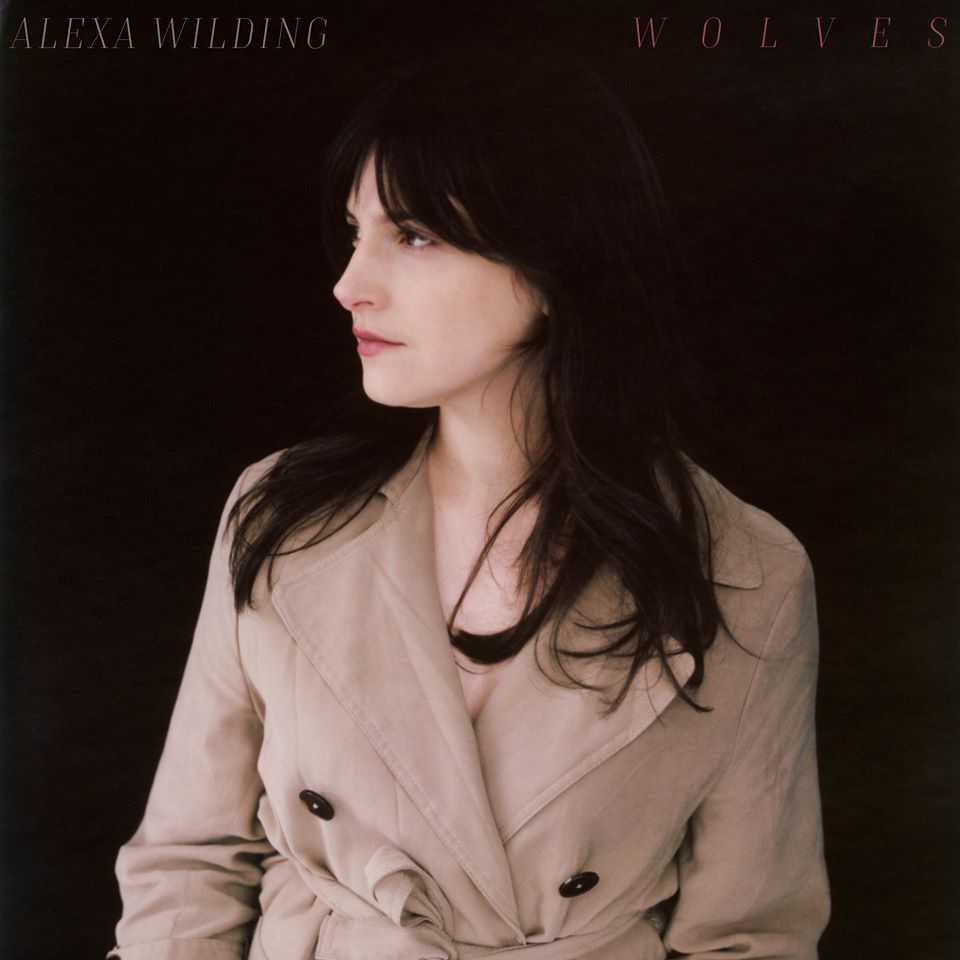
New York songstress Alexa Wilding has an upcoming EP Wolves, which sees a transition from her previously more airy folk music. We sat down and talked about where her inspiration came from for the piece, as well as what sort of transition we can expect from her past work. After taking a few years off from music, Alexa realized the pull toward this art form was stronger than she had previously acknowledged, and she found herself creating music when she needed an outlet. It also provided her with a chance to really focus on herself. This is an EP that saw her through a difficult time in her life—when one of her children was diagnosed with cancer—and both its name and content reflect the changes Alexa underwent.
Read on below for an interview with her, and keep an eye out for Wolves, which is due to release on July 8.
AudioFemme: Tell me about your musical history, are any of your family members involved in music?
Alexa Wilding: Yeah, I come from a pretty ridiculously arty family. My dad’s parents were well known opera singers. My mom’s an actress, my dad still is a filmmaker, my grandmother was a painter, so needless to say—and my aunt was a ballet dancer—we’re sort of an arty bunch. And music played a pretty big role in my childhood and in my family’s culture really.
What inspired you to create your new EP Wolves?
Sort of circumstances I never ever thought I’d be writing a record in. I had twins in 2013. They’re going to be three next month. And unfortunately—well, things are fine now, but my son Lou went through cancer treatment. So the record was written in the most unlikely of places. He’s fine, which is really good for him.
That’s such a relief.
Yeah, it was crazy. It was really crazy. But you know, becoming a new mother, I wasn’t really sure, like am I going to keep doing music? It’s all I’ve ever done, but I was just so sapped creatively from the wild psychedelia of being a new mother and then we were thrown into this crisis. And basically what it meant was weeks on end for six months, we basically lived in the hospital. We switched off nights, my husband and I, so my son at home always had a parent.
But for the first round, I was in such a state of shock that I wouldn’t be able to sleep. I would just stare out the window at the East River and be like, “Where am I? How did this happen?” I was so terrified. Then by the second round, I don’t know what happened, but I said, “Okay, that’s it, Alexa. You need to carve some space for yourself.” So I turned to what I always turned to, which is music. I wrote the songs on Wolves on a toy piano borrowed from the hospital playroom.
It was wild. And while my son slept and healed, the songs just came. And mostly it was an escape for me. Like when I tell people that I wrote the songs in these unusual circumstances, they’re like, “Oh my God, this must be a really depressing cancer record.” And I’m like, “Actually there isn’t even a mention of what was going on.”
I so needed an escape, and what I did was I really focused on a time in my life right before I became a mother. That year I was touring nonstop and different relationships were kind of coming in and out of my life, so the record was sort of making peace with some of those loose ends, things that were put on hold to become a mother. And by doing that, I was able to become present.
Pediatricians always joke when you become a parent, and they’re like, “You know, you’re a parent, you need to put the oxygen mask on you first and then your kid.” And I was always like, “What the hell does that mean?” But that’s kind of what I did. So it was very surreal to leave this six-month experience with a cancer-free child, which is obviously the most important thing, but also as an artist, to have these songs that were ready to go. And it was very reaffirming after taking a few years off to be like I don’t really have a choice. I guess making albums is just what I do.
That’s awesome. I’m so glad he’s okay.
Thank you! Me too, me too.
So what does your ideal audience to this EP look like?
That’s a good question. People have joked about me that my following are a small but dedicated circle of very well-dressed people. I was like, okay, yeah, I like that. I feel like this record in particular is my most accessible one to date. But, that said, it’s the one I find most interesting. So I hope I haven’t sacrificed any of the oddness by having my first full-band record. I think that women in particular, hopefully, will relate to it. I am definitely a 90s kid, so I came of age with Lilith Fair. Kim Deal was like my hero, and Tori Amos and Sarah McLachlan. Ya know, we all laugh because Sarah McLachlan is so dorky now, but I was listening to her recently when I was on a job, and I was like, “This is good stuff. Everyone’s got to chill out about this. She changed history.”
Yeah, I agree. There’s something about it where you’re like, this isn’t really a guilty pleasure because I’m not guilty about this.
Yeah, that makes sense! Totally. I loved all that stuff. So I am unabashedly saying and hoping to carry on that tradition of women who, ya know, wrote good songs and knew how to play their instruments and told stories that were very personal to the female experience. And that said, you know, I think more men are actually hopefully going to like the record, too, because it has a masculine side to it as well. It’s really—and this is really stereotypical—but it’s really trying to move. Which I wanted, because the whole idea with Wolves was be like, here are these feminine stories that I was trying to summon up in myself, like the wolf, to have the strength to handle my experience. With most of the record, there’s a softness to it, but to be totally blunt, the joke we made in the studio was always, “Boobs and balls, boobs and balls: They have to be in direct proportion, in an even balance.”
So I feel like it’s my toughest record, in a weird way. And I’m really proud of that because I was getting really sick of, ya know, before and people saying, “Oh, it’s just a girl picking her guitar. La-di-da.”
Right, yeah, that’s kind of insulting.
Or you get up to play a show and people would immediately look at you and before you started and be like, “I know what I’m in for.” And that used to make me crazy. I’m hoping it’ll reach a wider audience, and it’s not just the freaky folk thing anymore. When I wrote it, I was listening to a lot of radio and having fun playing with melodies for the first time in a way that I was like, “I want everyone to like this song!” Even the person who’s just tapping their foot, they’ll get that out of it.
Is there anything you’re hoping that your fans will take away from this piece?
Yeah, I mean obviously I can’t divorce the story of the circumstances in which it was written from the music. And my fans were so supportive during our crisis. Ben Lee, who’s a friend, did fundraising for us. So many of my friends used their celebrity to sort of help us. And the story, despite myself, got a lot of attention. And I was really happy to share our story with different media outlets. Because, as Ben said when he started—he did a Plumfund—because something people don’t realize is that I was like, “I’m not fundraising. What will people think? We have insurance! Blah blah blah.” But a medical crisis like that really wreaks havoc. Things you don’t even think about, like going to take cabs to and from the hospital every day. So that was really a lifesaver. But what he said was, “They are us. This could happen to any of us.” And what I’m hoping people get from it is the importance of holding onto yourself during a crisis, whether or not you are a parent. I don’t want to isolate or alienate fans who are not parents, but at the same time I’m pretty sure the record will hold a special place. It really has touched a lot of mothers, at least in New York City a lot of mothers have started following me during this crisis.
But what I hope fans take away from it is the idea that we can make friends with parts of ourselves that we used to be. I think that’s a lot of what the record is about. I talk a lot about different relationships. There’s one song, “Road Song,” in which it’s kind of a cinematic song. I mean, it’s basically a woman saying that she wants to be with somebody who’s with somebody. And that was a really scary song for me to write. I had to sort of make peace with that part of myself. We all have that.
I know I’m talking to a female music blog right now so I can say this, but I think it’s very hard for women to talk about their desire. Men are allowed to say, “I want that!” Or, “I want her!” Or, “I want to go on the road with my rock and roll band.” And nobody really thinks twice about it. And when it comes to women, we have a harder time talking about that. So for me, this record dealt with a lot of love as issues. Like with wolves. Like why can’t that person step up and do what the wolves do and be my partner? Why can’t I step up? In “Road Song,” it’s like I want that—I want what he has. And “Durga,” the last song, the lover is disappointed in the fact that her partner is not leaving his easel to tend to her needs. So like, all these little stories, these little snippets. Also, there’s this song called “Black” that’s a really small song where I just talk about going to a dark place. As women, especially as mothers, we’re not allowed to talk about wanting to go to a dark place. We’re supposed to just keep it together and lay low, so I think I was dealing with a lot of those questions on the record.
That makes a lot of sense. There is that weird expectation, especially with a mother, if you say anything is wrong, people are like, “She can’t handle motherhood.”
Exactly! I was even worried, like what are people going to think? She wrote this record about her son? It’s like what I was dealing with, and people were doubting me. It’s because I wrote a record that I was able to mother him. We’re so judgmental. And women are the worst!
I read a quote recently, a female filmmaker had a really bad interview where she had a movie come out and the interviewer kind of bashed her, and it was a fellow female. And she wrote an open letter defending her films, and in it she said, there’s a famous quote, I forget who said it: “There’s a special place in hell for women who don’t support other women.” I love that. All about the sisterhood!
Definitely. So since you feel you’re kind of switching genres, is there any genre that you now feel like you fit into better?
I definitely was sort of occupying—I mean, I was told I was occupying more of a freak folk, folky, flower crowns thing. And I love a flower crown, but I really want to be moving more into just singer/songwriter. And someone like Natalie Merchant is incredible, as sort of the godmother of this sort of genre. People that I normally look up to in my own sort of circle. Also, Adler is incredible; I love her stuff. She’s somebody who made really spooky folk music and is now sort of standing her sound. I see this in a lot of my peers. Merchant has really taken off, which is so good for all of us, but I see it in our circle, and we are really moving away from the pigeonhole of “girl with a guitar.” And I still, I mean, it’s so cliché, but I still hear in interviews or after shows, “Oh my God, you were so incredible. I can’t believe you play your own instruments!” It’s just wild. That still exists.
You’d think we’d moved away from that already. So is there any specific song that you feel more of a connection with than the others?
My favorite song on the record—I mean, I have a couple—but there’s this song called “Stars,” it’s the fourth song, that I really love because it was just such an example of my escaping. It was a memory of being on the road, and I talked about being by the Rockies and the clear skies and the sadness I felt because I was so trapped as I was writing it. I really love that song. The line is, “Sometimes the sky throws a handful of stars in your way.” For me that sort of sums up the whole thing: that life really takes these crazy, wild turns, but you can really get through them in a magical way if you consider the circumstances with the same wonder and curiosity as you would a good situation. So I really tried to do that during my son’s crisis. And people would say during it, “How are you so together? How are you so cheerful?” And I would just wake up every day and I’d wash my face and I’d put on a nice dress and try to make everything look nice and do my best and have the same curiosity toward a bad day as you would a good day, which sounds really Pollyanna, but it really takes fucking guts. And I’m in awe of some of the people who really inspired me to summon up the wolf woman. The she-wolf.
That sounds amazing. What do you have planned for the future right now?
So we’re releasing Wolves in July, and I’m really only playing a limited amount of shows just because I’m with my kids right now and the logistics of three-year-old twins. I don’t know, I am a bit of an overachiever, but I have to sort of draw the line. I’m still going to do what I can to share the songs with the world. And I’m actually beginning the next record, which will be a full-length record. I’m really excited about that. And also, I’m writing a book, basically about the whole experience.
If you could perform at one venue, existent or nonexistent, which one would you choose?
Oh my gosh. One venue. As a New Yorker, I would kill to perform at the Beacon. That’s a real dream of mine. Or Carnegie Hall.I saw Suzanne Vega do something there a few years ago, and she couldn’t help herself and said, “How do you get to Carnegie Hall? Practice, practice, practice!”
But my one regret is that, before becoming a mother, I didn’t tour in Europe. And I really look forward to doing that in the future. In particular, I just want to play in Paris. That would be a really happy, happy night.
What besides creating music do you do as a hobby? Do you have anything that kind of forms your identity?
Yes, so mother/musician/writer. I’m quiet about my writing, just because music is so in your face. But I write and read constantly. I’m a real bookworm.
Do you have any musical milestones that you’re working toward adamantly?
For me, the biggest milestone is that I’d really love to have a label or a team behind me. I’ve been doing this by myself for so long, and I’ve never really found the right fit or didn’t ask for what I wanted or didn’t have that sort of fateful connection happen yet. And while I know those relationships can be very fraught, whether it’s label or manager, I’m really ready to put the proper team behind what I’m doing simply so we can reach more people with the music. I want it to happen in a natural way, but I’m just hoping I can continue to. And I’m sort of coming back after a long time. And it’s might be a bit of a slow ride, but I’m realizing that my ambition is much greater than I ever thought it was. Again, another thing as a woman is that we’re not really supposed to be like, “I want to take over the world!” But I really want my music to reach everyone.
Isn’t it difficult to relax? Despite summer, and implications of letting stress melt away with the seasons, we all struggle with finding contentment. Ironically, a beautiful song about just that may be exactly what you need to settle into the now. “Older,” off New England singer-songwriter Lina Tullgren‘s debut EP, Wishlist, out on Captured Tracks is about just that. “When you’re a kid, all you want to do is be old. When you’re old, all you want to do is be a kid again,” Tullgren wrote the Fader, who recently premiered the song.
The melancholy new tune “Older” perfectly captures that tragically beautiful feeling of displacement. Take a listen below.
Over the past couple decades, EDM has gone from a small subculture to a mainstream, worldwide craze. Artists like Diplo and Calvin Harris constantly pop up in celebrity news headlines, and a long roster of celebrity DJs from Elijah Wood to Joe Jonas (and wannabe DJs like Kylie Jenner) are taking up the practice. The frenetic dancing of EDM audiences rivals the energy only of heavy-metal moshing, if even that. Basically, DJs are the new rockstars.
I say this now, but I was years late to the game. Until last weekend, I thought of DJs as the people who spun beats at nightclubs or curated songs on the radio.
What lifted this rock I’d been living under?
I attended one of the most epic music festivals in the world, Electronic Daisy Carnival. EDC springs up every year all around the world, from New York to Brazil. But Las Vegas was the perfect place to lose my EDM virginity. Electronic music booms through the city’s famed hotels and casinos, screens on the insides of cabs advertise DJs, and it’s home to posh nightclubs like Omnia, where Calvin Harris performs.
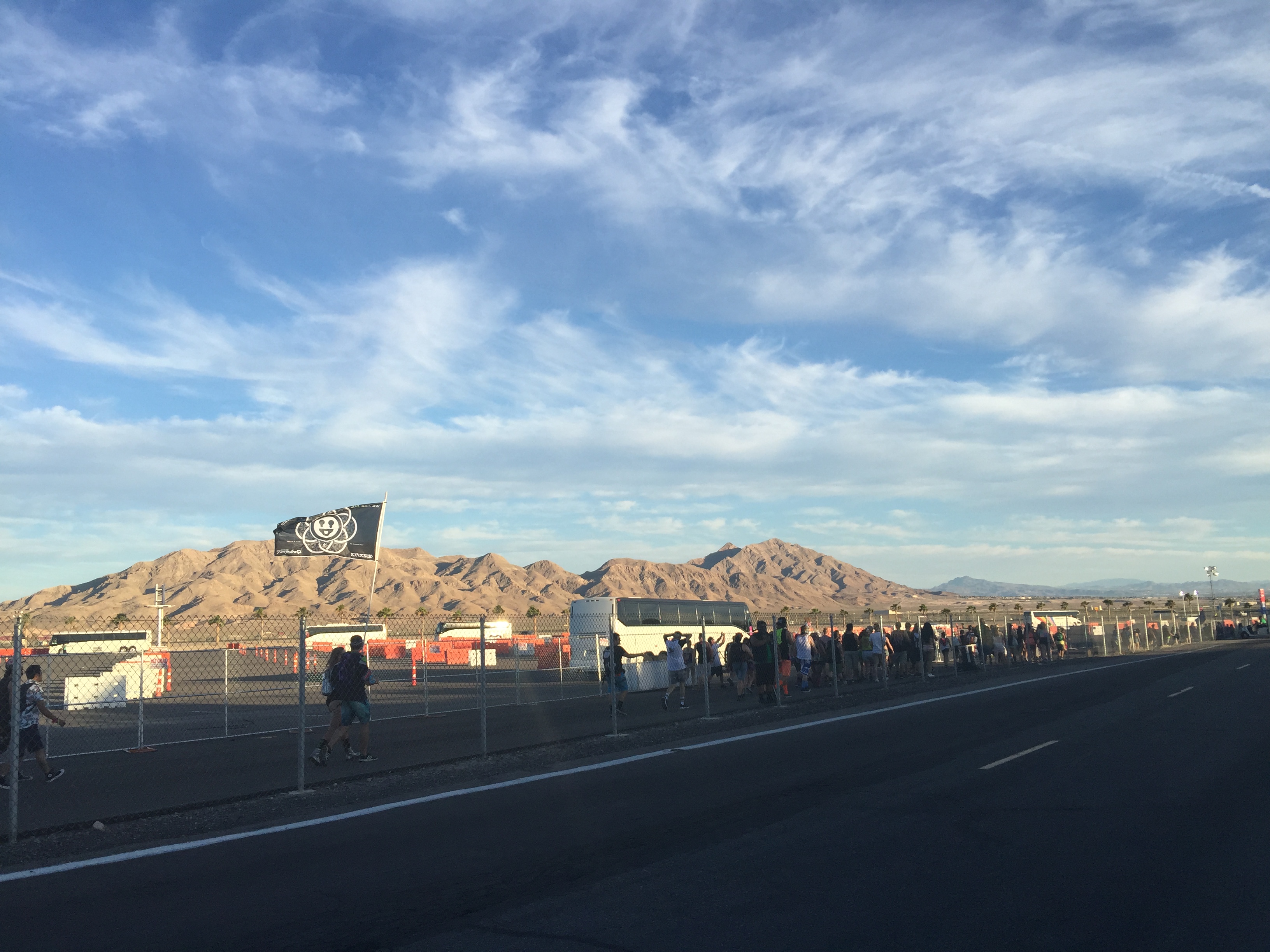
Famed Vegas hotel Caesar’s Palace was packed with people from all over the world waiting hours on line to procure passes. Mountains loomed in the desert sky as they paraded by the thousands — some in animal costumes, others in wings, and some just in bathing suits — toward the entrance to the Las Vegas Motor Speedway, where carnival rides, art installations, and majestic-looking sets stood.
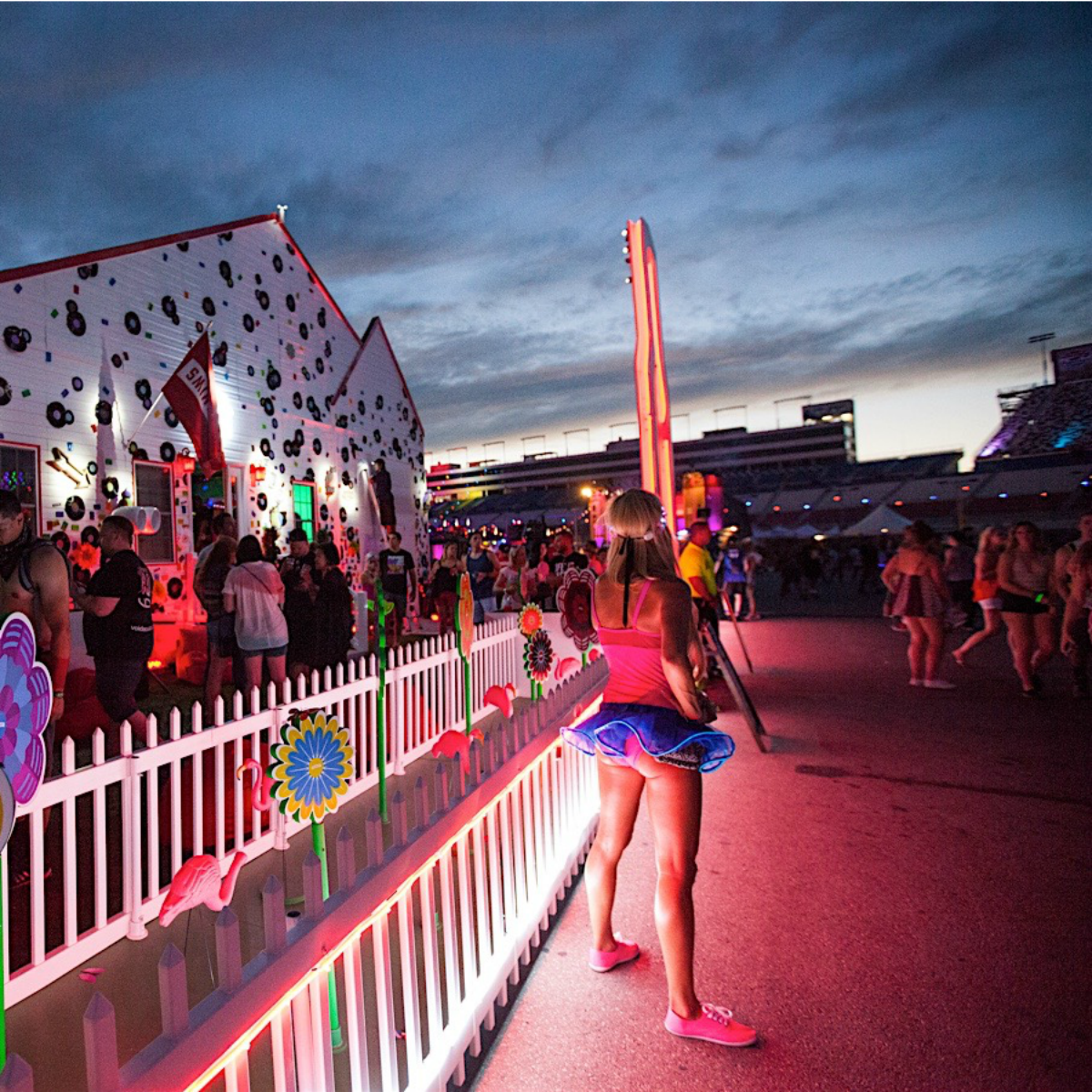
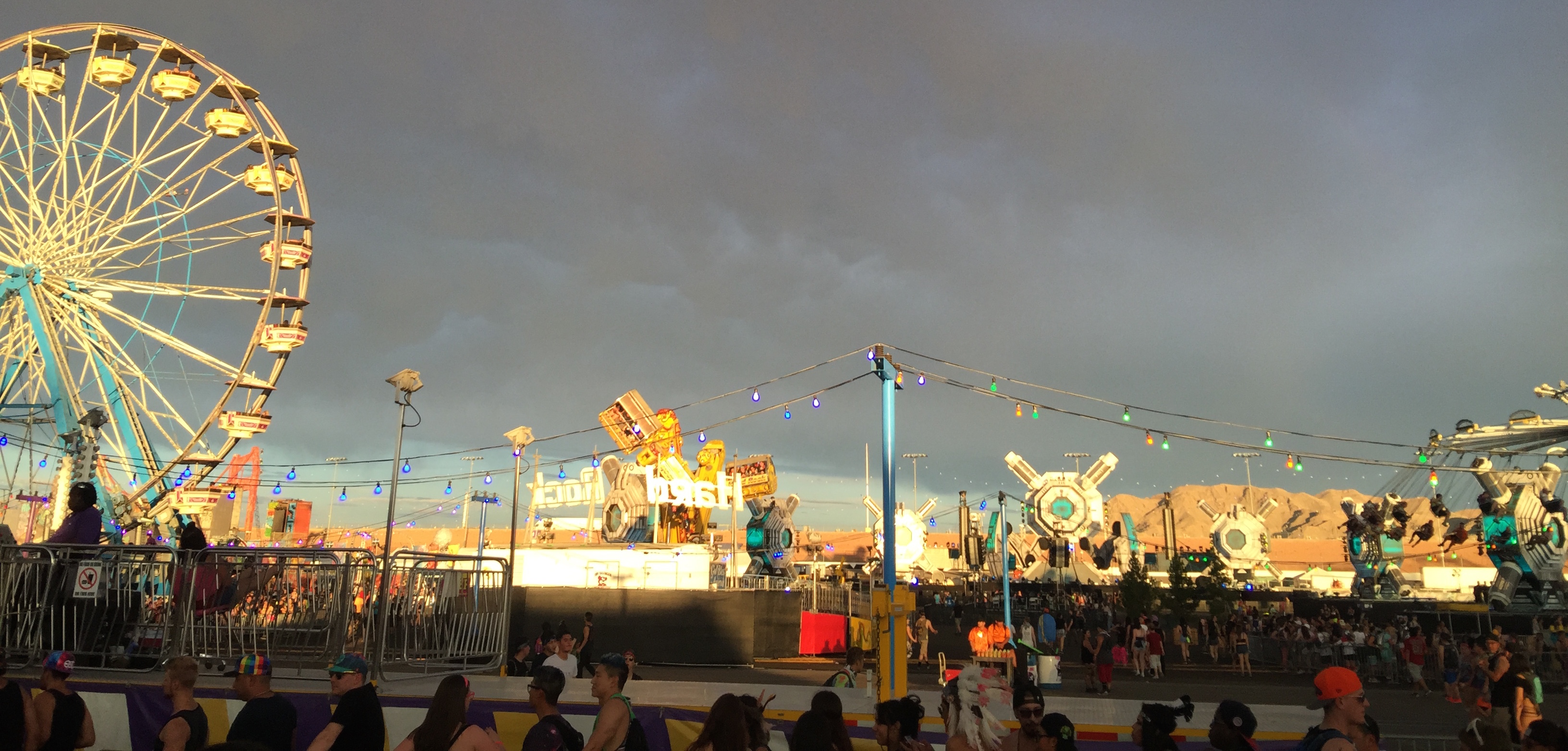
It felt like the Nevada dust had swept me to another land. Feathered creatures marched around on stilts. People in circus uniforms climbed light poles. Giant sculptures resembling space crafts shot flames. In a small house labeled “School House,” attendees colored with crayons and old-fashioned schoolteachers distributed gold stars. And as the event’s name would suggest, technicolor electric daisies bloomed from the festival grounds.
From the top of the stadium bleachers, I heard a cacophony of electronic music styles emanating from the varied stages. At a pyramidal pavilion called Neon Garden, Russian DJ Julia Govor set the tone early Friday evening with sensual, outer-space-like techno beats. Meanwhile, at the playground-like Upside Down House, hip-hop mixes got festival goers jumping.
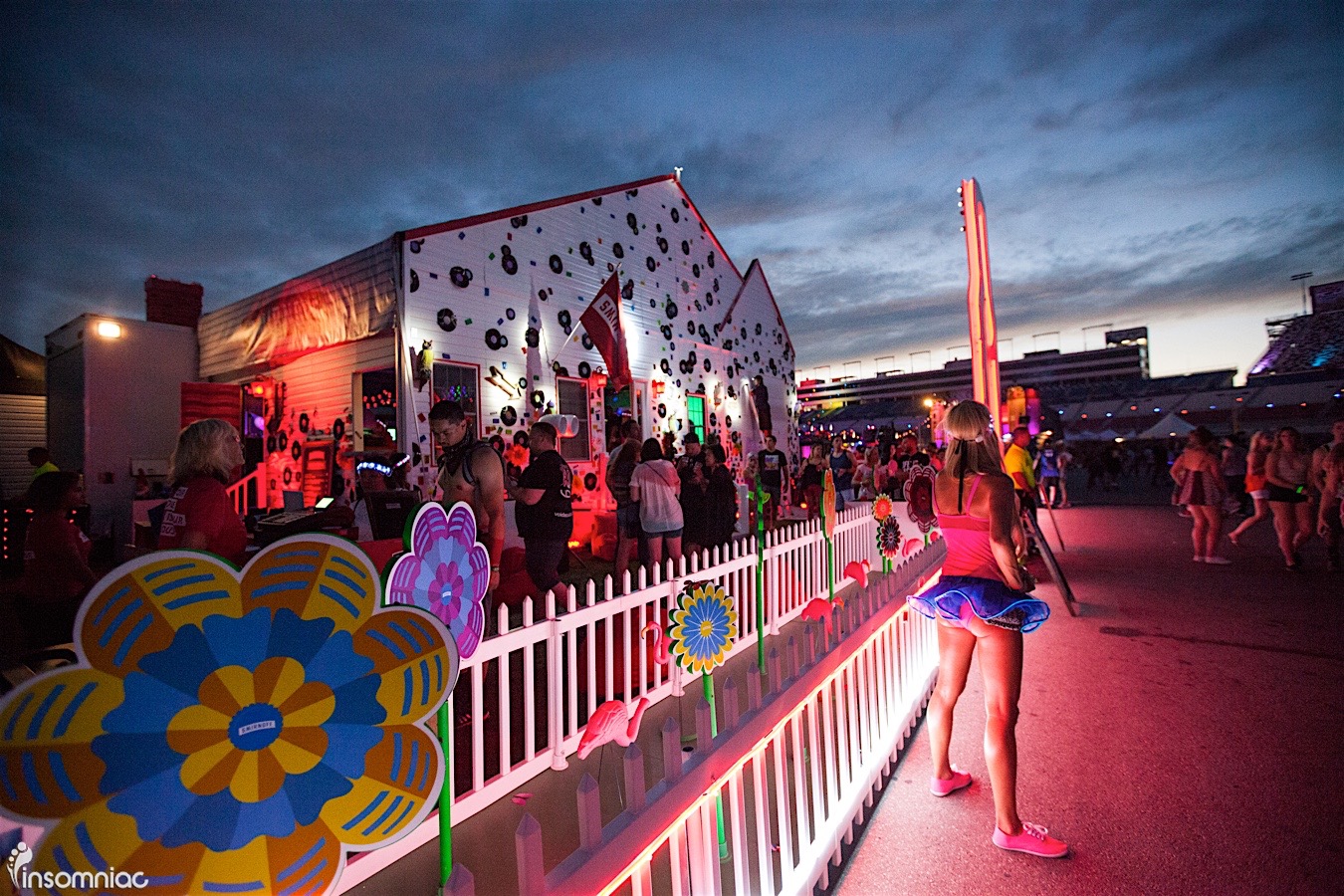
A mini festival within the festival took place at the Smirnoff House, a home/art installation where select DJs performed and guests colored on the walls. The packed crowd went wild as Martin Solveig, a French house DJ who rose to international fame with 2011’s “Hello” and has released hit after hit since, played upbeat tracks like “Do It Right.”
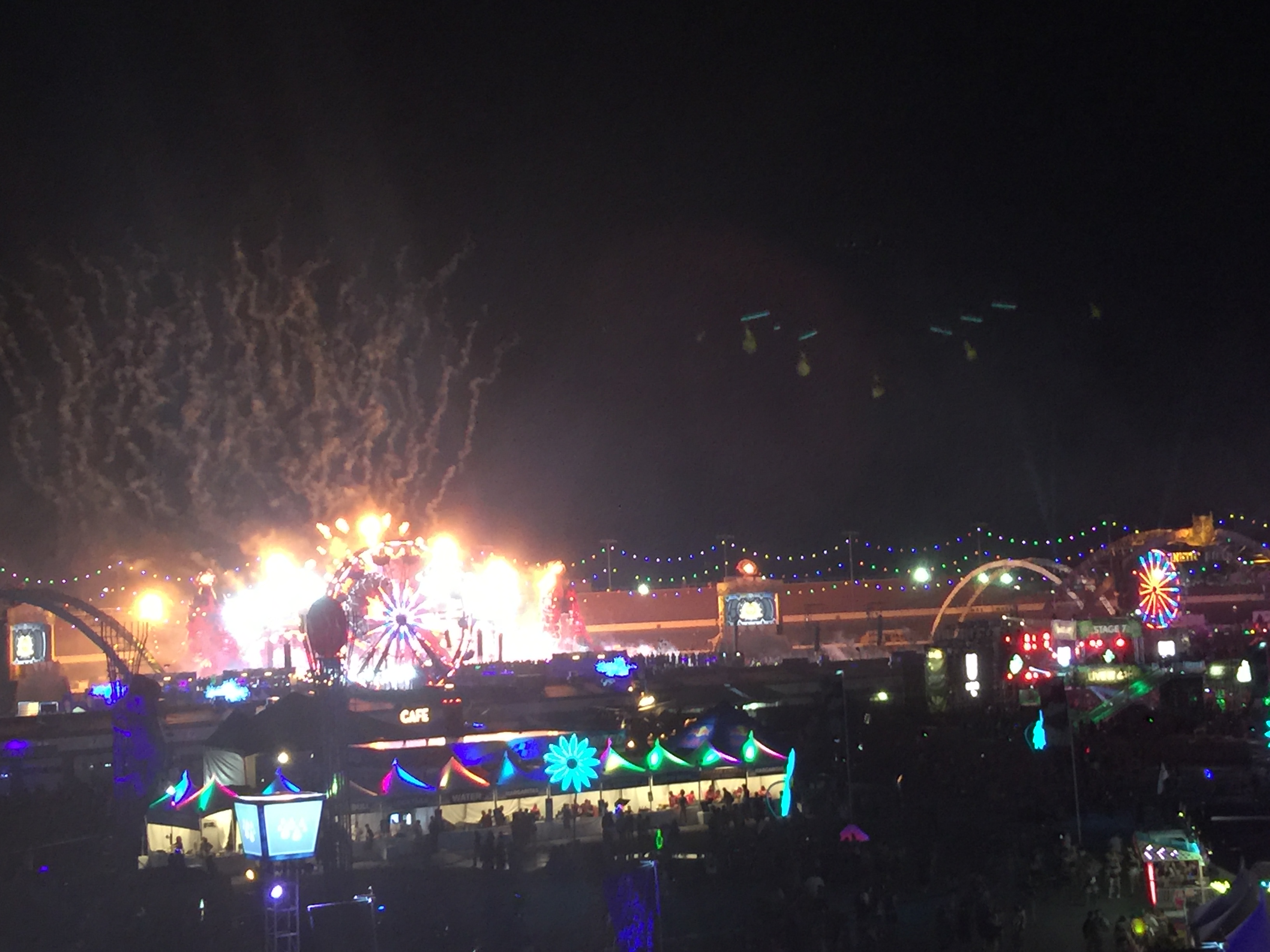
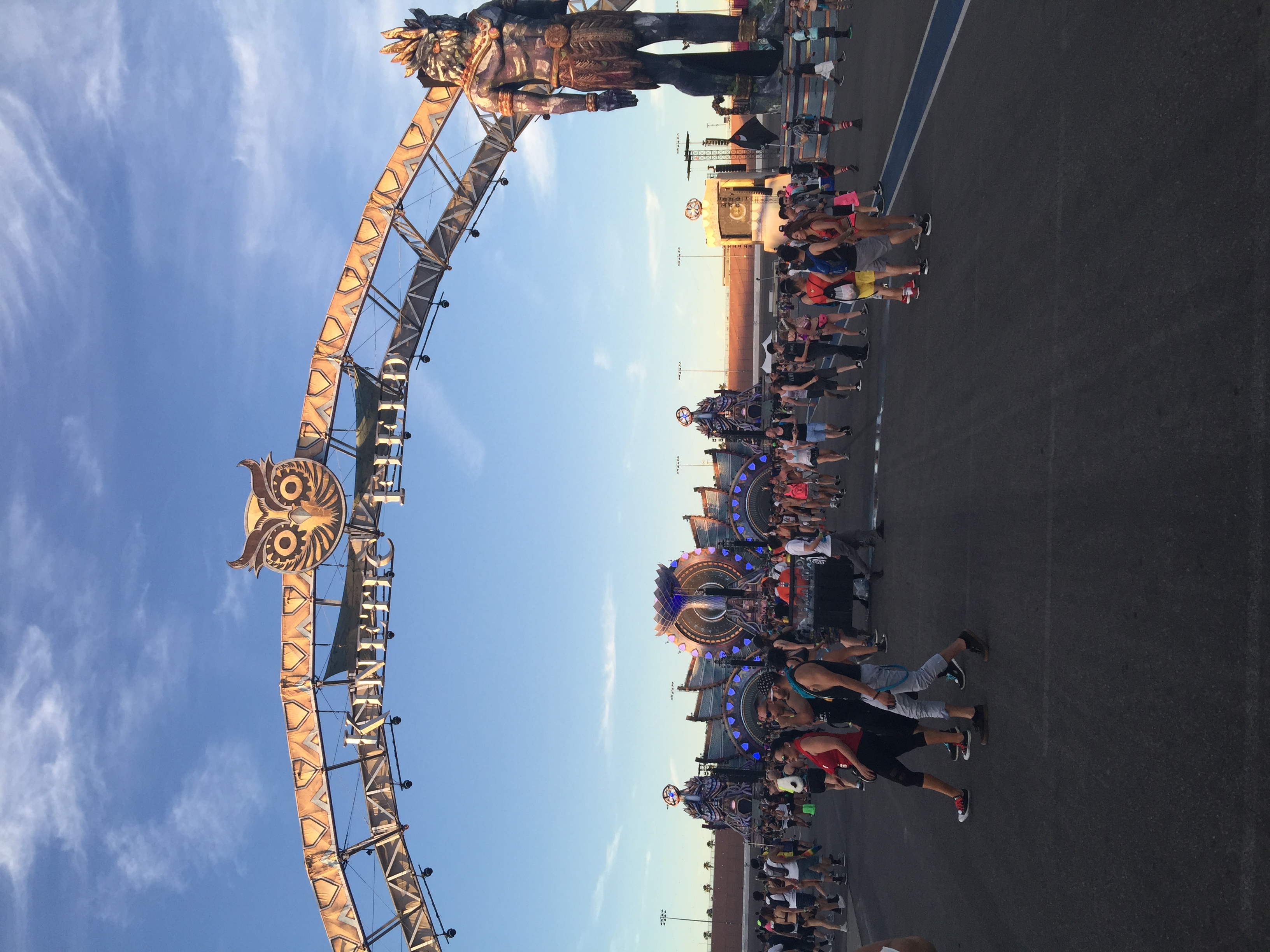
But it was the main stage, Kinetic Field, where the fuse burning throughout the night exploded. On a stage guarded by two enormous human-owl hybrids, eclectic up-and-coming electronic artist Jauz remixed songs ranging from Queen’s “We Are the Champions” to Israel Kamakawiwo’ole’s “Over The Rainbow/What A Wonderful World.” The night reached a climax when he asked the audience to get out their metal horns and banged out a punchy rendition of System of a Down’s “BYOB.”
Kinetic Field was also where the innovative Australian DJ Anna Lunoe became the first female artist ever to take the main stage at EDC Vegas. Saturday’s highlights included her infectiously harmonized “Stomper,” Tommy Trash’s haunting version of Nancy Sinatra’s “Bang Bang,” and Axwell Λ Ingrosso’s swaying electro-house.
Despite the eclectic lineup, the stages had one peculiar thing in common: No matter where you were, you were likely to hear a remix of either INOJ’s “I Want To Be Your Lady Baby,” The Chainsmokers’s “Don’t Let Me Down,” or, of course, Drake’s “Hotline Bling.” One cool thing about EDM is that it reflects the current state of our culture’s music right back to us.
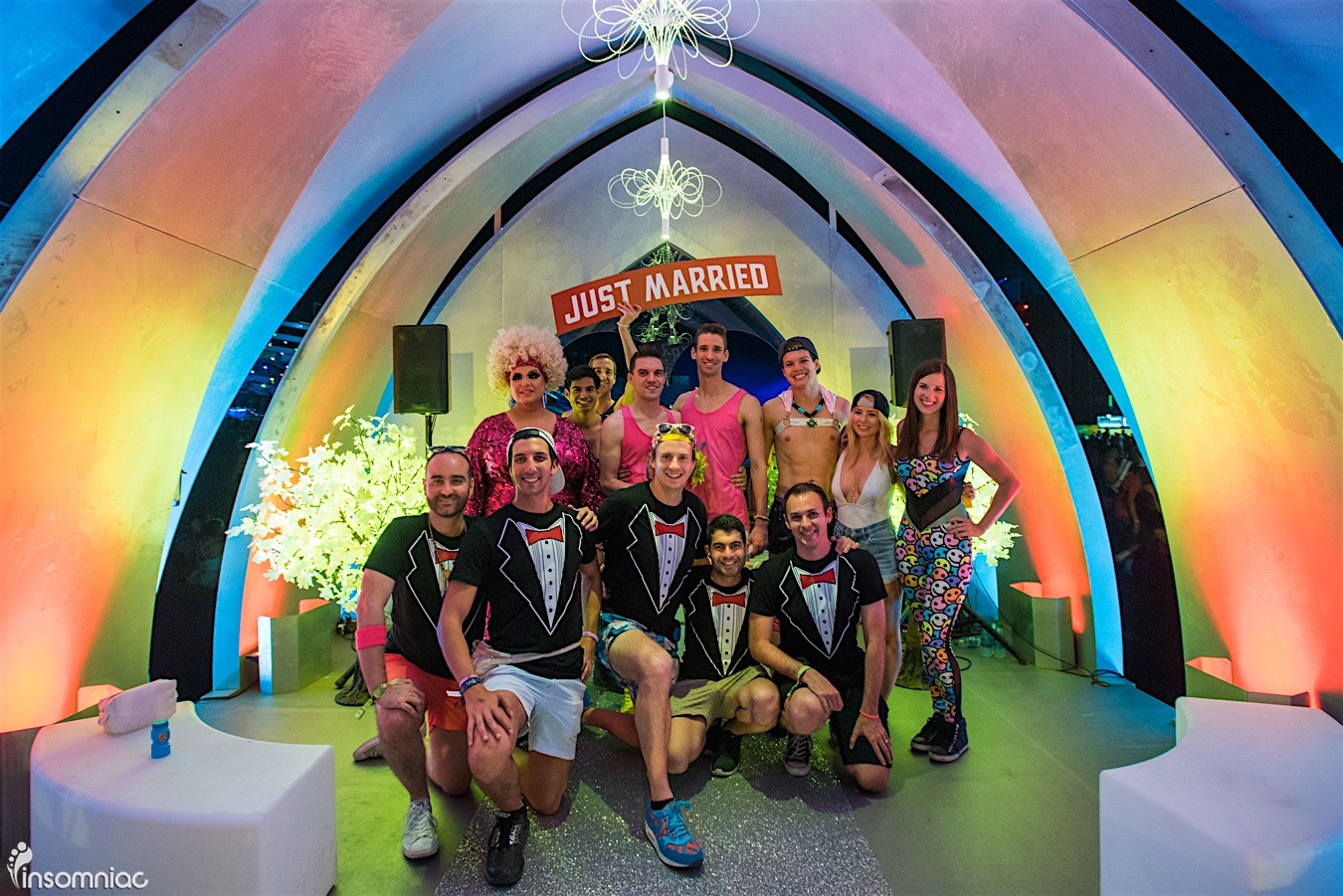
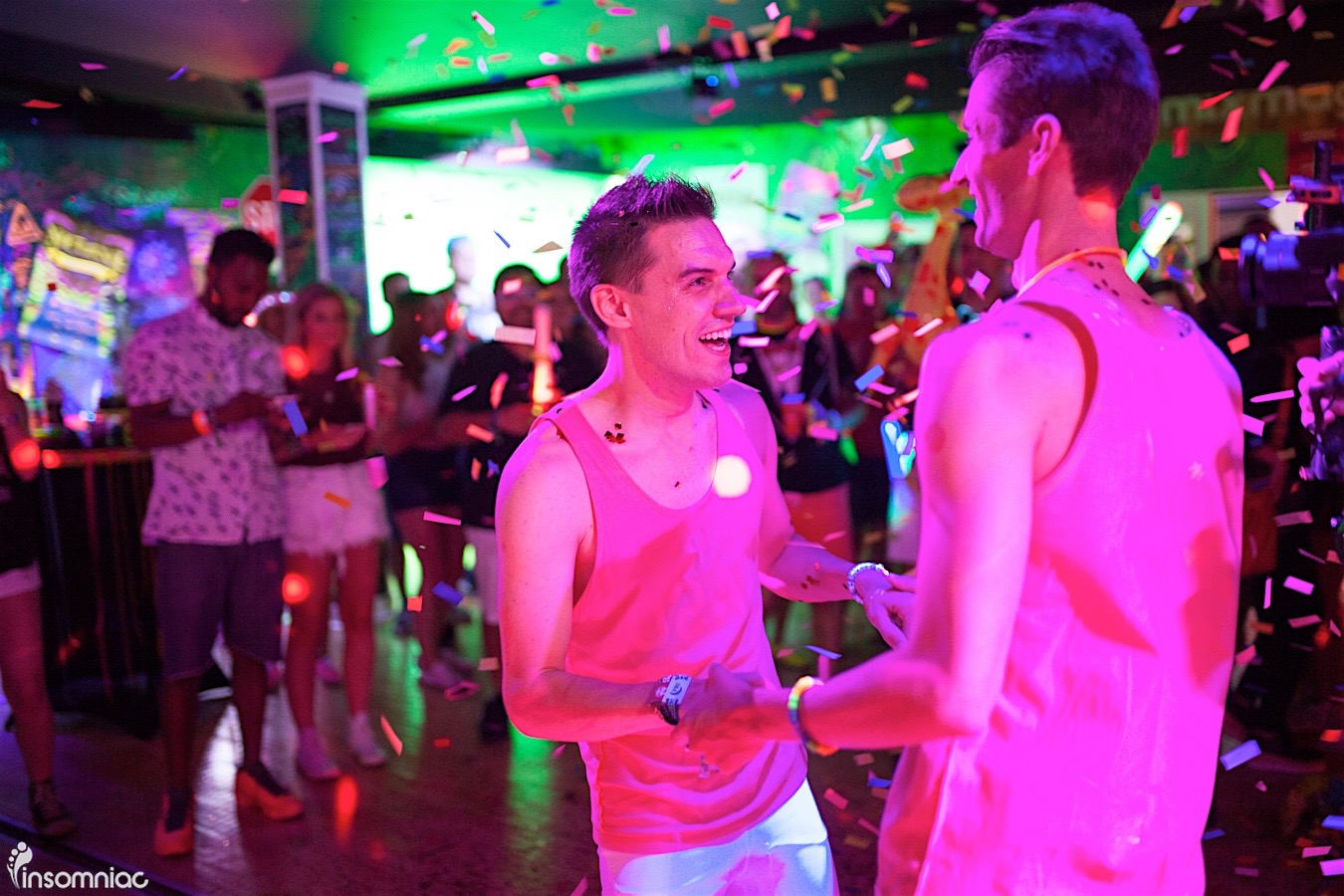
In EDC tradition, weddings were held in a 400-square-foot “Chapel of Nature” between stages. For the first time this year, legal same-sex marriages took place there. One couple named Chris and Skye’s wedding was live-streamed and given a reception at the Smirnoff House. The officiator asked that they “take good care of each other and rave on forever.”
That could be the slogan for EDC as a whole. Festival-goers doled out high fives as they danced past one another. Strangers asked me if I was staying hydrated. Another guest spotted my pass around my wrist by the hotel the day after and greeted me as part of the “EDC fam.” On my flight back, I was already planning my next EDM festival.
If EDC is not on your bucket list, pencil it in right this minute. Whether you even have a bucket list or not, just go. Because even when you have not slept for two days straight and you’re being evacuated from a stage because it just caught fire and your legs are collapsing because you’ve been jumping on them so hard, you will love every second of it, the 5 a.m. end time will still feel too soon to leave.
Those outrageous “service fees” that get tacked on to each concert ticket you buy resulted in a $386 million class action lawsuit against Ticketmaster. You would think that would mean there would be no more fees, but instead, customers were informed that they would have access to ticket vouchers in their account and discount codes worth- wait for it- “a $2.25 credit on a future online ticket purchase of primary tickets.” You can use up to two of these per transaction, but many customers are having trouble accessing them.
Of course, you could take advantage of the free tickets the company is offering to make up for their sketchy business practices, if you want to see artists such as The Kidz Bop Kids or an Elton John tribute band. Granted, there are some cool shows available, but as other sites have noted, shows are only available in 19 states.
Sky Ferreria vs LA Weekly
The super-gross Sky Ferreria “thinkpiece” caused a lot of negative reactions on the internet; personally, it’s one of the most misogynist things I’ve ever read, though it inspired a pretty funny satire where Tom Hawking rewrote the article with John Lennon as the subject.LA Weekly has apologized for trying to be edgy with the article, but has decided to leave it online as a “topic of discussion, or outrage, or as a cautionary tale about how not to write about a female recording artist in 2016.” Pretty sure that nearly every other writer already knows that, but thanks for clarifying guys.
Watch J Mascis Test A Wah-Wah Pedal Shoe
Hey musicians, Converse has gotten use one step closer to not having to carry around a bunch of pedals- just put them on your feet! The “All Wah” shoe allows you to plug directly into a Converse sneaker, and uses Bluetooth and microsensor technology to determine the position of your foot. Watch J Mascis of Dinosaur Jr test it out below:
There are certain voices that stab straight through you and assert their place in your life immediately. Bill Callahan wields such a voice. From the first second it struck me I knew it would be with me forever-like a well-won scar. Admittedly, this scar isn’t very old-I only heard of Callahan on my 26th birthday, which was not all that long ago. So wasn’t it just my luck when after months of pouring over his massive catalogue as both Bill Callahan and as Smog, I should find that the tall-drink-of-sorrow himself is playing six gigs over a three day residency at Baby’s All Right?
Hallelujah.
I had the pleasure of catching up with Bill over email to talk about joy, rap, and epitaphs.
AudioFemme: You’ve been doing this for quite some time now-at this point in your career, what aspect of your work brings you the most joy?
Bill Callahan: Probably starting a new song. It’s like morning full of promise. It’s like a guarantee of rich full days ahead of self-satisfaction, group interaction, performance, etc.
I understand you’re a big hip hop fan-any contemporary rappers lighting your fire these days?
It seems that in the past, motion was very important to you; the idea of constantly moving forward and being on tour has surfaced lyrically as well as in interviews. How do you reconcile the contrast of perpetual motion and settling down now that you’ve found a home in Austin?
It’s more a state of mind and a perspective than necessarily physically moving great distances. There is a time of gathering experience, that was my youth — after that you can be a little more still and just live what you learned. It’s like Willie says, “Still is still moving to me.”
On the subject of home, what is something that makes you feel instantly at home, at peace?
My wife. My nylon string guitar if that’s all I got to hold on to. Bob Odenkirk as Jimmy McGill.
We currently live in a culture where music is ubiquitous-people utilize it as background noise, to make people shop more, to pump themselves up at the gym, etc. In what setting, or at least, state of mind, do you hope people listen to your work?
Whenever they feel they need it, I guess. And I hope they feel they made the right choice. I recently re-recorded some songs from Apocalypse to be a 12” that goes along with the early copies of the Apocalypse Tour Film DVD that’s coming out on Factory 25. Listening to those mixes in my car, especially One Fine Morning just felt so, dare I say, perfect.
The two things seemed to need each other — the music and the scenery needed each other.
What have you been listening to lately, and in what setting do you like to listen?
I have a stereo set up and pointing at a particular chair at the kitchen table. I sit in that particular chair and listen to records. It’s kind of like a musical meal. Been listening to Carly Simon and the Bee Gee’s a lot lately.
Are you someone who feels at odds with your own era? Or in sync with it?
I believe I’m in sync with it. Because I am nothing special. I’m not an iconoclast or a freak. I’m a product of my era.
What moves you to write songs?
Knowing that humans need more good songs. I might as well try give some out.
I always like hearing established artists’ opinions on longevity. You’ve clearly withstood the test of time as a songwriter and performer, but do you feel that longevity is a viable goal for up-and-coming musicians? Is a steady career possible with such high turnover rates, saturated markets and the ease of piracy?
I can envision an awful future of corporate owned music production and distribution. Then maybe 70, 80 years down the line we’re going to break up into tribes again. And make great music again. And some of the tribes won’t make music at all. I’ve been oblivious to the music industry from day one. I always just do what makes sense to me. Mostly. Sometimes I’ll do something that doesn’t feel right if there’s someone I love and trust urging me to do it. I’ll do it for them as a concession. But I’m usually right in the end! I got into music to make a living, it’s the profession I chose or it chose me. These days I would say if you feel it’s not viable then you’re a fool to start up with it. If it doesn’t feel viable to you then do something else that feels viable. I’m not saying you should only do it if you’re immediately making money at it. Struggle is good. As long as there’s a light at the end. The longevity really comes from within. It’s not “the times” or “the state of things.” If you have the longevity in you then you’ll have longevity.
Words seem to hold high importance for you. At the risk of sounding too morbid, and assuming you would even bother with one, what words would grace your headstone? If that’s too heavy for a weekday-how ‘bout a vanity plate instead?
Loving Husband, Father and Three Pump Chump.
Be sure to catch one of Bill’s sets with Sunwatchers in the next couple of days. I’ll be there somewhere, slow dancing alone.
You always notice growth in a plant or pet when you haven’t seen it for a while. The little evolutions we undergo are lost to the everyday eye, but reveal themselves as blazing metamorphoses to the intermittent onlooker. The latter is also true in the case of Jerry Paper, at least according to my eyes and ears. Jerry Paper is a music-making entity, who’s earthly birth name is Lucas Nathan. Like most of life’s best offerings, JP drifted into my frame of awareness with bizarre ease, at first entirely by accident.
Two summers ago I was just dipping my toes into the loungey sound-pool of Sean Nicholas Savage, who was headlining a gig at the late and great Death By Audio. Manning the slot just before Savage was an unlikely looking fellow with big, wire frame glasses and a purple lei ’round his neck, a storage unit’s worth of effects pedals and cables tangled at his feet. It’s hard to say if he looked at the crowd once, but I do remember his fanatical immersion in each song.
After a fair share of “live” gigs whereupon the stage is taken over by a man on a date with his laptop, you can become a bit underwhelmed by this sight. And yet Nathan’s music negates the stereotype married to such a setup. I didn’t realize at that point in time that Jerry Paper was more than a stage name reminiscent of 80s power pop. I wasn’t privy to the mythology of Jerry Paper-that Lucas Nathan was merely a host-body which Jerry possesses in order to generate tunes. Nor did I know that Nathan was originally a student of philosophy; though a brief leafing through his lyrics could have informed me so, as he discusses the likes of simulacra, fuzzy logic, and “the settings of the synthesized mind.”
That first set knocked me out completely. Despite the sterile stage layout Nathan was writhing with groove, seemingly possessed whenever a song commenced, and back to normal upon its completion. I remember thinking at the time that he reminded me of Elvis Costello, but it wasn’t just his glasses; something in the depth of his voice and the quiet arrogance of his stage presence. It was perhaps the impression that his performance was a 40-minute revenge act from a man who’s much smarter than everyone in the room. I rushed to the merch table immediately after and bought a copy of his 2014 LP Big Pop For Chameleon World, which I’ve been listening to ever since.
One of the things that make Jerry Paper so special is his potential capacity for cynicism and his subsequent denial of it. Though wearing the guise of empathetic AI and employing tools of the Muzak genre such as keyboard saxophone and elevator synths, he manages to make sincere, and more importantly good music that is relatable to humans and algorithms alike. Nathan is the first to admit in interviews that yes, he does find synth sax hilarious, but he also truly enjoys the sound of it, or else it wouldn’t get anywhere near the record to begin with.
Seeing Jerry Paper perform at Secret Project Robot this last weekend, it was evident that a lot of things have turned in his favor in only a couple of years. No longer an obscure opening act with only his machines for sonic scaffolding, he was playing a headlining gig backed by a full band. The lineup touted local “non-country” outsider Dougie Poole and the aforementioned bizarro crooner Sean Nicholas Savage, the latter of whom predominantly sang cover songs with a backing track (unfortunately). Dougie Poole was also accompanied by a backing track, but interspersed the noise with guitar phrases and pedal manipulation. Poole’s dopey pigtails only made the melancholy of his ass-dragging cowboy act all the more blue. He is seemingly in character, but it’s a heart-rending effect nonetheless. It was an evening of undeniably odd birds, but what a wonderful thing to see when so many modern bands are required to be ultra slick and fronted by supermodels. Poole resurfaced as a funkified bassist in Jerry Paper’s backing band, which indulged in great versatility via keyboards, guitar, pedal effects, and flute. But it was Nathan who truly rose to his headlining post for the evening. Sporting a fine and shiny spandex body suit he looked like a deep-sea diver-or a black seal maybe, as he was bobbing around the stage with similar grace and silliness.
It seems as though Nathan has undergone a fair amount of change since I first saw him at Death By Audio in 2014. Two full length albums (2014’s Big Pop For Chameleon World and 2015’s Carousel) and 3,000 miles (he recently relocated to his home state of California), the evening was a celebration of his latest record Toon Time Raw!. And it was the first celebration: the record release party, the first gig of the tour, and I believe the first time Nathan has ever been backed by a full band; this last little fact seeming odd as Jerry Paper was evidently born to front a band.
JP is a wildly charismatic entertainer, his interpretive dance gestures conveying equal sincerity and hilarity. His on-stage banter is wonderfully deadpan, an air that is contradicted by his nervous and polite off-stage presence. “It’s great to be alive,” he droned into his headset microphone. “But having a body is sooo annoying.” Jerry’s jab at his own host body earned a hearty laugh from the room. “But you are a body, so…fuck it,” he concluded.
Nathan’s lyrics and performances seem rife with these sorts of blasé aphorisms that wink at his education, but don’t force it down your throat. Conceptually the music of Jerry Paper could be coined as abstract or out-there, but the inherent groove is what makes it approachable. Much like Daft Punk are robots with beating, blood-pumping hearts, Jerry Paper is code with soul. This combination of the perceived coldness of technology with the foolproof warmth of human music is part of what makes Jerry Paper so compelling; he describes the phenomenon best in an interview with The Editorial Magazine:
“What the fuck is more human than a computer? That doesn’t happen outside of humans. Electronics are purely human tools. I think a lot about the separation of humans and nature and why we think like that instead of thinking of humans as part of nature. I hate to sound like a douchebag but it’s very Cartesian/mind-body dualism. We think of electronics as not natural, but if humans are natural then our tools are also natural.”
Agree or disagree, it is an irrefutably relevant perspective, especially considering that so much of our budding technology is used for social purposes, including the making and sharing of music.
Toon Time Raw!, as with last Saturday’s performance are markers in the upward motion that Jerry Paper is riding high. The LP, out on Bayonet Records, picks up where Carousel left off, but lets things get even warmer, even groovier, proving that Nathan is a legitimate pop songwriter with beauties such as “Ginger and Ruth,” “Zoom Out” and “Stargazers.”
It’s a rare thing to locate genre-less music. They majority of hype bands seem to fit into some sort of self-referential box labeled with a bygone genre. Just check “dream pop” or “psych rock” or “surf-girl-group-garage” and you’ll get someone’s attention. But Jerry Paper, be he your cup of tea or not, won’t be squeezing into a box any time soon. And for that, I tip my hat to him.
Erin Fein is a twin, but only to herself. Though she started as a solo recording artist, there’s a ghostly presence to her music, created with additional layers of her own vocals and melodies that seem to have a life of their own. While developing her music, she was “as overcome with the surreal but persistent feeling she was writing and recording with her twin.” So, she named her project Psychic Twin.
“Lose Myself” is the lead single from the upcoming album Strange Diary, out September 9 via Polyvinyl. Fein’s vocals have a floating quality, while the beat of the song mirrors an anxious heartbeat, or the steady pace of a runner. It feels like Fein is chasing something just out of reach, a shadow that is only visible as it slips around a corner. Her voice gets more and more desperate until the song’s end, as she chants “And when I go farther, I lose myself/ And get over you.” The emotional range of “Lose Myself” makes perfect sense when you learn that Strange Diaries was written as Fein’s marriage ended and she relocated to Brooklyn from Champaign-Urbana; she perfectly captures the bittersweet feeling of moving towards a new life while holding on to the last remnants of the old.
Pre-order Strange Diarieshere, and listen to “Lose Myself” below.
Once hailed “The Best Band That Doesn’t Have an Album” pysch-rockers Mountains and Rainbows can finally re-categorize themselves. After bouncing around for almost a decade with nothing but a cassette tape and some scattered demos, Mountains and Rainbows caught the ears of Thee Oh Sees frontman John Dwyer after sharing a bill with the head rattling 70s art punk revivalist foursome last year. Dwyer signed them to Castle Face Records and released their double debut LP Particles last month. Particles is more than an album, though. It’s a transient, transcendent head trip that sweats and absorbs in equal measure. There is a boldness to the album as an adventure through time and memory, trailing across stateliness and atmospheric boundaries, that convinces you to overturn yourself as if you were some government implemented barrier between happiness and obligation. Particles is salty and dry, thirst inducing and never quenching. It is that very thirst that makes Mountains and Rainbows’ long awaited exploration of chaos so surprisingly satisfying. It’s a high without the hangover.
It’s hard to consider the album as individual tracks. The songs blend together, not monotonously or statically, but with a meticulously reckless smashing. Each song strikes one another forcing tinier and finer divides like an astral phenomena we read about but never actually see. Sludgy, strung out Velvet Underground-esque track “Fancies” breaks the album up and clocks in at just over ten minutes. It’s anxious and uneasy and feels more like a band warmup where the instruments sound like vocals and the vocals are a series of warbled announcements. This is a complete departure from the bouncy beach party track “How You Spend Your Time,” which is tightly composed and fulfills the albums strained pop tendency. Mountains and Rainbows play with distance and warped dissonance, which invites a cosmic spacial awareness that lends itself to feeling like fabric ripped at the seams. Drums seem to interrupt, the guitars are manic and distressed and the bass is spastically metallic. These elements crowd the vocals in such a way that it often feels like attempts to suffocate, but also is aurally victorious at regaining breath. Considering it is their first “proper” release, Particles is a fully formed thought that is not for the faint of heart, rather for those whose heart beat persistently askew.
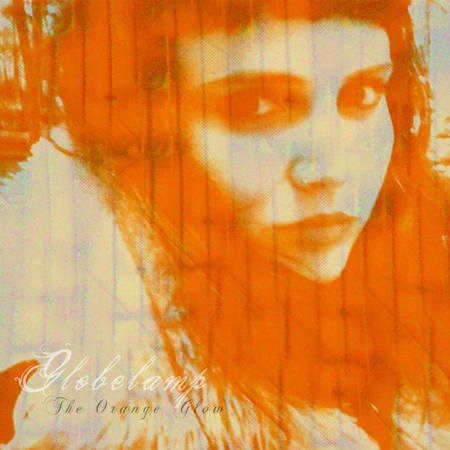
From the beginning, it is immediately evident that Globelamp’s new album The Orange Glow promises to take you on an adventure. Songstress Elizabeth Le Fey captivates and distorts reality with airy, ethereal vocals. Her latest piece tells tales of love, loss, and survival while bringing you two steps closer to nature without actually heading outside. It’s a mastery of genre-mashing, and will leave you mesmerized. Her lead track “Washington Moon” is a fantastic introduction to an album that ensures a unique auditory experience, and it transitions nicely into the more upbeat “Contraversial/Confrontational.” True to its name, we reach the next track,“The Negative,” which weaves a heartfelt tale of loss and sadness. Somber guitar chords pull on your heartstrings as Le Fey croons on about “focusing on the negative.” The track brings you through a short, two-minute journey where Le Fey comes out on the other side, instead “blocking out the negative” and ending on a more optimistic tone. The following track, “Moon Proof,” feels like a rebirth into that calmer and more positive perception. Plucky guitar and more measured vocals make this an enlightening track that’s sure to lead to at least one life-changing revelation. At the midpoint of the album is “Don’t Go Walking in the Woods Alone at Night,” which holds a passion that flips between otherworldly and savage. The track offers up a visceral experience where you almost feel placed exactly in the dark woods you’ve been warned against, goose bumps raising along your neck and a chill slithering down your spine. Yes, it’s that sort of song. The titular track following is epiphanic, with a full blown sparkly moment of realization included in the song and everything. The album makes another transitional change at “Master of Lonely” where Le Fey’s breathy vocals are backed by a more Americana, 80s rock sound. It’s the sort of track where the words don’t necessarily match the pacing of the song, giving you a piece with saddening content yet an energetic, almost happy-go-lucky beat. And again, with “Piece of the Pie,” Globelamp makes another genre hop, showing us her grungy garage rock side. It calls to mind Screaming Females who are also well-versed in ethereal grunge rock. Closing out with “Faerie Queen” only feels appropriate: it’s anthemic yet surreal, a bit of reality mixed with the magical, which is a sentiment the album seems to hold overall. Now out on Wichita, The Orange Glow is a full-length that’ll bring you to important conclusions, and is chock-full of inspiration and vivacity. If you’re looking for an artist that’ll not only satisfy your ears but also your heart and soul, look no further than Globelamp. Catch our exclusive interview with Lizzie below!
**********************
Audiofemme: What were the inspirations behind your new album?
Lizzie Lefay: fairy tales, my love for the west coast (including the two places I lived; traveling, Simon and Garfunkel, Tori Amos, The Microphones, Taylor Swift.
AF: When you started playing around with the idea for the record, where were you in life? Were there any circumstances that sort of pushed you to sit down and create?
LL: I was in a weird period of my life where I was floating around my hometown in Orange County and waiting to start school at The Evergreen State College. I was going back and forth from Olympia and California a lot. I am always creating but I sort of thought of the name “The Orange Glow” once and wanted it to be a metaphor for something that is deceivingly beautiful, that pulls you in, but is actually scary up close.
AF: Are you hoping that your fans will take anything away from listening to your album?
LL: I just hope that they like it and if they do, I hope it makes them feel things. Not everything is good all the time and hopefully some of my songs can soothe people going through hard times.
AF: What was it like collaborating with Joel Jerome for this album?
LL: It was amazing. He is one of my best friends and has a terrific ear for music. I trust him. He is really easy to collaborate with and understands the sound I am going for. I am not only grateful that he recorded me but am also grateful for his friendship as well.
AF: If you could choose the setting for your dream performance—vast, echoey dessert; a dimly lit forest; anything—what sort of space would you create?
LL: a dimly lit room with candles and globes everywhere, where I have access to a grand piano and a guitar. any intimate comfortable setting I would like.
AF: Who are some of your musical influences?
LL” Sid Barrett, Bright Eyes, Fleetwood Mac, David Bowie, Tori Amos, Elliott Smith, Nina Simone, The Decemberists, King Crimson- Court of the Crimson King, The Beatles, The Zombies, Kathleen Hanna, Patti Smith, Jefferson Airplane, Devendra Barnhart
AF: What areas are you most excited to play at on your upcoming tour? And what were your favourite places on the recent European tour?
LL: I am excited to play in Canada. It will be my first Globelamp show there! People have been asking me online to play there for a while so I am looking forward to it. I always love being in Berlin, London, and Amsterdam but I have been there a few times. My favorite places on the European tour were probably the places I have never been to before (like Glasgow, Cardiff, and Brighton).
Today’s New Music Monday features the first single, “The Strangest Game,” from Swedish indie pop singer-songwriter MIYNT‘s forthcoming debut EP. The track recently premiered on Stereogum.
The dreamy, beautifully lethargic song features calming and introspective vocals from MIYNT that swell among a soundscape you want to curl up inside of. It’s a truly lovely tune.
If you’ve ever logged onto Facebook only to be sickened by that one friend that insists on documenting every single thing that happens to them in order to prove how #happy and #blessed they are, “Good Lie” by The By Gods is the song for you.
Whereas January’s album, Get On Feelings, was a solid, sincere throwback to 90’s rock, the Nashville trio take a confrontational turn with their latest track. Singer George Pauley demands, “Tell me ’bout your friends and your wedding day/ Tell me how you’re blessed in every way,” before pulling back the curtain on all the positivity, practically sneering the words: “Tell me ’bout the good life, yeah it’s such a good lie.” The By Gods have figured out the perfect formula for catchy songs: repetitive riffs and rhythms that build on tone and texture, making the track memorable and immediately recognizable.
Speaking of repetition that isn’t so catchy, how annoying is that friend we were talking about? They’re probably instagraming their lunch right now. Ugh. Get ready to vent by listening to “Good Lie” below, and order The By God’s upcoming Phone Calls EP ahead of its July 8 release date here.
Hopefully it’s temporary; during last weekend’s Northside Festival, the DIY space Palisades was shut down by police and the venue’s shows have been moved to other locations. Management tweeted that it would be closed for a few days, but it’ll be more like most of the summer after the NYC Department of Buildings gave them a complaint for problems like “GROUND FL OPERATED AS A CABARET WITHOUT A SPRINKLER SYSTEM CELLAR WORK W/O PERMITS & FAILURE TO MAINTAIN PREMISES.”
Patti Smith to Release Nico Tribute
Patti Smith recorded a tribute to the late Velvet Underground singer, with Smith’s daughter contributing as well. “Killer Road” is inspired by Nico’s own poetry, her harmonium is used on the track. It sounds kind of like Nick Cave decided to take a shot at ambient music: chilling and foreboding with whispers in the background alluding to death. The track will be officially released on the Soundwalk Collective’s Killer Road, coming September 2nd. Listen below:
The unpredictable band recorded The Magic by renting an abandoned New Mexico office building and recording for a week with no prepared material. NPR describes the result as a “tense, visceral, unpredictable sound that doesn’t let listeners get comfortable for very long.” Stream The Magic here, and watch the video for “Criminals Of The Dream,” which appears on the album, below:
With Father’s Day around the corner, Madison Bloom revisits her dad’s record collection. A version of this article originally appeared on the site in 2013.
My dad has more records than your dad. Roughly 4,000 of them. And as the former owner of a record shop located in Eastern Washington, he used to have many more to his name. The Chelan-based shop was only his for a few years in the late 1970s, and it was aptly titled: The Music Store.” Among other fads, like men shopping in the women’s section to find the coolest threads, my dad also predicted titular minimalism before it hit the mainstream. Or perhaps the moniker was a nod to the simplicity found in his favorite band’s name: The Band.
Dad used to stock The Music Store with stacks of pop/rock, country, bluegrass, jazz, folk, blues, and countless sub-genres. A large portion of his inventory was accumulated secondhand, as he would peruse thrift stores for rare finds as well as record discount sections, then known as cutout bins due to the rectangular chunk punched out of the LP’s sleeve. He’d buy milk crates full of albums for a few bucks.
To this day the cutout bin records are my dad’s scapegoat of choice when defending ownership of such releases as A Flock Of Seagulls’ 1986 release Dream Come True, and a surprisingly large body of the Huey Lewis and the News discography. “Must have been a cutout bin!” he always says. Yet the crates and bins were also responsible for some of the most strange and obscure gems. Take for instance my dad’s album of whale songs, narrated by none other than the late and great Leonard Nimoy. Or perhaps Ambrosia’s 1982 release Road Island, which, although sonically terrible, boasts a Ralph Steadman illustration on the cover. He also has an original pressing of A Tribute To Uncle Ray, an album released by (Little) Stevie Wonder at age 11, in which Wonder performs the songs of Ray Charles in his signature, sugar-sweet voice.
Giving the milk crate hauls and cutout bins all the credit would be unfair. The truth is the majority of my dad’s collection, in all of its diverse excellence, is due to his shameless, unrelenting love of music. It’s the reason he has everything from Todd Rundgren’s Runt to Marlene Dietrich Returns to Germany, an album of the starlet singing in her native tongue over Burt Bacharach’s orchestra. It’s the reason he has Tom Waits’ first seven albums, and T-Bone Burnett’s first two. He owns every record Harry Nilsson released, and as much of The Kinks’ output he could locate. He has an unopened copy of an interview with The Beatles, which could probably pay a few bills here and there if he could part with it, as well as a sealed collection of speeches from the 1934 Olympics, featuring monologues by American gold medalist Jesse Owens, and Axis leader Adolf Hitler.
As lucky as I feel to have this massive archive essentially at my fingertips, I have earned the access. In the span of ten years my dad and I moved that hulking collection five times. With each move the records would be put in orderly boxes, keeping their alphabetical ranks and genre-specific confines. A box for Christmas LPs, a few for country, soundtracks, jazz, etc. The collection was always the first thing I wanted to unpack, as our new house never felt like a home without that tower of vinyl watching over.
I realize that these are niche bragging rights, especially for someone born after the invention of the CD, such as myself. It is true that I’ve been surrounded by more iPods than turntables throughout my life. But the objects of our childhood fascination rarely lose potency over time. Mine just happened to have an “adult” application as well as a visceral one. Records, you see, were as good as my baby blanket. More than that, they were road signs for me all the way through adolescence, and they’re still guiding my infatuation with music today. In the same way I fervently rummage through my mother’s closet each year and find something previously overlooked, I spend hours in front of my dad’s massive library of albums during the holidays, eyeing each spine for a hidden pearl. Unfortunately, our steady rotation of house cats over the years has left most of the spines illegible and shedding their own skin.
Shamed as I am to say it, I have spent the majority of my eight years in New York sans turntable, and therefore have not allowed myself the indulgence of purchasing any vinyl for over six and a half years. Then, one birthday I was gifted a flimsy little dollhouse of a record player; a 1980s suitcase model by Vestax that I refer to as “Fischer Price My First Turntable.” It’s no collector’s item, but it does the trick. Ever since then I’ve allowed myself the occasional purchase-an occasional purchase which has swiftly escalated to weekly purchases, a subscription to a monthly vinyl club, and the slow but steady transplantation of my original collection in Washington to my growing one in Brooklyn.
One time, while selecting some records to take back to New York from the small corner my collection occupies in my dad’s shelving unit, I noticed something amiss. Dad had filed a handful of-go figure-my favorite albums in with his behemoth pop/rock section. As I started plucking my copy of Wire’s And Here It Is Again…Wire from the W’s he caught me. This immediately spawned an argument about whether the album was in fact mine, gifted to me by my mother, or his from before they were married-a promo copy from the Music Store days. I was tempted to challenge pops to name five Wire songs as proof that he even liked them, but instead simply pleaded, saying it was one of my favorite records of all time. This ended up being far more effective.
When my parents separated 18 years ago the retrieval of records was a painful order of business. Was that copy of The Pretenders’ first LP mom’s or dad’s? What about The Specials, or Hunky Dory? These disputes still surface, but I like to look on the bright side, which bears a simple fact: my parents have amazing taste in music. What if they were bickering about who ended up with the Kenny G record? Things could be worse.
He may not own a record store, or play in a country rock band, or wear navy suede cowboy shirts anymore, but my father has reintegrated music into his life in a whole new way. He never stopped writing music, or listening to music, or loving music, but now he nurtures the music of others in the restaurant-cum-club he owns with his wife. It has become a welcoming home to many Northwestern artists in its two years as a Bloom establishment. The bistro is just one more facet, one more excuse to talk about music, which we do more than anything, sending each other songs via email and watching the ever-impressive musical career of my older sister.
Recently I asked him what some of his most prized records are.
“Wow, that’s kind of a tough one,” he texted, responding almost immediately after with “of course my Harry Nilsson collection would come to mind. I also think my Mills Brothers collection and my collection of Django Reinhardt and Stéphane Grappelli are treasures.” The former two were easy guesses, and yet I had no idea he even had Django Reinhardt or Grappelli on wax. I suppose that is the constant allure of his collection.
A few months ago, my dad and I were on the phone, and I expressed to him a conundrum I often find myself in while record shopping. “It’s like, I want to own Astral Weeks on vinyl, but I’d feel stupid buying it,” I said. “Because you already have it, and then someday I will inherit all of your records, and then I will have two copies of Astral Weeks.”
“They will all be yours soon enough,” he replied, sounding oddly resolved.
“Hey!” I barked. “Don’t talk like that! Jesus. I’ll just buy a copy!”
“Oh, no I don’t mean that,” he laughed. “I mean when Sharon and I pick up and move to France one day. I don’t want to move all that shit again.”
Beverly Johnson is Bevlove, Detroit‘s premier pop goddess. She writes. She sings. She’s changing the game. Produced by SYBLYNG and Assemble Sound and directed by Detroit visual wonder-kids The Right Brothers, “Do What I Say” dropped last night at midnight. Relevant both conceptually and sonically, the track proves that Bevlove is more than a breakthrough, she’s a wrecking ball.
“DWIS” acts as a seductive instructional and a warning for future lovers, victims and anyone who dare take on Bevlove on the streets or in the sheets. “DWIS” could easily be the sequel to Rihanna’s “Bitch Better Have my Money” and the video could be the more sinister, less PG sister to rival girl-gang in Taylor Swift’s “Bad Blood.” The video features some of Detroit’s favorite bad girls following behind leading lady Love with torches and man eating scowls, ready to attack. Flashing to smokey dance scenes and the ultimate pink confetti girl party. Where “DWIS” bares its visual duality is when we see Bevlove in bed with white feathers floating around her lingerie clad angel self, making us believe she is to be trusted. But we know better. Bevlove uses her vocals as a Trojan horse, delivering the lyrics “Such a fucking lady/tonight I’m going to take control.” Her voice breaks into another stratosphere, departing from her hardened hip-hop cadence to reveal ethereal tones and a richness that Beyoncé herself would envy. The song is perfectly crafted with everything that makes a song raunchy yet radio ready and impossible to shake from your head. The catchy hook, the bass beat and choppy hip-hop delivery is current enough to blend in and original enough to set its own precedent for badass-ery. The video celebrates women and flips the script on sex, desire and not taking shit. Bevlove is a great reminder of why you should get you a girl that can do both.