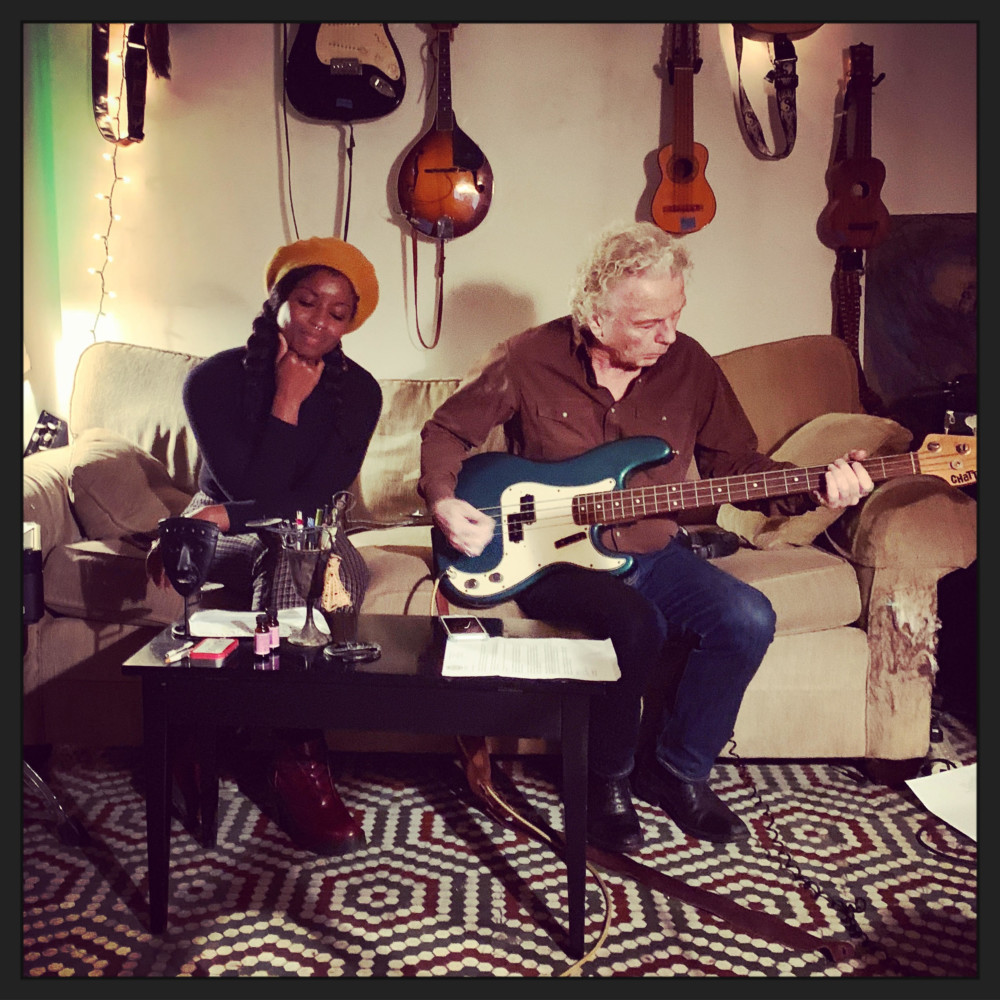
PREMIERE: Renee Holiday Covers Patti Smith’s “People Have The Power”

Patti Smith’s voice is a hammer striking an anvil, her songs often come across as poetry set to a tune. In the era of fake news, Smith’s work has come into the spotlight: she has been nominated for induction into The Songwriters Hall of Fame, performed at Pathway To Paris (a nonprofit trying to bring awareness of climate change), and even called President Trump an “uneducated man.” Written by Smith and her late husband, Fred “Sonic” Smith, 1988’s “People Have The Power” is considered a classic protest song. The perfect song to dust off in the melee that is 2019.

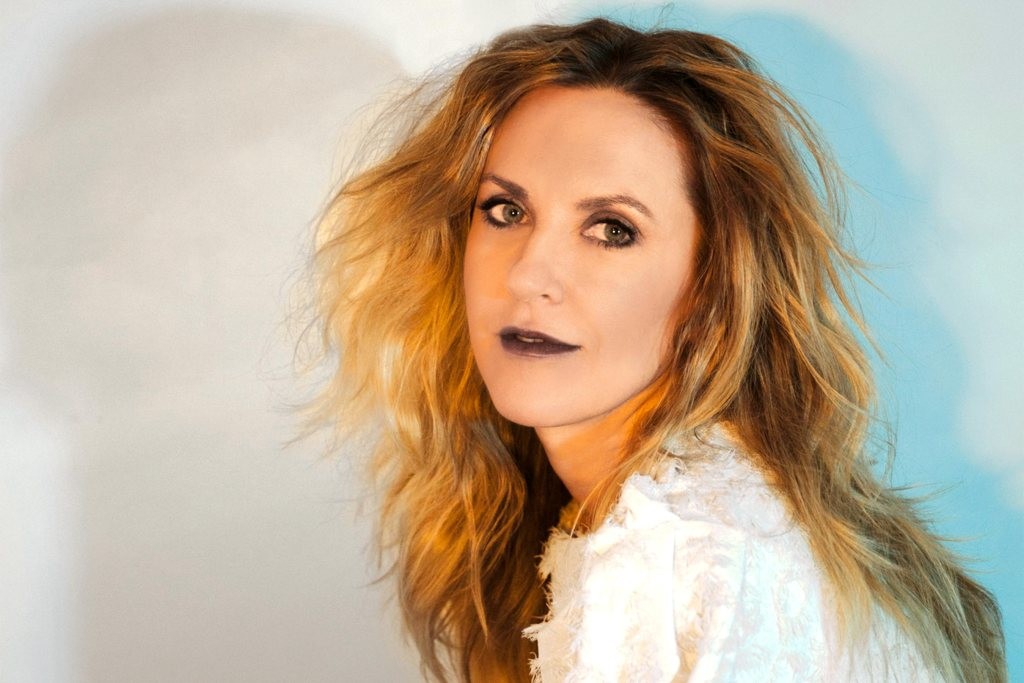
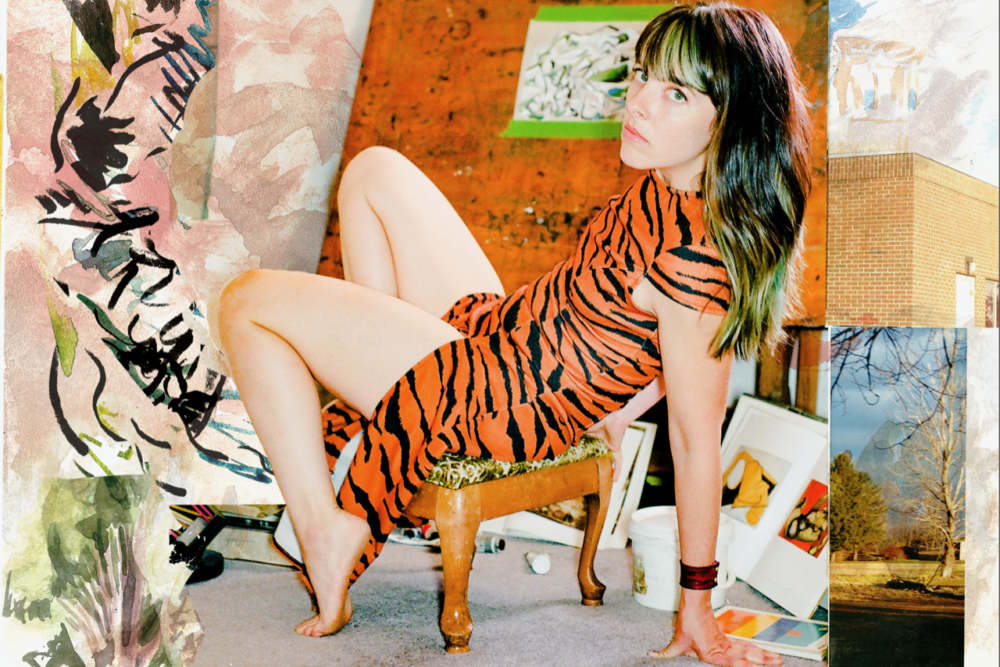
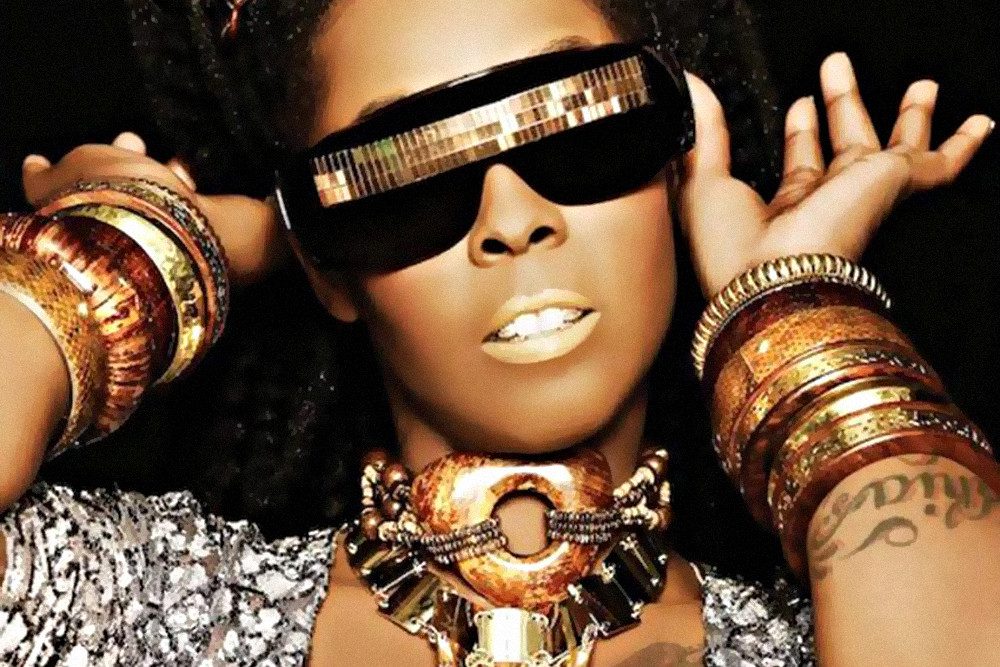
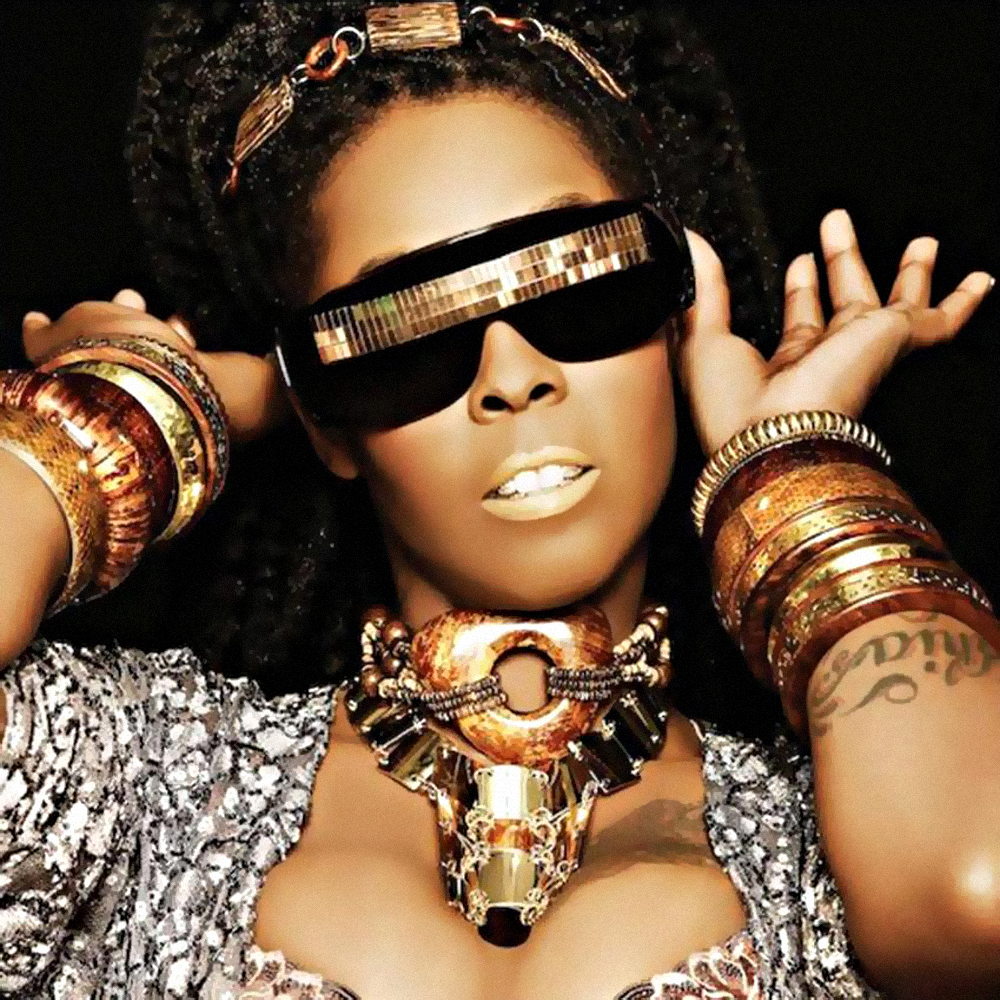
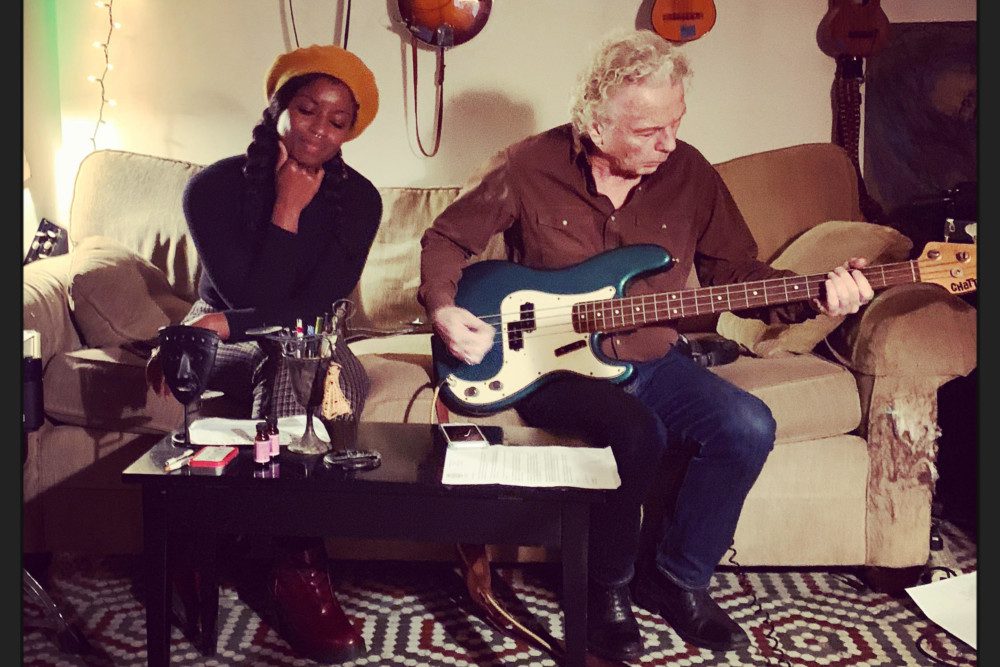
Seattle’s own Renee Holiday teamed up with Nigel Harrison (of Blondie) for a true cover of Smith’s “People Have The Power.” True in the sense that it uses the material in a fresh, subversive way. Patti Smith’s original recording is raw rock n’ roll, while Holiday manages to infuse hope into every note. From the first “I was dreaming,” Holiday’s voice takes the form of a warm trickle of water: smooth, comforting, confidant in its path. While Patti commanded the audience to remember their power, Renee gives a gentle push. And in a world on fire, we could all use a little gentle ribbing.

Watch AudioFemme’s exclusive premiere of “People Have The Power” and read our interview with Renee Holiday below:

AF: Tell us about your childhood. When did you first take an interest in music and how did that lead you to the work you create today?

RH: I grew up in a very musical household so it’s no surprise that I took an interest in singing at a very early age. My family always tells me cute stories of me forcing them to be my audience for at-home concerts and performances. I also clearly remember watching a performance of Sade when I was around the age of 5 or 6, and knowing right away that I wanted to be a like her. I wanted to float around stage while serenading whoever would listen, so that’s what I did!

AF: You’re a Seattle native – what’s the music scene there like nowadays?

RH: The scene in Seattle is pretty eclectic. There’s definitely something for everyone!

AF: You’ve recently changed your stage name from Shaprece to Renee Holiday. What was the catalyst for this change?

RH: I had the idea to change my name years ago but the timing felt right, now. The break from performance that I took allowed time for me to meditate on the idea and when I started working with this new team and label, it felt like the right time to make that decision.

AF: Will the music be altered as well?

RH: The music is still very true to my voice and story but the production and direction has evolved.

AF: Your live performance has an incredible amount of tension to it (we were enthralled with your Sofar performance). How do you ready yourself for performance? Do you have any rituals before a show?

RH: No particular rituals but I do have a tendency to become very quiet and reserved right before a set. I think it’s my mind’s natural way to preserve every ounce of energy for my performance.

AF: You incorporate a variety of instruments into your live performances. When you’re writing songs, do you normally think: “Ok, and here’s a brass section” or “I want a harp to back me up on this one,” or is it something that comes in later during production?

RH: Production is always a collaboration of sorts between myself and my producer(s). Sometimes the producer will place unusual instruments to the production and I’m like woooow, I never would have thought of putting a banjo on this! Sometimes I phantom hear instruments while the track is being made, and suggest adding whatever that may be. It really all depends on the mood and the energy of the song.

AF: How did this “People Have The Power” cover come about?

RH: I was catching a flight to New York for a vocal session, and I met a very eccentric man by the name of Roger Greenwalt. He was dancing around the back of the plane with noise cancelling headphones and I just knew we would get along! I ended up moving seats next to him for the remainder of the flight, and we quickly found that we both have grand ideas when it comes to creating music. Next thing I know, he invited me to sing on a compilation album for his label Petaluma Records (which is now my label home). He explained to me that the compilation was a collection of protest songs and of course, I was immediately interested. When I showed up to his studio later in the week, Nigel Harrison of Blondie was there working on the track as well. I felt so honored that they both trusted me to carry the power of this song.

AF: Have you always been a Patti Smith fan?

RH: Actually, I didn’t realize how much of a fan I was until I was asked to perform the cover. I had so many jaw dropping a-ha moments once I traveled down the Patti Smith rabbit hole. She’s a legend!

AF: What was it like working with Nigel Harrison?

RH: He is so kind, and such an encouraging person to work with! He complimented me on my professionalism, ability to learn a song on the spot, and perform it with confidence. I was majorly flattered and appreciative to get that sort of feedback from Rock Royalty. He has written some majorly ICONIC songs that I absolutely love so needless to say, I was honored to be working with both Nigel and Roger!

AF: If you did an album of covers as Renee Holiday, what would be your top tracks?

RH: I can’t pinpoint exact tracks because I have so many favorites but I can say that there would definitely be some Amy Winehouse, Bjork, Sade, Minnie Riperton, Stevie Wonder, Radiohead, Bill Withers, Jazmin Sullivan…

AF: Is a Renee Holiday album in the works?

RH: Definitely. Stay tuned!

AF: When and where can we see you live?

RH: If you happen to be in Seattle between November 7th and December 1st, you can catch me at the Can Can Culinary Cabaret in historic Pike Place market for my residency, “Beautiful.” The show’s concept is based on life transformation and rebirth which is definitely something that we can all relate to. I’m excited to showcase the transition from Shaprece to Renee Holiday through song, stunning visuals, and an incredible dance team!

A portion of “People Have The Power” proceeds will go to headcount.org.
LIVE REVIEW: HARD Day of the Dead Festival Mixes EDM and Spirituality

On Saturday, October 26, I attended a San Pedro ceremony. With a group of fellow journeyers, I drank the extract of a psychedelic cactus sourced from Peru, danced around a circle to live music, shook rattles, played drums, lay down to focus on my own insights and visions, and had drug-induced heart-to-hearts with other participants.

The following Saturday, November 2, I went to the HARD Day of the Dead festival in downtown LA. I microdosed some iboga and met others on their own substances of choice, whether that was weed, alcohol, MDMA, or something else. We danced together, sang along to the music, went on our own inner journeys as we swayed to the electronic beats, and talked to one another by the food stands. It struck me how similar this experience was to the one I’d had a week prior.

EDM festivals are modern-day shamanic ceremonies: People use music, dance, and often substances to connect with one another and achieve a higher state of consciousness. With the occasion of the Day of the Dead, which is already full of spiritual rituals meant to connect with ancestors, this association was extra prominent at the HARD Day of the Dead festival.

The afternoon and evening included many diverse manifestations of the EDM genre. Early in the day, Vietnamese-American DJ Softest Hard bound the festival-goers together by inspiring them to sing along to remixes of well-known tunes from Travis Scott’s “SICKO MODE” featuring Drake to t.A.T.u.’s “All the Things She Said.” Then, new-beat producer 1788-L delivered a delightful combination of trappy rhythms and unexpected interludes of classical piano and other instrumentals.

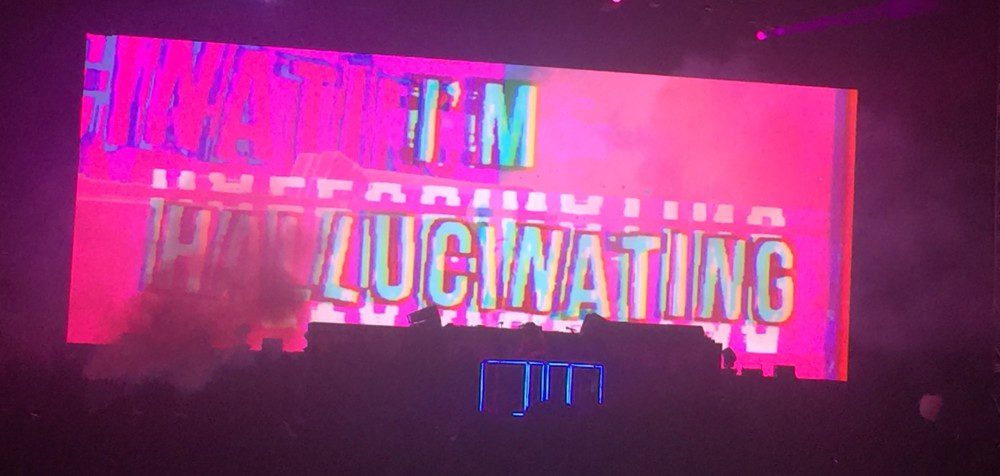
Later on, electropop artist Elohim took the stage for the trippiest set of the evening, with technicolor images of pills and the definition of “hallucination” on the screen behind her. It was during her act that the connection between EDM and psychonautic exploration was made clearest. In “Braindead,” she sings about drugs and spirituality: “All I know is I know what I don’t know / And what I don’t know could fill up a whole bible.” She also played an unexpected and musically fascinating cover of Harvey Danger’s “Flagpole Sitta,” her breathy voice gently drawing out lyrics punchingly shouted in the original.

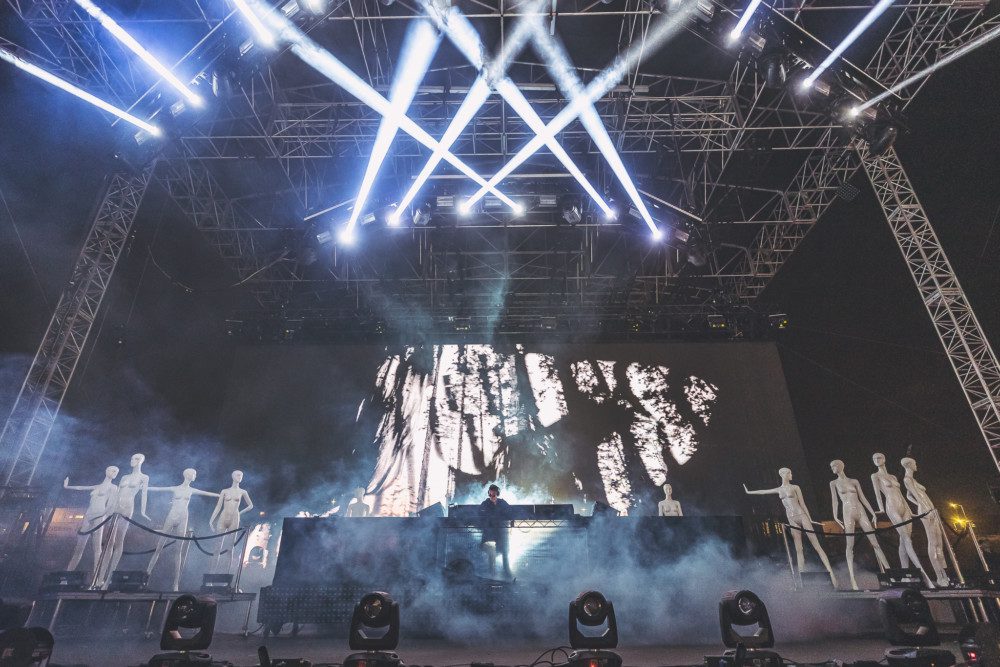
Another highlight of the evening was Blacklizt, Zhu’s deep house/techno alter ego, who blasted haunting sounds alongside a creepy collection of mannequins in front of a screen showcasing eerie images like scissors. His set reached its climax when he played “Faded (Baby I’m Wasted),” prompting the audience to belt out the lyrics, “Baby I’m wasted / All I wanna do is drive home to you / Baby I’m faded / All I wanna do is take you downtown.”

The headliner was Dog Blood, a collaboration between Skrillex and Boys Noize, ending the night on a high note with fast-paced electro-house beats and R&B influenced songs like “Midnight Hour.”

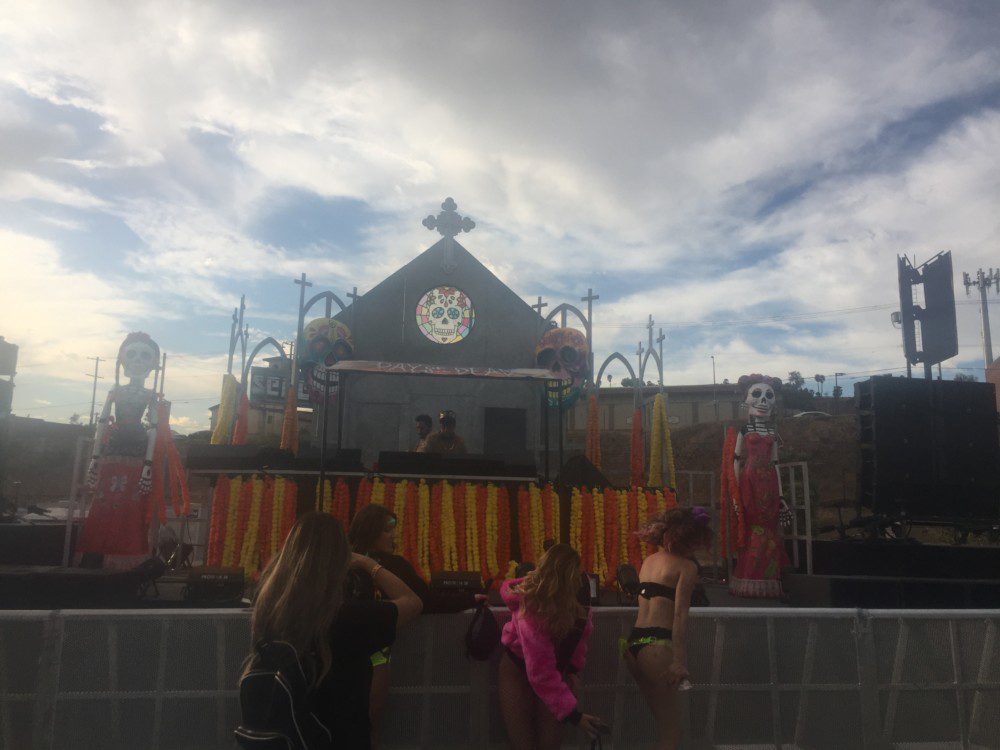
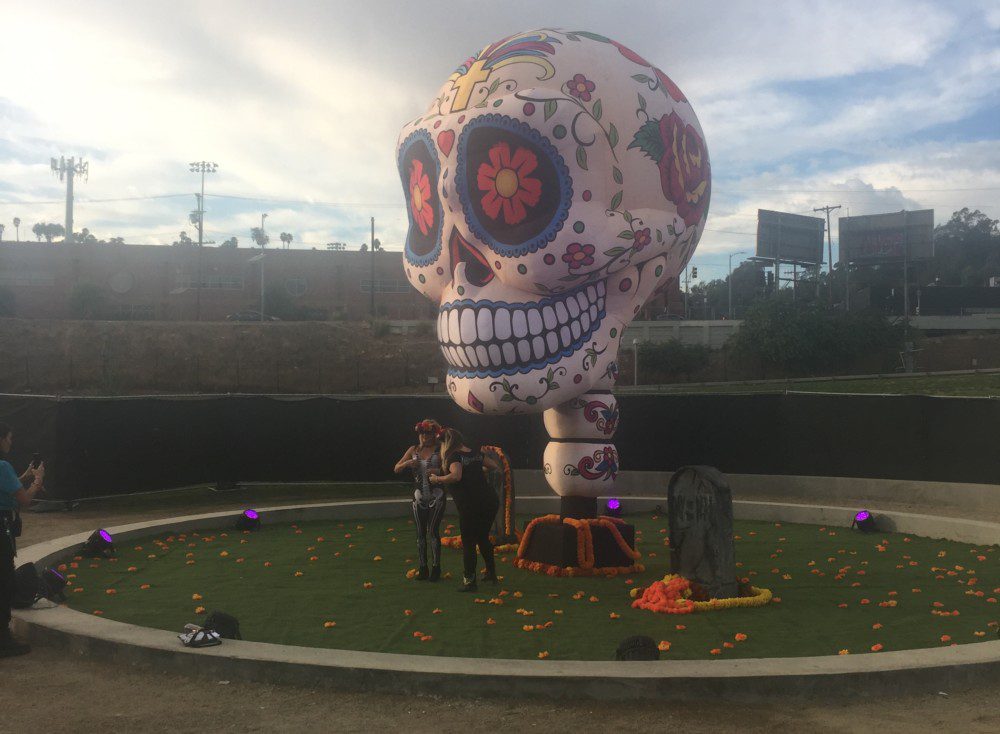
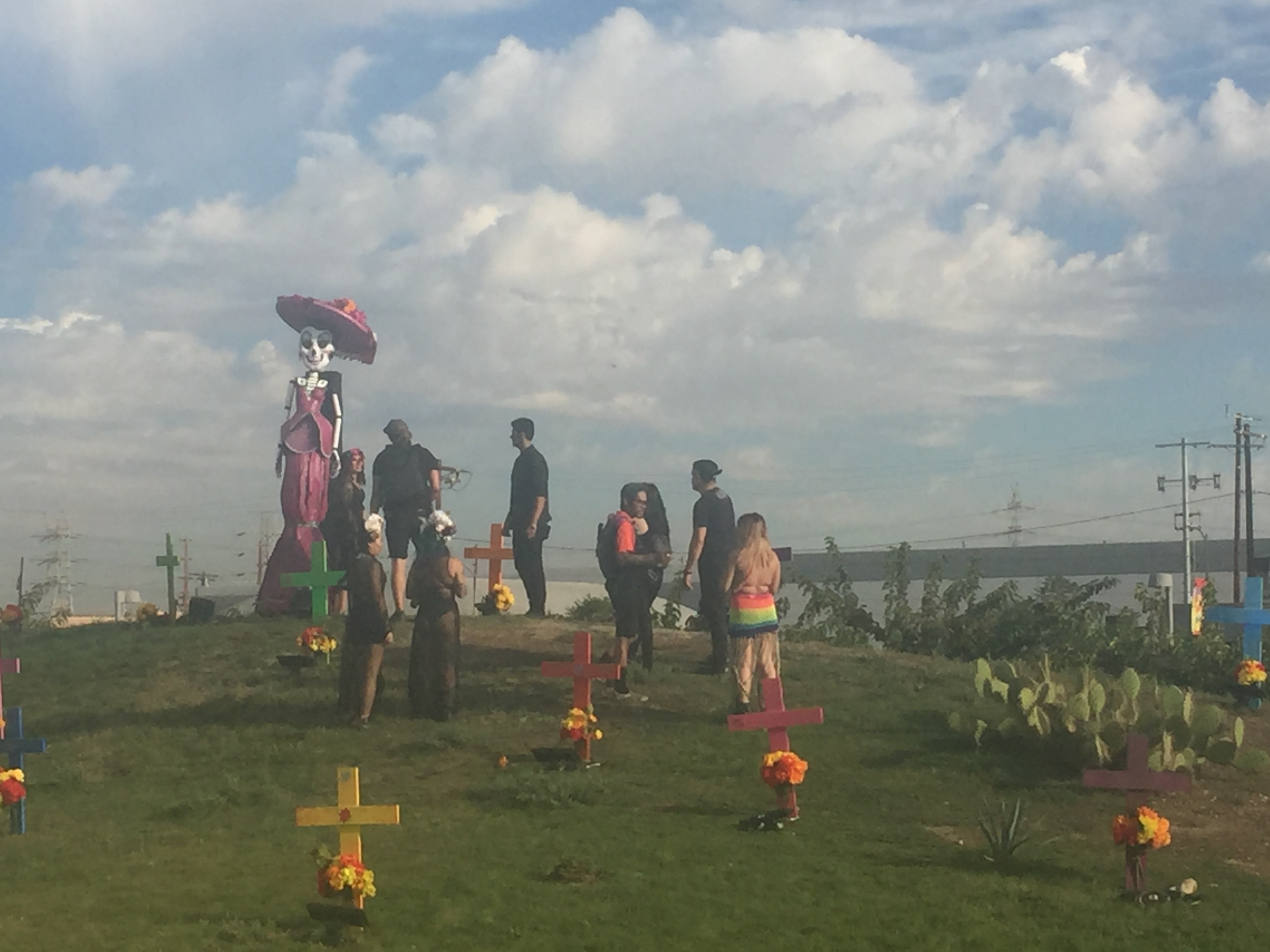
Despite the performances’ mystical undertones, it would be a stretch to say the festival honored the holiday’s spiritual traditions. Its representation of the Day of the Dead was fairly surface-level and came off a bit culturally appropriative given the poor representation of Latinx artists in the lineup. The event’s nods to the holiday and Mexican culture were essentially the symbols white America is most familiar with: a giant skull, a mariachi band, a stage flanked by skeletons.

What it did represent well was the spiritual culture of EDM: one full of trance-inducing songs, drug-facilitated connections, and crowds that move like one giant being. Whether or not it accurately celebrated the Day of the Dead, it was — like all music festivals — a celebration of life.
PREMIERE: True Dreams Follow EP with Title Track from Upcoming LP No. 1

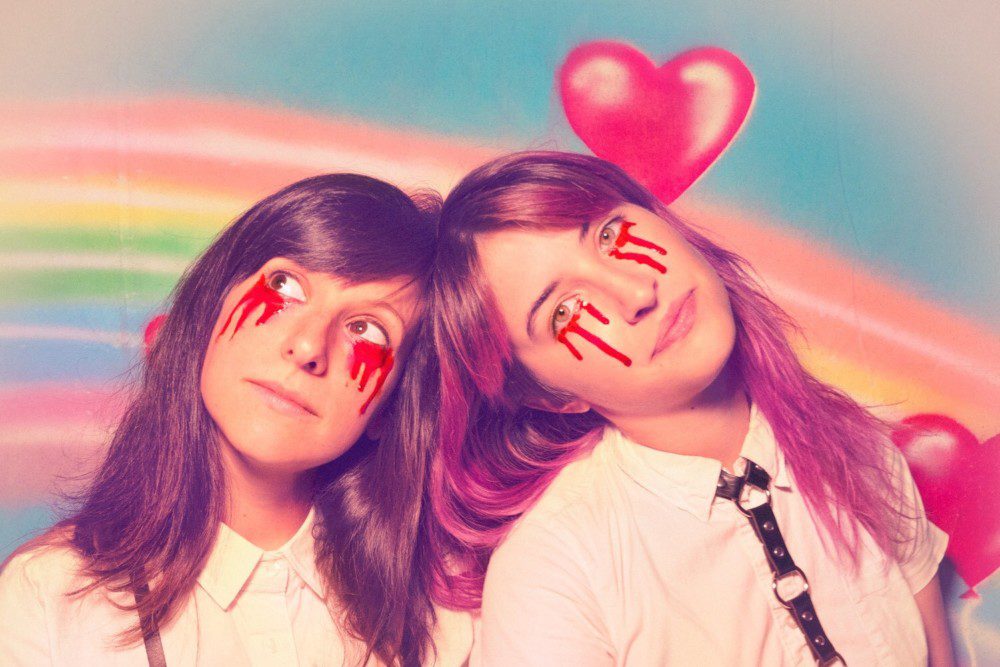
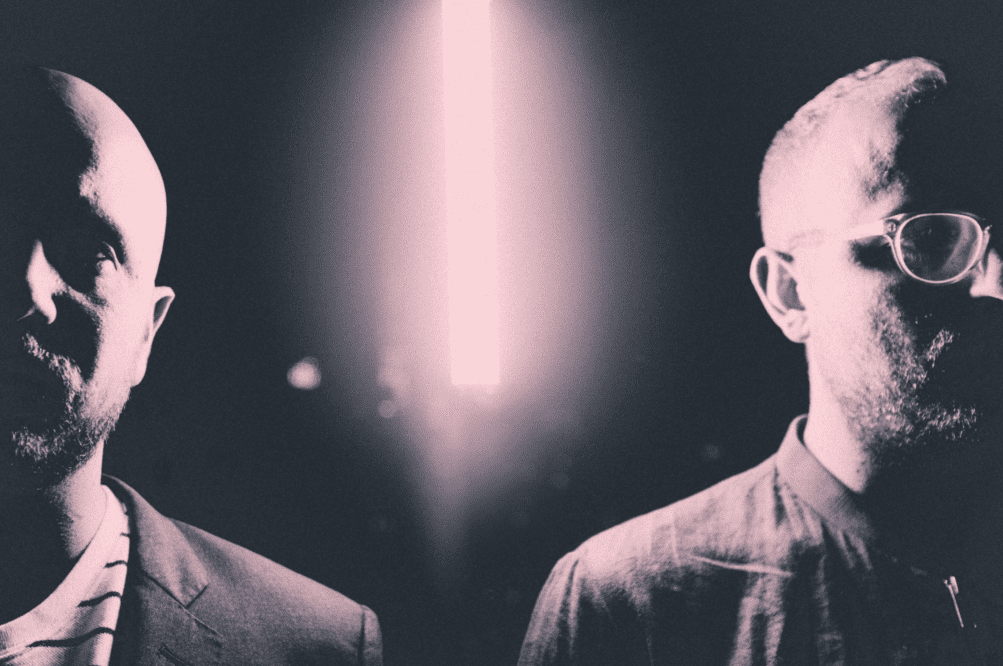
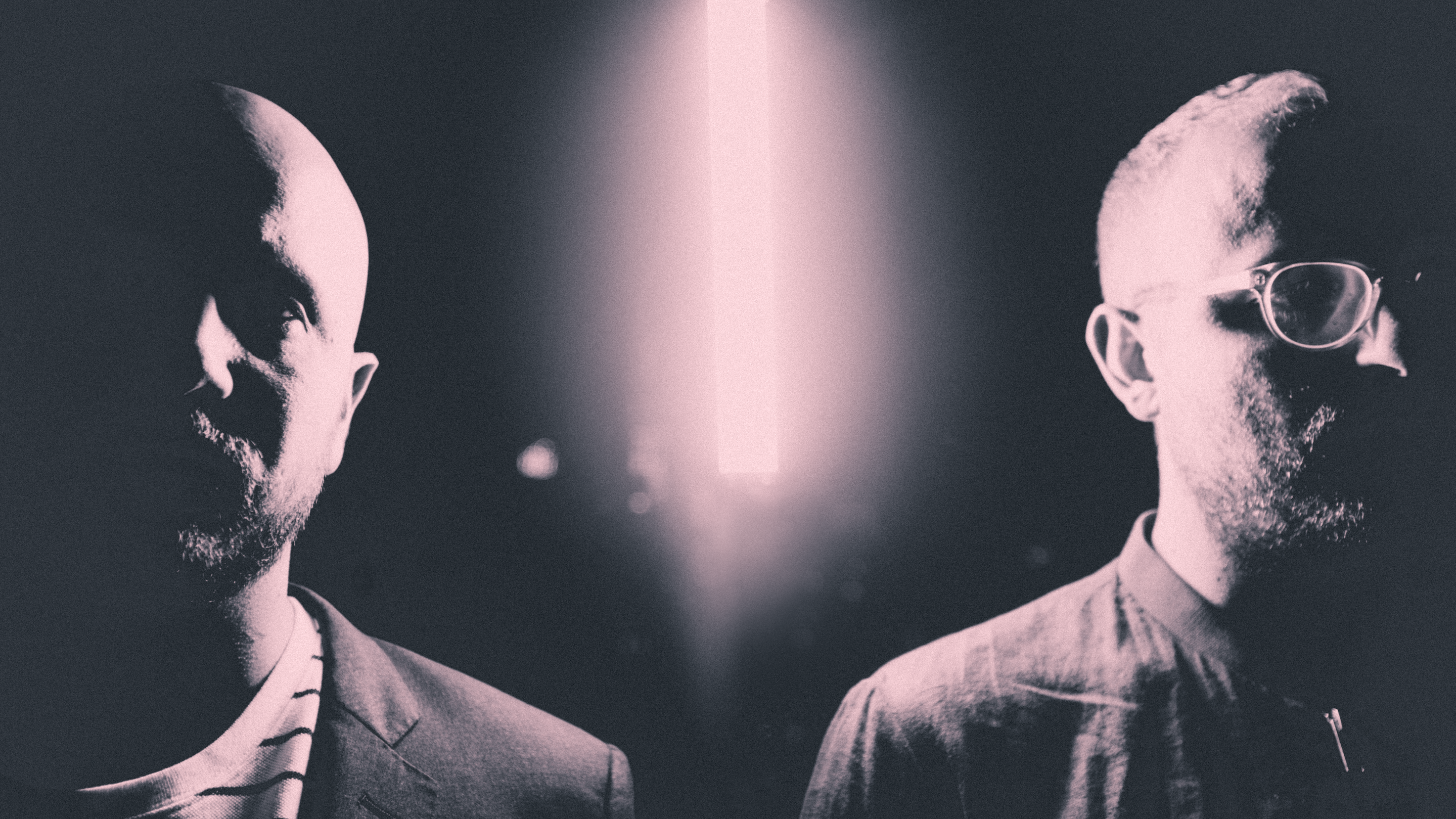
When I meet up with feminist punk duo True Dreams at drummer Hannah Nichols’ Brooklyn apartment, they’re wearing what they call their “uniforms”: black school girl skirts, leather harnesses, and crisp white Dickies button downs, each emblazoned with half of the band’s logo: Nichols’ shoulder says “TRUE” and guitarist Angela Carlucci’s says “DREAMS” in a slimey green font with pink stars Carlucci embroidered herself. It’s a twisted take on the “Best Friends” necklaces girls trade with their gal pals in grade school, each half of the necklace a broken heart that connect to the other whenever said besties reunite. Nichols and Carlucci are very much two halves of a whole, their friendship the gooey glue that holds their band together; on their forthcoming LP No. 1, you can hear it pulse in their call-and-response vocals, shouting out supportive messages to one another (and to anyone else that might need to hear them).

“A big part of our band is our friendship,” Nichols says. “We’re best friends – [Angela] is like a sister to me. You can’t separate the two.” They co-write everything, and Carlucci says the act of writing together is a huge adrenaline rush. “We really try to make it 50-50,” she says. “There’s no one leading.” The egalitarian approach is rooted in their political ideals, which make their way into the songs as well.

Carlucci and Nichols met at a video shoot for an ex-boyfriend’s band, back when Nichols was just beginning to learn drums on an electronic kit in her living room. Carlucci had already been involved with a number of anti-folk bands, most notably with duo The Baby Skins and as a backup singer with Herman Düne, as well as releasing solo work under the moniker Little Cobweb. As the two became close, they realized making music together was the next step, and punk music felt the most accessible. “Growing up listening to punk bands was what made me want to play drums,” Nichols says. “[Punk] is fairly easy to pick up; it’s simple when you’re first starting out. It was what I wanted to do and what I was capable of.”

Carlucci says “as soon as I learned Hannah was learning to play I was already scheming” to get a band going, but it took a while for Nichols to feel confident enough to do so. They formed True Dreams about four years ago, and the project is now beginning to bear fruit – they released a three-song EP in 2016, and slightly re-mastered versions of those songs will appear on their forthcoming full-length No. 1, out Novembver 22 on King Pizza Records in Brooklyn and Lousy Moon Records in Frankfurt, Germany. Audiofemme is pleased to premiere its first single and title track, “No. 1.”

“No. 1” is an excellent introduction to the album, a delightfully lo-fi affair recorded mostly live in a few days at their friend Frankie Sunswept‘s New Hampshire studio. The single quickly gets to the heart of what the band is all about; its jangly guitar riffs show off the duo’s DIY garage rock influences like Shannon & the Clams and Bratmobile. “It’s made to feel empowering,” Carlucci says. “It’s about getting dumped and owning the bad feelings around being dumped, feeling that thing that happens in New York where you feel really alone and lonely but there’s people right next to you on the subway.”

Carlucci’s verses dial up the snotty factor when she sneers “I am my own horror show” and laments “Why is it so hard to find somebody who will call me No. 1?” Nichols chimes in her support with a deadpan echo of Carlucci’s inner monologue (“Never should’ve left you!” she agrees as Carlucci bemoans the end of a relationship). “[My vocal] is kind of calling the person out on treating me bad, and [Hannah] is basically like, ‘Yeah what she said!’ like a team or something,” Carlucci says. “That’s how it goes down with your best friend when you get dumped,” Nichols adds with a laugh.

There are a couple of songs on the LP of a similar theme: the contemplative “Across Your Arm” and seething surf-rocker “The Scum” both express frustration with being taken for granted. Though these frustrations feel acutely personal, there are just as many moments on the LP that express frustration with society at large. Whether it’s the rollicking, tongue-in-cheek “Female Artists” or the incensed “Please Sir,” (Nichols warns: “If you were born a woman you better act sweet/We’ll save you a piece, We’ll save you a seat” and Carlucci spits back, “Everything I’ve suffered for and all that I’ve achieved/doesn’t mean shit when you’re a piece of meat!”), these songs demand respect when it’s lacking without feeling heavy-handed – more like complaining about the state of the world to a girlfriend than excoriating the patriarchy. “I feel like the act of creating this band is sort of a feminist statement in a way,” Nichols says. “It feels good to scream.”

Even if the band’s feminist anthems are cathartic to perform, their casual delivery is all in the spirit of fun. “We play music to have a good time,” Nichols explains. “We’re not here to like, try and be self righteous or condemn other people. We want to open up a conversation; we want people to have fun when they see us. It’s like… we could be your friends, but also, shut the fuck up and listen to us.”

In other words, True Dreams is not looking to alienate anyone, just state their piece. “If you’re trying to connect to people and have them hear what you’re saying, singling them out or telling them they suck is not gonna get anyone to hear it,” Carlucci points out. “It’s a little bit scary, but I’d be happy to talk with anyone who felt negative about it.” Their biggest goal is to inspire young women, particularly those keen to start their own bands (because “There aren’t enough, aren’t enough FEMALE ARTISTS!” as the two sing on “Female Artists”). “Music was so important to me [as a teenager],” Carlucci says. “I would love to somehow influence women or girls, especially ones in high school, feeling left out or different and not really knowing where they fit in [to start their own bands].”

For now, the pair live double lives – Carlucci as a baker and Nichols as a barber – and rock out on short weekend tours. But they’ve got big plans; in February, they’re off to Europe to play shows in Belgium, France, Germany, and possibly more. They’re having a blast – like their mutual heroes The Ramones – with making music, but what drives them day to day is knowing that they’re at the forefront of a progressive sea change. “The world is really changing right now in a tangible way and I feels good to part of it,” Carlucci says “We’re with the change, adding our part to it, and that’s awesome.”

True Dreams’ No. 1 is out via King Pizza/Lousy Moon Records on November 22. Pre-order the cassette here and RSVP for their record release show at Alphaville on 11/23.

PLAYING CINCY: Jay Madera Picks Himself Up in “Curb Appeal” Video

Curb Appeal

Last month, Jay Madera arrived on the Cincinnati indie-rock scene, releasing his debut single, “Curb Appeal.” Taking influence from Cincinnati mainstay band The National, Madera blends an indie-rock feel with pop and folk nods over a diverse instrumental display.

Catchy in a gloriously moody way, “Curb Appeal” tells the story of a breakup: the initial crushing blow, the post-breakup blues, and the defining moment where you shake yourself off and realize the power of moving on.

“Met a girl from the flyover states/She laid out the line and I dove onto the bait/ Oh I know, why I dive/She wasn’t lovely and she wasn’t bold/She could cure my cancers then give me the common cold/Oh I know, she’s not benign,” he sings.

Friday, November 1, Madera returned to his debut effort to drop visual for the Mia Carruthers-produced single, in which he shares his own cinematic breakup story.

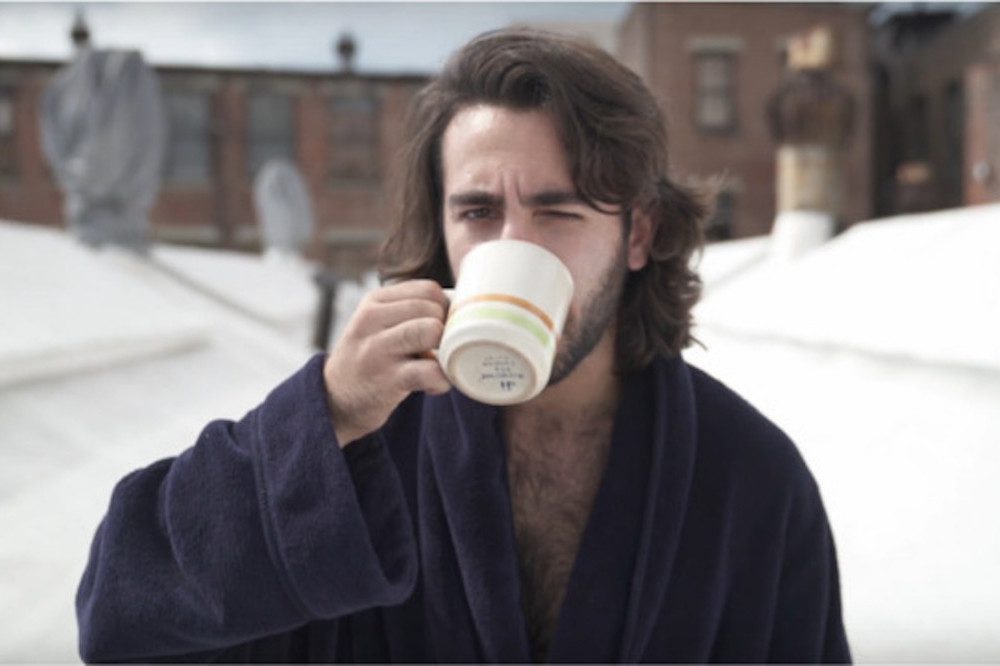
Directed by Alok Karnik, the clip opens up on Madera walking along Cincinnati‘s rooftops. The indie artist looks disheveled and contemplative, holding a cup of coffee and wearing a bathrobe. His initial appearance seems to mark the first blow of gloom and disorientation. However, Madera keeps moving, as the camera changes to find him biking through the city, appearing as though it’s almost out of desperation.

Throughout the visual, we see Madera making subtle positive changes. Flashes of the video find the singer-songwriter shaving his beard, opening a window, and putting on a new shirt. At the end of the clip, a clean-shaven and smartly dressed Madera hits the open road on his bicycle, looking triumphant.

“You can guess that it’s (an) archetypal breakup song,” Madera says of the single in a press release. “There’s the self-doubt, the isolation, the resentment. But there’s also the watershed of catharsis, the reunion with the self, and the magic of moving on. ‘Curb Appeal’ is the story of a love lost and a groove found; it is as much of a toe-tapper as it is a testament to the power of moving on.”

Madera is set to perform live this Veterans Day, November 11, at Cincinnati’s MOTR Pub. The free show will also feature Kaitlyn Peace & The Electric Generals, beginning at 9:30 p.m.

Watch Jay Madera’s new video for “Curb Appeal” below.

PREMIERE: Maija Sofia “Elizabeth”

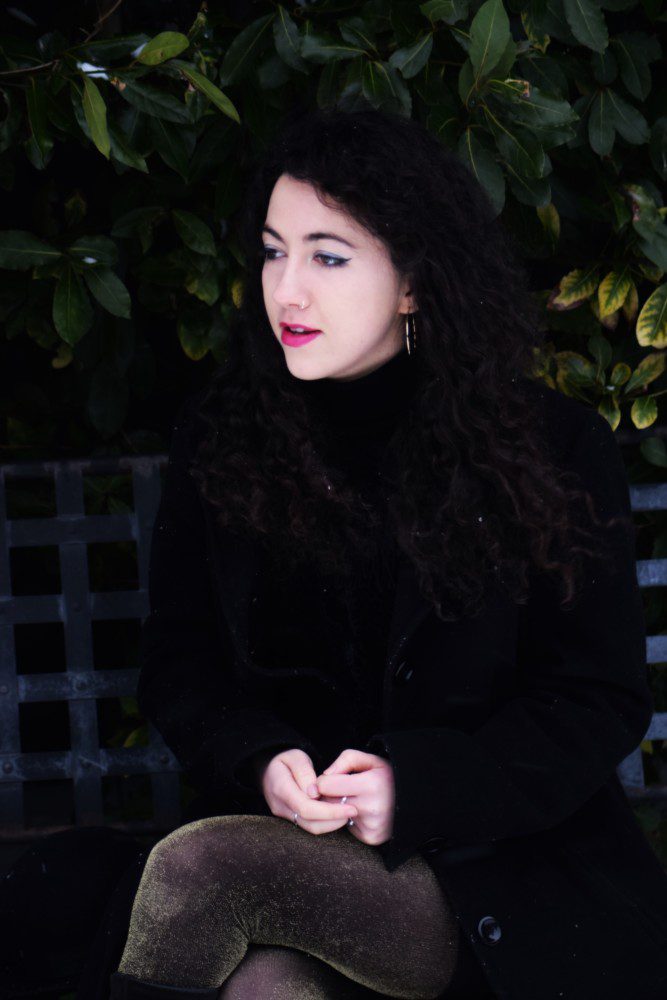
Irish singer-songwriter Maija Sofia‘s debut album Bath Time (Nov 22) is a lesson in history — particularly in history’s forgotten women. Its first single, “The Glitter,” centers on Caribbean novelist Jean Rhys and the displacement and misrepresentation she faced after coming to England at age 16. Another of the tracks, “Elizabeth,” is about Elizabeth Siddal, a 19th-century English artist, poet, and art model, and the ways she was mistreated and erased from history.

Hailing from the countryside of western Ireland, Sofia has been writing music since she was a teen and recorded an EP before her label Trapped Animal connected with her last year. We spoke to her about her album and how it ties to issues faced by women in both the past and present.

AF: What would you say is the overall theme of your album?

MS: When I was writing this album, it didn’t feel that there was a theme. But looking back now that I’ve put it together, so much of it is kind of about forgotten stories and women’s voices that have bee misrepresented throughout history. I’ve got different characters that I’ve written about, like Bridget Cleary, a woman whose husband said she’d been possessed by a fairy. It was in the 1890s, and it was a ritual exorcism, and she was murdered, but her husband got away with it because he said he was banishing the fairies. That was a real thing that actually happened, and he never got sent to prison or anything because he’d been convinced that he wasn’t actually murdering his wife but was killing a fairy. It was really awful.

AF: What was significant about that to you?

MS: It struck me that it was only 120 years ago — it’s not that long ago that that could be taken seriously. And she was an independent seamstress. She had her own income, and that was unusual in rural Ireland at the time, and it’s kind of like this woman who was powerful — her life was just taken completely by her husband, and it was a murder, but it didn’t seem like that at the time.

AF: Which other historical women feature prominently on the album?

MS: Edie Sedgwick, who was Andy Warhol’s muse, who was never thought about in her own right. She also went out with Bob Dylan, so he has all these songs about her, but her own voice has never been remembered. She’s just her image, and men have been inspired by her, but we don’t remember her as a person. She’s just a face.

And Elizabeth Siddal was a muse to these painters in Victorian London, and again, she’s always kind of remembered as a muse rather than an artist or a writer in her own right. She was a muse to the Pre-Raphaelite Brotherhood in London. She’s just like a character in history that fascinated me, and I always loved those paintings. When I was a teenager, I was really fascinated by the Pre-Raphaelite paintings, and I started reading about the women in the paintings, and she’s the one that struck me as interesting.

She was a poet as well and an artist, and Rossetti, the painter, was really in love with her, but he would never marry her because she was lower-class. She had tuberculosis, and after she died, Rossetti decided he was in love with her all along, and he had his manuscript of poems buried in her coffin. But several years later, he was bankrupt, so he had her grave dug up in the middle of the night, and he tried to get his poems back, and he published the poems. He disrespected her in life but also in death. He disrespected her so much that he did his offering and then had her dug up to get his poems back. It’s another weird real-life strange historical tale.

AF: The lyrics to “Elizabeth” read to me like a love song. Whose perspective is it from?

MS: The song is from the perspective of Rossetti, the painter. I was kind of poking at the fact that she’s only ever been represented through his perspective. It’s kind of like a satire.

AF: Do you see this erasure of women’s voices happening today?

MS: Less obviously so, and women are being given space to tell their own stories now, and I feel very grateful that I am of a generation that I can do this. But I do think that the male gaze is still  such a prevalent thing in cinema and in art and photography and the fashion industry and everything. I wasn’t intentionally writing about this theme repeatedly. It was only after the songs were written that it was like, “Oh, I’m obviously interested in this.”

AF: I read that your album was inspired by the repeal of the 8th Amendment, which banned abortion in Ireland. How did that factor into it?

MS: I was really involved in protest and activism to get a referendum to get that law repealed, and part of that meant I was constantly around women giving testimonies around their abortions and the traumatic experiences of having to sneak across to the UK or order pills online and all the risks that come with that. It was a really intense time for Irish women because most of us were really active in trying to get this law changed, and it was successful. But I think that constantly hearing women’s stories and hearing about women’s struggles definitely impacted the writing.

AF: What are your next plans?

MS: I’m doing a project with another artist called Rachael Lavelle. That’s my next plan after the album’s released, and then I don’t know after that. She’s a composer, and I’m more interested in writing lyrics, so probably, she’ll be doing more of the music side, and I’ll be doing more of the writing side. We’ll be looking at themes of witchcraft and folklore, so we’re still in the early stages. I don’t know what form it’ll take, but I’m excited about it. She’s an amazing artist.


Maija Sofia’s debut album Bath Time is out November 22 via Trapped Animal Records & Cargo Records. Follow her on Facebook for ongoing updates.

HIGH NOTES: An Acid Trip on a Third Date, in Music

J and I met on Tinder and developed a relationship equal parts unconventional and beautiful. Our first date was vegan food and a late night beach walk, our second was mushrooms, and our third, perhaps the richest with meaning, was acid.

J had a few hits left over from a prior trip, which he was waiting to take with the right person. I had a few tabs a friend had given me to microdose. Together, we had enough for one hit and one re-up each.

It started off in my sunlit bedroom, with its lacy curtains and white king bed, where we each mixed the liquid with a lemon drink I’d bought and drank in down with anticipation.

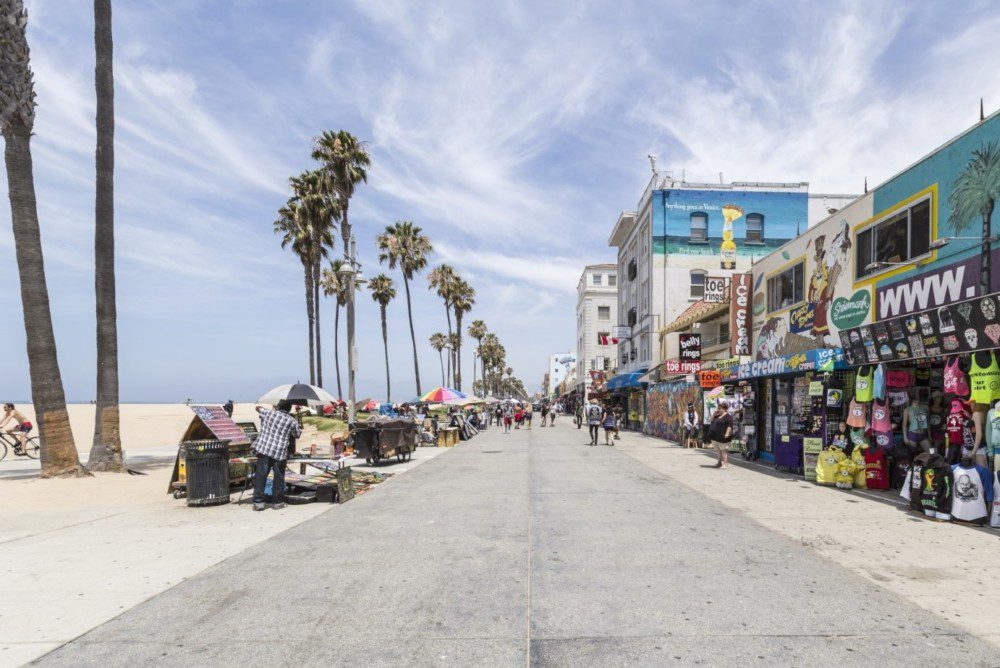
Then, it transitioned to the sun, the shine of Venice Beach, where we ambled down the boardwalk, stopped to chat between cacti, and lay in sand where fleeting traces of mermaids scampered. Feeling how burned we were getting, we bought sunscreen, and he tenderly rubbed mine into my skin, a gaze of deep affection on his face. Once he was done, his eyes diverted back to the ground.

Back to the room we went, where we re-upped and put on music. After a lull in the song selections, I told him I’d channel the next song to play from above. For some reason, “Lazy Eye” by the Silversun Pickups popped into my head. I found it on Youtube.

“This song always made me sad,” I told J.

“Why?”

“I’ve been waiting for this moment all my life / But it’s not quite right,” I quoted the opening line. “It’s like when you’re trying to make a relationship work.” Tears came to my eyes. I couldn’t explain further.

“Did you notice something special pass between us, when you were putting on my sunscreen?” I asked as we held each other in piles of blankets and pillows.

“I know what you mean,” he said.

“I want to look you in the eye again.”

He peered up for a second, then hid his face in a blanket. “It’s scary,” he said.

“To appear sad / With the same old decent lazy eye / Fixed to rest on you / Aim free and so untrue,” the Silversun Pickups sang.

“What do you feel you need to hide?” I asked.

“Do you think I’m hiding?”

“Well, when you’re afraid to look people in the eye, there’s usually… shame.”

He buried himself further, then pulled himself up to meet my gaze at last. His eyes looked particularly beautiful in that moment, like sunflowers in a field.

My own eyes met his as I whispered, “You have nothing to hide.”

“Still the same old decent lazy eye / Straight through your gaze / That’s why I said I relate / I said we relate / It’s so fun to relate,” the music continued. “It’s the room, the sun, and the sky / The room, the sun, and the sky.”

After the room and the sun came the sky, the satellite-speckled Santa Monica sky that we lay under and talked about the siren sounds nearby, the song of the sirens, how Odysseus plugged his ears and Oedipus stabbed out his eyes.

“Everyone’s so intimately rearranged / Everyone’s so focused clearly with such shine.”

Back in the room, now full of sand from the sun and the sky, he told me about his goal to be more adventurous, inspiring me to play another song.

“I read with every broken heart / We should become more adventurous,” Rilo Kiley sang. “And if you banish me from your profits / And if I get banished from the kingdom up above / I’d sacrifice money and heaven all for love / Let me be loved / Let me be loved.”

We fell down a Rilo Kiley rabbit hole, and “The Absence of God” came on: “And Rob says you love, love, love / Then you die / I’ve watched him while sleeping / And seen him crying with closed eyes.”

He decided to go home. I wondered if the intimacy scared him. It didn’t scare me anymore.

“And Morgan says maybe love won’t let you down / All of your failures are training grounds / And just as your back’s turned / You’ll be surprised, she says / As your solitude subsides.”

Our fourth date was molly, our fifth was a cacao ceremony followed by a sex party, and our sixth was a San Pedro ceremony. After the latter, we lay in my bed talking again, and J told me about a friendship of his that almost became a relationship. “It’s like that song,” he told me. “Like what I’d been waiting for all my life… but not quite right.”

“You know,” I said, “that’s how I feel about us.”

“Me too.”

“No wonder I picked that song.”

“Nailed it.”

Then we gazed into each other’s eyes, eyes unafraid and unashamed, eyes that cried open, eyes that were more adventurous, eyes that were lazy no more.

PLAYING ATLANTA: Shepherds Explore Toxic Nostalgia with “Your Imagined Past” Video

For Atlanta sextet Shepherds, “genre” is a worn name tag hanging on by its last thread as theme and experimentation take prominence, rapidly setting the art-rock group apart in an ever-changing Atlanta market.

Since the release of their 2011 debut EP, Holy Stain, the band has been in a state of constant flux as they navigated rapid changes, from their lineup to the state of the world around them. Featuring the creative minds of Vinny Restivo,
Ryan York, May Tabol, Adrian Benedykt Świtoń, Peter Cauthorn, and Jonathan Merenivitch, the group released their expansive new LP, Insignificant Whipon October 18th, following a music video for their lead single, “Your Imagined Past.”

Interest spurred by the band’s pointed lyricism and social commentary, I got the opportunity to sit down with lyricist and vocalist Jonathan Merenivitch to find out what drives the experimentalist evolution that keeps the group moving forward.

AF: You guys have been together for almost nine years now, released two full-length albums, and evolved sonically from a minimalist soundscape to lush, textured art-rock. What has it been like to see such organic evolution and growth as a band? How have you evolved individually as songwriters, musicians, and performers as the years have passed?

JM: It’s been very natural. When we started we had an idea that we would sound like Smokey Robinson meets Jesus and Mary Chain. A simple idea, kinda gimmicky, but a clear goal in terms of sound. As we’ve had a variety of musical experiences both as sidemen and collaborators/leaders in other projects, we’ve learned the necessity of that kind of genre elevator pitch but also the importance of not boxing ourselves in as musicians. We used to be very concerned with the wildness and diversity of our sound but now we’ve accepted that wildness. It’s a bit of a challenge to describe what exactly we sound like now and honestly that’s how we like it. We’ve listened and played too much music to be hemmed in by anyone’s expectations. That speaks to how we’ve grown as individuals in all these roles as well. Through our experiences, we’ve learned to be better songwriters, performers, and collaborators. We wrote most of these songs in a few weeks because we know the pitfalls and figured out how to move past them. Recording, on the other hand… that took a bit longer.

AF: What does the term “art-rock” mean to you? 

JM: It feels kind of nebulous. It’s a sort of catch-all marketing term that gets used when a band seems kinda highfalutin and difficult to pin down. It works for us for now. It speaks volumes that the term has been used to describe artists ranging from fusion-era Miles Davis to Roxy Music.

AF: You tackle some weighty topics lyrically, from Catholic guilt and toxic masculinity to YouTube comments (a thoroughly modern source of inspiration). What inspires you as lyricists? How has music allowed you to express your discontent with the world we’re living in while also inspiring others to take action — or just make it another day? 

JM: I look at an album as a diary of whatever I was thinking about when I was writing it. This was written around winter 2016 so I remember I was going out a lot, dating, being depressed, taking consideration of what exactly it means to be a man, taking stock of weird political changes that were slowly coming around the bend and just being on YouTube late at night trying to find weird shit to listen to and watch. You put all those things together and you have the lyrical contents of the record. 

My hope with this record and all the things we do is that folks find we share their concerns and anxieties about living in this modern world and are inspired to do whatever they feel is appropriate, whether it’s finding some respite from this world or burning it all down.

AF: Can you tell us a bit about your songwriting process? Is it collaborative, or do you come in with a finished product and flesh it out as a group? 

JM: For this record, one of us would usually bring in a demo or a snippet of a chord change or idea and then we would either stick pretty close to the demo or tear it apart and put it back together again. Sometimes that would be a really extensive overhaul; for example “Perhaps This was a Thorned Blessing, Pete” started off as a heavy Black Sabbath-style tune and we ripped it up and sped it into a goth punk thing. “Savor Your Sons” was a 30-second loop of the chorus that we expanded upon greatly. Other times it was subtle changes. “Your Imagined Past” is very similar to the demo and “Blood Moon” and “Perfecting a Function” are the same arrangement-wise, but [we] just added new elements like saxophone or synth.

All Photos by Meghan Dowlen

AF: What do you love most about songwriting? 

JM: I love the puzzle aspect of songwriting. Taking a piece and trying to figure out how to make the arrangement as satisfying as possible. What the song needs or doesn’t need to make it feel perfect.

AF: Do you feel that you’re able to express yourself as deeply through instrumentation as the lyrics themselves, or do you feel that they enhance each other? 

JM: They enhance each other or in some cases inspire each other. The melody of “Perpetual Yearning” inspired the confessional nature of the lyrics.

AF: Which bands inspired your sound, and how have you evolved after years of playing together and in front of fans? How have the personnel changes affected you as a group, and how has it helped keep your sound fresh and modern instead of acting as an homage to a former lineup or a bygone era?

JM: There were a few sonic hallmarks and tidbits we were influenced by. The massive jangly guitar at the end of “Harborcoat,” the unusual percussion of Einstürzende Neubauten, the tambourine on “We Can Work It Out,” the soundscaping on To Pimp a Butterfly. The personnel changes have stopped us from ever getting too bored and each new person has added a new perspective that’s kept things interesting. We’ve recently been writing with a friend who has a background in bossa nova which has been interesting to experiment with.

AF: You released a music video for “Your Imagined Past” a few months ago. Can you tell us a bit about the song and what inspired it? Why did you choose it for your music video?

JM: The song was inspired by me reading the comments on a YouTube video for “Blinded by the Light” by Manfred Mann’s Earth Band. In the comments was a Baby Boomer lamenting a lost love and how they used to listen to the tune in his pickup truck. I began to wonder what kind of person would use the comments of a YouTube video of a classic rock song to express deep emotion and nostalgic regret and came up with the character at the heart of the song: someone who had nostalgia for a bygone era but was unable to reconcile it with his present. We chose it for the video because we wanted it to be the first single and the themes of the song lent themselves well to the themes of the video. Toxic nostalgia, Baby Boomer aesthetics, etc.

“You were full of shit then.
You’re full of shit now.
Your imagined past is just that.”

AF: What’s been your experience in the Atlanta market? How has the growing and changing scene given you space to grow and change as a band? 

JM: I think we probably fit in better now than when we first started for a variety of reasons. The growing progressiveness of the scene allowed us more chances to express ourselves and play bigger stages. There are so many great bands and so much opportunity to play with excellent musicians. Everybody seems to be in a few different projects because of the quality of players here.

AF: What’s next for Shepherds? 

JM: We’ve already started recording a new record and we’ll probably put out a new single by early next year. We plan on moving into new sonic territory. Less noise, more space, more melody, more focus on grooves. Something like soul music.

Keep up with Shepherds on Facebook, and stream Insignificant Whip on Spotify now. 

RSVP HERE: A Deer A Horse Play Brooklyn Bazaar + MORE

Welcome to our new weekly show recommendation column RSVP HERE – your source for the best NYC shows and interviews with some of our favorite local live bands.

This week A Deer A Horse are supporting The Art Gray Noizz Quintet featuring Lydia Lunch for one of Brooklyn Bazaar’s final shows. The Art Gray Noizz Quintet features Stu-art Gray Spasm of Lubricated Goat joined by members of Live Skull, Woman, Cabbages & Kings, Twin Guns and more; playing a set of all “unreleased collaborations and bastardized classics.” A Deer A Horse are perfect openers with their melodic 70s punk meets post rock sludge. They are constantly touring so don’t miss the opportunity to see them while they’re in NYC! We asked ADAH a few questions in anticipation of their show this Wednesday 11/6…

AF: What are your top 5 bands to see live?

ADAH: Daikaiju (they light their instruments on fire while they are being crowdsurfed around the room, they’re fucking insane).

Ono (when they perform you are transformed from an audience to a congregation and Travis is your preacher. You will follow him wherever he goes).

Minibeast (intense, relentless noise rock from providence, memers of Mission of Burma).

Blacker Face (soul, r&b mixed with aggressive noise rock, some of the most inventive shit we’ve seen in a hot sec).

No Men (you’re dancing so hard that you don’t realize you’re worshipping Satan, these heathens rule).

Black Midi (fresh operatic noise weirdness from far far away, best band we saw at SXSW).

Listen… so we know we already did six here, but also s/o Big Business for melting our faces off for a week in August! When they play the song “Horses” Coady leaps out of his seat to slam the cymbals as hard as he can at the end of the song and it’s fucking amazing.

AF: I read somewhere that The Shining is one of your biggest inspirations. What’s your favorite scene from The Shining and has that film influenced your live show?

ADAH: I think you must have misunderstood the article… We could care less about that terrible piece of drivel, we worship instead, The Shinning. It’s a true masterpiece, a horror classic, The Shining pales in comparison to The Shinning. And who could forget those words repeated into the ether “No TV and no beer make Homer something something”? Chilling.

AF: If you could ask Lydia Lunch anything, what would it be?

ADAH: Lydia Lunch is one of the most prolific artists out there.  I mean seriously, just scroll through her credits on Wikipedia, the list goes on and on. It’s insane how much she’s accomplished! We’re all creative people, but Lydia is on another level; it’s both inspiring and intimidating. So I would definitely like to know where she feels her drive to create comes from.


RSVP HERE for Art Gray Noizz Quintet feat. Lydia Lunch with A Deer A Horse and Conduit on Wednesday, November 6th @ Brooklyn Bazaar. All Ages / $10-12

More great shows this week:

11/2: Deli Girls, Murderpact, Safe Word, Beak Trio @ The Broadway. 21+ / $12  RSVP HERE

11/2: Pinc Louds (4-year anniversary), Los Cumpleaños @ Market Hotel. All Ages / $15 RSVP HERE

11/2: Goth Prom III:  Parlor Walls, Whiner, Daily Therapy, Meganoke, The Sewer Gators, Holy Wisdom LLC @ Rubulad. All Ages / $8 RSVP HERE

11/4: Swanky Tiger, Nihiloceros @ Mercury Lounge (early show). 21+ / $8 RSVP HERE

11/5: The SpeLcast Live Variety & Medicine Show @ The Living Gallery. All Ages / $5 entrance and hand writing analysis / $1 sense of humor, spells and tinctures / free bandaids RSVP HERE

11/5: Dead Tooth, Karaoke Mood Killer (tape release), Should’ve, Johnny Dynamite @ Alphaville. 21+ / $10 RSVP HERE

11/5: Jenny Slate @ Town Hall, NY Comedy Festival. All Ages / $41 RSVP HERE

11/5: White Reaper, The Nude Party, Wombo @ Bowery Ballroom. 18+ / $15 RSVP HERE

11/6: No Swoon (Record Release), Big Bliss, Wooing @ Union Pool. 21+ / $10-12 RSVP HERE


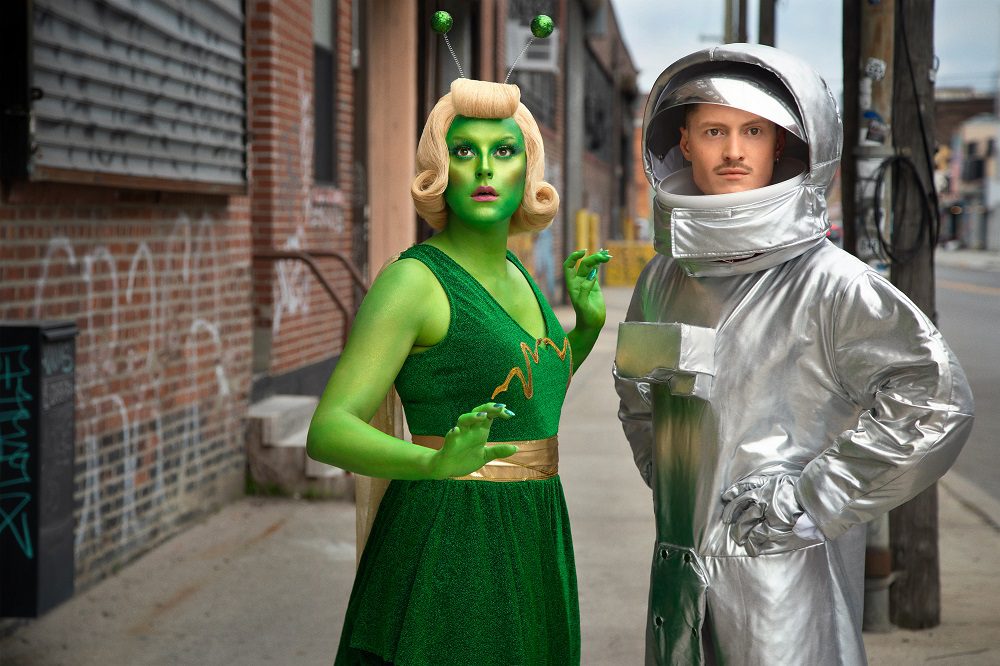
REVIEW: BHuman Has Landed With Intergalactic Queer Concept LP BMovie

B movie sci-fi and horror flicks are special kinds of charmers. The Blob (1958), It Came from Outer Space (1953), Plan 9 from Outer Space (1959) and War of Planets (1966), among countless others, all possess a particular aesthetic: delightfully outlandish. Certainly in the 1950s and ‘60s, such bizarre fantasies and their bloated space creatures cloaked a very real, tangible paranoia that spread like wildfire. The world was in the throes of the Cold War, and the art of cinema was vital for the collective cathartic release.

Brooklyn alt-pop duo BHuman ─ comprised of Billie Lloyd and Harrison Scott ─ excavate a smorgasbord of cosmic energies and classic b movie imagery to plot a concept record that dissects identity, self-discovery and alienation as queer folk. The aptly-titled BMovie is structured “to be almost a fictional movie soundtrack that reveals itself through the song and tracklist,” says Scott. BMovie comes on the heels of a self-titled EP released earlier this year, signaling big things for the prolific duo. The LP is raw, honest and relevant – a treasure trove of electro-pop that is unafraid to be bold and drive the narrative forward. Billie Lloyd and Harrison Scott are the kind of innovative thinkers that could be total game changers for pop music.

The effervescence fizzes right from the start ─ “Strange Things (Overture)” pops the lid with a kooky soundbite: “I saw a flying saucer…” Though the songs focus on the innate human desire to love and be loved, quirky production choices inspired by cult films and television gives every song an eerie kitsch.

On “Melt,” BHuman’s synth-filtered forms dissipate into pitter-patters of percussion and other sticky distortions that feel so peculiar its easy yo get lost in their haze. The lyrics reflect that liquid, permeable feeling; “I know that you’re scared / I feel it, too / Maybe I’ll just melt right into you,” the duo vow on one of the album’s most immediate hooks. Their boldness in composition and vocal performance is always the appropriate amount of strange and never appears so left field as to ward off potential fans. In fact, it’s their aloofness that is most compelling.

“Other Way” (soon to have its own Carrie-inspired music video) emerges with a radio-ready earworm of a chorus that cribs The X-Files theme song. Distant samples come back like lost transmissions from outerspace (“You didn’t actually believe you were the only inhabited planet in the universe?”) as Lloyd coos, “I guess what they say is true that / Things find you when you’re looking the other way.” Here, the surreal subtext elevates the relatively common pop trope of finding love in an unexpected place.

Their blip-bent version of Cher’s “Believe” is also a marvel to witness. A marching band washes in sharp waves beneath their vocals, which almost seem detached and cold, as if cast in ice, yet they remain quite evocative. In the video, Scott assumes the role of Mulder to Lloyd’s Scully (again referencing The X-Files and giving an altogether different context to the word “Believe”), as well as an intergalactic odd couple.

“Distraction,” meanwhile, is slathered with hip-hop shimmer, and its less linear melody underscores the aching mood writhing across their bedroom carpet. “Fiction” draws from a similar musical wellspring, employing handclaps and clicks to heighten its intensity, and builds upon the emotional framework. “Baby boy has got this mad ambition / But it’s all lies and contradictions,” they weep. The web of lies into which they’ve fallen becomes nearly unconquerable, but in shedding the stark truth, they wiggle free and soar into a liberating glow. “Materializations (Intermission)” is a glittering reprieve and sets the more polished tone of the second half. “I May Never Know” bounces along neon-colored synths and teases that they’ve finally come to accept heartache (“If your love is gone, I can let it be”) and embrace who they were always meant to become.

Their story comes to a crescendo on the one-two punch of “Creator (Interlude)” – which makes reference to 1953’s Glen or Glenda, starring Ed Wood (also the director), a docudrama about crossing-dressing and transsexuality – and “Teachmehowtobeyourgirl,” perhaps the set’s most vulnerable moment. Lloyd sings candidly on the pressures she experiences as a trans woman in relationships, striking a timely core: “You don’t have to be ashamed / Your love for me is not so wrong / You just weren’t raised that way.” Juxtaposed with the Ed Wood snippets, it’s easy to see why Lloyd and Scott are so drawn to tales of alien invasion hysteria; modern society still has a long way to go to fully accept those in the LGBTQ community, but BHuman confront the world that still sees them as “freaks,” destroys any and all preconceptions, and move one step closer to finally feeling comfortable in their skin.

PLAYING NASHVILLE: Nashville Vinyl Gets to ‘Spin On’ at Showfields in NYC

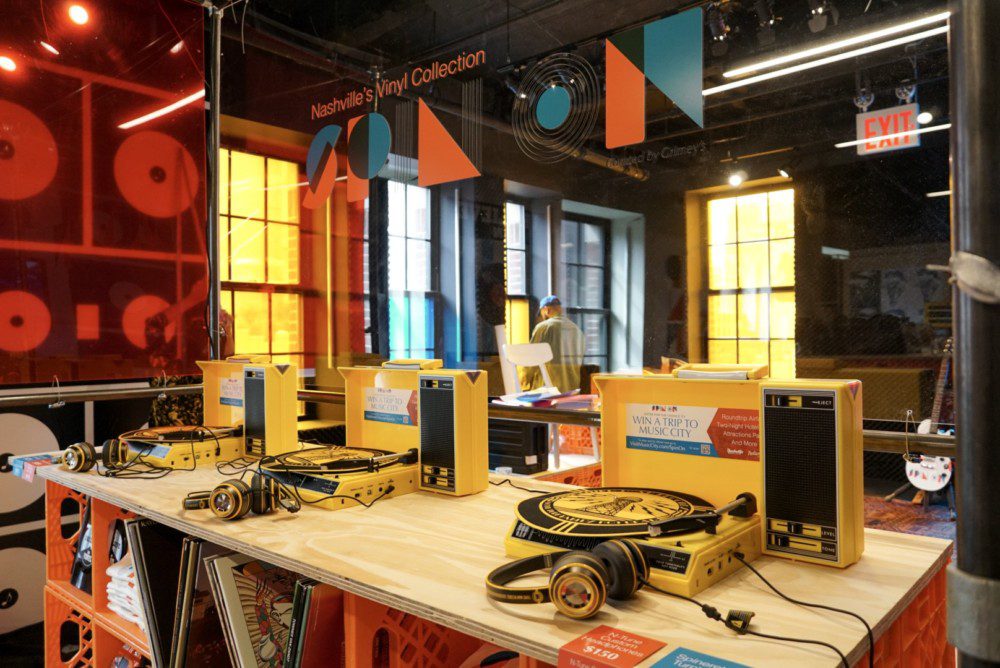
Nashville and New York City have established a deeper connection by honoring the history of vinyl with a new pop-up store, Spin On: Nashville’s Vinyl Collection.

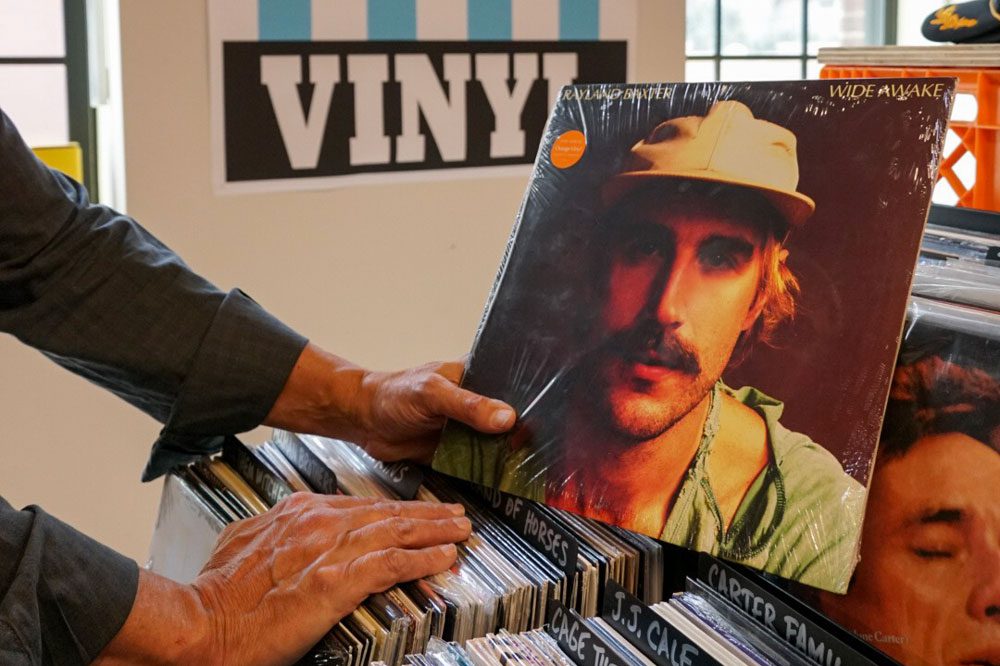
Spin On finds Nashville’s beloved independent record shop Grimey’s New and Preloved Music partnering with the Nashville Convention & Visitors Crop and Showfields to bring vinyl records made by artists who live in Nashville or were recorded in Music City to NYC. Grimey’s has been an important part of the fabric of Nashville’s music scene since opening its doors in 1999, offering an expansive archive of vinyl new and old, along with used books, magazines, cassettes, CDs, turntables and more. It also provides support for local talent, hosting performances and album release parties for the likes of Jason Isbell and The Black Keys. Metallica also recorded their 2008 live album, Live at Grimey’s, at The Basement, a popular nightclub housed below the shop’s previous location that’s run by Grimey’s co-owner Mike Grimes.

Meanwhile, Showfields is a modern, multi-purpose retail space that opened in Noho in December 2018. It’s easy to see why it’s branded as “the most interesting store in the world” with four innovative floors dedicated to multi-media products and a vast array of rotating clients ranging from holistic wellness company Almeda Labs to candy artist by robynblair and smart mattress manufacturer Eight Sleep, in addition to serving as a gallery and community space.

Spin On: Nashville’s Vinyl Collection is open at Showfields in New York through Jan. 15. Photo by Garrett Hargis

The idea for Spin On came after the Nashville Visitors Corp participated in a panel in Manhattan alongside a member of the Showfields team. Inspired by Showfields chic and slick business model that shines a spotlight on creativity and artistry, the Visitors Corp wanted to partner with the eclectic NYC store to create a retail shop that reflects a vital aspect of Nashville’s music culture – vinyl. “There’s something about vinyl that lends itself to a simpler, more authentic time. Couple that with the fact that the music sounds so much better on vinyl that it makes it important for cities that produce music to deliver the best possible product available,” Butch Spyridon, president and CEO of Nashville Convention & Visitors Corp, shares with Audiofemme.

More than 800 vinyl records have made the voyage from Nashville to New York for the collection curated by Grimey’s, featuring music icons like Jimi Hendrix and Elvis Presley to country legends Dolly Parton and Roy Orbison. Living alongside them are albums by Kings of Leon, The Milk Carton Kids and Jessy Wilson, the latter a Brooklyn native formerly of Nashville-based rock duo Muddy Magnolias who dropped her solo album Phase earlier this year.

The pop-up also features performances and signings by Nashville-based singer-songwriters Andrew Combs on November 5, Trent Dabbs of duo Sugar & The Hi Lows on November 10, The Cadillac Three on November 19 and Caitlyn Smith on December 4. Hootie & the Blowfish are scheduled to sign copies of their new album, Imperfect Circle, on November 1. Every Thursday, Spin On is serving up $2 beers from Tennessee Brew Works.

“Nashville’s music brand is as diverse as the day is long, but 90% of the time people want to gravitate to country only. This town is built on diverse music and it is well represented in the store. That’s the message we want to send through the pop up,” Spyridon says. “Nashville is a diverse, welcoming, creative community.”

Spin On: Nashville’s Vinyl Collection is open until January 15, 2020 at Showfields (11 Bond Street, NYC). Hours are Sunday and Monday from 11 a.m. – 7 p.m. and 8 a.m. – 11 p.m. Tuesday through Saturday.

REVIEW: Lizzo Speaks Her Truth at Final Stop of Cuz I Love You Too Tour

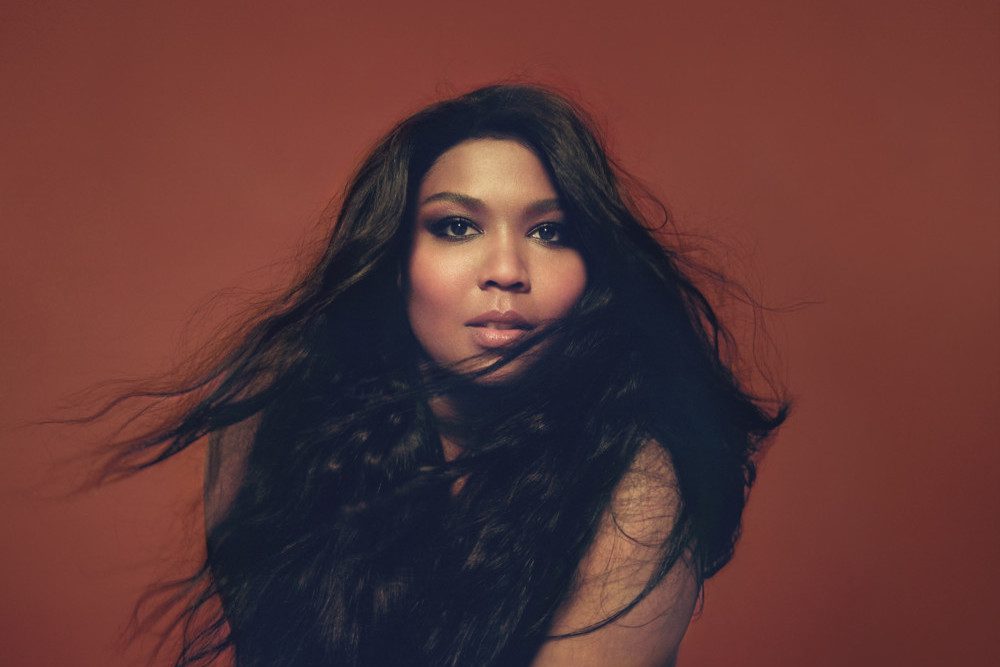
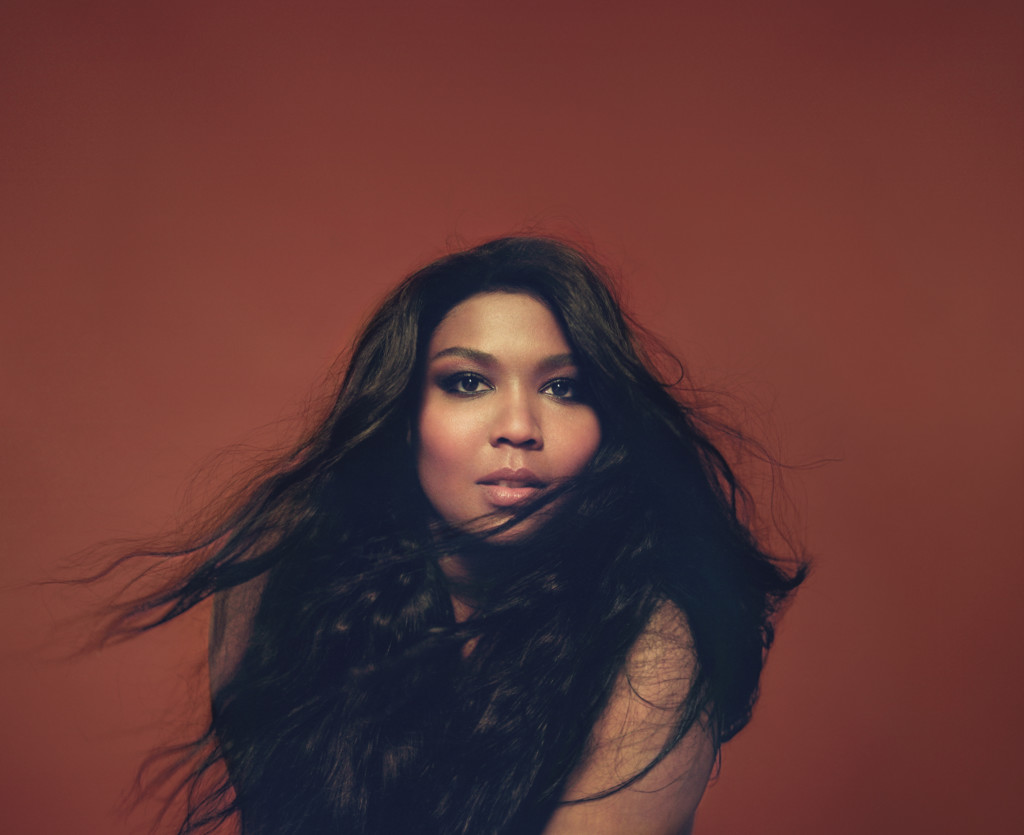
Lizzo press photo by Luke Gilford, courtesy of Atlantic Records.

Midway through the final show of the Cuz I Love You Too tour, Lizzo let the crowd know where she stands on the drama surrounding the iconic line on “Truth Hurts.” From her purple pulpit with golden robes a-flowing, our patron saint of self-love was not mincing words. “Recently I’ve been getting a lot of letters…from past fuckboys.” She then offered any future fools a warning: “Thou shalt not fuck with Lizzo because thou shalt come back two years later, bitch.”

“Truth Hurts” is a resounding hit and has been a huge part of the massive momentum behind Lizzo’s rising star – enough to sell out the first leg of the tour supporting her most recent LP, Cuz I Love You, and extend it two more months, wrapping up at the Bill Graham Civic Auditorium on Sunday. But with this success comes some dispute. Everyone wants their cut of “Truth Hurts,” whether they deserve it or not.

Like a game of telephone, the tale of the traveling lyrics – “I just did a DNA test / Turns out I’m 100% that bitch” – crosses international waters, through singers and producers, reminding us once again that women, especially black women, have to fight hardest for what is rightfully theirs. Lizzo recently gave a writing credit and rightful compensation to British songwriter Mina Lioness, who initially tweeted the line in 2017 (in response to an embarrassing tweet from Demi Lovato claiming her 1% African DNA) and Lioness says that she and Lizzo are on good terms.

Litigation continues between Lizzo and three white male producers – whose names I really don’t feel like giving any more attention to, but OF COURSE two of them are named Justin – and they are demanding 20% of the song’s profits. They claim that the demo Lizzo recorded in their studio, “Healthy” which includes the DNA line, is something they created together, and they deserve writing/producing credit. There’s no doubt that intellectual property and artists’ creative rights matter and are legally, rightfully protected. Today’s collabs though, continue to blur these boundaries. When sharing, sampling, curating is everywhere, where is the line? Well, the line here is money, and the Justins want some.

Lyrics are important and fundamental to the songs we love and remember. 100%. But you know what else is important? Delivery. Ask anyone who’s ever been to karaoke night or watched The Voice. The Justins of the world can keep trying to steal her shine, but right now on this planet, there is no human being delivering more starpower and talent than one Melissa Vivianne Jefferson. All 8,500 of us at the Bill Graham Civic Auditorium felt that love on the tour’s final stop. Even for San Francisco, the crowd was noticeably diverse. Humans of all kinds came to worship at the church of Lizzo and we were not disappointed.

Backed by DJ Sophia Eris and her dancers, the Big Grrls, the vibe was loose and playful. The last show of a long, blockbuster tour, their bodies gave us every bit of talent left in the tank. The bedazzled Patron bottle made an extended appearance as did, of course, the glorious diva Sasha Flute. Warming us up with “Heaven Help Me” and “Worship Me,” breaking our hearts with “Cuz I Love You,” and setting some hella clear boundaries with “Exactly How I Feel” and “Jerome,” Lizzo came prepared with her biggest hits. On “Like A Girl,” she added new lyrics, extending the self-acceptance even further: “If you feel like a girl then you real like a girl – if you feel like a boy then you real like a boy – if you feel like neither then, bitch, do you! Do you, period. PERIOD. Do your thing and run the whole damn world.”

She wrapped up the party with her record-breaking bangers “Truth Hurts,” “Good As Hell,” and “Juice,” coming down into the crowd to get closer to us. There were moments where she would pause and catch her breath, visibly soaking it all in, alone on stage in between songs, her brown eyes earnest and open, big smile beaming. It’s been one hell of a ride for this band geek and classically trained flautist from Minneapolis. Six years since self-releasing her first album, Lizzo has arrived and she is just getting started.

Between last-show hugs and tequila shots, she left us with clear goals for 2020: “You know what I realize, at the time when I was dealing with these people, with these fuckboys? I thought I was the problem, I thought it was me. But I’m here right now to let you know – I don’t know who needs to hear this message – it’s not you, bitch. It’s not you. It’s them. You are 100 PERCENT that bitch. We are no longer dealing with fuckboys in 2020, ok? No fuckboys, no fuckgirls, no fuckthems, no fucktheys. We are free from the fuckery, Amen?” To which all 8,500 of her new best friends agreed: AMEN.

PLAYING THE BAY: Nu Normol Embrace Lo-Fi Sass on no love songs EP

nu normal new ep

Listening to San Francisco band Nu Normol’s new EP, no love songs, is akin to having a cassette tape slipped through your mail slot. Peel away the Scotch tape and recycled wrapping paper and you’ll know: you’ve been visited by the spirit of DIY rock n’ roll, conveyed in a conveniently-sized rectangle complete with Wite-Out flowers and nail polish petals.

no love songs by NU NORMOL

Album opener “don’t cry to me” is the stubborn little sibling to the EP’s title, the “I’m serious this time!” foot-stomp after everyone else rolls their eyes. It was only after repeated listens that I realized what it reminded me of — the Donna’s self-titled debut from 1997, where chanting choruses, gleeful cursing, and crackly, distorted vocals were part of the record’s lo-fi charm. All of that gum-chewing, eye-rolling attitude is still there on no love songs, but with a welcome heap of poeticism and lyrical sophistication that comes from having narrowly escaped adolescence. There’s a price to pay/don’t forget, the band reminds the song’s self-indulgent subject, flicking their crocodile tears right back at them like little glittering beads with each chorus.

The EP vacillates interestingly between tones; “warrior for hire” sounds like a 70’s war protest song with its soldier’s march riff, while “manhole” is the sort of song you find yourself muttering as you do chores around the house. The band, which includes new drummer Shavi Blake (replacing EP drummer John Kolisnekow) and punk band veterans Lizzy P. and Alice Choe on lead guitar and bass, respectively — sings it with a hypnotic, detached quality, the almost sole lyric  not gonna give you my love anymore — repeating itself into oblivion, like when you say a word so many times it loses meaning.

“don’t wanna go home” is a standout, the bratty beginning jumping into a cover of The Beach Boy’s “Sloop John B,” thoroughly enjoyable in this new iteration of woman-fronted grungy rock. And in a surprising heel-turn to folk, “little black hole” closes the EP on a sweet note, albeit with some cutting lines (is my sensitivity threatening?). As the only song written by Alice Choe (all others were written by in collaboration with EP recorder and mixer Lizzy P.), it’s no surprise that it’s also the little black sheep, but Nu Normal’s willingness to jump from genre to genre shows a band looking to expand and experiment.

Follow Nu Normol on Facebook for ongoing updates.

PLAYING CINCY: Jay Hill, JayBee Lamahj & Ronin Halloway Collide on “Babs Forever”

Babs Forever

Ronin Halloway, JayBee Lamahj, and Patterns of Chaos alum Jay Hill teamed up on a high-energy single and video called “Babs Forever.” The three Cincinnati emcees spit bars at a fiery pace while maintaining their lyricism over the cascading SmokeFace-produced beat.

The video, directed by Bradley Thompson, matches the rappers’ energy with colorful lighting, quick cuts, and dizzying effects.

“Working with this lineup is definitely a dream-team scenario,” says Ronin. “Me and JayBee had been talking about getting a track with Jay Hill all the way since last year, so it’s super dope to have one with all of us out in the world.”

Babs Forever
“Babs Forever” cover art by Paul Kellam

“I think it’s a crazy song with three unique verses. Everybody snapped,” he continued. “I definitely hope to keep making songs with all three of us in the future. It’s an exciting moment – those guys inspire me a lot, and it’s crazy to think how much room we all have to grow from here.”

For Ronin, “Babs Forever” follows up his Smokeface-collaborated Pressure EP, which arrived earlier this year. The single comes in a series of musical output for JayBee, who previously released “Angels (Bron Bron),” featuring F.A.M.E. and Phonz, and appeared on Ronin’s The Icarus Trilogy. Jay Hill most recently hopped on Khari’s “Da Art Of Ignorance” remix and dropped his “40% Of Cops” freestyle. His group, Patterns of Chaos, released their debut EP, Freedom, last year.

“They’re two of the artists I admire most in the city and the collab itself was a long time coming,” Jay Hill says of the track, calling the collab “the first of many.”

“I love how none of us really discussed a topic for the song, yet all of us were able to tap into the same well of energy and deliver something this cathartic,” he said. “Shooting the video was a really fun time too, I couldn’t be happier about how it all went. We spent every moment between takes—sometimes during takes—joking around with each other and Bradley, and y’all see the result: three grown-ass kids making hard ass rap music.”

Check out Jay Hill, JayBee Lamahj, and Ronin Halloway’s new single and video, “Babs Forever,” below.

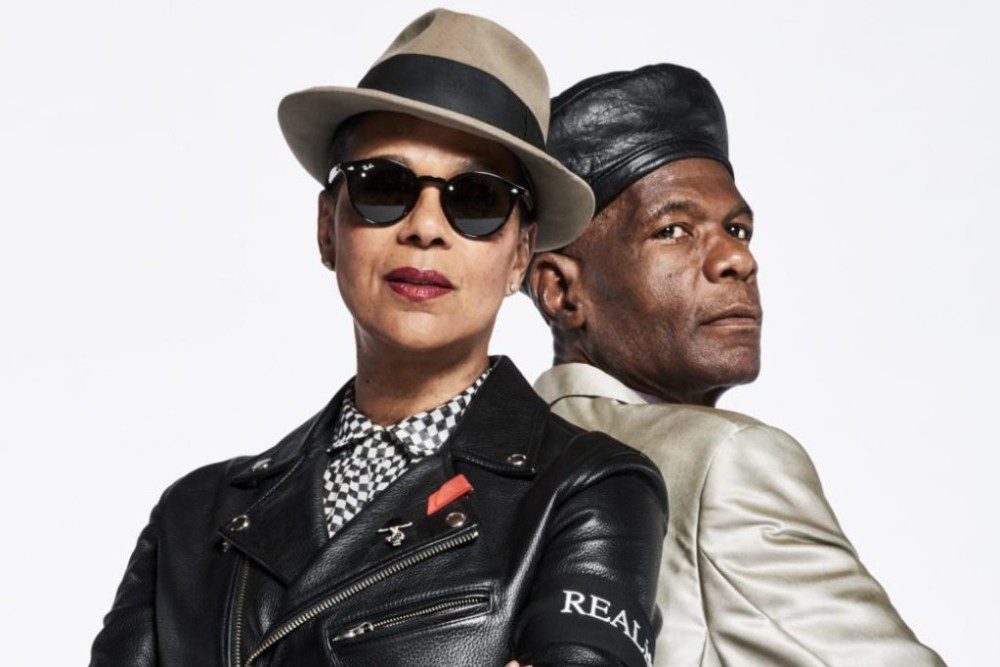
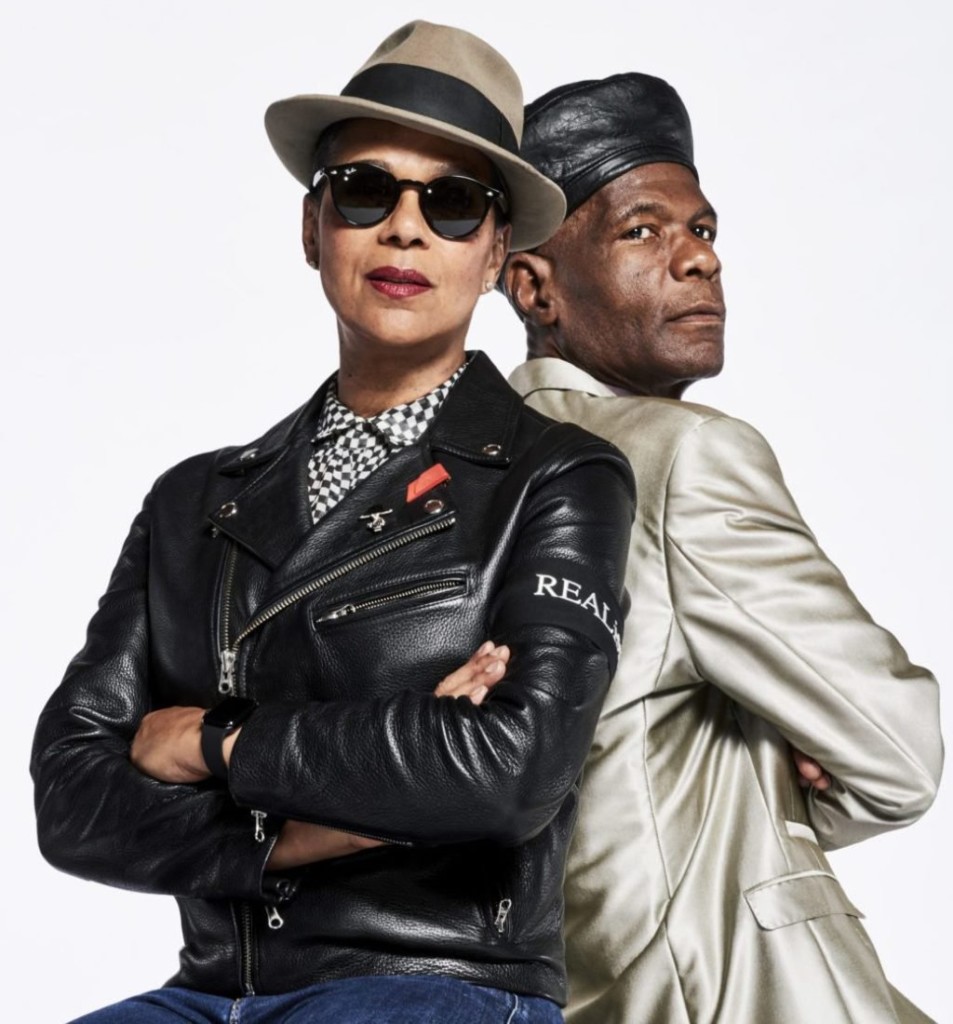
INTERVIEW: Pauline Black On Why The Selecter Is Still Relevant Today

“I don’t really think that history repeats itself perfectly,” says The Selecter front woman Pauline Black on a call from Monterrey, Mexico, where the band was on tour. Instead, she notes, “history rhymes,” adding, “I think that we’re definitely very much in a kind of rhyming situation right now.”

In May of 1979, the same month that Margaret Thatcher become Prime Minister of the United Kingdom, The Selecter first appeared with a self-titled track on a split 7″ with The Specials. This release marked the inception of what would become a pivotal part of a growing movement – 2 Tone Records, founded by Jerry Dammers of The Specials. A British take on Jamaican ska that derived its name from the label itself, two tone merged energetic, bouncy rhythms with lyrics that delved into the struggles of British, working class youth, and The Selecter was at the forefront of the scene as one of the genre’s most prominent acts. “Disaffected people are normally the ones who enjoy two-tone music,” says Black, “because it actually talks about them, their concerns and possibly what the future might be if the people that run things weren’t running them quite so badly.”

At the end of the ’70s and into the early 1980s, The Selecter were an antidote to the wave of conservatism that had spread throughout their home country. “The 2 Tone label came along at the right time, at the time when somebody like Margaret Thatcher had just come into power and was deciding to wage war on people who were working class, blue collar people, who worked for a living,” says Black. “She had absolutely no time for them and wasn’t in any mood to make things better for young people at that time. Those were the issues that we decided to sing about.”

It resonated. By October, The Selecter were on Top of the Pops performing second single “On My Radio.” You can hear the beginnings of frustration and dissent in the multiple meanings of its refrain: “It’s just the same old show, on my radio.” But The Selecter wasn’t the same old, same old. For one, Black notes, their original line-up featured seven members, six of whom were black. “That immediately made us very different from all of the other bands,” she says. Moreover, Black was a rare female voice within the two-tone scene.

She points to the cover art of their debut full-length, Too Much Pressure, released in early 1980, as an aesthetic reflection of what was, and remains, the band’s message. It’s designed in black-and-white, with a checkerboard print border. “Black people, white people, women, men – that’s embodied, I feel, in that kind of iconography, using that black and white checker,” says Black. She points to the man on the cover of the album, leaning against the checkered border as if it’s a wall, his hat lying on the ground. “He’s really at rock bottom,” she says, “he’s almost in this prison of the black and white check that bounds the actual square of the record, if you’re looking at the vinyl.”

“I thought that was very emblematic of the time,” Black continues. She points out too that the checkered pattern was also used by police in the U.K., adding another layer of meaning. “You’re imprisoned in this shell of authority and those extremes, I suppose, that held you in in society,” she explains.

Their songs – like “Three Minute Hero,” “Time Hard” and “Danger” – reflected struggle, but Black notes that there are threads of hope in their work too. “There is a way forward,” she says. “But, the main thing about the way forward is actually unity and not letting all those outside forces who like to keep us in the status quo, as it were, using things like racism or sexism for their own ends to divide.” She adds, “I think all the 2 Tone bands were very much of that kind of ilk.”

Following the release of their stellar sophomore album, Celebrate the Bullet, The Selecter split. After regrouping in the 1990s, the band continued to delve into socio-political issues in albums like Cruel Britannia (1998), its title a play on the catchphrase “Cool Britannia,” and their 2017 release, Daylight.

Forty years later, and in the midst of another conservative political movement, both in the U.K. and the U.S., The Selecter, led by Black and fellow founding member Arthur “Gaps” Hendrickson, are back on the road to celebrate their anniversary. The night before our interview, the band played Mexico City, their first non-festival gig in the city. Fans brought vintage pressings of The Selecter’s releases and copies of Black’s memoir, Black by Design, with them. “It was just wonderful,” she says. On September 11, they began a jaunt through the U.S., with gigs in Europe and the U.K. continuing through fall.

The Selecter has remained active in recent years and had been touring as co-headliners with fellow two-tone outfit The Beat (known as The English Beat in the U.S.). The Beat frontman Ranking Roger fell ill and, ultimately, died in March of this year. The loss of their tour mate made this anniversary trek all the more imperative. “We just felt that we really had to celebrate this milestone, if not for us than for the memory of Roger,” says Black.

With the anniversary gigs, Black says, the goal is to take listeners through the band’s history, showing them the “narrative line” in The Selecter’s view of the world. She says, “What we were talking about then is very similar to what we’re talking about now.”

Catch The Selecter live and follow the band on Facebook for ongoing updates.

INTERVIEW: WEKS Navigates Adulthood on 20 Something EP

Twenty-Something
Twenty-Something
Courtesy of Woke Media


Queens-bred singer-songwriter Alex Weksler knows a thing or two about the constant process of evolution that occurs as a person goes through their twenties. Though her folksy 2017 EP Air was released under her full name, her latest EP, 20 Something, introduces her pop-oriented persona WEKS to the world. Out last week, these six tracks thoughtfully reflect on Weksler’s professional and personal growth – dating, going out, navigating identity, and feeling that crushing weight of responsibility during what’s been portrayed as the freest period of your life. Her down-to-earth lyrical style (and its laid back pop packaging) encourages a relatable discussion of what being in your twenties really means.

We chatted with Weksler about the inspiration behind the EP, the evolution of her sound, and what’s in store for WEKS next – stream 20 Something and check out her interview below.

AF: “Two Faced” is definitely a standout track – can you tell me in your own words what the song is about?

AW: For me, “Two Faced” is really literal. It’s about a real-life situation that I went through. I was casually dating two people at once and I feel like, for me, it’s really odd to have that type of feeling—or the same feeling—toward two different people. So, it was really just me navigating that and trying to do the right thing and try not to hurt anyone’s feelings, but also try to listen to how I was feeling. Of course, it ended up being a mess [laughs] but it was sort of me sorting out all those emotions.

AF: And the title track, “Twenty-Something,” can you tell me a little bit about that one?

AW: Yeah, it was basically sort of this polarizing expectation of what your twenties should be like. You have like these amazing highs—you’re young, you’re going out. It’s like you feel all the responsibility and no responsibility all at once. You kind of crash down from the highs after a while, so for me it was the contrast of emotions of feeling super stressed out and also feeling really free. That’s kind of what inspired the whole EP, but definitely that song in particular.

AF: What are some other themes we can find in the EP?

AW: I think a big issue that I never really sang about is the aspect that mental health plays in our lives, especially in your twenties. We’re faced with a lot of impossible-to-overcome circumstances… I feel like everyone was kind of giving me unsolicited advice on how to face those emotions, but sometimes it’s okay to just be sad. So mental health definitely plays a role [on the EP], especially in that song.

AF: And this is your sophomore project – what was different for you in the writing and recording process on this one and what can we hear that’s different from your debut project?

AW: I feel like it’s different in every sense of the word. So, stylistically, I wrote these songs as they were being recorded, whereas the last concept I kind of had five songs set aside and was like, okay, this is gonna be an EP. I felt like this was more of a natural process of developing the songs. They were all also very much influenced by a change in musical style, because [Air] was definitely a lot more folk-rooted and a lot less pop-rooted, but I feel like that also attributed to the change of scenery. Because the last one was about a breakup and this one’s more about navigating life in a different way, so I felt that the musical style, like getting more production, befitted the newer style.

AF: Do you see yourself continuing with the pop style or going back to more a more folky sound?

AW: I don’t know. I think it kind of depends on the things that have happened to me this year. The songs I’ve been writing lately have been in a similar style, so I see myself kind of staying on the pop route. Another reason for that is I feel like I’ve just been so inspired by so many pop artists lately and pop music is such a broad genre. There are so many areas I really want to explore, so I feel like if I keep writing in that ballpark, I’ll be able to explore a little bit more.

AF: Who are some of your favorite pop artists right now?

AW: First and foremost, The 1975. I just love them. I’m also really into Lorde, especially the Melodrama album – that had such an impact on me as a songwriter.

AF: Are you thinking of doing any visuals for the project?

AW: Yeah, definitely. We discussed videos for a couple of the songs. I have some concepts in mind that I would love to see us do, but we’re still trying to figure out which songs we want to do that with. I think, right now, the ones that are sticking out in my mind the most are “Bayside” and “Twenty-Something.” I can imagine a lot of really cool video concepts for those.

AF: And “Bayside” is about your hometown of Queens, right?

AW: Yeah, Bayside is the neighborhood I grew up in. It’s a really weird feeling to live as an adult in the community you grew up with, just how your view has kind of changed.

AF: What other ways has Queens influenced your music?

AW: There are so many amazing artists in Queens. There’s so many small venues, and especially for acoustic-rooted artists, there’s lots of spots you can go. You’re obviously influenced by the environment—it’s very diverse, there a lot of different people. Queens definitely plays a big role in—not just my accent—but the way I write my songs!

AF: Anything else to add?

AW: I’m also in the works to plan some shows, so stay tuned for that!

Follow WEKS on Facebook for ongoing updates.

PLAYING SEATTLE: Katie Kuffel Premieres Video for Recovery Anthem “Jelly Donut”

In 2013, Seattle musician Katie Kuffel broke out as a fierce-yet-tender songwriter, with artful piano skills and a husky, blues-imbued voice. She’s also made a name for herself as a community builder, organizing the Fremont Abbey Sessions in 2016—a community-driven music and video project—and striving to collaborate with and raise up local talent.

Kuffel is also a survivor. When the singer-songwriter was freshman in college, she was brutally raped and almost lost her life. With this new song and video, “Jelly Donut,” premiered with Audiofemme, Kuffel takes the time to look at her recovery in the big picture.

On “Jelly Donut,” Kuffel’s piano line repeats like the chime of a rusty church bell, and the lyrics “I don’t think about you,” also come up several times. This captures the “two steps forward, one step back” nature of her recovery, as she puts it, and the determination necessary for so many assault survivors to keep going. The video adds to this tone—a crew of roller derby skaters, the Tilted Thunder Rail Birds, glide around a dimly lit track. There are collisions and straightaways, smiles and grimaces. It’s an artful metaphor.

“I’ve been back to square one many times. That doesn’t mean I’ve failed. It means it’s a battle I’ve won before, and can win again,” she said.

Along with premiering this video, Audiofemme talked with the singer-songwriter about her recovery, why she cares about community, and how she sees Seattle’s musicians being sorely overlooked.

AF: Tell me a bit about your upbringing in Seattle — and what got you into Seattle music? Did you go see shows? How were you involved at a young age? Who/what did you listen to most in your early years?

KK: I had a pretty wonderful time growing up in the PNW. I was actually born and raised just outside of Seattle on Bainbridge Island. Small town vibe, very musically supportive family, and in a lot of ways fortunate in that I was encouraged to pursue music from an early age. I started cello when I was 8, played marimbas through middle school and high school, and also learned piano in that time as well. Music was a much needed sanctuary for me during my teen years, as it is for many.

I would often go to Seattle to see big shows at The Paramount (I recall seeing Regina Spektor, Sufjan Stevens, and Vienna Teng being among my favorites), or travel to eastern Washington to see musicians and attend festivals at The Gorge.

AF: You say it yourself—your music is a combo of a lot of different genres, and unlike anything most of us have heard before. Do you work to achieve this sound, or is it your natural output?

KK: It’d be much simpler for me I think, if I came at songwriting with any real goal in mind. I write what feels right for me, and try to be as genuine as I can. Music is my chance to be transparent, so it’s definitely something that just naturally flows from me, and because I embrace my oddity and I love change, that’s directly reflected in my output.

I have a pretty broad range of tastes as far as what I consume goes, and I love playing with others. I’ll often bring the bones of a song to my band, like lyrics and structure, then we workshop it together until it feels good to play. We all have different backgrounds, tastes, and I think it gets all mixed together to make something that I never could have arrived to on my own. We finalize songs by just performing them a ton. So in a way, our audiences also have a part to play in how it sounds in the end.

AF: Is music your full-time gig?

KK: I’m firmly in this weird, self-employed, gig economy that many twenty-somethings find themselves in. Music makes up the biggest part of my income, but I also do design work, I paint murals, illustrate, and will take random jobs as they come. Before this I was working an 8 to 5 office job for over a year, and I think it was the final push I needed to attempt being fully self-employed. I wasn’t fulfilled, I had no energy, I was running on fumes and feeling like I had no room to create. Happy to say it’s been over a year since then and I still have a roof over my head.

AF: What’s your songwriting process like? What sort of mantras do you have to help keep yourself on track creatively?

KK: It totally depends on the song. I’m definitely a lyrics-focused artist, so words are usually what I’m basing my music around. I’ve also started trying to write songs quickly, as a kind of exercise. Like… a few hours before a show quickly. It makes me less afraid of experimenting, and I think allows me to share a genuinely unique moment with my audience. I really don’t have a concrete process, but I do have some principals I like to create by.
Not everything is going to be good. But sometimes you have to unclog the drain to get started on the next thing.
No one else can create what you create. That’s both humbling and powerful. Own it.
Get out of your own way. And by this I mean, don’t put limits on the kind of songs you think you should write. In the creative arena you are all-powerful.
Not every song is meant to be shared. That’s okay.

AF: You are a very community-focused artist. Why is community important to you, and in particular, what are your goals for Seattle’s music community?

KK: I’m very thankful to the people in my life who support me, and I think I’m lucky to have landed in such a welcoming music community. Seattle’s scene is special, I believe, and people look after each other here. I think it doesn’t make sense to be competitive in music. I want to see others be successful, I want to play with people, I want to lift others up where I can, because it’s one of the few ways I know to help make the world a little more palatable. I believe music is a conduit for sharing our experiences, sharing space, and understanding that we are not alone.

AF: Many Seattle musicians are leaving the area because of cost of living and other struggles amidst the tech boom. What are your views on that? Why/how do you remain here?

KK: Seattle is choking out its creative community. It’s true, a lot of us are moving outwards, to Tacoma, or Olympia, or to new states all together. If housing costs aren’t addressed soon, if the continued indifference for protecting diverse communities isn’t addressed and the fight against Seattle’s extreme gentrification isn’t won, Seattle will lose all of its soul. I really believe this. It shouldn’t be our job to explain to a city why we matter. Why art matters. Why it is not just for your passive consumption, but a part of our collective cultural identity. Seattle used to be a city proud of its rich history in jazz and grunge, and now it feels like a lot of the tech community likes the idea of living in a “cool” city, but doesn’t want to put their money where their mouth is by going to local shows, supporting art programs, and rethinking Seattle’s archaic tax structures to serve the larger populace.

I stay because for now I can afford to. For now there are enough genuinely supportive folks and musicians here to let me forget about the overarching problems Seattle’s growth is causing. I also recognize as a white, cis woman, a lot of these issues won’t effect me as drastically as it does other minorities. This problem doesn’t just effect musicians. It effects families, it effects small business, it effects Seattle’s future. I wish I had an answer.

AF: Tell me about this new song, “Jelly Donut.” It is about recovering from sexual trauma. Will you share a bit about that context? Why did you decide to share your story?

KK: I think sharing my story played a large part in my recovery. When I was a freshman in college (before I eventually dropped out due to PTSD-related issues) I was violently raped, and nearly lost my life. Once from the incident, and once from being suicidal. It’s not something you get over, but it is something you learn to live with. Each story of rape, or recovery from sexual trauma, or abuse, is different. So know anything I say is based entirely on my own experiences, and shouldn’t be taken as a blanket statement for every survivor.

“Jelly Donut” was a song I wrote after I was able to have relationships again, after I’d gone to therapy for years, after I’d taken anti depressants, and had a toolbox of healthy coping mechanisms at my disposal. I wanted to highlight, yes that I’m alive and I’ve made it, but also memorialize in a way all of the downswings inherent in recovery. Flashbacks are common and unpredictable. Manic episodes don’t wait for a convenient time. Your brain is scarred, and sometimes those scars will flare up. In recovery I’ve lost my footing so many times, but I find my strength in knowing that those times will pass, that I have and I will be able to live to see another day, and find happiness and worth, and love. I will probably continue to stumble for the rest of my life. Maybe in moments few and far between, but that’s okay.

AF: You talk about the “cyclical nature” of recovery. What does that mean to you? How did you represent that musically on “Jelly Donut”?

KK: Recovery for many things is a two steps forward, one step back kind of deal. Or sometimes you have to start all over again. There’s a common misconception that recovery is a straight line, a linear process where the survivors gets further and further away from the incident, so they must be getting better and better in equal measure. This is false and dangerous thinking, and by refusing to acknowledge that healing is repeating the same behaviors, and understanding how your brain works, and failing then finding new ways to continue on with your life, we run the risk of punishing ourselves for an incident that was outside of our control. I’ve been back to square one many times. That doesn’t mean I’ve failed. It means it’s a battle I’ve won before, and can win again.

Musically, I love the repetition of the piano lick. It reminds me of when a record is scratched, and repeats the same line again and again. The beginning and ending also feature the same bell sound. I wanted the music to begin and end at the same place. I also repeat a lot of words over and over again in this song. Phrases like “I don’t think about you” or “I can say a lot of pretty words” and “Do you even know my name” also have that same scratched record quality. I wanted it to feel like I was struggling to even move on in the song.

AF: Tell me about the personnel on the track— where’s it recorded and who’s playing on it?

KK: So I recorded this with Johnny Bregar over at Brickyard Studios in my hometown of Bainbridge Island one sunny afternoon. It was then mixed and mastered by my two close friends Cody Kilpatrick and Hunter Rath. These three people are some of the most genuine, sensitive souls I’ve met and have had the pleasure to work with. I felt I could trust them all with a song that’s this personal.

I sang and played keys. But Jon Robinson plays bass on this track, and Jordan Wiegert plays drums. They’re part of my trio and we’ve played together for over two years. I wanted to record this song with familiar folks, friends, and peers. It was a cathartic process for me, and their support was important for the success of the track.

Kuffel and her bandmates.

AF: Will “Jelly Donut” be part of a forthcoming album? If so, can we expect that to drop shortly?

KK: “Jelly Donut” is actually a one-off. It’s a song I needed to get out into the world. It felt strong enough to stand on it’s own, so no, there will be no new CD featuring this track. That does not mean there won’t be a new CD come 2020 however.

AF: What’s the future look like for Katie Kuffel? What are some goals you have for your music career?

KK: Music has always taken me to places I never expected to be. My goals are kind of loose. I don’t really want to be a famous person. I know I would make music even if no one would hear it. As long as I’m allowed to keep growing, as long as my music feels true and genuine to who I am, then I will be proud of it. Then I will trust that it will reach the people who need to hear it. Monetarily, I really just want my music to be able to support itself. To allow me to afford to keep making it. To allow me to bring it to people around the world.

Follow Katie Kuffel on Facebook for ongoing updates.

BOOK REVIEW: Liz Phair Lights Up the Dark Side in Horror Stories Memoir


Liz Phair photo credit: Elizabeth Weinberg

Liz Phair is a badass and always will be. Time has not dulled this truth teller. Her vulnerability is a weapon – honed and aware – and the world is better for it.

Earlier this month, she released her first book, Horror Stories, a raw, unexpected collection of 17 personal essays. This isn’t the drug-fueled, name-dropping adventures you’d expect from a rockstar memoir. It’s something different; quieter, more intimate. These are stories of love and loss that have shaped Phair’s life – those seemingly small, often painful moments that stick with you forever.

Phair first kicked us in the guts with Exile in Guyville in 1993, cutting through the alt-rock-bro scene with a self-assurance and sexuality not expected of women (on “Flower” Phair sweetly rounds “Every time I see your face I get all wet between my legs” with “I want to fuck you like a dog”). A visual artist at Oberlin, she started making the Girly-Sound tapes in Chicago, soon catching the attention of Matador Records with her lo-fi authenticity. Whip-Smart (1994) soon followed, solidifying her feminist icon status and earning two Grammy nominations.

I was 14 when I first heard Guyville. It was 1995, the internet was a newborn babe and I was stuck on an island 2,000 miles away from anything cool. But after a business trip to New York City, my dad came home with three albums that changed everything: Guyville, The Breeders’ Last Splash, and Alanis Morissette’s Jagged Little Pill (shout out to the angel with a nose piercing who pointed my old man in the right direction). That music was everything – girls with guitars speaking their truths, not worrying about looking or sounding perfect. Loud, angry and brutally honest, I was hooked and still am.

As the nineties closed and pop music dominated, Phair moved to Capitol records, releasing the more mainstream whitechocolatespaceegg (1998), Liz Phair (2003), and Somebody’s Miracle (2005) to brutal criticism as she gained public popularity. But by 2018, Phair began to experience something of a renaissance – reuniting with Matador to reissue Girly-Sound To Guyville: The 25th Anniversary Box Set, showcasing the original tracks with new unreleased songs. It was this project, along with the U.S. political fiasco and loss of iconic musicians in 2016, that inspired her to look closer at her own history. The confessional Horror Stories is part one, with part two, Fairy Tales (release date TBD), digging into more of the music.

Phair writes like she sings – confident, intimate, human. Exploring prose in a way that feels instinctual and original, and yet so classically her. “What I can’t articulate is the way my soul resides in my pussy; in my clitoris, to be exact. It’s not just biological tissue to me. It’s a whole different way of knowing.” Amen, sister.

Between tales of surviving the NYC blizzard and blackout are unguarded reflections on faith, monogamy, and motherhood. Each chapter a non-linear exposure of childhood embarrassment, teenage shame, and grownup regrets. Lines feel like song lyrics; her words giving shape to the sins we share. Regrets are punctuated with sharp bits of hilarity and pride.

From ignoring a drunk, passed-out freshman in the ladies room to breaking men’s hearts, Horror Stories exposes Phair’s behavior so that we can feel better about our own. She wants us to know that to be human is to be imperfect. And that’s beautiful. “We spend so much time hiding what we’re ashamed of, denying what we’re wounded by, and portraying ourselves as competent, successful individuals that we don’t always realize where and when we’ve gone missing. Our flaws and our failures make us relatable, not unlovable.”

And flaws she exposes, often unintentionally. The whiffs of white, affluent, attractive privilege are hard to ignore. She stumbles when faced with #MeToo. The chapter titled Hashtag gives light to her own painful and numerous sexual assaults, painting a stark picture of what it means to be a female trailblazer in a man’s world. But the message falls short when Phair is caught up in Ryan Adams’ NYTimes reckoning. “We are trapped in a culture of silence,” she writes, acknowledging her own denial being driven by ingrained coping mechanisms. Adams may be “hardly the worst monster” Phair has encountered, but her silence is disappointing and she knows it.

This week, Phair was in San Francisco for her book tour, joined on stage by MTV News alum Tabitha Soren. Presented by Noise Pop and City Arts & Lectures, they discussed the memoir and songs behind the stories. Today’s Phair is frank but polite, asking the audience if it’s okay to curse before gifting us this nugget: “When I made Guyville, I was sick of boyfriends and guys telling me what music was good. I think I just needed to say to them that it’s not that fucking hard.”

For over 25 years, Liz Phair has done the heavy lifting. She has put herself out there, writing songs that have been loved and eviscerated. The highs and lows, she says, have all been part of the plan. When Soren asks what drives her to create such intimate work, she responds, “I personally never feel stronger, never feel more powerful and more grounded to who I really am than when I have no armor on and I’m basically naked. Examining the weakest moments of our lives makes us stronger.”

The new music slated for early 2020 promises a return to her roots, reuniting with producer Brad Wood and engineer/guitarist Casey Rice, who both worked on the first three albums. “Good Side” is the first single, an easy palate cleanser, meant to balance out the darkness of the book.

Part of the magic of Phair’s music is in the space she leaves within it. Slowing down the tempo,  drawing out chords to leave the lyrics bare. She closes the conversation in SF with her last confession: “[With this book] I wanted to slow down time, of the myriad things that happen to you that aren’t great enough to tell your friends or that you don’t want to tell anyone about. Things that have shaped you and driven you throughout your life. I just… I don’t want to fucking hide anymore.”

ONLY NOISE: I Can’t Remember All the Shows I’ve Seen. Does It Matter?

A collection of ticket stubs are often more reliable than memories. Photo courtesty of Liz Ohanesian.

ONLY NOISE explores music fandom with poignant personal essays that examine the ways we’re shaped by our chosen soundtrack. This week, Liz Ohanesian wonders what it means when her musical memories start to blur together.

My first concert was Morrissey in 1991, a week or so before I finished eighth grade, at an amphitheater in a Southern California suburb at least an hour away from the one where I grew up. I went with my mom, aunt and sister. Getting there was an ordeal that began the moment tickets went on sale – and managed to sell out in minutes – but we made it. The venue seemed enormous and it was packed with kids dressed in black, carrying lunch boxes covered with band stickers and wearing Doc Martens over their striped tights. I screamed during the whole show; maybe everyone did. When we got home, I taped up the ticket stub in my bedroom. I still have a t-shirt bought that night. A sticker I picked up from the local, alternative radio station at the concert is still fixed to my dresser.

The most recent show I saw was the night before I finished writing this essay. I went with my husband to an art space across the street from a strip club in a part of downtown L.A. that gentrification has yet to meet. It was a night of underground electronic music and video installations and we went mostly to support the another local DJ’s new band. I bought the tickets – two QR codes that popped up via text message – online earlier that day. The closest thing we had to a hassle was finding a parking spot, but even that was a breeze by L.A. standards. The venue was tiny and crowded with kids dressed in black. I danced a little, as best as I could in a tight crowd. My mementos are video clips and pics, some shared later on Instagram.

In the 20-whatever years between those two events, I’ve seen hundreds of shows. That’s not an exaggeration. There were the hot ticket events, where we would line-up outside malls and record stores at horribly early Saturday morning hours, and free, local band nights. There were shows in beautiful outdoor venues with picnic areas and grimy downtown warehouses. There were the ones my friends played and the ones where I was the DJ. I’ve taken road trips across Southern California and flown out of state to see certain bands. And then there are the festivals, the house shows and everything in between. At this point, I can’t remember every show I’ve attended, let alone every band I’ve seen live, and I’m not sure that it matters.

I know I’m not alone living in this haze of music and memory. My husband and I have talked about it often enough. We met at college in the late ’90s and have been to countless shows together. Neither one of us remembers what was the first one we saw as a date. It’s come up in conversations with friends. Did we see this band together? How about that one? Was that the same show or two separate ones? On Facebook, I recently asked friends how well they remember the shows they’ve seen. Some say they have a pretty good recollection. Others are a lot like me.

There are pieces of a paper trail packed deep in boxes, the few ticket stubs I saved, some photos snapped on a disposable camera, sporadic diary entries and some articles I wrote that never made it on to the web. I haven’t attempted to organize them into a proper archive. Just thinking about that is exhausting. At least for now, those pieces of personal history, much like my brain, will remain a cluttered mess.

I’ve tried to make myself remember. While writing this essay, I began jotting down bands I’ve seen more than once, but grew frustrated quickly. In a way, I feel guilty, as if I’ve taken music for granted. Should I be able to recall set lists from a decade ago or what someone was wearing on stage last month? If I can’t, does it mean that I don’t appreciate the work enough? I think the answer to both questions is no.

By the time I hit college, music was my life. I got involved with the college radio station pretty quickly, which led to DJing at clubs and both of those gigs led to writing for zines. And then I just kept following the beat to wherever it took me. On some level, shows have been a part of my work for a very long time, but they’re also how I choose to spend my free time. Music, to me, is like food. I crave its nourishment. And I can’t remember every meal I’ve eaten either.

For some people, music is a non-essential. Maybe they’re fine with whatever song is playing in the background. Maybe they have distinctive taste, but consider concerts a splurge reserved for when superstars play stadiums or when festivals give them an excuse to travel. I prefer the smaller shows, the ones where tickets are $20 or less and much of the crowd doesn’t arrive until right before the headliner hits the stage. I also like getting there on the early side, having the chance to check out the bands I haven’t heard before. All that adds up to a lot of music.

There will be times when those memories come back. I’ll stand in a venue I know all too well and flash back to a scene on stage that happened years earlier. I’ll hear a song in passing and remember what it sounded like live. Even if I can’t give you a detailed recount of what happened that night, I can remember the sensations. I might remember the bass rumbling down my spine, the smell of lingering sweat and spilled cocktails or the voice of the person who sang every lyric of every song from the crowd that night. Maybe that’s more important than remembering all the details.

PLAYING PHILLY: Frances Quinlan of Hop Along Releases First Solo Single

Frances Quinlan press photo by Julia Khorosilov.

Don’t get me wrong: Hop Along is one of the best bands in the business. But what would Hop Along be without Frances Quinlan’s distinctly shrill vocals and unparalleled, witty songwriting? On Tuesday, Frances Quinlan announced her first solo record, Likewise, out January 31 on Saddle Creek, and shared its first single, “Rare Thing.” The track feels fantastical because it was inspired by a dream, and though it is, admittedly, about Quinlan’s relationship with her baby niece, there’s a universality to her declarations of selfless love. It’s a typical Quinlan move – to lull us into a sense of comfort as her vocals lilt around the melodic plucking of a harp, only to drop a truth bomb on us when we least expect it: “There is love that doesn’t have to do with/taking something from somebody.”

Quinlan’s solo work isn’t unfamiliar compared to Hop Along, which makes sense, since bandmate Joe Reinhart engineered the record at Philadelphia’s Headroom Records. But there’s a certain sense of creative freedom and urgency on “Rare Thing.” Her solo project gives her room to veer away from the structure of a rock band – the baggage of its guitars and drums – and experiment with something more stripped down. It’s not unlike her live performance of Hop Along’s “Happy to See Me,” off of the band’s 2015 record Painted Shut (usually, Quinlan’s three bandmates will leave the stage for her to perform with just her guitar). Only this time, rather than just performing acoustically, she’s able to explore other instrumentation, incorporating synths, harps, and what sounds like a drum machine.

This isn’t the first time Quinlan has worked without a full band. After her first year at the Maryland Institute College of Art (MICA), she wrote and recorded Freshman Year (2005) as Hop Along, Queen Ansleis. Though she was just a teenager when she released her first freak folk album, the low-budget project took on a digital life of its own, amassing such a cult fan base that Saddle Creek put out a vinyl reissue of the LP in 2015, its tenth anniversary. Waxahatchee’s Katie Crutchfield even has a tattoo on her arm of the Freshman Year album artwork: a surreal and somewhat indiscernable doodle, which looks like a goose wearing an oversized chef’s hat and apron.

Given her schooling at MICA, it’s not surprising that Quinlan makes all of Hop Along’s album art. When I wrote about her artwork for She Shreds in 2015, Quinlan said, “There’s going to be a point when my voice goes, and I’m not going to be able to tour anymore, but I think I’m going to have painting in my life forever.” So it’s exciting to see her painterly touch on the promotional materials for Likewise – Quinlan’s press photo looks like it’s taken in an art studio, and the album’s cover is almost undoubtedly of her own making. The limited edition pre-order of Likewise – which sold out within hours – even includes two signed screen prints.

Like her music, Quinlan’s artwork is beautifully incoherent. Something feels off-kilter, though her work – visual and aural – creates a sense of ease. The intimacy and overflowing wordiness of her songwriting feel like a friend who’s so eager to tell you a story that she has to stop to catch her breath; likewise, the paintings and screen prints that crop up on Quinlan’s Instagram are as soothing as they are frenetic: in the image below, the earthy landforms seem to morph into animals the longer you look, like an optical illusion.

Like her paintings, “Rare Thing” gains more depth the longer you listen – what at first sounds like it could be a Postal Service song ends up evolving into something more artful, with bassy riffs and melodic strings dancing through the song. Frances Quinlan’s music – whether solo or with Hop Along – demands close attention, and it’s a joy to sink deeper into her fantastical, cluttered world.

PLAYING NASHVILLE: Sinclair Premieres “Drop Dead Knockout” Video

Sinclair reaches through the screen with confidence and positive energy in the music video for her song, “Drop Dead Knockout,” premiering exclusively with Audiofemme.

Co-written by Sinclair, Nikolai Potthoff and Julia Hugel in 2018 in Berlin, Germany, the unapologetic bop embraces themes of individuality and self-acceptance. The free-spirited video features LA-based choreographer and actress Courtni Poe dancing her way through the streets of Berlin, past graffiti and into the subway station, with her effervescent moves, bright energy and spirit reflecting the song’s nature. Sinclair and her wife Natalie Rose spent a couple of months living in Berlin and wanted the playful video to capture its unique, eclectic vibe. “The thing that I’ve connected to is that there is this overall sense of self-expression and individuality. There is a sense of crazy freedom,” she says of the city. “I feel so at home there.”


Sonically, the track intertwines Sinclair’s vast-ranging influences, from the bold hip-hop of Timbaland to Sade’s blend of pop, jazz and soul, while the singer herself plays that infectious guitar loop. Filled with attitude, the track finds Sinclair stepping into a place of self-confidence, singing lines like “all the girls/try for me/ I’m as good as they want me to be” with casual bravado.

“We’re allowed to say that; we’re allowed to have that confidence,” she says. “‘Drop Dead Knockout’ is really about me coming to this place in my individuality and being able to wear what I want to wear and self-express the way that I want to. I think knockout, it’s that power, it’s like that guttural confidence. It’s feeling in your gut you can do anything and take on any shit you got going on in your life and dreaming big.”

Though the video solidifies her singular vision, the singer admits that seeking individuality has been a lifelong quest. Raised in upstate New York in the small town of Madrid, Sinclair is sixth in a line of nine siblings, her father an Evangelical pastor and mother a teacher who homeschooled all nine children. A Beatles fan at the age of four and learning to play piano a year later, Sinclair discovered her musical passion at age 12 when her father began teaching her how to play classical guitar, quickly becoming “obsessed” with the instrument.

It was during this time that she began writing songs and accepting her sexuality, knowing her whole life that she was attracted to women. But growing up in a religious household where the family’s belief system was tied to the church stifled her ability to share her feelings with those closest to her. “It was really hard for me in that period to write honest songs. I was writing in code,” she heartily laughs. “I was trying to write songs that sometimes were reflecting that, but if I wrote those songs, they had to be enough in code that nobody would ask questions that would get to the bottom line.”

All Photos by Tobias Ortmann

Sinclair came out to her family when she was 20, the news creating friction between them, as they wouldn’t accept her. “When I came out, it was really hard because I felt really betrayed in the sense that they projected on to my character new things,” she reflects. “I think what was heartbreaking was that there was a sense that I was a totally different person in my character overall. Even though the truth was there now, there was still this overarching sense of loneliness, because nobody was really trusting me and knowing my character at that point.”

She left home for Nashville in 2011, where she met and fell in love with Natalie. The couple wed at an all-boys school in Nashville in 2014. Rather than viewing the lack of acceptance from her family through the eyes of bitterness, the singer says it’s part of the journey to finding pure happiness and peace, knowing she found the person who brings meaning to her life. “I have this sense of excitement over the freedom that I get to experience now every day and it’s never lost on me,” she observes, adding that she has recently reconnected with her family. “I understand more than a lot of people how simple life is and I’m lucky, and it’s really because of all that shit. It’s a blessing and a curse.”

With a sound that blends hip-hop and flamenco music, along with her colorful style that’s splashed across her Instagram, she seems to embody individuality; each element is a piece of the journey to Sinclair’s discovery of her creative identity. But she admits that pressure to conform to music industry standards has made it difficult over the years to find artistic independence – she notes that she didn’t start dressing the way she wanted to until two years into her relationship with Natalie. She says her “awakening confidence” allowed more of her true self to click into place. “I just wish for everybody that wherever they’re at now, they’re able to find happiness and confidence in their own skin,” she says.

She pinpoints one relatively recent epiphany: a visit she and Natalie took to the Picasso Museum in Barcelona, Spain in 2018. While analyzing his work, she saw a progression in which he began his career following his contemporaries, to eventually abandoning classic technique and creating his revolutionary style. As she continues down her own distinct path, Sinclair may find herself voyaging through an artistic evolution of equal lengths. “He was good until his 40s, and then he was good and different, and then he was a noteworthy artist. And I just was like ‘that’s what being an artist is about,’” she proclaims. “I think that I’ll always be learning that.”

“Drop Dead Knockout” is available now. Sinclair is currently on tour with Kevin Griffin of Better Than Ezra through Nov. 20.

PREMIERE: The Brilliance “Facebook”

Something’s brewing in the water over in Marshfield, Wisconsin. It’s the home town of David Gungor and John Arndt, aka The Brilliance, a liturgical (read: Christian) band who has taken a turn for the secular, with political anthems that explore the human condition. The band’s latest single “Facebook” explores our culture of celebrity and hero worship. It begs the questions: Should we keep waiting for someone to save us or should we save ourselves?

“The man assumes that what he’s got / that what he’s got / is called the truth,” the lyrics call out to the listener, planting seeds of doubt, asking them to question their reality. In the era of fake news, you could call it a jingle. While the music in context clearly utilizes Contemporary Christian music tropes, it is the message itself – a message of  doubt – that allows The Brilliance to push itself into a new stratosphere of genre-bending. It’s a song that could easily be played to the acid trip crowds at Bonnaroo, yet it contains the vastness, the grandeur of musicians who have played under stained glass, to audiences whose hands yearn to raise. The ability to conjure up a steady foot tap while also asking people to tear down their preconceived notions of right and wrong? This is the brilliance that is The Brilliance.

Listen to AudioFemme’s exclusive stream of “Facebook” and read our interview with David Gungor of  The Brilliance below:

AF: Your sophomore album is titled Suite No. 2: World Keeps Spinning: An Antidote to Modern Anxiety. As someone who was raised as a Born-Again Christian I relate on a daily basis to the anxiety of this age. What about modern life did you want to address on this record? What speed bumps or eyesores were the most glaring in your minds?

DG: We explore themes of existentialism, truth, and doubt on this album. John and I have both dealt with anxiety and depression. For the first time in my own life, I needed to reach out for help. The record eventually lands in a place of the need for other people in the midst of anxiety.

AF: In 2017, you played a show together in Chicago, during which you said you were “a little too brutally honest to the crowd,” saying “Sometimes we play these shows and we’re like ‘What are we doing with our lives?’” Do you still feel this way? Or have these more recent projects refocused that sense of malaise?

DG: I think that show was a turning point for our music. We had a great conversation with our dear friend after the show who asked some wonderful tough questions about the music we wanted to make. From that night, we commissioned ourselves to write a series of suites with bigger ideas around them. The first suite is inspired by DACA Dreamers around the theme of the American Dream. And the newest suite is based around the idea of modern anxiety. Do I still feel this way? Yes. But the question doesn’t scare us as much.

AF: You’ve both said you’re interested in opening up your music to move beyond the worship genre. Why is that distinction important to you both?

DG: The music has evolved. It grew out of a friendship where I was a pastor and John an atheist. But we were best friends. We love making music that brings people together. That helps build bridges relationally. The music has evolved from music created for Liturgical art, to spiritual protest music, to finally music that inspires empathy. We don’t want it to be boxed into a certain musical genre that we don’t resonate with. And we also wanna make music that’s not just for Christians.

AF: You’ve known each other your whole lives – your dads were in wedding bands together. Your self-titled debut album came out in 2010. How has your relationship to each other changed over time?

DG: We are like a family. We are still close friends and it hasn’t really changed other than times we hurt each other or are punks to one another. But we love one another and are dear lifelong friends.

AF: In terms of the writing process, how do you normally operate? Does a song start with an image, a string of words, or a tune?

DG: I think we both write usually from melody ideas or big-picture theme ideas. We love commissioning ourselves to write around themes. We write individually and usually show each other songs we are working on through little demos. Or when working on a project in a studio will write and collaborate often.

AF: Tell us about “Facebook.” What was the genesis of this song?

DG: We wrote this song while staying at a farm. It was totally disconnected from so much of the busyness of where we live (NYC). Facebook goes into themes of needing and wanting a celebrity and hero culture and the quest for who is right and who is wrong. It’s a place we go to be connected but usually ends up a mirage for human connection.

AF: The question we’re all wondering: Do you believe this is the end of the world?

DG: Many people before us have asked that question, and we believe many people after us will keep asking.

AF: There is a beautiful bigness to your music, often playing with call and response, as well as the wall of sound technique. What artists are currently inspiring you?

DG: Thank you! Been listening to a lot of Vampire Weekend, Paul Simon, Chris Thile, Radiohead, Joao Gilberto, and The Beatles as of late.

AF: If you could pick two music acts to go on tour with, who would you pick?

DG: Chris Thile, and Sufjan Stevens.

AF: What would you say to someone who has no “faith” who wanders into your show? What would you want them to take away from your performance?

DG: Welcome. Come as you are. Our ethos is to give me doubt. Without a doubt you can’t have faith. Certainty is the antithesis of faith. So we hope they learn to doubt and question with an open mind any world view. Our ethos is based around the idea there is no idea above critique and no person below dignity.

Preorder The Brilliance’s new single “Facebook” HERE

TOUR DATES
12/12 – Seattle, WA @ Chop Suey
12/13 – Tacoma, WA @ Alma Mater
1/09 – New York, NY @ Rockwood Music Hall Stage 2
1/10 – New York, NY @ Rockwood Music Hall Stage 2
1/24 – Grove City, PA @ Guthrie Theatre
1/30 – Los Angeles, CA @ The Hotel Cafe
1/31 – Los Angeles, CA @ The Hotel Cafe

PLAYING THE BAY: Boy Scouts Artfully Embraces Resignation on New LP Free Company

Taylor Vick of Boy Scouts. Photo Credit: Ulysses Ortega

It’s hard not to heavily associate new music with the time of year that you first heard it, where a few notes or a chorus can propel you back in time to months before, your eyes and ears filling with the sounds of springtime or the scrubbed-clean scent of winter.

Free Company, the new LP from Oakland band Boy Scouts, feels engineered for that strange time between summer and winter that some may refer to as “fall.” But here in the Bay Area, August through Halloween is a unpredictable haze, a season of busts and starts and long, lazy shadows, where everyone acts just a little bit strange, not sure what to expect from each other or themselves. It’s a far cry from the postcard fall aesthetic of cowl-necked sweaters and acres of fiery treetops, but carries its own magic just the same.

Free Company steps into this annual wind-down with brittle confidence, its strongest songs by far the ones that embrace resignation with a firm hand, leaning into the inevitable end of a relationship with exhausted eyes but determined words. Album standout “All Right” contradicts its title with a wink and nod as Boy Scouts vocalist, lyricist, and main instrumentalist Taylor Vick moons I’m all right, I swear/I’m all right/how dare you. Coming right on the heels of that is “Throw Away Love,” a great lyrical showing with an episodic feeling, like Boy Scouts is looking to expand the canon of their personal storytelling in micro: your friends I thought they were mine too/turned out they left along with you/now I’m a living example of/throw away love. Limiting the song title to one verse was a smart idea on Boy Scout’s part, as it would have been easy to turn those last few lines into a repeated chorus, but by making us wait for the payoff, the line — and the song itself — gains emotional weight and resonance.

Vick’s voice is quite distinct, floating somewhere in the realm between adolescence and adulthood. This isn’t to say that she sounds childlike or immature, but moreso that her voice can inspire a sense of nostalgia, especially on “In Ya Too,” where her easy delivery is doubled up during the chorus, making me feel like my eerie twin camp counselors pulled out a guitar during the s’mores roast.

The album overall is even-keeled despite the emotional weight; shower-sobbing breakup playlist music this is not, but post-breakup playlist music — when you have begrudgingly tried to “learn from the experience” and found the lessons wanting — it certainly is.

Album closer “You Were Once” works as a great wrap up of the album’s themes; guarded nostalgia, impermanence, the fallibility of friends and lovers. It was the year that I lost my friend/I knew I’d never be the same again, Vick sings, some of that even keel crumbling into the ocean at the last possible second, not unlike the best of us when we try to pretend we are more fine than we truly are.

Seven Songs Celebrating the Female Orgasm

Female sexual pleasure doesn’t get the attention it deserves, in the bedroom or in music. It’s traditionally been more common for male artists to sing about what turns them on, but that’s changing. With more and more female artists unabashedly singing about sex — and more male artists unashamed to admit they love pleasing women — women’s orgasms have come into the spotlight (no pun intended). Here are some songs celebrating female orgasms, from the subtle to the very explicit.

“Butterfly” by Crazy Town

Given that Crazy Town sings “I’ll make your legs shake,” I’m guessing they don’t just mean “come here” with the chorus “come, come my lady.” The lyrics read like an ode to a woman who is truly the narrator’s princess, paying homage to her “sex appeal” as well as the way she’s “always there to lift me up.” It’s nice to see women getting the respect (and orgasms) they deserve.


“Laid” by James

This song is fantastic in multiple ways, describing a woman who “only comes when she’s on top,” leading the neighbors to “complain about the noises above.” It also touches on gender-bending themes (“Dressed me up in women’s clothes / Messed around with gender roles”) that are accentuated by Tim Booth’s falsetto voice. The woman in the song is depicted as destructive, but they’re clearly both enjoying their “passionate love.”


“My Neck, My Back” by Khia

In this ode to cunnilingus, Khia is not afraid to ask for exactly what she wants: “Then ya suck it all ’til I shake and cum nigga / Make sure I keep bustin’ nuts nigga / All over yo’ face and stuff.” She concluded about the song’s popularity: “I guess the world is just nasty and freaky like that.”

“Get Sleazy” by Kesha

“Rat-tat-tat-tat on your dum-dum-drum / The beat so phat, gonna make me come, um, um, um, um, over to your place” might seem to just be expressing Kesha’s desire to visit a crush… if she didn’t then sing, “you really think you’re gonna get my rocks off.” I’d really love to hear whatever beat is having such a profound effect on Kesha.


“Get Low” by Liam Payne and Zedd

Don’t be fooled by Liam Payne’s innocent past as a One Direction member; this song is dirty as hell: “I’m right here, you know, when your waves explode… I like the way you touch yourself / Don’t hold back, I want that / When the water come down, I’mma get in that.” It sure sounds like he’s talking about squirting (not the same thing as orgasm, but certainly an adjacent topic).

“Sweetener” by Ariana Grande

As usual, Ariana’s being more sexual than the casual listener might expect here. Throughout the song, baking becomes a metaphor for oral sex, with lyrics like “Twist it, twist it, twist it, twist it / Mix it and mix it and mix it and mix it / Kiss it, kiss it, kiss it / You make me say oh, oh.” But the real kicker is when she sings, “I like the way you lick the bowl / Somehow your method touches my soul.” In case you were wondering, “licking the bowl” is slang for “licking cum from a girl’s pussy after she has had an orgasm,” according to the Urban Dictionary. Apparently, it’s the way to at least one woman’s soul.

“Or Nah” by Ty Dolla $ign Feat. The Weeknd, Wiz Khalifa, and DJ Mustard

Ty Dolla $ign leaves to mystery as to what he’s after, asking the object of his affections (if you could even use that word), “Do you like the way I flick my tongue or nah? / You can ride my face until you’re drippin’ cum.” You have to respect the way he asks for clear verbal consent. Still, I don’t recommend using these lyrics as pickup lines.


REVIEW: Sleater-Kinney Isn’t Dead

Carrie Brownstein and Corin Tucker carry on as Sleater-Kinney despite drummer Janet Weiss’s departure. Press photo by Nikko Lamere.

Sleater-Kinney is dead. Long-live Sleater-Kinney.

I kept thinking these words as two-thirds of my favorite band played Milwaukee’s Pabst Theatre last Wednesday. Sprung from the riot grrrl movement, powerhouse trio Carrie Brownstein, Corin Tucker, and Janet Weiss had become known as one of the best rock bands on the planet, until Weiss abruptly left the band after recording their latest album, The Center Won’t Hold. They’d just begun promoting it, a tour loomed… and then there were two.

I first encountered Sleater-Kinney in 2002. I was a sophomore polisci major in a boring, rural Midwestern city, listening to the university radio station while working in the dingiest gas station imaginable, when I heard “Sympathy,” from their most recent record at the time, One Beat. The post-911 album paired impassioned, unapologetically shrill and howling vocals with precise, catchy guitar riffs and cleverly written songs on topics like wars for oil, thriving through discrimination and patriotic dissent.

Sleater-Kinney sounded how I felt in a way I’d never heard women emote. I was in love. After a few years of fangirling – and realizing I wasn’t skilled or dedicated enough to play most of their songs on guitar – I saw Sleater-Kinney in a bar following the release of 2005’s The Woods. After a nine-year hiatus that ended in 2015, I saw them again at a much larger concert hall in Milwaukee (with Lizzo opening) on the No Cities to Love tour. Each performance was mesmerizing and impassioned. This was my band.

When news broke in January that Sleater-Kinney’s ninth record would be produced by musical genius Annie Clark, a.k.a. St. Vincent, I – and everyone else – rejoiced. Cue choirs of angels. This album, I posited, would make everything in the post-Trump era more bearable. The influence of of Clark’s arty, edgy, experimental rock on Sleater-Kinney’s indefatigable brand of smart poppy punk… What could go wrong? Well… fuck.

In mid-June, the band played its first single, “Hurry on Home,” on Jimmy Fallon. The performance had a dark vibe with costumes, makeup and stage design more reminiscent of St. Vincent’s self-titled record tour than Sleater-Kinney. (Suspiciously, the video of the performance is no longer available.) On July 1, six weeks ahead of the record’s release date, drummer Janet Weiss announced she was leaving the band. The sisterhood-vibey video for “Get Up” flashed in my mind and I cried in disbelief. I had already bought tickets to see them in Milwaukee. I didn’t listen to the new record for fear of being let down.

And then I heard it live last week. Initially, the palpable disconnect between the remainder of the original band and the audience created an air of uncertainty. Touring musicians outnumbered founders on the stage: drummer Angie Boylan of Aye Nako; No Cities touring guitarist Katie Harkin; Toko Yasuda, St. Vincent touring musician and member of defunct electro-indie rockers Enon, on keyboards and percussion. Despite a strong, strobe-light heavy opening with “The Center Won’t Hold,” the audience didn’t recognize or wasn’t excited enough to cheer as new songs began. But intros to tracks from other records were met with applause and dancing. Early in the show, Brownstein noted with a smile, “We know you’re going to dance to songs from [1997 record] Dig Me Out,” before cautioning people in the steep balcony to shimmy with care. I teared up a little when my concert buddy ran out for a drink. Not until about 10 songs in, when they played “Ironclad” from 2000’s All Hands on the Bad One followed by Dig Me Out track “One More Hour” did my inner turmoil relent as I began to feel more at home.

The crowd eventually warmed up too, as more “oldies” were played along with some of the more rockin’ tracks from Center, like “Bad Dance” and “RUINS.” The set and two encores were inarguably dynamic. Yet they passed over three early records worth of material: The Hot Rock, Call the Doctor and 1995’s self-titled LP. Nevertheless, the band and the audience warmed up to each other for an overall excellent event on a tour that was undoubtedly difficult minus a founding member. I left the show feeling partial catharsis. I’d danced and sang along to some of my favorite songs and simultaneously processed some emotions (probably not all Sleater-Kinney related).

A few days later, I found myself singing tracks from the new record, like the semi-boppy “Can I Go On” and the title track. True to the riot grrrl ethos, Sleater-Kinney remains a political band – “Broken” is a reaction to Dr. Christine Blasey-Ford’s testimony a year ago. “The Future is Here” is about life in the digital age. We’re living in an unprecedentedly bleak time and tone of Center reflects that.

It’s undeniable that Clark’s signature style is all over The Center Won’t Hold, and though it still sounds like a Sleater-Kinney record, it probably was not the funnest record to drum on, particularly for someone of Janet’s caliber. The band I knew and loved has changed. And I still love them – but less in that impassioned, idealistic college manner and in a wiser, more experienced, mid-30s kind of way.

Sleater-Kinney (obviously) is a band that’s personal for me. Bands can feel like family and friends – especially when their music comes to you at times when you don’t feel connected to or even have close loved ones. Musicians’ arty renderings of their energy and emotions can help you sort through and understand your own, helping you connect to yourself in the process. And bands, just like people, are allowed to change, even if it’s uncomfortable for their loved ones.

When Janet left Sleater-Kinney, it felt like my aunties were in a fight. These women were and are role models for me, particularly since I was actively discouraged by lame guys from making music as a teenager because of my gender. Initially, I felt like St. Vincent broke Sleater-Kinney. But actually, she challenged them and their fans to try something new. We grow through how we handle change and challenges. Now more than ever, I respect Carrie, Corin and Janet for doing what they do – or deciding not to do it – unapologetically and with heart.

Sleater-Kinney continues their tour through October and November; check their website for dates and locations.