ONLY NOISE: Creatures of Discomfort

A few nights ago at a bar, someone asked me a reasonable but difficult question: what do I want to experience when listening to music? What do I look for in a band? I floundered briefly, rattling off some vague declaration about placing a “good song” above any technical music ability.

“What do you mean, a ‘good’ song?” my interviewer prodded (this person is a reporter by day). “You can’t just say, ‘good’ song; obviously you prefer a ‘good’ song – but what makes a good song to you?”

Touché. I stewed over the question momentarily, thinking of other forms of art I’m drawn to; imagining the display of fleshy imagery covering the wall above my home desk – a collection many houseguests find revolting. Boobs, hairless cats, cadaverous feet, Hans Bellmer’s doll. Nondescript, pink perversions.

I thought about my lifelong gravitation towards objects and subjects of disgust; the numerous occasions my parents would come home from work asking what I was watching.

Confessions of a Serial Killer: Jeffrey Dahmer,” I would reply, munching a Cheeto. My dad still recommends movies to me by saying, “We just watched this really depressing, fucked up film – you’d love it!” without an ounce of sarcasm. We also have a game in which we text each other when famous people die. First to text wins.

I considered my fondness for bitter, astringent, and blazing flavors; my love of rare and raw meat; my affinity for unsettling (but funny!) books.

Looking back at my inquirer, I delivered the most succinct reply I could muster:

“I just want to be assaulted,” I said.

Sonically assaulted, of course…but what does that mean?

Last year, while still working as a panty designer for a big company called, let’s say, Veronica’s Privacy, I found myself in need of a date night…with me. I scrolled through concert listings in search of something unexpected. If there was one thing I was not in the mood for that evening, it was “good old fashioned rock n’ roll.” I did not want dream pop, nor chill wave, nor beach wave, nor dream wave. I craved something dour and unpleasant, like ya do.

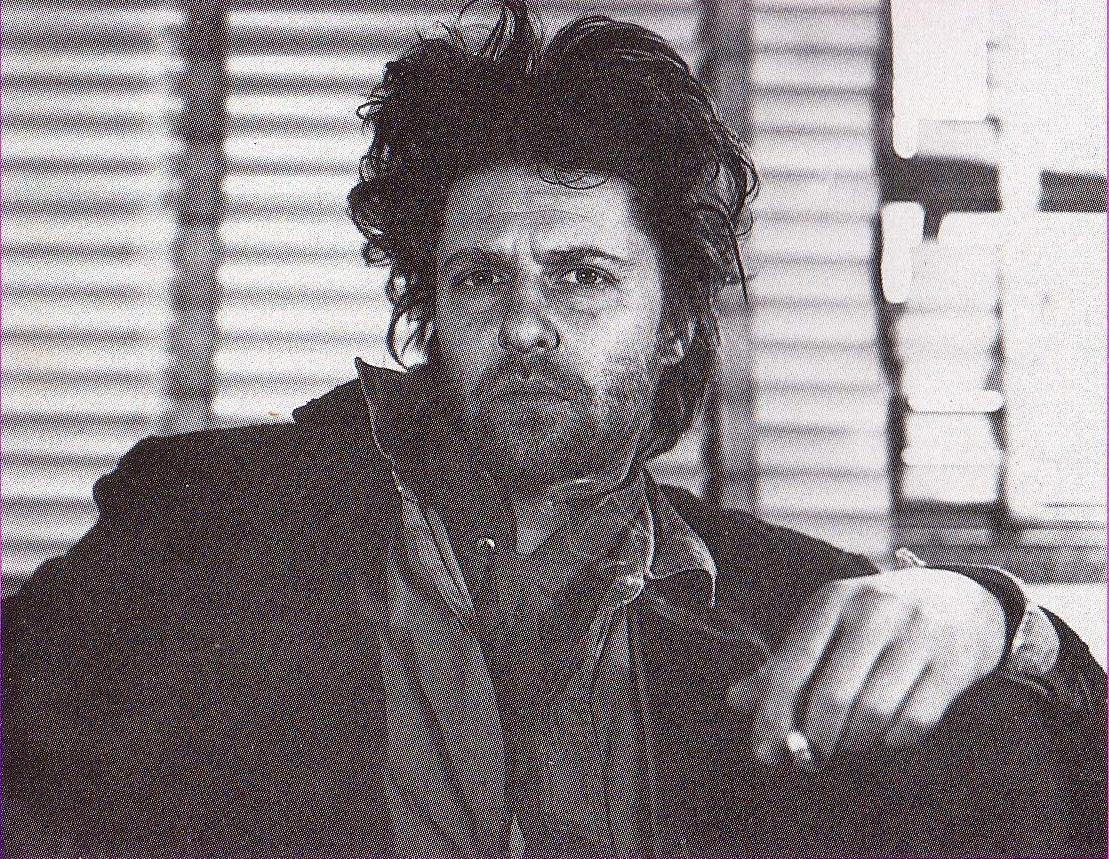
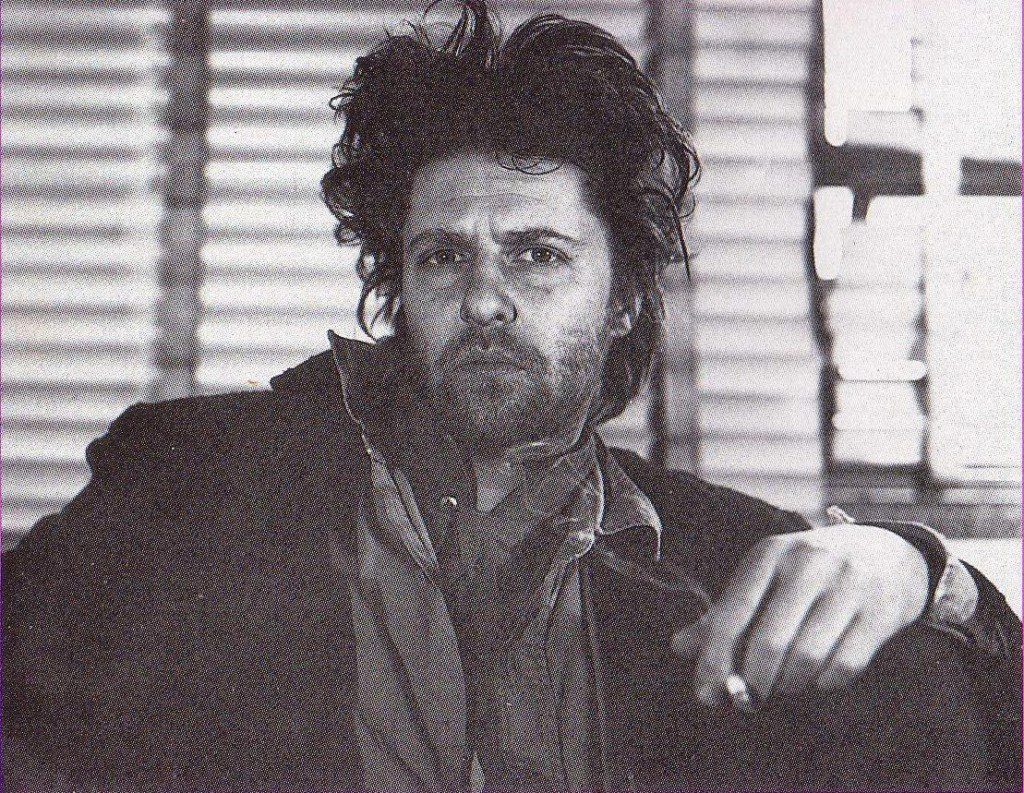
Sifting through gigs by Sunflower Bean and Shark Muffin, I paused on a vaguely familiar name: Glenn Branca. Where had I heard it? Something about the name commanded respect. Though I was mystified as to why, an air of provocation and intrigue hung around those two words. I bought a ticket immediately.

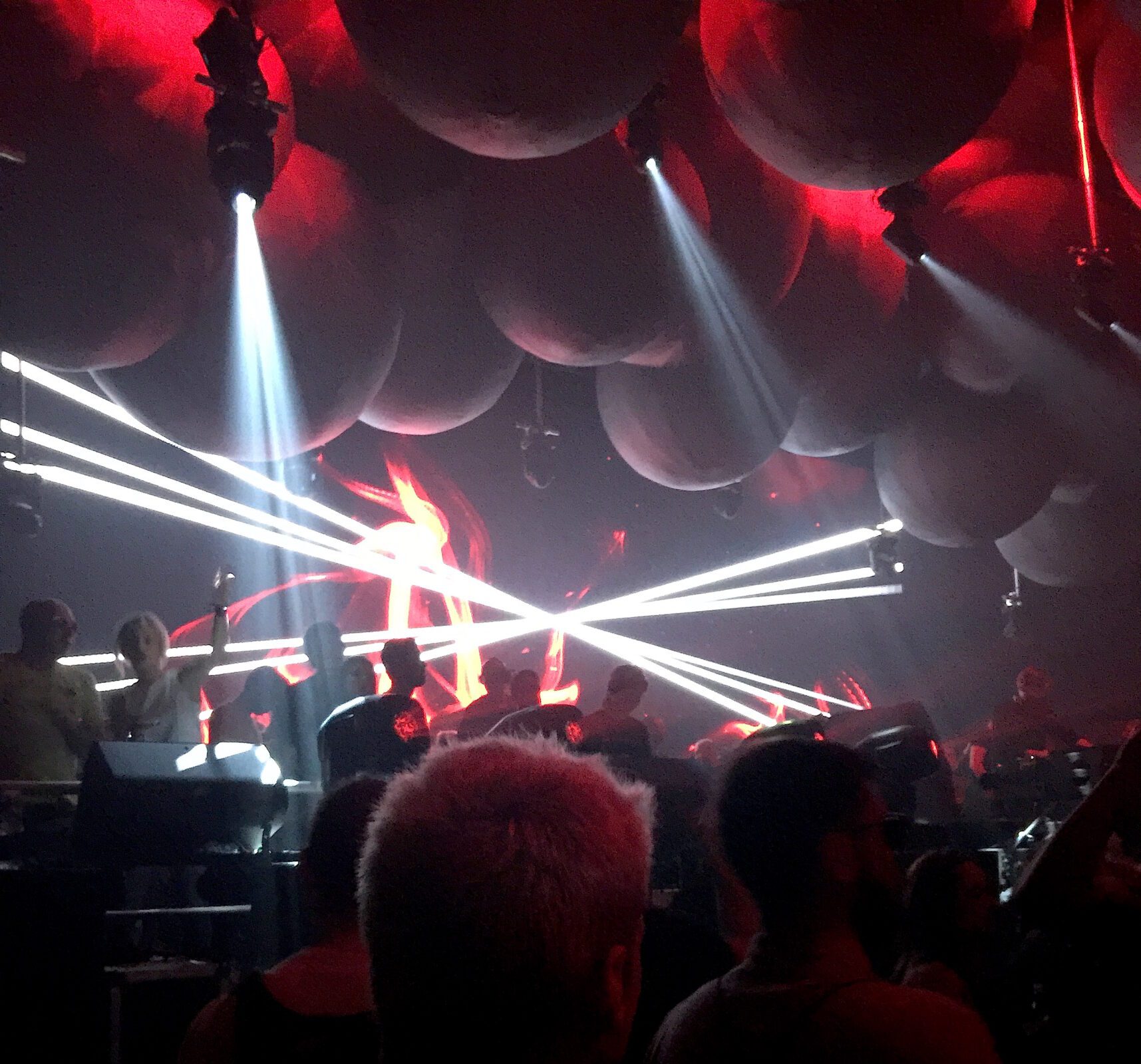
Taking a seat at The Kitchen in Chelsea, I glanced around. The only other solo-goers were middle-aged men who looked like they used to be in bands. Silver hair. Black Sonic Youth t-shirts. Sensible, manly shoes. Leather belts. The low stage was set with a drum kit, a bass, and three guitars. When Branca and Co. sauntered onstage not a word was spoken before they crashed into a belligerent wall of sound. Fumbling for my complimentary earplugs (courtesy of the venue), I felt bathed in distortion – baptized in cacophony. Discomfort. A hail of splinters. Railroad ties and metal siding. It was all being hurled at us – and we loved it. Were my concert mates likeminded gluttons for punishment? Did they too adore unlistenable, violent music at all hours, even in the wee, small, pre-coffee hours? I left The Kitchen feeling like I’d been in a boxing match – no – like I’d gotten the shit beaten out of me by a biker. Boxing is too clean and dignified a sport for how I felt. And yet there was another sensation spread all over me like cream cheese on a bagel: elation. For lack of a less annoying word: transcendence.

There are entire message boards full of people who want to be tied up for fun. Fetishists get shoved into bags, closets, vacuum-sealed plastic. For many, there is pleasure in physical discomfort. Factions of the sex accouterment trade cater to such needs. So what about auditory discomfort? Where be the cottage industry for audio-de-philers? (see what I did there?) Where is the safe space if you’re looking to be cleansed by rage and mayhem and high decibel levels?

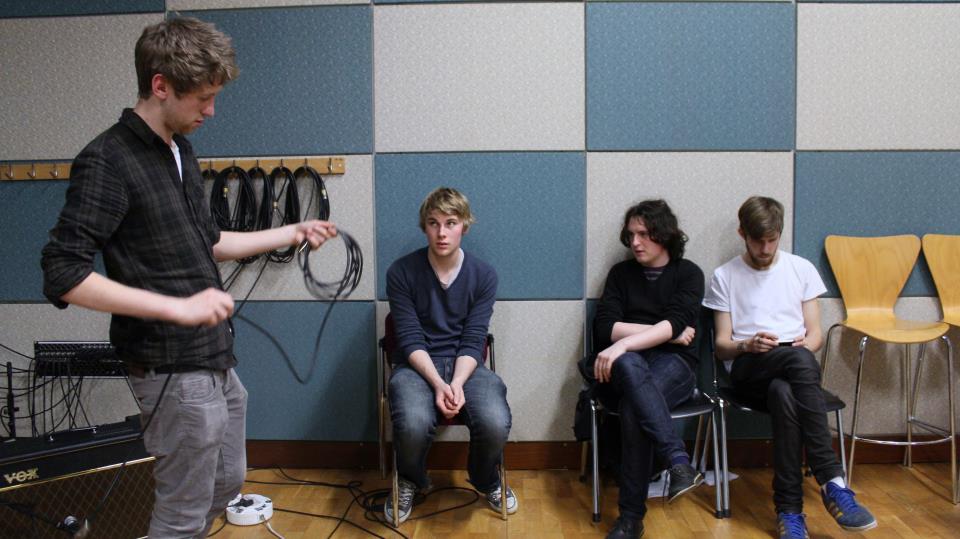
I’ve certainly found my fix in Branca and his No Wave ilk – John Zorn, Steve Reich, and John Cage, to name a few. Then there is Girl Band, the Irish foursome I’ve been admiring for the past year. The Dubliners are fresh on my mind as I just saw them live a few nights ago and felt intoxicated after their antagonizing set. Screaming? Odd time signatures? Squealing guitar? Weaponized bass? Yes, please. Makes me all warm and fuzzy inside just thinkin’ about it.

Two nights ago I was speaking with an artist friend of mine. A brilliant photographer, she also curates at the Museum of Sex, and has a keen eye for the odd and outcast. “I’m always looking for art that is standing on the ledge and about to step off of it,” she said, her head bobbing over a goblet of frozen margarita at Dallas BBQ. I nodded in agreement, nursing brain freeze and thinking about why I’m so enamored of grotesque and furious things. Her mention of the “ledge” intrigued me. Is that where the fascination lies? Perhaps music and art that seems “out of control” is in fact the most controlled, as it assures us we can still keep it together while staring at the messiest aspects of humanity.

Girl Band is a prime example of this, in fact. The group’s singer Dara Kiley suffered an intense psychotic episode in the lead up to their debut release, Holding Hands With Jamie. Understandably, much of that record’s lyrical content was inspired by the event. You don’t have to listen closely to realize that Girl Band’s music sounds like a psychotic breakdown – or at least what you would expect one to sound like. If you’re drunk enough, sleep deprived, or maybe just malnourished, giving Holding Hands With Jamie a spin can make you feel like you are going crazy – but you probably aren’t. And maybe that’s the amazing thing – that someone like Dara Kiley can survive psychosomatic hell and then channel his agony into an unconventionally beautiful record with the help of bandmates. Perhaps some artists stand on the ledge, so we don’t have to.

PLAYING DETROIT: Will Sessions Tease New Album, Deluxe

The word “fusion” doesn’t begin to skim the surface of the rich and diverse stylings of Detroit’s hardest working band, Will Sessions. Not easily categorized, Will Sessions’ influence spans decades and their accumulative sound swells with an authentically reimagined funk renaissance. Equal parts 70’s jazz, soul, hip-hop and yes, pure, sweet funk, the only thing this recipe calls for is more. The eight-piece, whose output modernizes and anthologizes Detroit’s sonic roots, celebrates the release of their first full length record, Deluxe, comprised of previously released, newly remastered tracks in addition to some fresh collaborations. The first single, “Run, Don’t Walk Away (feat. Coko)” is as sly as it is seductive and embodies what it means to strut. What is achieved here is a sense of empowerment. The marriage between growling funk beats that roll like patient hips and vocalist Coko’s insatiable determination makes “Run, Don’t Walk Away” less of a plea and more of a motivational command.

Deluxe drops 4/21 on Sessions Records. Get your groove on below:

LIVE REVIEW: Girl Band @ Saint Vitus

It’s been a year since I last saw Girl Band, and I’m a bit more prepared this time around.

Boots: check.

Pulled-back hair: check.

Pre-show snack: check.

Purse-less. That’s the big one. After getting caught in a swirl of flailing bodies at their last New York gig, I’ve consolidated my belongings into a jacket instead.

Phone. Gum. Tiny notebook.

Wallet. Keys. Tiny pen.

Advil. An appetizer amount of rage – just enough for dancing.

It’s not a daily anger I’m bringing to Saint Vitus, but a squirrel’s store of frustration easily disposed of after one of Girl Band’s sets. But that catharsis is contingent on one thing: will there be jumping? As the Irish four-piece crash into their first song, I am not so sure. The sold-out crowd is motionless, justifying the worst of New York audience clichés. Even Girl Band seemed on the “mellow” side, whatever that means for an a-melodic noise group. Had I prepared too much? Was I holding an umbrella on a dry day? I felt a bit stupid, sweating in a heavy, overfilled jacket while other women wore lightweight shirts and clutched purses, visibly more comfortable than I.

One, three, five songs passed. Lead singer Dara Kiley guzzled water as the representative Irish audience members heckled lovingly, shouting highly original material such as “IRELAND!” and “Come on IRELAND!” I was beginning to worry I’d suited up for nothing, and that my little supply of ferocity would dissolve into its truer state: hangriness.

What I’d forgotten about is Girl Band’s ability to leverage potential energy throughout their sets. Despite their untethered sound, Girl Band are not chaotic. They approach their performances with surgical precision, exuding more focus than blind fury. Like EDM mega DJs, they conduct the pulse of the room with each song – knowing exactly when to break it down, stretch a measure, and drop the beat like an anvil from 12 stories up. I suddenly remember this as the band break into a patch of new songs, which are structured far more like deep jungle techno cuts than noise punk thrashers. One is purely instrumental; with a driving drum rhythm that demands movement. Bassist Daniel Fox and guitarist Alan Duggan practice maximum restraint as they advance and recede in volume – something that whips us into a bit of a state. We are dancing. It is not enough, but it is all part of the plan.

Anticipation. Swans have volume; The Flaming Lips have props; Girl Band has anticipation. Feeding off the frenzy of a crowd primed for a unanimous tantrum, they know precisely when to strike with the big guns. So when they burst into “Pears For Lunch” off of 2015’s Holding Hands With Jamie, the vibrating build-up of tension bursts into kinetic energy. The jumping and shoving ensues.

If Girl Band were once taken to task for not actually being girls, then their use of the word “band” might also be questionable. If a band plays songs on instruments, what does Girl Band play? Are their records made of songs? Or riots? Are they playing their instruments? Or assaulting them? Arguably only drummer Adam Faulkner is approaching his instrument in a “traditional” way, while Duggan and Fox manipulate theirs; Fox making a slide guitar of his bass with a beer bottle, and Duggan beating his guitar like a drum. Even Kiley would be ill-described as a “singer,” as he often utilizes his serrated scream rhythmically. I can’t help but notice this calculated nature of theirs on stage; it has become all the more apparent now that the crowd has burst into unruly motion.

The last three songs are blood-boilers; we are fiendishly pleased when Faulkner strikes the opening beat to “Lawman.” By now I am steeped in sweat, attempting to regulate my breath between verses like a swimmer I saw on TV one time. I’m probably doing it wrong. After a stabbing six minutes of “Lawman,” Girl Band launch into “Paul,” and my suspicion that they were saving the most incendiary tracks for last is confirmed.

Perhaps Girl Band have mastered a kind of regimented wrath; micro-dosing with madness. Their work is an example of what anger can achieve when it is sharpened to a fine, sparkling point. Freud called it sublimation, but for Girl Band it is merely the creative process. As they arrive at their final song, Kiley thanks the crowd. The quartet rip into “The Cha Cha Cha” – a 29-second, distorted shout storm. A bite-sized bit of rage.

PLAYING BLOOMINGTON: Why Bloomington? An Intro to Hoosier Punk

[fusion_builder_container hundred_percent=”yes” overflow=”visible”][fusion_builder_row][fusion_builder_column type=”1_1″ background_position=”left top” background_color=”” border_size=”” border_color=”” border_style=”solid” spacing=”yes” background_image=”” background_repeat=”no-repeat” padding=”” margin_top=”0px” margin_bottom=”0px” class=”” id=”” animation_type=”” animation_speed=”0.3″ animation_direction=”left” hide_on_mobile=”no” center_content=”no” min_height=”none”]

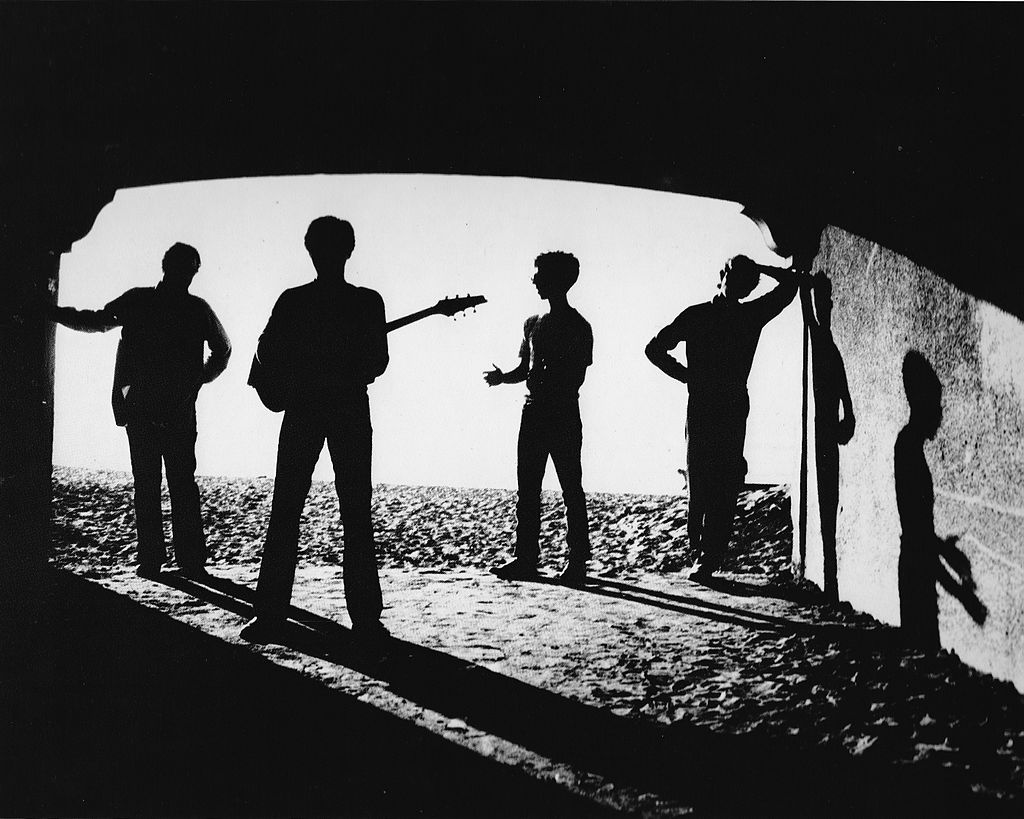
MX-80 Out of the Tunnel LP
The back cover of MX-80 Sound LP Out of the Tunnel. Photo by Kim Torgerson (c. 1980)

I moved from Brooklyn, New York to Bloomington, Indiana in the fall of 2014 to pursue a PhD in Ethnomusicology at Indiana University – in a nutshell, to study music within its cultural context. Coming from a background in music journalism and with a life-long interest in punk and underground music, I began to explore the Bloomington punk scene. What I found was a scene that looked nothing like the one I had encountered in New York, and certainly wasn’t trying to be that. I decided to make the local underground and punk scene the topic of my academic research and dissertation.

I include this information about my process and position not for narcissistic reasons, but for clarity and transparency.  Who we are – our positions, our experiences, our backgrounds – largely determines how we write, who we write about, and why we write. This column, therefore, is my interpretation and presentation of the Bloomington underground music and punk scene, and all of the weirdos and misfits that constitute it. But enough about me. What follows here is a (very) condensed history of the Bloomington punk scene and why it is so incredibly awesome.

1974. Patti Smith recorded Horses, the Ramones began playing at CBGB, and the New York Dolls released their second studio album. That same year, guitarist Bruce Anderson and bassist Dale Sophiea formed MX-80 Sound and began to perform their unique brand of art rock at local music venues and houses across Bloomington. By 1976, they were circulating a fanzine, Big Hits. Considered by many to be the pioneers of the local underground music scene, MX-80 was soon joined by proto-punk band the Gizmos (the first iteration), who began recording with Gulcher Records in 1976.

Collaboration took place between Bloomington punks and the punks of nearby Lafayette and Indianapolis. From Lafayette, post-punk band Dow Jones and the Industrials recorded a split LP, Hoosier Hysteria (1980), with the Gizmos (the second iteration). Bands from Bloomington and Lafayette traveled to Indianapolis to perform at the legendary music venue, Crazy Al’s. The Gizmos (1), MX-80 Sound, and then later The Gizmos (2), Dow Jones and the Industrials, The Zero Boys, The Jetsons, The Last Four (4) Digits, The Premature Babies, The Panics, Latex Novelties, The Joint Chiefs of Staff, The Dancing Cigarettes, and many others, constituted a vibrant scene that is still celebrated today through band poster exhibits, roundtables about the history of Gulcher records, reunion concerts, re-issues, and compilation CDs.

When listening to early Bloomington punk, the Gizmos’ (1978-1981) album is telling: Never Mind the Sex Pistols, Here’s the Gizmos. While the Bloomington and Indiana dirtbags were certainly influenced by the dirtbags in New York, London, and Los Angeles, they distanced themselves from these powerful urban centers and created a sound that was distinctively hoosier.

This remains true in 2017. A few times a week, punk bands can be found performing in houses and D.I.Y. venues across town, such as The Bishop, Blockhouse, The Void, Rhino’s, and The Backdoor. Bloomington is home to a number of punk and indie labels: The Secretly Group, Winspear, Plan-it-x Records, and Let’s Pretend Records are a few. Bloomington’s Landlocked Music and TD’s CDs & LPs sell local punk music, which is broadcasted through Bloomington radio stations WIUX and WFHB. 

A thriving zine scene augments and documents the music. The volunteer-run Boxcar Books and Community Center boasts one of the most impressive commercial zine collections that I have ever encountered. Zines like Neurodivergence and Shut Up and Listen are produced and celebrated through youth zine-writing workshops and zinefests.

It should be clear at this point that the Bloomington punk scene is rad; that such an unassuming Midwestern town has such a deep history with punk music, and that the scene is still flourishing today shouldn’t be surprising. My goal for writing this column is to shed a light on the scene itself, and all of the humans that make it special.    [/fusion_builder_column][/fusion_builder_row][/fusion_builder_container]

NEWS ROUNDUP: Tokyo’s Octogenarian DJ, Killer Pink Floyd Shrimp & More

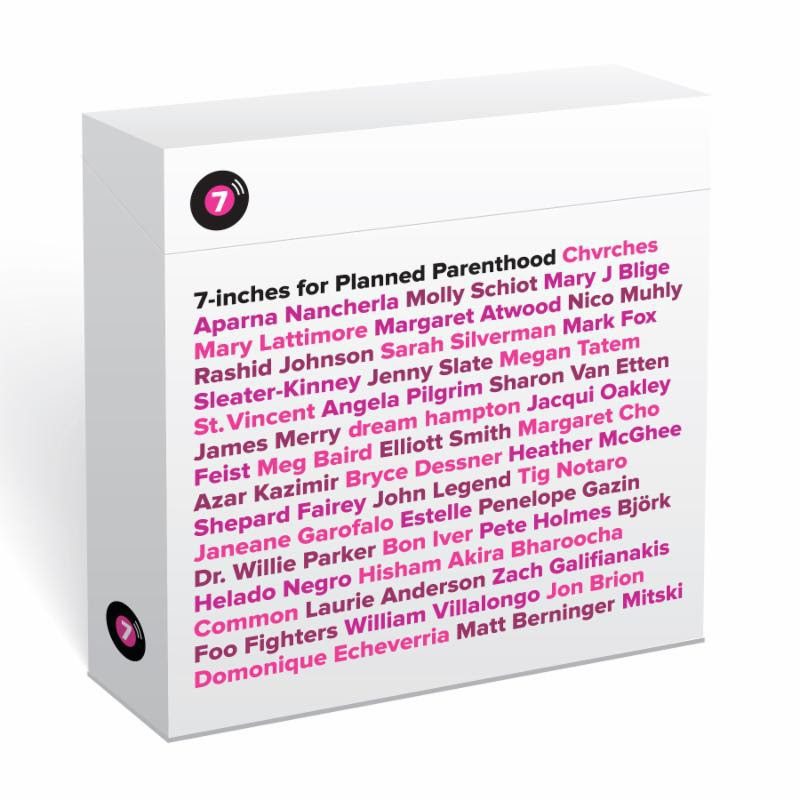
  • Coming Soon: The Creative Independent’s 7-Inches For Planned Parenthood

    Brandon Stusoy of The Creative Independent has curated a boxset of 7” singles with all proceeds going to Planned Parenthood. Artists that contributed tracks include Chvrches, Mitski, Foo Fighters, St. Vincent, Laurie Anderson, Sleater-Kinney, author Margaret Atwood and much more. A statement on the set’s Facebook page reads, “This curated series of 7-inch vinyl records is being made by a group of people who believe that access to health care is a public good that should be fiercely protected. Do we know there’s a joke in the name? We do. We hope the title evokes the rich history of 7-inch vinyl records as a medium for protest music and resistance.” Check out pre-order information here.

  • The Seriously Inspiring “Dumpling DJ”

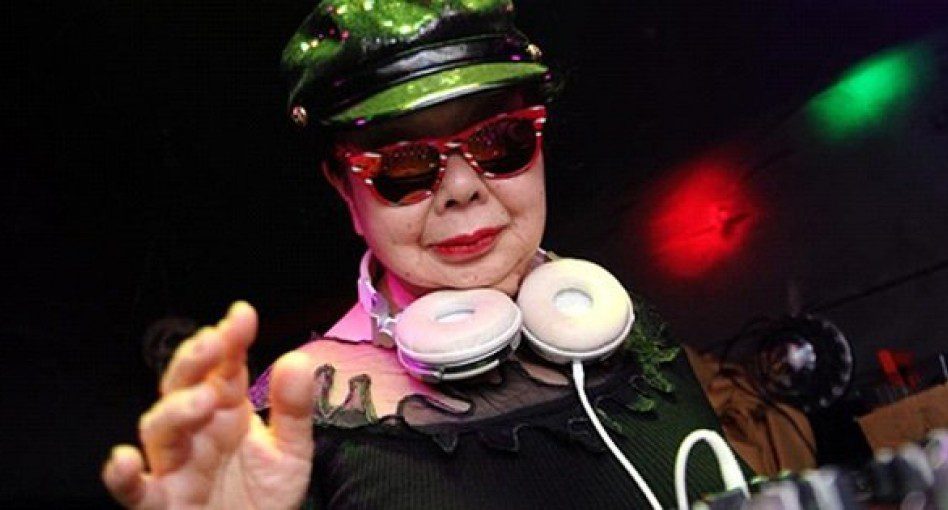
    Sumiko Iwamuro is 82 years old. By day, she runs a Tokyo restaurant, making dumplings. By night, she’s a hit DJ in the city’s red light district, proving that someone’s age or day job has nothing to do with their musical taste or talents. Check a mini documentary on Sumiko, via Al Jazeera, here!

  • Meet The New Killer, Classic Rock Shrimp Species

    Last year brought us a tarantula named after Johnny Cash; now, let us introduce you to 2017’s Synalpheus pinkfloydi, a shrimp that can kill (fish, at least) with a pink claw that, when it snaps, produces super loud  and deadly sounds. According to rock mythology, Pink Floyd once performed loudly enough to kill the fish in a lake near London’s Crystal Palace. And according to The Washington Post, this shrimp’s snaps are 210 decibels loud(for context, a thunderclap is around  110 decibels). Check out a video of a Pistol Shrimp below, which has a similar attack method:

ONLY NOISE: A Can Of Earworms

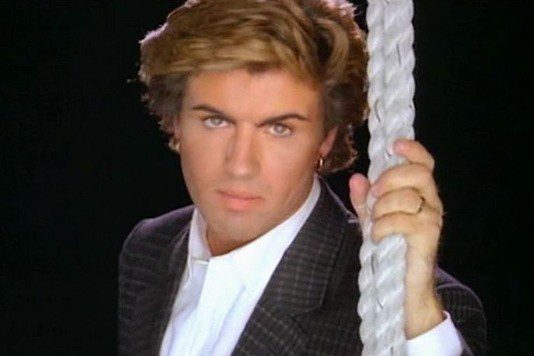
It is unrelenting. Circular. A clump of chains I can’t untangle. It is like that hedge maze in The Shining: I cannot get out of it. I am trapped. Trapped in the ceaseless sax solo from George Michael’s “Careless Whisper.”

But why? Why is it stuck in my head, in a perpetual loop? What part of my frontal lobe – a locality so full of things that are not George Michael songs – has weakened in just the right moment for that slithery little woodwind to slip in? And furthermore: where did I even hear it in the first place?

Maybe it was playing in my corner bodega…or was that the new Drake single? Was it the jingle gracing my gynecologist’s waiting room? Oh, no, that was “Nasty Boys” by Janet Jackson (true story). Surely I didn’t hear it at a party…or did I?

I am mystified by how these things happen; I don’t listen to George Michael (RIP) – not yet anyway. And while it has been on my to-do list to “go through a George Michael phase,” I didn’t even know “Careless Whisper” was called “Careless Whisper” until I Googled “George Michael saxophone song.” So why is my mind rapt with it today?

For several hours the saxophone has persisted. It will not stop. To make matters worse, I can’t quit vocalizing the sax riff: “Byeah-duh-duh-duh-Byyyeaaaaah-duhduhduh- Byeah-duh-duh-duh-Byyyeaaaaah-duhduhduh” again and again and again. This is partly why I do not listen to classical music – the irresistible urge to sing instrumentation. It was because of people like me that phrases such as “shoobie doobie doo-bop” and “walla-walla-bing-bang” were created: so that we wouldn’t ruin the guitar solo by trying to sing it. But “Carless Whisper” hath no “walla-walla-bing-bang” to shout; therefore “Byeah-duh-duh-duh-Byyyeaaaaah-duhduhduh” we must!

George Michael’s wriggling little number is not the first unwelcome “earworm” to invade my brain – an earworm being defined as “a tune or part of a song that repeats in one’s mind” by Dictionary.com. Kelly Clarkson’s “Since You’ve Been Gone,” U2’s “It’s A Beautiful Day,” and that godforsaken new Ed Sheeran single have all been contaminants in my auditory cortex. Perhaps the strangest occurrence of these spontaneous earworms (never prompted by actually hearing the song in question) was the handful of times I woke up with Shania Twain’s “Man! I Feel Like A Woman” stuck in my head, after not hearing it for over a decade. That ditty probably hasn’t even been on the radio in that long. Had I dreamt about Shania? Had I dreamt about my friend’s mother, with whom I used to sing Shania songs? Did I feel super, extra, especially “Like a woman” upon waking, as the lyrics might suggest? No.

I’ve tried to battle these unwanted worms with “good” music; music the culturati and I regard as “worthwhile,” “respectable,” or “hip.” This cannon of “good” music can be repurposed as an arsenal of songs to deflect the “superficial” melodies holding our heads hostage – right?

Not necessarily. In an attempt to quell the writhing earworms, I’ve tried everything; all the songs I claim to love. “Still Ill” by The Smiths; “Outdoor Miner” by Wire; “Palimpsest” by Smog. I sing them on repeat, feeling every word leave my lips; begging them to stay a little while longer. But they just crumble. None of these songs – songs I deem “better” than the earworms – none of them have the fortitude to withstand the stab of “Careless Whisper’s” sax solo. One sticky note from that hunk of curved brass, and all “interesting” music buckles at the knees. Go ahead. Play “Careless Whisper” and Suicide’s “Girl” back to back. Let’s see which one gets stuck in your head.

Is this the triumph of practice over theory? Beauty over brains? Wonderbread over homemade, whole wheat? Is the micro-phenomenon of a song getting lodged in your brain representative of some greater, macro-phenomenon, like the longevity of certain music? Aren’t there scientists who can answer my questions?

Of course there are! Particularly the researchers whose study title will not get stuck in your head: Dissecting an Earworm: Melodic Features and Song Popularity Predict Involuntary Musical Imagery. Catchy! All jokes aside, I was pleased to discover that this question had plagued others to the same degree: why do certain songs get stuck in our heads, while others float away? What makes an earworm an earworm?

According to the study’s lead author Kelly Jakubowski, the “findings show that you can, to some extent, predict which songs are going to get stuck in people’s heads based on the song’s melodic content.” A few factors are at play when a song is riding a relentless carousel ‘round your brain. Familiar melodies, simple lyrics, and upbeat tempos are often proponents of the earworm, as well as unexpected intervals or jumps in the song, which add jusssssst enough interest – but not too much!

Given this formula and over 3,000 survey responses, the study compiled a list of the nine most earwormish songs out there:

  1. Lady Gaga: “Bad Romance”
  2.  Kylie Minogue: “Can’t Get You Out of My Head”
  3.  Journey: “Don’t Stop Believin’”
  4.  Gotye: “Somebody That I Used to Know”
  5.  Maroon 5: “Moves Like Jagger”
  6.  Katy Perry: “California Gurls”
  7.  Queen: “Bohemian Rhapsody”
  8.  Lady Gaga: “Alejandro”
  9.  Lady Gaga: “Poker Face”

While “Careless Whisper” didn’t make the cut, Kylie Minogue’s “Can’t Get You Out of My Head” is too perfect for words; so perfect, that I can’t help but wonder if Cathy Dennis and Rob Davis had earworms in mind while penning the lyrics… Regardless I’ve learned two things from this list:

  • Lady Gaga is Queen of the Earworm, given her monopoly.
  • I loathe almost 80% of this list – Kylie and Queen being the exceptions.

I’ve also learned that you can’t control what songs get stuck in your head, no matter how hard you try. So you might as well relax, sit back, and enjoy the…

“Byeah-duh-duh-duh-Byyyeaaaaah-duhduhduh- Byeah-duh-duh-duh-Byyyeaaaaah-duhduhduh.”

HIGH NOTES: A Safety & Health Guide for Music Festivals

After discovering the crazy and liberating world of EDM at EDC Vegas last year, I was alarmed to learn that someone died at that festival and many more ended up in critical condition. A quick Google search for “people dying at music festivals” yielded more reports that made EDC look tame. Many festivals have been home to multiple deaths, typically resulting from drug overdoses combined with the crowded, hot, high-energy environments these events foster.

Yet few of the articles I read offered any advice beyond the usual “don’t do drugs, kids!” and the festivals didn’t provide any information either. The website for Time Warp, one of Germany’s biggest EDM festivals, includes no guidance regarding drug use other than, “Say no to drugs. Please stay away from drugs. We want to have a ‘clean’ party!” — a warning more fitting for a middle school DARE class than adults attending an event that runs from 7:30 p.m. on a Saturday to 2 p.m. on a Sunday. The “health and wellness” page for Insomniac, the tour promoter behind dozens of EDM events including EDC, reads, “Insomniac institutes a zero-tolerance drug policy at all of its events — end of story.”

But the reality is, that’s not the end of the story. One in 25 Americans ages 18-25 has used MDMA over the past year, according to the Drug Policy Alliance, and that number is likely far higher among ravers. A March 2015 DrugAbuse.com study found that over 25,605 Instagram posts about 15 popular music festivals mentioned MDMA, 9,705 mentioned weed, and 4,779 mentioned cocaine. In total, over 40,000 posts about EDC alone mentioned drugs.

Festivals are starting to recognize this: Last year, the Secret Garden Party in Cambridgeshire, England became the first to offer on-site drug testing. And on Friday, March 31, DanceSafe—an organization that promotes safer raving—held the world’s first International Day of Drug Checking to teach people how to reduce the risks of party drugs. This is especially important amid several recent reports of young women dying after taking ecstasy, coke, and ketamine.

To learn how to be as safe and healthy as possible at music festivals, whether we’re high or sober, I got in touch with DanceSafe’s Director of Programs Kristin Karas. Here are some tips she gave for taking care of yourself and those around you.

1. Test your drugs

Many drug-related deaths result from unknown substances mixed in. To make sure you’re getting what you asked for, consider investing in a home reagent kit. These won’t tell you your drugs’ purity, but they will reveal what’s in there.

2. Control your doses

When you’re high, everything can seem like a good idea, including getting higher. To avoid this spiral, research how much of your chosen drug you should take in advance, and pledge not to exceed it. If you don’t know exactly how much you’re getting (which you usually don’t), take less than you would otherwise. And if you’re not feeling the effects you’d like as soon as you expected, wait it out. People often make this mistake with weed edibles, says Karas, which can take up to two hours to kick in.

In the case of MDMA, RollSafe recommends never exceeding 125 mg at a time, and that’s an absolute maximum. For women or newbies, that number’s going to be lower. RollingPro recommends 60-90 mg at most for smaller or more sensitive people. For reference, the average ecstasy pill has 75-100 mg, and many find that half a pill is plenty. If you’re not sure how much you’ll need to see an effect, start off with a small amount, see how you’re feeling an hour later, and take more if needed (but question your initial impulse, which will probably be to take it). And avoid taking more than one drug at a time.

3. Hydrate

Between the sun and the dancing, music festivals can leave you parched even without drugs. Add in MDMA, and you’ll end up dehydrated while losing the sensation of thirst. A lot of festivals have hydrating stations, so bring a water bottle and fill it up regularly. But water alone isn’t enough. Since you’re also losing salt and retaining more water than you normally would, balance your electrolytes with sports drinks, juice, or snacks to avoid hyponatraemia (dangerously low blood sodium levels) or cerebral edema (swelling of the brain cells). Remember: just because you’re high doesn’t mean you don’t need to eat or drink.

4. Take breaks

With all those people packed together, music festivals can get hot, and MDMA, coke, and amphetamines can also cause overheating. Take time to get out of the crowd and cool off every hour or so.

5. Wear earplugs

Another health risk people don’t always talk about is hearing damage, says Karas. Some festivals have such loud noise levels, they can do their damage in just a few seconds, according to DanceSafe. A study last year found that festival-goers who wore earplugs were able to hear better after the event than those who went without, so stash a pair in your bag to safeguard your ears, and try to stay away from speakers.

6. Be aware of your surroundings

Additional potential causes of deaths and injuries at music festivals include getting hit by cars, getting crushed in crowds, and other accidents you can help prevent through vigilance. Stick with a friend or group so you can look out for one another, especially if you’ll be high.

7. Learn what resources are on the festival grounds

Some festivals have peer security teams and sanctuaries to help people experiencing medical problems. Consult your festival brochure, map, or website beforehand to figure out what to do in the case of an emergency.

8. Get help if you don’t feel good

Take any physical discomfort or incapacitation you start to feel during the festival seriously. “Signs that something is wrong and you should seek medical attention include difficulty breathing, seizure, loss of consciousness, rapidly increasing body temperature, rapid or irregular heartbeat, signs of head injury, confusion, chest or abdominal pain, fainting, and signs of severe dehydration or heatstroke,” says Karas. “Signs of heatstroke include altered states of behavior, lack of sweating in a hot environment, nausea, vomiting, and headache.” If you experience any of these and can’t get to the festival’s sanctuary right away, call 911. Don’t try to save your ass — tell them if you’ve taken anything. After you recover, you’ll want to avoid partying hard or getting too much heat for the next few months.

9. Look out for those around you

Part of the magic of music festivals is that for that day or weekend, you’re a family. And that means looking out for one another. If you notice any signs of heatstroke in a fellow attendee, call an ambulance or the festival’s medical team, take them somewhere as cool as possible — even if it means leaving the festival grounds — pour water over them, fan them, give them dry clothes or a blanket, and give them a sports drink or water mixed with salt. Let the medical professionals know what they’ve ingested, and make sure they get to the hospital.

During EDC last year, a cute guy I spontaneously made out with offered me his water bottle. Though I hadn’t felt thirsty, I suddenly found myself guzzling it like there was no tomorrow. Then, he put his hands on my shoulders and said with an entertained but concerned look in his eyes, “Stay hydrated.” At the time, I didn’t understand what he meant. Now, I do. I even carry my own water bottle to events – and offer it to anyone who lacks the information I have now. 

PLAYING DETROIT: ADULT. Return with Avant-Garde Video

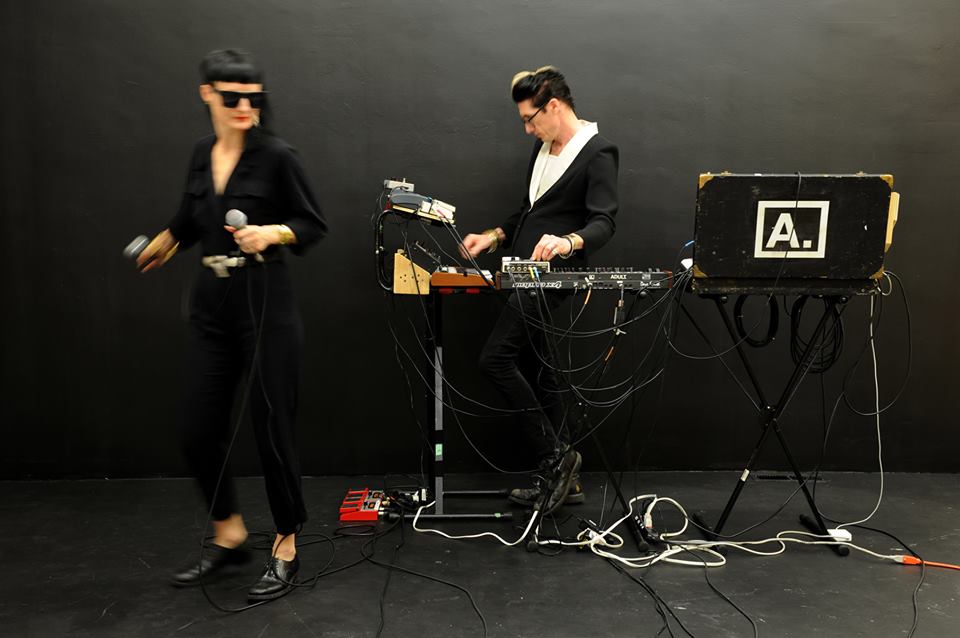
Over the course of 20 years, electro-clash duo ADULT. has challenged the conventional with avant-garde prowess and an unmatched affection for letting their freak flag fly. Nicola Kuperus and Adam Lee Miller returned last month with an experimental collaboration and their seventh record Detroit House Guests. 

“We Chase the Sound” (featuring Shannon Funchess of Brooklyn band Light Asylum and !!!) is a brooding, pulsating dark corner riot and its video companion is a testament to the duo’s unique capacity for connecting the line between art and audio. Paired with knocking synths and hyper-sexual panting, the addition of Shannon Funchess’ carnally commanding presence is not so much a breath of fresh air as it is a pleasantly masochistic hand over the mouth. Convulsive and uneasy, “We Chase the Sound” has Terrence Malick party-scene tendencies. Haze-heavy with static spasms, the world created here is intoxicating and dangerous; the underground unearthed.

Slip into some pleather and dive into the twisted world of ADULT. with “We Chase the Sound” below:

[fusion_builder_container hundred_percent=”yes” overflow=”visible”][fusion_builder_row][fusion_builder_column type=”1_1″ background_position=”left top” background_color=”” border_size=”” border_color=”” border_style=”solid” spacing=”yes” background_image=”” background_repeat=”no-repeat” padding=”” margin_top=”0px” margin_bottom=”0px” class=”” id=”” animation_type=”” animation_speed=”0.3″ animation_direction=”left” hide_on_mobile=”no” center_content=”no” min_height=”none”][/fusion_builder_column][/fusion_builder_row][/fusion_builder_container]

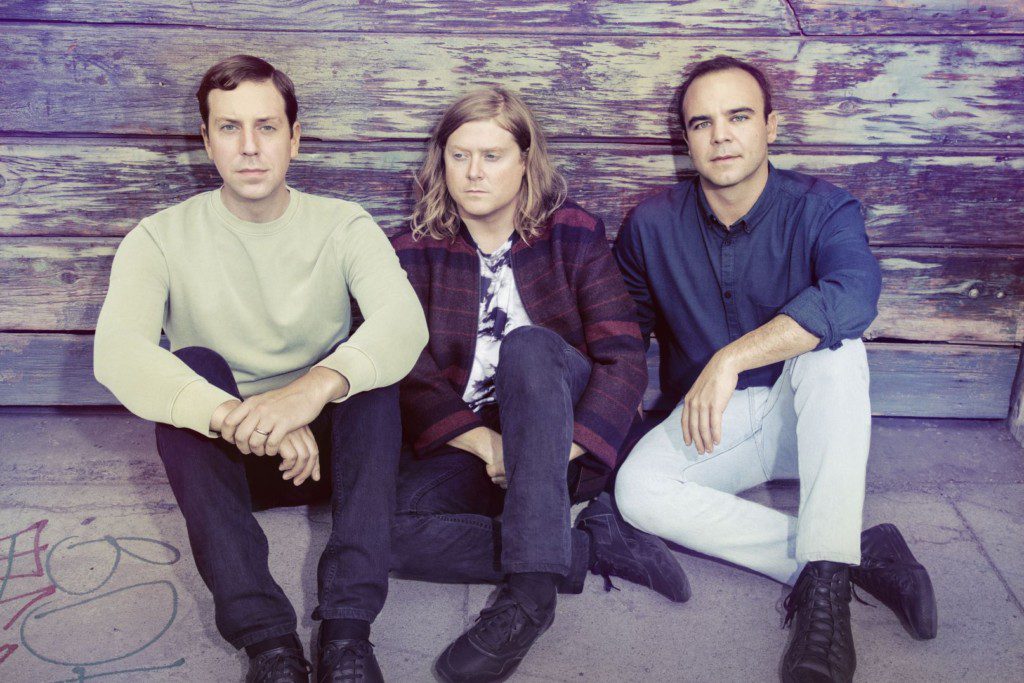
ALBUM REVIEW: Future Islands “The Far Field”

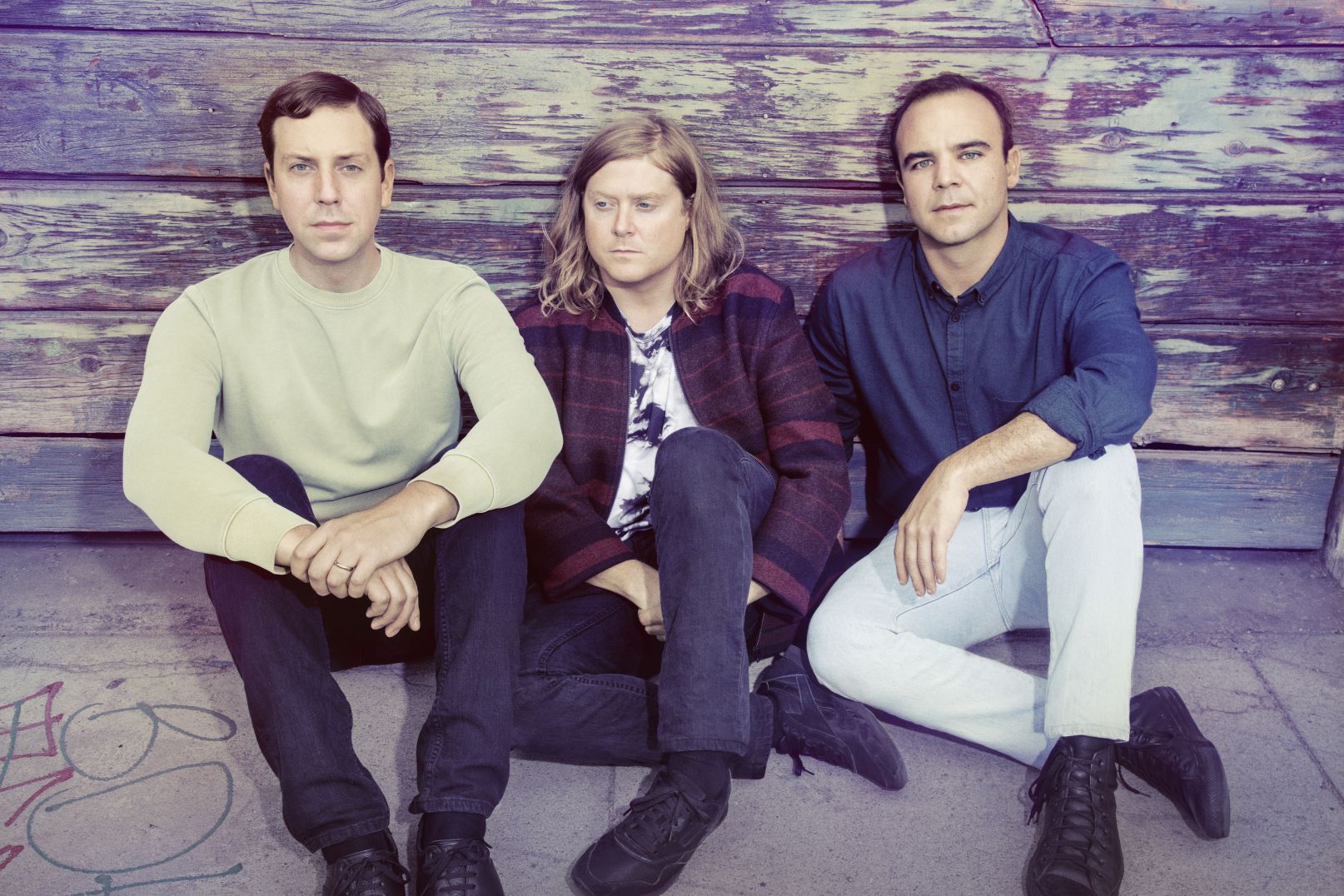
“It’s not easy, just being human, and the lights and the smoke and screens,” sings Sam Herring on Future Islands’ latest record, The Far Field. It isn’t. Our lives are a sloppy amalgamation of highs and lows, love and hate, obsession and apathy. In essence, this record faces this reality head on: it’s a devastatingly beautiful case study on love and infatuation, the thin line that separates them, and the sting that comes close behind.

Musically speaking, this is the Baltimore band’s final descent into straight indie-pop. With five albums under their belt already, it’s difficult to find anything else to reinvent, audibly speaking. And so they dig deeper, doing what they do best even better – pairing impossibly catchy tracks with deeply moving, emotionally insightful lyrics. Yet the catchiest songs on the record – “North Star” and “Shadows” (featuring Debbie Harry!) – are not the most compelling. It’s because they lack the sheer emotional depth and the stark truth of the other tracks that hammer home the difficulty of our humanity. We fall too easily; we fail to stay neutral by our very nature, and oftentimes that hurts us.

This becomes apparent right off the bat with opening track “Aladdin,” on which Herring sings “I built a ship for two / It waits for me and you” before he asks “Is it real?” He wants, he builds the ship, he projects the relationship he wants onto whomever “you” is before he can even really know what “you” thinks or feels. And don’t we all do that? It’s the way we idealize situations and people; we imagine the reality we’d like to live in, all the while forgetting that’s not how life works. And when actual reality crashes down upon us, it hurts.

This obsessive imagination touches on nearly every track of the record, opening scab after scab while you realize you’ve felt every feeling he describes. “Beauty of the Road” captures the way it’s sometimes hard to remember the last time you saw someone because you never imagined it could possibly be the last time, boiled down to one wistful line: “I never thought you’d really go.” On “Cave” he sings “All I hold is all I own,” one of those rare moments on the record where he removes his rose-tinted glasses to face the stark reality of our solitude. We can’t make anyone do or feel anything, and our suffering is often a direct result of refusing to accept that. It’s those light and smoke and screens he mentioned earlier – life is by nature uncertain, and this uncertainty is uncomfortable to live with. But he acknowledges our ability to let go of this, to accept the fact that we can’t control anything but ourselves. On “Ancient Water” he sings “Too many wasted days and nights, obsessed with the flickering moments of my life, forgetting what giving and living can be–what it can mean, first forgiving myself…” It’s the moment we realize rumination doesn’t serve us, that we aren’t chained to the memory of what was and that we’re “strong enough to be free.”

After all of this – the idealization, the denial, and ultimately the self-realization and forgiveness – the greatest irony of all is that the last word on The Far Field is “stay,” leaving us to wonder what it would be like if life actually worked that way. It’s a moment of terrifying realization: that no matter how much we say we’ve gotten over it, our past is still a vital aspect of who we are and it’s nearly impossible to truly let anyone go. It may seem as easy as asking them to stay, but Herring’s lyrics remind us that life’s beauty resides in the complications.

The Far Field is out now via 4AD. Check tour dates here.

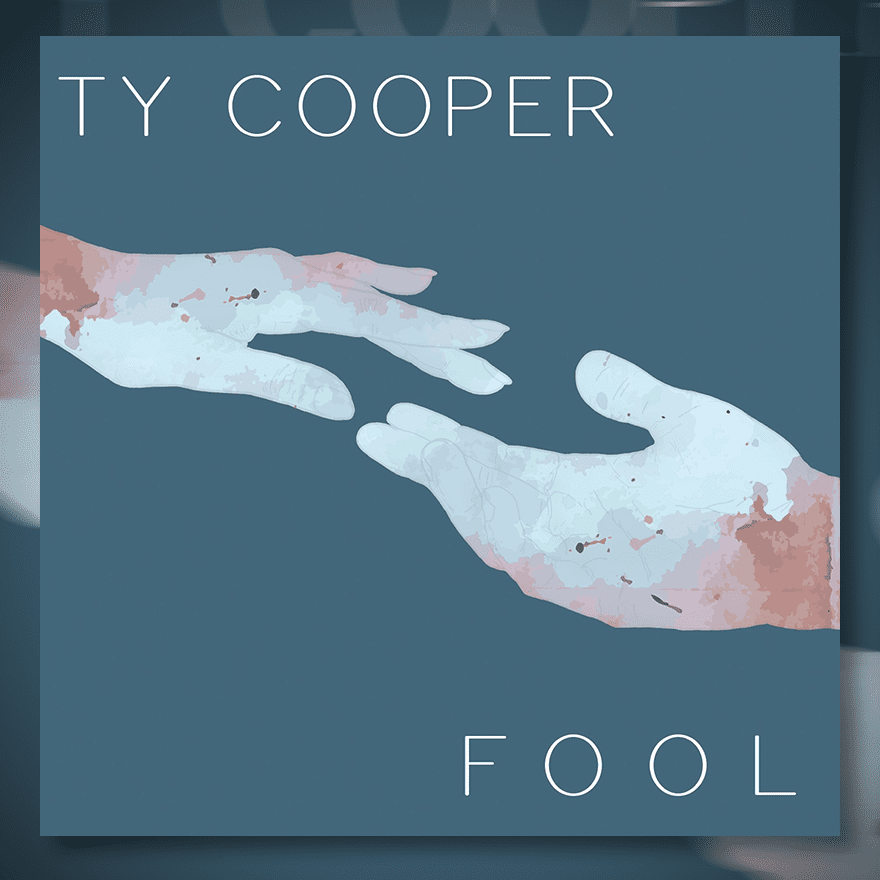
INTERVIEW: Ty Cooper


Americana folk artist Ty Cooper delivers some smooth, soulful music in the form of his latest EP Fool. The EP is full of inspiration and drips with passion, and it’s evident upon first listening to his crooning vocals that it’s a piece that Ty’s put his heart and soul into. Fool is a showcase of romance and relationships, with an emphasis on the sometimes embarrassing, awkward things love can make us do. It’s brutally honest and raw, an album that evokes a smile as well as a sobering reality check. Recently Ty made the move to Nashville where he’ll certainly be sure to draw even more musical influence for future pieces. We spoke with Ty about his new release and the creative process behind its creation, as well as some dreams and aspirations he has for his own musical future.

Can you tell me a bit about your musical history and background with performing?

As a child, I had access to all kinds of different music. My parents would listen to everything from the soul music of Sam Cooke and Otis Redding to the bluegrass music of Ralph Stanley and The Osborne Brothers and everything in between. I have always enjoyed just about every type of music there is, and I think that shows up in my music. I have two brothers ten years older than me that introduced me to a ton of music that a lot of people my age never have a chance to hear: Nineties music, from R&B to rap, rock, pop, and all kinds of stuff. I have very eclectic taste in music as a result.

I saw The Temptations movie when I was kid, and that’s what really sparked an interest in performing. I would memorize the dance moves and sing and dance in the mirror until I had a respectable rendition of their performance. I didn’t start actually performing until right after high school, but I have been [fusion_builder_container hundred_percent=”yes” overflow=”visible”][fusion_builder_row][fusion_builder_column type=”1_1″ background_position=”left top” background_color=”” border_size=”” border_color=”” border_style=”solid” spacing=”yes” background_image=”” background_repeat=”no-repeat” padding=”” margin_top=”0px” margin_bottom=”0px” class=”” id=”” animation_type=”” animation_speed=”0.3″ animation_direction=”left” hide_on_mobile=”no” center_content=”no” min_height=”none”][performing] regularly ever since.

Where do you draw inspiration from, both for Fool and in a general sense?

Inspiration can come from all kinds of places. Usually, it comes from personal experiences or things my close friends have experienced. For Fool, it was mainly the recent relationships I had been in and how I was pretty foolish in all of them, as we all are sometimes. The EP is a story of falling in and out of love and kind of the stages of how that happens.

Who are some artists, dead or alive, that you wish you could perform with? Why them in particular?

Some artists I would love to perform with are Otis Redding, Jerry Lee Lewis, and The Avett Brothers. Otis Redding because he is a legend and has one of the greatest voices of all times, and I just wish I could have been in the building for one of his shows. Jerry Lee Lewis because, by all accounts, he was crazy on stage and anything could happen at any time, which I’m sure would guarantee for some fun.  The Avett Brothers because they’ve been a favorite band of mine for many years, and I’ve seen them countless times live and they never disappoint. They were a huge influence on me when I first started playing music, and it would be amazing to share a stage with them.

I saw that you recently moved to Nashville. Was that to get more involved in the music scene Tennessee has to offer?

The move to Nashville was one I had wanted to make for a long time so I could really pursue music as a career and explore what opportunities a place like Nashville has for me. I feel like I have so much to learn about the city and the business, but I’m excited to finally take the next step and see what happens.

What are you hoping your fans will take away from Fool?

For anyone that listens to Fool, I hope I’m able to evoke an emotion in them. There’s a lot to take away from it, whether that’s happiness, sadness, or anything in between. I just want to make music that people can understand and relate to, but most of all I just want to make music that makes people happy.

What stops are you most looking forward to in your upcoming tour, and why?

The stop I’m most looking forward to is at Peach’s Grill in Yellow Springs, Ohio. I feel like I grew up as a musician at this venue. I have been going to their Tuesday Open Mic for many years, and it was a place for me to try new things and really evolve as a songwriter and performer. I have made so many great friends there, and I just feel at home on that stage. It’s a great town, and it’s very close to my hometown so I will get to see so many familiar faces that will make for a great atmosphere for a show.

[/fusion_builder_column][/fusion_builder_row][/fusion_builder_container]

MORNING AFTER: Bloody Marys At Enid’s With Evelyn

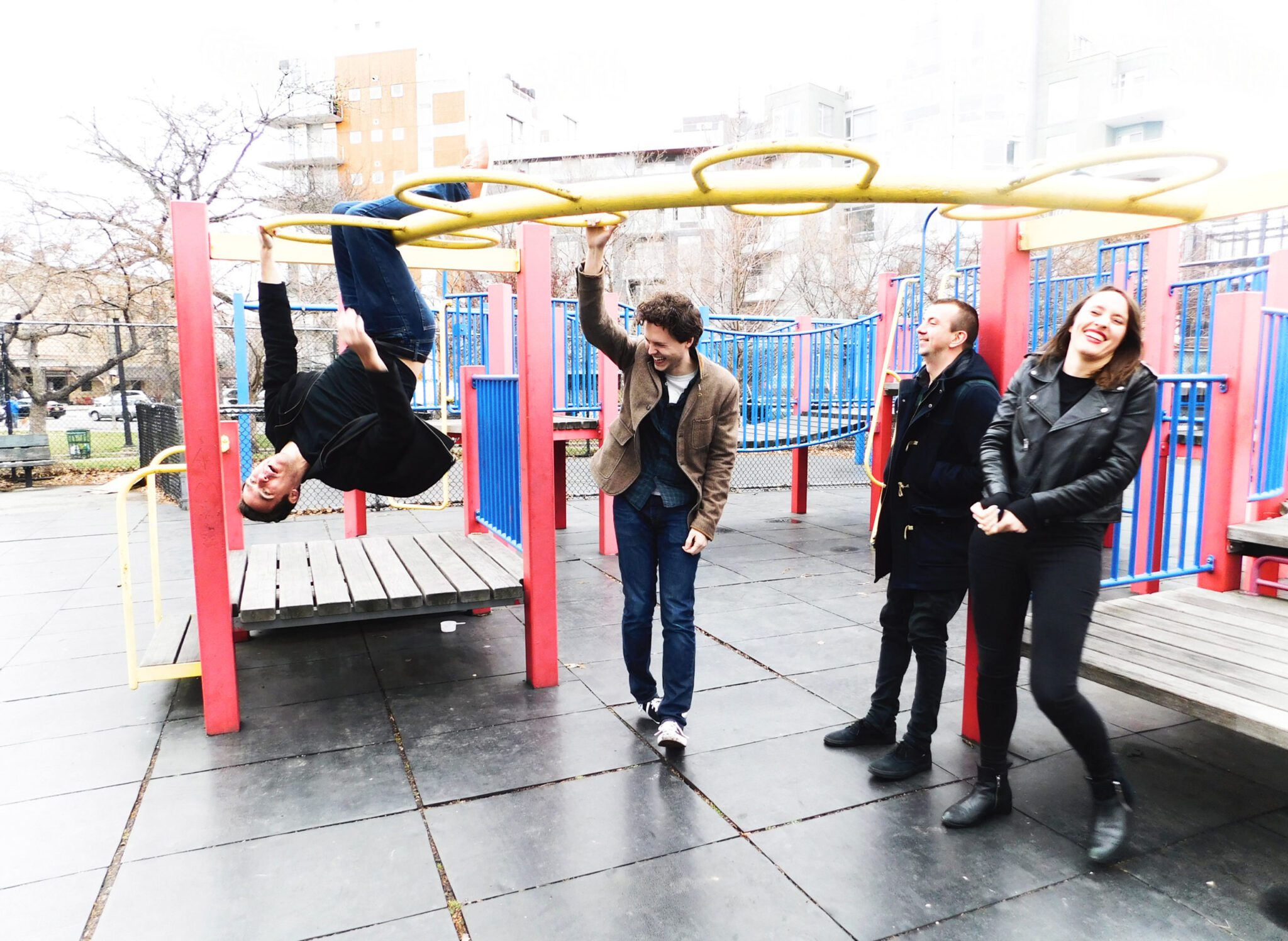
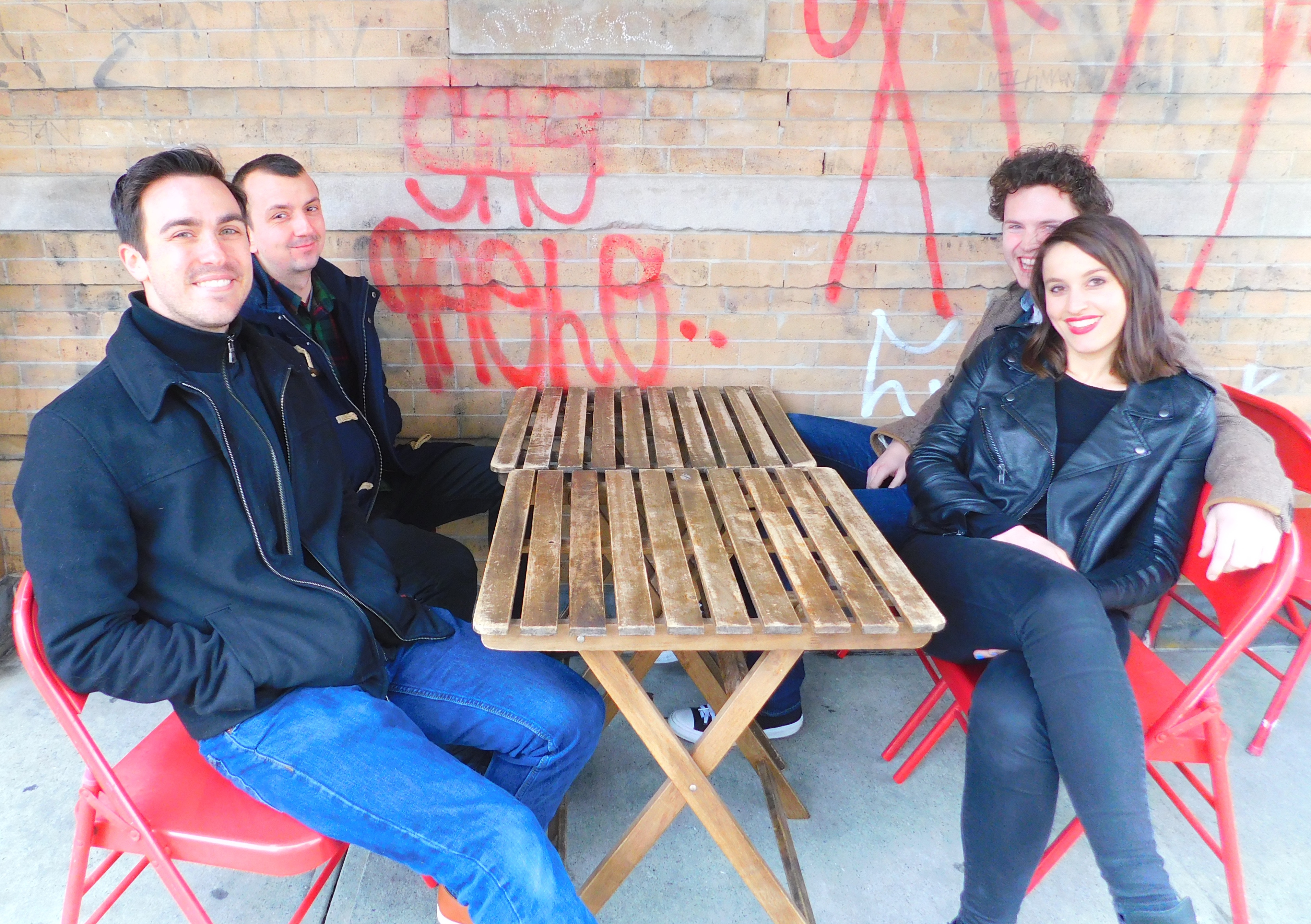
“We’re a lot to handle.” “We’re pretty laid back.” Dani Lencioni and Drew Broussard overlap the contradiction adorably, with the former shooting a broad red grin at the latter. Dani is the frontman—frontwoman, technically, but she wears the pants in this family and bears the tongue-in-cheek title in a song of the same name—of Evelyn, Drew is the lead guitarist, and they’re bf/gf in classic BK fashion. Bassist Zachary Joy Smith sits to Drew’s left, drummer Bryan Miltberg is to my left, and Jordan Kisner is several thousand miles away in Manila on assignment, because sometimes journalists leave Brooklyn for their stories (weird). Whatever the truth is, I’m in for one hell of a show.

If I didn’t have these characters in front of me, I’d imagine Evelyn as a dazed girl in a button-down dress, seemingly shy, quietly out of place among scruffier alt kids, yet spirited and quick to prove she’s sharp in conversation. The titular song off their EP Light Full muses: “Oh, to be delightful;” perhaps that adjective best describes both this phantom girl and the band’s work all at once. Dani drafts and delivers lyrics that ponder, that wander, that tumble out as they’re needed. Like a Morrissey sing-song with a thorough softness, not lacking in occasional bursts of sass, but definitely void a jaded edge and without the allusions to hating Queen Elizabeth.

Most importantly, Evelyn bears the amusing distinction of being the first band to order booze with our meals. Prepare to be entertained.

The Scene: Dani gave me two options for brunch, the first being Egg in Williamsburg. The band is friends with the chef there and spent a lot of time turning the place into an event space for The Bellwether, an arts collective Jordan, Drew, and Dani help run. Instead, we end up sandwiched in a wooden booth at Enid’s.

Half of why is because it’s easier to get a Sunday morning table-for-five at Enid’s. The other half is because it’s my favorite brunch place (like the restaurant love-of-my-life) and Dani’s as well. So I’m thrilled, even when our Bloody Marys arrive stuffed to the brim with a veritable Farmer’s Market of vegetables. Truthfully I’m more of a grimosa girl.

11:18 We’re talking about Bryan’s very legitimate job as a teacher so I ask the rest of Evelyn about what they wanted to be when they grew up… before, you know, failing and finding their current professions. We decide to Round Robin it, the preferred format for the day.

Dani wanted to be the first female baseball player for the Dodgers. Not softball, baseball – she’s very clear on that. She then floated around following whatever her parents suggested (doctor, psychologist, journalist) and landed in the theater world, and is working in education at the Whitney.

Drew originally went into acting, and he’s done all sorts of work across New York: Shakespeare, musicals, the usual. But between all the auditions and the constant hustle, full-time acting took its toll. So he restructured, working at the Public Theater and the occasional odd editing gig here and there.

Apparently this is a theme because Zach was also an actor. He was in a memorable web series about Adolf Hitler and Joseph Stalin being college roommates and, less eyebrow-raising, toured with a Texas troupe for six months back in the day. Working on musicals with the latter pushed him towards music, which seems like a good trajectory.

Evelyn sort of convened in this theater world, it seems, save for Bryan. “We found Bryan on the internet,” Dani says.

“Like, where on the internet?” I ask. “Newgrounds? YouTube?”

It was Craigslist. “I actually responded to a bunch of ads, I don’t know if I ever told you that,” Bryan confesses.

Dani feigns shock. “You mean you didn’t just throw your eggs in one basket?”

11:32 Historically Dani makes the gang wear fancy outfits, a decision that spawned from their first show coming out party, a wishful “black tie” affair. “Drew does dapper very well, so I was like, ‘Do your situation.’ And then I was like, ‘Zach, dress like Drew.’” They didn’t want to be another flannel-wearing Brooklyn band, so when Bryan signed on, he put his best suit forward, too… except for today. More than half the table is wearing some kind of plaid.

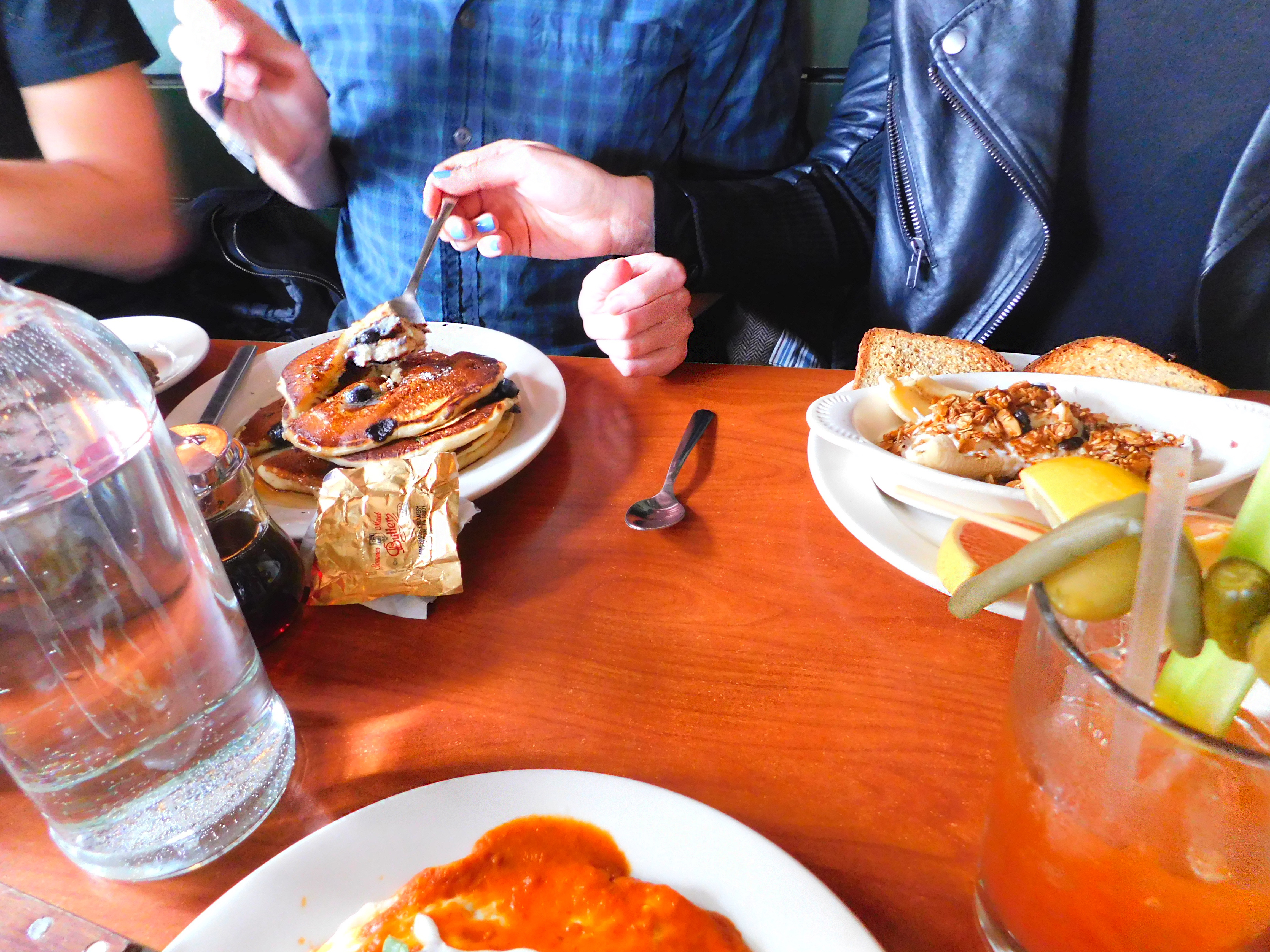
11:38 Bryan’s going to be a dad soon (May 20th is the due date) which is mind-boggling to me. Personally, I’m obsessed with babies in an uncharacteristically suburban way, but no one in my particular social circle is about to take care of a tiny sobbing person (that isn’t me). While I’m low-key reeling our food gets here—cheeseburgers, blueberry pancakes, huevos rancheros, monkey boats—and then talk somehow bleeds into karaoke stories.

Once upon a time Zach had a Washington Heights apartment on top of a police station. He was told he could use the fire escape and go up on the roof, so at one particular party he did just that, with all of his friends singing Dr. Horrible together. Obviously.

Later that night his friend Joey says, “Hey, this guy is on the roof and he has a gun.” Zach dismissed him to go to the bathroom, comes out of the bathroom, and Joey is adamant about the guy on the roof. “And right at that moment, the door to my apartment –”

“Do you want some more coffee?” a waiter interrupts. We get refills before Zack continues.

The door gets kicked in and it’s two gun-toting NYPD officers telling everyone to freeze, asking if anyone lives here. They yelled at him for five minutes about how it is so not ok to be on the roof, that they thought he was breaking in, and to “never do that again, ever.”

“And then you all sang Dr. Horrible together,” Dani chimes in.

“I think the alternate title for this column was going to be Dr. Horrible’s Sing-Along Blog,” I pipe up.

“I like the image in my head that after the cops put their guns away and turn to leave, one turns around and says, ‘By the way, whoever was singing Dr. Horrible was flat,’” Drew offers.

And that’s how we’re retelling the story now.

12:55 Btw, Evelyn led me believe this was their first breakfast together (a momentous occasion) but that’s wrong. When they recorded their first EP Dani brought muffins – hand-crafted muffins, no less. “I feel a strong need to take care of everyone,” she explains. Clearly there are like, real perks to being in this band. Evelyn: they make muffins, they make music.

Incidentally their former drummer would promise candy when promoting shows (Bryan: “I’m very insecure about being compared to the old drummer, so now I’m thinking about what I have to do.”) and yet never delivered. I find this incredulous. “It’s so easy to acquire candy too. You just have to go to a doctor’s office; they have all those lollipops…”

“I thought you were going to say you just go to Duane Reade and get candy, but no, you were just like, ‘You can steal candy from somewhere,’” Dani says. Oh, sure, that too.

12:04 The band’s lamenting that they didn’t bring stickers and before I realize that they mean, you know, band stickers, I pull some stickable Disney characters from my tote bag. Zach personally finds stickers disgusting, but would’ve gone with Dumbo, Drew selects Monsters Inc’s Mike Wazowski, Bryan’s unfamiliar with most characters and settles on Nemo, and Dani picks Aladdin because he was her first (very valid) crush. She believes that’s a common infatuation, and the other animated alternative was Robin Hood.

“Ok, he was a literal fox” I say, although “Robin Hood Fox hot” instantly comes up as the second Google search when I try to get a picture for the table. There’s a darkness to this discovery. Also for some reason I always thought everyone’s creepy anthropomorphic crush was Simba from The Lion King (Dani: “I get it. I don’t feel that way, but I get it.”)

Anyway, the Aladdin appeal I understand in my old age: “He sings, he’s poor, he really is every guy that I’ve dated so far.” The band points out that he also has those sexy parachute pants and owns a monkey. Yeah, “owns a monkey” is definitely a box to check off.

Speaking of check, ours mercifully hits the table before this conversation gets any weirder.

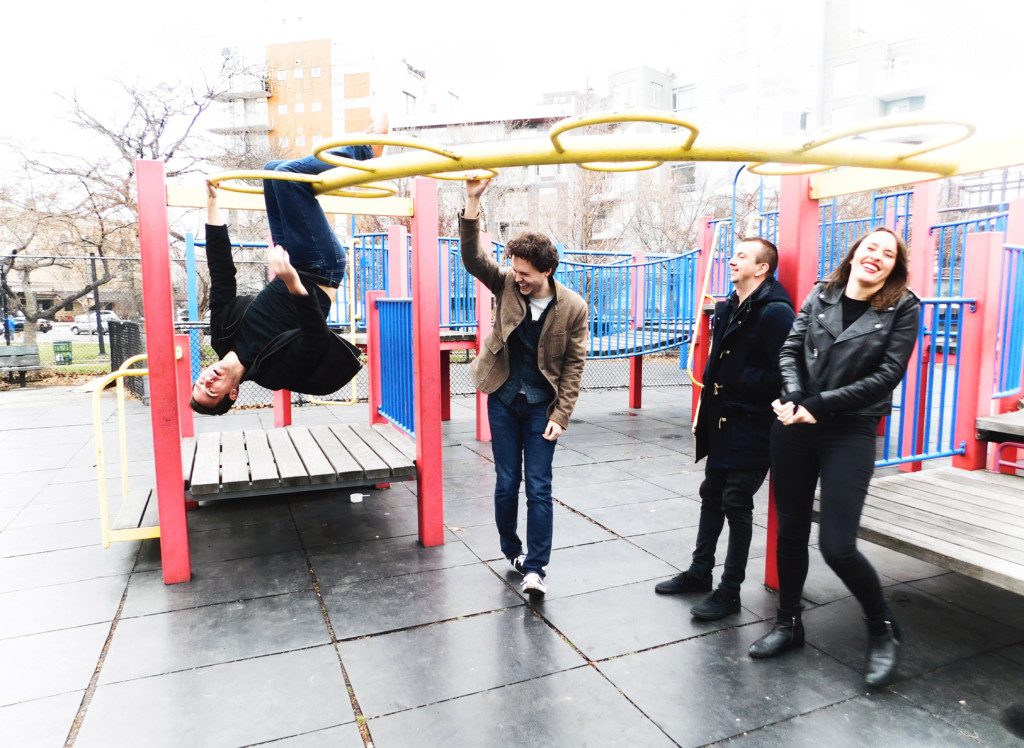
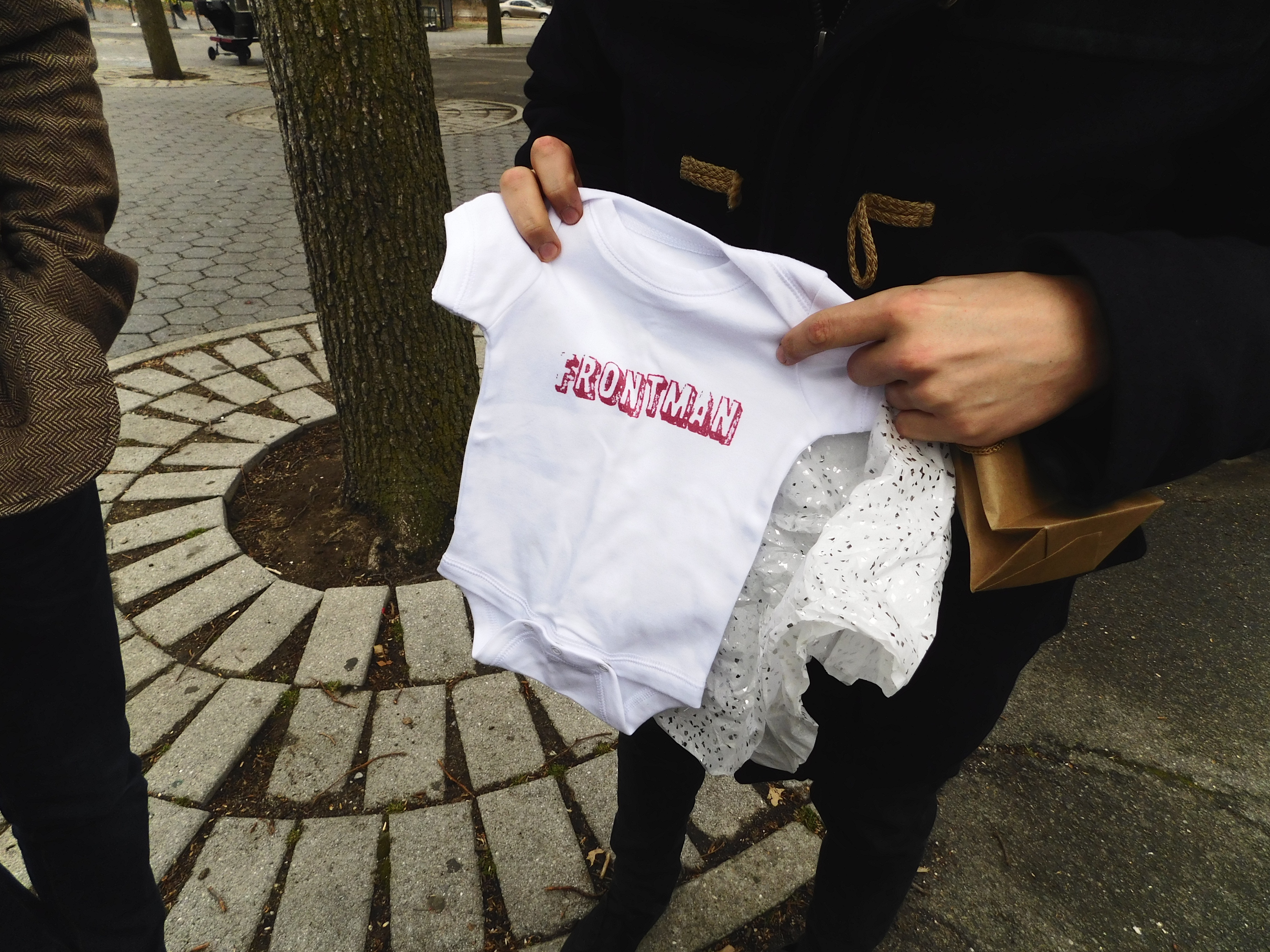
12:36 After an exhilarating time playing on a McCarren Park jungle gym, Dani asks if I want to see the baby gift the band got Bryan. Uh, yeah, more than anything in the world. So out of the bag Bryan pulls out the teensiest onesie with a single word shouting across the chest.

Dani designed it herself (perhaps whilst a little drunk) after writing the track. “The next week were were like, ‘Bryan, have you figured out the sex of the baby yet?’ And he was like, “’Yeah, it’s going to be a little girl, it’s going to be a little frontman,” She explains. “And I just wept.'”

I’m emotionally frazzled typing that out, it’s my damn suburban sentimental side. Maybe also my existential side: it’s crazy how we all start out as a tiny blank slate before we seek out our Disney spirit animal and find a job that isn’t soul-crushing. Growing up is just playing around with identities until you find titles that feel right. It’s endearing that the band wants to start this newborn’s life with a strong label. Who knows, maybe one day she’ll be a frontman, too. Failing that, she could always be like Evelyn: delightful.

You can listen to Evelyn on Bandcamp and visit their website at OhEvelyn.com.

NEWS ROUNDUP: BK Steel Opens, Synth Pioneer Dies & More

  • RIP Ikutaro Kakehashi

    Ikutaro Kakehashi passed away last Saturday at age 87. He founded Roland in 1960, meaning without him, we’d be way behind in drum machine and synthesizer technology. After leading the company for decades, he founded the electronic instrument company ATV Corporation in 2014 and received a technical Grammy in 2013 for work in MIDI technology.

  • Stayin’ Alive: A CPR Playlist

    CPR is most effective when chest compressions are performed at 100 to 120 beats per minute, but how can someone easily remember that tempo? If you’ve been CPR certified, you were probably told to think of the Bee Gees classic, “Stayin Alive.” But, there are more options. As NPR reported, the New York Presbyterian hospital created a playlist of songs that are the right tempo to save a life, with artists ranging from Shakira to the Beastie Boys to Modest Mouse. Listen below.

https://open.spotify.com/user/12129503156/playlist/6TImxVFJXR6y3E6P6M5BQU

  • Brooklyn Steel Officially Opens

    Last night, the new, huge Williamsburg music venue Brooklyn Steel opened with the first of a five nights LCD Soundsytem residency. Tickets to all five nights – 10,000 tickets, to be exact – sold out in minutes. The band reportedly debuted three new songs and mentioned that they’re almost done with a new album. Signs posted outside the venue tried to deter concertgoers from filming the show, saying, “It’d be a real gut punch to all the people who have been working insanely hard the past 18 months to release this music.”

ALBUM REVIEW: Vanbot “Siberia”

Vanbot’s latest full-length Siberia has arrived, and though it immediately seems like the ultimate relaxation record, it was created by a musician far out of her comfort zone. After getting rid of an entire album because she was unhappy with the end result, Swedish musician Ester Ideskog brought producers Petter Winnberg and Johannes Berglund along on a literal journey; the trio rode the Trans-Siberian Railway from Moscow to Beijing, writing and recording the album as the train rolled along. They pulled inspiration for each song from the stops they made, even going so far as to include the location for which the song was written in parenthetical titles. A documentary will also be released with the album, showcasing the behind-the-scenes moments on the train.

Siberia is an apt title for the record, not only because of the surroundings in which it was written, but because sonically, it exudes a cool, smooth, iciness evocative of the frozen tundra even without knowing the record’s backstory. It’s a raw, crystalline album that cuts down to a lonely core and resonates on a deep, meditative level, reflective of the band’s constantly changing environment and fast-paced accommodations. At times, the music appears to blur past and then abruptly slows before fading into the next track, like a train pulling into a station only to dart back out again.

Ideskog, Winnberg, and Berglund mimicked locomotive speed to create Siberia, working on a limited schedule of just seventeen days to pull everything together. With these constraints imposed, the pressure was on to channel a creative muse and deliver something that would be sure to stick – and they certainly succeeded. The journey behind the album’s creation was Ideskog’s attempt at escaping from the mind-numbing boredom of everyday routine, and it brought her to a place where she was able to truly channel something that stands out in Siberia. The resulting record is a testament to creativity and using items at one’s disposal to make a piece of art that utterly transports its audience.

ONLY NOISE: Big Sister’s Clothes

Who are the great musical influencers of our lives? Lovers, friends, parents, librarians. The people who were in close proximity when our cultural preferences were still small, squishy, and developing. Their impact on our taste was indispensable and unforgettable, as they passed down songs to us like cherished family recipes. Rare is the record collection built solely from autonomous discovery – because that wouldn’t be very interesting, would it?

But what about that other person in your life? The one who got the bigger bedroom, the better car, and all of the boys? The keeper of crucial adolescent information, such as the definition of words like “Phat,” “wangsta,” and the meaning of Limp Bizkit’s LP Chocolate Starfish and the Hotdog Flavored Water? The wearer of JNCO Jeans and “candy” bracelets. What about your big sister?

Until recently, I might’ve excluded my big sister – one of them at least – from any Pop Culture Sherpa accolades. But that would’ve been a great injustice. Older siblings are often our first reference points for culture and cool – or perhaps they were before children had handheld access to the Kardashian lifestyle brand 24/7. But our crib didn’t even have dial-up…until several years later, when everyone was on that high-speed shit already.

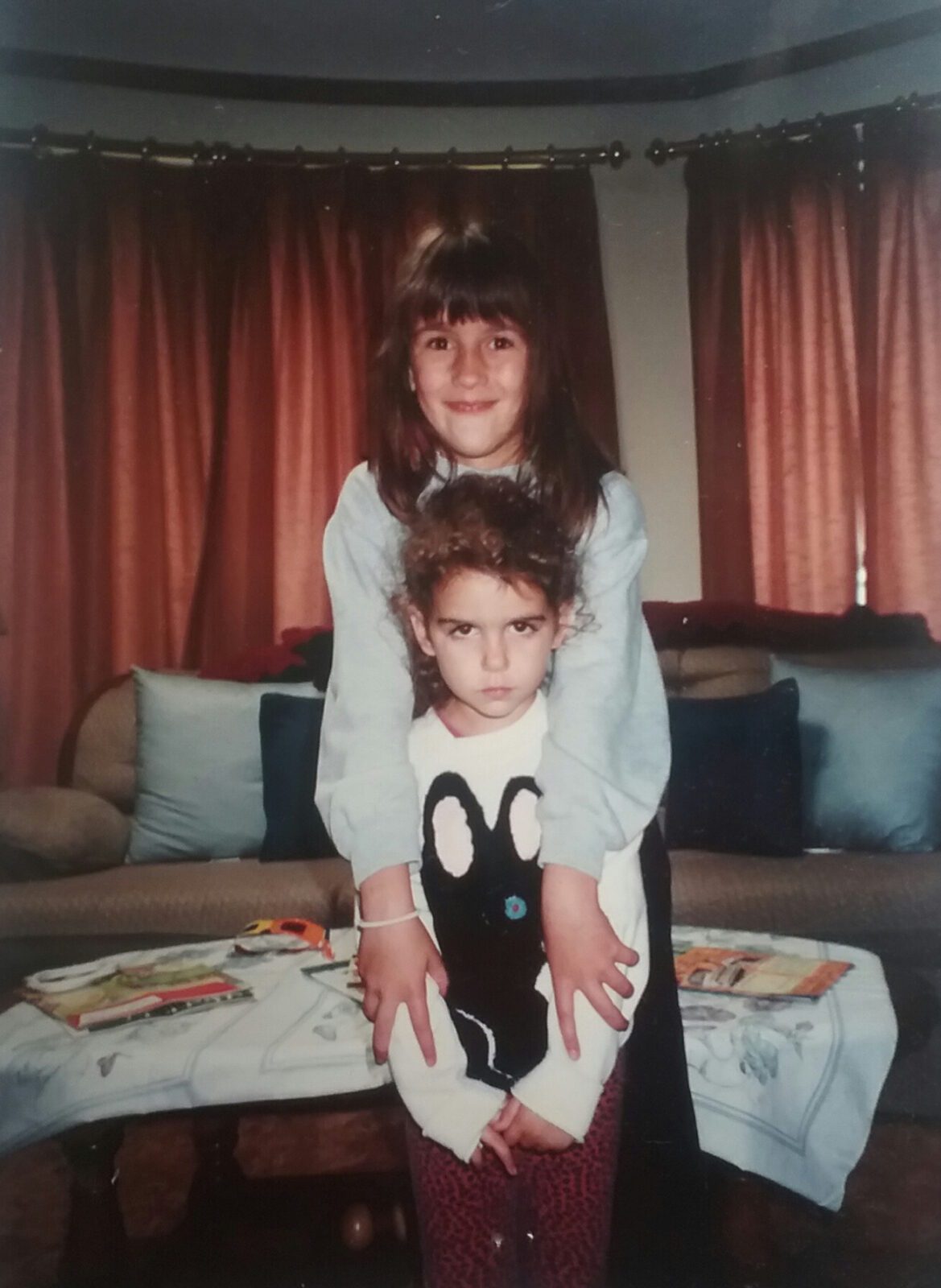
Our household was always a stride behind the times, and the only window to the cool kid world was through my big sister, Miranda. At five years my senior, she wasn’t always thrilled to share her secrets with me, however. Pleas to hang out in her room, watch her play AOL chat, and borrow any article of clothing were frequently denied. The latter was a pretty fair decision though, as an eight-year-old might have looked questionable in pleather snakeskin bellbottoms.

Her closet and clique of friends were off limits. Music, on the other hand, served as diplomatic territory, although I was never sure why. Maybe Miranda just needed an audience for her carefully choreographed dance routines to the pop gems she exposed me to. The moves for Ace of Base’s “Don’t Turn Around” for instance, featured literal interpretations of the lyrics: turning around, grabbing and “breaking” her heart, a bicep curl to show that she was “gonna be strong.” This was nuanced stuff, I tell ya, and I ogled over her creativity and grace. She was always better at dancing; had a long, lean dancer’s body that must have come from her biological father. My own frame couldn’t be more disparate: short and hippy with an inexplicably large ass. We look almost nothing alike.
Miranda was my mainline to the cool world. Her dance performances were sacred ceremonies that were known to us alone. Whether it was this consecrated exchange, or the music itself, I loved everything Miranda played for me…and singing along to that breakout Ace of Base record The Sign is one of the earliest memories of sisterly peacekeeping I can recall. We fought a lot, but so long as a pop song was playing, a ceasefire ensued long enough to dance and sing.

If there is one artist I associate with Miranda the most, it has to be Mariah Carey, whose 1995 masterpiece Daydream dominated our living room sound system. My sister knew every word, and therefore, I knew every word – kind of. “Always Be My Baby” and “Fantasy” were our favorite cuts, the latter inspiring many a dance performance. If I slipped up on the lyrics, I could always resort to the many “Sha-da-da-da-da-da-da-doos” throughout, while Miranda hit those “freestyle” high notes (with more passion than pitch per se). “One Sweet Day” was also a big one for us, as it was Mimi’s collaboration with another childhood staple: Boyz II Men. Listening now I realize “One Sweet Day” is about a dead person, speaking to Mariah from behind the grave, embodied in the sultry voices of Boyz II Men. But at the time we embraced it as a syrupy love song, and that was enough for us.

Those were the early days – when pop felt innocent (as we all say when we get older). Our favorite songs were about heartbreak, staying strong, dancing, and loving ghosts. Kid stuff! In a few years the pop paradigm would shift however, sprinkling our newly complicated lives with subversive content. By 1999 Miranda was a teenager, and I was an awkward 10-year-old completely adrift in a post-divorce family. My big sister was engaging in increasingly hazardous behavior, and our relationship was often on the rocks, to put it lightly. But despite our tumultuous sisterhood, I never stopped wanting to be a part of her clan. Sure, she may have been hanging out with the “bad kids” at school, and maybe she was even doing “bad things,” but she still looked fabulous.

I distinctly remember a trip Miranda, my mom, and I took to Southern California during spring break of ’99. We were visiting my grandparents, who lived a stone’s throw from the ocean in Huntington Beach – a place rife with all the beautiful tan people we didn’t have in rainy Washington State. There were swimming pools, and beach days, and ice cream trucks. We went to the glamorous South Coast Plaza mall, which had an Abercrombie and Fitch! Miranda procured a pair of purple pleather flair pants that fell low across her hipless body. I think they were from Spencer Gifts, or maybe Wet Seal – high-class establishments we had limited access to in our hometown. God I wanted those pants. It was as if Miranda knew that pleather was about to be the number one fashion look – because spring break of ’99 wasn’t just monumental for us – it was a big moment for Ms. Britney Spears, too.

Our grandparents had something we lacked: MTV. For years we didn’t even have basic cable, so it was a treat visiting Grandma and Grandpa, who were apparently much cooler than us. Few music memories are as clearly etched as sitting on their couch that trip and watching the video for “Oops!…I did It Again,” which mesmerized us. The pleather. The lip-gloss. The weave. The shoddy space narrative. The pleather!

It was a massive turning point in our musical education. Britney was “not that innocent” anymore, and neither were we. Our minds were further infected with pop’s sex appeal – for it was the same week that Pink’s revenge-tinged “There You Go” dropped, as well as Jay-Z’s “Big Pimpin,’” Crazy Town’s “Butterfly,” and of course, Sisqo’s “Thong Song.” Sisqo’s hit especially appealed to my young demographic, as “That thong-thong-thong-thong-thong” were super easy lyrics to remember. What a time to be 10.

Thanks to pop, and Miranda’s dutiful descriptions, that was the week I learned what a pimp was, what “come” meant (as in “Butterfly’s” “Come my lady, come come my lady”), and that letting your thong rise above your low-slung (pleather) pants was really cool. And called a “whale tail.”

It wasn’t long before I acquired my own pleather snakeskin pants, began anointing my forehead with a bindi a la Gwen Stefani, and for reasons I’ll never understand, started putting shimmery blue eye shadow on…my eyebrows. It was a sweet spot of time when my interests intersected with Miranda’s. Punk hadn’t quite entered my life yet to temporarily obliterate my love of melody. Back then, I loved everything she loved, simply because she loved it. I wanted to be the Monica to her Brandy in the video for “The Boy Is Mine.” I wanted to put on living room lip synch concerts to No Doubt’s “Spiderwebs” and Aaliyah’s “Try Again.”  And I must say – I still do.

PLAYING DETROIT: JR JR “Same Dark Places”

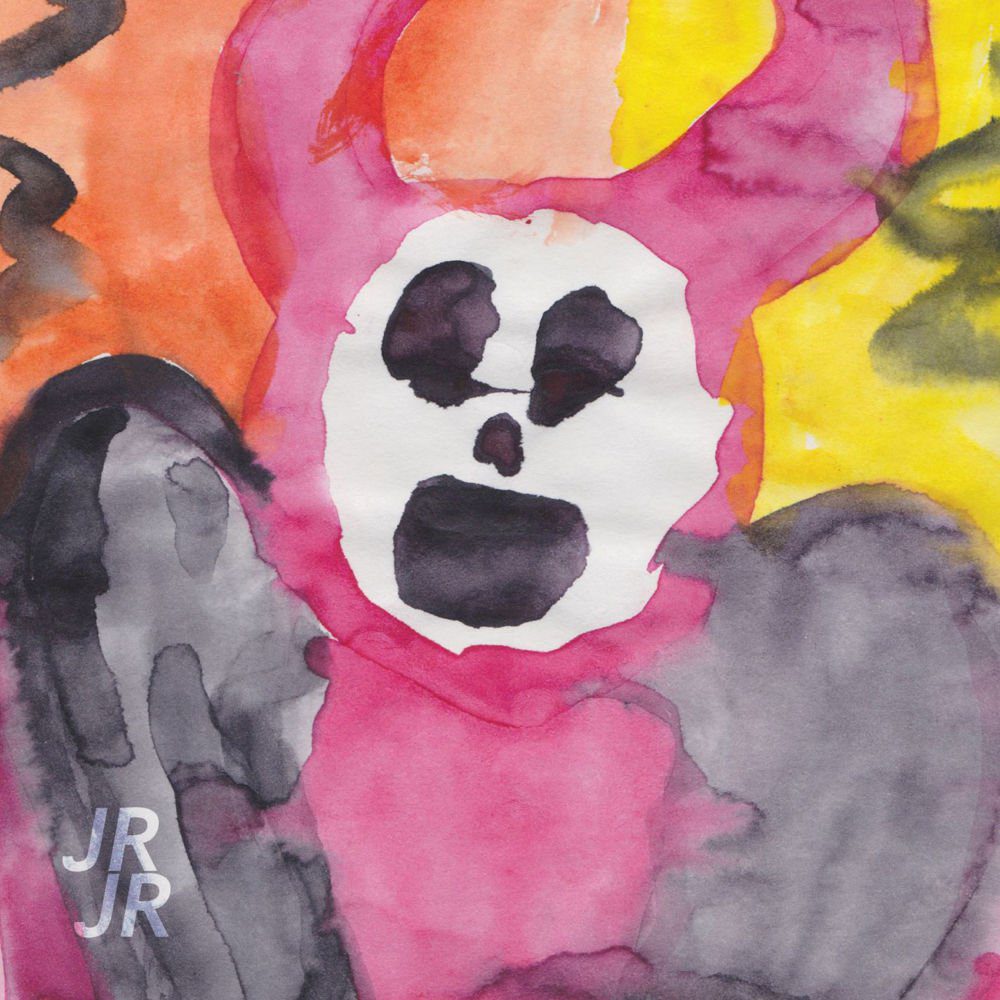
The first taste from JR JR forthcoming fourth record, “Same Dark Places” follows suit with what the duo does best: hook-dependent melodic pop menageries that feel more clever than sincere. If the duo’s 2015 hit “Gone” was a movie trailer for some generic teenage girl coming of age tale, then that would make “Same Dark Places” an ad for anti-depressant medication, the kind where the black and white shifts to color during the narration of common side-effects ending with cartoon bluebirds landing on the shoulder of some hesitantly happy real-life woman in a cardigan.

There are many masterful elements at play here, however, all of which make it nearly impossible to hate this song (which is what I really want to do.) First, there’s singer Josh Epstein’s thoughtful lyrical cadence. The words swell and bounce in such a way that his inflection alone could be listed in the credits as an instrument. And then, of course, there’s their reoccurring penchant for crafty arrangement and production. The fusion of Andrew Bird vibes (the layering of manic horns and sorrowful strings) meets The Lion King for Sega Genesis (this I can’t explain) meets that “LIVE. LAUGH. LOVE” wall hanging in your parents guest bedroom (okay, I’ll stop) would fool you into believing that JR JR woke up one day with this exact song, as you hear it now, in their heads. The drums feel like an afterthought and the lack of an end-point or clear resolve sink this track into “can’t-get-it-out-of-my-head-but-I-won’t-remember-it-five-years-from-now” territory. Although it was likely intended to be an anthem for swimming against the current, “Same Dark Places” merely treads water.

Let the light in and listen to “Same Dark Places” below:

[fusion_builder_container hundred_percent=”yes” overflow=”visible”][fusion_builder_row][fusion_builder_column type=”1_1″ background_position=”left top” background_color=”” border_size=”” border_color=”” border_style=”solid” spacing=”yes” background_image=”” background_repeat=”no-repeat” padding=”” margin_top=”0px” margin_bottom=”0px” class=”” id=”” animation_type=”” animation_speed=”0.3″ animation_direction=”left” hide_on_mobile=”no” center_content=”no” min_height=”none”][/fusion_builder_column][/fusion_builder_row][/fusion_builder_container]

LIVE REVIEW: Time Warp

Time Warp, an annual electronic music festival in Mannheim, Germany, represents all the worst things EDM culture has become. But before I get into the poor safety conditions, the utterly depressing morning after, and the most antisocial ravers I have ever seen, I’ll start with the one good part: the music.

I arrived around 12:30 p.m. and instantly started swaying to RØDHÅD’s dramatic buildups fading into understated dubstep beats. Behind him were extraterrestrial-looking designs, and the sound effects made me feel like I was inside an alien-attack arcade game. Then, Dubfire’s psychedelic set hypnotized me with low, growling vocals and crashing wave sounds as fish swam over the screen.

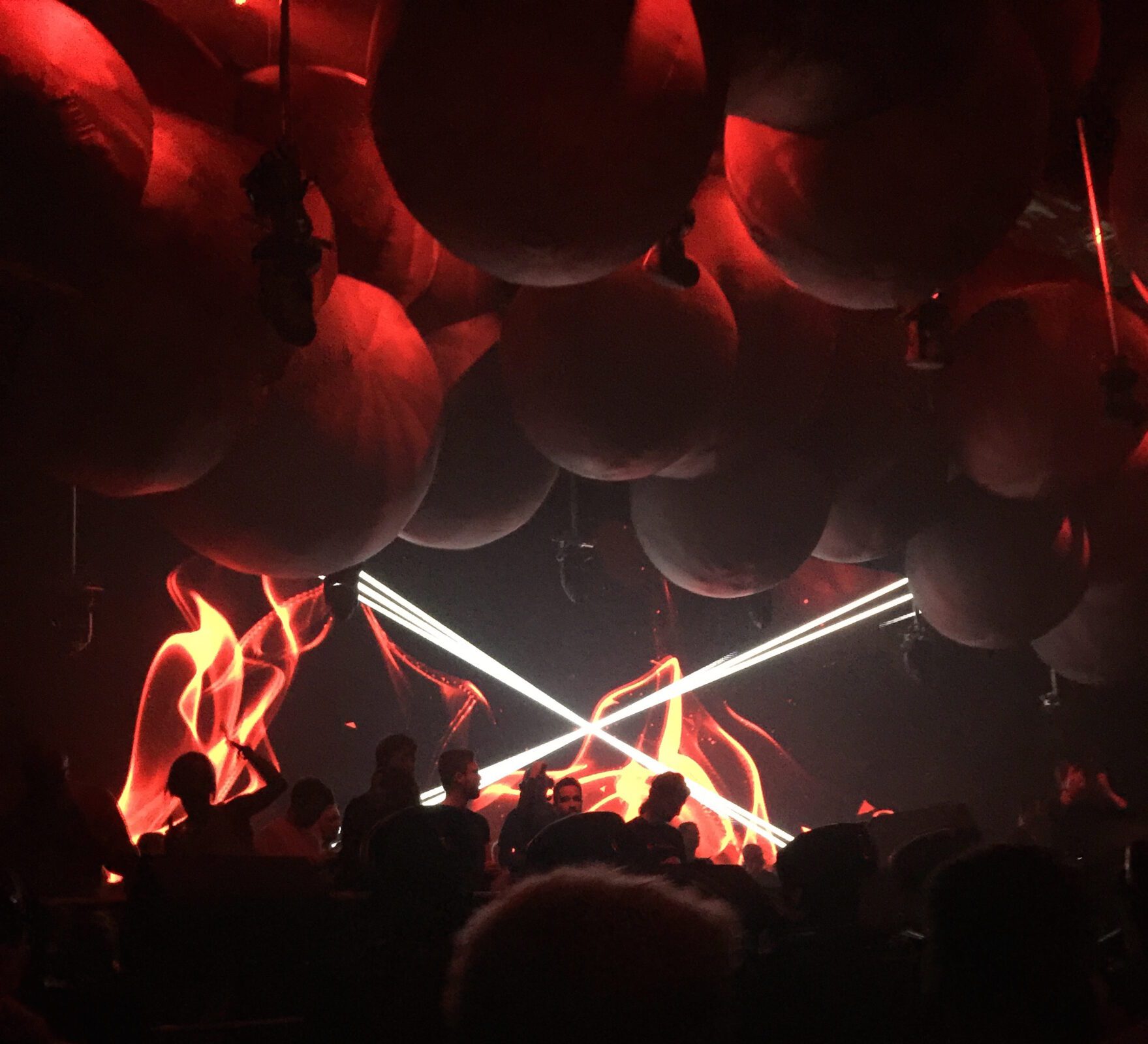
Next door, glowing red fangs appeared to swallow the stage where Chris Liebing performed, and beams of light shot down from the ceiling like lasers darting to high-pitched percussion.

But the highlight of the festival (or at least the pre-9 a.m. portion, because how does anyone make it past that point?) was Nina Kravitz’s set. Behind her were projections of bats, spiders, cobwebs, and ghosts. Some of the music gave off an appropriately witchy vibe, with menacing whispers and operatic instrumentals. Other portions transported us to a rainforest, with chirping and waterfall effects. At one point, she mixed Da Hool’s “Met Her At The Love Parade,” an ode to Germany’s famous (though now-defunct) EDM parade. We had to wait for ten minutes just to make it into the hall, once again proving that EDM’s gender problem does not result from a lack of good women DJs.

The first and second stages were connected, and if you stood in the underpass between them, you could catch two sounds at once, blending the tunes just by moving your body. I lingered there to hear the clash between Adam Beyer’s haunting orchestrals and Richie Hawtin’s upbeat, futuristic synths.

If you spent the entire time staring at the stages, the event lived up to its expectations. But aside from the fact that this would probably be a safety hazard due to the heat, that’s not all I go to music festivals for. I go to meet interesting people and make meaningful memories with them. And that’s where Time Warp fell flat, big time.

When my boyfriend and I asked to sit next to a group, they side-eyed us as if to ask why we would talk to them and turned away. We tried again with a guy sitting alone against a wall, but he’d passed out before we could open our mouths. Excluding those I came with, only three people spoke to me: one to apologize for burning a red circle onto my hand with his cigarette, and two to ask if I had ecstasy on me. When a festival runs from 7:30 p.m. on a Saturday to 2 p.m. on a Sunday, drugs go from a fun addition to a survival strategy. And people barely survived.

During my first attempt to get water, the stand only carried beer, so I had to find a new one. Once I did, they were out of water bottles and could only sell me a small cup. Meanwhile, just the feeling of my ponytail on my neck was unbearable, and I had to step outside every few minutes to escape the heat. Equally often, I saw someone escorting a semi-conscious friend out. At one point, smoke filled my lungs and trains of people flooded out coughing. Throughout the night and into the morning, I witnessed stretchers carried into the first aid tent.

I remember at the end of EDC Vegas last year, buses and cars lined up to bring us home. In the one I entered, someone put on Justin Bieber’s “Sorry,” and we all stood up and danced our way home. After EDC, everyone looked thrilled. After Time Warp, they looked defeated. That festival ate us alive and spit us out with blank expressions on our faces and giant bags under our eyes. I have never seen a sight as dreary as the zombies silently retreating from the concert halls to the Porta-potties that morning.

As an American expat in Germany, the party scene has been one of the biggest culture shocks. I now go out when I used to come home. I’ve grown accustomed to the orange and blue swirls of crushed pills on club floors. Along with an aversion to “commercial” music that makes them scoff at the DJs filling Vegas clubs, Europeans treat EDM like some extreme sport you must make your body suffer to take part in.

Maybe I’m just not well-versed in the art of raving. But I guess I’m OK with that. I’m still firmly in the camp that we can appreciate electronic music without sacrificing fun, safety, health, or camaraderie. And why not admit it: I’m not above that involving Justin Bieber.

BAND OF THE MONTH: Saltland

It might sound silly, but I can hear Rebecca Foon smiling through the telephone. The masterful cellist behind Esmerine, Thee Silver Mount Zion Memorial Orchestra, and her autonomous project Saltland is nothing but lovely – her beaming positivity a bit surprising given the sonic and thematic weight of her music. Foon’s latest record A Common Truth is a moving rumination on climate change – a topic to which she has dedicated a great portion of her career. There’s a reason why the album title sounds familiar, and when its underlying motif is revealed I ask Foon if she’s alluding to An Inconvenient Truththe global warming documentary from 2006.

“I guess you could say it’s a play on An Inconvenient Truth,” Foon admits. “I’m trying to talk about how this is our one and only planet and how climate change and the state of the world ties us all together. You can’t run away from climate change. You can to some extent depending on how much money you have, but at the end of the day we are all interconnected and we can’t hide.”

I can’t help but wonder how she remains so positive despite the world’s current state – Trump, glacial melt rates, water crises…how does she deal with the harsh reality and cynicism?

Serenely, Foon relays that she sees “problems as opportunities –climate change is an enormous problem, but it also presents incredible opportunities that can come from it by trying to address and fight it. And with that comes beautifully resilient, creative cities for example that are not dependent on fossil fuels. Imagining a world where all your favorite cities are not reliant on fossil fuels by 2050…to me that’s an exciting prospect and that’s something exciting to start to imagine and put energy into figuring out.”

Foon puts her energy into music, but also activism. A member of Sustainability Solutions Group, and co-founder of Junglekeepers and Pathway To Paris, the songwriter is a big proponent of the symbiotic relationship between art and ethics. “I think the arts and music have a huge role to play in terms of bringing a visceral, emotional and spiritual energy to politics and love,” she says. “This is our planet; this is our world. Do we want to go extinct? Let’s feel things, you know?”

You’ll certainly feel things while listening to A Common Truth, a dense ecosystem of live and looped cello – its raw and manipulated iterations conversing hypnotically. Foon’s ghostly vocals sew throughout her undulating compositions, several of which feature Warren Ellis of The Bad Seeds and The Dirty Three. It’s a match made in sorrowful string heaven.

When I ask her about working with Warren Ellis, Foon mentions that Nick Cave and The Bad Seeds’ recent record Skeleton Tree is one of her favorite LPs of all time. “That’s interesting because that record and A Common Truth are both sown from tragedy,” I say. Foon agrees, but her intrigue lies mostly in the chemistry Cave and Ellis conjure together.

“Nick Cave and Warren Ellis have an incredible musical connection and I really love Ellis’ chords,” she says. “The melodies that he can tap into are so deeply moving and very emotional and visceral. I think for me what stands out is that ability that they have to tap into a real emotional depth, which is something I really appreciate with music that I don’t feel very often.”

Foon is also a big Arthur Russell fan, identifying 1986’s World Of Echo as her favorite in his discography. This makes immediate sense to me. “I think your music really captures what he did as an artist,” I tell her. “You’ve both taken a classical instrument and stretched it to the bounds of its sonic potential. Has Russell influenced your approach to the cello at all?”

“Absolutely,” she assures me. “Huge influence for me. And it’s interesting with him because if you didn’t know his music, if you were to put it on it feels so relevant, you would maybe think it was made this year.”

Ok, so Nick Cave and Arthur Russell – I can see that, or rather, hear it. It’s Foon’s love for Marvin Gaye’s What’s Going On that catches me off guard a little bit, until I realize that, like Foon’s crusade for climate change, Gaye was making music about the defining political movement of his era.

Foon immediately confirms this. “I’ve always loved Marvin Gaye. I’ve been listening to that album lately, and the lyrics make me want to cry! He was talking about environmental degradation and humanity and the fact that we’re facing extinction and about loving our planet – his lyrics are super intense! It’s so crazy how relevant his lyrics are today, and that he was singing them in that time. I feel so deeply moved listening to him.”

“How about contemporary protest music? Any favorites?” I inquire.

“Matana Roberts, for sure. I think there are quite a few artists who are doing that not necessarily with words, but who are very tapped in. Anne Waldman, who’s a New York poet, is definitely a big source of inspiration for me, she’s really staying engaged in the world and writing about it. Even Thom Yorke, if you listen to some of his lyrics from the new Radiohead album, you can tell he’s engaged in climate change, which makes me so happy. There are a bunch of artists on Constellation [fusion_builder_container hundred_percent=”yes” overflow=”visible”][fusion_builder_row][fusion_builder_column type=”1_1″ background_position=”left top” background_color=”” border_size=”” border_color=”” border_style=”solid” spacing=”yes” background_image=”” background_repeat=”no-repeat” padding=”” margin_top=”0px” margin_bottom=”0px” class=”” id=”” animation_type=”” animation_speed=”0.3″ animation_direction=”left” hide_on_mobile=”no” center_content=”no” min_height=”none”][Saltland’s record label] who are doing the same thing; Constellation seems to tap into artists who are engaged with the state of the world, which is inspiring to be around.”

“You seem to be very appreciative of the collective in that way – can you speak about the importance of being collaborative – whether it’s in art or activism?”

I can hear her light up. “Oh yeah, I love it. I really feel that we’re only as good as our collective ideas. I don’t really believe in an individual idea. I think the best ideas come from being worked and rehashed through collaboration where ego’s not a part of it and it’s just for the sake of making the idea better. With music I think it’s really beautiful when you can collaborate with people you respect and admire and see what comes out and really put ego aside. I live for moments like that – I find it really spiritual too, that process.”

Foon’s approach to activism is collaborative as well – focusing on community-based organizing, whether it’s pressuring your Mayor to implement sustainable initiatives, envisioning a future independent of fossil fuels, or addressing climate change at city council meetings. She is a humble visionary; an altruistic artist in an often cynical industry.

So: if Rebecca Foon could have her audience take away one thing from her music, what would it be?

“I think at the end of the day, because it’s just a record, I’m just trying to create a space where I can channel music from an open heart to try to access something that’s within me and communicate with others something that’s honest,” she says. “All that I hope for is to cultivate that kind of energy amongst listeners, and to inspire an honest dialogue around the state of the world, because I do feel there is an obligation at this point with artists to honestly engage with what is really going on around us. I feel we’re in a state of emergency.”


A Common Truth is out now on Constellation Records; she’ll play National Sawdust on April 7 and tours Europe with Esmerine throughout spring.

[/fusion_builder_column][/fusion_builder_row][/fusion_builder_container]

NEWS ROUNDUP: Kendrick Lamar, Brexit’s Musical Consequences & More

  • Kendrick Lamar Releases “Humble”

    “Wicked or weakness, you gotta see this.” Last night, the rapper released “Humble,” a visually stunning video that features Lamar dressed as a pope and recreating the last supper, among other things. The songs itself is full of low-key bravado, instructing other unnamed artists to “be humble.” Watch below:

  • How Will Brexit Affect The UK Music Scene?

    The answer is, badly. If Britain leaves the EU, it could be harder for musicians to tour across Europe due to visa issues and stricter border control, and it could lead to “currency fluctuation and/or devaluation alongside other commercial restrictions [fusion_builder_container hundred_percent=”yes” overflow=”visible”][fusion_builder_row][fusion_builder_column type=”1_1″ background_position=”left top” background_color=”” border_size=”” border_color=”” border_style=”solid” spacing=”yes” background_image=”” background_repeat=”no-repeat” padding=”” margin_top=”0px” margin_bottom=”0px” class=”” id=”” animation_type=”” animation_speed=”0.3″ animation_direction=”left” hide_on_mobile=”no” center_content=”no” min_height=”none”][that] will impact first and foremost on new bands taking trying to break into Europe.” The situation slightly mirrors the recent struggles of international artists who were turned back as they tried to attend SXSW. Read more about the Brexit situation here.

  • Union Hall Cancels Shows Due To Fire

    The cause has yet to be disclosed, but a fire that broke out last Friday has forced the Park Slope venue to cancel all April shows. Luckily, there were no injuries. A statement by the venue says they hope to reopen as quickly as possible, but they’re still assessing the damage.

  • Bob Dylan’s Triplicate Comes Out Today

    Yes, it’s another album of covers: 30 of them, to be exact. Dylan did an interview with Bill Flanagan last week, and revealed some details and intent behind it, such as that the album was recorded live, with no overdubs, and “these songs are meant for the man on the street, the common man, the everyday person.” Dylan adds, “Maybe that is a Bob Dylan fan, maybe not, I don’t know.” Listen to Triplicate’s “My One And Only Love” below.

https://www.youtube.com/watch?v=rTTNu3wkXM8

https://www.youtube.com/watch?v=iWdoi1M9vrM[/fusion_builder_column][/fusion_builder_row][/fusion_builder_container]

VIDEO PREMIERE: Mizuna “And I Do”

[fusion_builder_container hundred_percent=”yes” overflow=”visible”][fusion_builder_row][fusion_builder_column type=”1_1″ background_position=”left top” background_color=”” border_size=”” border_color=”” border_style=”solid” spacing=”yes” background_image=”” background_repeat=”no-repeat” padding=”” margin_top=”0px” margin_bottom=”0px” class=”” id=”” animation_type=”” animation_speed=”0.3″ animation_direction=”left” hide_on_mobile=”no” center_content=”no” min_height=”none”]

Photo by Felix Chan.

New York-by-way-of-Maine-based duo Mizuna invite you to escape your hectic week in their new music video for the single “And I Do” off of their debut album, From Away, From Here.

Despite spending their childhood together in Maine, Genviève Beaudoin and Mackenzie Leighton aptly became friends in a poetry class at New York University (where I also met the girls), after which they continued sharing their work. Though serendipitous in their reunion, their voices were made to harmonize with one another, melding together like warm tea and honey.

Those voices carry the sentimental quality of lines such as, “Sour so much I taste, harder bitter your love is so/I know I’ll see you on the street.” Genviève recalled that she first wrote this verse in the spring of 2012, and didn’t return to it until the making of the album last summer.  “I came upon the demo this past August, a time when I was feeling the weight of a pretty sore break-up,” she revealed.  “And it surprised me how real that verse had come to be.”

The lyrics go hand in hand with aged footage of cloudy skies and telephone lines, and the film grain crackling across cropped-haired ladies in one-piece swimsuits in the video directed by Victoria Deleone.

From Away, From Here, released independently for streaming in January, was recently made available for physical purchase via bandcamp as well.  The sublime debut features a catalog of warm sounds that make sense of being between places called home.

Check out our exclusive premiere of the dreamy music video for “And I Do” below, and be sure to catch Mizuna at Brooklyn’s Pete’s Candy Store on April 1.

https://www.youtube.com/watch?v=-Ul4WzBKWNA&app=desktop[/fusion_builder_column][/fusion_builder_row][/fusion_builder_container]

ALBUM PREMIERE: I Am The Polish Army “My Old Man”

I Am The Polish Army is a Brooklyn-based three-piece led by Emma DeCorsey on vocals and guitar, joined by Eric Kuby on drums, and Turner Stough on the bass. The trio’s debut LP My Old Man comes out tomorrow, and is available to stream today via yours truly. Their sound directly references some of my favorite classic/alt-rock and grunge of yore – styles that are a dying breed in today’s era of high gloss electro and experimental pop, making for a totally refreshing yet ironically nostalgic experience (think if The Breeders and Hole were to join forces and make an album vis-a-vis modern production capabilities.) Emma’s sharp, drone-y vocals cut like a knife through loud, heavy-handed guitar melodies in opening track, “You Don’t Know”, captivating our attention for what they have in store for our ears. As the album unfurls, Charles Burst’s (Neko Case, Psychic Ills, Crystal Stilts) deft engineering behind each track becomes discernible (and is highly appreciated!!). In songs like “David Bowie” – an ode to/lament of erstwhile and dead musical icons – the mix is so perfectly balanced that I found myself easily lost in it, especially toward the end when Emma’s vocal harmonies come in.

Toward the middle of the album on tracks like “Throat” and “Dead Cat”, the band’s emotional energy and fervor reaches a new fever pitch, unexpectedly veering the sound towards a more metal vibe, with propulsive drums and brooding, screeching guitar lines, grafting Emma’s direct and confrontational vocals in seamlessly. “Set Up” surprised  me with another directional shift in genre, showcasing way more 70s style guitar melodies that harken back to Grateful Dead or The Who. Yet overall it still emphasizes angsty, derisive lyrics juxtaposed by lush, structured vocal harmonies. I was left feeling delightfully unsettled by this track (and have pretty much decided it’s my favorite on the album.)

“Woods” and “Gene” bring us full circle back to the band’s original musical conceit: solid, mid-tempo rock defined by blistering guitar solos and Emma’s insistent, unwavering voice and sassy lyrics. Title track “My Old Man” is way more stripped down in the opening measures, with a simple bass line and rhythm guitar. As the verse escalates into a more cacophonous chorus, it becomes clear that the story is about a Lower East Side sex predator, making the emotional intensity pack all the more punch, and compelling me to go back and listen more closely to each track to decipher the storytelling behind the album as a whole. This feat alone makes the project a success in my opinion.

I Am The Polish Army will be performing their album release show at the Gutter, tomorrow (3/31), joined by Tuff Sunshine and the Royal They, more info here. In the meantime dive into “My Old Man” below.

LIVE REVIEW: Sleigh Bells @The El Rey

In 2010, I woke up each day in Queens, NY and took the N train to the Flatiron district. The walk from the train stop to the publishing company where I worked was just enough time to listen to a few songs off Sleigh Bell’s first album Treats. The blare of “Tell ‘Em” was the shot of adrenaline I needed each morning. Seven years and another coast later, I was about to see them live for the first time, and feeling a little anxious.

Luckily, opener Tunde Olaniran was beyond welcoming. “This is a safe space,” he said warmly, spreading his arms out slowly as the opening crickets of “The Highway” filled the El Rey. Olaniran commands the stage like a mystic healer in a Broadway musical, his two background dancers acting as as extensions of his own body, moving and twisting about him. In 2014, Tunde told AudioFemme’s Lindsey Rhoades “I come from the band mentality where people pay their money, you gotta give ‘em show. So I really just try to incorporate choreography, movement, fun pop, really hard hitting beats.” Olaniran doesn’t disappoint. He manages to convey difficult topics like homophobia, violence, and racism within a tight package of syncopated beats and soaring vocals. When he asked those in the audience who don’t normally dance to dance, the air in the room shifted as people obliged.

[fusion_builder_container hundred_percent=”yes” overflow=”visible”][fusion_builder_row][fusion_builder_column type=”1_1″ background_position=”left top” background_color=”” border_size=”” border_color=”” border_style=”solid” spacing=”yes” background_image=”” background_repeat=”no-repeat” padding=”” margin_top=”0px” margin_bottom=”0px” class=”” id=”” animation_type=”” animation_speed=”0.3″ animation_direction=”left” hide_on_mobile=”no” center_content=”no” min_height=”none”][fusion_soundcloud url=”https://api.soundcloud.com/tracks/275266745″ params=”color=ff5500&auto_play=false&hide_related=false&show_comments=true&show_user=true&show_reposts=false” width=”100%” height=”166″ iframe=”true” /]

Jessica Rabbit, Sleigh Bells’ fourth studio album, has received mixed reviews overall, with Pitchfork calling the album a “hodgepodge of clashing sounds and concepts that’s united only by its indiscriminate maximalism.” The reviews gave me pause as I listened to the new material and revisited Treats. The school-girl edge of their early catalogue has morphed over the years, taking a turn for metal. After an initial listen, I wasn’t thrilled with the change. Stretching my calf muscles in preparation for high energy jumping (my only dance move), I worried I might leave disappointed.

Lead singer Alexis Krauss bounded out to the sounds of fans cheering from the darkness; her positive energy was immediate and galvanizing. Initially the brain-child of guitarist Derek Miller, Sleigh Bells has matured to become a more balanced collaboration between Krauss and Miller. Alexis’s vocals take center stage on much of the new album, sometimes battling Miller’s guitar riffs in songs like “It’s Just Us Now” and “Lightning Turns Sawdust Gold”.

[/fusion_builder_column][fusion_builder_column type=”1_1″ background_position=”left top” background_color=”” border_size=”” border_color=”” border_style=”solid” spacing=”yes” background_image=”” background_repeat=”no-repeat” padding=”” margin_top=”0px” margin_bottom=”0px” class=”” id=”” animation_type=”” animation_speed=”0.3″ animation_direction=”left” hide_on_mobile=”no” center_content=”no” min_height=”none”][fusion_soundcloud url=”https://api.soundcloud.com/tracks/290450808″ params=”color=ff5500&auto_play=false&hide_related=false&show_comments=true&show_user=true&show_reposts=false” width=”100%” height=”166″ iframe=”true” /]

Old favorites like “Infinity Guitars” and “Kids” were easy crowd pleasers; Krauss got up close and personal with the front row, encouraging them to shout the lyrics. The show felt like a Richard Simmons workout video: Krauss, our emo leader, screaming at us “Sing louder! Dance harder!”. Tunde Olaniran and his dancers joined Sleigh Bells on stage toward the end of the show, creating a sense of chaos that seemed apropos. There was no encore, the crowd left spent, and for some…sore. The morning after the show, I put on Jessica Rabbit. It was time for another listen.[/fusion_builder_column][/fusion_builder_row][/fusion_builder_container]

ONLY NOISE: Kill Your Idols

Bob Dylan is finally going to accept his Nobel Prize…with a taped lecture. Ed Sheeran is losing his “nice guy” status and getting called out as a blatant misogynist. Even in death, Chuck Berry can’t escape his reputation as a scat-loving pederast.

We listen to them. We love them. We live for what they do. Hell, I make my wages writing about them. But let’s face it: musicians can be massive assholes.

Entering adulthood, we all experience the humanizing of our parents. The great gods of early childhood, those people who said that yes, you could watch Beavis and Butthead, but, no, you could not watch Pulp Fiction; those adults who taught you “right” from “wrong” and “cooking sherry” from “sipping sherry” – they are just people. As we age, their humanity – with all its foibles – comes into better focus, and we forgive them as they relinquish their post on the pedestal.

So if we’re able to endure the humbling of our own parents, why are we so devastated by the mortal trappings of the famous? Furthermore: why do we put rock stars on a pedestal to begin with?

Because: Fandom. That temporary (or life-long) insanity that made teenagers convulse for four mop-topped Brits, and grown women sexualize teen Bieber.

I was thinking about the word “fan,” which I suspect is connected to the word “fanatic” etymologically. And sure enough, my Googles confirm that “fan” is in fact, “a late 19th century abbreviation of fanatic.”

And what about “fanatic”?

“…The adjective originally described behavior or speech that might result from possession by a god or demon…”

We’re not Beliebers. We’re possessed by demons. In truth, a lot of fan-related content surrounding Bieber does resemble Pentecostal seizures.

But there is a difference between being a fan and a demon-possessed Belieber – right? Perhaps that gap is smaller than we assume.

I’d like to think of myself as someone who is rationally distanced from celebrity gossip, and for the most part I steer clear of tabloid rags – but what do you do when it’s your favorite artist under fire, and for good reason? You feel the pain of betrayal. Like when Mariah lip synched her way through New Year’s Eve.

A couple of months ago the erudite and envelope-pushing Brian Eno released his ambient record Reflections. It was but another stroke of brilliance from a man who’s had a seismic impact on most of the music I love – as both a producer and an innovator. My adoration for Brian Eno (or, as I referred to him in my head alone, Bri-Bri Eno) reached its zenith in 2015, when he delivered the distinguished BBC Music John Peel Lecture. His voice: so soothing. His scalp: so shiny. He even (kind of) made jokes!  I had what you could call a serious brain crush on Bri-Bri Eno. There was a calm wisdom emanating from him at all times; a breed of serenity mirrored in his ambient soundscapes.

And then. Reporter Simon Hattenstone ran an interview with Eno in The Guardian that changed my perception of the artist forever. What began as a genial convo about art turned into sizzling vitriol spouting from the mouth of an unmannered diva. After merely asking a question about the history of Eno’s bizarre, long-winded full name (Brian Peter George St John le Baptiste de la Salle Eno), Hattenstone was met with outrage from the artist: “God, are we going to do any interesting questions? This is all bollocks. I’m not fucking interested at all in me. I want to talk about ideas. Can we do any of that?”

Rude. From then on the interview oscillated between forced diplomacy and whacky, insolent outbursts from Eno. Hattenstone kept his composure throughout, and rather eloquently defended himself against Brian Meano.

I was in shock. On the one hand, I felt a sense of solidarity with a music journalist just trying to do his job in the presence of a genius. On the other hand I was an enormous fan of Eno’s; a crushed fan who couldn’t believe that one of my favorite artists was, well, a belittling asshole. Of course that appraisal isn’t entirely merited by one messy interview, but my reaction was. The one-sided contract between the fan and the famous had been breached; he’d shown his toothy, human side – and I didn’t want to see it.

This must be a common phenomenon. The fall of icons. That crazy sense of betrayal we feel when someone we have never met does something we can’t stand. But is the Judas effect any more bonkers than the fact that we allowed ourselves to fall in love with a famous stranger to begin with? Probably not.

Any fan of Morrissey knows treachery well. A charming man indeed: his sex appeal, sensitivity, and bookishness (those glasses) made people crazy for decades. I mean, when I was 20, I waltzed into a salon and told them, “I want Morrissey hair.”

But what a dick?! This is the man who screwed his hardworking Smith-mates out of large sums of money, called the Chinese people a “subspecies,” and more recently issued a t-shirt with James Baldwin on the front reading: “I wear black on the outside ‘cause black is how I feel on the inside…” And then there is “Morrissey” written on the bottom left – smack on Baldwin’s shoulder.

No. Just no.

I wondered if I was the only sad bastard who actually felt hurt by rock star fuck-ups. It’s an absurd dilemma – but a real one nonetheless.

A favorite example came from fellow music journalist Allison Hussey, who covered a Sun Kil Moon gig for Indy Week in 2014. Like a good, I don’t know, journalist, Hussey reported the truth, which was sadly that SKM frontman Mark Kozelek was an insufferable prick the entire set. Hussey, of course, used far kinder words in her recap, stating that, “because the show was at the Lincoln Theatre, people were chatty, as all Lincoln Theatre crowds will be. Kozelek was displeased with this, and let the crowd know it by demanding that the ‘fucking hillbillies’ shut the fuck up before he’d strum a single note.”

Instead of ignoring an unflattering review like most artists do, Kozelek then “wrote a song about me where he called me a bitch,” Hussey recounts. “It was…an interesting roller coaster.”

Even my dad had a tale of rock star boorishness, though his was not of a beloved musician, per se. My dad has spent most of his life working in the music industry, whether as a record store owner, a musician, or a pro audio salesman. During the latter vocation, he crossed paths with a certain Guns N’ Roses guitarist.

“Slash was a total egotistic d-bag,” he relayed. “Spent an entire afternoon around him at a music show in Ventura, California around ’88 or ’89. He pranced around and acted like he was King, and everyone else were serfs.”

Ok, so Slash being a douchebag isn’t exactly breaking news, but you always hope that in the face of all odds, he might deflect his own stereotype.

In all of my crowdsourcing for quotes about artist meet-and-greets gone wrong, there were tales of Joe Jackson being “cheap and pompous” to a server, a comment about Puddle of Mudd’s Wesley Scantlin being a “jerk,” (shocker) and damnations of Madonna. But amongst the slew of dirt, one friend piped up to say that, “all the [fusion_builder_container hundred_percent=”yes” overflow=”visible”][fusion_builder_row][fusion_builder_column type=”1_1″ background_position=”left top” background_color=”” border_size=”” border_color=”” border_style=”solid” spacing=”yes” background_image=”” background_repeat=”no-repeat” padding=”” margin_top=”0px” margin_bottom=”0px” class=”” id=”” animation_type=”” animation_speed=”0.3″ animation_direction=”left” hide_on_mobile=”no” center_content=”no” min_height=”none”][musicians] I’ve met were very nice, especially Ric Ocasek.”

So I guess there’s hope, after all.

[/fusion_builder_column][/fusion_builder_row][/fusion_builder_container]

PLAYING DETROIT: A Springtime Playlist

There is an undeniable shift in self when the clocks return to their forward position and warmer days begin to outnumber the cold ones. Spring, though different depending on your geographic specifics, happens under the same sky at just about the same time. Perhaps you’re like me and mending a broken heart after the end of what can only be described as a cruel internal winter, looking forward to dusting off, stretching out and starting over. But whatever version of spring suits you best, let these emotionally selected tracks from Detroit’s vast pool of feelings-feelers guide you through the waves of change.

Zoos of Berlin: “North Star on the Hill”

[fusion_builder_container hundred_percent=”yes” overflow=”visible”][fusion_builder_row][fusion_builder_column type=”1_1″ background_position=”left top” background_color=”” border_size=”” border_color=”” border_style=”solid” spacing=”yes” background_image=”” background_repeat=”no-repeat” padding=”” margin_top=”0px” margin_bottom=”0px” class=”” id=”” animation_type=”” animation_speed=”0.3″ animation_direction=”left” hide_on_mobile=”no” center_content=”no” min_height=”none”]

The Bowie-esque closing track on Zoos of Berlin’s groundbreaking return from hiatus, last year’s Instant Evening, swirls like winter’s final snow against new growth on your favorite neighborhood tree. “North Star on the Hill” encapsulates hesitance and imbalance but with a fragility suited for this polarized change in season.

Anna Ash: “Player” 

[/fusion_builder_column][fusion_builder_column type=”1_1″ background_position=”left top” background_color=”” border_size=”” border_color=”” border_style=”solid” spacing=”yes” background_image=”” background_repeat=”no-repeat” padding=”” margin_top=”0px” margin_bottom=”0px” class=”” id=”” animation_type=”” animation_speed=”0.3″ animation_direction=”left” hide_on_mobile=”no” center_content=”no” min_height=”none”]

Yeah, okay. It’s no secret that I can’t get enough of Michigan native and songstress/sorceress Anna Ash’s 2016 release Floodlights. Her Lucinda Williams-esque warble and her completely unique vocal warmth could melt the most stubborn frost from the windshield of your equally stubborn ’89 Cutlass. “Player” is timeless and sun-soaked (why do I feel like it could be on the Erin Brockovich soundtrack or, like, Ally McBeal?) but what makes it a great addition to this seasonal transition is her ability to meld vulnerability with hair-flipping  “I-told-you-so” vibes.

Minihorse: “Drink You Dry” 

[/fusion_builder_column][fusion_builder_column type=”1_1″ background_position=”left top” background_color=”” border_size=”” border_color=”” border_style=”solid” spacing=”yes” background_image=”” background_repeat=”no-repeat” padding=”” margin_top=”0px” margin_bottom=”0px” class=”” id=”” animation_type=”” animation_speed=”0.3″ animation_direction=”left” hide_on_mobile=”no” center_content=”no” min_height=”none”]

I’m not the biggest Minihorse fan. Or maybe it was a timing thing when they dropped their fuzzy, lo-fi EP Big Lack last year. But hey. I sort of get it now. “Drink You Dry” is laced with memories of riding around in your girlfriend’s ex-boyfriend’s best friend’s backseat while you may or may not be day-drunk, trying not to get dizzy watching the blur of houses and trees from the lap of someone you met once. It’s an afternoon. It’s boredom. It’s quietly and politely reckless. And in a lot of ways, it’s Spring.

Saturday Looks Good to Me: “No Good With Secrets” 

[/fusion_builder_column][fusion_builder_column type=”1_1″ background_position=”left top” background_color=”” border_size=”” border_color=”” border_style=”solid” spacing=”yes” background_image=”” background_repeat=”no-repeat” padding=”” margin_top=”0px” margin_bottom=”0px” class=”” id=”” animation_type=”” animation_speed=”0.3″ animation_direction=”left” hide_on_mobile=”no” center_content=”no” min_height=”none”]

There’s something so nervous and sweet about this 2005 release from one of our most beloved indie pop acts Saturday Looks Good to Me. Led by the incomparable Fred Thomas, “No Good With Secrets” embodies an innocence and aimlessness that tugs on our teenage heartstrings but 12 years later makes space for our adult selves as we still carry those bashfully brazen tendencies to drive by someone’s house (even if they can’t come out to play.)

Deadbeat Beat: “When the Sun Soaks in” 

[/fusion_builder_column][fusion_builder_column type=”1_1″ background_position=”left top” background_color=”” border_size=”” border_color=”” border_style=”solid” spacing=”yes” background_image=”” background_repeat=”no-repeat” padding=”” margin_top=”0px” margin_bottom=”0px” class=”” id=”” animation_type=”” animation_speed=”0.3″ animation_direction=”left” hide_on_mobile=”no” center_content=”no” min_height=”none”]

Maybe I’m getting a little too literal, but there is something perfectly riotous and manic about Deadbeat Beat’s “When the Sun Soaks In.”  It elicits that moment you realize you don’t need a jacket to leave the house and how the sight of your own bare arms turns you on. A fusion of a 1960’s beach party and a 90’s make-out session, this track is equal to smelling salts or pheromones for our shared and stagnant winter coma.

JR JR: “Gone” 

[/fusion_builder_column][fusion_builder_column type=”1_1″ background_position=”left top” background_color=”” border_size=”” border_color=”” border_style=”solid” spacing=”yes” background_image=”” background_repeat=”no-repeat” padding=”” margin_top=”0px” margin_bottom=”0px” class=”” id=”” animation_type=”” animation_speed=”0.3″ animation_direction=”left” hide_on_mobile=”no” center_content=”no” min_height=”none”]

The truth is, I’ve spent more time over the past two years trying to convince myself that I like JrJr than I have actually spent liking JrJr. The verdict? I don’t get the hype or the Warner Brothers continuous record deal. This song, however, is insufferably Spring and is so infectious that you may as well make an appointment with a licensed physician or psychiatrist because even when the song ends the whistling will go on and on and on…and on. I’m sure you’re wondering why a respected music journalist with what some would say exquisite taste would include something that makes her so despairingly nauseous on a playlist about Spring. The answer is simple. “Gone” is carefully crafted to make you feel invincible. It’s a look back, a look forward and ultimately it’s about leaving what is truly gone in the dust to never be found again. This will be the last time I ever listen to this song willingly. But maybe for you, the right person in the right moment, you’ll see “the light through the trees.”[/fusion_builder_column][/fusion_builder_row][/fusion_builder_container]

TRACK PREMIERE: Mimi Raver “Creatures Of Habit”

The album art for Mimi Raver’s upcoming LP ’06 Female will give you an insight into the songwriter’s knack for duality. At first glance, the cover for Raver’s imminent release bears the precious, painterly image of a grey tabby, sitting pretty by a Kelly green couch. On closer inspection: droplets of blood color the cat’s mouth…and then you see the dead seagull, punctured and pinned between kitty’s paws.

The same secretly sinister allure is at play on Raver’s new single, “Creatures Of Habit,” which digs far deeper than its “bedroom pop” branding suggests. Raver’s music has also been branded as “analog,” which is far more fitting given the warm tape hiss that greets you in the opening bars of  “Creatures Of Habit.” Mimi Raver feels close. Very, very close. Her voice is too interesting to call a whisper, but it is made of a similar softness – gliding lithely on top of pitchy rhythm guitar. So it’s all the more surprising when she coos:

“Frank fell in the kitchen again/And he smashed his head on the window sill/Said he saw his wife at the door/But she’s been gone since 2004.”

Raver’s breed of “dream pop” plumbs far greater depths than songs about chilling at the beach. As for her approach to form, Raver has taken great care to convert her love of analog photography to an album exalting the messiness of tape recording. The entirety of ’06 Female was laid down on a Teac-3440 A 4-track reel-to-reel tape machine, which accounts for the wonderful graininess throughout.

Raver’s subtle songwriting is equally intriguing as her ability to harness discomfort so beautifully – and utilize the unexpected effects of her recording method. As “Creatures Of Habit” tapers off, warbling voices clamor in conversation – a result of radio signals the tape machine picked up from nearby broadcasting stations.

Raver is a quietly captivating songwriter; one that can merge the eerie and the intimate, the analog and contemporary, and a sordid sweetness that makes you want to hear more from her. Much more.

Stream our exclusive premiere of Mimi Raver’s “Creatures of Habit” below; ’06 Female arrives this April.