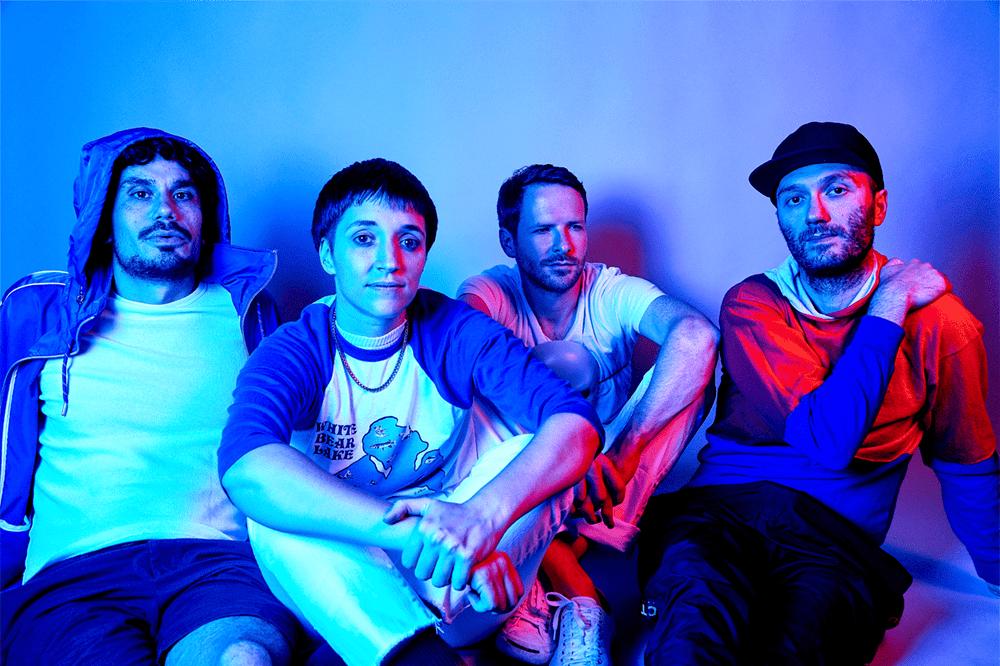
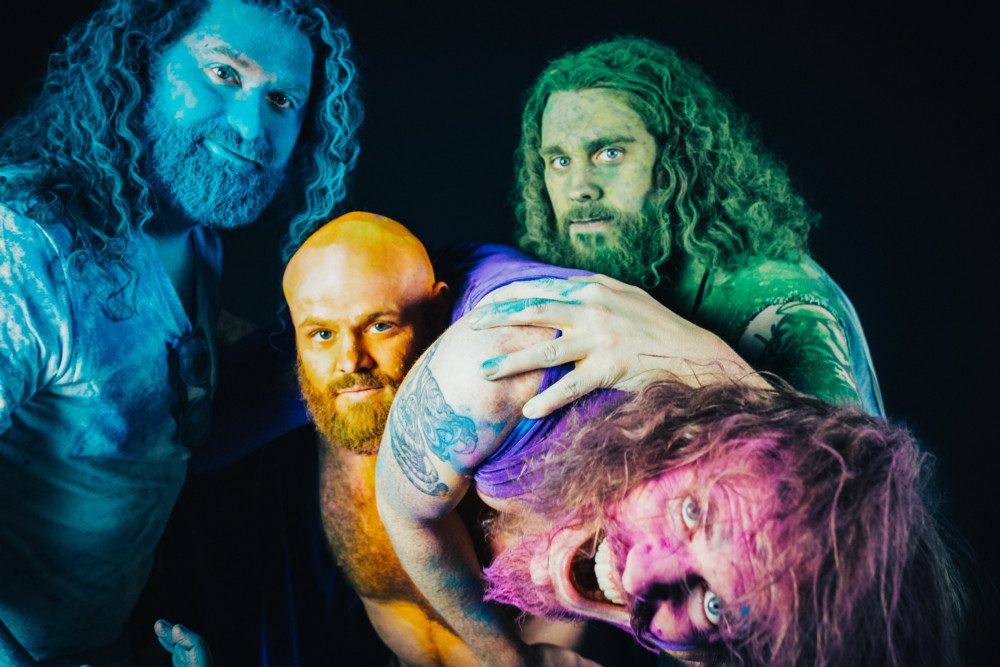
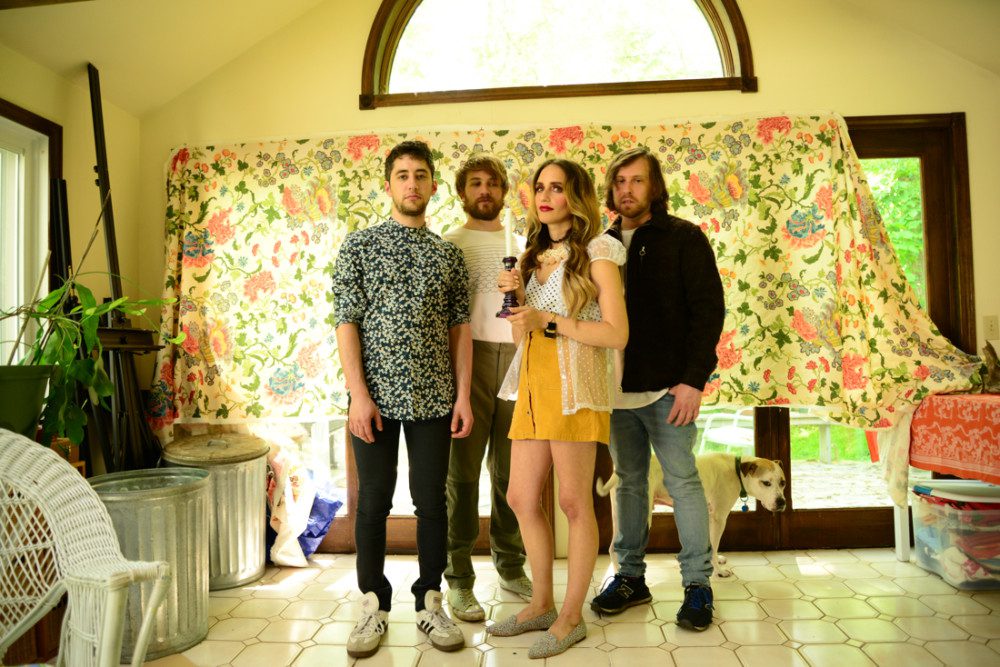
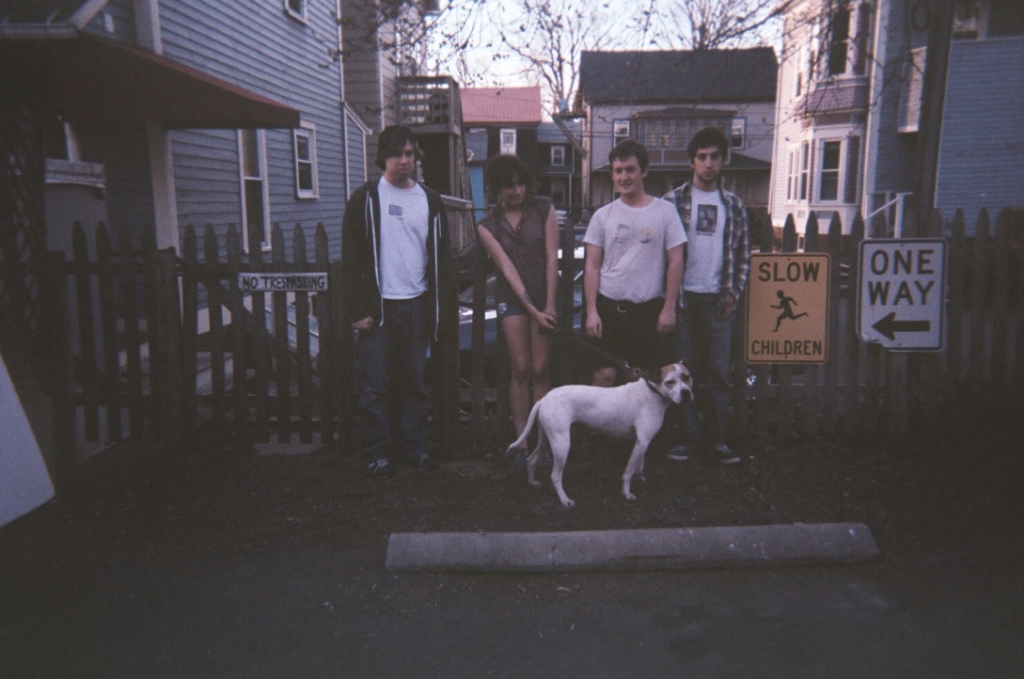
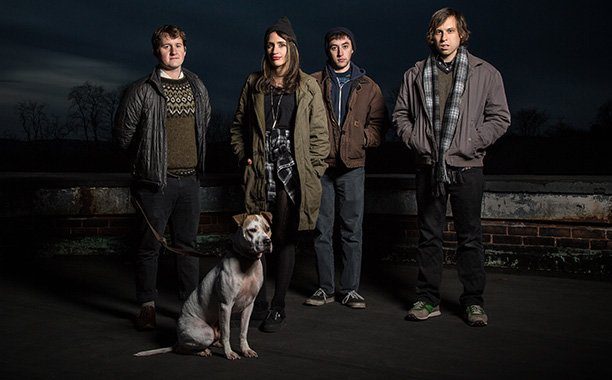
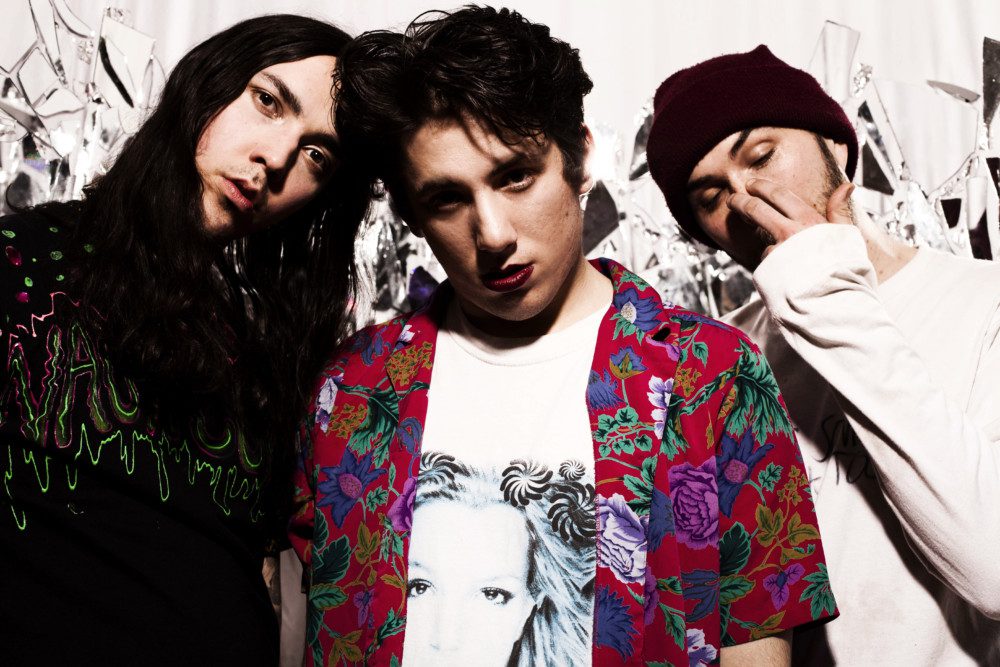
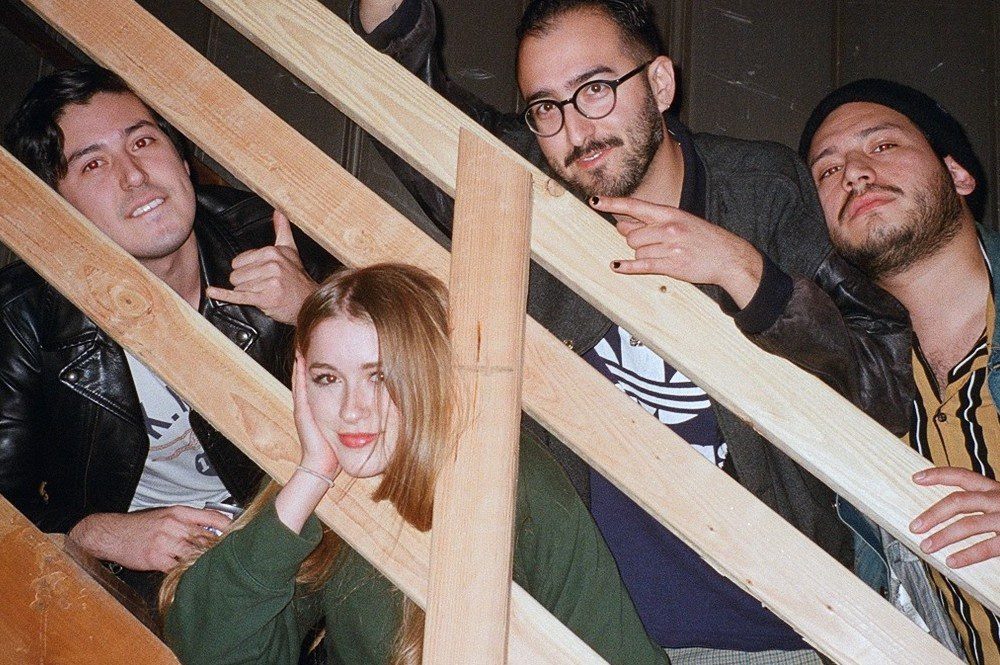
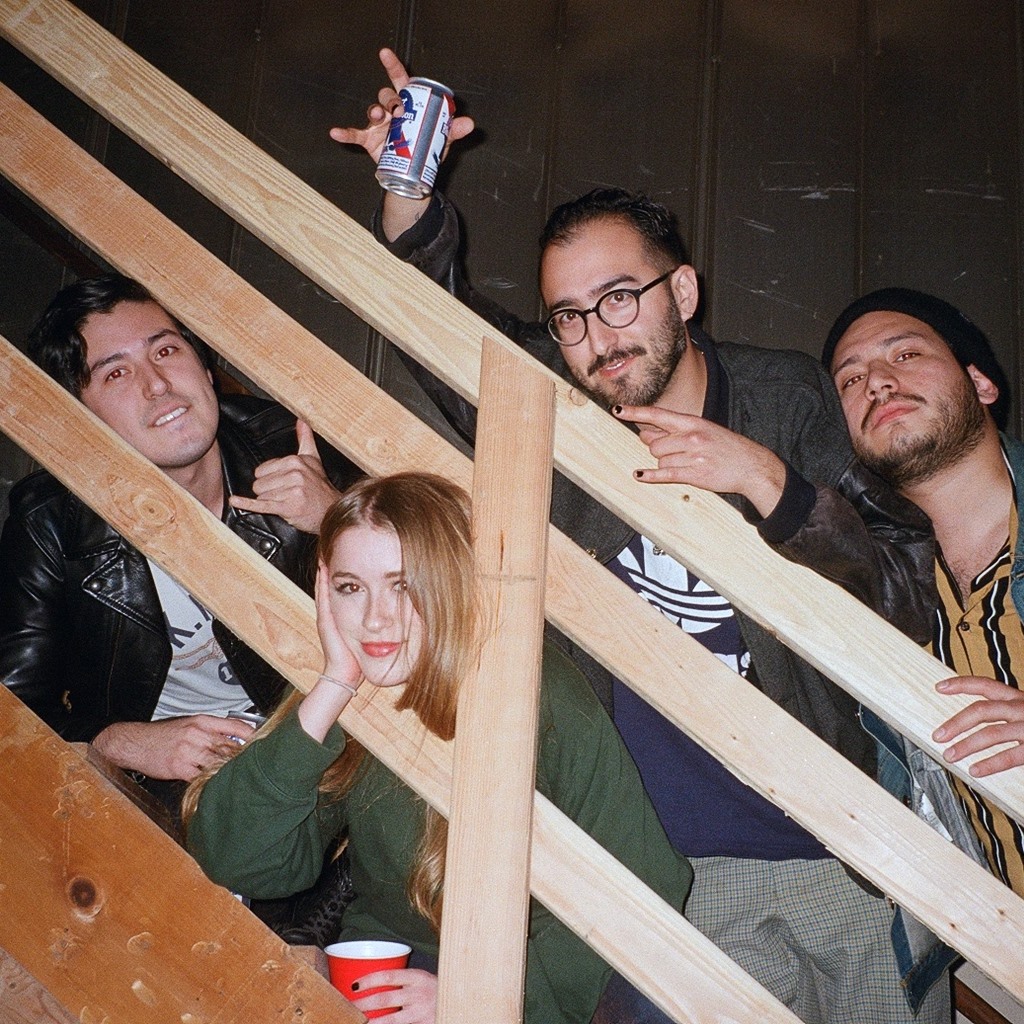
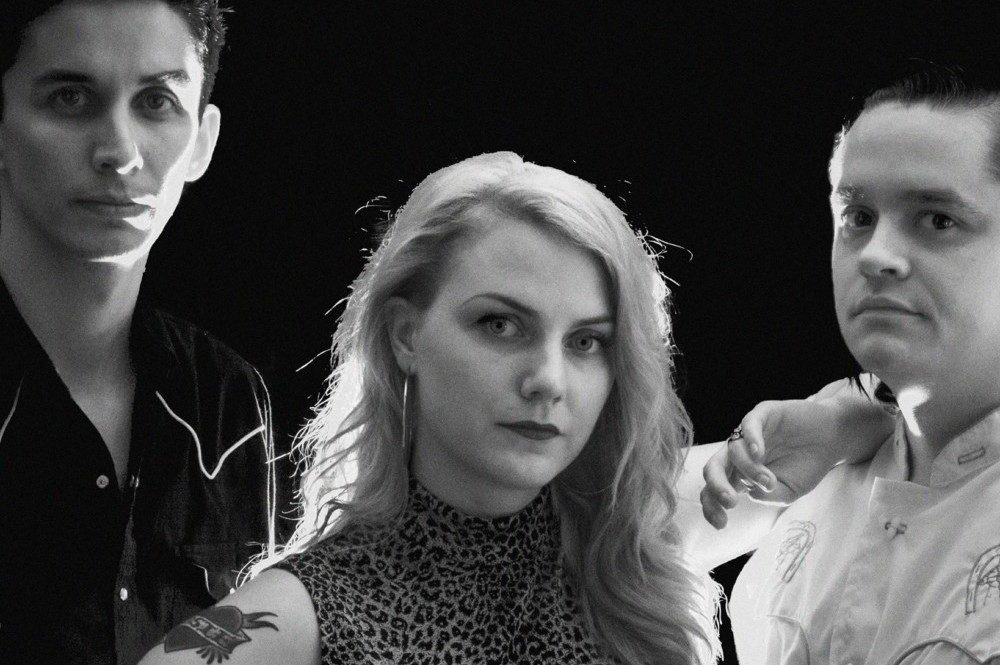
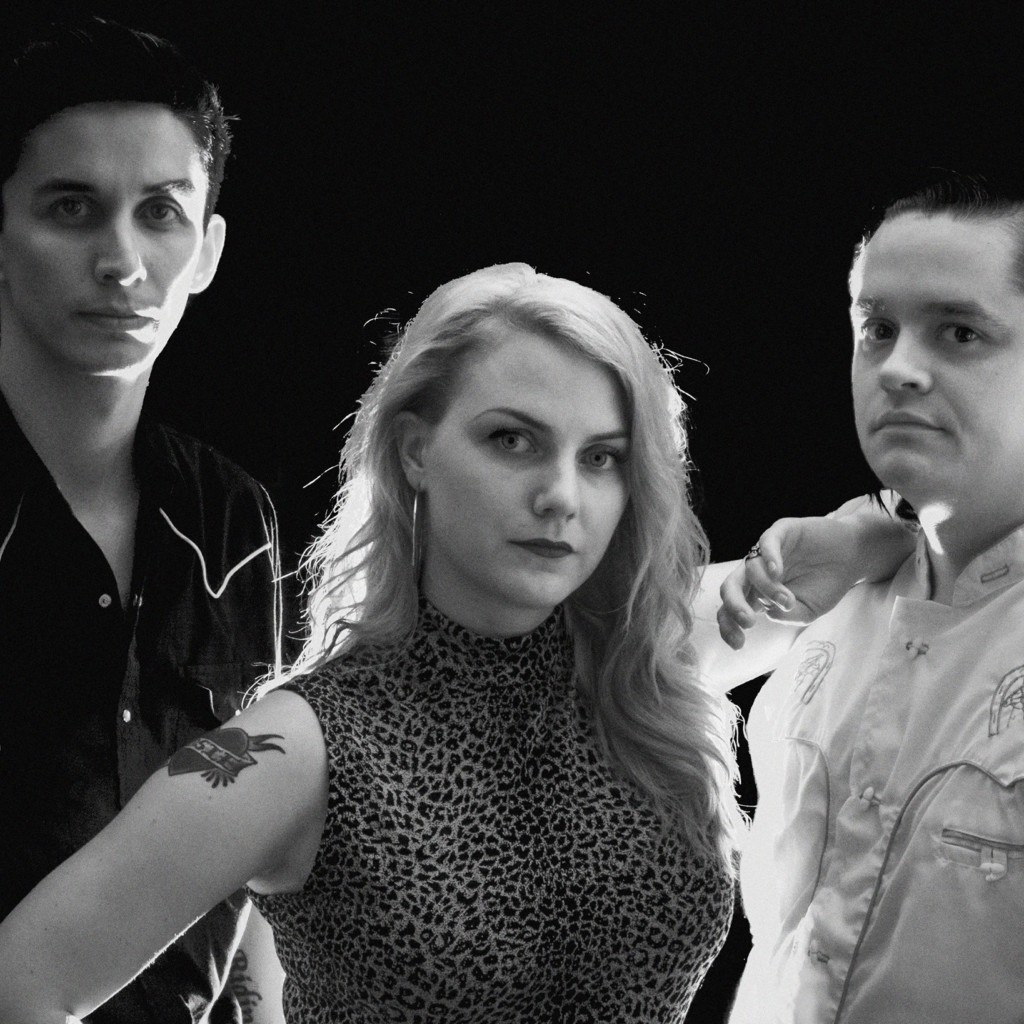
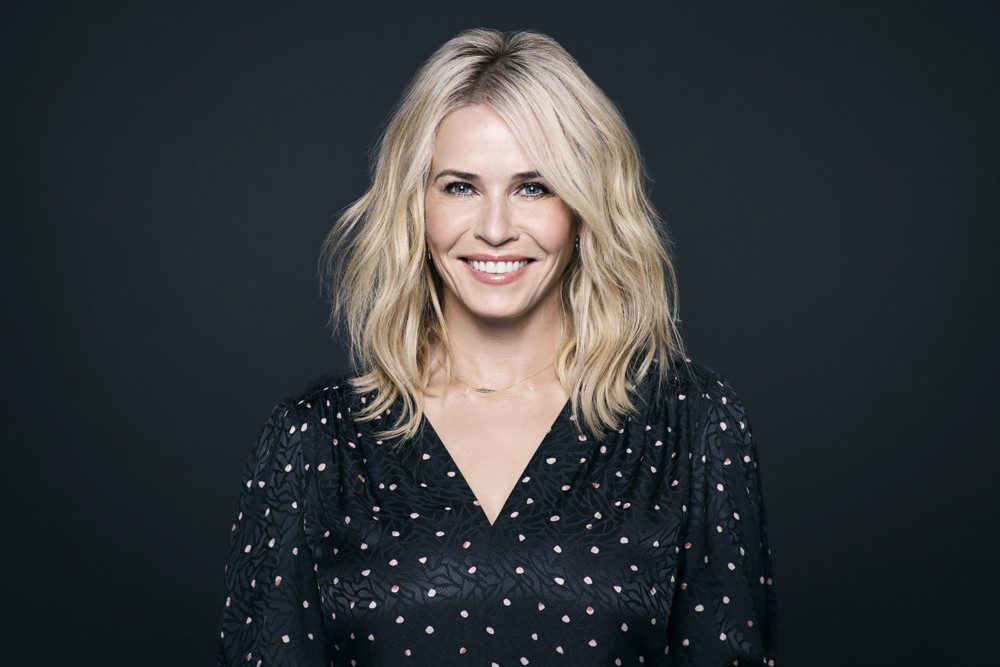
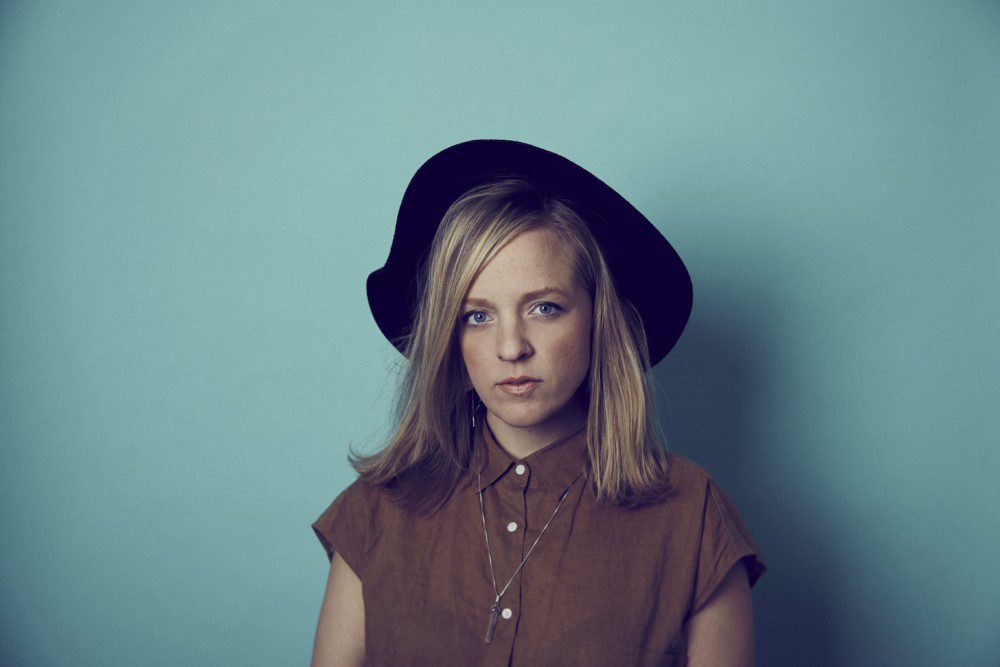
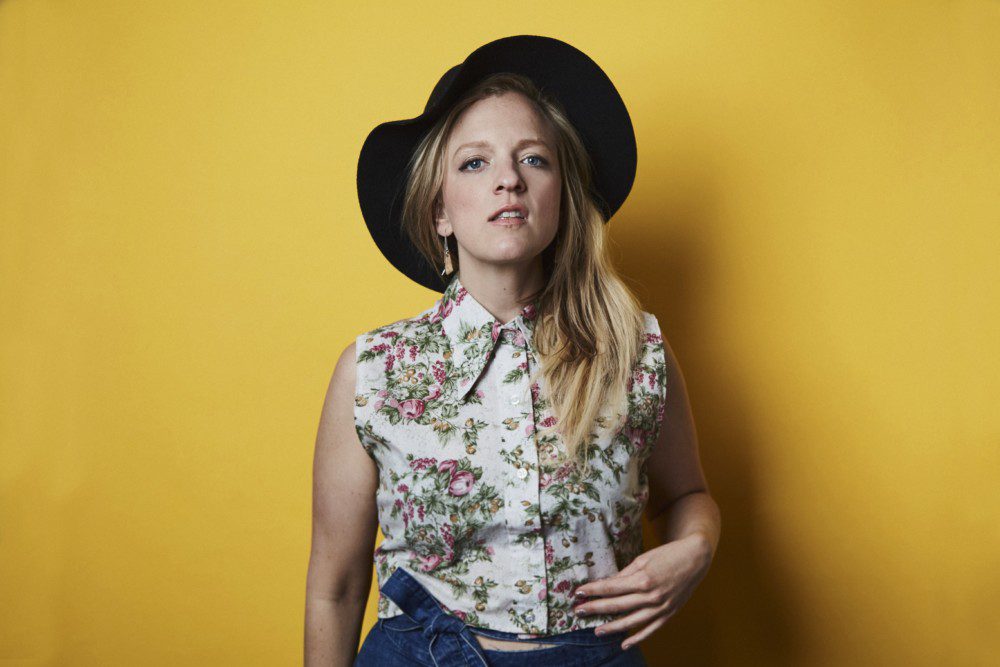
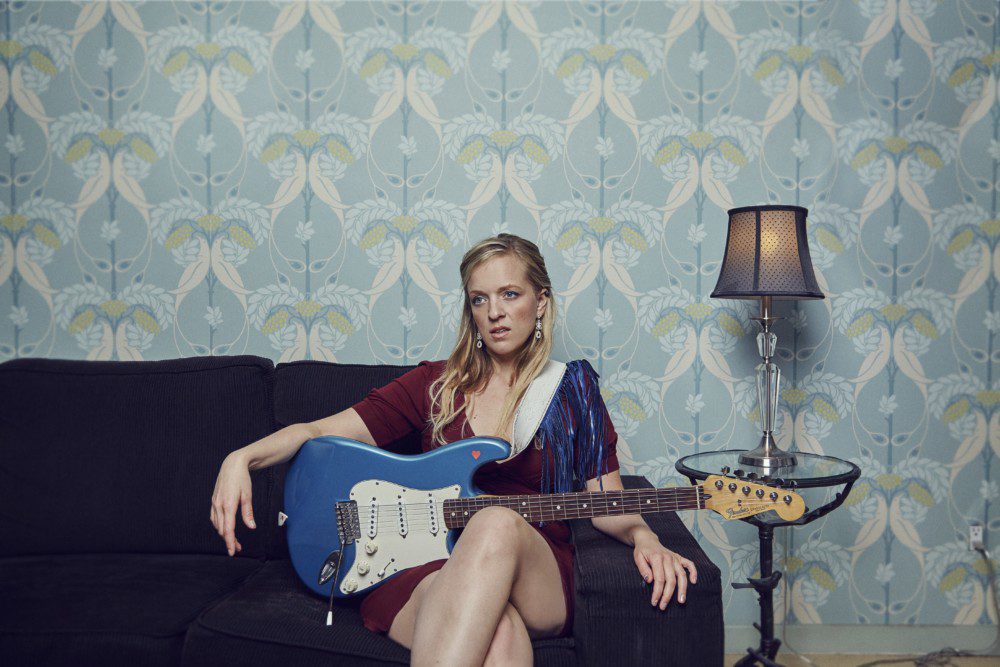
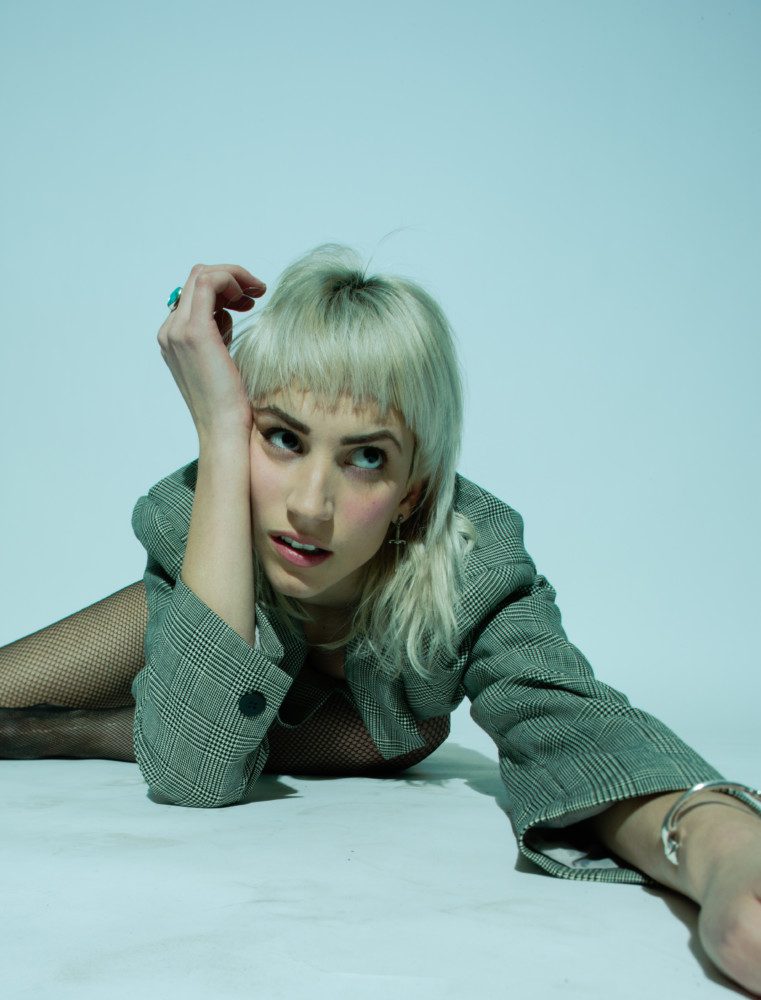
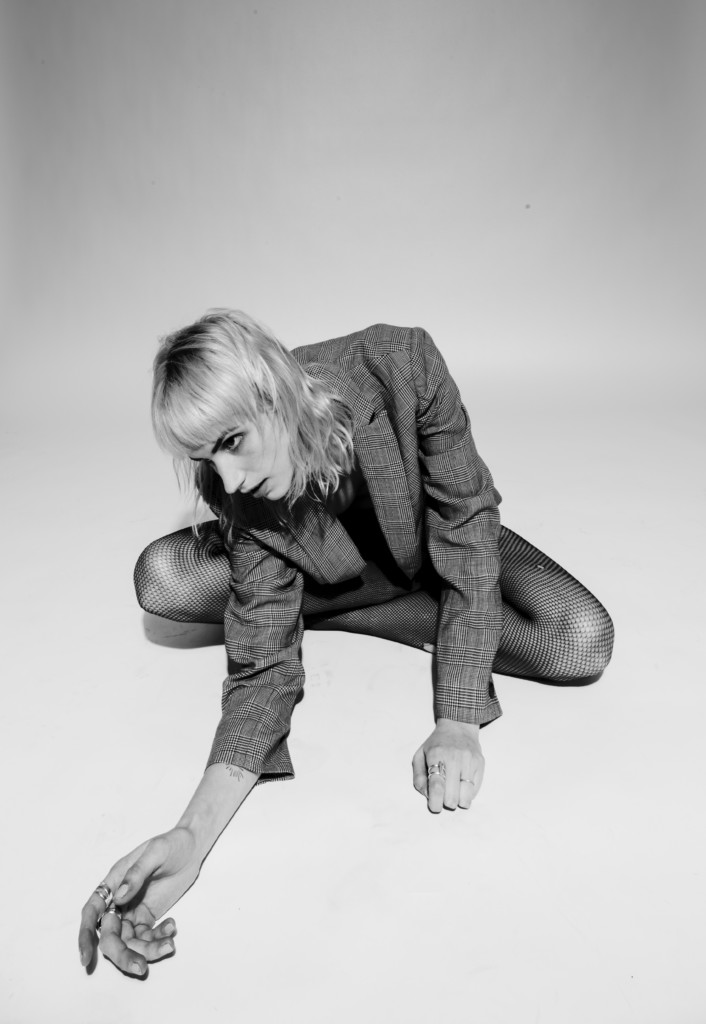
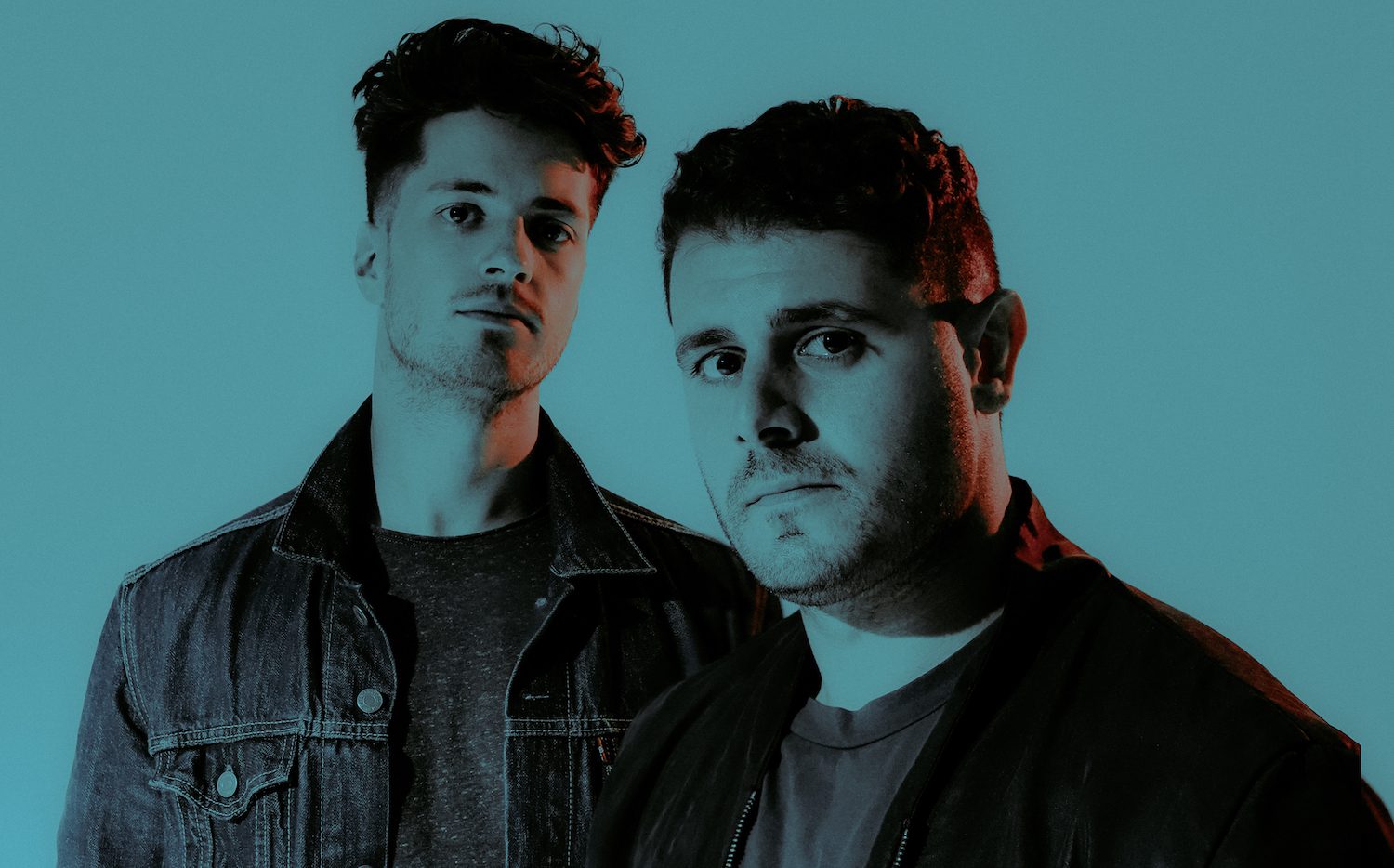
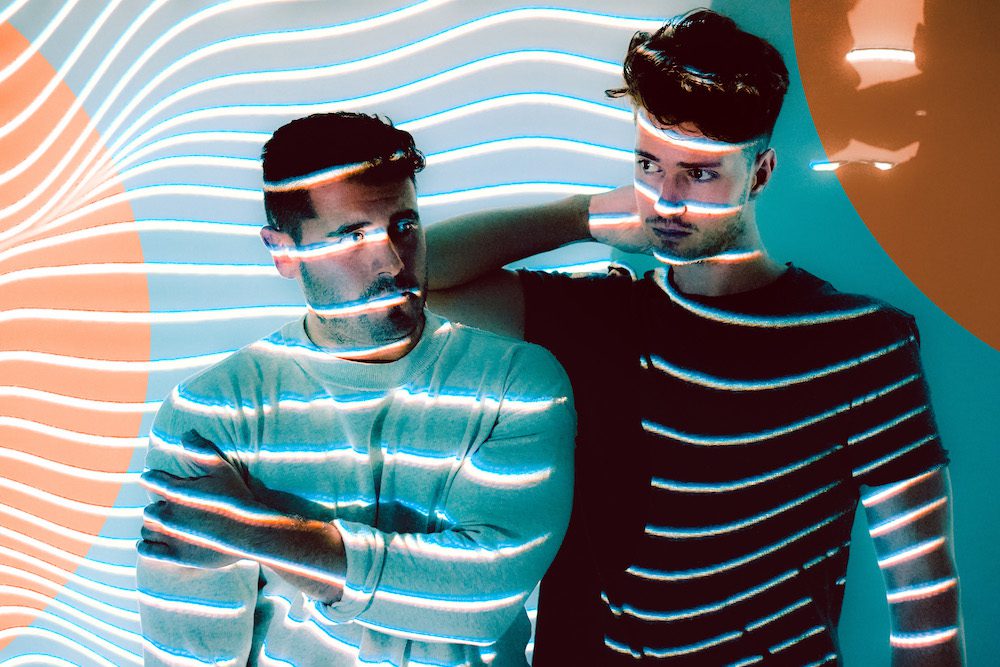
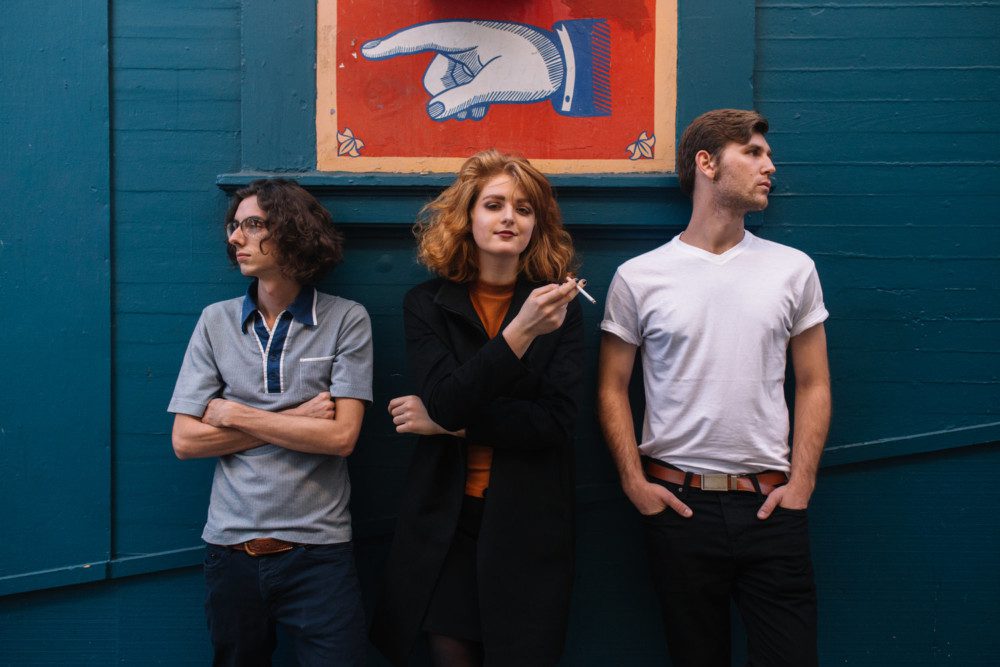
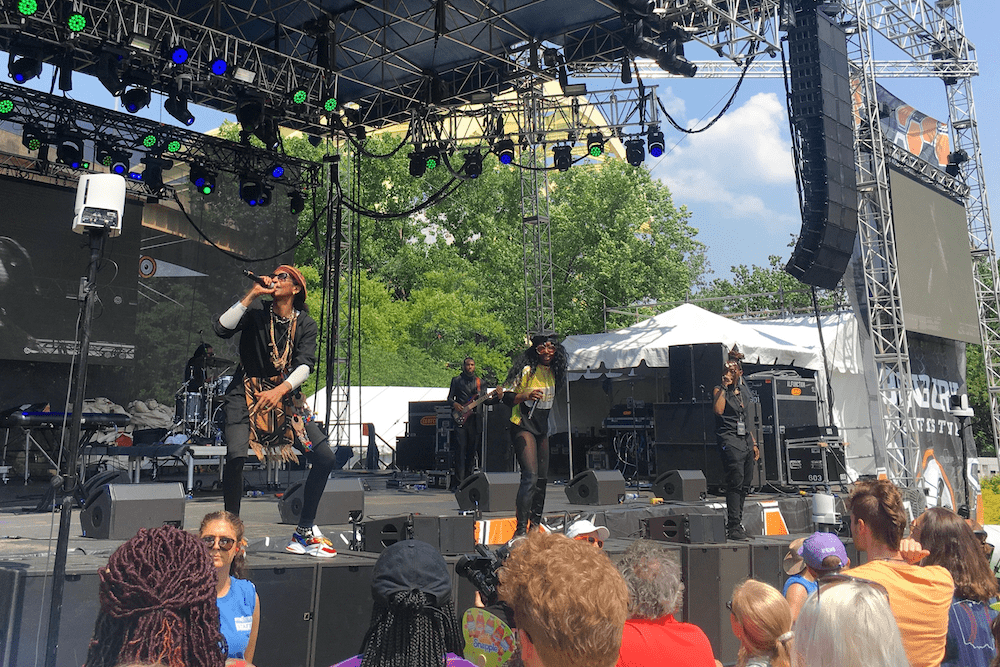
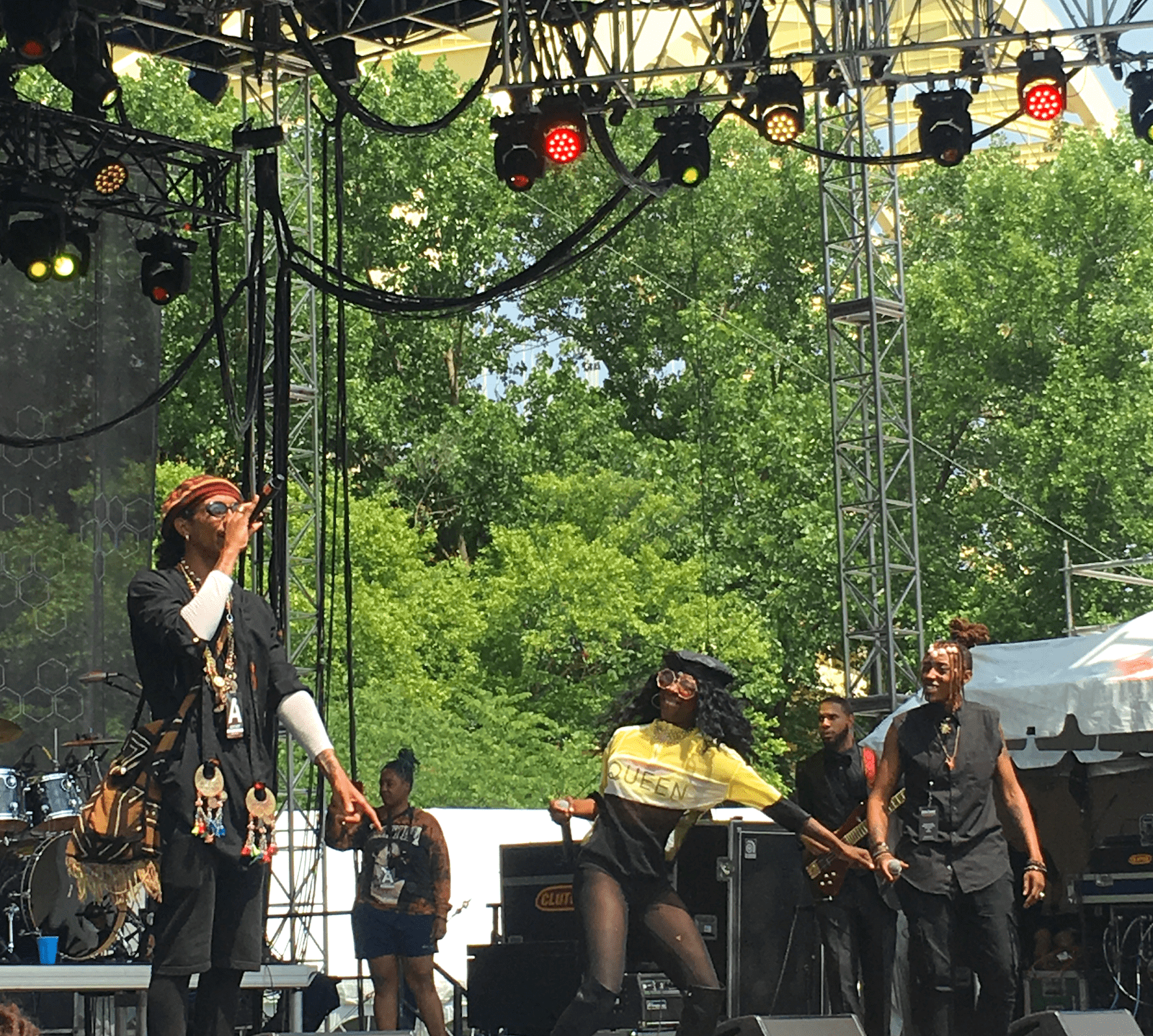
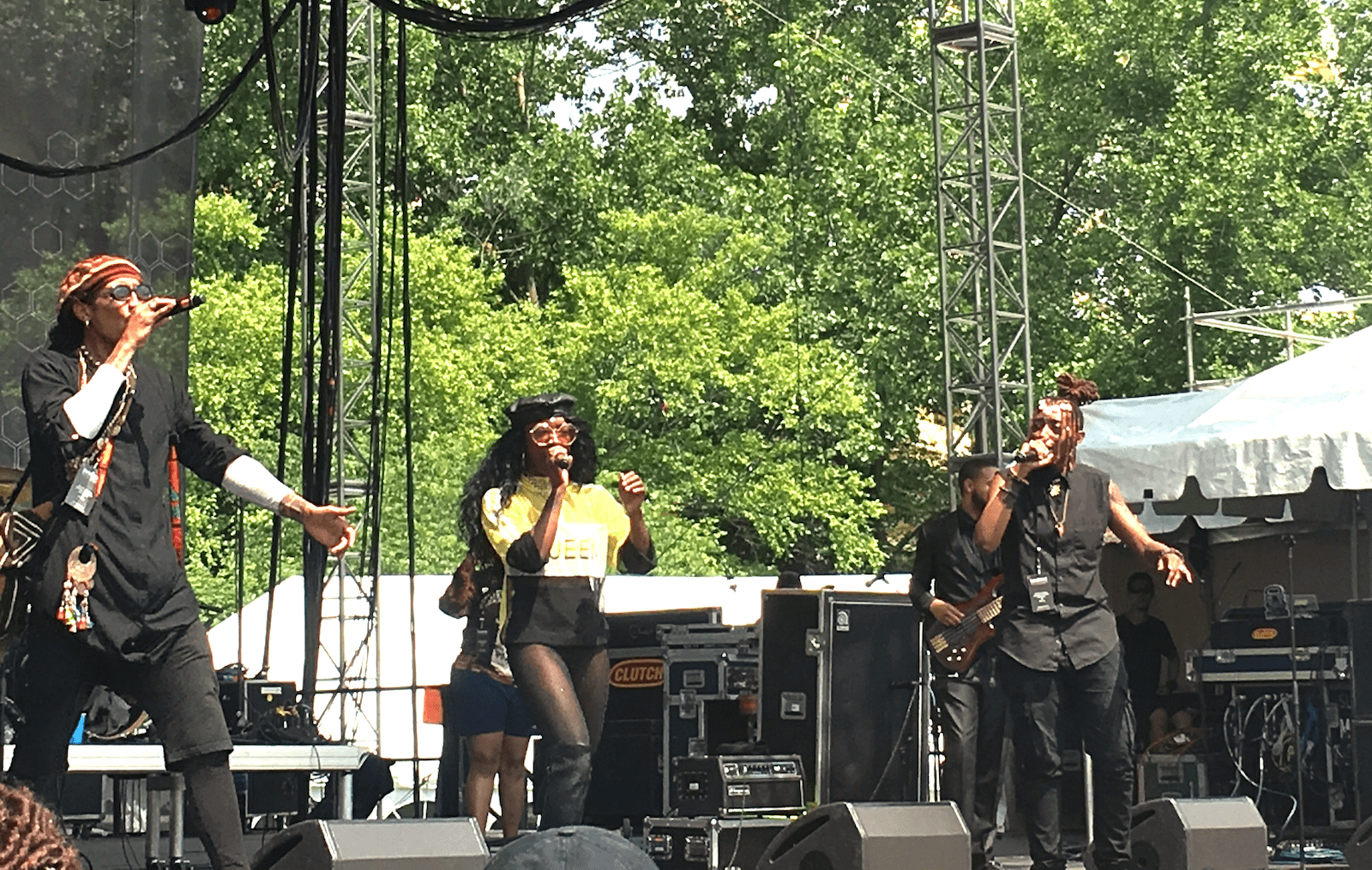
Brooklyn electro group Late Guest at the Party taps into the carefree, house-inspired rhythms, glistening synth lines, and instantly recognizable lyrical themes that ushered electronica into crossover pop in the ’90s – surely a golden era for club jams if ever there was one. While their sound seems to have solidified around that nostalgic inspiration, it truly took hold with the arrival of Beth Hansen – the proverbial “late guest” to the party started by three Italian dudes (Gabri, Ian, and Renzo) back in 2005. They’d released a couple of LPs with producer Caleb Shreve at the helm, but Hansen absolutely transformed the band, infusing it with earnestness and energy.
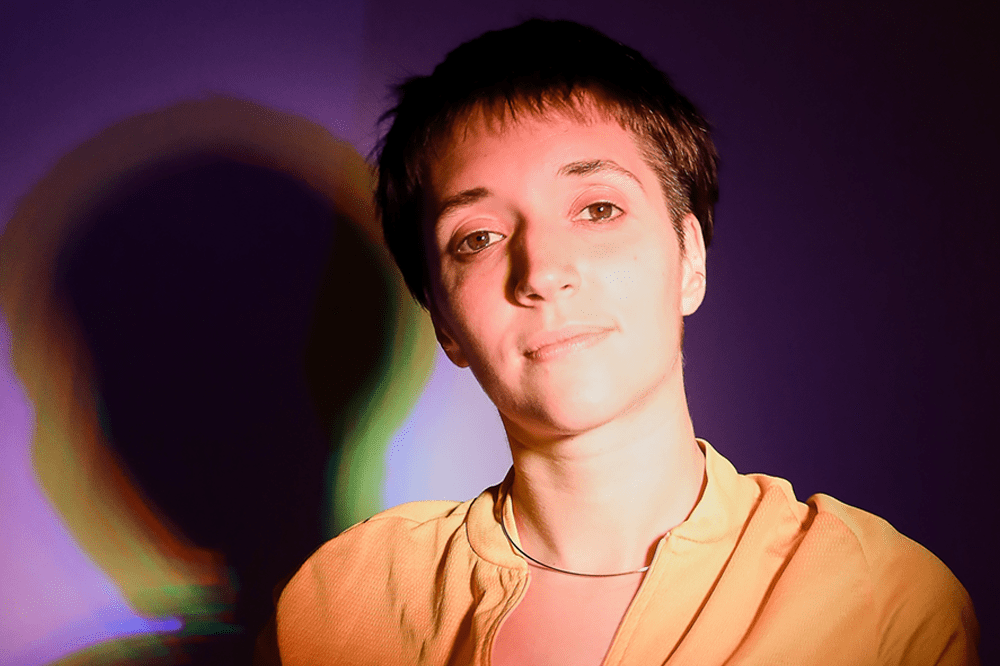
Their latest string of singles graces listeners with thoughtful hooks, catchy concepts, smooth synths, and danceable beats, and the newest of these, premiering exclusively on Audiofemme, is “Bend,” a song that combats codependent tendencies and internal intimacy issues in an infectious, danceable package. “Why do you find it so hard to be by yourself?” Beth croons in her androgynous timbre, making the track feel intimate, like an inner monologue. The pulsating beat drops out here and there but always returns, keeping things grounded and thoughtful.
“Bend” will resonate with any Brooklynite who’s found themselves raving until the sun comes up, swaying and swerving at an abandoned Bushwick warehouse, only to feel totally alone with their racing emotions as the dawn reveals the dissonance. We sat down with Beth to discuss the evolution of LGATP, the group’s songwriting style, and the inspiration behind the new single.
AF: The band has been together since 2002, Beth when did you step in as the lead singer?
BH: I stepped in late 2016 after writing “Give You A Life” with Renzo. Late Guest had started thinking about playing live again, and when he asked me to sing live for them I countered with joining them full time. I missed having a band.
AF: How did the sound evolve once you joined?
BH: Renzo and Gabriel had developed many tracks to bounce off of, and with their production and my voice, I pushed us into a more ’90s sound. I get to use a big voice and Renzo has a largely sample-based production.
AF: What does it feel like being the front person in the often male dominated genre of electro dance rock?
BH: I spent almost all of my childhood trying to find a band, and was often rejected being a young girl. It’s great now to be the loudest one in the group and I often get to bring in other women to work with us. Happily, I think fans of the band have only been excited to have me as the new vocalist.
AF: Can you discuss the origins of “Bend”?
BH: I’m still writing the insecurities of my first love despite having many longer and deeper relationships. The worries still come up. I want to make those insecurities as clear as Haddaway would when singing “What is love / Baby don’t hurt me, no more” – but I want you to get over the insecurities with me throughout the song.
AF: Late Guest At The Party resonates deeper concepts that provoke thoughtfulness and courage, while remaining playful and digestible. Can you talk about the themes you explore lyrically?
BH: I tend to explore the more bitter or cheeky thoughts that I have. They are less treated or metaphorical than many dance pop songs. “Give You a Life” is both about having depression and naively trying to push someone out of their depression. “Add It Up” is the only way I could think of yelling “I fucking love you, don’t you see?” I sometimes sneak my girlfriend’s name into the song when I sing it live. “Bevel” was me working through the feelings of being unable to directly empathize. I think it’s one of the most positive songs I have written.
AF: How would you describe your songwriting process?
BH: In general we write in small groups usually, using a started track from Renzo. “Bevel” was written with Renzo, Gabriel, Ian and I all together in one weekend. I would love to do this more. Until then, we have a studio we go to whenever possible – we all just have different schedules. I write lyrics almost everywhere. I’m usually singing out loud on a walk to the train.
AF: Who are your top three artists that have influenced your writing and performances?
BH: Lately, Jamie Principal (lyrics and melodies), Nation of Language (performance), and I’m gonna put Queen Sessi in here. We worked with her on “Bend” and honestly she really helped me to get out of a writing rut. Just seeing her run through different melody ideas effortlessly is inspiring.
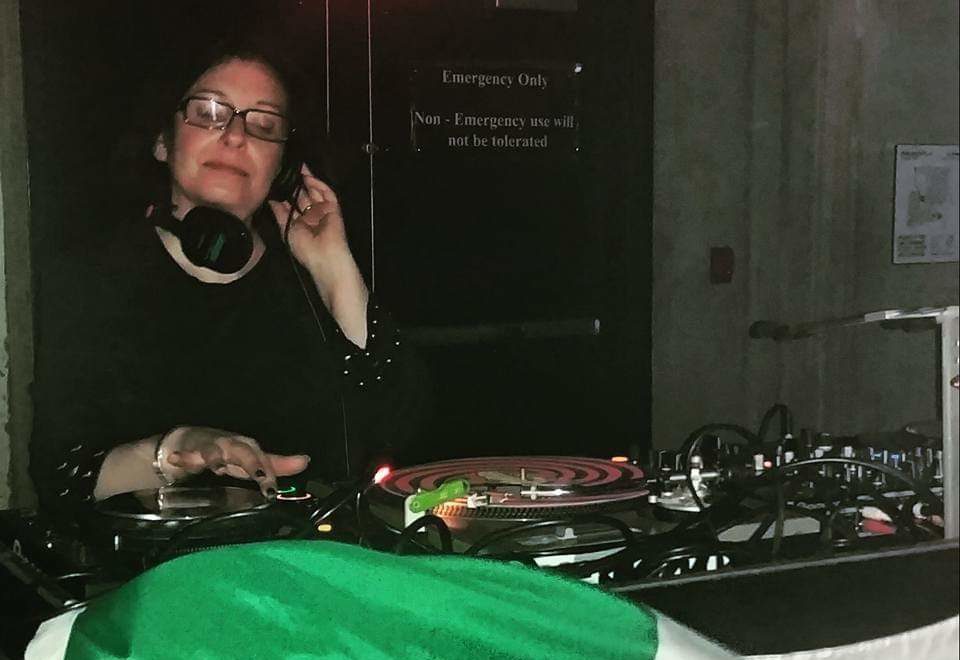
The author blisses out on the decks: Dolce Vita at The Lash in Los Angeles, 2018. Photo courtesy Liz Ohanesian
ONLY NOISE explores music fandom with poignant personal essays that examine the ways we’re shaped by our chosen soundtrack. This week, Liz Ohanesian struggles to focus and live in the moment – until she realizes that’s exactly what she does when she’s spinning records.
In the midst of a perfect night inside a downtown Los Angeles club, time faded. It didn’t stop or disappear. Seconds counted down toward the end of tracks spinning on the CDJs. Night hours flashed on the cell phone that I sporadically checked. Eventually, the bar lights flickered as last call approached. I was conscious of all that, but none of it mattered. I wasn’t thinking about what happened five songs ago or where I wanted to be in three songs’ time. In fact, I wasn’t really thinking about anything beyond the moment.
This happens a lot when I DJ, although I’m not sure how or why. Maybe it’s a song that pulls me deeper into the mix. Maybe it’s the sight of people vibing with the music. Regardless, I lock into a groove and go with it. The songs will change, the tempos will rise and fall. On this particular night, the genres changed. It was the rare gig with no stylistic restrictions, meaning that I could (and did) play everything from Missy Elliott to Hercules and Love Affair to Dolly Parton. By the end of the night, I couldn’t tell you much about what happened, just that it did happen. Over a year later, this still stands out as one of my favorite gigs. The details are fuzzy, but I remember a blissfulness that was overwhelming. And, mostly, I remember this as the night where I understood what it meant to be present.
By day, I’m a freelance journalist and my work hours – really, most hours that I’m awake – are a constant exercise in juggling multiple stories, in trying to finish assignments while finding new work, in managing an incessant onslaught of emails, multiple social media accounts and monthly/weekly/daily schedules. It’s a lot of work for what is, essentially, a one-person operation, and it often feels overwhelming when you’re the sort of person who is as easily distracted as I am.
I wasn’t always like that. I used to slide so deeply into books that I could finish reading thick ones in just a matter of days. I loved long, subtitled movies. I listened to albums until I had the lyrics memorized. Over the course of the past decade or so, my attention span has gradually shrunk to the point where I can barely get through a book chapter, half-hour television episode or a song without checking my phone. I catch myself thinking, “tl;dr” while reading newspapers. Unless I snapped pics or posted a status update, my memories of the previous day will be far more vague than those of events that went down 20 years ago. I wake up too many times in the middle of the night thinking about too many things that I have to do the next day.
I’ve slipped into this 21st century mind suck, giving away my brain power to platforms that will hold my memories, my time to tech that always wants more of it. On top of that, I’ve become this person who performs productivity, trying to show that I’m always alert, always aware and always working because #Ilovemyjob and want you to #hireme. All of this has come at the expense of my physical and mental well-being and, likely, my personal relationships. That has to stop. I’ve taken steps to do that in various ways from time management apps to yoga. To an extent, this has helped me regain some concentration skills on the daily. Still, nothing seems to push me towards mindfulness like DJing does.
I started DJing back in college and I still step into the DJ role at Los Angeles venues a few times a month. Music and clubs have been a constant throughout the bulk of my adulthood. Even though everything from technology to my own career and personal life have changed over the years, the way I work in the DJ booth hasn’t.
Whether you’re the DJ at a large dance club or an intimate bar, you have certain responsibilities for the night. Your main task is to keep the crowd engaged, which you do by reading the room and making snap decisions on what to play next. If the energy has been building for a few songs, it might be time to drop a big hit. If the crowd has been going hard for a while, you might want to ease up on them for a bit.
Next, and equally important, is that you have make sure everything sounds good. While your eyes are fixed on the floor, your ears are tuned into all the sonic nuances. You may have one ear directed at the monitor to hear the song that’s currently playing while your headphones are cupped to the other ear as you cue the next song. Meanwhile, your hands will be in action as you mix tracks together seamlessly and/or adjust the levels.
As you’re doing all this, you will probably be approached by friends. You may have to field a few requests, sometimes from people who are flat-out obnoxious. If your booth is set up near the dance floor, you’ll most likely have to deal with klutzes knocking into the gear. It takes a lot of focus to get through a DJ set. If someone annoys you, you have to let it go. If you mess up – and everyone does – you can’t dwell on it. If there’s a technical problem, you have to fix it fast and keep moving. You need to stay in the groove until your set ends.
In a way, everything I have been trying to learn from yoga videos and guided meditation recordings was stuff I already knew from my DJ life. I just didn’t have a word to describe the transformation that happens when I’m in the midst of a set. I couldn’t understand why I usually feel so elated when I’m finished or why my gig nights are the only ones followed by uninterrupted sleep. This practice of playing music for people had become a form of meditation. It just took a while to realize that.
It makes perfect sense. Dance music is designed not just to keep you moving, but to make you let go of the stresses and distractions that surround us during the day. Beat-matching is a standard DJ skill because you can keep the music going without people noticing that the songs have changed. Extended remixes of short pop songs exist to heighten the excitement of a tune you already love. There are so many songs about the joy of dancing that it could be its own genre. But, to be the person charged with bringing everyone into the moment is a little different.
Technically, I’m working and doing that in a space that’s surrounded by technology, with both digital and physical distractions – yet, they don’t have the same power over me that they do anywhere else. Maybe it’s not the tech that’s the problem, but the way I’ve trained myself to interact with it that’s become an issue I have to handle. I’m still not sure how to do that, but the answer might be in the club.
Kevin Nichols wanted to know how much time he had left on stage.
“Till you puke!” cried the man behind me.
This was met with silence, perhaps one nervous laugh, but I couldn’t help but appreciate the purity of an old punk sentiment in a an old punk stomping ground, even as it was delivered to a distinctly new punk audience.
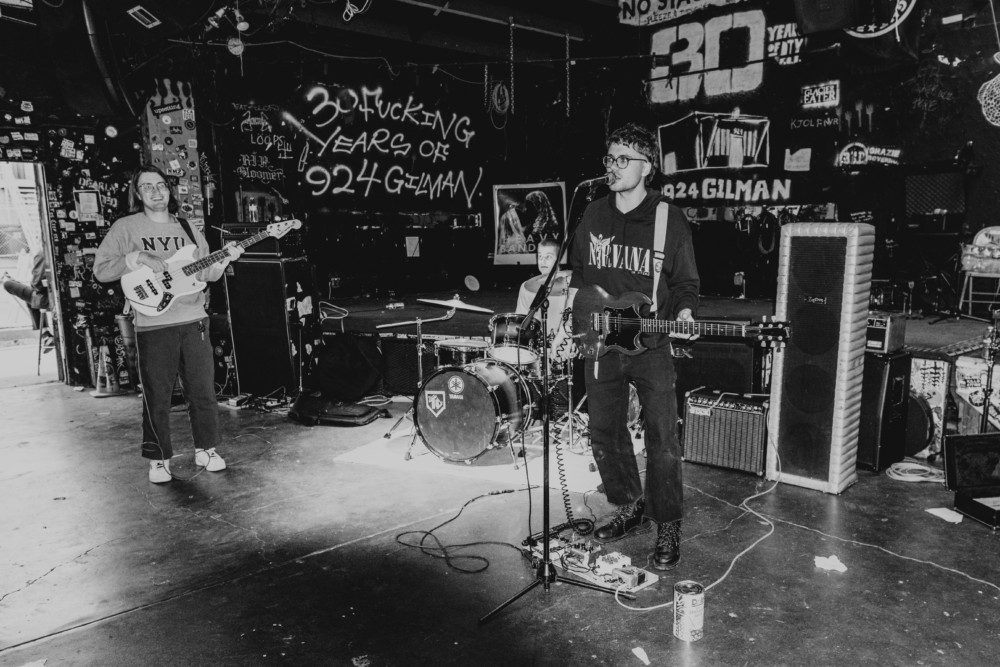
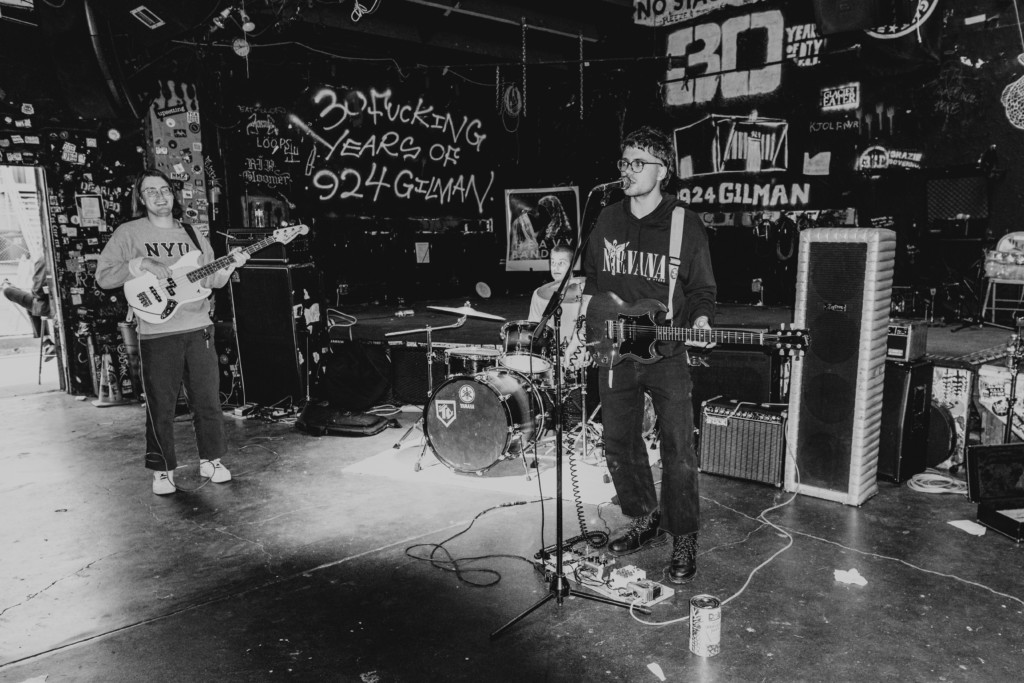
On a Sunday night at the end of June, 924 Gilman (aka the Alternative Music Foundation) hosted the record release show for Oakland’s Rex Means King, who released their first full length album Semanticson June 28th. The final opener, Kevin Nichols preceded their set for a scant but tight half hour, certainly long enough to have me messaging Slumped to thank them for the rec.
Nichols was unquestionably the live wire of his three-man stage ensemble, his accompanying guitarist and drummer content to bring some serious crunch while letting Nichols bring the energy and emotion. Later, he told me he was exhausted from working all day but had come straight to the Gilman afterward.
Despite the manic energy gifted to the worn and weary, Nichols chugged water (or pineapple juice?) between songs from an overlarge can of Dole. This is what I mean about the new punk — the sweat, blood, and tears are still there, but no one wants to see you puke on stage — they want to see you fight through the your worst impulses and still emerge with music worth spending time on.
924 Gilman is the perfect place to observe the effects of such a transition. Its walls are graffitied and stickered down to the minute inch, the performance floor edged with ratty couches and chairs. I sat through most of the show, bookended by three younger boys, one of whom was wearing noise-dampening earphones.
The Gilman has been a Berkeley mainstay since 1986, operated by the nonprofit Alternative Music Foundation. Everyone is required to buy a yearly membership card at the door ($2) along with the show fee, a long-time tradition to remind show-goers that this is their venue, too, if they so choose to attend one of the bimonthly membership meetings.
photo by Rianne Garrido.
I had not, in my 25 years of living in Berkeley, attended a show at the Gilman. It felt odd to enter a space that would have been so eminently foreign to me as a teenager, but felt absolutely welcoming to me as an adult. Hindsight is 20/20, of course, and it took me ten years of life experience to develop the music taste I have now. Nevertheless, I still felt some misplaced sadness for 15-year-old me, who had only a peripheral idea that such a space existed and was simply too limited by my own perceptions to have taken advantage.
One of the great things about the space is that no inch of the Gilman escapes commentary. “30 fucking years of 924 Gilman” is scrawled is sloppy letters over the stage, and the women’s bathroom hosts stickers on the toilet seat while messages of love, rage, and everything in between surround from all sides, letters inside secrets inside notes inside declarations.
Nichols, I found, had a similar experience of appreciation for the men’s. It’s always the bathroom, we agreed. It’s always the place where you have to stop and take in the grunge for what it is — not a messy sprawl of disconnect, but a canvas of experience, like little fortune cookies from this and that person’s life, scribbled between songs or at the end of a long sweaty night.
Nichols is not a furious performer. He does not spit words out without regard for where (or on whom) they land. He is more restrained than that, which isn’t to say he is holding back; moreso that he wants to put on a show without losing himself entirely.
His last EP, Long Lungs, documents a heartbreak in four succinct rocks songs well-rounded enough that they feel like a much more substantial tracklist. Even with the short, staccato lines in “Carrion Crow,” Nichols and his bandmates Sam (bass) and Elliot (drums) take us on a rollicking, head-banding journey that ends with a instrumental lead-out with the fizzing intensity of popping open an over-shaken soda can. While “Crow” is my favorite off the EP, “Easy Way Out” packs a great closing punch, a song equal parts fighting and pleading with Nichols switching between vocal deliveries with ease.
During his set, the three baseball cap-wearing men standing in front of me would occasionally let themselves knock lightly into one another’s shoulders, their bodies slipping into some classic punk-show footwork before clapping each other on the back and embracing, knees still bouncing to the music.
When I asked Nichols after the show how the Bay Area has impacted his music, he told me without hesitation that he came for the support and camaraderie, a feeling of authentic community that he felt his old stomping grounds (Orange County) distinctly lacked. There was no moment last night when I did not feel that sentiment reflected in the audience, in Nichols, in Rex Means King, in those three boys hugging as their hair fell in messy strands from their caps.
If this is new punk, I’m happy to even be late for the ride.
We last heard from Becca Gastfriend, a Brooklyn-based alt-soul singer who performs under the shortened eponym beccs, back in 2016, when she released her harrowing Unfound Beauty EP. The debut (and the powerful video for its lead single, “Therapy”) chronicled her struggles with an eating disorder and celebrated the ups and downs of the healing journey she had embarked on. Now, she’s back with “By the Sea,” a new single that explores coming of age themes, lustful longing, and abandonment, while meandering into hopeful escapism and finally ascending into the higher power of self love.
“By the Sea” is a huge leap for beccs, who makes her debut in music production and filmmaking with the help of co-producer Sam Mewton, guitarist Corey Leiter, and photographer/multimedia artist Katelyn Kopenhaver. “The making of the song — learning to produce, arrange, mix and make a film— made room for me to live what it was speaking about,” beccs says. ““By The Sea” became a testament to women finding out what is possible when they trust themselves and start creating with their own hands.”
I sat down with the John Lennon Songwriting finalist to discuss the inspiration behind the sonically mesmerizing, haunting ballad.
AF: Can you discuss the inspiration and meaning behind “By the Sea”?
Beccs: I feel the original intent behind the song is quite literal. It’s about someone I’m thinking of, but the song, despite its meditative cadence, takes you for a ride. By The Sea mourns the ethereal loss of someone you love as much as it discovers what lays beyond — a return to oneself. I tried to capture, through the sonic and visual direction we took, how both healing and painful this return can be.
AF: How did you connect with your collaborators? What was the creative process for the music video?
B: Katelyn and I have been collaborating for three years now in mostly photography and conceptual work but neither of us had ever made a film. We were at a diner when Katelyn popped the question, “Can you let me make your next video?” I booked our bus right then and there. We were a two-woman crew, writing, shooting, and editing our very first film start-to-finish, working around the sun in the dead of winter with one camera. It was one of the best weekends of my life. Katelyn learned final cut pro in an afternoon and it took us seven editing sessions to finish it up, our eyes and taste maturing as we went. I remember playing K “By The Sea” and seeing her cry for the first time. I’ll just say the song became as much about what Katelyn and I found together as it did about the person I speak to in the song.
Corey Leiter, a most thoughtful songwriter himself, and I had met at a show in Barcelona. I knew his tender touch on guitar was it for “By The Sea.”
Sam Mewton and I met on a Bockhaus bill. Sam had just released his EP Ensnaring (imagine a digital Perfume: Story Of A Murderer meets 28 Days Later). This dystopic soundscape could not have been more different than the demo I was about to send him. But Sam stretched my ears and gave me the space to say no. This sort of collaboration in the music studio felt invaluable to me as a female artist.
AF: Feminine agency is so important when building a body of work that feels authentically your own. Can you talk about your personal growth through the process of reclaiming your voice, and trusting your creative instincts?
B: I feel like I barely got my feet wet – excuse the pun – with “By The Sea.” It was my first stab at producing and arranging, and I can’t begin to fathom how far I have to go. At the same time, it felt monumental relative to my growth. I just never thought I could turn the knobs. I don’t think I was prepared for how much work and stillness it took to sit, listen and learn. At first glance, it’s the technical skills that feel daunting. Looking back, it was the skill of listening—to myself and my song— being patient with the answers and okay with the disappointment that made the greatest difference. It’s true how having so few female producer role models can have a significant impact on an artist. If you don’t see it, it’s hard to believe it. Marina Abramović advised artists to look out into the horizon where the water meets the sky. Observing that expanse has the power to stretch our minds to new possibilities. Luckily, I got out to the sea and had friends and collaborators nudging me back towards me. Thank you, if you’re reading this!
AF: Can you discuss the process of independently learning to produce, arrange, and make a film?
B: I think the first step is dissolving the fear, doubt, and guilt that gets in the way from learning something new, particularly in a field that is male-dominated. It took me a year or so to get past this first wrung on the ladder. I started learning guitar. Then Ableton. I enlisted some friends to give me lessons. Honestly, I had to make sticker charts for myself. It was like pulling teeth. But I did it, though it wasn’t until Katelyn and I had already made the film that I really plunged into the production on this song. Katelyn became a motivation. I didn’t want to disappoint her and I wanted to find the sonic world to match our visual one. Coming back to my cello which I hadn’t touched in years also played a big role in the actual production as did my voice and its different capabilities. I was like “if turning knobs on midi irks me, why don’t we just start with what we like?” So I just messed with my voice. It can do some WEIRD things. It’s funny… the whole thing felt like a letter to someone I love. The more specific and obsessed I got in writing that letter, the deeper I could plunge into the learning of it all. That’s probably why I made these postcards – hit me up if you want one!
AF: Your sound resonates music from generations past. If you could choose a different time period to create music in – even just for a month long residency, which era would it be?
B: I normally would say ’90s and cozy up with Paula Cole (which I’ve actually done!) and Tori Amos and my beloved Beth [Gibbons] from Portishead. But honestly, I’ve been feeling ’60s/’70s Janis Ian and Melanie hard lately. I do have to say that “Mysteries” on Beth Gibbons’ solo album Out Of Season was a big sonic inspiration for “By The Sea.”
Photo by Katelyn Kopenhaver
AF: What advice do you have for women and girls out there searching to find their authentic voice and creative freedom?
B: Spend time with yourself. Embrace your boundaries. Get rid of the miscellaneous — the people-pleasing mannerisms and language we use to muddy our message, mute our power and cut ourselves short from communicating what we really want and need. Develop the skill of listening to the pit in your stomach. The one that cramps up when someone is crossing a line, when you hear a sound you don’t like around your lead vocal, when you’re about to make a decision, big or small, that disagrees with what you believe in. And take the time to become autonomous, take the time to learn. As my friend Paul says, we are always in the middle. Future you will thank you.
beccs performs live in collaboration with Little Kruta Orchestra on Wednesday, July 17 for The Hum Series with opening act Treya Lam. Purchase tickets here., and follow beccs on Instagram and Facebook for more updates.
It’s a simple statement, impactful and to the point… and it describes Half Hot perfectly. The Atlanta-based rock quartet – made up of Andrew “Goose” Hughes on guitar and vocals, Tyler Messer on guitar and backing vocals, drummer and percussionist Jacob Hicks, and Casey Reid on the bass and “sweet ass harmonies” – was founded in the far-flung corners of North Georgia before migrating south to the swing of the big city. Together, they combine the sheer drama of bands like Foxy Shazam with the dramatic rock overtones of The Darkness. The result is an all-encompassing experience that lifts listeners out of 2019 and back to the age of hair bands, Spandex, and arena rock.
Audiofemme caught up with the quartet as they prep for the release of their first music video, which arrives on August 3rd, to talk all things music, performance, and their shameless love of Lady Gaga and ’90s boy bands.
AF: If you had to describe Half Hot in three words, how would you do it?
HH: Raw energy and flair.
AF: How did Half Hot form? Were you guys always involved in music, or was it something you grew into?
HH: Andrew, Tyler and Jacob met and started playing together in bands through college, one of which was Whiskey Tango. While that was going on, Andrew was also in a band with Casey Reid and Caleb Little of Wet Jeans. Whiskey Tango spent several years only performing once or twice a year. Plagued by line-up changes, we fell into a musical rut and didn’t venture far outside of our comfort zone. Lightning seemed to strike as we collectively decided that no one was going to give us what we wanted. We were going to have to get way outside of the comfortable place we had nestled into, while remaining true to ourselves.
After working with several talented bassists over the past few years, we had found ourselves once again with a sudden opening for a bassist. After several discussions, one name kept coming up: Casey Reid. As if one major change wasn’t enough, we decided that with our growth and evolution over the past few years, we needed to shed the Whiskey Tango moniker in favor of a name that we felt summed up our ‘serious about music, but not so serious about ourselves’ approach. That’s how we got to Half Hot.
AF: Did you ever imagine yourselves playing in a band?
JH: Absolutely not. But I guess it was inevitable – I was always drumming on stuff growing up.
AH: After I saw Led Zeppelin’s concert footage [in] The Song Remains the Same, I couldn’t imagine doing anything but performing.
TM: Yeah, as a child I’d tell anyone that would listen that I was going to be in a rock band.
CR: From the moment I picked up an instrument and began learning a fire was lit to perform.
AF: Who do you consider to be your greatest inspirations? Your most surprising inspiration?
JH: John Bonham, Keith Moon, Levon Helm are my greatest inspirations. My most surprising inspiration would be Jason Isbell’s influence on my songwriting.
AH: Freddie Mercury, Jimi Page, Justin Hawkins (The Darkness) and Ric Flair. ’90s country music’s influence on my playing has to be the most surprising to me.
TM: Dennis Casey (Flogging Molly), Andrew Stockdale (Wolfmother), Kyle Shutt (The Sword). My most surprising would probably be the ’90s power pop influence I somehow picked up.
CR: Cake would be my greatest influence and my most surprising would have to be Paul McCartney’s influence.
AF: What’s your guilty pleasure when it comes to music?
JH: Ke$ha, Mariah Carey, and Rihanna.
AH: I would say Lady Gaga, but there’s no shame in that game.
TM: Seal – that shit SLAPS!
CR: ’90s boy bands.
AF: You just released a brand new album, Whiskey Tango, on April 27th. Can you tell us about writing the album and the recording process? Is it cooperative, or does one of you tend to come in with a finished idea?
HH: It was a long, arduous process bringing this record to life. We attempted to record the album two times previously and ran into some roadblock or another in the process. Apparently, the third time was the charm and now we have the record out for the world to hear. We’re cooperative when it comes to songwriting. Someone will come in with an idea, we’ll flesh it out on our given instruments, give it a tweak here and there, do some constructive criticism and then rehearse and see if it needs further adjustments.
AF: How has the writing process evolved since you formed?
HH: We’ve gotten more efficient at it! We’re definitely more comfortable writing with each other now than when we began. The ideas flow more smoothly and the constructive criticism is better received.
AF: What was your proudest moment while working on this album? The most challenging?
JH: My proudest moment was getting a drum track finished in one take! The most challenging was pretty much everything else – there was always some obstacle or issue in the process.
AH: My proudest was writing and tracking the lead guitar section of “Higher Ground” in one take, and getting the harmony vocals where I wanted them rather smoothly! The most challenging for me was getting vocal takes I was completely happy with.
TM: The proudest was getting the ideas for the call and response solos in “It Won’t Be Me” together and it coming out so well, and also watching Andrew nail double-tracked vocals. The most challenging for me seemed to be the roadblocks and issues each time we went in.
AF: What’s the craziest thing that’s happened to you guys since forming Half Hot?
HH: Selling out our album release show was absolutely, mind-blowingly surreal.
AF: You guys are based in Canton, just outside of Atlanta, which is further proof that the Atlanta music scene has grown and spread out. What’s it like to be a part of such a booming scene?
HH: It’s Awesome! The camaraderie between bands is amazing. Every time we walk in a green room at any given venue, we always walk out with new friends in this ever-expanding circle.
AF: Favorite place to grab a drink and catch a show?
JH: Eddie’s Attic.
AH: Smith’sOlde Bar or The Star Bar.
TM: Smith’s Olde Bar or The Masquerade.
AF: What are you guys listening to lately?
JH: James Brown and Coheed & Cambria are my go-tos on Spotify. In my car I’m currently listening to Lucero’s Live at Terminal West.
AH: Queen and Prince are always mainstays. I’ve been throwing in some Foxy Shazam, and The Darkness recently too.
TM: I’m usually listening to The Sword, Wolfmother, Flogging Molly or Lucero. I’ve also been digging on The Black Keys, The Ides of June, The Dround Hounds, Casket Creatures, Royal Blood, and All Them Witches, recently.
CR: Early ’00s pop-punk, Jimmy Eat World, Lucky Boy’s Confusion, Lit, and Eve6, with some ’70s funk thrown in to mix it up!
AF: Last one! What’s next for Half Hot?
HH: We’re getting material together for our next record and expanding our area of influence in the southeast. We also have a video for our song “Nowhere,” directed and filmed by Garrett Drake, being premiered August 3rd at our show at 529 in East Atlanta Village.
Keep up with Half Hot on Facebook and check out the trailer for “Nowhere” now.
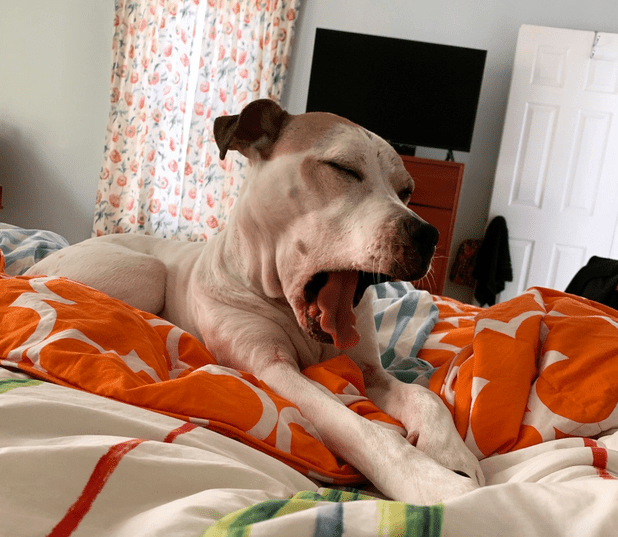
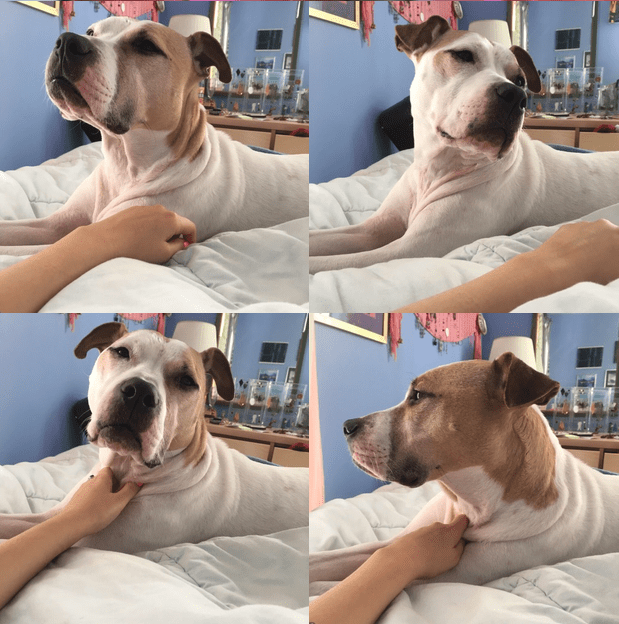
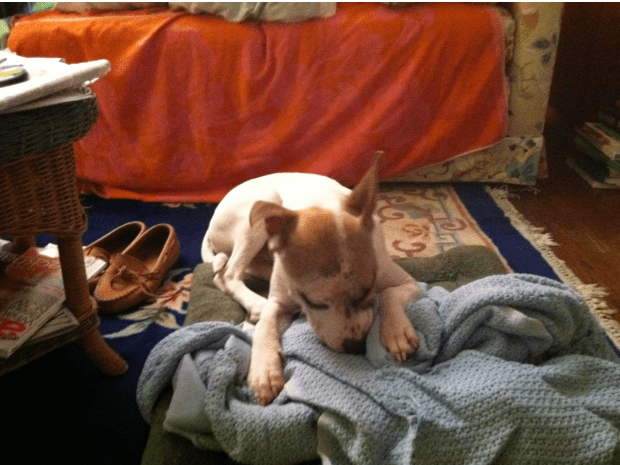
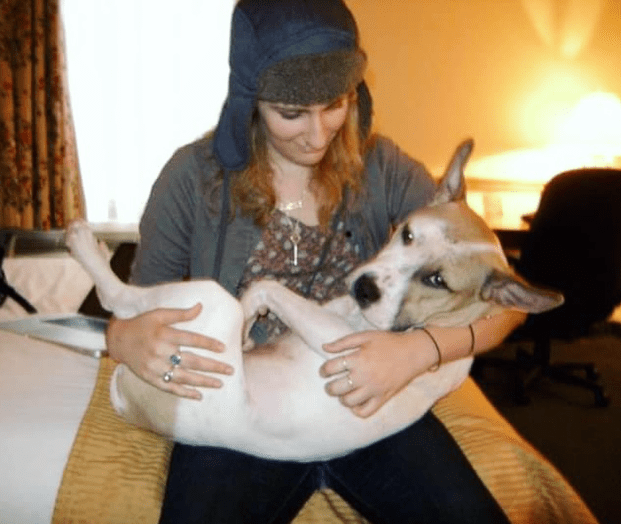
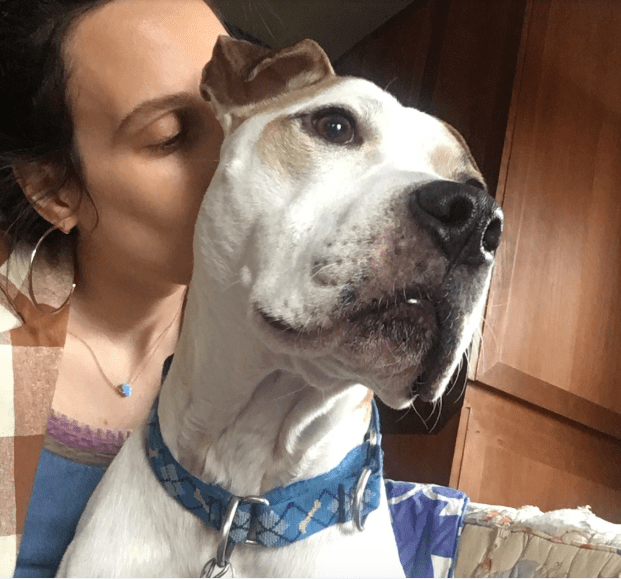
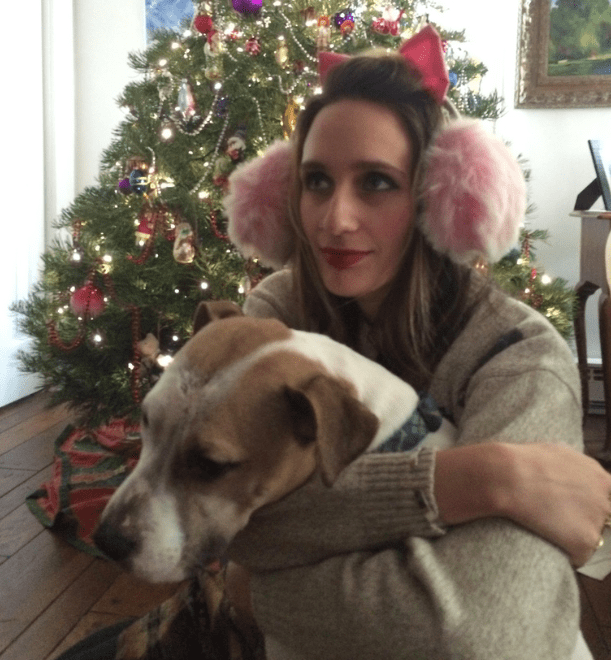
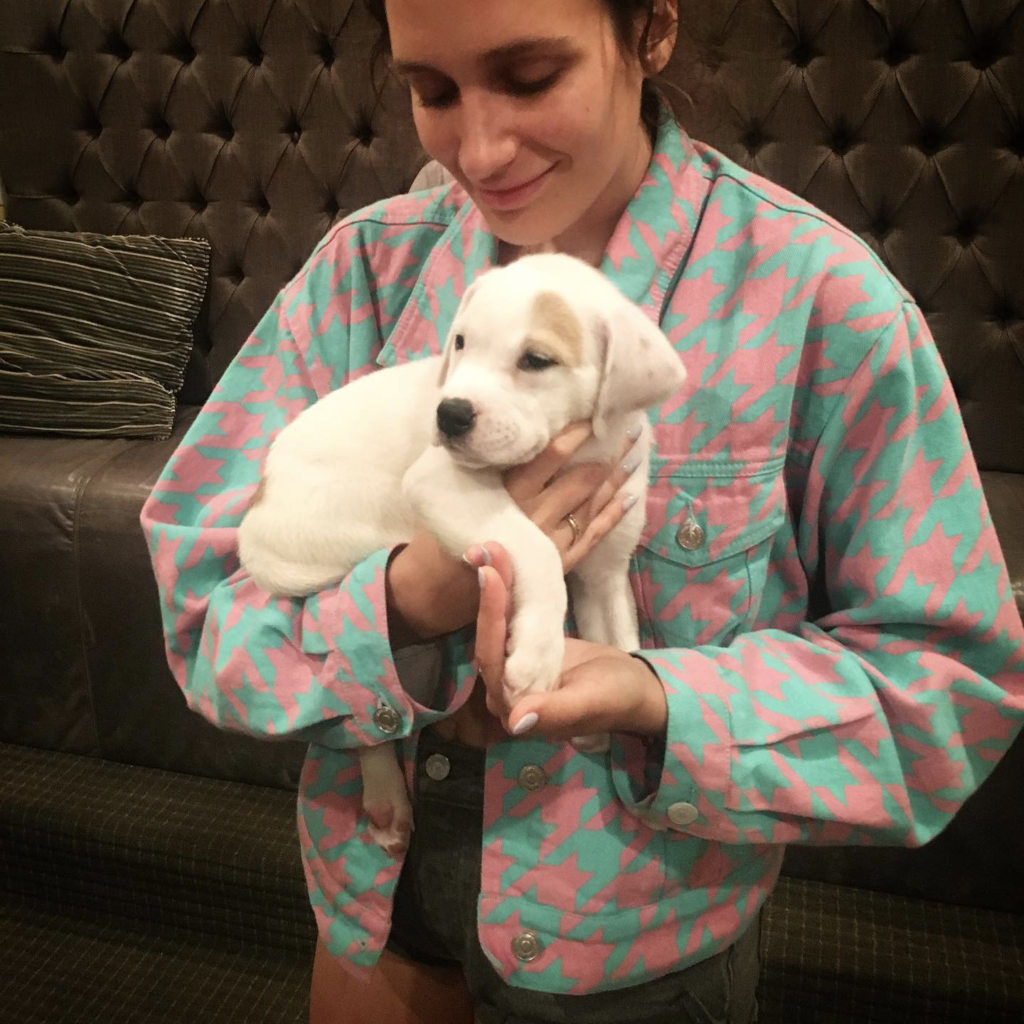
Sadie Dupuis is a shredder with a cause. An artist through-and-through, Sadie is a prolific songwriter, poet, and visual artist. She’s the imagination and voice behind the innovative and ever-evolving rock group Speedy Ortiz, who are fresh off a tour with Interpol. Sadie also releases solo work as her alter-ego to SAD13. But Sadie’s voice extends beyond the artistic realm. She has consistently been one of our generation’s most outspoken artists on a wide range of issues – standing up for human rights, political justice, climate change awareness, sustainability, and this column’s favorite pals, the animals. Sadie is a long-time dog mom to a pitbull cutie named Buster. Audiofemme talked to Sadie to hear about the many causes Sadie supports (and how we can help too), some stories from Speedy’s tour with Interpol, upcoming dates for Speedy Ortiz in 2019, and mostly Sadie’s love for animals and the history that led her to dog-parenting and animal advocacy.
AF: Please introduce us to your fur son.
SD: This is Buster, who I think of as my regular son who happens to be only slightly furrier than me.
All photos courtesy of Sadie Dupuis.
AF: How did you and Buster find each other?
SD: I started fostering Buster on Valentine’s day of 2011. I found him on Craigslist while I was living in New York. My friend and roommate had passed away in late January, and I was having trouble adapting to living without him in what was our shared space, which was also where he died. You can only sage an apartment so much.
I started fostering pit bull mixes in my first apartment as an 18 year old, and loved the experience. I thought that giving care to another animal in that way might help me get out of my head and my grief. Which of course it did. Buster was four months old, a stray rescued from North Carolina by a now defunct New York pit bull rescue. He was recovering from a bad case of mange with tons of bald spots, and his eyes were so scabbed over from it that he was still recovering his eyesight. But I knew right away I would wind up adopting him.
I wanted to change his name from “Buster,” which the shelter had given him, to “Fry.” He wasn’t having it. And besides, he’s a major mama’s boy, very like Buster Bluth. But of course he responds to all manner of nicknames. Chief among them “Lil B.”
He had a very calm and timid energy at first – he didn’t bark until after his first birthday – but he came into his own. He’s got a weird sense of humor and an impossible to predict bratty streak. He cracks me up constantly, but is also great at intuiting when the people around him need quiet, cuddly support. I always thought he’d make an incredible therapy dog. He’s certainly provided that for me.
Buster at 4 months.Buster at 6 months on his first road trip.
AF: Are there any animal shelters you can recommend to people looking for a furever friend?
SD: Now that I live in Philadelphia, I pay attention to Morris Animal Refuge, the first animal shelter in the country. They are open admission and do tons to provide homes for the animals that pass through. Supporting your local no-kill shelter or rescue is the best, whether that’s with money, fostering, volunteering, or social media sharing. Donating to shelters in someone’s name is a thoughtful and useful gift for birthdays or holidays!
Sadie and Buster having themselves a Merry Little Christmas.
AF: Did you have many pets growing up?
SD: I grew up with a miniature schnauzer. I have a tattoo of him.
My mom’s boyfriend for most of my childhood was not only a former punk drummer, but also an amazing dog trainer, and a really formative influence for me in both those departments. At any given time, he’d have at least ten dogs in the house, at different stages in their education. He’d get tasked with dogs who had histories of violence due to poor training and seeing them make progress was amazing early learning experience that no dogs are inherently bad, and that with love and support animals can make tremendous recoveries. Matty’s still an incredible dog trainer for the Animal Rescue Fund of the Hamptons and I keep up with his posts on Instagram. We also had six rescue cats at one point. Well, one rescue cat and her five kittens. Which is wild to me, because I’m so so so allergic to them. I was drugged up on antihistamines my whole childhood for this reason.
1999ish, high on Claritin, holding Rudy (mother Kitty in the background).
AF: What is your spirit animal?
SD: I’m non-Indigenous and white, so spirit animals aren’t a belief system or phrase I have access to in a way that isn’t appropriative. If I had to pick an animal I identify most with, it’d be (big surprise) dogs. Especially dogs that are territorial over their food. There is a corgi named after me called Sadie Dogpuis (she has a very cute Instagram) so I feel like we are forever psychically linked in name at least.
Sadie Dogpuis and Sadie Dupuis at Junior High in LA.
AF: Have you ever written a song about (non-human) animals?
SD: There was an early Speedy Ortiz song called “frankenweenie” about putting down my childhood dog, partially as a metaphor for getting out of my first long-term relationship. That’s the most specific one I can think of. Animals show up all over my work, though, now that I think of it. Our first album has songs about tigers, horses, fish, rats, not to mention some dog-specific terminology like “coats for curs” and “kennel cough.” The second album has a golden Foil Deer as its album artwork, title, and central metaphor. So I’m very drawn to non-human entities in my work. Also, we’ve tried to put Buster in music videos or press photos like five times. Varying levels of success.
Our first press photo. 2012. I remember getting told it wa too lo-res to print in Nylon. Even though there is a very willing dog model. Real Hair era. By Emma Rothenberg-Ware. EW ran this, I think. Buster is eager, ready. ‘Twerp Verse’ photo shoot by Shervin Lainez, 2017. Buster is over it.
SD: All-time is tough, but I have Palehound on my mind right now and I love her song “Dry Food.” Nicki Minaj saying “you a lil dusty possum” is one of my favorite moments of recorded music.
AF: You just returned from a few big tours this year. Can you share an interesting story with us?
SD: We were just on tour with Interpol, and on a few of the dates, they invited local animal shelters to bring puppies and kittens backstage. The band hung out with the animals and took some cute photos for promotion and were able to help them find forever homes for rescued animals. I think that’s a genius way to support animals and also feel some love on tour, which can be lonely and isolating. Definitely one of my favorite things I’ve seen a headliner request.
A sweet puppy backstage on tour with Interpol.
AF: If your pup Buster had a band, what instrument would he play and what would the band be called?
SD: Buster’s a yodeler and sometimes yowls along to music I play. He thumps his tail aggressively while wagging, so drums are an obvious choice. He’s a good dancer too and loves scampering around when we play, so he doesn’t necessarily have to go into performing music – I’m not gonna force him to follow in my footsteps. Although his jingling collar does show up on some of our recordings when I incorporate excerpts I tracked at home.
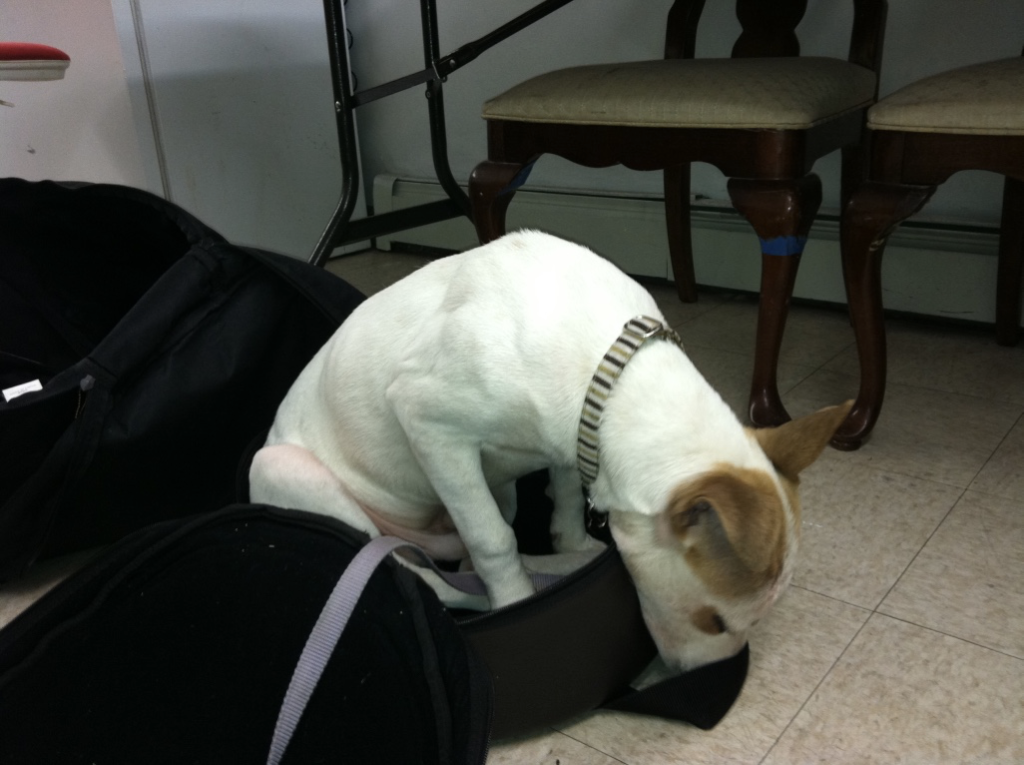
Buster’s first favorite bed, a snare drum bag.
He loves music with high pitched guitars and always liked when my ex-bandmate Devin McKnight (now of Maneka) played with a Digitech Whammy. Weirdly, high-pitched, rhythmic vocals are a no – he hates when I play Melt Banana and early Guerilla Toss.
He shreds (not anymore).Buster at Sonelab in Easthampton, MA while we were mixing Major Arcana.
AF: If he could have another (non-human) animal friend to hang with, fictional or real, what would s/he be?
SD: As he’s gotten older – turning nine this year, already! – Buster’s gotten less good with other dogs, which is a bummer since he used to love playing at the dog park. My mom lives near a dairy farm and when we drive past the cows, Buster loses it. I think he wants to befriend them, which of course I would encourage if I wasn’t worried he’d scare them. Personally, I would love it if Buster made pals with a pig, because that would mean I got to be pals with a pig, too. But honestly, he thinks he’s a person and mostly he just wants to hang out with us.
Sporting a Tooth and Honey sweater.
AF: You have done a commendable job using your voice as an artist to incite positive change among fellow humans, our friends sharing the animal kingdom, and the world at large. Many of us have been hit even harder than usual with the current political climate. Are there any organizations currently that you would like to highlight and urge readers to support?
SD: On the human side, in 2019 we’ve focused on fundraising for and promoting Harm Reduction Coalition, who do work for individuals and communities impacted by drug use. They focus on agency, dignity, safety, and policy reform for people who use drugs, and are involved in initiatives like needle exchange, injection sites, naloxone training, fentanyl testing, and more. I’m really glad for every opportunity to tell people about the life saving work they do and am honored that some of their representatives will be tabling with information at upcoming Speedy Ortiz shows.
On the animal side, I’m daily inspired by people and sanctuaries on Instagram who share their processes in rehabilitating and caring for animals. Kitten Lady, Ducks and Clucks, Prissy Pig, Sesame the Opossum (RIP) are some favorites. Goats of Anarchy recently took in a friend’s special needs goat, and I’ve never felt closer to celebrity. As a vegan I’m psyched when animals others think of as food get to show off that they are as loving and intelligent and funny as dogs and cats. A friend works for Woodstock Farm Sanctuary and I love seeing all the adorable and happy sheep, goats, pigs and chickens. Definitely an organization worthy of support.
AF: When did you become vegan and what prompted you to make the switch?
SD: I became uncertain about eating animals at age 7 after The Simpsons episode “Lisa the Vegetarian” first aired, and as I started to connect “foods” with the animals they came from – like lamb, or rabbit – I couldn’t do it. I stopped eating all mammals in 1998 after my mom moved close to the aforementioned dairy farm and I got to see cows and calves up close every day. So I’m vegetarian purely for animal welfare reasons. Veganism happened right before my final semester of high school in 2006 once I learned more about the environmental impacts of farming industries and the health risks associated with animal milk and eggs. I’d had sports-induced asthma, which went away immediately, and chronic stomach issues I’d had my whole life were seriously diminished.
There were a couple times when I was still a teen that I tried local and sustainably sourced dairy or fish, like when I was studying abroad in Spain, because it then seemed culturally significant to me, or something. But that doesn’t fit in with my philosophy any more and it’s been more than a decade since I viewed anything from an animal as “food.” I get to tour globally and try all kinds of amazing foods and I never wish I followed any other kind of diet. Also, over the past 13 years of veganism, food creatives have gotten so much better at replicating pretty much anything in a plant-based way.
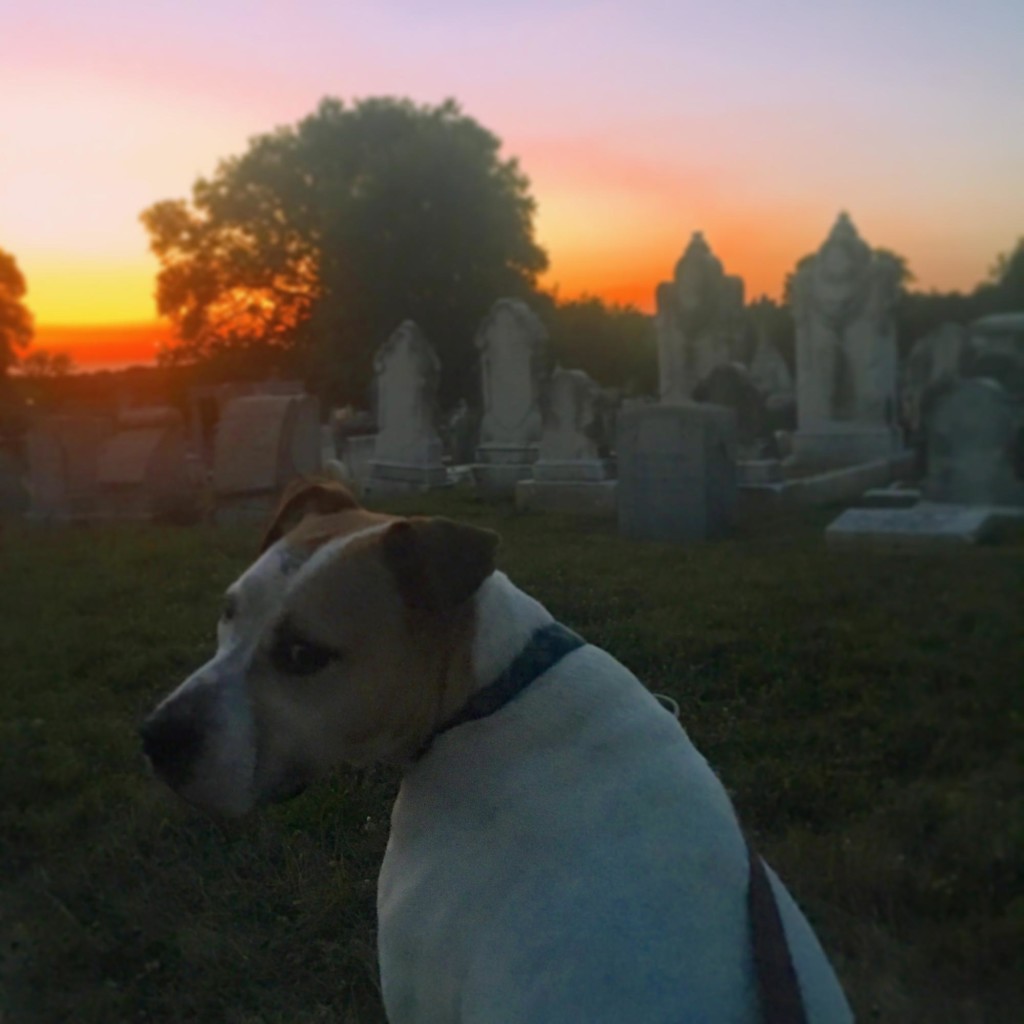
Buster enjoying the sunset at a cemetery screening of The Craft.
AF: I noticed you have made some plugs to sustainable brands on your Instagram. Can you recommend any vegan companies to our readers looking to reduce their carbon footprint?
SD: I recently learned about mushroom leather, and bought my first mushroom suede bag, which is a sustainable (and PVC-free) way to have some beautiful accessories! Native Shoes are my new favorite sneakers – they’re recycled, affordable, and come in very cool styles and colors. MooShoes is a great resource for finding out about new brands in vegan and eco-conscious footwear and I go to their locations in New York and Los Angeles regularly.
AF: Any favorite vegan restaurants or recipes to share?
SD: I have a favorite in every city, but Philly has a crown jewel of American veganism in Vedge. They do a rutabaga fondue that every non-vegan I’ve brought there raves about for years. It’s a bit pricey so it’s best for a really special occasion or if someone else is footing the bill. I did just come home from Mexico City yesterday, which is perhaps the greatest vegan city in the world. Gatorta, Por Siempre, Los Loosers, La Pitahaya and Pan Comido are five of my favorite restaurants – it’s crazy that one city gets to have all of them!
AF: What do you have in store for us with Speedy Ortiz, SAD13, and all your musical endeavors for the remainder of 2019 and 2020?
SD: Mostly eating on tour or eating while recording! You can find all Speedy Ortiz dates at speedyortiz.com, including upcoming dates with CHVRCHES.
Seattle’s Nauticult— equal parts industrial hip-hop and thrashing noise punk—was born in a moment of raw inspiration. For years, the members had known each other and even considered rapping over beats together, but they didn’t actually pull the trigger until a surprise birthday party performance in 2015. The result was cataclysmic innovation—electric drums, synth guitar and rasping energetic rap over a rousing Busta Rhymes instrumental—so memorable, friends at the party were reliving the moment on social media the next day.
This marked the beginning of Nauticult and the fiercely conscious music they continually chew on and spit out. Their new EP, Human Use of Human Beings, the follow up to 2017’s Phantom Limb, drops July 9th, and all three members of Nauticult—vocalist Austin Sankley (She/Her), guitarist and synth Dylan Berry (He/They), and drummer/sampler Evan Fitzgerald (He/Him)—gave Audiofemme the scoop on their upcoming release show at The Ruins on July 9th, bridging the seemingly disparate genres of hip hop and noise punk, and their preoccupation with themes of religion, cults, and group thought.
AF: Tell me in more detail how you got started making music together—and about that birthday party in 2015.
EF: We had been friends or at least known each other for years and wanted to do some sort of rap group type shit for a while. In 2015, we had a birthday party for Dylan, and that night Austin had some intense family trauma happen and said she didn’t want to perform that night at all. We had only thought about just making beats and rapping to them, but we got juiced and put on Busta Rhymes instrumentals, then I got on my electric drum set and Dylan picked up his synth guitar and Austin quote “channeled the negative energy into the mic.” At the time I actually didn’t remember a thing about it until Dylan told me the next day “yo, Geoff got a sick Snapchat of us last night.” I watched it, and it was the filthiest blend of bassy, thrashy hardcore rap that I hadn’t heard, and I was like yo, fuck making beats, we’re doing this.
AF: What was the objective you had when you first started out?
AS: Our objective was purely to make music we wanted to hear. I had never really imagined I would be in a band, let alone making the music I was making. I think the feeling was mutual. We were all obsessed with experimentation. We were really trying to create a style we hadn’t heard before, and to make music that contrasted what was being made around us. It took me a while to really learn how to match the energy and for us to find our rhythm together.
AF: What’s Nauticult mean?
AS: It is a play on “Not a cult.” To me it really means not assimilating to toxic bullshit and group thought, and not making music that everyone else is making. And trying to be successful while retaining individualism. Sort of critiquing the cult-like logic that goes into writing processes, and social dynamics and powers and the way we operate in society. It’s also thought of as something that someone says about the cult they are in to someone they are trying to indoctrinate into a cult. It also plays into nautical themes. My rap name is Argonaut so it plays into the last four letters of my rap name.
DB: Nauticult also directly translates to a cult of the sea, and relates to how a lot of sounds and textures we use are drenched in effects and very wet in the mix of things, almost to the point of being overloaded; it represents the more psychedelic elements of our band and the overall vastness of the influences we are pooling from. Nauticult is definitely a multiple iteration type of name.
EF: Naughty cult (lmao). We were way more naughty and trouble making a few years ago; now we’ve cooled our shit down. But yeah we used to go egging and shit. Ah man, I got some good stories from then though.
AF: What inspired you to combine elements of hip hop with punk?
EF: I wouldn’t say we were inspired to do anything from other artists, [but] me and Dylan had been death metal musicians from the jump, and now we are just influenced from a wider range of music. [We’re] heavily [into] production of rap, goth synth shit, all that, and now with our unique music equipment, the music is an organic blend of how we play our instruments naturally and what we listen to. And Austin has rapped since she was five, so why would she do anything else than her super power? Might I also add she is the greatest lyricist of all time.
AF: Who or what do you feel like your music is in conversation with? A place, another artist, an era?
DB: There was never one artist that we’ve all looked to as a band upon starting this group. Part of what made the inception of Nauticult so exciting was the raw energy of all the genres we were bringing to the table. This day and age there is more noisy/industrial music than ever, bridging from hardcore to hip-hop and psychedelic music and everywhere in between, screaming out to the void of the world. This tension we all feel. We have been inspired by artists such as Shabazz Palaces who blend live percussion with psychedelic productions and more metaphysical and spacial themes, similar to the lyrical themes used in the group, clipping. who also bring a blistering, industrial flavor to hip-hop, and JPEGMAFIA, who has some of the grittiest production and lyrical style out there in this genre—which has been described as nihilistic, villainous or satirical. Our music is not a nod to any of these artists but an acknowledgement that we are all a product of our environments and influences in an intense and evolving sort of way when it comes to our experimental approach, musical background and industrial creed in approach to sampling, ideology and crafting our own sounds.
AF: What spaces and communities in Seattle have been most supportive to you and your music?
AS: There have been so many spaces that have supported us: Fred Wildlife Refuge, The Ruins, Chop Suey, Barboza. We have gotten a lot of support from the hip hop community, punk, queer community, burlesque, and metal scene. We are so lucky to have the support that we do. I love everyone who comes out to our shows!
AF: Tell me about your new EP, out July 9th. What energies or forces brought it to fruition? What are some of its underlying themes and drives?
AS: We honestly wrote a lot of the songs on this EP directly after Phantom Limb came out and have just been refining them. The process has taken a long time with playing shows and everything else taking up time. The themes are commodification, violence, group thought, possession, technology, and war. It really plays into a lot of the themes behind our name. It’s an exorcism for the things that possess us, such as religion, group thought, trauma, identity, abuse, sexism, masculinity and all things cult.
AF: How did the new EP challenge you?
DB: Some of the material on Human Use of Human Beings we’ve been sitting on for some time but with how many shows we would be playing and tours we went on we had a hard time solidifying our writing process in the studio, having four different practice spaces since our first album. We took a much needed hiatus last fall/winter in order to distill these elements and finally put together our own home setting where we have the utmost control in our writing process and production as well as the workflow of putting together our music. It was a real challenge to get to this point.
AF: In comparison to your other releases, how does the new EP stack up?
DB: With our first EP, Phantom Limb, I feel like we were really finding our voice, charging straight ahead into making these songs that were thrashy, psychedelic and dense. With this EP we are about to put out I feel as though all of our approaches are much more developed. We use more effects and arrangement and samples, pieced together with more progressive song structures, longer songs and even more conceptual lyrics. We have all integrated more as far as how we write together and communicate and that has definitely translated into the music.
AF: Tell me a bit about the show at The Ruins. Is this a place you play often? Will you have an opener? Any surprises as a part of the release show?
AS: This is our first time playing the venue. We are playing with So Pitted, Fucked & Bound, and Guayaba. OC Notes is doing a DJ Set, we have burlesque and aerialists, as well as live tattooing & vendors. It’s going to be wild.
AF: Are you touring with the EP? What are your future goals for Nauticult?
AS: We actually aren’t going to tour with this EP – we want to play a few more shows and then go back into writing. We have the skeleton of an album that we are writing done, and it’s a big switch up from either of our EPs. It’s going to be our first full length. So after this release we are going to get back to cooking.
AF: How can people follow your band/buy your music?
AS: We are available on all streaming websites – Bandcamp is a good place to purchase our music and merch. We are most active on Instagram and Facebook as far as updates go.
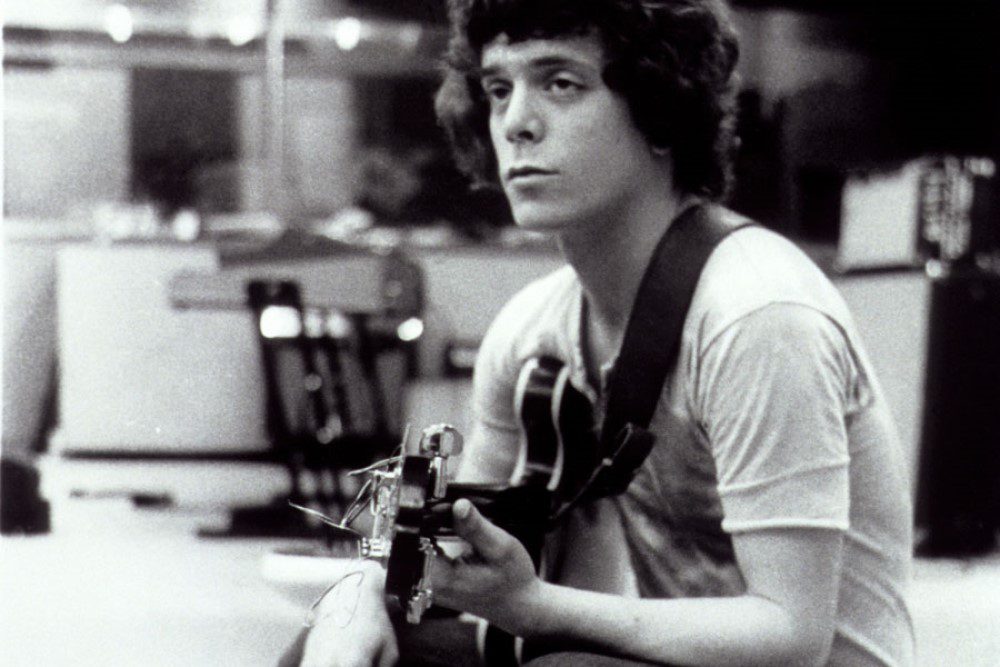
ONLY NOISE explores music fandom with poignant personal essays that examine the ways we’re shaped by our chosen soundtrack. This week, Taylor Ysteboe tries to reconcile platonic versus romantic love through Lou Reed, whose lyrics spoke to her when her own words failed.
Her name was Alexandra, and I thought she was the weirdest person I had ever met. She changed her hair color as often as the seasons changed. She made mix CDs out of discs that looked like miniature 45s. She was obsessed with The Rocky Horror Picture Show.
Although we first met in fourth grade, we didn’t really get to know each other until our junior year of high school. She became my best friend, and we were inseparable. We shared everything with each other: our interests, our dreams, our secrets. With Alexandra, I no longer felt different. I felt whole, wanted. Other friends didn’t quite understand me – I didn’t fit into their mold that had been shaped by our conservative and religious town. But Alexandra always understood.
A few months after our friendship was rekindled, I sent her “Pale Blue Eyes” by the Velvet Underground, telling her it was the perfect song – a label I don’t apply lightly. I told her it was the type of song I could imagine myself dancing to with a tall, handsome man, perhaps as it rained outside. (Later on, it was her who I imagined dancing with.) And she just got it. She heard the yearning, the love in Lou Reed’s voice, and she felt it, too. Through that song, we were connected by an infinite, invisible string.
If I could make the world as pure
And strange as what I see
I’d put you in a mirror
I put in front of me
The song itself is about Reed’s first love, the one who got away, and he wrote “Pale Blue Eyes” in response. You can hear the hurt in his voice and in his guitar at the foreground as a faithful tambourine keeps time. But there’s content resignation, too. He accepts that she’ll never love him like he wants her to love him, but he’d rather live with this feeling than live without her.
And I fell in love, too. I didn’t mean to, not really. I didn’t even know that’s what it was at first. I loved her heart. Her hair crinkled by bleach. Her bright laugh that reminded me of sunlight. I loved her with every part of me. How Reed sang about his lost love is how I felt about Alexandra. I couldn’t risk our friendship, though, so I didn’t say anything. I didn’t want her to cut that string that held us together.
Looking back now, there’s something truly special about your relationships in high school. It’s often the first time you fall in love. Sometimes it’s the romantic kind of love. Other times it’s the platonic kind. Both are pure, exhilarating. I’d never experienced anything like that, and I was scared shitless I’d never experience it again. I wanted to hold on to Alexandra, just in case that was true.
Alexandra moved midway through junior year. We tried to keep in touch, but that invisible string grew more and more taut. It worked for awhile, until it didn’t. By the time we both entered college, we were strangers. The string broke.
Thought of you as my mountaintop
Thought of you as my peak
Thought of you as everything
I had but couldn’t keep
I miss sitting with her in the cafeteria before the morning bell rang, watching her carefully and tenderly sketch in art class, getting milkshakes on a Friday night, lying down on the soda-stained carpet of the movie theater after a late showing. I miss it all.
Even now, a few years later, I miss it all. I miss her. We’ve both graduated college and are going down our own paths, but I still think about her and what we had. Some days I think that our friendship was beautiful and could have grown into something more. Other days I think that our friendship was beautiful and just that. I couldn’t keep her. Perhaps I wasn’t meant to. When I think of her, I think of “Pale Blue Eyes” as our song. Lou Reed’s words linger on, but she is just an echo.
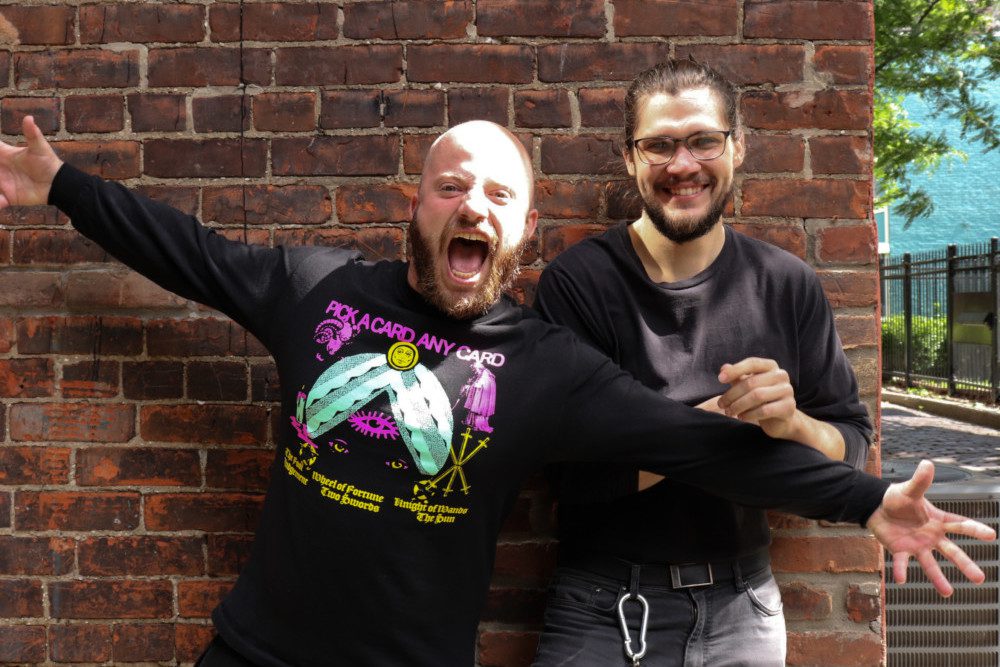
Cincinnati rapper Ronin Halloway and producer SmokeFace teamed up to release their collaborative album, Pressure. The six-track project has been four years in the making and with its release, the duo is able to reflect on how far they’ve come. Although they say the style of the record is vastly different to what they’re creating now, Pressure reveals a unique drama and depth, with Halloway spitting ferocious bars over SmokeFace’s meticulously crafted beats.
Here, AudioFemme catches up with the rapper-and-producer team as they tell us the story behind their one-of-a-kind project.
AF: How long in the making was Pressure?
SF: Four years exactly.
AF: Why did it take four years?
RH: So we started making it and it took us about—for the first version to be done—two years and we went through a long mixing process trying to get everything to sound right. This is when we were still dumb kids, and we didn’t have any proper representation or know how to properly promote it, so no one heard it, so we pulled it. We reworked it and trimmed the fat and made it a better album, and we’re going to finally let it out and give it its actual day in the sun.
AF: So it’s getting its second chance here and will get its justice this time.
SF: I definitely think so. It’s like half the length, which helps, and I already think that there’s more of a response to it than there was the first time. We did a video for the title track, which was good, and there’s a couple more visuals to follow. It’s exciting.
AF: Ronin, you’ve been putting out projects in the meantime, like your most recent EP,Icarus. How have those other projects influenced the direction of this album?
RH: I think it’s kind of cool because a lot of these songs were done and one of the main reasons we even went back to this was because we did this song called “Sirens.” We probably would’ve let [the album] just go away, but we loved that song a lot and really wanted to put it out with the project. I think it’s cool because the stuff that I’ve done recently is like way different. Him, too.
SF: Yeah, my stuff now doesn’t sound anything like this, but it’s still a great album.
AF: Does your new music sound different because your styles have evolved?
RH: Big time. Artistically, personally, I feel like I found my voice. Pressure is a lot of working out and finding out what that might be, experimenting with a lot more aggressive, industrial types of styles, which is not what I do. I think it was good though, but it’s not really my wheelhouse anymore.
AF: What were some big lyrical and compositional concepts that you were both inspired by?
RH: A lot of it is just really aggressive and crazy and some of it I didn’t even put the pen down, I just freestyled.
SF: At the time, I was really inspired and listening to a lot of El-P, specifically he has a song called “Up All Night.” I was listening to a lot of slow, dredge-y, synth-heavy, trap drums—big epic stuff. The song “Cartoons and Cereal” by Kendrick [Lamar] was probably one of my biggest influences. That song was always in the back of my mind when I was making this record. I’ve since fallen in love with sampling old records and really twisting sounds.
By Samuel Steezmore
AF: For somebody who’s about to listen to the album, what would you tell them so they can experience it in the way it’s intended?
RH: Buckle up! I think it does have a little bit of a story to it, a loose story. It starts off with this song called “Fading Blade,” which I recorded myself as a choir. It almost sounds like this Lion King-thing. And then “Pressure” sounds really, really dark, it does all the way through. I think it does end on an interesting note.
It definitely changes in the middle of the album, it goes into the “Be Okay” beat, [which is] up-tempo and manic. The track after that is probably the closest to a ’90s rap sound, and then the next track is completely left-field. And then we have “Sirens.” I would definitely categorize it as almost alternative hip-hop, like Danny Brown, JPEGMAFIA, Death Grips.
AF: What kind of story does it tell?
SF: One of my favorite things about the album is the backstory. You can kind of hear it in the album – it’s a coming-of-age story starting off as kind of young crazy boys. We’re kind of going through it and growing up and experiencing consequences for decisions and then, coming out on the other side, hopefully having learned something. Especially with the pair of songs “Be Okay” and “Hangover.”
AF: Are you working on any individual projects right now?
SF: I just put out a tape with some beats on SoundCloud and Bandcamp. I just want to keep doing that for a little bit, make something and put it out. I don’t want to sit around and wait around.
RH: I have a couple things I’m working on. The next project is going to be called Excalibur and I’m working with Devin Burgess on part of it. It’s going to be three parts and one of them is produced by XVII, so that’s almost done. I’ve been recording that at Timeless. So XVII and then Devin Burgess are working on a set of songs for it and then the last one will be with [SmokeFace]. It’s going to be like three EPs.
AF: But for now, just excited that Pressure is finally out?
The first time I ever had the chance to see Pip the Pansy perform, she was known by another name and draped in flowers: her body, her microphone stand, her keyboard. She was a character from a Greek myth that had traveled through the ages to grace us with her song, and she captivated the audience with an imperceptible magic.
Combining haunting piano melodies with fuzzy synth and driving rhythms – and the occasional flute solo – Pip the Pansy dispels every notion I ever had about pop music and replaces it with a lilting, quirky melodicism. With the release of her latest single, “Siren Song,” I can’t help but find myself even more completely under her spell. Read on as we deep-dive into her creative process, her collaboration with her husband (Atlanta singer-songwriter Sam Burchfield), and her take on timeless lessons found in ancient literature.
AF: Thanks so much for sitting down with me! You are one of the most uniquely creative artists I’ve ever encountered; how did you find your way to music?
Pip: Gah, thank you! Ya know, it never really crossed my mind growing up that I would pursue a career in music. I had taken some piano lessons as a kid, started playing flute in the 4th grade, took some chorus classes in grade school, and dabbled in musical theatre, but it was never really my main focus; it was a hobby. I put a lot more energy into the visual arts, I would say.
I got my degree in photography and figured I would end up doing something in that field but everything shifted pretty quickly after I graduated college. I remember applying for photography jobs right after college and feeling sort of blue about it. I love photography so much — it is one of my passions — but I had a gnawing feeling that if I pursued only photography, I would be neglecting a lot of my other interests and strengths.
I had sort of toyed with the idea of writing songs, but nothing serious. My good friend Gemille encouraged me to give it a real effort, so I figured why not? Having a musical persona seemed like a good way to combine all my passions into one little package. There’s a visual aspect to it, an opportunity to connect with people, a little bit of theatre in a way, lots of traveling… I liked the job description and decided to give it a shot. It helped that I had always kept some musical hobby in my back pocket and I grew up with a fairly musical family; everyone sings or plays an instrument — not professionally — but still, it was always around me. Looking back, I should have known I would end up doing something like this.
AF: You combine such stunning visuals with music that really draws listeners into another world, and it verges on performance art, in my opinion. Can you talk some about your evolution as an artist, both as a singer-songwriter and a visual artist? How do you create such powerful choreography in your music videos?
Pip: I think the visual arts portion of me and the songwriter portion of me are constantly informing each other and shaping each other. I wouldn’t write the songs I write if I didn’t have a background in the arts, and my art wouldn’t look the way it does without the music. When I first started this whole thing my goal was just to get it out there, a “fake it ’til you make it” sort of deal. My material was more vapid, but still eye-catching, simply trying to attract some attention. I figured people were probably going to remember what they saw more than what they heard, and nowadays people may not even stop to listen unless it looks interesting. All the flowers were just a way to get people to stop and listen and hopefully leave something in their brains to remember.
Of course, you can’t fake it the whole time; the art has to mature if you want it to last at all. I know now that I have a responsibility to create things that are meaningful or that at least say something. As my career and life move forward, I am finding it more and more enjoyable to take my time with things, to learn and soak up experiences, so that when I do create art, it is coming from a place of depth and not just shallow content, although “shallow” content can have its positive place in art sometimes. But yeah, I used to not care if things didn’t make sense; as long as the melody was beautiful, I felt satisfied. Things stylistically and technically have improved over time for me as well, but the biggest evolution is probably that I care more about the meaning behind my art now more than ever.
As far as choreography goes, I am not really a dancer, but I do love the idea of the human body being another expression of creativity. I can’t help but move when I hear music playing. It just seems natural to dance in some of my videos. For my most recent music video, I had some help from my friend Jordana Dale. She came over one day and we worked through some choreo together for “Siren Song.” It was one of the most fun things I have ever done with a friend. I highly recommend it.
AF: What is your creative process like? How do you take a song from the idea to the studio to the stage?
Pip: The creative process can be so hard to explain, and it differs from project to project. The best I can say is that I absolutely have to be alone at first. I feel too shy and vulnerable to create while people are around, especially during the initial conception of an idea. Even my husband being home can give me a lot of anxiety while trying to create. I like to start at the piano and eventually I move to the computer to add the proper atmosphere around whatever melody I came up with. I don’t even know where lyrics come from. Most of my songs start with some placeholder lyrics that make no sense at all, but it’s the right number of syllables for the melody, and then I try to plug in the right words from there. Sometimes it feels like it’s all happening simultaneously.
My most productive, creative moments are a whole day ordeal. I get the best stuff done when Sam is gone on tour and I wake up and spend an entire day alone. I don’t talk to any other humans and I hole up in the house and drink a ton of coffee and tea. I pace a lot on those days or just lay in the middle of the floor looking at the ceiling. Sometimes I will have three of those days in a row. I like to get to the point where I feel really lonely and a little crazy; that’s when stuff starts to flow better.
I tend to prioritize how the song is going to sound in the studio. I want it to exist as its own little piece of art. I don’t ever really consider how it is going to feel on stage until it’s completely done. Even now, I have a new EP that is about to come out and I still haven’t thought about the show. Maybe a proper comparison would be a painter wanting their painting to look really good and they don’t even think about how it’s going to look hanging in a museum or printed on a postcard. They just care that their creation now exists in its proper form, but eventually, they’re like, “Oh yeah, I probably should put it in a good frame and have good lighting on it I guess.” Maybe that’s a dumb analogy. I definitely care that my shows are a good experience, but my songs on the stage feel like a completely different thing than the song itself.
AF: Which bands or artists do you consider your greatest inspirations?
Pip: Grimes and The Beatles.
AF: Your husband, Sam Burchfield, is a musician as well. Do you collaborate creatively with each other, or do you keep your projects separate? Does your creative process differ when you’re working together versus when you’re working alone?
Pip: I love an opportunity to work with Sam but it’s rare. My anxiety ramps up the most when we are trying to collaborate and that usually causes us to stop. But there have been a few times where we’ve kept that under control and have been able to work together and it’s always really gratifying when it does work out. He recently released a song titled “Blue Ridge June” that was our first true co-write. We were both working on our computers one day and I heard him sort of humming this melody — I don’t think he even realized he was humming — and I quickly got out my phone recorder and was trying to steal the idea without him noticing. I was caught red-handed and we decided to stop sending emails and go write the song together. I’m still pretty private with the start of an idea but once I get something going I do like to sort of bounce some ideas off of Sam and get his input. He was definitely a bigger part of this upcoming release. The melody for “Land of Love” came from him just messing around on the piano one night and a lot of the lyrics in “Medusa” were co-written.
The nice thing about working with Sam is that we play completely different genres so there is never any feeling of jealousy or competition or fighting over which artist the song will belong to. We genuinely want to serve the song and come up with something that is true and genuine for whichever one of our projects we are working on. Sam is so patient and graceful; I am really lucky to be married to him. It’s a vulnerable process but it’s really beautiful to be able to create music together.
AF: You’ve gone through quite a few changes over the last few years, most notably a name change. What has been your biggest takeaway through the changes, and what advice would you give to your younger self, knowing what you’ll face in the future?
Pip: Don’t be too prideful and stay focused on your aim.
AF: You’ve got a brand new album, Love Legends; Part 1, coming out soon. What was the inspiration behind the record? Did it differ from previous projects?
Pip: Love Legends; Part I is inspired by Greek Mythology and the Italian Renaissance. I wanted to revisit the Greek classics and bring them into an indie-pop realm. I am fascinated by the lessons that can be learned in ancient stories and it’s interesting to see the same truths reflected across many cultures. At the moment, I don’t feel like writing about parties, or ‘being yourself,’ or the political climate, or even love songs for that matter; that’s all already out there. If I am going to add to the noise I want it to be about our mortality. All the things happening around us are important but above all, we are going to die, and I want to nourish my soul with truth. At least that’s my aim for this current project. I feel like I am only on the tip of the iceberg with Part I so I am excited to further the concept with future projects.
This EP differs from other projects in that it is my most DIY. I did a lot of pre-production at home and then recorded the EP with Sam and our good friend Caleb Hawley in an empty apartment in Spanish Harlem and had our friend Owen Lewis mix everything. It’s also the first time that all the songs revolve around one theme.
AF: You’ve just released an incredible music video for “Siren Song,” and it’s absolutely stunning! What’s the story behind the song?
Pip: “Siren Song” is my version of the sirens in Homer’s Odyssey. The sirens are winged creatures that lure sailors to their destruction with their beautiful song. They are symbolic of something that is essentially too good to be true, like fame or fortune. We are tempted by the allure of fame, money, beauty, more social media numbers or lust, et cetera, but these things lead to an empty life, to the death of our souls if we aren’t careful.
In my version of their song, the sirens sing, “Call out my name.” I believe when we say something out loud, we speak it into existence. Acknowledging a desire enough to say it out loud allows it to gnaw at you and taunt you. You will start to chase it but you will never be happy.
AF: We’re living in a time where women in music and art are given more of the respect they so deserve, but, at the same time, more and more injustice is coming to light, as shown by the #MeToo movement, not to mention several groups petitioning for more visibility for women on the radio or festival lineups. What has been your personal experience as a woman in the music industry? Do you feel that the industry is changing, and, if so, for the better?
Pip: I cannot speak for others, but my personal experience as a woman in the industry has not been bad. In fact, I am very happy with how things have gone. With the exception of a few drunkards, I generally feel like my fans and peers are extremely respectful. While true injustice needs to be addressed, I am personally very hesitant to add to the subject as a “victim” of some patriarchal system because I believe all these issues are far more complicated than that. There are more factors than just gender bias that play into the visibility of women vs. men on the radio/festivals. If someone is treating me unfairly I would rather have the mentality that they are treating me that way because they’re an asshole instead of because I am a woman. I don’t want to further a culture that starts to demonize the “white man” or masculinity; I think that is a dangerous approach to the problem. I am still trying my best to understand it all and I want to be careful with my words, so for now I will continue to observe and research while grinding away at my art, finding my voice and hustling as hard as I can. I do think positive changes are happening and women have more freedom than ever to pursue something like this.
AF: You’re a fixture in the Atlanta-Athens music scene. What’s it been like to see the music and art scenes grow over the last few years, and why did you decide to make it your home base?
Pip: Athens was the perfect city to start doing music… everyone there is so receptive of art no matter what form it comes in, plus the motivation you get from being surrounded by an artistic community is priceless. I love Athens for that and owe a lot of my career to that community. I moved to Atlanta to challenge myself and to be closer to Sam. For now it is a great home base; we love our friends and we are able to travel easily out of Atlanta.
AF: Last one! What’s next for Pip the Pansy?
Pip: Part II, I suppose!
Stream “Siren Song” on Spotify now, and keep up with Pip as she prepares for the release of Love Legends; Part I, direct from the Land of Love.
Having analyzed how LSD influenced The Beatles, my understanding of psychedelic rock music may appear sophisticated. But I have a confession to make: my favorite psychedelic rock band is actually Panic! At the Disco. Yes, you heard me right. I just called Panic! At the Disco a psychedelic rock band.
This discovery started my freshman year of college, when, as usual, I was a little late to the game and began listening to the 2008 album Pretty. Odd. It was entirely unlike the band’s 2005 breakout album A Fever You Can’t Sweat Out. First of all, several of the songs featured vocals from the band’s guitarist Ryan Ross, whose voice is reminiscent of a “Strawberry Fields” or “Across the Universe” John Lennon (and who apparently admires Paul McCartney). Secondly, it contained lyrics like “Don’t you remember when I was a bird and you were a map?”
I began to do more research, and what I discovered was that Panic! At the Disco are, indeed, the unsung psychedelic rock icons of our time. Here’s why I came to this conclusion.
1. The Alice in Wonderland References
Alice in Wonderland has become the ultimate musical signifier of all things trippy. Exhibit A: Jefferson Airplane’s “White Rabbit.” Exhibit B: Panic!’s “Mad as Rabbits.” Bizarre body-horror images like “the stove is creeping up his spine again” and “his arms were the branches of a Christmas tree” conjure up Alice’s body distorting under the magic potions, and they even sprinkled a Disney reference into a very strange (one might say pretty odd) plot line: “Rope hung his other branch / And at the end was a dog called Bambi / Who was chewing on his parliaments / When he tried to save the calendar business.” And then, of course, there’s the chorus: “He took the days for pageant / Became as mad as rabbits / With bushels of bad habits / Who could ask for any more?” Indeed, who could ask for anything more trippy?
2. Ryan Ross’s Beatles Shout-Outs
As you might suspect from listening to Pretty. Odd., Ross has counted the Beatles among his biggest influences — but not until he was already making the album. “I was partly drawn to them because they weren’t afraid of doing any kind of song. That was something we were trying to figure out: Are we allowed to do a jazz song? Are we allowed to do cabaret? Just from hearing the Beatles, it was like, ‘Well, they did it. It’s okay to write something other than a standard rock song,’” he told Spin. The album was actually recorded at Abbey Road, the recording studio used by the Beatles. Since then, Ross has called the Beatles “nature’s Disneyland” and “nature’s therapist.” (I think he’s a little confused about what nature is, but I’ll let him have it.)
3. Brendon Urie’s Pivotal Mushroom Trip
When frontman Brendon Urie got into a rut a few years back, feeling uninspired and reluctant to leave his home, he invited some friends over to do mushrooms. “I felt great. I felt alive again,” he told The Chicago Tribune. “Thirty minutes of a bad trip, kicked back into an amazing time — I really liked that I liked feeling uneasy again, like anything is possible. It wasn’t even taking the mushrooms — it was seeing what was out there. I like keeping that curiosity alive. It goes in waves, but it’s nice to keep that. It helps everything. It helps my anxiety, too. I love it.” This led to Urie’s creative resurgence following the departure of last-remaining original band member Spencer Smith and directly influenced 2016 LP Death of a Bachelor.
4. “Nine in the Afternoon”
Urie has admitted that “Nine in the Afternoon” is about psychedelics, and that probably won’t come as a surprise to anyone who has listened to the band sing “your eyes are the size of the moon” (hello, pupil dilation) and “losing the feeling of feeling unique” (likely a reference to depersonalization). “We ended up just partying, by ourselves up in this cabin, which was supposedly haunted—just a bunch of guys on psychedelics,” Urie said. “The title came from our drummer, Spencer Smith — we were high and he was like, ‘Yeah, I don’t know what time it is but it feels like nine in the afternoon.’” His statement actually makes perfect sense if you’ve ever experienced time distortion from psychedelics.
5. “Northern Downpour”
Some of Panic!’s songs may be more obviously trip-inspired, but “Northern Downpour” is a masterpiece in the subtleties of its psychedelic influence. This song’s greatest lyrical accomplishments are the portmanteaus created from entire phrases. “You are at the top of my list” and “top of my lungs” become “you are at the top of my lungs,” mimicking the way perceptions and ideas bleed into one another on psychedelics. If there’s any doubt that this song was psychedelic-rock-based, it mentions “tripping eyes and flooded lungs” and even uses some “Lucy in the Sky”-esque imagery. While the star of the Beatles’ hit has “kaleidoscope eyes,” Panic!’s has “playful lips made of yarn.” Panic!’s diamonds, however, “appear to be just like broken glass.”
6. “Behind the Sea”
This track from Pretty. Odd. is unique in that the entire song features Ross’s vocals. Ross also wrote the song, along with the band’s bassist Jon Walker, which was also the case for “Northern Downpour.” Continuing the lyrical themes of “Northern Downpour” and “Mad as Rabbits,” “Behind the Sea” uses absurdist and rather inventive imagery like “the men all played along to marching drums… so our matching legs are marching clocks” and “scarecrow, now it’s time to hatch sprouting suns and ageless daughters.”
7. Urie’s New Video With Taylor Swift
I’m not saying Taylor Swift was tripping when she wrote this song or created this video, but people familiar with Panic!’s psychedelic influences will find the “ME!” video consistent with Urie’s style. The entire city in pastels, the creepy man flying down from an umbrella like Mary Poppins, the way Urie’s heart turns into a tunnel, and the snake that combusts into a bunch of butterflies will delight psychedelic users and non-users alike.
ONLY NOISE explores music fandom with poignant personal essays that examine the ways we’re shaped by our chosen soundtrack. This week, Jason Scott embraces their genderqueer identity with a little help from pop icon Britney Spears.
Britney Spears’ …Baby One More Time turned 20 years old in January (talk about a punch in the gut to remind you exactly how old you are). But I remember the first time I held that shiny pink compact disc in my hands like it was yesterday. I was a squeaky, pimple-riddled 13-year-old coming of age right at the turn of the century. I was standing on my best friend’s front porch, the sun glistening at the edges of the record, and I kept turning it over and over in my fingers. Her eyes pierced right into my soul, and her dazzling white smile struck me as that of someone just coming into her own as a strong, fiercely independent and confident young woman. She was me. I was her. It was one of those transformational moments with music that changed the entire course of my life.
A teen growing up in rural West Virginia, nestled among shimmering Appalachian hills and rows of steeple-topped churches, I felt suffocated by tradition and a deep-rooted helplessness to understand who I was. Gender hadn’t yet been broken down. The world still operated predominantly within gender normativity then – but such queer icons as Elton John, Freddie Mercury, Melissa Etheridge, George Michael and Tim Curry in a transcendent binary-busting performance in Rocky Horror Picture Show certainly moved the needle in the right direction. Then, there was Will & Grace, a smartly-written primetime comedy that spotlighted queer characters in a way that had never been done before. Will, Grace, Jack and Karen immediately became beacons for the changing face of America and pop culture; their hilarious antics propelled the conversation forward and truly shifted how the world saw queer folk. The stigma around AIDS was lessening and the dawning of a new millennium stoked the flames of a social revolution.
Meanwhile, I still didn’t quite feel like I was seeing my true self up on the screen or stage. The blackness in my heart was all-consuming, and I would carry this around with me for 18 more years. Sometimes, it’s hard to put it into words, exactly, but when I look back on my first experiences with Britney Spears, the emotional gravity of her impact on my youth comes into clearer and more profound focus.
I had already hit puberty by the time I heard my first Britney song. With its slurpy-thick beat and Britney’s playfully-coy vocal lines, “…Baby One More Time” still to this day evokes a sense of power and sexual command that I’ve never managed to find anywhere else. At the time, I often masqueraded around in high heels and smeared on lipstick – there is a photo floating around on the internet of my sister and I caked in a cool, vibrant-red hue, and we’re holding a sign that says “Don’t hate us because we’re beautiful” – or pretended to be Kelly Kapowski from Saved by the Bell or T-Boz from TLC. Truth be told, many a fight broke out between my girlfriends and me on who’d play those parts. I was unapologetic even then.
That first record also hit hard with other glitter-pop bangers like the disco-inflected “Deep in My Heart,” “(You Drive Me) Crazy” (featured prominently in one of my favorite Sabrina the Teenage Witch episodes, complete with a Melissa Joan Hart cameo in the song’s neon-splashed video) and the criminally-overlooked, late-night fizzer “Soda Pop.”
Elsewhere, the Queen of Pop tore down the facade and really plucked the heartstrings. Hits like “Sometimes,” which gives me goosebumps every time I let it wash over me, and “Born to Make You Happy,” another absolute stunner, flexed the full extent of her potential. The chewy “Thinkin’ About You” and the piano-based ballad “E-Mail My Heart” made me want to grow up, fall in love, get my heart broken and then cry on my bathroom floor with a bottle of rosé. “When you need someone, you just turn around / And I will be there,” she crows on “I Will Be There.” And oh my stars, does that lyric hit me even harder today than it did two decades ago.
Her music made and still makes me feel alright in my own skin.
Later that summer, Britney made her debut on the MTV Video Music Awards with a sizzling performance of “…Baby One More Time.” She had to share the stage with that year’s other hit newcomers, a group of men called *NSYNC, but the school room setting gave her the proper arena to prove to the world that she was worth it. That two and a half-minute explosion cemented what I had already known: a superstar had been born and pop music was never going to be the same.
I would never be the same either. In fact, summer ‘99 was the turning point I’d never forget. I knew I was attracted to guys. I mean, gym class always made me hyper-aware of my surroundings and totally uncomfortable. I always waited for everyone else to change before slinking to the furthest corner. I never told anyone how I was feeling, but I assumed all other queer boys felt the same: teetering on the edge of masculinity and femininity. Socially, terms like “non-binary” or “genderqueer” were far outside of our understanding of identity markers, so I felt even more alone and isolated from the world and myself. I looked to Britney to satiate some need that I couldn’t quite figure out on my own, and her ability to command the attention of the entire world was inspiring and gave me hope that someday I might be that confident, too.
I’m not sure when it started, but my feminine energy began to inhabit most of my being. I started to dream, imagine, think, and act as a girl, and so, I gave her a name: Britney. Britney Spears, the pop icon, almost became ingrained within my bones. Her magnetism, her charm, her style, her prowess, her humor, her personality, all soaked into who I was becoming. She fueled me to think beyond an ordinary life, because I knew I was special. I was extraordinary, coated in a thick layer of sass. And it was as if the singer was the only one in the entire world who could understand the Britney I held within.
In the coming years, I followed Britney’s career as any loyal, avid pop fan would and should. Each step of the way, I grew as she did, and sometimes, dipped to her deafening lows as she did. When the media made fun of her mental health in 2007, my heart was both broken and empowered by her, seeing her somehow endure such disgusting ridicule. It was still years before the idea of non-binary identity broke into the conversation about gender, so I came out as a gay man one year prior and had my first sexual encounters. But even that huge step in naming what I felt inside didn’t quite go far enough; I was still troubled by something far deeper. Along the way, though, Britney was my haven, and I watched the starlet climb out of unimaginable darkness to release more albums, including 2011’s Femme Fatale and most recently, 2016’s absolutely astounding Glory, both among her greatest artistic feats.
It was actress and producer Natalie Morales (of Parks & Recreation fame), not Brtiney Spears, who finally completed the puzzle for me – she wrote a powerful essay on her own journey with gender, and that’s when I knew once and for all who I was. I came out as non-binary (or genderqueer) in the summer of 2017.
I am here. I am queer. I am Britney.
It’s certainly been a long, winding road, as they say, and I am eternally grateful for Morales’ fearlessness to proclaim her truth from the mountaintops. But it was and forever will be Britney Spears who first unlocked that mysterious door for me so many years ago. Her humanity, her truth, her daring and her music have and will always be there in the darkest of hours.
My Britney has certainly morphed and blossomed in various forms through the years, often mirroring personal breakthroughs and turmoil that could have swallowed me alive. I sometimes wonder how my life would have turned out had we not been blessed with Britney Jean, one of the most prolific pop creators of our time. I don’t think I ever would have been sent down this path on which I now stand.
Britney, if you’re reading this, from the bottom of my broken heart, thank you.
The debut EP from San Francisco-based band Thank You Come Again occupies an interesting space between old-school rock n’ roll and something newer and more intimate. EP opener “Creature” starts us off with a grungy guitar riff that takes its time burrowing into one ear before the rest of the instrumentals join in. A few seconds later vocalist and guitarist Izzie Clark enters, delivering her lines with the gentleness of someone singing a bedtime song. I’ll love you till the end of time, she assures. But I’m feelin’ off today.
“Creature” is my favorite song off the EP, with a soaring chorus that takes full advantage of Clark’s throaty voice. Her strength as a vocalist comes from her ability to makekey lines feel distinct, small moments of storytelling that create layers even within simple lyrics. In “Creature” Clark manages to sing however temporary, understand you have my soul with a palpable sense of tenderness even as the chorus projects utter exhaustion, Clark throwing up the white flag when she realizes that she can’t save someone from themselves. “Creature” starts its final quarter with a high-energy guitar solo reminiscent of The Donna’s under-appreciated Allison Robertson before Clark lets out a spirited “Woo!” in what feels like a homage to female-fronted rock groups of years past.
EP closer “Anza” takes this thread and runs with it, Clark belting out her best Janis Joplin, letting emotion break crests and troughs in her voice. The chorus sees Clark begging for the attention of a “wild woman” while rolling out a thinly-veiled sexual metaphor that fits in nicely with the nature imagery in the rest of the song. Below it all is an ethereal siren song of distant oohs that proceed the chorus.
Because of choices like this, I assume that Thank You Come Again’s quartet of Clark, Danny Lomeli (guitar), Julian Paz (bass), and Steven Sessler (drums) see the potential in contrasting Clark’s moments of softness with the table-upending power of a good guitar riff or grinding solo, as exemplified in “Tall Boy” (also the EP’s preview single) which very literally takes dips into a bare cymbal-and-guitar sonic valley as Clark bemoans watching calls go unanswered on someone’s phone, her voice slowly rising in anger. “Tall Boy,” like “Creature” also has a lot of fun with the guitar solo, a layered slow-burn that incorporates the slow/fast/slow instrumentals of the rest of the song.
“Taking It Off” is an interesting one, a song that starts with what sounds like an ending before becoming something else entirely, a claustrophobic account of desperation for someone to see you free from artifice even when you know it will leave you too venerable. It grew on me with repeated listens.
I look forward to seeing what this band will do with the narrative room afforded by a full-length album. Based on this EP, I hope they take the opportunity to lean into the strengths of “Creature,” where they let Clark and the instrumentals color the lyrics. While I appreciate the old-school theatricality in the lyrics of “Anza,” Clark has the chops to enrich the sound without it. As a new band, Thank You Come Again is still working on finding balance, but they have more than enough energy to carry them along for miles.
Follow Thank You Come Again on Facebook for upcoming events.
Hamtramck-based DIY band Prude Boys (Caroline Thornbury, Quentin Thornbury, and Connor Dodson) recently celebrated the release of their new 7-inch record, The Reunion/Daddy. The songs – put out on the band’s own label, Grumble Records – are a preview of a full-length record the band recorded last July. C. Thornbury’s rock solid vocals are the constant between two very different songs: a fuzzy, dream state rumination on loss and a folk-driven reflection on unconscious cycles of hurtful patterns.
“The Reunion” feels nostalgic, heartbroken and triumphant all at once. Not shying away from the band’s comparison to new wave trailblazers The Pretenders, Thornbury dons a short blue wig and sings alone under a disco ball for the song’s music video. Her solitude in the video reinforces the song’s core ethos – grappling with the loss of a loved one while finding a way to stand on her own two feet.
“It’s actually about my sister who passed away two years ago,” explains C. Thornbury. “I had this dream that I had to go to her high school reunion for her in her place, so the song sort of stemmed off of there and how, in the grieving process, all the real sadness and realization of loss happens later on when all those little things happen…like I would text her about this article I’m reading or send her a picture of this t-shirt I like.” The song acts as a refreshing catharsis for anyone experiencing loss, whether it’s a loved one who has passed away or one someone who’s just not in your life anymore.
The band drops the guitar solos and drums for “Daddy,” a staggering song that C. Thornbury originally wrote on acoustic guitar. Her cyclical lyrics and guitar melody reflect the heart of the song, which talks about the Sisyphean task of loving someone that keeps hurting you. “It’s about the wrongs that your family does to you without their knowledge and how you sort of carry that with you,” C. Thornbury explains. “And how you keep trying and trying with people you love even though their behavior towards you isn’t improving and they have no idea what they’re actually doing to you.”
Overall, Prude Boys deliver brutal honesty wrapped in razor-sharp instrumentation and gorgeous melodies in this pair of songs. Look out for more Burger Record releases in the future and listen to The Reunion/Daddy below.
“Not only is it giving you messages for your soul, but it just has an all-around good vibe to it that I think anybody would like, from the streets to the book-smarts.”
Cincinnati rapper Dayo Gold knew he was dropping something special when he first opened up about his album, E.P.S.M., to AudioFemme in April. The R&B-tinged 10-track LP hones in on two things: Gold’s undeniable bar-for-bar cadence and an upbeat soulfulness – prefaced in the extended name, Essential Positive Soul Music. He drops his melodic verses off with a carefree lightheartedness, yet his words are intentional.
The Trey produced-record opens up with classic R&B, “2:24 am,” featuring Cincy songstress Latrell. “Dance 2 This” stands out as the bop of the album, while slower jams “Blunts & Wine,” “Love & Pain” and “Late Night Interlude” unfold catchy bars over nostalgic beats.
The night E.P.S.M. dropped, Gold shared his project with a large gathering of supporters. At first, he deliberately stayed out of the limelight while the listening party received the record, but after seeing the crowd’s positive response he emerged to thank every person for attending.
“I was really nervous,” he admitted. “I was anxious, I was eager.”
Dayo Gold signing “E.P.S.M.” tapes at album listening party. Photos by Victoria Moorwood.
As Gold mentioned in our previous interview, he’s studied the greats, like J. Cole, Joey Bada$$, JAY-Z and Nipsey Hussle. The latter inspires not only his style, but also his approach to the music industry.
To finish out the album, Dayo included a snippet of Nipsey Hussle speaking in the middle of the final track, “Gold.” Hussle talks about how he feels solidified in his role and how his reach and purpose extends beyond his music, but throughout his community.
“I made that project and I was already done with it, and Trey sat on it for a while, and we ended up figuring out that Nipsey has passed,” Dayo said. “In honor of that, I wanted to put a snippet of what he had to say. What he had to say just correlated exactly with what the tape was about. Just explaining that he feels like he knows his purpose now, he feels like he has a mission beyond what he used to be. It’s beyond the music.”
Hussle famously owned his own masters and set an example of business savvy within, and beyond, the music industry. Learning from his efforts, Dayo chose not to release E.P.S.M. on Spotify or Apple Music, but instead make the record available to download on his own website.
“We made our own shit,” he said. “Come to our shit. We’re gonna build it from the ground up.”
Gold poured his heart and soul into E.P.S.M., and it shows. Stream the new record above or listen on his website.
While the concept of personal growth has become more and more ubiquitous – NPR reported last year that millennials spent twice as much as boomers on self-care essentials like workout plans, diet regimens, and therapy – the reasons for this welcome shift in focus to mental and physical health remain less obvious. One hypothesis is that the volatile political climate makes people feel as though they have little control over the course of their lives, and they’re searching for solace wherever they can find it; we cannot control the Trump administration rescinding regulations put in place to mitigate the existential threat of climate change, but we can control whether or not we make it to the 8am yoga class. As these larger cultural reckonings inspire shifts in our personal priorities, we’ve gravitated toward behaviors that promise greater emotional well-being and work with more efficacy than more traditional band-aids like boozing, drug abuse, and casual sex.
But what if these traditional band-aids are your creative calling card? Stand-up comic, actress, TV host, and writer Chelsea Handler has made a name for herself sharing these types of exploits like an open book, one-night stands and DUIs serving as punchlines. But as of late, through a vigorous self-care practice, Handler has seen a shift in her priorities and the way she approaches her work. She recently published a memoir, Life Will Be the Death of Me, which she has developed into a one-woman show that comes to New York and New Jersey this coming weekend. Though Handler is celebrated for an irreverent sense of humor that fearlessly confronts sex and partying, this new work dives deep into her inner world in a different way. It tells her story of overcoming childhood trauma – namely the death of her older brother in a hiking accident when she was only nine years old.
Handler has never been one to shy away from tough conversations, identifying her brash honesty as one of her most quintessential personality traits when we speak to her over the phone. “First of all, anyone who knows me knows that they can rely on me for the truth, not some glossy finish of it,” she says. And yet, one wonders if sharing the gory details of her sex life feels the same as sharing more intimate, painful secrets. She sees little meaningful difference here; regardless, she always tries to be as forthcoming as possible as a means to find shared experiences, finding solace for herself or offering that space to others. “It’s just liberating to talk about the truth – any time that I want to share [my experience], it’s just because I’m kind of ringing the bell, like ‘Is anyone else dealing with what I’m dealing with?’” she explains. “And it turns out we all are! From the response alone to the book, it’s made me realize we’re all dealing with the same stuff. No one gets through childhood or adulthood without any trauma, grief, or loss. It’s just impossible.”
Humor, as a means of coping with grief and loss, can be a form of self-care in and of itself. It’s why we oftentimes find ourselves laughing at a wake, sharing stories and fond memories of our dearly departed as a way of recognizing the fullness of human experience. Life is far too complex to be purely humorous or humorless, a realization Handler had as she went on the initial book tour for the memoir. “I never thought I wanted to do stand-up again until I started doing this book tour, and then I was on stage being interviewed, telling all these stories, and it was just like doing stand-up,” she says. “It highlights how ridiculous it all is and how silly it all is and how we can laugh at ourselves in the darkest of times. And how hilarious death can be if you just give it a minute.” This was the genesis of her one-woman show: combining the concept of the book tour and more traditional stand-up comedy into one performance in which she expands upon brief readings of her published words. She’s calling it her Sit-Down Comedy Tour.
Handler’s growth as a person, writer, and performer these last few years has extended beyond the realm of overcoming personal grief; she has carved out a space for herself as a political activist as well. Following the 2016 election she left behind her eponymous Netflix talk show to focus on activism full time, devoting herself to issues like reproductive rights and gun control. When asked how the 2020 election would fit into her newly conscious mindset and self-care regimen, she cited her burnout after the midterms and emphasized the importance of self-preservation. “It’s about finding a balance in my life and not chasing it around like a squirrel chasing around its own tail, or a cat, or whatever animal chases its own tail,” she says. To that end, she had to remind herself to “take some time for yourself, get your head on straight, and take a break from all this so that you’re not talking about the same candidates for two years… Everything I’m saying is such a cliche because it’s true.”
Even still, this resetting of priorities has allowed her to explore new topics in her work. She just finished shooting a documentary about white privilege (her own, she specifies) that will premiere on Netflix in September. It all comes full circle, she says, when you do the hard work of figuring out who you are and why you are the way you are. “It’s kind of the work I was doing when I was writing the book – it’s just about learning more about everything!” she says. “After the election [I realized] I was so misinformed. [I started] digging and trying to find out why I’m so misinformed about what it means to be a person of color in this country, and how different my experience has been from anyone with any real struggle.”
This serves to underscore the importance of being mindful, of reawakening one’s self-awareness: outside of your own head, the larger context comes into play, as well as an opportunity to share the wisdom you have gained with others. Handler says that’s the main difference between sharing the material she used earlier in her career and the personal details she shares now, but she notes that both come from a place of openness.
In the rush of the upward trajectory she found through her first ten gigs, then her first ten arenas, and so on, she pointed out how easy it can be to lose this sort of mindfulness. “If you’re not being mindful or conscious of what’s happening, you lose sight of it all, and you’re not in it, and you’re not present,” she warns. “You can miss all the biggest moments because you’re too far up your own ass.”
Her desire to help others – and the desire to improve her own awareness – made her rediscover why she wanted to be a performer in the first place. “It’s been a long time since I loved it, since I’ve been loving being on stage, and being on this tour was the first time it came back for me!” she says. “And it totally makes sense. Of course I’m going to come back to the thing I love so much, because I’m in a different place now. But it feels good to be a fuller, whole-er person, too. You just want to spread that joy around. You’re like, oh my god, here! Everybody gather in, let me tell you what happened, this works! Meditation works! I didn’t want to do it either, but it works!”
With this in mind, Handler has evolved into a better version of herself, with the hope and intention to continue to grow. She will take Life Will Be the Death of Me through the U.S. and then onto the U.K. and Australia, and will eventually develop it into a television show about her relationship with her therapist, reminiscent of Curb Your Enthusiasm. Additionally, she’s developing her own line of cannabis products, which she says is coming out “just in time for the holidays, with your family,” as though she read my mind. Meditation and therapy can do wonders in terms of self-care, but mind-altering substances are still there when you need to take a more traditional route and treat yourself. Either way, as Handler says, “We all are going through it, and some of us are trying to be better, and some of us aren’t thinking about being better at all. Some of us are just trying to survive.”
Life Will Be the Death of Me: Chelsea Handler’s Sit-Down Comedy Tour arrives at the Wellmont Theater in Montclair, NJ on 6/28 and NYCB Theatre in Westbury, NY on 6/29. Enter to win tickets to the New York show here!
As we grow older, it’s natural to take stock of where we are in life. For singer-songwriter Sarah Burton, that introspection resulted in a dramatic change of scenery and inspired her latest record, Give Me What I Want, released earlier this year. On it, Burton reflects upon the lessons she’s learned following her move from bustling Toronto to a quiet Texas town, in love and loss after a bad breakup and figuring out fact from fiction in today’s social media age. The LP combines Americana, folk, alternative and indie to tell stories that come from the heart.
While touring the Midwest, Burton took time out out to chat with Audiofemme about her album, selfie culture, and moving to the US.
se
AF: There are a lot of different themes going on in Give Me What I Want. I picked up on heartbreak and growing up, can you tell me a little bit about what went into the songwriting process?
SB: It’s a coming-of-age story, but I think all my albums are a coming-of-age thing. At this point, as a woman in my 30s, I sort of was weighing the different options in life. It stems, on a personal level, from my move from Toronto to Texas. I went from a big city to a really small town in West Texas and now I live in Austin. I just got to a point where I was reevaluating my whole life because people around me would say, ‘Oh it looks like things are going great,’ but I was like, no, I’m not doing great. So I had to basically ask myself: what do I want? That’s kind of the core essence of the record—a search for self-fulfillment.
AF: How long in the making was this album?
SB: Some of the songs I wrote back when I was living in Toronto, like “Smiling For The Camera” and “Fool’s Gold,” but then some I was in transition; “Desert Sky” I wrote in Canada when I was deciding to move to Texas. “Give Me What I Want” and “Time To Go,” were written in Texas.
Sarah Burton / Photo by Jen Squires
AF: Was it a therapeutic album to record?
SB: Sort of. It’s funny because I would say even now that it’s out, I’m looking at things differently and a lot of these songs have different meanings to me now, whether it’s how it pertains to my life or how it pertains to my friends’ lives, because I use a lot from not just my life but what my friends are going through and what I think a lot of people are going through.
AF: I love “Smiling For The Camera” – can you tell me a little bit about the meaning behind that song?
SB: When I wrote that song, I was still kind of recovering from the aftermath of a bad breakup and I was pretty sad, but I was forcing myself to go out and just fake it ‘till you make it. On a surface level it’s really a song about getting back on the horse after a breakup and building your confidence and getting back out there. But the subtext is definitely more about the disconnect. Like, I think it’s so funny that we use a device to connect with people that are within our proximity. We’re so disconnected that we have to do this in order to connect, like, we’re using the most impersonal medium to try and find the most personal relationship. It’s a dating song [for] the selfie era.
AF: What was making the video like?
SB: The video was super fun ‘cause I got to work with my friend, Andy Landen, who directed it. He was in my first band, Nancy Drew And The Hardy Boys, back in the day and he left the band to go pursue his filmmaking career and we actually didn’t see each other for like seven years. We reunited in Austin a few years ago when I was there for SXSW. It seemed really fitting to bring him to Austin to shoot that video. We shot a lot of it on 6th Street. It was just really fun – we went to the roller rink, I tried to learn how to roller skate. Something that I wish was in the video, but you can’t see, is that Andy is an amazing roller skater!
AF: Has living in the desert influenced your music at all?
SB: Absolutely. Definitely lyrically, like “Ride Til Dawn” is based on something that happened to me since moving to, not just a desert town, but a small desert town. It’s really the Wild West out there still, and some of the things I was like, wow, I can’t even believe this is happening. And not just the actual events that influence the songs, the kinds of lyrics, like using horses as imagery. The feeling I get driving down a desert highway is also something that I was trying to evoke in some of the songs.
AF: Are you planning any more videos for the album?
SB: Yes! When I was last in California, Andy and I shot another video, for “Desert Sky.” Unfortunately, it would’ve been better to shoot out in Texas, but we did do it in Joshua Tree. I don’t have a release date yet.
AF: Are you working on any new music right now?
SB: I’m kind of always working on new music. I am actually getting back to the studio to record a single in July and, knowing me, it’ll probably turn into an EP.
AF: Final thoughts?
SB: I’m excited about touring with American Opera. Last night we just went song-for-song, it was so fun. He’s really funny. I don’t want to say it because it hasn’t happened yet, but I’m really looking forward to see what we could write together.
In Seattle, bands are known to achieve success in unconventional ways. Unlike bands in popular music towns like L.A. and Nashville, Seattle musicians are stubborn about forging their own way in order to maintain creative control, playing music that’s authentic first and foremost, and bucking industry commercialism. It’s how grunge was born, and why Seattle continues to export unique artists that take listeners by surprise.
Great Spiders is a perfect example of this sort of Seattle band. For twelve years, Omar Schambacher has made music under the moniker, playing shows throughout the city and building a solid following of “Spiders.” And yet, Great Spiders only has two singles to their name on Bandcamp, and not a single full-length album. It’s not that he’s creatively blocked or doesn’t want to record—Schambacher is a prolific songwriter and performer. More so, it’s that Schambacher is a self-proclaimed perfectionist who is putting his music out exactly how he wants to.
Luckily, those two tracks (and a new single that was recently leaked, as Schambacher put it, called “Cisuicide”) are really good—meticulously written and arranged without being overly-polished, catchy without being saccharine, and nostalgic with a modern spin. They tease listeners with just enough to bring people out to shows, and defy the typical industry standards, in a way only a Seattle band could.
AF: How did you get started with music?
OS: I started playing guitar when I was 15, but I used to hum along with the lawnmower and play Hippie whistles as a kid. I always loved music. I think mostly about composition. I moved to Seattle after high school and joined a top 40 cover band. That was a great education. We played casinos and private occasions.
AF: What was the first live show you ever attended?
OS: My father tells me he took me to see Spirit when I was very young, like one or two years old. He told me Randy California the guitar player made thoughtful eye contact with me while I sat mesmerized at the foot of the stage. But I don’t remember that. Actually, the first show I remember seeing would have to have been Bob Dylan, Tracy Chapman and Chet Atkins. Quite a bill!
AF: How long has Great Spiders been around?
OS: Shit, like 12 years? I’ve always had songs. My friend threw that name (Great Spiders) out there and I thought it was dumb at first, but then I realized it was alright. I just went with it.
AF: Tell me about your sound—what influences come together?
OS: Oh man… This question. So much! And so much not. I really don’t like much from the last 20 years. I do find myself rescinding on that statement a fair amount. Especially if I’m high and listening to a newish banger. I’m like thinking ‘damn, I was wrong!’ But when people ask me usually I’m just like: “classic blues like Albert King, groups like Guns N’ Roses, The Supremes… John Denver, Madonna, etcetera.” I think Guns N’ Roses has been my favorite band since I was like 10, despite any stupid shit Axl did as a young man. They just sound so good to me. Especially the Use Your Illusions. To me those records sound like The Rolling Stones but with the musicianship of Queen. But, yeah. Mostly all that old stuff, and on up through the Nirvana era is my shit. Really the truest epoch of formative archetypal western pop/rock.
Whether people hear that in my music is a different story. See, unfortunately the problem is my voice naturally lends itself to that sort of twee, northwest “indie” quality that makes you think of the Verizon Wireless guy. Yuck. Not feeling the Geico commercials or the whoops. I would die to have a voice like Iggy or either one of the two Morrisons. I’ve tried to get other singers. It hasn’t worked out yet.
AF: What’s you songwriting process like? Do you have a routine?
OS: It’s always different. Sometimes a hook will just happen. Sometimes I will consciously rip off a melody from a song I hear and then put different chords beneath it, then tweak it until no one but me would know how it came to be. Almost like a remix. My biggest problem is writing too many songs about ex-lovers or people I want to love. Cliché but timeless!
AF: How has Seattle been to you as a band?
OS: I have come to know an abundance of beautiful friends and musicians. There have been some gracious industry folks who have had my back. However —truth be told— the hype machine here never gave much of a shit about me or my music. You know how superficial things are. I’d say maybe they just don’t like me? Or, a more lofty assessment would be that they don’t get me. But I know they know about me. Ha! Also, I have myself to blame because my recorded output has been fairly spare thus far. I’m just too much of a perfectionist. I want to share my music, but I want it to be just right!
AF: Do you feel that your music is in conversation with any bands or other communities in Seattle? If so, which ones?
OS: Not really. Well, I don’t know if I’m really bouncing off of anyone around here. Ya know? Like I said I’m mostly just influenced by all that tired ol’ classic rock. I could name bands I like in town, but that gets dicey. I love playing in my friend’s bands whenever they need something. I really try and get the part to be how they want it to be. I’m probably gonna move to LA soon like a lot of folks have, or Mexico.
AF: It’s been a little bit since you’ve released any new music. Do you have anything in the works?
OS: Ugh. Yes. I swear I’m not a poseur, just a perfectionist! I don’t even have one record out. Just YouTube vids and a Sound/Camp and MySpace or whatever. There is one unmastered new track that kind of got leaked from a compilation on to Spotify recently. It’s called “Cisuicide.” You can Google it on Spotify or whatever people do. At this point I probably just sound really old. Ha!
AF: Do you make your entire living from music? Or are you about the side-hustle?
OS: It actually picked back up this year. It’s never been a lot but I’ve made enough to pay rent. I’ve been fired from every service job I’ve ever had. I’ve done all sort of shit here and there. I’ve sold weed, I’ve been up commercial fishing in Bristol Bay a few times.
AF: Many will see your story and wonder how you manage to garner a solid following and make money on your music with so few releases? I know you’re live shows are a blast, though, which helps. What do you think it is?
OS: People tell me that the show is entertaining live. I know I probably look like a total dork. Anyway, I realized long ago, if your will is good it’s better to do absolutely whatever you feel like live. So, if I want to stop and tell a joke in the middle of a song, or go into a cover impulsively, I will. Mac Demarco does this sort of thing. It’s one of the coolest things about him. About six years ago, after a show, someone told me I reminded them of this kid blowing up in New York and it was him. I went home, checked out one of his vids and I cried… I was like: ‘Wow, he gets it. All the layers of absurdity, humor, tongue in cheek hipster-dom, pop culture, mixed with real musicianship and fundamental goodwill.’ I ended up opening from him once. I think we share the same *hat*titude. Ha! But yeah, if we have any following live it’s probably because we’re LIVE as hell.
AF: Tell me about your band members. Why’d you choose them to accompany you?
OS: Really it’s like a team first and foremost. So personality is number one. We have to be able to joke around with each other. Being basically prepared, the less seriously we approach the stage the better the performance. That holds true 110% of the time. Folks who want to play music — that’s worth a shit — should also have a basic level of musicality. Like, just be able to tap your foot in rhythm, or whistle a tune. The more realistic one is about one’s own musical prowess, the better the musician.
AF: When you founded Great Spiders, what sort of vision did you have for the group?
OS: Uh, success? Ha! I would be thrilled to have a hit. I’m not sure that my sound or vibe is in vogue though. I try to use hooks and elements I think are timeless, but you never know.
Honestly — superficiality aside — music hits me on a soul level and if I can continue to connect with people through it, and make a little money at it I’ll be pleased as punch. Music is meant to be shared I think, more so than any other art form. Like, it cries out to be a synergistic social catalyst.
New Yorik-based Tanner Peterson is the cowgirl prom queen the LGBT music scene has been waiting to experience. A Tennessee transplant, she’s had a diverse and international upbringing, spanning from Switzerland to Chattanooga (a moderately liberal artistic college town). She’s a dynamic, authentic artist, with an uninhibited curiosity and self-aware demeanor. In a dream sequence – she’s the androgynous girl on the playground doing backflips in a neon unitard.
Shedding the skin of her prior moniker Baby Montana – her second EP as the fully formed and infectious “Tanners” explores love, lust, and longing through a glistening sound palette of ’80s nostalgia. Her most recent single “Fumes” is a slow-burning ballad that examines the raw first beginnings of love, tempered by doubts that the initial spark is not always enough to sustain the fire. I sat down with Tanners at Ludlow House to get to the bottom of her humble beginnings, and her musical journey thus far.
AF: How would you describe the origin of your musical journey?
TP: I first started playing the piano around seven years old. Mostly because my brother did and my parents encouraged it since it also helps with basic math and reading skills for kids, which I needed help with.
AF: What was your first band, or the first person you musically collaborated with?
TP: My brother Robbie was the first person I ever played music with. He convinced me to buy an electric bass when I was eight so that he’d have someone to play guitar with. We’d bring our dinky little amps out into the backyard and exclusively play “Brain Stew” (Green Day) and “Are You Gonna Be My Girl” (Jett). From there I started taking voice lessons and picked up drums and keyboard. We played in bands together until he left for college.
AF: How would you describe your childhood? Were there any specific events you felt shaped you during your teenage adolescence?
TP: Unique and full of wild adventures. Music, travel, and food tied my family together. I was born in Pittsburgh, moved to Austin shortly after, then to Switzerland, and then back to the states where we ended up in Memphis and then Chattanooga. Traveling and moving around so much at a young age gave me a lot of perspective and insight but the trade off was that nowhere really felt like home. My parents divorced while I was a sophomore in high school and my family as I knew it pretty much dissolved. I lost such an important, grounding aspect of my life as a teenager and I began consuming art and music more as an emotional outlet than entertainment.
AF: What was the transition back to The United States like?
TP: The last year or so of living in Switzerland, my brother and I started feeling like we were missing out on American “culture.” My brother wanted to play American football and I couldn’t live without easy access to quintessential American delicacies such as Cheetos. My parents tell me I was dead set on attending an all-American high school prom. We moved to Memphis in 2000 and it was such a drastic contrast to Zug. On top of the stress of moving 5,000 miles away, my brother underwent an intense hip surgery and I started experiencing panic attacks and acute anxiety. I was bullied in school, struggled academically, and misdiagnosed with various learning disabilities which took a blow to my self confidence. I ended up going to three different schools within the span on five years.
AF: Was there a highlight during this time?
TP: Going to all girls schools saved my life. We moved to Chattanooga, TN in 2005 and I started 6th grade at GPS (Girls Preparatory School). It was incredibly academically challenging for me. But, once I was properly diagnosed with a learning disability (severe ADD) and had my anxiety under control, I began to thrive. GPS was the first place I began to feel like myself.
AF: You enrolled at NYU in a male dominated music tech program. Can you talk a bit about this?
TP: I don’t regret going through the program by any means but I did realize around sophomore year that it wasn’t the best fit for me. I wanted to study vocal performance but my parents were adamant that I get some sort of engineering degree. So the Music Technology program was a happy medium. My graduating class was about 18 and I was 1 of 4 women. Going into the program was a little intimidating especially after attending an all girls school for seven years. I was so hesitant to ask questions in class because I was afraid of looking stupid, which was a stark contrast to how I felt in high school. I really regret wasting those opportunities to learn but then again it taught me a (very expensive) lesson about the importance of asking questions. Even if it does make you feel silly or dumb!
The music industry, especially on the tech side, is such a boys club. I interned at studios and venues and my skills were often underestimated by my supervisors which then made me second guess myself. I was working at a studio in Nashville for two months the summer before junior year. A few days before the internship was over, I was finally invited to sit in on a session and the assistant engineer asked me what I was studying in school. When I told him I was in an audio engineering program he said something along the lines of, “Oh, I had no idea! Thought you were just doing this for fun…” As a woman in the industry, I’ve learned that you just have to assert and trust yourself and call people out when they’re being daft.
AF: When did you redirect to performing your own songs?
TP: For the first couple of years in college I convinced myself that I wanted to be a studio engineer because my brother was active in the field. I think I liked the idea of it more than actually doing it. I interned at a lot of studios and helped engineer sessions for my friends, but I never felt that spark. At NYU I surrounded myself with so many talented people who were heavily involved in creating and performing their own music. Looking back, I was scared to start writing songs because I felt so behind in comparison. Around junior year I finally decided to record some of my own songs because I was more afraid that I’d regret not giving it a go.
AF: Can we talk about the inception of Tanners?
TP: Tanners was birthed from an identity crisis! I had just released an EP for my first project called Baby Montana which ended up connecting me to my first manager. While I was recording and producing Moons EP I had such a difficult time conceptualizing what I wanted to sound like as an artist. Those songs will always be special to me but I knew at the time it wasn’t exactly in line with what I envisioned in my head. My manager started putting me in co-writing sessions and encouraged me to figure out how to verbalize what I wanted while working alongside other producers. He also hated the name Baby Montana and urged me to change it.
The artist name Tanner was already taken so I had no idea what to call myself. Long story short, I met some Aussie friends while traveling in SE Asia and hadn’t noticed until the end of the trip that they kept calling me/thought my name was Tanners. Thanks my sweet Aussie dudes!
AF: Have you felt you’ve had any setbacks? What would your advice be for young girls just starting out on professional music projects?
TP: I think I’ve set myself back in many ways through self-sabotaging. I was afraid to ask questions at the risk of being embarrassed, and avoided moments of vulnerability for the same reason. I’ve compared myself and my journey to my peers. Most of all I’ve struggled with the fear of what could happen if I actually believed in myself. What if I give it my all, and I fail and everyone laughs at me?! It’s taken years and I’m still working on it, but whenever those voices start to get too loud, I try to kindly tell them, “thank you for your input! Bye now!”
Words of advice…
FAKE IT TILL YOU MAKE IT ! People gravitate towards those who emit self confidence and will most likely believe you know what you’re doing even if you have no idea!
RISK IT FOR THE BISCUIT!
ASK QUESTIONS!
AF: Who are your current musical collaborators?
TP: Been working with a bunch of new people over the past few months, but lately I’ve been writing most recently with Myles Avery, Dominic Florio, and my two long-term collaborators Mike MacAllister and Julie Hardy.
AF: What elements of your music tech background do you bring into your creative process?
TP: Producing music from an engineering perspective allows me to create sounds as well as problem solve in a very concrete, linear way. I’m a visual learner, so having an engineering background helps me make sense of the overwhelmingly abstract nature of making music. Also having the technical jargon needed to communicate clearly with my collaborators has been helpful in shaping and solidifying my sound.
AF: What’s your primary instrument for writing currently?
TP: Piano. When I write alone I tend to get distracted with synths and plugins, etc so I’ve found that limiting myself helps keep me on track.
AF: Who are your visual and sonic influences and why?
TP: Fashion and fashion photography is a huge source of visual inspiration for me. Bright colors. Texture. Looking through my saved instagram posts, there’s quite a mixture of graphic and visual artists, models, photographers, and brands… Big hitters are definitely Neil Krug, Violet Chachki and Aquaria, The Blonds, Jennifer Medina, Robert Beatty, Nadia Lee Cohen, Maya Margarita, and Franz Szony.
Nowadays artists have so many platforms to showcase their work via social media and it’s become increasingly important for musicians to have visual content accompanying their work. I’m inspired by artists who are able to create a visual aesthetic that exudes the sound and feel of their music. As if they are one and the same. I think the people who pull this off best are Tame Impala (duh), Sateen, Kacey Musgraves, Dorian Electra, Lizzo, Rosalia, Dani Miller (Surfbort), and Kali Uchis.
Hailing from Windsor, Ontario, alt-rock duo The Blue Stones performed at Bunbury Music Festival earlier this month after wrapping up their headlining North American tour. This year, vocalist / guitarist Tarek Jafar and drummer Justin Tessier have followed up their 2018 debut album, Black Holes, with several live music releases, including a cover of The Rolling Stones’ “(I Can’t Get No) Satisfaction” and album hit “Black Holes (Solid Ground).”
The pair is currently gearing up to hit the studio in preparation for a new album, set to drop next year. While they’re still in the planning stages, the guys shared some new details about their “swagger-filled” album with Audiofemme to get us excited.
AF: You guys just finished up your Be My Fyre Tour. How was it?
Really, really great.
AF: And it was your first headlining coast to coast tour?
It wasn’t really coast to coast, but it was definitely our first tour through the majority of the North American places that we’ve wanted to play. We missed a lot of places—like Texas—we didn’t get a chance to go there. We want to. Next time we’ll do more of the South.
AF: That’s a big milestone!
It was great. It’s nice to have actually gone out and done it. You don’t really know what to expect. Like Seattle, I’ve never been there before, but there’s a bar full of people that know your music. So it’s really, really nice to have that and that was most of the stops, so we really appreciated that.
AF: You guys have released two bodies of live music this year, one through Audiotree Live and one through SiriusXM Studios. Are you currently recording any new music?
Yeah, we’re constantly developing new stuff. We have a pocket of songs right now that we are actually going to be taking to the studio.
AF: So a full project is in the works?
Yeah, I mean nowadays you record a batch of songs and then put it out and [you] keep doing that, but that’s going to be coming up in the early fall. We’ll be putting out new stuff and then next year the full album will be ready.
AF: You guys have such a special energy when you are performing live on stage – is that what made you want to release live tracks?
Partly, yeah. Other than that, we were just given really good opportunities to do that so we just took it. But yeah, we didn’t have any good quality live stuff from our recent set, so we wanted to make it.
AF: Anything else you can tell us about your upcoming album?
It’s been cooking for a long time, we can say that. I mean, the last time we were in the studio was 2014.
AF: So it’ll be songs from a few years ago and new music?
Yes, songs from years ago to two weeks ago.
AF: For fans that have been with you since the beginning, what will they notice on future releases?
It’s kind of hard to frame right now, but definitely an in-your-face, energetic, swagger-filled batch of songs.
AF: Should we be on the lookout for any visuals?
We’re starting to transition to the new stuff. Like, we’re going to the studio in the next couple months. We love doing cool videos, cool visuals, it’s important. It kind of ties the whole idea of an album together. We take care in making sure that works out.
Credit where it’s due to Madi Sipes & The Painted Blue for maintaining a consistent aesthetic. The album art for the last few singles look like snapshots from the underground parlor of a lovelorn 1940s tattoo artist who hasn’t skipped a day of adding her beauty mark in the last 10 years. Their latest, “Heavy Heart,” features the same boudoir red-and-blue lighting as the previous follow-ups to their 2018 full-length debut Privacy, but this is the first snap in which a body actually appears, wrapped in comically large chain to represent the weight — both emotional and (seemingly) physical — of romantic attachment.
On first listen, melancholy oozes from the opener, but there is a palpable energy and odd optimism in the lyrics that undercuts the moody guitars and tinkling 80’s piano. Sipes’s voice is deep and rich, sliding through harmonies and call-and-responses in a way that makes me question if this was production magic or if Sipes is, simply, a sort of musical hydra who can create her own chorus of smokey-voiced clones at will.
Its previously-released b-side, “I’ll Be Ready When You Are,” starts out with a very Marvin Gaye-esque riff that carries a hint of the song’s more sensual leanings, despite an early switch to more low-key piano backing. It certainly works in tandem with “Heavy Heart,” but the latter’s more complicated production and glam guitar solo allow Sipes and her bandmates Nick Cunningham (bass, synth) and Caleb Koehn (drums, sampling), to elevate the tune to a more modern place.
This is a sensual piece of work, but the sense of coolness is steadfast, both literally (I love Sipes’s immediately recognizable voice) and sonically. The tones are bright, the beats like the gentle back-and-forth of pool waves. Listening feels like stepping into open space, even with the intimate lyrics.
At just 19 years old, soft-spoken Canadian singer Taylor Janzen tackles big emotions in her songwriting, including navigating her own experiences with anxiety and depression. Through her lyrics, Janzen hopes listeners can see their own feelings reflected and reduce the stigma toward mental health.
She recently dropped her sophomore EP, Shouting Matches, which follows up her co-produced debut EP Interpersonal. When Audiofemme caught up with her after a passionate Bunbury Music Festival performance, the self-named “sad song enthusiast” opened up about using music to cope with mental health, her love for Dennis Quaid, and her latest project.
AF: Your sophomore EP Shouting Matches dropped last month, can you tell me a little bit about it?
TJ: Well, it’s my first release with a full band, which is huge for me because it’s something I’ve always wanted to do and I’ve never had the resources to do that. I feel like I’m so picky that if I wanted to do a full band thing, I’d have to do it right, and I got the opportunity to do that and it has been such a cool experience to have the band with me. I like the different textures of having the full band and the EP itself is very personal, lyrically and emotionally charged. I like having a band to support that.
AF: Can you tell me where your inspiration came for the project lyrically?
TJ: All of the songs at some point talk about conflict, whether it’s conflict with yourself or other people or just in general. That’s a huge part of the EP and lyrically I get ideas really randomly. So, for instance, “Dennis Quaid” is a song that I wrote right as I was about to graduate high school, so it was a while ago, and I was super anxious all the time. Like, all the time, and I was like, I just need to yell. So I took my acoustic guitar and went into my basement and just yelled over my guitar and the melody of the chorus just kind of came out my yelling. So that song was designed just for me to be able to yell in the middle of my anxiousness.
AF: Why is addressing mental health in your music important to you?
TJ: I think it’s important because one of the biggest things for me about depression is that I’m feeling things by myself, but when you hear someone else talking about it, it’s kind of like breaking through a wall in your brain, which is nice. It’s nice to feel things with other people. Personally, for me, I write the songs so that I can express myself and find words for things, so it’s kind of like a therapeutic thing for me. I write things to figure out how I feel about them. And then I put them out so that other people can kind of see themselves in it a bit. It’s less about people looking for me in songs and more about people looking for themselves.
Taylor Janzen performing at Bunbury Music Festival on May 31. Photos by Victoria Moorwood.
AF: As a Canadian artist performing in the US, what are some differences you’ve noticed in the stigma and access to mental healthcare?
TJ: The Canadian mental health system is still pretty rough. Unfortunately, mental health is still a bit tricky to get into—long wait periods, sometimes can be a little bit expensive, [and] the free ones are not always great.
AF: What’s something you would like somebody who’s never heard your music to know about you?
TJ: Just like a disclaimer, I’m not sad [laughs]. Sometimes people will hear my music and think, “Oh no!” Like my mom listened and thought that and I was like, “I’m fine.” I think a lot of it speaks for itself, so anybody can head over to it without any context. Another thing, the song “Dennis Quaid” is not about Dennis Quaid. It’s about imposter syndrome anxiety, but I couldn’t figure out a name for it, so I just named it after him [laughing].
AF: But you love him right?
TJ: I do love him, a lot!
AF: Any shows or upcoming music we can look forward to?
TJ: I am playing at my hometown festival. I’m from Winnipeg, I’m playing Winnipeg Folk Fest and I’m very excited because I’ve wanted to since I started playing music. That’s been the goal and now I’m on the lineup, so that’s fun. I’m always recording. I’m always kind of thinking of the next thing, so I’m definitely working, but it’s not very far along yet.
AF: So not this year, but maybe next year?
TJ: Yeah. Stay tuned for a music video for the song “Shouting Matches!”
Bringing a one-year-old baby to Bonnaroo never seemed like an easy idea – an interesting one, but not an easy one. The average weather at Bonnaroo varies from an intense dust-bowl heat to a chilly, rain-infused swamp mess. Your days are spent trekking from one end of The Farm to the other, pushing past an average of 40 to 80,000 people in order to catch a new act that may perform well (or may bite the dust). So this year, we wandered into the unknown, armed with a #killer stroller, snacks for miles, and grandparents…
We also cheated. Instead of camping with our cohorts over in Reddaroo, we climbed into an RV in Austin, Texas and drove the 13 hours to Manchester, Tennessee. Once on property, we plugged into our power hookup, turned up the AC, and took a look at the lineup. Overall, the experience was a very different one from the last four years we’ve gone. VIP camping definitely had its perks, with special viewing areas for both the main stages. It allowed us to do our usual hustle to the tent stages, while not feeling as rushed for the bigger name acts.
Even with a baby in tow, we didn’t slow down this year: The Grande Ole Opry, Childish Gambino, Maren Morris, The Lonely Island, Phish. It was a packed year, with a wide variety of music from across all genres. We narrowed it down to those stand-outs who really embody the Bonnaroo spirit, radiating positivity with music that speaks to a listener’s soul. Here are our highlights.
The Nude Party
Thursday nights are for new bands, tunes that feel fresh and in step with the times. North Carolina’s The Nude Party is definitely on the pulse of music’s semi-recent psychedelic rock resurgence. From beginning to end, the show felt like a college party, complete with a pickle party totem dance (thank you, The Pickle Crew), fishnet-clad bottoms wagging, and the kind of easy, fun lyrics a whole crowd can sing along to: “Spend half your life in that Chevrolet / Driving up and down the freeway / Someday when you’re too old to play / Yeah, you’ll wish you got a job.”
Magic City Hippies
Miami was in the house this year. Indie funk trio Magic City Hippies was as smooth as Rob Thomas in 1999 (that may read as an insult, but we were seriously into Mr. Thomas in 1999). Lead singer Robby Hunter crooned to the crowd with a sideways smile that said “I know you’re into it.” “Limestone” continues to be one of my favorite MCH tunes, its relaxed sexiness lulling the crowd into a dope-infused stupor.
Nahko And Medicine For The People
In the blistering sunshine, there’s not a lot of wiggle room when it comes to whether you like a band or not. Decisions are made quickly, with little to no regret involved. We came in halfway through Nahko’s Friday set and were immediately transfixed by the Oregon native’s stirring vocals and heartfelt lyrics. If you’re looking for music that will challenge and transform, here’s the ticket; Nahko describes his own spiritual journey with a jubilation that’s infectious: “So, tap me out and tap me into you / Heal my brain / and my body too / Balance my chemistry, hydrate these cells / Cause the body talks and meditation helps / The body talks and meditation helps.”
Rubblebucket
It’s always a little terrifying to look forward to one band at a festival above all others. For me, the band to see at Bonnaroo was Rubblebucket. For two years, I’ve been wanting to see them live, but with pregnancy and a busy first year, this mama hasn’t been able to see a lot of live music. Rubblebucket had the dreaded first set of The Which Stage on Saturday, but despite the hour and the heat, the band rose to the occasion. Kalmia Traver (vocals, saxophone) and Alex Toth (trumpet, band leader) have an enviable onstage relationship built on balance and play; how they came to work through alcoholism, cancer, and a breakup is a miracle in itself. The band’s music reflects the turmoil they’ve been through and the joy they’ve found through song.
Hozier
I’ve skipped out on Hozier many times throughout the years. At least three times, maybe more. There’s always been something more juicy, a set rumored to be the talk of the festival. After all, we’re talking about Hozier. This year, there were no conflicts, no reason to skip; I found myself sitting on the mound at sunset, crying, because it turns out Andrew Hozier-Byrne is more than just a beautiful voice. His songs are tightly constructed political messages woven into pop songs. The real intent of Hozier’s message is never more clear than in his live performance, where you can hear him sing about homophobia on “Take Me To Church,” social justice on “Nina Cried Power,” and the end of the world on music from his latest album Wasteland, Baby!
After a few years of rebuilding its image, Bonnaroo 2019 felt more like itself, a solid mixtape of music spanning many genres. Sold out tickets and the sad smiles of festival goers leaving the grounds echoed the positive sentiment of this year. We already can’t wait til next ‘Roo.
With three very active members in Cincy’s hip-hop community, TRIIIBE always has a lot going on. Aziza Love recently dropped her solo effort Views From The Cut EP, Siri Imani is gearing up to release her debut solo project Therapy project next month, and as a trio they’ve not only been working on new music, but also developing community outreach projects, and credit Cincinnati for stepping up and following them on their musical and philanthropic journey.
After their Bunbury Music Festival set on June 2, members Siri Imani, PXVCE, and Aziza Love opened up about spreading positivity on stage, their individual and group growth, their next album arriving this fall, details on their youth and homeless outreach programs, and the important of investing in their community.
AF: Your set was awesome, really great energy. Siri, I know you have a solo project coming out soon, can you tell me a little bit about it?
Siri: Yeah, it’s called Therapy. It releases on July 19. It definitely just goes into a journey of my life, not only this year, but just everything I’ve been through.
AF: And since it’s your debut solo, how has that been different from your usual group recording?
Siri: It is different. Not too different, because PXVCE is producing pretty much every beat that’s on the project, so it still has the TRIIIBE feel. It has the same vibe and message, but it’s more personal and it’s more specific. Therapy goes into five points and it’s the five stages of healing from PTSD and it goes into different parts of my life that reflect those different stages, leading into the transition of a healthier life and healing.
AF: At your set today, you had everybody repeat: “I love me.” You said, “You are worthy.” You implement that positivity not only into your music, but also in your stage presence. Why are those messages important to you?
Aziza: I feel like healing is its own vibration. Music carries and supports that vibration when we all come together to speak our truths. I think that, in itself, creates the opportunity for community healing. So our music, not only when we perform live, but when we’re in the studio among ourselves performing, we open that space for clear communication and raw expression and that, in itself, can be a release, which supports a healthier state of mind, spirit, and being. So joining with people we’ve never met before in that same space, to invite them to do the same thing, I think is really powerful.
PXVCE: It’s a healing process. It’s a transfer of energy. We are able to get to know the audience [and] the audience is able to get to know us, in a very small amount of time, and it’s a lot of our first impressions for a lot of people, so in order for us to relay our message I think it’s powerful to have it received so easily. Words are very powerful; vibrations are very powerful. With us saying, ‘We love you, we love ourselves,’ I think it is very healing.
TRIIIBE performing at Bunbury on June 2, 2019. Photos by Victoria Moorwood.
AF: Siri, you’ve got a solo project coming out. Aziza, you just released your Views From The Cut EP. Is TRIIIBE recording anything together at the moment?
Siri: Oh yeah. Our last album came out on 10/10, our next album comes out 10/10.
PXVCE: We’re about to make it like a ceremonial thing.
AF: What stage is the project in?
Aziza: We’re in a transformative stage because it’s a mixture of writing, recording, reconnecting. We’re setting our focus to our philanthropic side and all that we do. Especially seeing all what’s been happening in Dayton right now, reconfiguring in general with one how we’re operating in Cincinnati and how we’re operating elsewhere and how we can help on a more grand scale. We’re in a transformative state in our music because it reflects our work in the community as well.
Siri: It reflects the project. III Am What III Am was last year. That was us literally showing who we were. III Am What III Wanna Be is showing what we want to be, that’s musically, physically, in reality and all. It’s all a process and we’re playing with different styles. We all bring different things to the table and us figuring out how to leverage that is the key toward III Am What III Wanna Be.
AF: What philanthropic projects are you currently working on?
Siri: Potluck For The People is for people experiencing displacement, homelessness, and that’s every final Sunday from 12 to 5 [p.m.] and Raising The Barz is every first and third Thursday at the public library. That is an Intro To Hip Hop class for the youth, we’ve got as young as 6-year-olds and as old as 30. We invite local artists and local students to help themselves get better with hip hop or any craft they want to work with.
AF: Most Cincinnati artists I’ve spoken with credit you to bringing togetherness and acceptance in the hip hop scene here.
Aziza: Really!?
Siri: Wow.
Aziza: That’s so beautiful.
AF: Do you guys feel a little bit of pressure with that recognition or has this just been your natural progression?
Siri: We curate spaces, but we can curate a space and nobody shows up. The people genuinely wanted to connect and taking the time to do it makes this work. Without anybody supporting, we’d just be three people trying to do something. This is something that the city wants and the city made it happen and it’s not just the credit to us, it’s never just the credit to us. That’s the whole point of TRIIIBE, it’s understanding that we are doing this. It’s one big machine and without any of us playing our part it wouldn’t work out.
PXVCE: When you look at Atlanta or Chicago, who have huge underground scenes, many people can become catalysts for some of those movements, but to take the credit completely, it just doesn’t make sense because if not everyone is participating then you can’t even say that.
AF: It’s a give and take.
Aziza: It’s a unified decision to make change.
Siri: I’m definitely proud to be one of the holders of the idea… but the city and the people are the catalysts of it.
Aziza: We’re not the first. And we’re not the last.