
NEWS ROUNDUP: RIP Nipsey Hussle

Nipsey Hussle Laid to Rest in LA

This Thursday, funeral services and city-wide celebrations were held across Los Angeles to honor slain rapper Ermias Joseph “Nipsey Hussle” Asghedom. Shot fatally outside Marathon Clothing, a store he co-owned near the intersection of Slauson and Crenshaw in South LA, on March 31 by a man policed have identified as Eric Holder, the Grammy-nominated rapper and activist made a name for himself by putting out a series of mixtapes from the mid 2000s onward, finally releasing his acclaimed debut LP Victory Lap just last year on his own label. Admired for his integrity, Nipsey remained staunchly independent and had previously invested in STEM programs for inner-city kids.

Nipsey’s emotional farewell was held at Staples Center and attended by more than 20,000 people, including fans, loved ones, and a few famous faces, too. Tributes poured in from Kendrick Lamar, Jay-Z, Barack Obama, Snoop Dogg, and longtime girlfriend, actress Lauren London, with performances from Jhené Aiko, Stevie Wonder, and others. While his funeral procession, for the most part, brought many LA residents together, violence erupted on Thursday afternoon when a drive-by shooting at 103 and Main resulted in another senseless death. Tragically, this would’ve been the last thing Nipsey wanted; he was set to meet with LAPD officials to find ways to end gang violence in his community, despite his former affiliation with a sub-group of the Crips. His death is still under investigation but appears to stem from a personal conflict and is not believed to be gang-related. He was 33.

That New New

I never need to watch another music video (or eat another potato) again thanks to this starchy bit of Tierra Whack genius.

Kaytranada teamed up with VanJess for “Dysfunctional,” a teaser single for the as yet unannounced follow-up to 2016’s 99.9%.

Hand Habits’ placeholder LP came out in March and remains one of the best of the year thus far; check out this video for “wildfire,” which was inspired by the recent California wildfires and makes a poignant statement about our 24-hour news cycle.

Ahead of their May tour with Refused and the Hives, Bleached have returned with a stripped down song called “Shitty Ballet,” their first single since 2017 EP Can You Deal?

Emily Reo’s Only You Can See It is out today, and she’s shared the video for its lead single “Strawberry” to celebrate.

Mega Bog has released the first single from their forthcoming concept album Dolphine (out June 28 via Paradise of Bachelors).

SASAMI put together a video starring her grandma for the single “Morning Comes,” from her excellent self-titled debut, out now.

Blonde Redhead frontwoman Kazu Makino is going solo with her forthcoming album Adult Baby (and she’s launching a record label of the same name). Details are scant for now, but there’s a video for the vibey first single, “Salty,” which features Ryuichi Sakamoto, Mauro Refosco (of Atoms For Peace), and Ian Chang (Son Lux).

Aldous Harding is back with another song from her forthcoming LP Designer, out April 26 via 4AD.

Atlanta’s Mattiel has announced the release of their sophomore album Satis Factory via ATO Records (out June 14) with a fun video for lead single “Keep the Change.”

Brooklyn band Crumb prep their debut full-length Jinx for release in June with a video for its lead single, “Nina.”

Jackie Mendoza continues her streak of beguiling biligual electronica with “Mucho Más,” from forthcoming LuvHz (out April 26 on Luminelle Recordings).

Clinic are set to release their first album in seven years, Wheeltappers And Shunters, on May 10 via Domino Recordings. After previously sharing a video for its first single “Rubber Bullets,” the art-rock weirdos return with “Laughing Cavalier.”

Longtime Animal Collective videographer Danny Perez has directed a truly bizarre Dating Game-meets-Beetlejuice video for the title track to Panda Bear’s recently released Buoys.

Recent Partisan Records signees Pottery have shared another single, called “The Craft,” from their No. 1 EP, which comes out May 10.

Feminist art-punk quartet French Vanilla have a new LP coming out on June 7 called How Am I Not Myself? and have shared its lead single “All the Time.”

Amsterdam’s Pip Blom drums up some anticipation for Boat (out May 31 via PIAS/Heavenly) with a video for latest single “Ruby.”

Courtney Barnett shared Tell Me How You Really Feel outtake “Everybody Here Hates You” ahead of its official Record Store Day single release for Rough Trade (the exclusive 7″ will also feature B-side “Small Talk”).

Watch Fanclub’s Leslie Crunkilton play a crushed out ghost in the video for their latest song, “Uppercut.”

If you’re missing SXSW, The Pinheads have your cure – their video for “Feel It Now” compiles footage from this year’s festivities, including the band’s set at Burgerama 8. The Aussie’s sophomore record Is This Real comes out May 24.

West Virginian indie rockers Ona release Full Moon, Heavy Light on May 10 and have shared its mellow second single “Young Forever.”

Jesca Hoop has signed to Memphis Industries for the release of her next LP STONECHILD, which arrives July 5. It’s first single, Shoulder Charge, features Lucius.

Swedish supergroup Amason announced the August release of their first record since 2015’s Sky City with a new single, “You Don’t Have to Call Me.”

The National shared a cinematic video for “Light Years,” from I Am Easy to Find, out May 17.

End Notes

  • Now in its 12th year, Record Store Day promises another Saturday afternoon of rare releases, in-store performances, and general celebration of all things vinyl for dedicated crate-diggers and more casual music fans alike.
  • Radiohead has issued a statement on the now-concluded investigation of the 2o12 death of their drum technician during a stage collapse in Toronto.
  • A new clip for Perfect, the Eddie Alcazar film being released by Brainfeeder’s recently-established movie production house, features snippets of its soundtrack by Flying Lotus (who says his next LP is ready).
  • Vampire Weekend will celebrate the release of their next album Father of the Bride with three New York shows in Buffalo, Kingston, and a day-long affair at Webster Hall that includes a bagel breakfast, pizza lunch, and three separate sets (including one that will consist of the new LP in its entirety).
  • Coachella is upon us! In addition to the premiere of Childish Gambino and Rihanna’s Guava Island film, the festival will feature Billie Eilish, Ariana Grande, Lizzo, Janelle Monáe, Anderson .Paak, Maggie Rogers, Kacey Musgraves, Christine and the Queens, the first US appearances by Black Pink and Rosalía, and more. But the legendary fest hasn’t been without conflict; Solange dropped out this week, citing production issues, and a worker was killed in a fall setting up for the fest last weekend. In happier news, a new doc about Beyoncé’s epic headline performance last year is set to hit Netflix April 17; watch the trailer below.
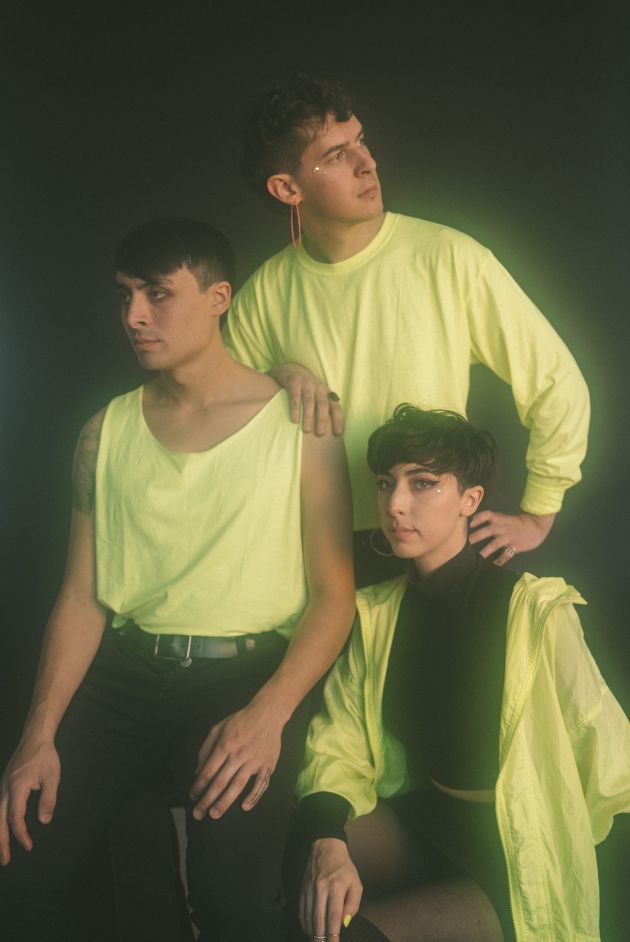
INTERVIEW: Chicago Synth-Punks Pixel Grip on their Debut LP Heavy Handed

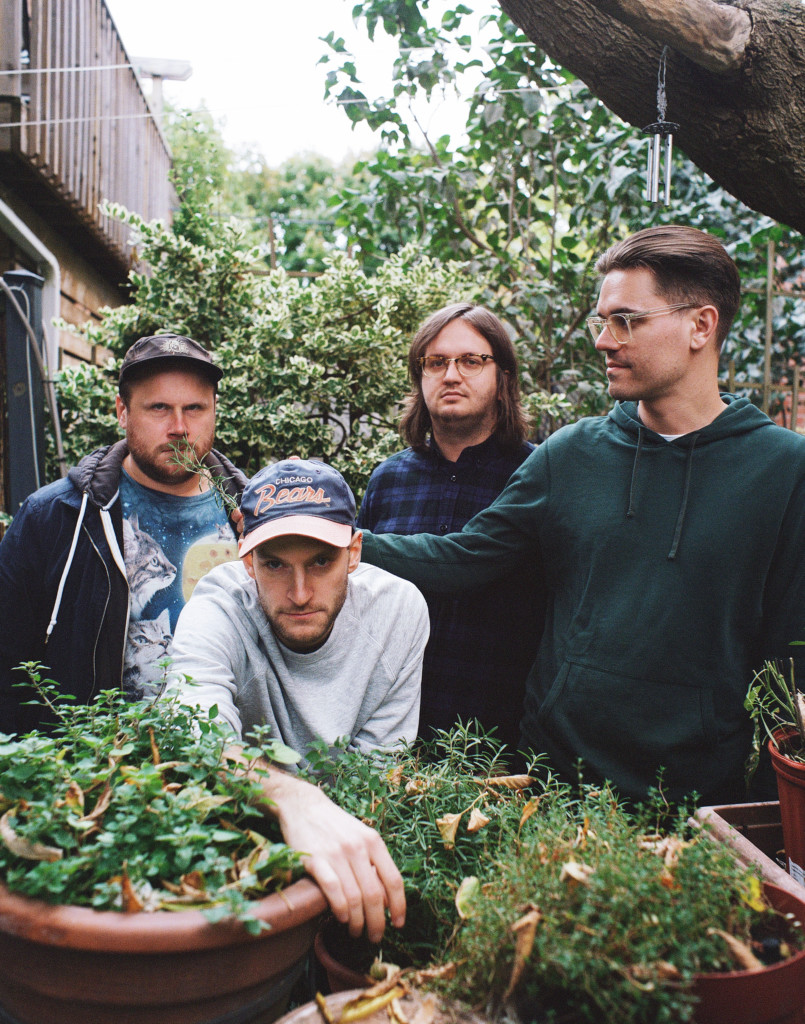
band photos by Alexa Viscius

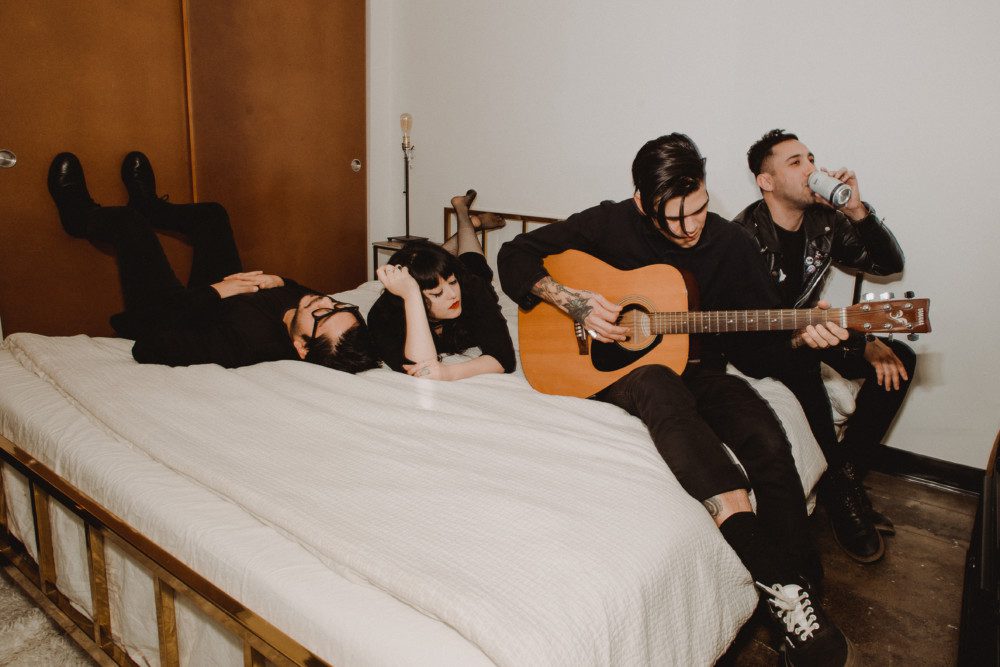
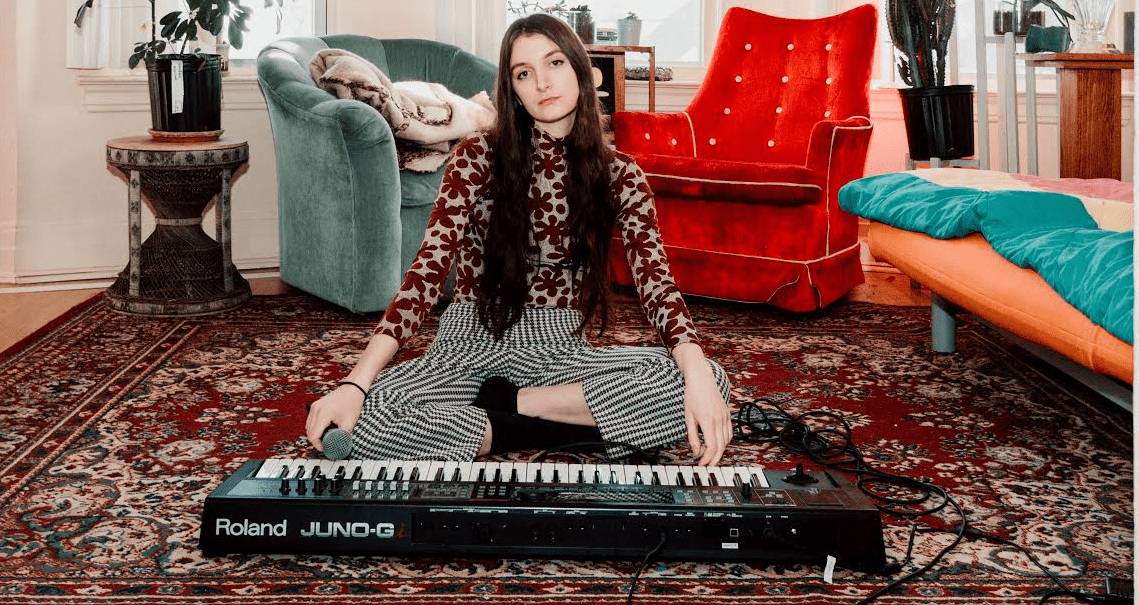
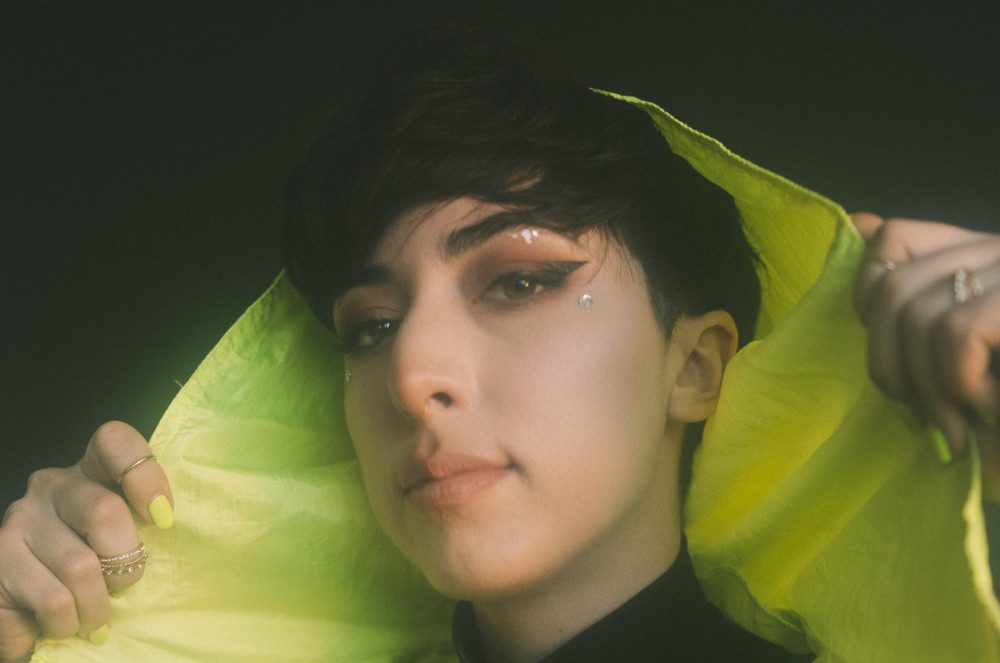
With “band interests” listed as “fresh cut flowers & cum” on their Facebook page, it’s no surprise that Pixel Grip’s debut LP, Heavy Handed, is about as sweet as a goth-disco record can be. Bandmates Rita Lukea, Jonathan Freund and Tyler Ommen grew up in Chicago suburb, Crystal Lake, but found themselves drawn to the house and electronic sounds that their neighboring city has to offer. After taking two years to fine-tune the record, the result is a lush, dark-wave wonderland, filled with catchy hooks and cutting lyrics.

Imagine if Aphex Twin, Lorde, LCD Soundsystem and SURVIVE  got together to make a supergroup. Entré Heavy Handed. Made primarily from three different analog synths, Pixel Grip definitely leans into the vintage synth realm without sounding derivative. The clarity and range of Lukea’s voice differentiate the group from archetypal “synth-pop” acts and guides the listener through the record’s peaks and valleys – of which there are many.

There’s a little bit of everything thematically on the record, from fun, lovestruck bangers like “Tell Him Off” to dark murder fantasies in “Body Like That.” Resounding themes of freedom, escapism and acceptance reverberate throughout the record. That being said, the band doesn’t seem to take themselves too seriously – it’s a delicate balance of blending life’s absurdity with brutal honesty and a whole lot of dirty synths.

AF: I read that you recorded this record over the last two years — how did you all start playing together? When and how did the first song on the record come together?

Jonathan Freund: We all met in high school. Rita and I had been making music together since then and Tyler joined about two years ago. “Golden Moses” is the oldest song, that one came about as an improvisation we later developed into a pop song.

AF: What type of synths do you use? How do you all normally start working on a track?

Rita Lukea: A few songs on the album start with a really crude demo. I would record a little demo on my phone using a $10 Yamaha that I found at a thrift store and my loop station. Jon would then go in and use more sophisticated equipment and sounds to produce a track.

JF: We also like to improvise all together and record what we come up on the spot, then stitch together the best moments into a song. We use a core group of three analog synthesizers, one vintage and two recent ones.

AF: What are some of the artists you grew up listening to? Did you all grow up in Chicago? How has being in Chicago now affected your sound as a band?

RL:  We grew up in Crystal Lake, a northwest suburb in a Red County.

JF: We shared a love for groups such as Daft Punk, Boards of Canada, Little Dragon, Trust, the list goes on! Chicago has an exciting music scene – we’re definitely noticing the club and techno influence starting to creep in.

AF: Your music feels very escapist — is this purposeful? How do you hope listeners feel when they hear your music?

RL: It’s not intentional but I welcome that.

JF: I want listeners to be taken on a ride when listening to Heavy Handed, as we embraced a variety of sounds and moods throughout the album.

AF: In “Body Like That,” the music is so fun but clouded with a terrifying theme. What inspired this song? Is it difficult to write/perform this kind of material?

RL: “Body Like That” was written during a very stressful time for me when a guy I had fling with over the summer started stalking me during the fall. I wrote the song as a form of catharsis and a warning. The girl I “met in Texas” is fictional. It’s just one long “don’t fuck with me” in the form of a narrative.

AF: What are some of the Chicago house bands that you’re inspired by?

JF: We love the classics, especially Mr. Fingers. We have the same synthesizer he used to make his first dance hits, the Roland Alpha Juno, and it feels like that instrument allows us to channel his spirit more closely.

AF: How did you all learn your instruments?

Tyler Ommen: I bought a drum pad and would play along with the radio. Once I purchased my first drum kit, I started playing along with my favorite records as best as I could and played in rock bands with some friends in middle school. I became really obsessed with drumming and started working with local instructors and entering myself into drum solo contests. Eventually, I moved to Chicago to study music performance and music business at Columbia.

JF: I learned saxophone and piano growing up, but switched to electronics the minute I heard Aphex Twin for the very first time.

AF: Death metal or k-pop?

RL: K-Pop.

TO: Death metal.

PLAYING SEATTLE: Rat Queen’s Jeff Tapia on Facebook Drama and D.I.Y. Collaboration

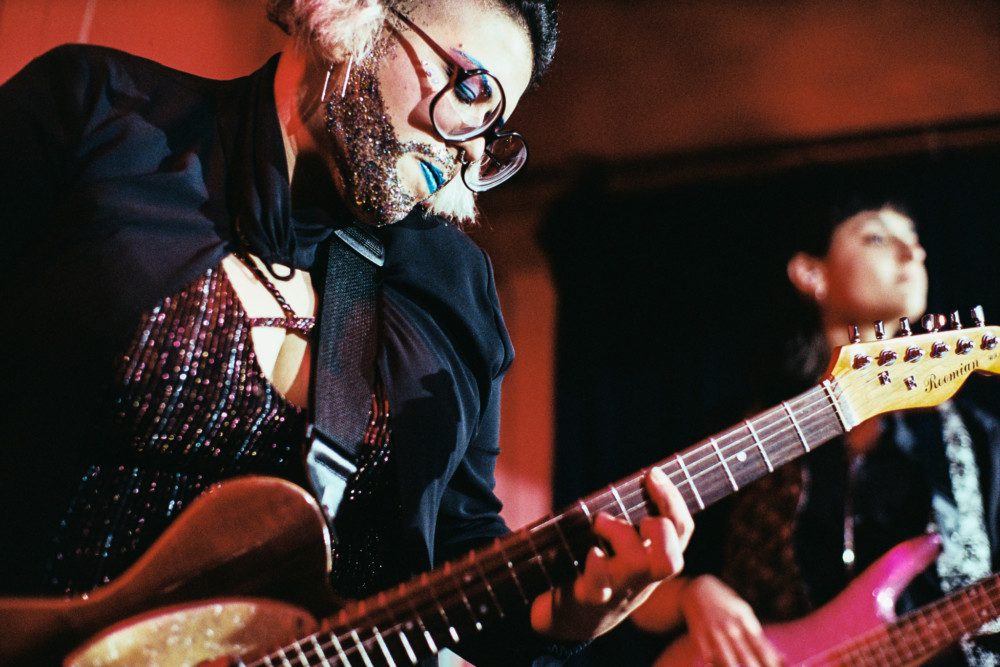
Songwriter, guitarist, and singer Jeff Tapia is a true Seattle artist. As an honest, quirky lyricist and melody-focused songwriter, Tapia carries on the traditions of true Seattle D.I.Y. culture. Along with their staunch support of other communities in the local arts scene, their authentic connection to the soul of city can be heard in their various projects and continues the city’s story of grunge and punk—and the grit in taking the road less traveled—that became more widely-known as the “Seattle Sound” in the 1990s.

Sitting down for a whisky at Belltown’s gritty Lava Lounge, Tapia is in their element—surrounded by other hip, irreverent creatives in high-top Doc Martins and black hoodies.  It’s in this atmosphere that Tapia—leader of pop-punk band Rat Queen, lead guitarist in glam rock 5-piece Razor Clam, and collaborator on several other projects like His Many Colored Fruit—feels most inspired, honest, and at home.

Tapia chatted with AudioFemme about how their move to Seattle at the end of their twenties launched their songwriting and performing career, and how a vulnerable journal entry turned into a new single for His Many Colored Fruit, “Staring At Facebook till it Makes Me Vomit,”—a sparse, electro-psychedelic departure from Tapia’s typical raw pop-punk.

AF: What is your earliest memory with music? When did you get interested in songwriting?

JT: I was like 7 years old and I was watching Star Search and there was this girl doing a song and she used vibrato and it blew my mind. I thought I could do that and I started doing vibrato. It made me sound more professional and people noticed. People thought it sounded good and though I felt shy [about singing in front of others] I started doing choir.

AF: Who and what are your musical inspirations? Why do you love them?

JT: I’m always trying to recreate the music I listened to in my most impressionable years; there’s always an aspect of that in my songwriting. I listened to a lot of grunge and anything that was on the radio in 1996. But, if I were to pick inspiration for what I am doing nowadays, I’d choose The Pixies, Weezer, and Nirvana, as well as what I call “melody masters” like Billy Joel, John Linnell from They Might Be Giants, or Regina Spektor. Melody is really important to me—it’s a cornerstone to my songwriting approach.

AF: I know you’re originally from L.A. Why’d you move to Seattle and what does the Seattle scene bring to your music?

JT: I’m actually from Culver City, which is basically L.A. except it has its own school district. In other words, you grow up with the same people and families. I moved up here when I was 29 because I felt I couldn’t thrive there. When you grow up around the same people your whole life it’s hard to figure out who you are without out other people’s impression of you influencing your own view of yourself. I felt very boxed in.

AF: Did Seattle change your music?

JT: Seattle changed everything—there’s definitely a grunge influence that I really responded to that shaped a lot of what I do in my music and in my style. Plus, I was able to move up here and start doing whatever I wanted—people respond to that sincerity very well up here.

AF: Tell me about your primary group, Rat Queen. How’d you start? What are your goals with that project?

JT: Rat Queen started when I had Daniel Derosiers of His Many Colored Fruit join me on the drums at a solo show I was doing in south Seattle. I had no intentions of starting a band but the show went so well and Daniel and I had so much fun we decided to join forces that very evening. We came up with Rat Queen because I had an idea for a song that I was going to call “Queen of the Rats” and Daniel said—let’s just be called Rat Queen. It miraculously wasn’t taken so we registered all social media right then and there.

AF: I know Daniel is an important part of Rat Queen. What did his move to L.A. last year mean for you as a musician, for Rat Queen, and for other projects you and Daniel do together?

JT: It’s really hard on me for Daniel to be gone. I’m not as prolific without a songwriting partner and finding a partner you mesh with is hard to come by. However, since he’s moved it has been business as usual – he sends me song ideas and I work on finding melodies for them. Or, I’ll form full songs and he’ll make them cooler. He’s still very much present in the band in that way. Also, Evan and Michael, Rat Queen’s bassist and drummer who both live in Seattle, have brought so much raucous talent and personality to the band that I feel this is the strongest iteration of Rat Queen yet. And, Daniel’s joining us on tour this summer on rhythm guitar. I’m so stoked to have the gang back together!

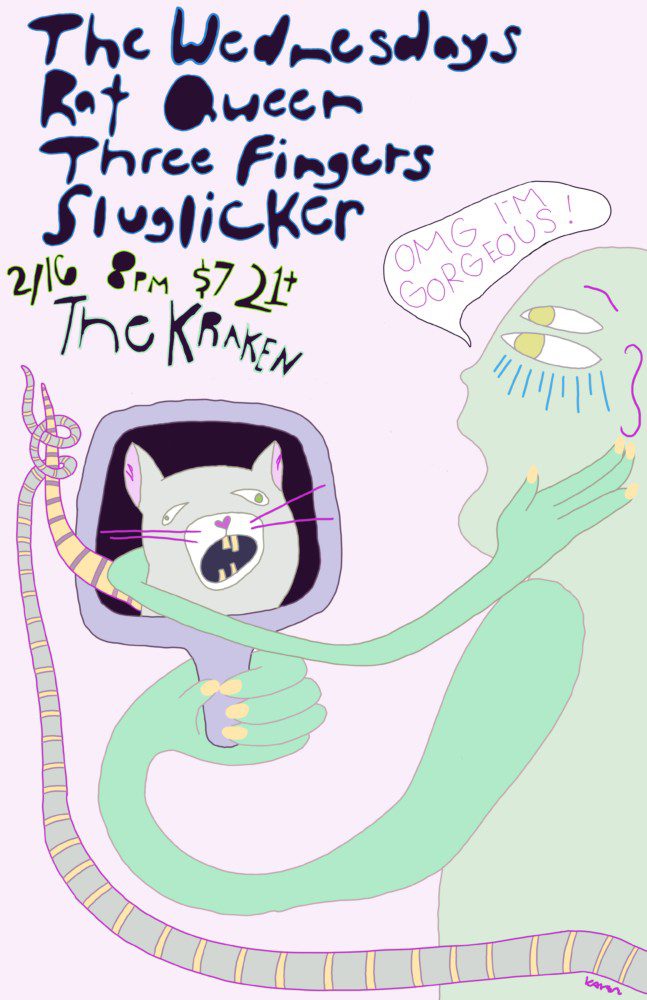
AF: You have the best posters for Rat Queen shows. Who is the artist? Are they local?

JT: It’s really important to me to try and hire as many local artists and I can and I’m very lucky to be friends with a lot of artists who are willing to do work for me. So, every poster that you see from us is commissioned. Most of my art work is done by Kalee Choiniere, who just does the weirdest stuff and I’m in love with it. I also go through Dax Edword and of course, Ana Von Huben who did our logo and all the cover artwork for the most recent Rat Queen album Worthless. I’ve even gotten into having a makeup artist, Leighla Jellouli, for my Razor Clam shows. Not everyone can afford it, I know, but a lot of local artists will be willing to turn something around quickly for a small fee. It’s definitely worth it—and it’s good for different communities to support each other.

Poster by Kalee Choiniere

AF: Tell me about this single you just released by His Many Colored Fruit. Daniel is also in this group, correct?

JT: His Many Colored Fruit is Daniel’s group—he’s been doing it for a while as a side recording project that he didn’t really have big intentions for, and it wasn’t until a couple years ago that he asked me to join officially.  It started with him just getting advice for certain songs from me and that blossomed into more of a partnership.

AF: And the journal entry that the newest His Many Colored Fruit single, “Staring at Facebook Until I Vomit”—what spurred it? It definitely has a different vibe than your more raw, punk-influenced Rat Queen tunes.

JT: It’s a different sound from Rat Queen because Daniel has a vision for that project and takes point on that project, whereas I tend to take point more on Rat Queen. This most recent single, called “Staring at Facebook till it Makes Me Vomit,” came about because I sometimes dramatically share my journal entries on Facebook. I shared this entry publicly because I liked how the writing turned out and Daniel took it and made something from it. I didn’t really know he was working with it, he just sent me something one day with his vocals and said “Hey, I just reworked this, I hope that’s okay.”

AF: What about Razor Clam? I saw you recently had your 1-year “Clamiversary” with the band. Has your time with them influenced your other projects?

JT: Yeah, I started playing in Razor Clam a little over a year ago. We’re a pop-goth glam band. I’m the lead guitarist in Razor Clam and that’s really pushed me into becoming a better soloist and musician. It’s really inspired me to be louder and unapologetic about the person that I am. They’ve definitely helped me take more risks in my other projects.

AF: I’ve noticed you taking risks, too, and getting more vulnerable in your music. What makes you feel brave?

JT: That’s something I’ve been working on lately. It’s something that I do push myself to do—to be honest and straightforward in the way that I write my lyrics. I’ve found, as the years go by, that being yourself is actually is important—just like they told us. Being myself and dressing cool makes me feel brave.

AF: Is there a place in Seattle that you like to go for inspiration? Or that makes you feel centered and ready to write?

JT: Home. I’m a homebody at heart. If I know I can brew a cup of coffee and hang out on my patio, I can get to place I need to in order to complete a project.

AF: Do you have a songwriting process? What’s it like?

JT: I don’t know if I have one. Like I said, I write best with a partner. Going to show and seeing what other people are up to really gets my creativity going.

AF: On that note, who are you listening to in the Seattle scene right now?

JT: I’m on a tape label called Den Tapes, and almost all my favorite local bands are on it: Choke the Pope, Happy Times Sad Times, Mud On My Bra and so many others. Lately, I’ve really been into Sleepover Club and Velvet Q. There are so, so many, though!

ONLY NOISE: How PUP – and Punk Rock – Changed My Relationship with Physical Intimacy

PUP photo by Vanessa Heins.

ONLY NOISE explores music fandom with poignant personal essays that examine the ways we’re shaped by our chosen soundtrack. This week, Sophia Vaccaro finds empowerment and personal autonomy in the mosh pit, with PUP providing the punk rock release. The mosh pit at a PUP show helped Sophia Vaccaro see the punk tradition as an exchange of energy rather than a violation of space.

“The mosh pit never lies,” Norah reminds herself in Nick and Norah’s Infinite Playlist. It took me a room full of friendly punk kids and almost ten years to understand what she meant.

I was not a wild teen. I was not even a wild college kid. Nick and Norah’s world of all-nighters, secret shows, and closet makeouts was as astronomically foreign to me as it was eminently desirable. I wanted to traipse through the post-midnight music crowd mooning over someone while not realizing how absolutely fucking cool I was being, too! But why was it so fucking hard?

It was the pit; moshing was asking too much of me. I spent a long time — too long — hyper-aware of the bodies of men in my space. I can’t stand a casual touch from a man I do not know. It feels like a physical weight, like leeches peppering soft marks on my skin to remind me: you did not want this hug. You did not want this hand on your shoulder. You didn’t want. You didn’t want. Everything was always about what I didn’t want, and it was exhausting.

So how could someone, uncomfortable even with the physical feeling that comes from an uninvited look, willingly throw herself into a horde of sweaty, aggressive punksters? Enter PUP the band — and my friend’s pink backpack.

I love PUP. Formed in Toronto in 2010, PUP consists of bassist Nestor Chumak, vocalist Stefan Babcock, drummer Zack Mykula, and guitarist Steve Sladkowski. Since their first self-titled LP, they have been steadily evolving as musicians and lyricists. But it’s not only the music that’s fucking good; they also seem to be four actual friends who are doing their best to deal with mental health, growing up, and the complexities of the occasionally vagrant musician life. They are more than aware of the community that has grown around them; in anticipation of their third full-length album, Morbid Stuff, which was released last Friday, they asked fans to cover the second single, “Free at Last,” with only the chords and lyrics available. The result was a funny, light-hearted music video compiling these clips that was not only surprising in its musical diversity, but also surprisingly tender and utterly appreciative — of both fans and band alike.

Release is paramount to every PUP song, as it is paramount to punk. Every song is an expungement of all the bad things you were thinking and feeling and have convinced yourself you were floating on top of which you were in fact slowly sinking under. There are many things about this that could be considered unsettlingly hypermasculine and phallic, especially when experienced live — the half-swallowing of the mic, the aggressive guitars, the plain and simple anger of it all. But I believe that this idea of release in punk is fundamentally about the body. Movement in connection with music is a way to take your love for the sound, unwind it from the ball inside your chest, and let it out. PUP showed me how that ball could have somewhere to go.

They were doing a show in Oakland as part of their headline tour for their second LP, 2016’s The Dream Is Over. I wanted to go. I needed to go. They were all I had been listening to for weeks straight at the time. But the part of me that stands between myself and the world, pickax in hand, had some considering to do. What would the crowd be like? What would the vibe be like? And, most importantly: would there be somewhere for me to hide?

The music won, because the music always does.

I bought my tickets, employing my friend Maranda as my chaperone. We Ubered to Starline Social Club, and as we waited outside the entry steps on that cool September night, I prepared to face the masses — and the men — from the fringes of the audience.

Only that is not what happened.

Not even halfway through the show, I was sandwiched between two huge guys, watching them good-naturedly shove anyone spinning out of the mosh pit back into its boisterous center. I watched, and I learned. As I screamed along to “Doubts” and “Guilt Trip,” I let my body relax into flow of the others around me. I began to see them not as violations of my space, but rather as an extension of myself and how the music made me feel. The last piece of the puzzle was watching Maranda, a modern dancer who is in incredible control of her body, throw herself with single-minded joy into the center of the pit, her mini pink backpack the only part of her I could see as she tossed and was tossed.

That’s the key, I realized. The mosh pit is not a stripping of power for the benefit of the biggest and strongest — it is an exchange. It is a release that gets passed from body to body, and if it is too much for one person to take, there are people waiting to pick you up, even you out, and send you back in. I didn’t go into the center of the pit that night, but I felt something loosen inside me. Those ragged and dirty knots of distrust had been tied by fear, but the music and mayhem of punk rock — and PUP — had started to pick them free.

As I said: I was not a wild teen. In fact, I would say the peak of my Big Messy Adolescence is currently happening right now, after a year full of last-minute moves, big betrayals, old friends lost and older friends renewed. So to make it through 24, to do things I had waited long too do, I needed to find a place where physical intimacy with people I did not know was not a cue to panic; I needed to have space inside me for things that were not fear.

Today, I turn 25, and Morbid Stuff arrives just in time to help me reckon with the good and the bad of those experiences. Besides mental health and yes, morbidity, the new LP is more than anything a painful dive into the hell of caring about people who couldn’t be more indifferent towards you. It is a testament to the self-inflicted, full-body bruise of obsession that blooms as you grasp for information and explanation, while those people think about anything else but you. The city of Toronto acts as both peer and antagonist, veering from rapscallion comrade-in-arms in “Morbid Stuff” to looming oppressor on “City.” The fact that it remains unnamed on the latter parallels the theatrical storytelling of 2016’s “Pine Point” and “The Coast” and this album’s “Scorpion Hill.” As Babcock croons “don’t wanna love you anymore” on “City” it’s not clear who this is in reference to — a partner or the city itself.  It’s a pertinent reminder that, in your 20s, the familiar becomes frightening, and your life can seem a folktale rife with monsters that take the faces of the people you care about — or yourself. And while these bigger-scale moments still hit, it’s the smaller stuff — Babcock’s cold-sweat fear about the potential deaths of former partners; running into one of those previously mentioned indifferent people while in the midst of mundanity at the grocery store — that have me inching further and further into the pit.

The first time I heard “Closure” on the new LP I yelped “fuck!” loud enough for a bleached-tip pedestrian at Yerba Buena gardens to look at me in semi-alarm. This was justified, as it was semi-alarm that was ricocheting through my body — at how hard this song was hitting, already, thirty seconds in. At how excited I was, changing my socks on a granite pillar for the benefit of my not-yet-broken-in Doc Martens, to press out my sorrow into the pit and watch it be washed away and returned as something softer.

The second time I listed to Morbid Stuff, I found myself itching to move — it’s hard not to listen to PUP without wanting to thrash. I would have gotten up, walked straight out of my house and put on the blistering “See You at Your Funeral,” but it was pitch dark and 11pm, so I sat, bound to the steps above the kitchen heating grate.

I turned the music off. The first few listens of any beloved band’s new album are a sacred thing, and it wasn’t right.

But those initial run-throughs also illuminated to me how much my listening has changed. I can feel myself anticipating that release of movement, but I don’t imagine myself alone any longer.

That is why the music always wins. It will drag you closer and closer to the stage. It will make you want to feel the bodies of others moving around you, moving against you, pushing and pulling and jabbing and screaming, because not every touch has intent to take. In the mosh, which never lies, touch is trying, simply, to be.

I needed to be reminded that that I could do that.

PREMIERE: Grizzly Coast “Half-Light Boy”

photo by Brendan Downey

“Music as background to me becomes like a mosquito, an insect. In the studio we have big speakers, and to me that’s the way music should be listened to. When I listen to music, I want to just listen to music,” David Lynch told The Independent in 2013. Grizzly Coast’s latest music video for “Half-Light Boy” draws on Lynch’s 90s TV classic Twin Peaks, employing more than just the show’s aesthetic by mirroring the foreboding, skin prickling plot in timber as well as tone.

Grizzly Coast, the project of singer-songwriter Alannah Kavanagh, grabs attention from her  first sweet, passive aggressive coo; the song is a kind of time vortex, instantly reminding the listener of young romances embroiled in misunderstanding. “Broke my patterns / have I not earned your words,” Kavanagh pleads with her lover, attempting to regain favor. “Half-Light Boy” has a winning restraint to it, the quiet angst that accompanies the slow death of intimacy.

Watch the exclusive AudioFemme premiere of “Half-Light Boy” and read our interview with Alannah below.
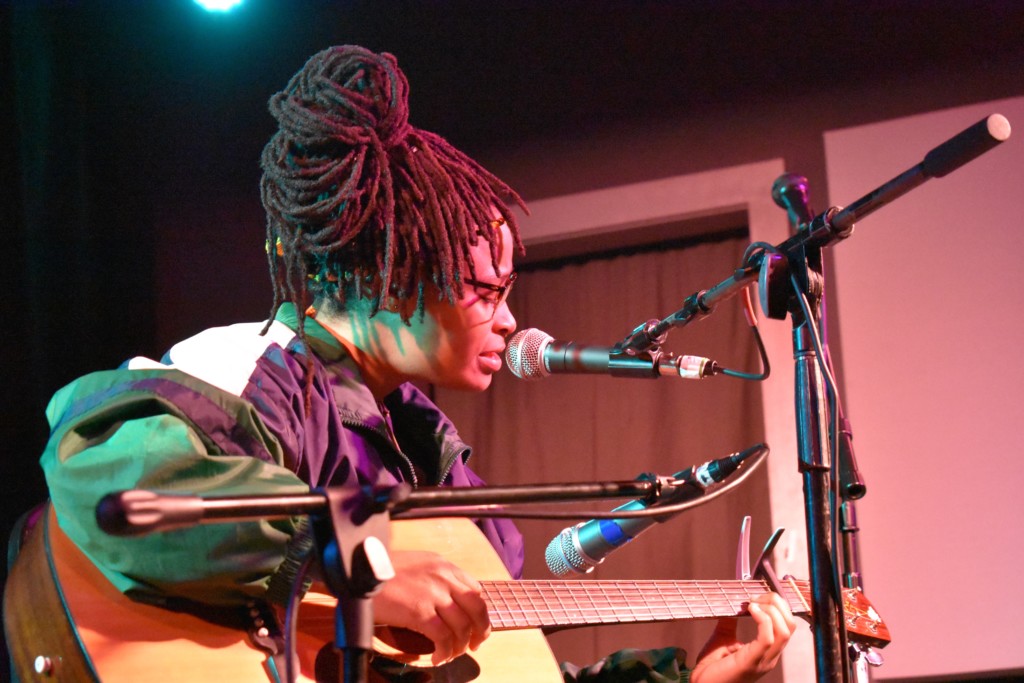
AF: Tell us about your new single “Half-Light Boy.” The music video is super dark and dreamy.

AK: Half-Light Boy is a song I wrote when I realized that not everyone you meet will have the same heart as you do. The lyrics explore the idea that someone else’s small capacity for caring for you is due to something lacking in them, and not an expression of what you deserve. I tried to illustrate this by exploring the aftermath of a scene where I felt insignificant in the eyes of someone I held a candle for. With the video, which was very much inspired by David Lynch’s spooky ’90s TV Show Twin Peaks, I had a lot of fun running with the idea of using the visual metaphor of being haunted by a ghost to make the lyrics hit harder.

AF: What is the songwriting process normally like for you? Do you start with a line, a general theme, or with the music itself?

AK: Songwriting is by far the most fulfilling part of the process to me, and the way I go about it changes from song to song. There are times that I do just go in with a general theme I’ve been aching to write about, but there are others where I sing stream of conscious lyrics along with my guitar to just see what presents itself. Sometimes, when I’m really lucky with the latter approach, a song will essentially pour out in its full form. These are typically the best ones and I’ll never know where they come from.

AF: You’re from Toronto. What’s the music scene like there?

AK: The Toronto music scene is welcoming and cool as hell. What I love about living in the city is the sheer number of different types of shows that happen every night of the week. There’s always something to go to!

AF: What’s your favorite local music venue?

AK: It really depends on what you want to see. But I’d have to say that the Horseshoe Tavern is my favorite. It’s always a good night there, they host killer bands!

AF: Name a book or painting or record you regularly come back to for artistic inspiration.

AK: I’m not big on re-reading books, but I’ll typically underline sentences and passages of what I’m reading if I feel like they speak to me in some way. Two books I’ll often check back on to see what I underlined are Just Kids by Patti Smith, and The Artist’s Way by Julia Cameron. Both are centered on the journey of what it takes to make it and feel fulfilled living as an artist.

AF: What artists do you have on rotation right now? Anyone new we should have on the radar?

AK: I’m currently into this Toronto artist named Lenny Bull. I saw her live show a while ago and was totally blown away by her entire deal. In my rotation though, Hard Bargain by Ron Sexsmith has been on repeat. I’m also super into the new Julia Jacklin album, Crushing.

“Half-Light Boy” will appear on Grizzly Coast’s forthcoming LP later this year. Check her out live at one of the dates below.

GRIZZLY COAST TOUR DATES:

4/19 – London, ON @ The Rec Room
5/6-12 – Toronto, ON @ Canadian Music Week, TBD
5/22 – Edmonton, AB @ Sofar Sounds
5/19 –  Burlington, ON @ TBD

PLAYING DETROIT: Moon King Adopts Detroit Dance Music on Voice of Lovers

Originally from Toronto, Daniel Benjamin has been hopping from city to city for the past ten years. The longest time he’s stayed in one place were the three years he spent in Hamtramck, Michigan – a multicultural haven tucked within Detroit’s city limits – and that period ended up having a heavy hand in shaping the sound for his electronic dance project, Moon King. His latest record, Voice of Lovers, was released last week and is a testament to the imprint Detroit’s DJ scene has had on his creative process.

The record sashays between decades and genres, all unified by its undeniable head-bopping feel. A far skip from his first release, Secret Life, Benjamin explains that something clicked when he set foot in Detroit. “I was going out a lot and listening to really great DJs and seeing the way the music affects people,” says Benjamin. It’s no secret (to most) that Detroit is home to some incredible DJs and electronic musicians, and Benjamin took full advantage of all the city has to offer; Mondays at Motor City Wine, Freakish Pleasures parties, and dancing to a particularly influential DJ for him, Scott Zacharias.

“I think he’s inspiring for making music and collecting records and stuff,” says Benjamin. “He can play synth-pop and disco and music from South America and Pakistan or Turkey all in the same set and have it aesthetically fit together and get people dancing – that to me is amazing. I didn’t realize until I came to Detroit that that was a thing.” Benjamin’s adoration for mesmerizing dance music is evident throughout the record. Lyricism takes a backseat to rhythm but still strings together a narrative of Benjamin’s nomadic lifestyle and trials of trying to live in the US as a Canadian Citizen.

“USA Today” can be read as an ironic title for an interpretive dance track, but the urgency in both the beat and the repetitive lyrics feel like Benjamin is trying to manifest his own destiny. After multiple failed attempts at getting a green card, Benjamin was forced to leave Detroit, one of the only places he’s ever felt a true sense of community. “I felt at home there. The community of people that I found myself surrounded by, I feel like they really want me there,” Benjamin explains. “I don’t really feel that way anywhere else. Life’s a bitch.”

But Benjamin didn’t leave Detroit without making lasting creative friendships along the way. In fact, Detroit’s own Vespre (Kaylan Waterman) makes an appearance on VOL and will join Benjamin for his Detroit show on June 22nd. For now, it’s back on the road for Benjamin until July, doing what he does best – making the world dance.

Listen to Voice of Lovers in full below.
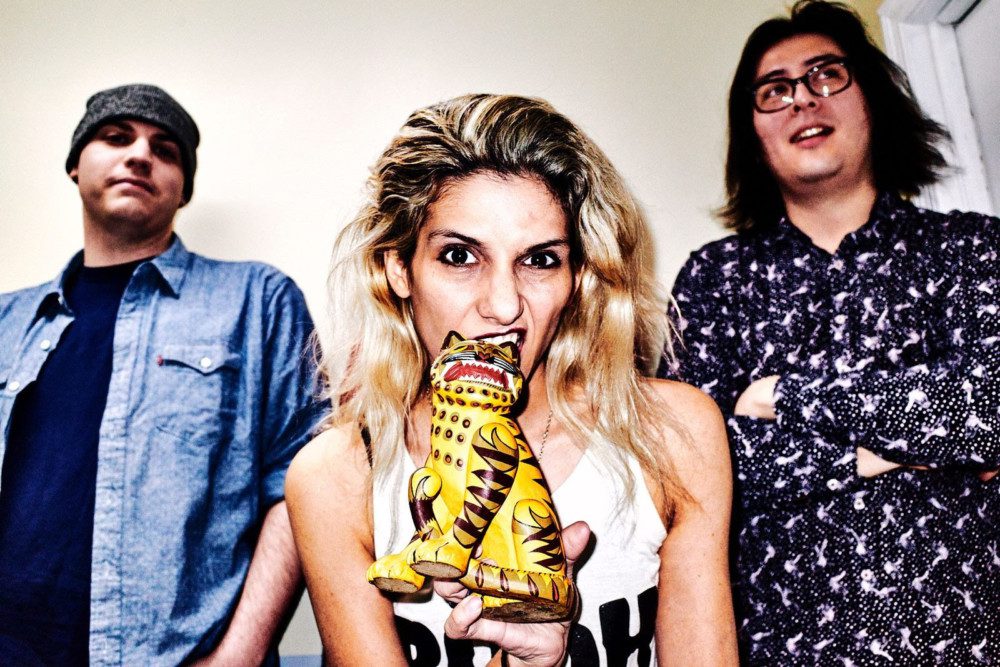
PLAYING CINCY: Sarai The Artist Makes Impressive Debut With “No More Humble”

Sarai

Sarai The Artist didn’t come to play on her new album, No More Humble. Showcasing a diverse range from slowed-down vibey R&B-tinged singles to spitting ferociously at an intimidating energy and pace, Sarai debuts as a Cincinnati rapper with serious skills. She previously teased the album’s release with No More Humble singles, “Switch Up” and “Normally” in 2018. Now, with the entire project out, Sarai makes her full first impression.

Although a fierce introduction from a new artist demanding to be taken seriously, No More Humble was born of more somber inspirations.

“This album came from a place of darkness, growth, but also triumph,” says Sarai. “It’s my message to the world that I [am] no longer doubting myself or selling myself short. Everything I’ve gone through has made me into the artist I am today. I lost a relationship and had to bury five family members in 2017. I was lost, but music helped me find my way.”

No More Humble hardly sounds like a debut, with Sarai’s lyrical dexterity and the project’s overall fluidity. The album starts strong with “Snapped,” a fast-paced intro where she can flex her rapid verbal flow and give listeners a reason to understand the LP’s title. Sarai transitions to “Amen,” a standout track, where she makes a flute-driven beat sound hard.

She gets more in her feelings later on in the 8-track album, exploring relationships in “2 Ways” and “To Be Loved” and reverberating struggle in the Great Wu-assisted “Normally” and “Neva Lost.”

Sarai
Sarai The Artist / Photo by Andre Whaley

Besides making an impressive introduction into the Cincinnati hip hop scene, Sarai uses No More Humble to make a point about grief and hardship. She’s only been making music for about a year, but found solace in hard times through her creation and hopes her album will help others in similar situations see the same light.

“My goal is to encourage others that it’s very possible to turn something dark into a beautiful situation. Stay the course and the work will pay off.”

Check out Sarai The Artist’s debut album No More Humble above and catch her performing for Industry Night at PRVLGD Nightclub April 12.

WOMAN OF INTEREST: Meet Sustainable Couture Fashion Designer Mia Vesper

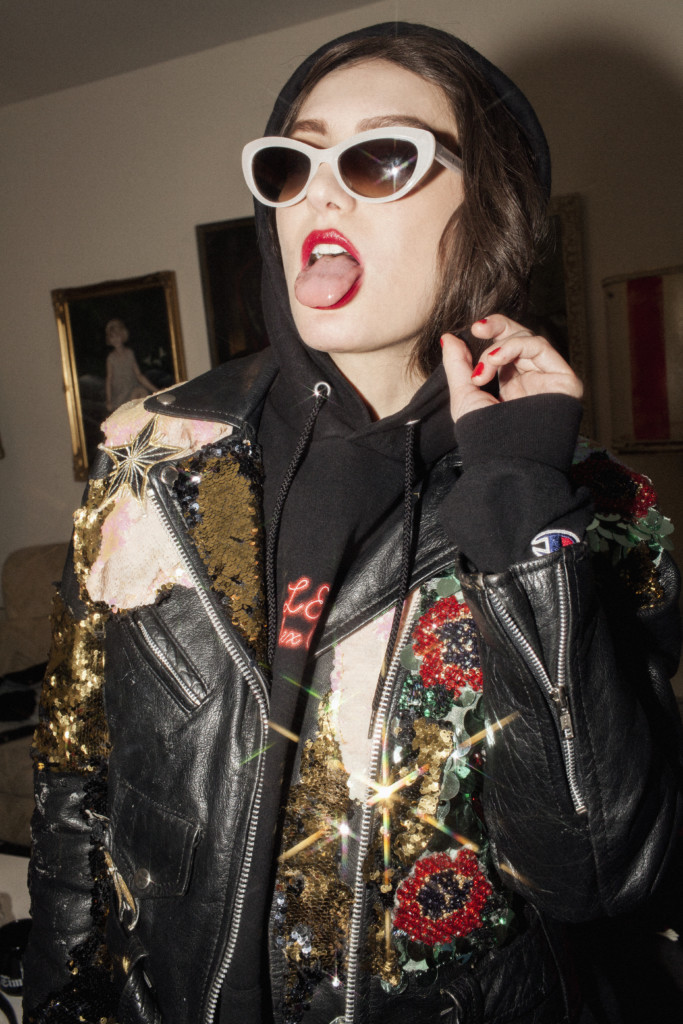
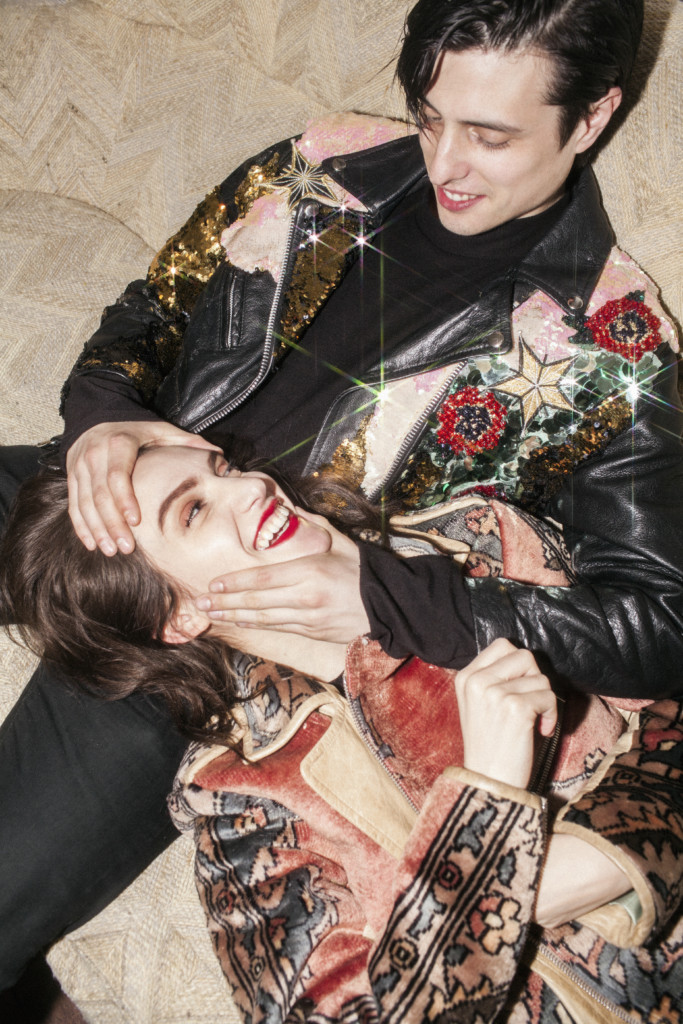
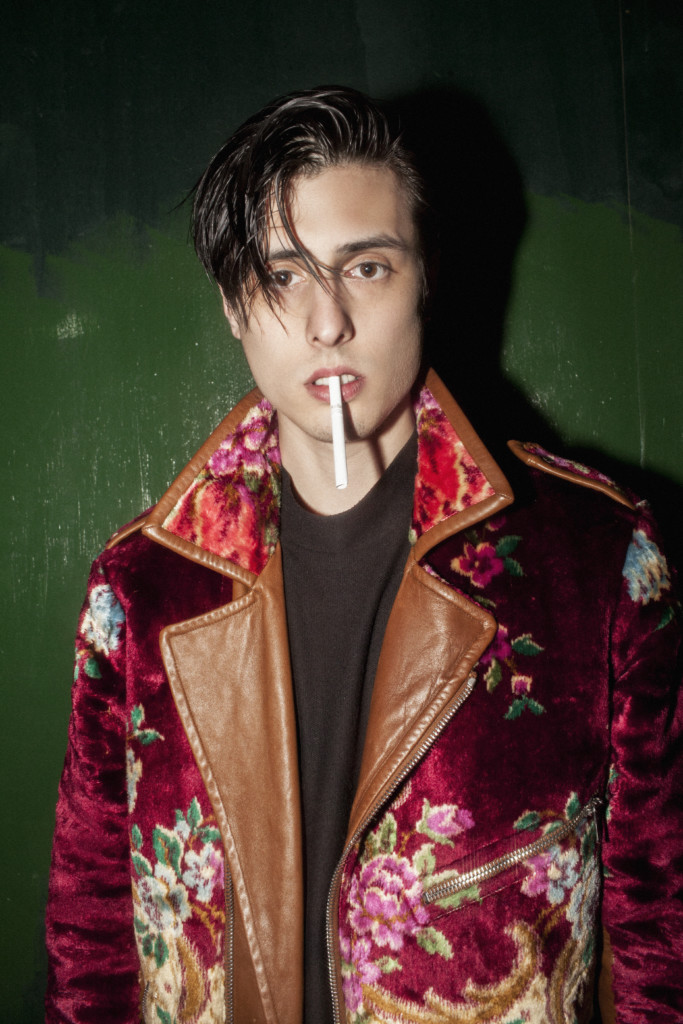
Mia Vesper is a New York based designer, creating sustainable couture fashion with a unique drive and collaborative ethos. With a studio space in the heart of Bushwick, Vesper’s aesthetic transcends counter cultures – think Debbie Harry meets Marie Antoinette. Her brand defines a world of romance, athleticism, and will leave you in a state of reverie. Aside from her striking designs, she exhibits a larger than life presence, and a strong intellectual understanding of the ever-evolving fashion industry. After generating major buzz for her one-of-a-kind leather tapestry moto jackets, she’s about to embark on an ambitious ready to wear collection and is opening a SoHo pop-up shop at 199 Lafayette later this month. In the course of our chat, I soon learned that her whimsical vision is backed by a sharp wit and vast knowledge.

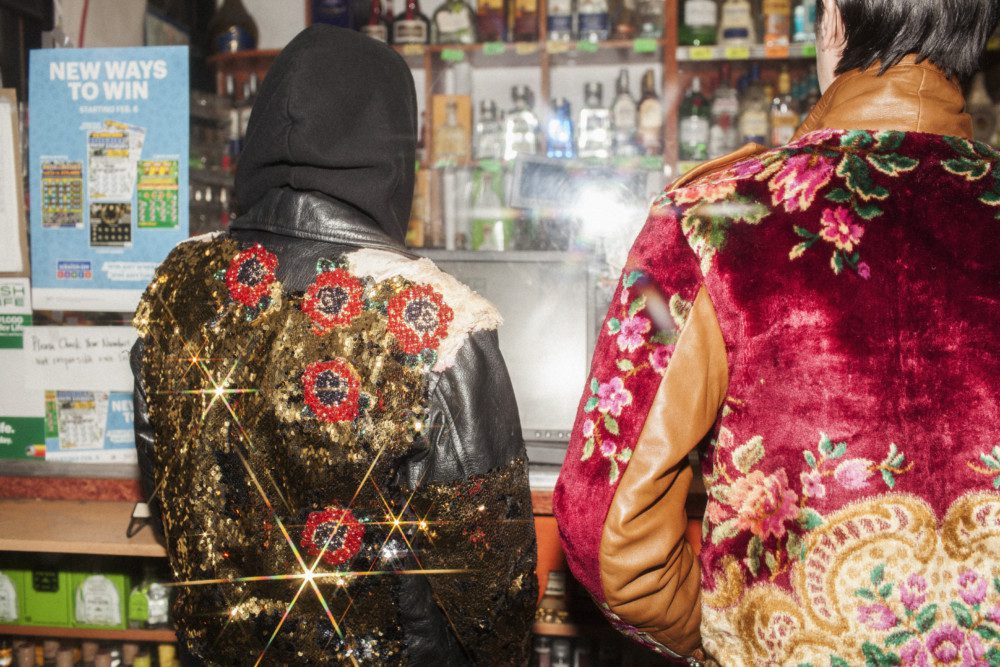
All photos styled by Michelle Rose & Ola Wilk, shot by Ola Wilk. Models : Abraham Martinez & Michelle Rose

AF: In the current climate, sustainable clothing has become a tremendous movement. Can you talk a bit about your process involved with sustainable sourcing for your couture line?

MV: The word tremendous is generous I think. The movement is on the precipice of being tremendous, but high cost and lag in green technology means a lot of popular brands that we call sustainable are just a bit better – and  in just a couple of ways – than fast fashion. Still, I have hope that it will gain speed exponentially over time.

Couture, by virtue of being couture, is sustainable (not necessarily green, but sustainable). Quantities matter to your carbon footprint and couture has a quantity of one. In my couture line I also use vintage textiles and tapestries which is really fun! Still, while I try to use natural fibers or vintage where I can, I do make concessions for aesthetic. I love sequins and specialty fabrics that certainly don’t qualify as green. What I do feel confident in is my ability to create enduring pieces that people don’t throw away in a couple months. I never design just to flesh out a collection with basics that someone else has already made.  My sustainability concept relies on a fair trade, direct-to-consumer model that concentrates on small quantities, design integrity, special-ness and longevity.

AF: There are a lot of resources needed to go from idea to prototype to production to market. Can you talk a bit about small scale production, and your collaborative team?

MV: I am just now creating a ready-to-wear collection, but I stayed small for a very long time prior to this point because I found it difficult to maintain quantity, quality and my sense of self at the same time. It’s hard for clothing designers to get started because there’s this perception that they need to do it all; create a 30-piece collection each season, put on runway shows, etc. I never understood why clothing doesn’t take a leaf out of the accessories book and create a few thoroughly considered pieces per season, changing their colors every now and then.

Another reason that I’ve stayed small is because I wasn’t in a position to hire employees and don’t really think interns are ethical, so I’ve only been able to handle a certain amount of work on my own. It’s really enticing to accept help wherever you can in this industry, but I think it’s important to wait for the right kind of help or you risk diluting your concept.

AF: What advice would you give to other entrepreneurs coming to New York to materialize their dream line?

MV: I have so many…

Always write a contract – even for collaborations.

Concentrate on online direct-to-consumer models. Wholesale is usually costly and a bureaucratic nightmare for designers. You can spend your whole season and budget only to have a deal fall through.  

Make sure your clothing has a perspective and deserves its place in the world. ‘I could do that too’ is not a good enough reason to start making products that will impact the earth for generations to come. If your concept isn’t there yet, keep developing it.

And finally, in an ironic end to this listicle of advice, remember that everyone will have a lot of advice for you; don’t let it pull you in too many directions.

AF: Your designs are really innovative and eye-catching. What are your main aesthetic influences? What was the first moto jacket you ever acquired?

MV: I didn’t have any experience with design before I started my line so I relied on sewing classic shapes in extraordinary fabrics. I do think that’s where fashion is going – classic sportswear in amazing fabrications. To throw things back to the eco conversation, I also wanted a time-enduring silhouette. My first moto jacket was a BCBG jacket that I bought in freshman year of college. It was a mushroom color that made me look sick but the idea of a leather jacket carried more cache to me than the question of whether it was flattering.

AF: What are your musical/sonic influences? Do you listen to music while you design?

MV: Actually no – I find myself too distracted by music to work while it’s on. I think of listening to music as an activity; you dance to it, you mourn to it, etc. I usually work in total silence. Fun story, I know.

AF: If your line was a soundtrack, or a score to any movie.. what would it be?

MV: Maybe Blade Runner’s ’80s futurism soundtrack or Sofia Coppola’s Marie Antoinette.

AF: Any inspiration from musicians’ personal style?

MV: Haha, Rihanna? I don’t think a lot about famous people’s style because it’s just way too easy for celebrities to look incredible. Anybody doing their own legwork to find cool clothes is more interesting to me.

AF: Is it true you staged a guerrilla fashion show outside of a Marc Jacobs show at NYFW in 2017?

MV: I did! I took a group of friends and models dressed in Mia Vesper suits on a fashion crawl through the city.

AF: Did this garner buzz? Seems like the perfect opportunity to gain DIY attention from paparazzi and press.

MV: Press wasn’t allowed into that show so I was able to get the eyes of every major fashion publication that I never otherwise would have gotten to open my email. It was an amazing way to launch my first collection without going broke.

AF: What exciting endeavors are coming up in the design world of Mia Vesper?

MV: I’m working on a more accessibly priced ready to wear collection with styles for men and women in 2019 and I’m also planning to open a short term retail space in Manhattan soon!

Follow Mia Vesper on Instagram and at miavesper.com.


PLAYING ATLANTA: Lullwater Talks Voodoo and the Legendary Athens Music Scene

Before any kickoff at Sanford Stadium in Athens, Georgia, a video rolls across the big screen, with a deep, haunting voiceover that repeats the same monologue at every game. Just thinking about it brings chills to my body; there’s something so nostalgic and powerful about it, highlighting the greatest victories UGA football has ever seen, the heroes, the fans (92,746 of them), and – of course – the mascot. It’s a long, measured speech, but the opening line is forever burned into my mind: “70 miles east of the bright lights of Atlanta…”

But Athens is more than a football town. It’s a city with a music history like no other. REM and The Drive-By Truckers lived and wrote and played there. Dead Confederate rocked the world from The Classic City, and songwriters like Levi Lowrey carry on the innovation and dedication to real, genuine music. It’s Atlanta’s sister-city; an older sister, without a doubt, with an incredible record collection and an encyclopedic knowledge of rock history.

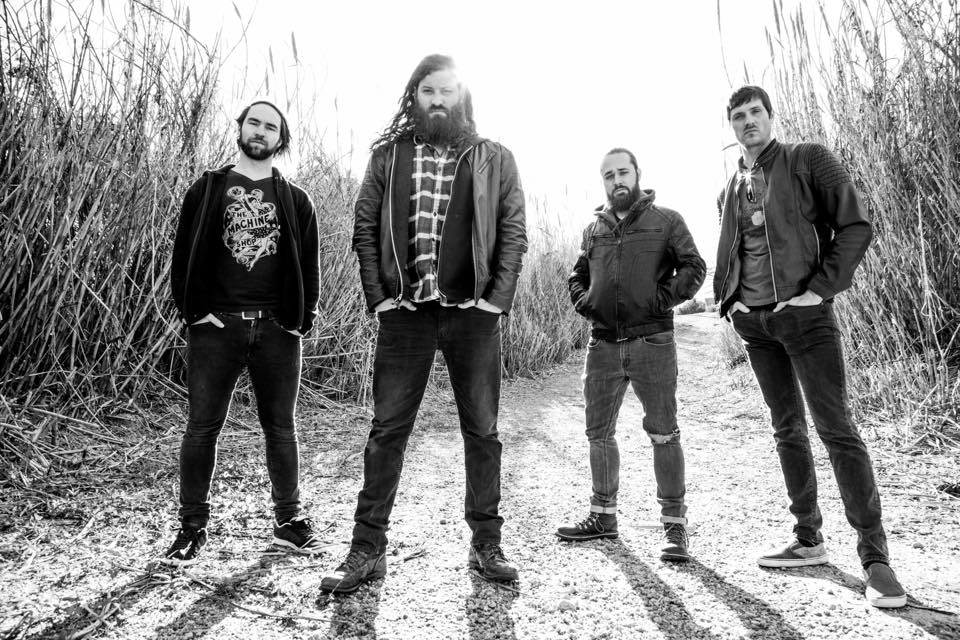
This week, Audiofemme is heading across those 70 miles to sit down with John Strickland of Lullwater. The rock quartet – made up of lead vocalist and rhythm guitarist Strickland, lead guitarist Daniel Binnie, Roy ‘Ray’ Beatty on bass and vocals, and Joseph Wilson on drums and vocals – has called Athens home for eight years, but with the release of their newest record, Voodoo, they’re ready to take on the world.

AF: Thanks so much for taking the time to talk with me! You guys are officially the first Athens band this column has covered, so let’s get started. How did the four of you meet, and when did you realize it was time to start a band together?  

JS: Lullwater has been around for a while now and has gone through its share of growing pains. Joe, Ray, and I have been in this band for seven or eight years, with Daniel joining on lead guitar over two years ago. We knew he was the perfect addition the first time we all jammed together. We used to be in a band together years and years ago. He is an amazing guitar player and writer, so it was an easy decision.

AF: Athens has a long musical history, birthing bands like the Drive-By Trucks and REM. How does the history of the city inspire you and encourage you to take risks? 

JS: Athens definitely has a long musical history, and I would say bands like Drive-By Truckers and Dead Confederate influenced us early on. It wasn’t until we started touring and playing big shows in other markets that Athens began paying attention to us. We owe a lot to Athens though; it kept us on our toes during our transition periods and made us work harder to be a better band.

AF: Your new record sounds massive; you blend grunge with Southern rock to create a sound that’s unique, compelling, and heavy. Which bands have inspired you the most? How do you draw from your influences to create something that’s unique to you? 

JS: I think our biggest influences are bands from the early ’90s Seattle grunge scene. I’m a huge fan of Pearl Jam, Soundgarden, and Alice In Chains, but our sound is unique because everyone in the band comes from different musical influences. Joe is a big jam band fan, Ray is influenced by metal, and Binnie draws inspiration from classic rock, so Lullwater has all of these elements blended together to create our sound.

AF: We’re living in a time where a lot of bands are hearing “guitars bands are dead,” or — especially in the South — bands are pushed toward Nashville and country music. What makes you dig in your heels and keep writing rock ‘n’ roll, and why did you choose Athens as your home base for creating the new generation of Southern Rock? 

JS: We’ve been digging in our heels for so long that it’s who are and what we love to do. Rock music for us is our passion, therapy, and motivation to continue touring and putting out records. If you don’t love the music first and foremost, you probably won’t be around that long. We’re committed to rock and roll and I think it shows. I went to UGA, and Athens has been my home for over a decade, but who knows where we’ll all end up.

AF: You just released your new record, Voodoo, the first since 2015. How did you know it was time to get back into the studio and make a new record? What inspired the new record? Do you have a favorite track? 

JS: We love being in the studio. If it was up to us, we’d probably be in the studio every month, if possible. We knew it was time to make a new record when Binnie joined the band. We all wanted to create new music together. Before Voodoo was written, everyone in the band was going through a lot of emotional turmoil and confusion. I feel like it’s very rare for that to happen where every member is going through seriously heavy shit at the same time. We put all of that emotion and energy into Voodoo. It’s hard to say which track is my favorite, but I’m gonna say “Fight of Your Life” and “Suffer Not.” Those songs are special and resonate with me on a deeper level.

AF: What’s the creative process like for you guys? Is it collaborative, or do each of you come in with a complete idea? 

JS: It’s definitely a collaborative process for us. We all bring ideas to the table and jam out the songs. I write most of the lyrics and vocal melodies once all the music is written, but we all bring different musical ideas to the writing sessions. I think exploring everyone’s ideas and following that process is what makes it so special for us to do a record. We’re all writing music for Lullwater and it’s exciting to go down the rabbit hole together.

AF: What’s your favorite part of the Athens music scene? 

JS: Watching the local rock scene gain momentum. Athens doesn’t really have a big rock scene, so it’s cool meeting younger rock bands exploring and honing their sound. It’s a pretty close-knit community and we enjoy going out and supporting that scene.

AF: What’s the best place in Athens to catch a live show? 

JS: The Caledonia Lounge always has something going on in the rock/metal scene, so that’s probably my favorite spot to catch a show. The 40 Watt and [Georgia] Theatre are legendary so those are a given.

AF: Last one! What’s next for Lullwater? 

JS: Touring Voodoo. We’ll be out all year pushing the new album. Also, we have an acoustic record coming out at some point this year. A lot of things are happening and we’re excited about what the year brings.

Follow Lullwater on Facebook and stream Voodoo on Spotify now. 

PREMIERE: Montreal Hip Hop Artist Shades Lawrence Debuts “Turn My Head”

Shades Lawrence
Shades
Shades Lawrence / Photo by Stacey Lee.

We spoke to Montreal-based hip hop artist Shades Lawrence about her new single, “Turn My Head.” The queer love track rocks ’90s hip hop vibes and flips the heteronormative love song narrative. Shades channels her spoken word roots as she describes the butterflies surrounding a budding romance, assisted by Emma Maryam with soulful vocals. The single is part of a tantalizing lead-up to the release of her EP, Second Life, due out in June.

Besides her music, Shades has made a name for herself in Montreal for her ambitious efforts to provide platforms for female and non-binary musical talents, as well as for womxn of color. She regularly organizes and co-presents events for advocates of mental health, the women and non-binary artist showcase, Sister Singer, as well as a DJ night for black womxn DJs, called Sister Spinner. She also recently brought together the Lux Magna Festival, curated to highlight the creative talents of womxn of color.

As a lyricist who is in touch with the needs of her community and a dedication to being transparent in her work, Shades brings a fresh and necessary narrative to the music scene in Montreal and beyond. Listen to “Turn My Head” below and check out our interview with Shades for more details on the inspiration for the track, her upcoming EP, and her activism.

AF: Congratulations on your new single! Was it a specific relationship or story that inspired it?

SL: Thank you! Yes, “Turn My Head” is based on 3 [to] 4 different relationships that I progressed through. I thought for simplicity’s sake to combine similar experiences into one song and narrative.

AF: “Turn My Head” flips the hetero narrative normalized in most love songs. As a queer hip hop artist and a woman, how do you make sure your music stays true to you and what would you tell another artist or woman who’s feeling boxed into certain roles or stereotypes?

SL: I speak from my experience of life and tell stories that reflect my reality. I find it important to be as genuine and authentic as possible in the music I write and release. Additionally, coming from a mixed-race background, I’ve always almost intuitively avoided boxes and labels as much as possible, but at the end of the day, folks are going to have an impression of me that is based on their reality. So for me, freedom from stereotypes is about letting go of what I can’t control and focusing on my music and my art.

AF: Will there be a visual coming out for the song?

SL: A visual is in the works. Will keep you posted!

AF: Tell me a little bit about what fans can expect from your upcoming EP. When’s it coming out?

SL: My EP Second Life is coming out June 7th and it is a diverse representation of my influences. There’s a dancehall/Latin infused track that speaks of my origins; there’s storytelling aspects to another track. And there are songs that make a political statement, all with beats that are catchy. I am so excited for this release.

Shades Lawrence
Shades Lawrence / Photo by Stacey Lee.

AF: When did you start practicing spoken word and when did that evolve into your rapping career?

SL: I started practicing spoken word in early 2015. Emma Maryam, who is the featured artist on “Turn My Head,” was actually at one of my shows the second or third time I performed poetry. In 2016, I had a collaborative spoken word show called “Extreme States” with Carole TenBrink in the Montreal Fringe Festival. I thoroughly enjoyed that experience. After having put together a complete spoken word project, I realized that I love the interaction with music so much, so I decided to cross over to hip hop, which was one of my original passions from when I was growing up.

AF: You’re well-known in Montreal for your activism and events that empower women. Tell me a little bit about these events, what they mean to you, and how you hope to help others.

SL: Two of the events I’m currently involved in organizing are Sister Singer and Sister Spinner. Sister Singer is a platform to highlight womxn and non-binary musical talent based in Montreal. Sister Spinner creates dance parties that feature all black womxn DJs. I was also recently asked to curate a show for the Lux Magna Festival in Montreal. We chose to feature womxn of color in the lineup.

I am proud of these undertakings because I know that womxn and non-binary artists, especially of color, have so much to contribute to our cultural landscape. It is also important to create these spaces and feature artists from underrepresented communities, since it provides opportunities for growth, while also enriching audiences and the music industry as a whole.

AF: Who are some artists you look to for inspiration?

SL: The Miseducation of Lauryn Hill informed much of my youth. Lyrically, I would say André 3000. Content-wise and stylistically, currently I quite enjoy Shad (a Canada-based MC).

AF: Anything else you’d like to add?

SL: I am grateful for platforms, such as Audiofemme, that provide a space to share a bit of my process and the backstory behind the music.  Enjoy “Turn My Head (feat. Emma Maryam)” and thank you!

PREMIERE: Beatrice Deer Returns to Her Inuit Home for “Immutaa”

Half-Inuk, half-Mohawk indie pop songwriter Beatrice Deer hails from Quaqtaq, a small village in Northern Arctic Quebec that’s only accessible by plane. There, she planted the seeds of what she would become—a television director, clothing-maker, mental health advocate, a mother and songwriter—and there she returned to film a heartwarming music video for her rendition of the traditional Inuk song, “Immutaa.”

Teeming with the children of Quaqtaq, bundled up to their noses in snow suits and dancing in their school gymnasium, the video for “Immutaa” is an upbeat and unadulterated view of this vibrant yet underserved indigenous community in Canada. Deer aims to shed light on her Inuk roots by spreading their traditional music, folk tales and legends—the Inuk cultural story—through her raw, joyful songs that oscillate between English, French, and the native Inuk tongue. She also carries on the tradition of Inuk throat singing in much of her music.

Recently, Deer caught up with Audiofemme to talk about her Inuk background, the filming of the Beatrice Deer Band’s sweet video for “Immutaa,” and her most recent album, My All To You.

AudioFemme: Where is this music video set and why did you choose this location?

Beatrice Deer: The music video is set in my hometown, Quaqtaq – the place I was born and raised and where I learned the song at school, in grade one with my auntie Louisa Kulula as my teacher. I chose this location because I wanted to involve my community and the children who love the song so much. Music is a communication between the musicians on stage and the audience and I wanted the video to be a part of the audience as much as it is ours as the band. I want the world to see the warmth of my community and the people in it.

AF: Who are the children? Why did you want them in the video?

BD: The children in the video are the children of Quaqtaq. They are my family. They are my friends’ children. They are the future of Quaqtaq and Nunavik. I wanted them to have fun and experience something different. I want them to see themselves on a music video and realize that fun projects like that are possible to do, even for a small town girl like me. They’re me when I was their age.

AF: Can you translate the chorus of “Immutaa?” What does it mean?

BD: The song is a very old song and no one knows the date of origin or the songwriter. It’s ancient. It’s a bunch of words without a real story line. Random – when I say random, like extremely random – words like “Harvesting walruses, fish spears, milk, his mittens, five” among other things.

AF: I love how playful this song is. What about the hand gestures—at one point you have your fingers over your eye and the children mirror it—what does that symbolize?

BD: I do that hand gesture where I have my fingers over my eye when the song says in Inuktitut “and his eyes” and the children watch me do it so they mirror it.

AF: Tell me a bit about your background. How did you get into music?

BD: Music is something that I’ve always enjoyed ever since I can remember. My father plays bass and guitar, my mother plays organ and accordion so I grew up around music at home and at church where my parents played. When I was maybe four years old, I remember liking a melody (that turned out to be Roy Orbison as I later found as an adult) and other ’80s tunes that my older sister was listening to. I loved songs in Disney movies and movies like Grease when I was kid. My brother and I watched Michael Jackson’s Moonwalker video cassette until the tape disintegrated pretty much. I always dreamed of being a performer on stage. I was 13 when I asked my father to show me some guitar chords but I wasn’t that serious about it as I mostly wanted to be a singer. As a teenager, I would blast music in my headphones and sing at the top of my lungs while my friends and I drove around town on a snowmobile or a 4-wheeler. I watched MuchMusic whenever I came to Montreal and recorded my favourite songs on VHS to take back home to Quaqtaq, as MuchMusic wasn’t available in Quaqtaq. I wrote my first song with my cousin Jaaji Okpik when I was 15. It’s called “Ilaapik.” We sang that song at a local hockey team’s fundraiser at the school gymnasium in 1998 in our hometown of 350 people. That was my first official performance.

AF: You seem to be involved in many different creative projects other than music—can you give me a brief synopsis?

BD: Right now, I’m fabricating an amauti as part of the upcoming Red Dress exhibition at the National Museum of History in Gatineau, Quebec in memory of the Missing and Murdered Indigenous Women and Girls as the Inquiry is coming to a close. An amauti is a coat that Inuit women wear to carry their babies on their backs from birth to about two years old. Hanging a red dress outside your door has become the memorial symbol of the missing and murdered indigenous women and girls in Canada. I am honored and humbled to have been asked to fabricate this red amauti to represent the Inuit women of Nunavik who have fallen victim to the tragedy. Also, I work in television production full-time so that’s my day-to-day job. I recently finished recording a cute children’s song for a production company based in Iqaluit, Nunavut. Collaborating on songs with other musical artists happens on a regular basis. And of course, so does writing new songs with my band.

AF: How did you learn to throat sing? Can you tell me a little bit about the tradition and your exposure to it?

BD: I learned how to throat sing at 18 from friends. Throat singing has been around for centuries and it’s a simple rhythmic imitating game between two women. The leader of the two start off by making an imitating sound of, for example, the river, and the follower mimics the exact same sound half a beat after and they create a pattern. It’s quite challenging and technical which makes it a lot of fun. It was a pass time activity as women spent their days at the camp while the men went out hunting for the family. No one really throat sang in Quaqtaq and I only used to hear it from time to time on the radio or the Inuktitut TV when I was growing up. It is because it was forbidden by the missionaries in the early 1900’s so the oppression caused Inuit to think it was bad. Times have changed and many, many girls and women throat sing thanks to passionate people to encouraged and taught the songs before the practice completely disappeared. We as Inuit prefer to keep it within our culture since it is unique to us and it was something we almost lost due to colonization so we kindly decline requests to teach outside our culture.

AF: Inuit culture is not very well-known by most outside of the community. Why have you made it your objective to share Inuit culture and teach others about it?

BD: We were an oppressed people until recently. We are only 12,000 Inuit in Nunavik and 60,000 in Canada. That is a small number comparing to other cultures in the world. We have gone through so much atrocities as a people due to attempts of assimilation in less than a century. The media portrays the negative image of Indigenous people so that’s what the majority only sees. It’s a one sided story. No one really questions the why and just assumes that we are all homeless, uneducated, on welfare and addicted to something. We didn’t get to where we are on our own. So, I try to make a point in educating about the resilience of my people and the beauty of our culture. Our values, beliefs, and ingenuity. All [of the] things that brought us here today.

AF: Tell me about your new album, My All To You. I know that companionship is a major theme, and that you invoke the legend of “Atungak.” Why do these themes come up on your new album and what do they mean to you?

BD: My All to You is really about giving in. Giving in to a higher power, giving in to vulnerability. There is strength in giving in to the right things. Life’s challenges can make us feel alone and powerless but knowing and believing we are not alone in whatever we go through can give us just what we need to get back up. It’s empowering.

I don’t invoke the legend of Atungak in the album. I wrote [a] song based on the legend of the shaman that an Elder told me, God rest her soul, because I value the tradition of story telling in Inuit culture. Storytelling was a nightly ritual in igloos and tents during nomadic times as families were going to sleep and it’s a shame that it’s not something that many of us do anymore. I wrote it because it’s my way of continuing the practice of Inuit storytelling.

AF: Who’s in your band? Is it the same personnel that’s on the album?

BD: It’s always the same core members and sometimes we’ll have keys or another throat singer. The core members are myself, Christopher McCarron on guitars, Michael Felber on bass, management and producer of My All to You, Jordey Tucker, on guitars, and Mark Weathon on drums, who [also] produced My All to You. I usually have my friend Pauyungie Nutaraaluk as my throat singing partner and Parker Shper on keys.

AF: Anything else you want people to know?

BD: Fun fact: The “eskimo kiss” is not the touching of two nose tips, it’s actually pressing both nostrils on the skin and inhaling—as shown at some point in the video. Just clearing things up!

ONLY NOISE: In the Wake of Kurt’s Suicide, Courtney Love Changed My Life

Courtney spent her career living in the shadow of Kurt Cobain, despite her own brilliant talent.

ONLY NOISE explores music fandom with poignant personal essays that examine the ways we’re shaped by our chosen soundtrack. This week, legendary ROCKRGRL editor Carla Black remembers how her sympathy for a grieving Courtney Love in the wake of Kurt Cobain’s death twenty-five years ago sparked a decade-long journey to bring gender parity to modern rock.

Like most people of a certain generation, I remember exactly where I was on April 8th, 1994, when the news broke that Kurt Cobain had ended his own life three days before. My son David had just turned six; the previous weekend, I’d slipped the organist at Pizza and Pipes an extra twenty to play a hilariously church-like version of “Smells Like Teen Spirit” on the giant pipe organ at his birthday party. It was his favorite song. As a part time bassist in an all-female ‘60s cover band, I wouldn’t dream of subjecting him to kid music as insulting to his intelligence as Barney the Dinosaur. Nirvana’s 1991 breakout hit, a paean to disaffected youth with its quiet verses, angry chorus, and video set in a flaming high school gym, had catapulted mysterious and shy Kurt into the spotlight. Fans and critics alike had already proclaimed him “the voice of his generation.” Now, I was hearing about his senseless death from an aid at my son’s school as I left the parking lot.

It was shocking, but not completely. Only a month before, Kurt had overdosed in Rome, reportedly an accident. Every station – not just MTV – covered Kurt’s suicide. He had shot himself in the greenhouse of the Seattle home that he and his wife, fellow grunge rocker Courtney Love, had only moved into a few months before with their infant daughter Frances Bean. Photos from the old-money neighborhood of Denny-Blaine splashed onto the screen. Kurt’s unkempt hair and facial scruff cut a stark contrast to the well-dressed, clean-shaven looks of the anchors that reported it. Grunge pilgrims flocked to tiny Viretta Park, the lot next to their home, etching goodbyes into the park bench with Sharpies and Swiss army knives. Courtney emerged from behind the gate and joined them in mourning.

As a newly single mother myself, I struggled to explain the death of David’s favorite rock star. I remember standing in front of the magazine rack at Barnes & Noble. It was Courtney, not Kurt, who graced the covers of most of the music magazines. Coincidentally – or maybe not – Live Through This, the major label debut album with her band Hole, was released the same week as Kurt’s death, and had already been getting significant airplay. I bought every one the magazines I found with her picture on the cover and pored through them, hoping to find an answer to explain Kurt’s passing to my young son.

Rock star deaths at age 27 were not uncommon. Jimi Hendrix, Janis Joplin and Jim Morrison – “the stupid club,” as Kurt’s mother had dubbed them – perished at the same age. But those deaths were overdoses. While Kurt and Courtney were both known to use hard drugs, it was still unfathomable to think how someone at the apex of their music career could take his own life. It wasn’t long before the conspiracy theories began to emerge. Maybe he wasn’t really dead after all. He could be flipping burgers somewhere with Elvis. But the most distressing of all theories, to me at least, was the suggestion that Courtney orchestrated his death. It was sexist, trite and cruel. Kurt was endlessly portrayed as a tragic angel, taken down by a demon wife. I found every bit of it disgusting.

As I learned more about Kurt’s widow, I discovered a parallel geography I shared with her. We both lived in Eugene, Oregon and the Bay Area at the same time. And in 1987 she had the lead role in a quirky indie film called Straight To Hell in which Dan Wool, a fellow student in my voice class in the mid-’80s, was the music supervisor. I remember hearing updates about the film from Dan, which notched up my remote feeling of kinship with Courtney. But while my upbringing was conventional, hers was not.

Both Courtney Love and Kurt Cobain each grew up in what used to be known as “a broken home.” After her parents’ divorce, Courtney’s mother took everyone in the family but Courtney to New Zealand to live. She spent time in reform school, was emancipated by age 16, and worked as a stripper to make ends meet. As legend has it, Kurt lived under a bridge after his parents’ split. Kurt and Courtney were two people on their own before they should have been, bonding over a voracious passion for music and a deep need to survive. By the time of Kurt’s death, the couple were a household name, and now that he was gone, Courtney bore the full brunt of Nirvana fans’ anger and disbelief.

Every evening, after David’s bedtime, I read whatever I could find about Kurt and Courtney and his mysterious death on America Online (AOL), which, in 1994, was how most of us discovered the strange new world of the Internet. It was riveting, and I found myself defending Courtney on AOL’s music message boards from what I perceived as blatant sexism. How inhumane, I thought, to anonymously lash out at someone who was suffering and so obviously in pain. He wrote her songs, they claimed. She was on drugs when she was pregnant, they said. She was a bad mom, they wrote. But I saw a vulnerable side of Courtney I found charming, intelligent, and even funny; this put me squarely in the minority. I loved the way she turned the only two existing female musical archetypes – waif folk singer and brash rocker – on their ear. She always spoke her mind, regardless of the consequences.

I was deeply offended by many – but not all – criticisms of her. Why was Kurt deified and Courtney vilified? Sure, she was outspoken, but weren’t rock stars supposed to be? The music world only embraced conventionally beautiful women as stars; men could be as ugly as Axl Rose. What about the rest of us? Didn’t we have anything important to add? It is an artist’s job to distill pain, and Courtney was the patron saint of the marginalized female, often giving away a guitar to a girl at her shows. I thought it sad how she was mocked by the press and Nirvana fans, but she seemed to be unfazed by it. I admired that greatly.

One night I logged on and was shocked to see posts from Courtney herself. The typing was challenging to decipher, but her stream-of-consciousness thoughts reflected an extremely high intelligence. She was pissed and had found a place to vent her frustrations. Initially her targets were indie musicians and record label executives I hadn’t heard of. But after finding the online world cathartic, she became a regular fixture – one of the first artists to actually participate with their fans virtually, not simply lurk.

I watched the daily drama unfold from the hulking desktop PC in my living room, and reached out to her in an email. After noticing I was one of her few adult defenders, Courtney and I became online friends. AOL charged by the hour in those days and the significant amount of time we spent messaging each other online racked up some hefty bills. Sometimes she’d call and we’d talk through the night. There was no such thing as a brief conversation with Courtney or an hour too late to call. When David went to bed, this was my entertainment: single mom by day, rock star confidante by night.

Soon I was adept at deciphering Courtney’s inimitable style. Threads I had been a part of began to appear in magazines, like Newsweek and Time. It was a heady experience to have access to such an important artist, and I took my role as “den mother of the Hole folder” seriously. With news spreading that its subject was a regular participant, the folder was the most highly trafficked on AOL.

I finally got the chance to see Hole and meet Courtney in person that fall when they performed in San Francisco. Courtney’s tour manager offered me comps and a backstage pass. “She wants to meet you,” he said. The performance was heartbreaking, emotional and sad. Throughout the set she looked up to the sky and yelled to Kurt, demanding to know why he left. Once the show was over, in the hallowed halls of Hole’s green room, the tour manager walked me over to Courtney to make the introduction. Tall and charismatic, she was covered in glitter makeup and still damp from the performance. “This is ROCKRGRL,” he said, referring to my screen name, which was more widely known than my given one. Courtney’s face lit up with instant recognition; our unlikely friendship was real after all. Following a long and awkward hug, she grabbed my arm and led me to an area far from the crowd so we could talk alone. But like a cocktail party on The Bachelor, the moment was short-lived and we were quickly interrupted by other admirers. She disappeared into the night.

That big moment may have been brief, but our enduring camaraderie created opportunities that changed the trajectory of my life. Inspired by her, but seeing a greater need, I created a magazine to build a community for female musicians that had never existed before. I named the magazine for my AOL screen name and the people I enlisted to write and do layout were my AOL friends. Journalists who also frequented AOL wrote about my plans – the first appearing in the Sunday LA Times – and many of those writers became contributors, too. I quit my typing job at a law firm to devote to the magazine full time.

I wasn’t exactly getting rich off my venture, but my little star was on the rise, becoming one of a handful of “go-to” experts on the topic of women in rock. I appeared on television, including VH1’s Behind the Music as a talking head, and a judge on a local singing talent competition alongside Sir Mix-A-Lot, Reggie Watts and Washington State Governor, Gary Locke. I booked gigs speaking to young women at colleges across the country and on panels at music conferences. I even reviewed the kick-off of Hole’s infamous Beautiful Monsters tour co-headlining with Marilyn Manson for Rolling Stone – the issue with Britney and Teletubbies on the cover. Without any financial backing, ROCKRGRL stood on its own as an influential publication, helping a generation of women find their artistic voice.

The magazine ran for 10 years and 57 issues, shutting its doors at the end of 2005. It can still be found in the libraries of many universities throughout the country. The archive was acquired by Schlesinger Library at Harvard (Radcliffe Institute) as part of their collection on American Women’s History in 2008. It still gets name-checked as an influence every once in awhile by a new female artist and that always makes my heart swell with pride.

Through the years, Courtney was a frequent contributor to ROCKRGRL. Whether it was a top ten album of the year list, kicking off a scandal about groupie abuse by all-male metal bands, or allowing me to interview her, Courtney brought positive attention to ROCKRGRL without ever overshadowing it. To me, this was what women helping each other was always supposed to look like. It was a shame Kurt’s death overshadowed her achievements.

In November of 2000, five years after the start of ROCKRGRL, I put together a conference in Seattle to discuss the state of women in music. We had panels, a trade show, and 250 female artists in all genres of music from all over the world performing throughout downtown Seattle. It took more than a year of planning, especially since I had no experience doing anything quite as daunting. I reached out to Courtney a few times to ask if she would participate but got no response. So I was surprised when, the night before the conference began, I got a phone call. “I’m coming,” she said. “What do you want me to do?”

What I had really wanted was for her to have told me this a month earlier. The staff jumped through every imaginable hoop – which included supplying her with a list of journalists in the room and creating a bag of questions she could pick through to answer. In the end, she gave a brilliant, funny and provocative Q&A to a ballroom of a few hundred female musicians, anxious to know the secrets of success, for more than two hours. Attendees got incredible advice and gossip – always a bonus – about Limp Bizkit, Stevie Nicks, Eve, Kelis and Jimmy Iovine. Courtney stayed to answer questions and sign autographs. It was sisterly, unpretentious girl talk of the highest order and an unforgettable experience for anyone lucky enough to have been there. And yes, she was completely sober for it! Her presence catapulted the conference from a cool Seattle event to an internationally recognized one (a friend vacationing in Bali said he even read about it there). But the best moment for me was her acknowledgement from the stage of my hard work, very much inspired by her.

“I had always planned to come,” she told the crowd, “But I wanted the conference to have a chance to build on its own, without it being all about a really famous person.” Then she turned to me and said the kindest thing ever, drawing tears to my eyes: “I’m really proud of what you have accomplished on your own.”

Maybe not totally on my own – I had the help of my fairy grunge mother. But twenty-five years ago, in a school parking lot, reeling from the news of rock’s biggest icon’s suicide, I never could have imagined his equally iconic widow would influence my future in such a profound way. I am forever grateful.

PREMIERE: Brass Box “The Cathedral” LP

Los Angeles band Brass Box

Los Angeles band Brass Box
Brass Box by Jenny Rolapp

LA-based band Brass Box will have you screaming “Heathcliff!” while you run across the moors in a long black gown. Their new LP, The Cathedral, out today via Dune Altar, paints a Wuthering Heights-worthy picture.

At the opening, Brass Box sets the tone with “Bats,” complete with a rolling guitar lick, vigorous drums, and sweet, faraway vocals from lead singer and bassist Ammo Bankoff; there’s a lot more tension there than the usual shoegaze description with which the band is often labelled. As The Cathedral continues, Bankoff, along with guitarists Neil Popkin and Matt Bennett and drummer Pablo Amador, take a torch into the darkness, exploring landscapes thick with fog, witches hiding in thickets, and romance consummated beneath a full moon.

AudioFemme is thrilled to premiere The Cathedral; read our interview with lead singer Ammo Bankoff and listen to the full LP below.
AF: Tell us about The Cathedral. What was the writing process like? Did you draw from any specific source material or visual inspiration? 

Ammo Bankoff: The Cathedral was a long drawn out process over a number of years. I’m always writing demos off and on with no goal other than to bring to life something that is in my head. When Neil and I reconnected after a number of years, I showed him a few songs and we started working on them. I had about 3-4 songs which ended up becoming an EP. Over the years I would write demos, bring them to Neil and work on them. There was never a strict goal in mind until Justin from Dune Altar reached out to us. We were working on a full length, but it wasn’t imminent. With Justin wanting to release our record it gave us a timeline to work with. I’m not sure the record would have been completed by now without Dune Altar. (Thank you Justin!)

AF: When working on a song, how do you navigate including different band member ideas? Is it a matter of creating multiple versions of the same song, then picking the one that resonates most?

AB: Most often I write and record a demo and bring it to Neil. We then go through it and flush it out. Neil is very good with arrangements and has an ear for pop.  I’m quite the opposite, but we’re a good match. It brings a balanced quality to Brass Box songs. It’s also nice to have someone who gets you to hash out ideas with. After we put together most of the track we have Matt and Pablo come in and add their magic.

AF: Does the band as a whole create on stage personas for live performance?

AB: The thing that I really appreciate about my bandmates is that no one is trying to be anything. They just are who they are and it’s genuine. They love music and being a part of Brass Box. I think being your true self on stage is the best way to present your art in my opinion. People can sense when it’s a sham. I get things like David Bowie, etc. but it was still a true vision for him and you could feel it. It’s very hard to let that shine through for some people. Most people have some type of a persona with social media. You’re only seeing one part of the story, so I think many people are craving genuineness and welcome it.

AF: Is it ever difficult taking studio songs into a live venue?

AB: Taking a studio song live has never been a problem for us. We will sometimes play a song and make changes to the live version. We’re not stuck on having everything match the record. I’ve heard feedback that we are a lot heavier live, which is great. I don’t think bands should sound exactly the same as their record at all times. Shows are for entertaining. We’re not robots, we’re human and that’s what makes it interesting. With our release of “Tragedy” we had two versions of the song. The first one was more upbeat; when we went into the studio to rehearse we were playing around and slowed it down and made a second version which we ended up recording as well. It came out as an A/B single and was an interesting experiment.

AF: How do you overcome any stage jitters?

AB: I lost the stage jitters many moons ago, but in the beginning [it was] nothing a shot of tequila or whiskey couldn’t fix.

AF: What’s your favorite LA venue to perform in?

AB: The Echo is the my home. I’ve been playing there for so many years and it’s always been lovely. They have a great staff and allow artists to be themselves. And it’s great that they have a no bullshit policy when it comes to female musicians being undermined.

AF: What music are you currently spinning at home?

AB: Dead Can Dance is always on my stereo. I’ve really been into Anna Von Hausswolff lately as well as a lot of Middle Eastern music. Anything heavy and emotional works for me. But some days I have to put on punk records – The Damned, TSOL, or Christian Death. And maybe some Lou Miami for some ol’ “tropical goth.”

AF: Do y’all have any shows coming up soon?

AB: Our West Coast tour starts Thursday April 5th.

The Cathedral is out today via LA-based label Dune Altar. Check out their tour dates below.
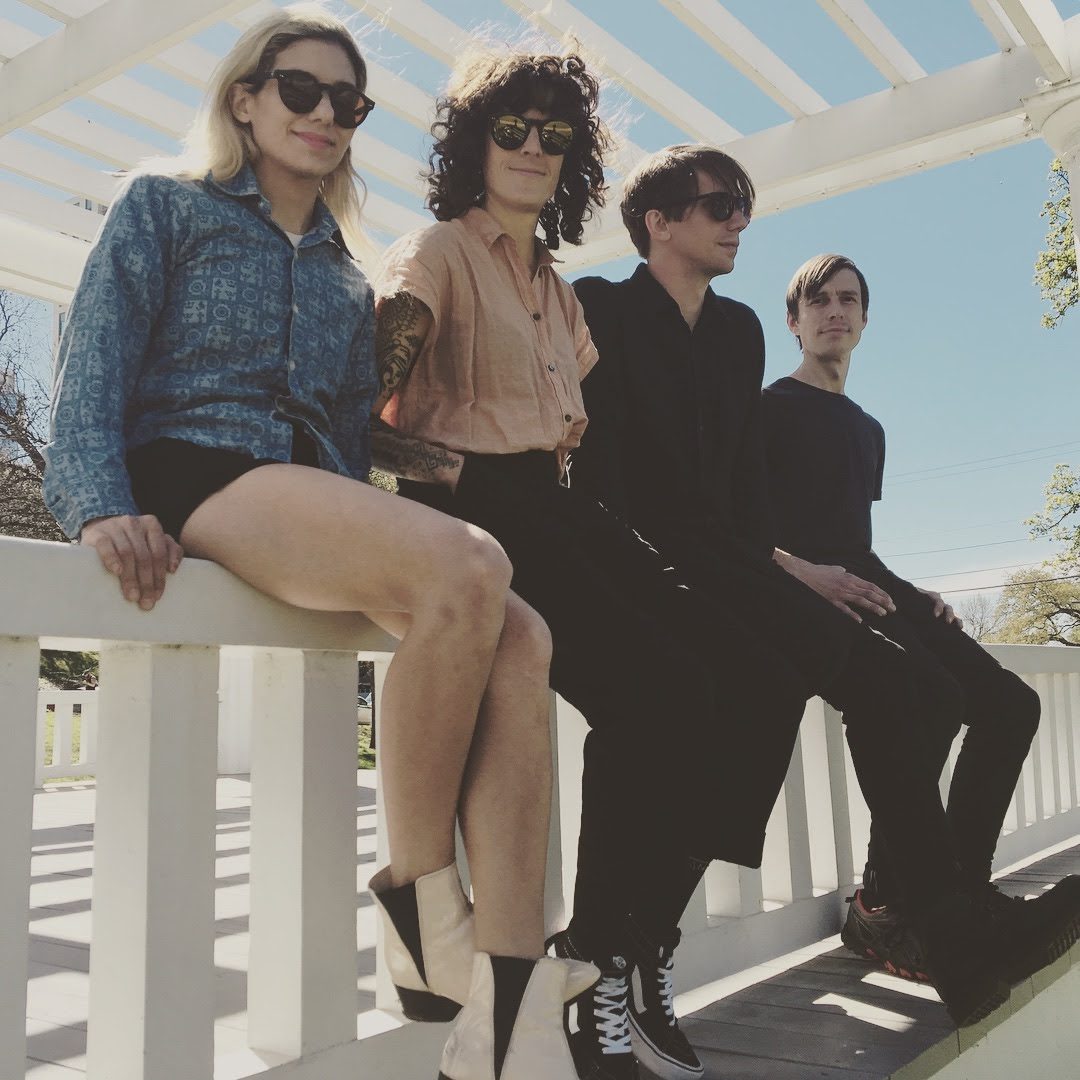
BRASS BOX TOUR DATES:

4/5 – Portland, OR @ Out From The Shadows Fest
4/7 – Vancouver, BC @ Astoria Hotel
4/8 – Seattle, WA @ Central Saloon
4/9 – Oakland, CA @ Elbo Room Jack London
4/11 – Joshua Tree, CA @ Furstworld
4/12 – Los Angeles, CA @ Echoplex (Record Release Show)
4/14 – San Diego, CA @ The Whistle Stop

INTERVIEW: I.L.Y. On Debut Single “Unlie Your Lies”

Ana Carolina, soon to be known by her artist moniker I.L.Y., moved to New York City a little over two months ago, and has hit the ground running. The 25-year old Brazilian native left behind her marriage and career as a technical training coach for an Olympic athlete to pursue her true passion – music. She’s already garnered fans from her debut New York performances at White Water Studios ( presented by Treble FM) and the International Women’s Day installment of Ludlow House’s Future Female Sounds showcase. I.L.Y.’s music exemplifies strength in vulnerability and following one’s inner truth. We spoke to Ana about her experience on The X Factor Milan, what it feels like to be the only female occupying a room in Bushwick artist collective Tangerine House, and her debut single, “Unlie Your Lies.”

AF: Where did your musical journey begin?

AC: It began in Brazil! My grandfather was (still is) an amazing guitar player and songwriter. Even though he only played for his own enjoyment, he was an inspiration. He gave me my first guitar when I was ten years old, and my love for music has grown stronger ever since.

AF: How does it feel embarking on your first professional music project, and release your first single?

AC: It is the most challenging thing I’ve ever faced. It’s the deepest connection with myself and what I believe to be my purpose in life. At the end of the day, it all comes down to that simple question: “Who am I gonna be, and am I happy with it?” It’s the best feeling to be doing what I love. I’m happy throughout the process of creation, regardless of the outcome.

AF: Where is your creative workspace?

AC: I live in Tangerine House, an artist collective in Bushwick. My creative workspace is usually my bedroom, or wherever the energy carries me.

AF: What is like being the only female in a creative house of men?

AC: We all respect each other and we’re a very dope family to be honest – everybody’s just amazing – so I’d say “easy.” It definitely helps me create more and more. Tangerine House for life!

AF: How would you describe your musical sound palette?

AC: Colorful, eclectic, and sexy!

AF: Who are your musical influences and inspirations?

AC: Michael Jackson, Aretha Franklin, Amy Winehouse, Erykah Badu, Alicia Keys, Maxwell, Stevie Wonder, Beyonce, Sabrina Claudio, James Blake, Kendrick Lamar. The list goes on…

AF: Can you talk a little bit about being on The X Factor in Milan?

AC: It was a very special opportunity. Going through so many auditions and being able to perform in front of fifteen thousand people was definitely amazing and scary! It taught me a lot about dedication and consistency. I got to meet and work with so many international, and dedicated artists. Overall I’d say it was a positive and formative experience.

AF: Your voice resonates wisdom and maturity – what sonic themes will you be exploring with I.L.Y.?

AC: Thank you! Definitely Neo-Soul and a lot of R&B, hip hop, lounge music…

AF: Why did you choose I.L.Y. as a moniker?

AC: I had a dream with this name!! And standing for “I LOVE YOU” is literally what I live for.

AF: Can you discuss the meaning behind your debut track “Unlie Your Lies?”

AC: The song tells an intimate and romantic story about two people who fell for each other but one of them just didn’t want to allow the whole “love story” to happen. It’s about real life choices and consequences – the choice of denying the love you feel for someone and all the weight that comes with that repression. “Unlie Your Lies” is an anthem to be emotionally honest with yourself, and follow whatever you truly feel.

AF: Have you performed live in NYC yet? What’s coming up next for I.L.Y.?

AC: Yes!!! Had an amazing experience at Ludlow House and another unforgettable one at the WhiteWater studios. Coming up is my first EP. Now I’m focusing on compiling all the songs I’ve written and pick the top 10 ones so I can work and create along side amazing artists! It’s really exciting.

PLAYING CINCY: Joness Releases Intoxicating New EP Sheep

Joness / Sheep

Cincinnati-based artist Joness flexes her ability to jump back and forth from bouncy bars to hard-hitting vocal ranges as she intertwines classic hip hop sound with an R&B style on her new EP, Sheep.

Joness first hit the scene with her debut EP, Rule Number 9, following it up last week with Sheep: An Extended Play. The EP carries the listener through the internal stages of drinking – the shedding of inhibitions, the slurred words, the inner ‘wolf’ that comes out to play and ultimately making peace with the sometimes regrettable hazy memories. It’s as much a drinker’s inner monologue as it is a public display of Joness’ sonic maturation. While relatively new to Cincinnati, she was heard on several albums last year and this EP marks her coming into her own and finding the balance between her own artistic sheep and wolf.

Joness was recently a guest on the Future Moguls podcast where she explained that the EP’s title is a symbolic play on the phrase ‘a wolf in sheep’s clothing.’

“Our sheep is that persona that we want people to think of us as, but we all have a wolf within us that we fight so hard to not let other people see that part of us,” she said. “Either because we haven’t come to terms with that darkness, or we’re not okay with how it makes us feel.”

Joness / Sheep
Joness / Photo by Kodak K.

The first track, “Waldo,” starts the party off. Joness raps over a fizzy beat with an energy that mimics the initial buzz. “Waldo” fades into “Composition 4,” which is where Joness gets to put her vocals on display. The boppy hip hop vibe from earlier drowns under an oncoming wave of R&B, from where Joness really thrives. Her inner drunk monologue is still having a good time, but “Composition 4” gets a little more introspectively dark.

“That’s kind of the context behind the EP,” Joness said on Future Moguls. “We all have an inner good or inner bad.”

The EP’s drama peaks at “Enterlube,” with dramatic bass-heavy production and Joness singing and rapping softy, almost eerily, over an ominous beat. Her speech becomes mumbled and her lyrics get distracted – also marking the peak of intoxication.

Sheep ends on a positive note with “Sweat,” featuring Cincy artist Muwosi. Joness again flexes her rhythmic flow and raps rays of sunshine, signifying the storm from the middle of the EP has passed.

As an artist who’s currently central to the Cincinnati scene, Joness’ long-awaited EP does not disappoint. She recently performed Sheep alongside an all-female set list at the No Cool Kids Allowed ‘Queens’ show. Vibe out to her latest offering and don’t be afraid to find your own inner wolf and sheep.
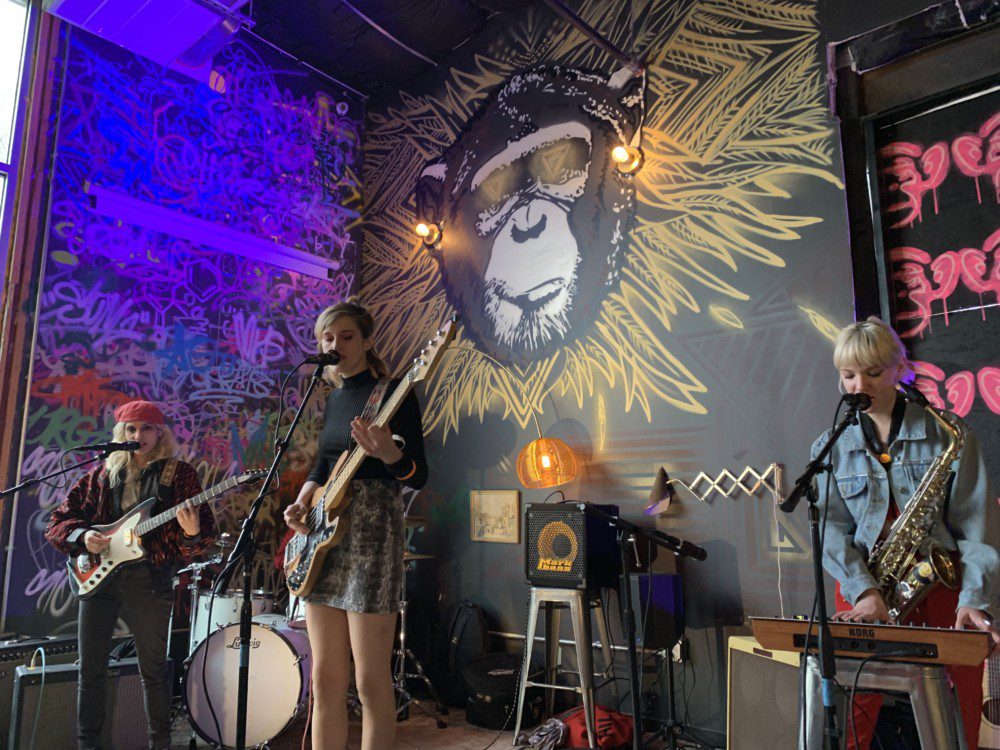
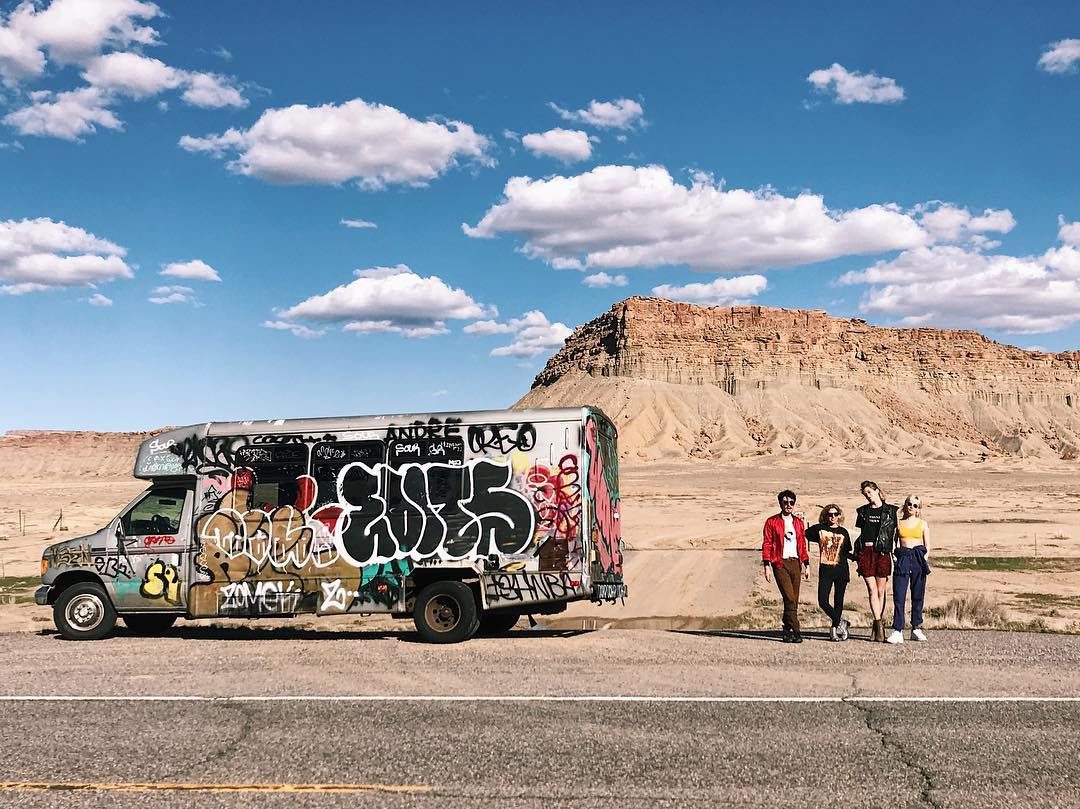
HIGH NOTES: The Sound of Iboga

“This life is just a dream. It’ll be over in the blink of an eye. Remember who you are. Remember what you are.”

Omkara’s “Remember” filled the dimly lit, sand-colored living room of my Venice Beach apartment. I was on the cusp of a discovery, or perhaps a rediscovery. The following day, I’d hop on an Amtrak to San Diego, cross the southern border to the beach of Rosarito, Mexico, and ingest the roots of the African Tabernanthe iboga plant.

I recalled advice I’d been given on an ayahuasca retreat a year prior: “Remember to remember who you are.” Why was this coming back now? Who was I that I needed to remember? What part of myself had been lost?

“I just listened to this song, and wow, it hit me,” I texted Dimitri Mugianis, who was about to administer the psychedelic, along with a link to the video. “This life is one of many, and it will really feel like a blink of an eye. And I incarnated here because I wanted all of this… and I chose a big mission for this life. I am here to do something so big, it gives me chills… I’m crying now. It’s like I’m remembering what I am, how big I am.”

Was I already under the influence? Although I hadn’t yet arrived at the apartment Dimitri rented for the occasion, I may have been feeling the plant’s effects, he said. “The ceremony’s already started.”

My motivation for taking iboga, which has been used for everything from treating drug addiction to ushering in spiritual experiences, was multifold. I was trying to recover from chronic Lyme disease, and I wanted to work through any trauma that had led me to contract it.

Before the ceremony, I emailed Dimitri a list of songs I’d like him to play. “Remember” came on in the beginning, just as I begun to feel stiff and woozy and like the room was spinning. I used the last of my functioning brain to sing along, then I slipped down into what seemed like the underworld.

“Show me my trauma,” I told Father Iboga, as they call the plant spirit. What I saw instead was the collective trauma of humanity. I saw the holocaust, I saw slavery, I saw animal abuse again and again. I saw so many cannibals. I asked if there was a word for what I was seeing. “Darkness,” Iboga told me. “Your trauma is a fear of the dark, which is a fear of death.”

I saw all the times I felt dead. I saw my head over a skeleton with grey hair. I saw flashes of myself on heart monitors. I saw myself as an old witch. I saw old ladies trapped in basements, slowly withering away. I saw bones breaking and organs falling out and heard my cousin saying, “Step on a crack and break your mom’s back.” Things falling apart, the death, the horror. The sense of being meat.

Death is not what happens when we die, I realized. It’s when we live as if we’re already dead. It’s when we choose dark. I saw the times I’d chosen dark.

“Show me my trauma,” I repeated. I saw montages of adults yelling at me as a child. I saw an afterschool program with a very mean teacher, a chalkboard, a dark room, a door slamming. “What happened there?” I asked. “That’s where you saw the darkness.” I did not know what that meant. Soon after, the sun came up. “Time to move into the light.”

I saw a cloud with a bunch of little squiggles. These squiggles were our souls. They jumped into Earth like a swimming pool, assuming bodies to communicate with loved ones. And then I met my soul! It was a pure, good soul. It was a part of the cloud where all the souls joined, and it was here to spread light! I cried and cried as I realized who I was: a bringer of the light! I spent the day weeping on the couch and spotted fairies, awestruck, in the night. 

Throughout the next five days, I heard Omkara’s voice from the corner of the living room: “Remember who you are.” Why was this song playing on repeat? I wondered. Then I remembered Dimitri warning me, “You might hear people saying things they’re not really saying.” That would also explain why I heard “Oh my god Becky, look at her butt” during the ceremony.

I thought back to what I told him the morning after: “I’ve been coaxed into the darkness, but I’m here to spread light.” Who was I? I was part of the hive mind, and the hive mind was made of light.

“This life is just a dream, a dream made of love.” I came from a cloud of love. That was who I was.

On the last day of the retreat, Dimitri and I went on a walk. “Is it just me or is the wind singing, ‘Remember who you are’?” I asked him. I knew the answer; the wind couldn’t talk. But my ears were still telling me otherwise.

“Just remember what you learned about the light and the dark,” he said. “The key to maintaining your health will be giving back.”

Over the following week, I heard the song emanating from the oddest places: airplane engines, microwave ovens, entirely dissimilar songs on the radio. Iboga had made the message clear: my job is to spread light. The challenge now is just to remember who I am.

ONLY NOISE: Kacey Musgraves Still Speaks to Me with Golden Hour, a Year After its Release

ONLY NOISE explores music fandom with poignant personal essays that examine the ways we’re shaped by our chosen soundtrack. This week, Cillea Houghton delves into her personal connection with Kacey Musgraves’ ground-breaking Golden Hour, a year after its release (and several Grammys later).

Watching Kacey Musgraves take home the Album of the Year Grammy for Golden Hour was a moment I can only compare to a football fan watching their team win the Super Bowl. When I listened to it for the first time, I had a gut feeling it would be one of the best albums I’d ever hear in my life and knew I would find meaning in it 10, 20 years in the future. I also had an instinct that it would earn her a lot of praise, and felt vindicated when it did, especially significant seeing as she did it with little to no support from country radio. Golden Hour felt like a full circle moment in a way, as it had me thinking about the beginning of my journey with Kacey many years ago, hearing “Merry Go ‘Round” for the first time, not yet knowing the breadth of her artistry and how it would affect my life. She has a special gift of capturing the raw, honest truth about life that most people may not consider or ignore altogether, and Golden Hour is her finest example of that gift. My initial review only touched the surface of this powerful album that I’ve since developed such a strong bond with; in the year since its release I’ve come back to revel in its beauty again and again.

My introduction to Musgraves is burned into my memory. I can still feel myself sitting in the passenger seat of our family mini van, my mom driving us home after she picked me up one Friday afternoon during my sophomore year of college. I had the radio on the country station and we’d just made it over the Sagamore Bridge when I heard the opening banjo lick to a new song that instantly grabbed me. A woman’s voice came pouring through the speakers, and I was enamored as she sang “If you ain’t got two kids by 21, you’re probably gonna die alone, at least that’s what tradition told you.”

A few weeks later during a weekend visit at my cousin Jacquie’s house, I learn that this captivating song was “Merry Go ‘Round” by Kacey Musgraves. I told Jacquie how much I liked it, and she said I needed to listen to the whole album because it was so good. She played Same Trailer Different Park for us while we were getting ready to go out for the evening and I remember being so intrigued by each track. It sounded so different from anything else I’d heard; the melodies were warm, but her lyrics provided such a sharp, real world perspective that I hadn’t been introduced to in the music I was listening to through my 19 years of life. There was something about Musgraves that resonated with me. The album quickly made it into my heavy rotation – I was particularly drawn to “Dandelion” and “Keep it to Yourself” for their gentle melodies and honest lyrics, but respected the realism of “Blowin’ Smoke.” I was struck by her boldness in “Follow Your Arrow” and applauded her weed references and celebration of LGBTQ inclusion.

This was merely the beginning of my journey with an artist that would deeply impact with me. “Merry Go ‘Round” has taken on new meaning as I look back on it with a refined perspective.  She makes me think of all the people who did settle like dust in their hometowns, and I revere how she presents these thought-provoking observations in a non-derogatory way. She doesn’t cast judgment on the people she’s singing about, but rather makes keen observations about life and conveys them in a way that’s universally applicable. Musgraves takes real risks in her songwriting, and it’s inspiring to see that her conviction has earned her acclaim from all walks of life.

Her second album, Pageant Material, grew on me more slowly. Though I loved “Biscuits,” I viewed it as sequel to “Follow Your Arrow” and unfairly judged the album based on that one song. Some three years after its 2015 release, I fully immersed myself in in the album, saw how dynamic it is, and discovered how much I had misjudged it. I fell in love with the melody and her IDGAF attitude on the title track, appreciating how she stands up for those who will never be deemed “perfect” in a world where this unachievable ideal is forced upon women from the day we’re born. “High Time” is a gem, while the line “had to get away so I could grow but it don’t matter where I’m going, I still call my home town home” from “Dime Store Cowgirl” always sticks with me. I’ve lived these words, moving away from my tight-knit family in Massachusetts to chase my dreams in Nashville, but still hold tight to my New England identity. She brings to mind fond memories with my family on “Late to the Party,” the sentiment of the song making me envision all of us laughing and enjoying each other’s company at our favorite local bar. I was awestruck by the sorely underrated “Fine” and the way she wrote such a timeless, melancholy song about the longing feeling of missing someone. It makes me think of how my grandmother must feel about my grandfather, missing her husband of more than 60 years every day in the wake of his passing. And I think the fact that she chose to cover the lost Willie Nelson song, “Are You Sure” instead of one of his hits, and that he willingly offered to sing it with her, is just one small example of how she’s a true original.

But I didn’t realize music could be so pure until I heard Golden Hour. When I heard “Space Cowboy” and “Butterflies” in the months before the album’s release, I knew they were a strong indication that Musgraves was going to gift us something incredible. But little did I know just how much the album would enlighten me. From the moment I pressed play on “Slow Burn,” I was stunned. Hearing her sing “old soul waiting my turn, I know a few things but I still got a lot to learn,” is the moment I bonded with her on a soul level. I often find myself using the term “slow burn” now in conversation, particularly as I contemplate my own life and how things tend to happen when they’re meant to. I’ve always been a late bloomer and not one to keep up with the pace of my peers. I come into things in my own time and I appreciate how the song speaks to that so viscerally.

I had never heard an album that reflected so many emotions I’ve experienced, but haven’t put into words. I’m in awe of the way she captures our existential existence in “Oh What a World.” How she managed to convey so brilliantly the overwhelming magnificence of the universe in such a simple and compelling way, I’ll never know. And I hold in high regard her ability to communicate such a specific feeling as that brief interval in time between a fleeting moment of happiness that’s immediately followed by sadness. It makes me think of my childhood and how excited I would get (and still do) about visiting my family, going to bed on Christmas Day, or coming down from a euphoric concert, feeling grateful for those special moments and also sorrow in knowing that they’re over.

I’ve identified with every aspect of “Lonely Weekend.” I know how it feels to have those lonely days when it seems like everyone else is out in the world enjoying life while I’m home alone. It was reassuring to hear someone touch on an insecurity I’ve often felt, but also acknowledge that it’s okay to have those days of solitude. And I admire how gracious she is in “Space Cowboy.” Most breakup songs carry an essence of bitterness, but Musgraves is the bigger person in this scenario. There’s a selflessness she brings to the act of letting someone go when you know it’s the right decision.

She brought me to tears with “Mother,” the way she so thoughtfully and beautifully conveyed the overwhelming emotion of the world while simultaneously tying generations of people together in just a few words. The way she expressed missing her mother, who was sitting miles away thinking of her mom, reminded me of how much I miss my own mother and grandmother being 1,000 miles away from them. And though they see each other every few weeks, I know they still miss each other. It also made me wonder how often my grandmother thinks of her mother who passed away years ago, one she wrote a poem about when she was 13 years old regarding the passage of time and watching her mother’s hair turn gray. I know she must miss her no matter how many years go by. With just 11 lines, Musgraves made me ponder my relationship with two of the most influential women in my life and the connections they have with their own mothers. Serendipitously, just before she performed “Mother” at the Ryman Auditorium, I was thinking about how my mom and grandma would enjoy her music and her stage show, my eyes welling with tears as I sat in the pew.

What I learned about Musgraves through Golden Hour is that she is truly a woman of her word. In an interview prior to the album’s release, she philosophizes about feeling her way through the music and being inspired by the beauty of the world after experiencing the solar eclipse. She detailed all the characters we’d see and be able to relate to, without any bullshit. Golden Hour is a marvel in that way – transcending earth while being incredibly grounded at the same time, just like Kacey herself.

Musgraves proved to the world that it is possible to take simple and honest thoughts and transform them into profound art. I love how Golden Hour connects with people on so many different levels, and I always feel a glimmer of pride when I hear one of her songs out in the world, whether on my local roots music station, hearing “High Horse” coming from the speakers at a strip mall or someone blasting “Slow Burn” from their car with the windows down. I can’t remember the last time I connected this intensely with a body of music, and that’s a personal revelation I’m so thankful I got to share with Kacey when I fulfilled one of my ultimate dreams of meeting her.

It’s rare that I want to share an artist’s music with every person in my life because I know they’ll gain something meaningful from it, but that’s what Kacey Musgraves does for me. She created an album that touched my soul because it stemmed from her own, and I’m so inspired by how she owned her truth in every way and made a project that was so genuine and personal to her, not knowing if it would be commercially viable. She taught me that magic exists and music born from sincerity can reach beyond the stratosphere. Thus far, this journey has made me understand that I want to live my life the way Kacey Musgraves creates art: vulnerable, observant, sincere, fearless, truthful yet compassionate, grounded while seeing the world from a grand perspective, and above all, pure.

PLAYING ATLANTA: Greco Make Magic On Stage and In the Studio

Even for a newbie in the Atlanta music scene, the name Greco is as familiar as the infamous straight-up-the-stairs load-in at Smith’s Olde Bar, one of the city’s most iconic haunts (don’t worry, out-of-towners; there’s an elevator now).

The rock quartet, made up of brothers Sebastian (lead vocalist), Josh (guitar), Zach (bass), and Gabriel (drums), is known for their grooving, high-energy rock tracks and riotous live shows. They’re larger than life, putting on stadium-sized shows for a few hundred loyal fans at a time.

As they count down the days to the physical release of their latest digital single, “Magic,” the guys sat down with Audiofemme to talk all things music, brotherhood, and the city we all know and love.

AF: How did you get your start in music? Was Greco your first band, or did you guys play with other groups before starting your own band? 

Sebastian and Zach have always played together. We started in a party rock band in Athens, GA with a couple other guys. Four years ago, we decided to do our own music with just our brothers, so we’ve been together a little over three years now.

AF: I’m sure you’re asked this all the time, but what’s it like to play in a band with your brothers?

It has been a fun and wild time. We know each other, so we know the quirks of the band and what really drives us. We have pretty much always lived together and still do. So we know what we like, we have some shared interests, and also know how to piss each other off!

A great extra tidbit; when we tour, we always go out and explore. Museums, parks, bars, monuments, tourist traps, local restaurants, pools, fan houses, parties, you know, the usual stuff. So when we are on the road working, we are also enjoying our time.

AF: Do you all have similar influences, or are there different bands or sounds that inspire each of you guys? 

We definitely love some of the same bands – The Stones, Zeppelin, Bowie, Duran Duran – but we’ve all got our own tastes too. Zach loves underground hip hop, Sab loves Americana and K-pop, Gab is an emo kid at heart, and Josh loves Jimmy Page and Keith Richards.

AF: What’s your creative process like? What inspires the music? 

We all write music and lyrics. Some of our songs come from a riff idea, others start with some lyrics Sab has, or a cool piece of art someone sees. Then we get together and bang out the song and get a demo down. Once we get the idea down, we start tearing it back apart and arranging and adjusting it. The nice thing about being brothers is we have beat each others’ ego out of existence. So we focus on what sounds best, and what makes the sound.

AF: What do you think sets Greco apart from other modern rock bands? What do you hope your fans take away from listening to your music or catching a show? 

We bring the soul of the music out in the studio or live. We don’t play music to put on an act. We love what we write, what we record and what we play, and we bring that same wild stage energy into our recordings. Our mantra is Sing.Dance.Sweat.Sex., and we truly want our music to touch our fans and make them feel alive when they are listening to us on their own or catching us at a live show.

AF: You’re prepping to release your first single of 2019, “Magic.” Can you tell us a little bit about the song?

We write and sing about common experiences that the four of us have experienced. “Magic” is a track that relates to people on a deeper level because they’ve shared a similar experience in their life. Magic is for everyone, life is a journey, and if you get lucky, you find someone or something that makes it magic!

AF: You guys are all over the Atlanta music scene, and gig all the time. Do you prefer making music in the studio or on the stage? Why?

Ooh, tough one. I’d say we all love the stage, but we appreciate and understand that you make the music in the studio and add onto it for the stage show. For instance, we love when the crowd sings along. At our last show, we stopped all the instruments and sang the chorus of “Magic” with our fans for a good thirty seconds before bringing the music back in and finishing the song.

AF: How has the Atlanta music scene impacted you as a band?

Atlanta has helped us grow as a band. The city is a great hub with people coming and going all the time, but there’s a strong rock scene here that has a lot of people behind it, pushing for everyone involved to succeed. We love the support we’ve received and the support we’ve been able to give other bands as we continue to strive forward in the music industry.

AF: What’s next for Greco?

More! The official release of “Magic” is April 13 on all available platforms, and we’ve got some surprises before and after its release pertaining to the track. There’s currently some exclusive content that is scheduled for a future release date to the public, but our Patreon supporters are promised first dibs.

AF: Last one — best place in ATL to catch a live show?

Local bands – Smith’s

Regional bands – Center Stage

National bands – Variety

Keep up with Greco on Facebook, and stay tuned for the official release of “Magic” on April 13th, plus top secret, exclusive content coming soon.

PLAYING DETROIT: Primer Crafts Goth-Pop Gems on Debut LP Novelty

photo by Alex Buks

We’ve all heard the cliche – “some of the best songs are written in ten minutes.” Think of the story behind pretty much any early Beatles song and you’ll land at some iteration of that. But what about the songs that unravel like a slow burn, painstakingly dragged along until they finally emerge from the ashes of rewrite after rewrite, evolving in meaning along the way? Detroit-based artist Primer (Alyssa Midcalf) took the latter path when crafting her debut album, Novelty, a heart-numbing goth-pop album that serves up heartbreak and catatonia in pink cellophane wrapping paper.

Midcalf began writing Novelty long before moving to Detroit just over a year ago. The Palm Springs, CA native made her way to Detroit by way of Grand Rapids, where she ended up by happenstance – “I fell in love,” Midcalf explains. She was playing in another electronic band in Grand Rapids, called Parts, where she honed her skills as an electronic producer. Prior to that, Midcalf had gotten by as an almost entirely self-taught musician. “I went through a lot of problems as a teenager and I think, for some reason, there was this time in my life where I was like [music] is what I’m going to spend my time doing.”

She experimented with drums, bass, and synth, but not before establishing her first musical love – singing. Midcalf’s background in musical theatre and singing competitions is clear even in Novelty’s muddled vocal production. Instead of feeling cloudy or lost, Midcalf’s subtly mixed vocals act as a pleasant surprise to the close listener drawn in by ’80s-inspired synths and captivated by Midcalf’s infallible, haunting performance.

The entire record feels like Midcalf threw a huge party in a haunted house but deliberately didn’t invite any guests. I can see it as clear as day when listening to “My House” – a ghostly woman, standing in the middle of a dark empty room, a disco ball radiating light on the walls and her face. It’s this knack for creating a mood that makes Midcalf’s songwriting particularly enchanting. There’s a uniformity throughout the record partly due to Midcalf’s main instrument of choice, a Juno GI synth, but also to the blaring emptiness that permeates throughout her lyrics.

“Lyrics are always the last thing,” says Midcalf. “So, I’ll have melodies and sometimes I’ll have songs for years that don’t have lyrics until some sort of meaning comes to it. Lyrics breathe life into something that’s otherwise a corpse.” Paired with new-wave dance beats, Midcalf’s devastating verses disguise themselves in a happy home. The dichotomy is irresistible and so is Novelty.

Novelty is out now via Young Heavy Souls Records. Give it a listen below.

PLAYING CINCY: Hip Hop Showcase Brings Out Cincinnati Talents

hip hop

Dayo Flow at Urban Artifact in Cincinnati rounded up some of the city’s top-rated hip hop acts. The evening showcased headliners Dayo Gold and Eb&Flow, singer Joness, Kelby Savage, Devin Burgess and more.

hip hop
Freestyling underway at Dayo Flow. Photos by Victoria Moorwood.

The show started out with some playful freestyling, where rappers and artists in the crowd were welcomed on stage. Kelby Savage started off the individual performances. His most recent production appeared on Big18foot’s Hogwash, which came out earlier this year.

K. Savage, hip hop
Kelby Savage at Dayo Flow.

R&B singer Joness opened up her acoustic set talking and joking with the crowd. Her debut EP, Rule Number 9, came out in 2017 and will be followed up Thursday by her forthcoming album, Sheep: An Extended Play, produced by Joey Thomas.

Joness/ hip hop
Joness performing at Urban Artifact.

Emcees Dayo Gold and Eb&Flow and producer/ rapper Devin Burgess ended the night on a high. Eb&Flow’s 6-song EP, Sympathetic.Audience.Control, came out last month. He and Dayo Gold collaborated on “Dayo Flow” in 2017.

hip hop
Dayo Gold, Eb&Flow.

Dayo Gold released two singles, “Twang” and “Came Up” late last year, while Devin Burgess, clearly out of retirement, bopped some singles off his 2018 album, Trash.

PET POLITICS: Ana Becker gets CATTY with Bruce Kittowitz and a New Band

Ana Asnes Becker has been a staple in the Brooklyn music scene for quite some time now. Like many of our interviewees, Ana is quite Renaissance woman: beauty, brains, a big personality, and loads of talent. A few years ago, she left her job at The Wall Street Journal to pursue her music career full time. You have most likely heard Ana shredding up a storm with the vocals to match it on stage with garage stars Fruit & Flowers, or on their debut release Drug Tax. She has also whipped up some wicked guitar lines with post-punk heroes Big Bliss, dream poppers Holy Tunics, The Hum series, and in a few guest sets with Sharkmuffin. Ana is also an excellent illustrator and graphic designer. In the midst of all these projects, Ana picked up an additional role: adoring cat mom. And Ana just launched a new musical endeavor: CATTY.

AF: Please introduce us to your kitty!

AB: This is Bruce Squiggleman Kittowitz! He’s almost a year old, and super-affectionate. He’s a purr machine with a huge personality. He loves to snuggle, play fetch, steal human food, chase a laser, run the length of the apartment and back at full zoomy speed, and drink from the bathroom sink. Whenever Tim or I comes home he greets us at the door and meows at us until we give him hugs. He’s an excellent conversationalist. He sleeps next to my head every night. He’s Jewish, like his mom, and we’re looking forward to giving him a bar mitzvah when he turns 13 (which is around 2 in cat years).

Bruce with his namesake. All photos courtesy Ana Asnes Becker.

AF: Did Bruce choose you or did you choose him? How did he come to be a part of your family?

AB: Tim [of Big Bliss] and I went to an adoption event in Union Square, flirting with the idea of adopting a cat. It was set up like a green market, except instead of fruit and vegetable stands there were rows and rows of stands from different pet adoption agencies, each with kittens and/or puppies. It was an unseasonably balmy day in September, and the animals were in cramped cages, in close quarters, in a very noisy, hot, and stressful place, getting poked and prodded. Most of the cats were VERY grumpy, understandably so. We walked around and held our hands out to kitties to sniff to try to make friends, but most of them just wanted to be left alone. When we came over to Bruce’s cage and I held out my hand, he sauntered right over and put his little paw in my palm. And then he did the same with Tim. We fell in love right away. He was the chillest little dude, totally unbothered, with such a sweet temperament. Also, Tim’s all-time favorite superhero is Batman, and Bruce, then named “Midnight,” had “I am the night, I am Batman” on the back of his name tag. We took it as a sign. (And then after some deliberation renamed him Bruce after Bruce Wayne.)

AF: Did you have pets growing up?

AB: I had a golden retriever named Jessie at my dad’s house, and a cat named Herman at my mom’s house. I miss them both. Jessie was the best. Excitable and kind of dumb and just a big ol’ fuzzy love bucket. Herman was my homeboy. He was declawed in the front (before we adopted him) and he still managed to be quite a formidable hunter.

AF: When did you start playing music and what was your inspiration to start?

AB: I got my first guitar for an early 14th birthday present from my dad. He was a guitarist – never did it professionally but he was an incredible player. I was a freshman in high school, and he had just been diagnosed with terminal cancer. I wanted to learn to play so that I’d have something to connect me to him after he died. It worked. I also wanted to impress a boy. That part didn’t work.

Ana on the road with Big Bliss.

AF: What was your very first instrument?

AB: My first instrument, after recorder that is, was trombone. I got it for school band in 4th grade. Trombone was my first-pick instrument so I was super excited, but we quickly realized that my arms were too short to play it. So the school gave me a baritone… which is like a half-sized tuba. It was ridiculous. I swear they gave the smallest kid a huge instrument just for a laugh. I quit band as soon as I could.

AF: How did Fruit & Flowers come to be?

AB: Caroline and our original drummer Shaw came up with the name of the project and started jamming with the idea of starting a band. Caroline met our original rhythm guitarist Lyzi at a Sharkmuffin show and invited her to play. I was friends with Shaw, he’d seen my band City Mice so he knew I could play, and he invited me to come to a practice. The four of us got together as Fruit & Flowers and had to race to write and practice a set before our first show, which had already been booked, and was only a month away. After a few months Shaw went off to pursue career goals, and we were joined by the excellent Jose Berrio on drums. We’ve also recently added Claire Wardlaw on saxophone and synth. Fruit & Flowers owes so much to Sharkmuffin – you’ve helped us out so much along the way, and who knows what the band would’ve wound up like without you!

Fruit & Flowers rocking SXSW 2019 (Photo Credit: Natalie Kirch)

AF: I know Fruit & Flowers is a collaborative effort. Can you tell us about your writing process?

AB: Most of the time, songs start organically, from a riff or beat someone is playing in the practice space, and we build the songs from there. Lately I have also been bringing in some material that I’ve written on my own, and we’ve finished the songs up as a group.

AF: Can you tell us a little about your new project CATTY?

AB: Sure! It started by complete accident. Matt Sklar from Parrot Dream put together a band lottery on January 5th – an all-day endeavor wherein random bands were formed at noon by picking names out of a hat, and then everyone went off to write a couple of songs together, and then the bands regrouped to play a show that same night. I wound up in a group with Don Lavis, also from Parrot Dream, Manny Nomikos from Gracie Mansion, and Bryan Thornton from Holy Tunics. It was an EXTREMELY lucky match up. We enjoyed playing and writing together so much that we decided to keep it going!

AF: Is it safe to say you identify with cats as your spirit animal?

AB: Hmm, I think I’m personally more like a dog than like a cat, but I could be wrong about that. Maybe something like a coyote or fox (canine but with some cat-like qualities). Or a starling. Jose says llama, because I’ve recently become very attached to a stuffed animal llama that I made Tim buy me in Austin for $5. I named it Brimothy, Bruce + Timothy, because those are the boys I miss most.

AF: You are on the road with Fruit & Flowers right now. Any funny stories to share?

AB: We were just driving on the way from Austin to Santa Fe, and we saw a church van next to us. Caroline wondered aloud if maybe it was a band that had rented the church van, and we waved at them. Sure enough, a couple of minutes later, she got a phone call from her friend Sam: “Am I on acid, or are you driving next to a church van right now?” The van was not only holding a band, but a band of Caroline’s buds. That was pretty surreal. We haven’t been on tour long enough yet for the really ridiculous situations to start accumulating. Any day now!

AF: Any past tour escapades?

AB: Where do I even start?!?!

Fruit & Flowers pitstop in the deserts of the USA to pose with their tour bus Sylvia.

AF: Where can we catch you on the way back up from SXSW?

AB: Fruit & Flowers is heading to Treefort fest in Boise, Idaho, then doing a run down the west coast.

AF: If Bruce was a musician, what instrument would he play?

AB: Hmm, maybe the recorder, because he’s still a little kid in cat years.

AF: What genre of music do you think Bruce would write?

AB: Lullabies.

AF: What is your favorite song about (non-human) animals?

AB: “Blackbird,” by The Beatles. It’s usually my general favorite song, regardless of non-human associations.

AF: Have you ever written a song about (non-human) animals?

AB: I wrote a series of songs about Greco-Roman mythology, through the eyes of the women in the myths. Those involved a couple of odd transformations, monsters, and other non-human creatures. I think that’s about as close as I’ve gotten to writing a song about animals.

AF: What do you miss the most about Bruce when you are on tour?

AB: I miss his fuzzy fuzzy cuddly face and his little paws and his expressive meows and his fluffy belly and his sweet head nuzzles and scratchy kitty kisses and the way he hugs your hand if you pet him while he’s sleepy. When Tim or I are home he is like our shadow, always following us from room to room, next to us or under our feet. I miss that special Brucey brand of loving companionship.

AF: Does he have any favorite foods?

AB: Bruce’s favorite food is whatever Tim or I happen to be eating at any given moment.

AF: What is on the horizon for CATTY and Fruit & Flowers when you return from tour?

AB: Fruit & Flowers’ homecoming show is on 4/10 at Our Wicked Lady, with Veronica Bianqui and Miranda & the Beat. Catty is playing Sharkmuffin’s EP release show on 4/5 at Alphaville, with Gustaf and Haybaby, and we can’t wait!

NEWS ROUNDUP: Grimes is (Sort of) Back, RBMA Announce 2019 Shows, and MORE

Grimes photo by Eli Russell Linnetz

So, About Grimes…

Where to begin? Claire Boucher (who turned 31 on Sunday and now prefers to be addressed as the italicized, lowercase letter ‘c‘) gave an interview to the Wall Street Journal; between the very odd conversation and her recent Instagram posts, it seems like she’ll be appearing in our News Roundups for a while, so buckle up.

First of all, she’s officially announced a new Grimes record. It’s called Miss_Anthropocene, and revolves around the concept of  the “anthropomorphic goddess of climate change,” according to her own Insta post. She describes the character thusly: “A psychedelic, space-dwelling demon/ beauty-Queen who relishes the end of the world. She’s composed of Ivory and Oil” and continues, “Each song will be a different embodiment of human extinction as depicted through a Pop star Demonology. The first song ‘we appreciate power’, introduced the pro-AI-propaganda girl group who embody our potential enslavement/destruction at the hands of Artificial General intelligence.”

In the same post, she also hinted that there might be an EP coming soon as well, which would ostensibly contain some of the stand-alone stuff she’s been working on while putting the LP together, like “Pretty Dark.”

On to the interview, which is behind a paywall I can’t afford and don’t want to pay to a conservative pub, so bear with me. c wants to “kill off” Grimes in a “public execution” because she feels limited by the branding she created back in 2009; her vision of herself as an artist is much more expansive, necessitating a Game of Thrones-esque book that will create a “lore” around her art and music. “It’s super, super pretentious,” she notes.

Reiterating her Instagram post, she says that she aims to make climate change “fun” with the new record, feeling that people ignore it largely because it makes them sad. Her solution to this dilemma is a series of “apocalyptic PSAs” in which she sits nude at a Last Supper-style dining table eating species on the brink of extinction, like a big bloody elephant head. You know, fun.

The album features an epic love ballad called “So Heavy I Fell Through The Earth” which Grimes says was inspired by the Assassin’s Creed movie trailer rather than her relationship with Elon Musk, whom she all but refused to talk about. She did say she “loves him” but was “simply unprepared” for the attention/criticism that dating him has brought her. WSJ did quote an email Musk sent to them about Grimes, saying, “I love c’s wild fae artistic creativity and hyper intense work ethic.”

Grimes tweeted that she was mostly pleased with the interview, but that generally she hates doing them because “it’s like fighting a battle with a fake version of urself to see who the public believes more.”

Red Bull’s NYC Music Academy Lineup is Here

Taking place across NYC throughout May every year, Red Bull Music Academy has become one of our favorite non-festivals – the lineup is always diverse and well-curated, with an eye on slightly more obscure avant-garde acts playing off-the-beaten path venues. Now in its 16th year, the programming for 2019 has been announced, and there’s a lot to be excited about.

For one thing, RBMA will host breakout Spanish singer-songwriter Rosalía for her first live appearances stateside. Her stunning 2018 album El Mal Querer flips Flamenco on its head, and the elaborate visuals that characterized her gorgeous visuals will likely make their way into the two performances scheduled for the newly-reopened Webster Hall.

Also performing over two nights, FKA Twigs returns to NYC for her first shows here since 2015, when Red Bull staged her vogue-opera Congregata in an abandoned hangar. This time, she’ll take over the Park Avenue Armory’s similarly cavernous drill hall. She hasn’t released new music in a while, so we’re curious to see what form these shows will take.

Four more women will bring immersive shows to the fest: Harlem’s own Teyana Taylor presents House of Petunia, a “spectacular audio-visual experience spearheaded by her all-female production company, The Aunties, featuring provocative stage design and mesmerizing choreography from a world-class team of dancers;” Tierra Whack headlines New York for the first time at the iconic Rainbow Room with “quirky and surreal stage design” that mirrors her surreal “Whack World” project; composer and sound artist Holly Herndon premieres the live iteration of her forthcoming album PROTO, “incorporating a fluid ensemble of eight vocalists, Spawn (a nascent machine intelligence), machine learning specialists, choreographers, and visual artists;” and Moor Mother weaves sound and history together with a “large-scale performance” she’s curated alongside an installation by Black Quantum Futurism, both of which are based on the race riots that engulfed America in the “Red Summer” of 1919.

More from RBMA’s press release:

Additional Red Bull Music Festival New York shows include: Rapper/producer JPEGMAFIA, who will showcase his gritty and abrasive beats with a dynamic live show in-the-round; NYC’s Onyx Collective bringing together their notable friends from the worlds of jazz, hip-hop, soul, and R&B for a free and unreplicable performance of intense, genre-expanding jazz at one of New York City’s beautiful parks; and the festival closes with Nyege Nyege Night featuring a propulsive and bass-heavy set from Ugandan DJKampire who – after laying the bedrock for the creation of safe party spaces for women and the LGBTQ+ community at home – will  make her US debut, co-headlining with rising singeli duo MCZO & Duke.

Tickets are sold for individual events and can be purchased here.

That New New

Speaking of Red Bull, break out that Hennessy – it’s Jenny Lewis Day, bitches.

Fresh off her Tim Presley collab DRINKS’ sophomore LP and tour, Cate Le Bon has announced her next solo album, Reward, out May 24 via Mexican Summer, with lead single “Daylight Matters.”

Nearly fifteen years after the release of their collaborative EP In The Reins, Calexico and Iron & Wine have reunited to record a full-length, Years to Burn. “Father Mountain” is the first single from the LP, out June 14 via City Slang.

Damien Jurado shared a new song from his stripped-down acoustic record In The Shape of a Storm, out April 12.

Juan Wauters has released the first single from Introducing Juan Pablo, out May 31. “Letter” was written in 2015; the record as a whole is something of a companion piece/prequel to his recently released La Onda de Juan Pablo LP.

Surprising no one, there’s a second volume to Broken Social Scene’s recent Let’s Try the After Vol. 1 EP on the way. Vol. 2 is out April 12 and its first single is “Can’t Find My Heart.”

Papercuts released a new three song EP, Kathleen Says, this week.

Lizzo and Missy Elliott have collaborated on a track, so music is basically over. Lizzo’s Cuz I Love You is out April 19.

Building on the momentum of recent single “Not What I Thought,” Somalia-born, Toronto-based vocalist Amaal brings the heat with another scorcher, “Coming & Going.”

Czarface, a hip-hop and comics collective featuring Inspectah Deck, has just released a collab LP with old Wu-Tang buddy Ghostface Killah. Czarface Meets Ghostface is out now, and so is this rad video for “Powers and Stuff,” seen from the POV of a very good boy.

Obliques are back with their first single since 2017’s “Instant Pleasure.”

Reptaliens’ sophomore LP VALIS arrives on April 26 – on cassette and limited edition pink vinyl. Watch the video for “Venetian Blinds” below.

Kero Kero Bonito released a video for “Swimming,” from last year’s Time ‘n’ Place.

Fat White Family return with a new video directed by Roisin Murphy. “Tastes Good With The Money” will appear on their third studio album, Serfs Up!, out April 19.

Plague Vendor unleash their new John Congleton-produced Epitaph Records LP By Night on June 7, and have shared a rowdy video for the raucous first track “New Comedown.”

Ibibio Sound Machine have a new album, Doko Mien, out today, and have shared a video for “Wanna Come Down.”

The latest video from Colombian breakout “Artist on the Rise” Elsa y Elmar is a journey, fam – and “Ojos Noche” is the Spanish-language alt-country bop you didn’t know you needed. Her next LP Eres Diamante arrives May 17.

Analogue special effects make for some gorgeous visuals in the dreamy new single from Heather Woods Broderick, who releases her newest album Invitation April 19. She’ll open for longtime collaborator and bandmate Sharon Van Etten at Webster Hall May 4.

Following the official announcement of her April 5 release Titanic Rising (and a video for “Everyday“) Weyes Blood shares a video for the album’s next single, “Movies.”

Tame Impala has released a new stand-alone single, “Patience,” to promote a headlining Coachella spot, numerous other festival appearances, and Saturday Night Live debut on March 30.

Honeyblood, now the solo project of Stina Tweeddale, releases their third LP In Plain Sight May 24, and have released a lyric video for “Glimmer.”

Here’s a ripper from new Queens-based band WIVES, who drop a two-part seven inch on City Slang in May.

Wes Miles unironically sings “Got the crew back together/Feels like it’s been forever” on “Bad To Worse,” the first song from Ra Ra Riot since the 2016 release of the LP Need Your Light; it’s produced and co-written by Discovery cohort Rostam Batmanglij.

End Notes

  • Iconic surf guitarist Dick Dale, best known as the man behind “Miserlou,” passed away on Saturday at the age of 81.
  • Myspace deleted your shit.
  • Did you know that Limp Bizkit’s Fred Durst hosts a jazz night at Los Angeles club The Black Rabbit Rose every Thursday? Lady Gaga does – she showed up last week to perform some Frank Sinatra covers.
  • San Francisco’s Outside Lands have announced the semi-retired Paul Simon as a headliner and reveal the rest of the lineup on Tuesday.
  • Woodstock 50 has official released their previously leaked lineup.
  • The Lollapalooza lineup has been announced; we’d save you a click thru and tell you who’s playing except that it’s literally the same bands playing every other festival, but in Chicago.
  • Justin Vernon and The National’s Aaron Dessner will bring a topsy-turvy version of Berlin event PEOPLE called 37d03d (get it? good, because it’s annoying to type) to Red Hook’s Pioneer Works; it’s a five-day residency featuring experimental-ish musicians like Vernon, Dessner, Sinkane, Boys Noize, Greg Fox, Shahzad Ismaily, and others, culminating in two performances on May 3 and 4.
  • The David Lynch Foundation, which brings transcendental meditation to sufferers of PTSD, have also announced a lineup for their benefit showcase on May 17 and 18 at Brooklyn Steel, featuring Wye Oak, Garbage, Phoebe Bridgers, Nancy Whang of LCD Soundsystem, and more.
  • Presumably riding high on Pepsi’s Super Bowl endorsement, Cardi B has filed paperwork to trademark “Okurrr.”
  • In other Cardi B news, she’s been announced as part of the ensemble cast for Hustlers, a movie about vengeful strippers based on this New York Times article.
  • The Wyld Stallyns have announced a most excellent reunion.
  • Madlib squashed some rumors that his collab EP with the late Mac Miller (dubbed “Maclib”) will see ever the light of day.
  • Questlove is teaming up with SF-based vegetarian “meat” purveyor Impossible Burger to created a Questlove Cheesteak sold at sports stadiums nationwide.
  • Democratic Hot but actually pretty centrist presidential candidate hopeful Beto O’Rourke has unveiled a unique platform: reuniting the Mars Volta.

PLAYING SEATTLE: The Black Tones Prep Cobain and Cornbread LP

Photo by L. Mckill

Brother and sister rock ‘n’ roll duo The Black Tones are all about rewriting Seattle rock history, and playing their asses off in the process. Their latest LP, Cobain and Cornbread, draws on the Seattle music and cultural aesthetic but puts the diversity and innovation back into the style. As the newest host of KEXP’s Audioasis, lead guitarist and singer Eva Walker is tasked with keeping a finger on fresh Seattle sounds, and says representing marginalized voices is her main priority in her new role. But even before that, Eva and her twin Cedric, who plays drums in the band, took every opportunity – in interviews, on stage, and in their music and lyrics – to point out POC contributions to rock ‘n’ roll, all too often forgotten now that the genre is dominated by mostly white musicians.

Ahead of The Black Tones’ release show at Chop Suey for Cobain and Cornbread, Eva chatted with Audiofemme about the upcoming album and what it’s like to see some of her wildest dreams – like working for KEXP and opening for Thunderpussy – come true.

AF: Did you and your brother play music together as kids?

EW: I mean we played with toys? But, we didn’t start playing music together until after Cedric saw me play at a Folklife Festival performance in 2008. Then, I started giving him drum lessons.

AF: Did that lead to The Black Tones?

EW: There would basically be no Black Tones without Cedric. He saw me perform and was like “she needs a band, she needs someone to back her up.” He wanted to do it.

AF: So what did the timeline look like—when did the band form?

EW: We started drum lessons on our birthday in 2008—and we did that for a summer and then that fall we started The Black Tones. We’ve had member changes since then—the most consistency in the band is me and Cedric. We’ve decided, “You know, it’s me and you and we’ll just hire people to play with us.” We are the closest and most reliable to each other.

AF: Like Steely Dan.

EW: Haha, yeah!

AF: What were some goals you had for Black Tones when you started the band?

EW: Just to play together and have music and hope that some people would like it. Cedric was newish to the [Seattle] music scene, but I had been doing it for a while so I knew a little bit more about the scene. I mean, I knew about KEXP and would often be like “Man, it’d be cool to do that.” I remember being like—if we play on KEXP one time I’ll be happy. It never has to happen again. And then, we got into rotation and then I got hired to be DJ. But, in the beginning it was more about playing shows and enjoying ourselves. And it’s been going really good!

AF: You mentioned having a little knowledge of the local community – what role does Seattle play in getting The Black Tones established?

EW: Yeah, there are a lot of successful people coming out of Seattle that have been so supportive and awesome to us. I mean, I had a friend who did lights for Mary Lambert and she asked me, “Do you know Thunderpussy?” When I got home I looked them up and was like—these girls are so cool! It’d be so cool to play with them, but it’ll never happen, blah blah blah, you know.

And then we actually got to [play together], and at the freakin’ Showbox on New Year’s Eve of all places! They said that when they were looking for someone to open for them at The Showbox they kept coming back to The Black Tones. I was like, “Are you guys freakin’ kidding me? That’s so goddamn flattering, you guys don’t even know!” I didn’t even know we had their attention or anyone else’s! It’s hard to see when you’re on the other side.

AF: I think people also struggle to see around the stereotypical definition of rock n’ roll. What are some misconceptions about rock ‘n’ roll that you like to set straight?

EW: I don’t do it as much as I used to—mostly because I’ve said a lot of this stuff in interviews and I think people got it—but [when I share my perspective on black history in rock] it’s  mostly coming from the past [when] I was being told “it’s so white that you like rock ‘n’ roll music,” or “you’re like the whitest black girl I know.” So, it was just me combating all those things I was told because, that’s a lie.

Everyone thinks that rock history is this —it’s Elvis or whatever. I think it’s really interesting. I read this interview where George Clinton mentions how white rock radio stations don’t play all-black rock bands.  They had to funk-ify themselves to get notoriety. I don’t know what it is about an all-black rock band that weirds out white rockers or white radio stations. I mean, we’ve been called a soul band and R&B—and I’m like, dude, we fuckin’ just play rock ‘n’ roll.

AF: Tell me about the new album Cobain and Cornbread. What are some underlying themes that drive it?

EW: We’re very family-oriented, so that helped inspire the name. We were at a show in Bellingham and someone asked “what’s your sound?” and I was describing the sound. I was like we’re full-blown Northwesterners, we were all born here, but my mom and everyone else is from the south—Louisiana. So as Northerners raised by Southerners, we’re sort of a hybrid of soul and rebellion. Sort of like the combination of Kurt Cobain and cornbread! Literally that night we were like, “oooh, that’s going to be the name of the record.”

AF: Why Cobain—is Nirvana near and dear to you?

EW: I love Nirvana, don’t get me wrong, but if I were to choose “my” grunge band—I’m an Alice in Chains girl. But “Layne Staley and Cornbread” doesn’t really roll off the tongue. And so, the name “Cobain and Cornbread” is supposed to represent more mascots—like when you think about Seattle in the ’90s and grunge, you think of Kurt Cobain even though me and some other friends think that Jimi Hendrix is the original founder of grunge. But I mean, “Hendrix and Cornbread”? A lot of times, when people think of Hendrix they think of Seattle’s music but they don’t think of the aesthetic of the Northwest—that’s more Cobain with the flannels and the long hair. So it was more about the aesthetic.

AF: What about the cornbread part? How does that connect to the South for you?

EW: When we think of the south, we think of soul food. Those people can eat and cook!  So,  I wanted to have some sort of a food meaning.

AF: Are there southern music influences on the album?

EW: There’s definitely blues influence in our music and writing in general. With our family being Southern it sneaks itself in there.

AF: Did you both write the songs on Cobain and Cornbread?

EW: I had a lot of the songs pre-written before I gave Cedric drum lessons. So, after he got lessons I said – “Hey, want to try this song?” But, even though I usually write the lyrics, I would say that it’s always a collaboration, as far as like when we start jamming and stuff. However, I would give more credit to Cedric for our song “The Key of Black.” He initiated that drum rhythm.

AF: What sets this release apart, in your eyes, from your last release?

EW: This one is more representative of the current band sound and what we are. And working with Jack Endino as a producer was the icing on the cake because he made some of these songs sound way better than I thought they would sound. He has such a scientific ear—I don’t even know if that makes sense— but he’s like a chemist behind a soundboard.

AF: Tell me a little about your new position at KEXP?

EW: So, I saw that Audioasis was looking for a new DJ. And originally, my fiancée Jake Uitti was looking at the job and then decided “Nah, I’m not going to do it.” Then, I was talking to a friend, and they were like “DO IT!” But I kept putting it off and I was like, they’re not going to hire me. I decided on the last day of applications to submit mine. They called me and asked to do an interview and I freaking hate job interviews. I guess they liked me though because they hired me!

AF: What happened when you found out?

EW: They called me while I was at Doe Bay playing a festival, and they were like “We want to give you the job!” And I was like “Aaahh, really?” And I couldn’t tell anyone for three weeks. Like, how do you keep that a secret? You’re the new host of Audioasis on KEXP, responsible for finding new artists!

AF: What are your goals with the show?

EW: I’ve been trying to highlight more underrepresented voices—and that’s in the POC community and in the transgender community, or wherever else. I did an episode for Womxn’s Day, and I had all POC and transgender women—voices who felt like they haven’t been heard. So, I’ve been doing things like that, and honestly, trying to play more genres. We’ve got enough indie rock here to last us—so I’ve been trying to get more hip hop music, more country music, and I need to do a better job with reggae and metal. I honestly want to play everything because I think the Pacific Northwest is more than this indie rock thing with some electronic stuff. There’s way more to it than that.

I’m also trying to get into prisons, because I think that’s an underrepresented population and my dad was in prison. My dad said that music helped him bridge the gap between sanity and isolation.  I want to go into prisons and record some of the work they’ve done, stuff like that. Talk about an underrepresented population—like, all the stuff we talked about like human rights, sexual assault, racism applies to them. The prison population can’t really defend themselves, and who makes up most of the prison population unjustly? POC people. It’s a population I feel a responsibility for reaching out to… and they’re supposed to be [in] rehabilitation, or correctional facilities.

AF: When can people listen to Audioasis?

EW: Saturdays from 6pm to 9pm live and people can stream it around the world at KEXP.org.

AF: How about Cobain and Cornbread? When can we hear the whole album?

EW: April 11th is the release show for Cobain and Cornbread at Chop Suey, and we have Page Turner and Black End opening for us. They’re all groups fronted by black females. They’re all pretty new so we thought—why not take the time to introduce some new artists? Then, the album officially drops on Friday, April 12th.

BAND OF THE MONTH: Mogli

There’s a calm awareness woven through singer-songwriter Mogli’s music, an overarching grace that winds its way from the first wordless track of her new EP, Patience, through the very end. It is subtle, rising and falling, a pulsing heartbeat driving each track forward at its own pace as her emotive vocals capture every twist and turn of a long, lonely path. Like the Netflix documentary, Expedition Happiness — in which she made her name as filmmaker and traveler, crossing the United Sates with her then-boyfriend Felix Starck, penning its critically acclaimed soundtrack, Wanderer, along the way — Patience is the tale of a journey that didn’t go as planned, yet one that she crafted into a masterpiece, minus the jaw-dropping views and winding roads.

Blending the ambient, driving sounds of alternative rock with deeply introspective songwriting, Mogli traces her steps through a year of depression, loneliness, healing, and ultimately, growth. Following her split with Starck, Mogli relocated from the idyllic German countryside to a fast-paced lifestyle in Berlin. “It was the right decision,” she says of the break-up and subsequent move, “but it was a lot to be suddenly on my own for the very first time. I was like, every morning, ‘What do you do with your time? Where do you go with your life?’”

The uncertainty was new for Mogli, who entered the world with a clear-eyed confidence, supported in following her own path by two artistic mothers. “In our family, it was always a good thing to learn something,” she said. “I was always encouraged, and everyone just let me have my space and find out what I wanted to do with my time,” she explains, and says singing felt the most natural. “I started to sing before I could speak. I hummed along when [my mom] either played music herself, or we just listened to music. I did that in my sleep as a baby… I still do sometimes,” she adds with a laugh. “It can be a bit embarrassing if you have a new date, and you’re singing in your sleep.”

Mogli spent her teens performing throughout Europe with an opera company, so traveling America with Starck was a natural extension of her nomadic spirit. “I was so inspired by my surroundings and the journey I made on the trip. It was beautiful. I was in the middle of nowhere in Alaska or New Mexico or the Grand Canyon, and I was so inspired by that, and how it moved me personally,” she remembers. But when it came time to settle down, the 25-year-old felt something was off – her life had become static, and it was time for a change, so off to Berlin she went, on her own this time.

Her new reality hit like a dull blow to the chest as she found herself struggling with depression for the first time in her life. “I was so overwhelmed with everything that I suddenly didn’t know what was right anymore, and where I was going,” she says. “I think I [shoved the fear down] for a long time subconsciously… then it all came down, and I think it always will hunt you down if you don’t address it.” It was a foreign experience to her, isolating and deeply unsettling. “I never had a single touch of any mental health problems before. I’m a very positive person, so I wasn’t used to it,” she explains. “I didn’t expect it at all; I didn’t see any signs. I didn’t have any energy left in me. It came as a shock to me, and I had to take time to process.” On the ethereal, piano-driven lead single from Patience, “Another Life,” she puts the experience to song, her voice heavy with the ache of loneliness: “In another life, this could have been / In another life, I let you in / I can’t seem to keep them in / I was happy, I was happy ’til the morning / This was never, this was never happening.”

Still driven by a need to create and perform, Mogli turned to friends and family, something she acknowledges as the start of the healing journey. “I asked for help for the first time in my life. I opened up to people and said, ‘I’m really not feeling well. I don’t know where it’s coming from, but I need help.’” The support she received, she says, gave her meaning again. “I was scared to be alone and to end up lonely. By opening up about that, I suddenly wasn’t lonely anymore.” Soon after, she took to the studio with two producer friends. This time, however, she turned inward for inspiration, rather than looking out over the Grand Canyon or the Alaskan wilderness with a guitar in hand.

“I started writing my album literally on the day where I started to feel bad,” she says. “It’s a documentation of the whole process I went through last year. I tried to let out what was inside of me. The topic of this whole EP is transition and change, because it was written in a time where I changed so much. I did really use music to get through it. It’s okay to make yourself vulnerable and to have fears; you give other people the chance to understand you and to have empathy, and we need more empathy in the world. I am making myself so vulnerable I am already a bit scared.”

The intensity of her vulnerability contradicts the stillness of her newfound awareness, a humming tension tucked below haunting melodies. Patience is her tell-all, a five-song snapshot of a year spent changing and growing, deeply intuitive and — ultimately — the healing she needed. Music not only gave her a way to express the loss and longing she felt, but a way to move beyond it; by naming her pain, she took away its power and transformed it into a masterpiece. The EP’s title track is a gentle but uplifting reminder that time can be the best remedy: “We should have patience to let the hurt dry out / We should have patience to let our hearts down,” she sings, before pledging to “fight the panic out;” the verse ends with the calming mantra “I’m gonna let it go.”

Even when her depression was at its worst, Mogli says she never doubted her path. “I am a very gut-feely person. I didn’t stop trusting myself. I just knew that I had to give myself time,” she says. In opening up about that process, she’s given her listeners the courage to open up about their deepest hurts as well. “I feel like my music is a way of connecting people, because whenever I have a concert and there are thousands of people in that room, and they’re all crying and they’re all listening to me making myself vulnerable and singing about being scared, suddenly, no one is scared anymore. We are all together.”
As she prepares for the release of Patience — and the full-length album to follow, which offers an even closer look into her year of growth— Mogli’s commitment to baring her soul to the world seems stronger now than ever before. Her hand is in every aspect of her music career, carefully designing merchandise, albums, art direction for her videos and live staging to authentically tell her story, a level of creative control that has earned her the title of Berlin’s DIY Ambassador. And while she’s aware of the freedom she has an an artist, she’s quick to correct the notion that she does everything on her own; she considers herself a curator, guiding a close-knit team as they assemble the puzzle pieces she crafts. Even more so, she’s conscious of the responsibility she carries as the creator of her own fate.

“I am the one that has the risk at all times,” she says. “I can control every piece of content that I share with the world. The downside is that I am the only one who has the risk, and all these people are dependent on me, so it’s a lot of responsibility. Being called a DIY Ambassador feels really nice, because it gives credit to the braveness it needs to do this job. People forget. It could sometimes look easy because it’s so much fun and I love doing it, but it doesn’t mean that it doesn’t take courage to do it.”

It’s been a long road for the girl from Expedition Happiness. She’s felt the bitter fear of loneliness, as well as the peaceful finality she sings of in “Cryptic,” the EP’s closing track: “Cryptic mind, cryptic soul / Always wondering where to go / And I was so damn right / I was so damn right.” From start to finish, Patience chronicles the first disoriented steps of her journey, of a year spent waiting, watching, and wandering through an unknown land with no guide but herself. But she emerged, a voice in the wilderness, shouting what she knows beyond a shadow of a doubt: life can be hard and scary and lonely at times, but it’s so incredibly, miraculously beautiful.


Follow Mogli on Facebook and Instagram, and stream her new EP, Patience, on Spotify

MOGLI TOUR DATES:

5/3 – Washington, DC @ Songbyrd
5/7 – Brooklyn, NY @ Rough Trade
5/9 – Boston, MA @ Cafe 939
5/11 – Montreal, QC @ Le Ministere
5/13 – Toronto, ON @ The Baby G
5/14 – Chicago, IL @ Schubas
5/15 – Minneapolis, MN @ 7th Street Entry
5/19 – Vancouver, BC @ Biltmore
5/21 – Seattle, WA @ Vera Project
5/22 – Portland, OR @ Holocene
5/29 – San Francisco, CA @ Rickshaw Stop
5/30 – Los Angeles, CA @ Moroccan Lounge