INTERVIEW: Jess Williamson’s Trek Toward Heaven on Earth

[fusion_builder_container hundred_percent=”yes” overflow=”visible”][fusion_builder_row][fusion_builder_column type=”1_1″ background_position=”left top” background_color=”” border_size=”” border_color=”” border_style=”solid” spacing=”yes” background_image=”” background_repeat=”no-repeat” padding=”” margin_top=”0px” margin_bottom=”0px” class=”” id=”” animation_type=”” animation_speed=”0.3″ animation_direction=”left” hide_on_mobile=”no” center_content=”no” min_height=”none”]

jesswilliamson
Matthew Genitempo

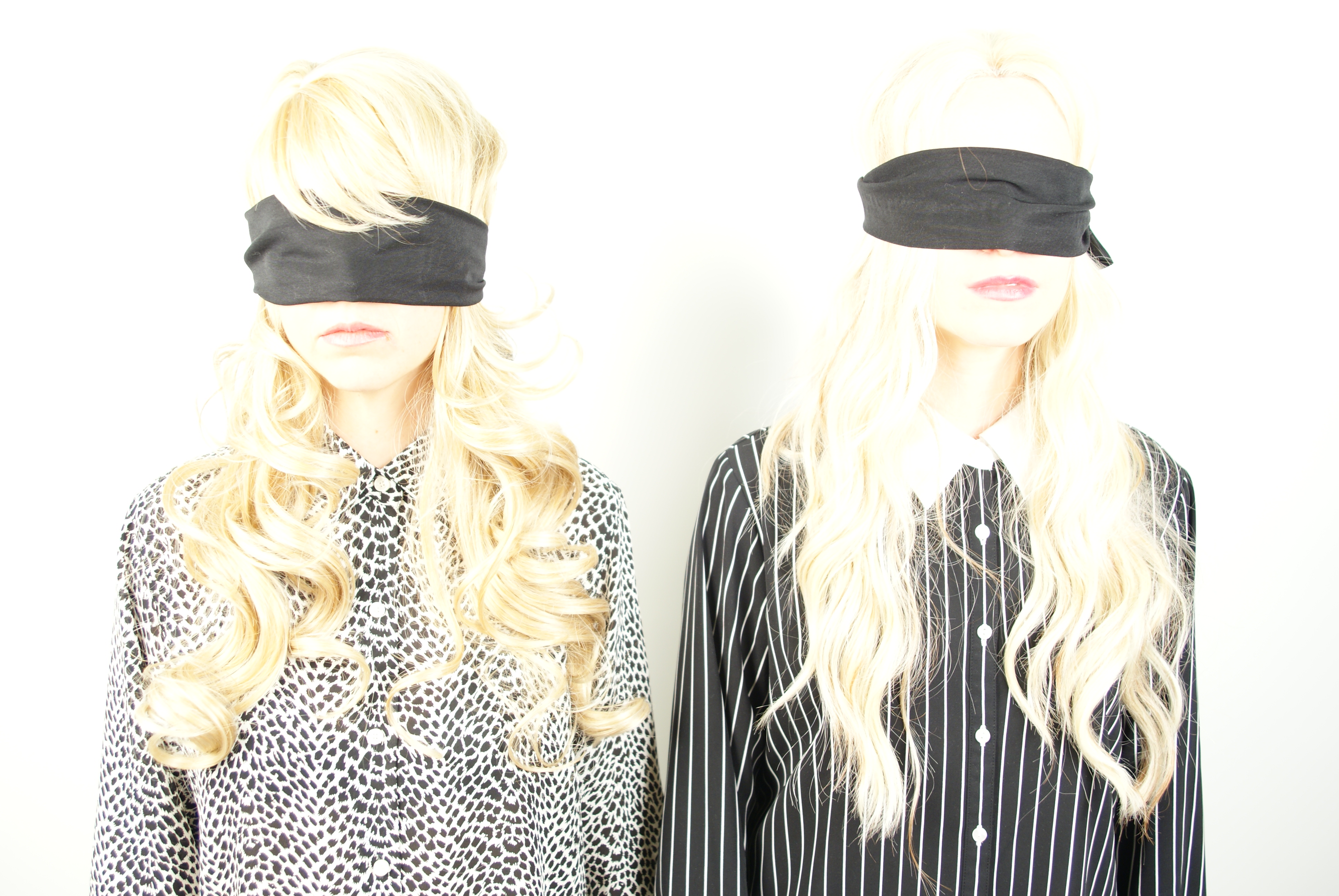
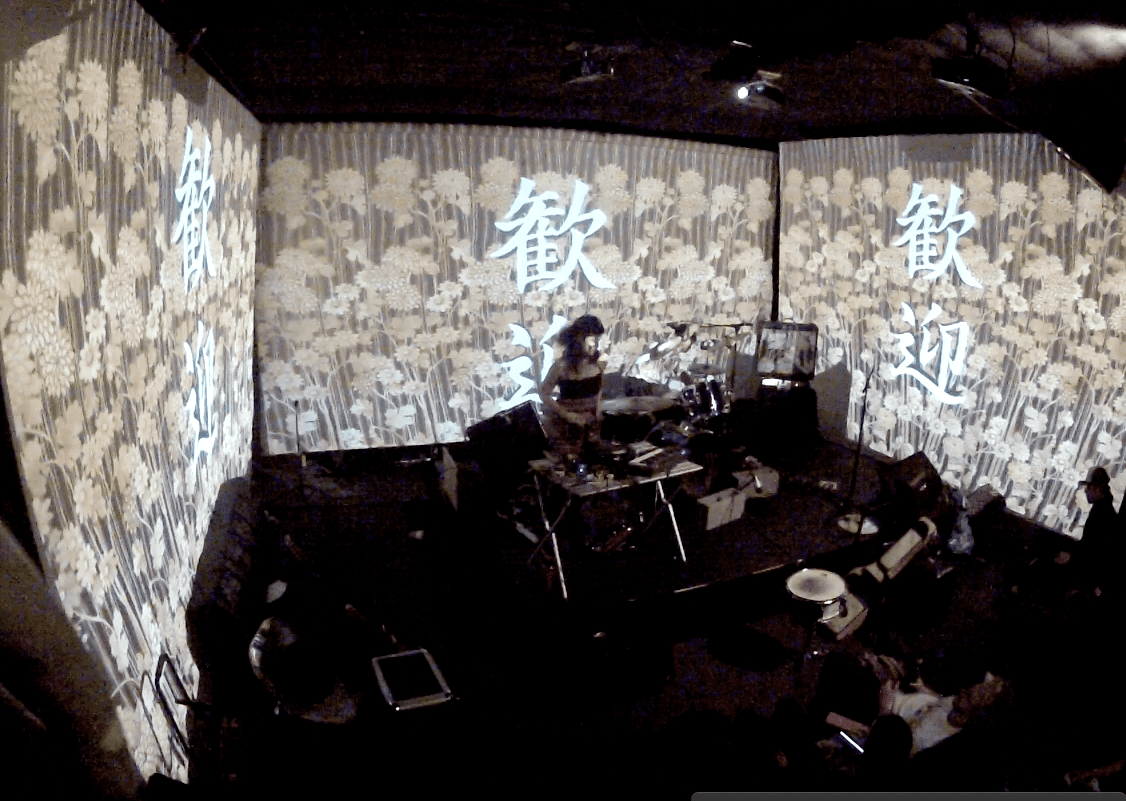
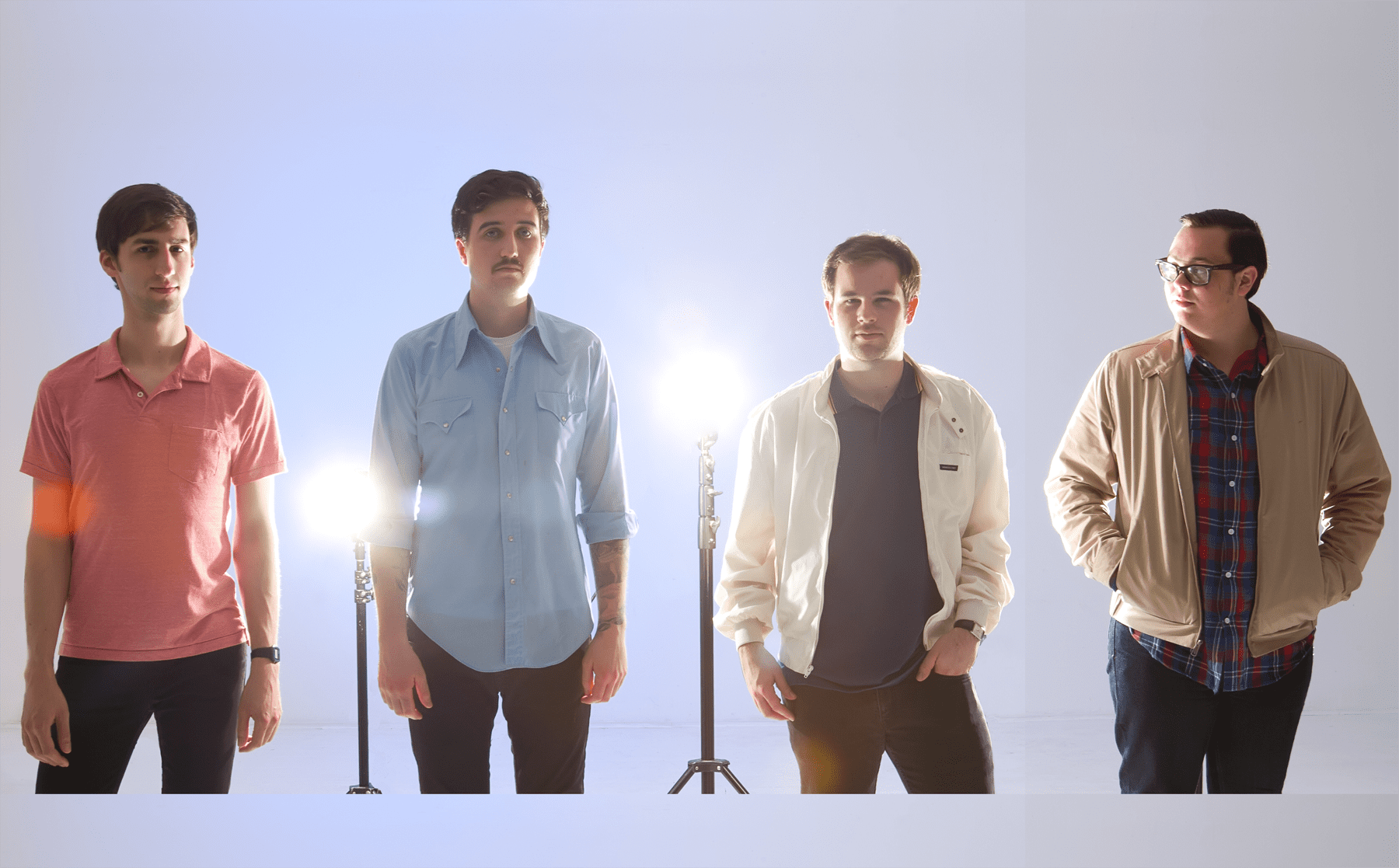
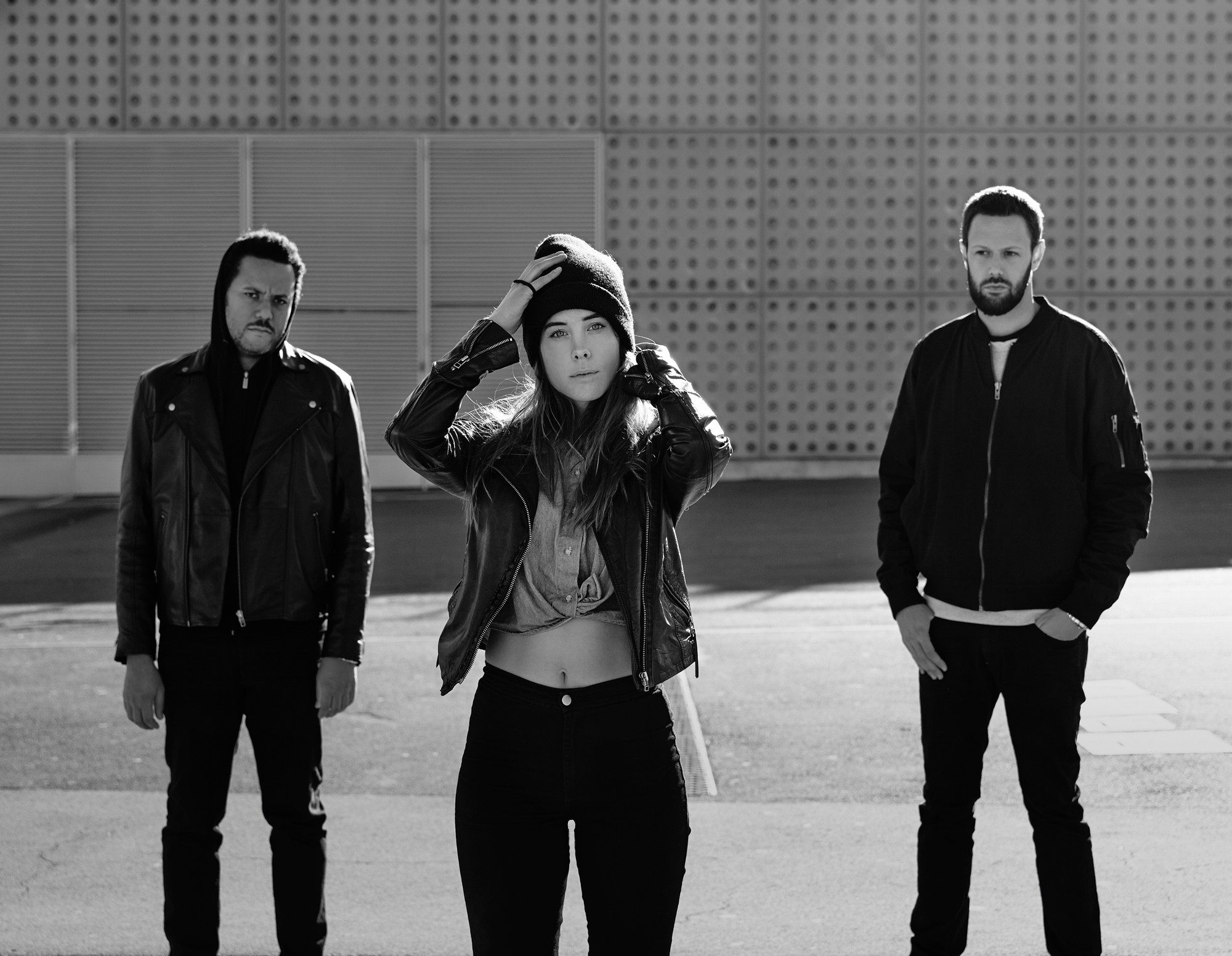
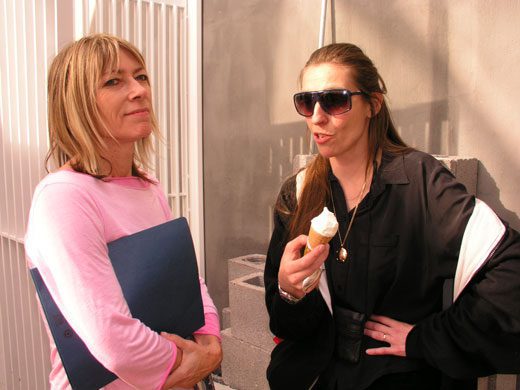
Jess Williamson found herself in a coveted grad school program for photography when she realized she had to leave. In high school and college she’d curbed her desire to create music, sticking to the sidelines as a journalist, a radio DJ or the friend and girlfriend of musicians. So two terms into her time at Parsons she dropped out, left New York, and headed back to Texas with the hope of piecing together a music career.

“In high school and college all my friends had bands, my boyfriend was in a band,” Williamson said. “I was a writer for the University of Texas newspaper so I interviewed bands, and I had a radio station so I was always finding out about new bands and playing new music on the show. But I was secretly so jealous of all those people that were playing shows—the people I was interviewing. I lacked the confidence to try because I didn’t know how to play an instrument. I was so late in the game try to start.”

Some of her earliest memories involve singing—as a small child on the playground or even at slumber parties—but her early passes at learning guitar were failures. It wasn’t until her final year in college that she saw the inimitable Ralph White play a banjo-fueled, spooky set in a friend’s basement that Williamson found a conduit for her creativity.

“I just fell in love with the banjo. I thought ‘I can do that, I can learn the banjo,’ still not really thinking I would pursue music seriously,” she said. “Just because it was a void that I wanted to feel. So that started it.”

Upon returning to Texas, Jess recorded a piecemeal set of songs in her friend’s studio. She’d written approximately five songs while living in New York, and these formed her initial EP Medicine Wheel/Death Song“The first EP felt like it was kind of just thrown together,” she admitted. “I wanted to record some things so I just recorded whatever I had. But after that, I wanted to make something that felt like a real complete document.”

Enter the deathblow to a multi-year saga of a relationship, and she was left to confront herself sans grad school or relationship. But instead of despairing, Jess welcomed the starkness. She began a campaign to face down her own rejection—to confront herself in loneliness.

“I stopped and realized that as long as I could remember I’ve always been so focused on dating. It was this huge distraction that society told me was normal. Look in teen girl magazines, it’s all about how to be attractive and what to do on dates [/fusion_builder_column][fusion_builder_column type=”1_1″ background_position=”left top” background_color=”” border_size=”” border_color=”” border_style=”solid” spacing=”yes” background_image=”” background_repeat=”no-repeat” padding=”” margin_top=”0px” margin_bottom=”0px” class=”” id=”” animation_type=”” animation_speed=”0.3″ animation_direction=”left” hide_on_mobile=”no” center_content=”no” min_height=”none”][Editor’s note: Except Rookie. We’re not biased or anything :)]. And I realized: I am not going to do this anymore. I don’t need to be in a relationship. Instead, I want to completely dive in to the feeling of being alone and of being rejected, of being lonely.”

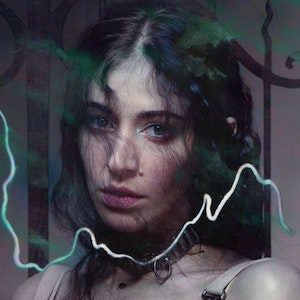
Holing up in a big Victorian house on the outskirts of Austin, Williamson’s self-seclusion led to the songs that make up her debut full-length album Native State. Although the easy assumption about the record is that it references her return to Texas, but there’s a reflective element to the close, defiant lilt of these seven songs that sprang from her solitude.

“The title Native State is a more obvious reference to Texas as my home, but it also speaks to this period of turning inward and trying to get to know myself for the first time. Doing so without all the distractions of impressing other people. It’s funny how much we don’t do that and how much no one really tells you to do that. Everyone is so externally focused.”

The songs are spare, with banjo, hints of a rhythm section and the deeper graveness of a cello, but it is the inward speculation of Williamson’s voice and lyrics that thrust Native State into a echelon that debut album rarely reach. In order to release her songs, Williamson started her own label under the alias Brutal Honest, and sent it out into the universe. It picked up brief traction on Pitchfork and she’ll embark on a short tour this spring with fellow Austin group RF Shannon, who will also serve as her backing band on the road.

“I remember a year ago wishing that I had the money to send RF Shannon into the studio myself to record something and put it out,” she said. “We’re going to do a 7-inch together after the tour too that’ll be out through a small Austin label called Punctum Records in April.”

Williamson doesn’t have much conception of what the future will hold beyond the tour, the 7-inch and the chaos that is Austin’s looming annual music festival South By Southwest (SXSW). But, despite the banjo as an entry point for her music, she is increasingly drawn to other forms of instrumentation and has been hypnotized by the basic flexibility of electric guitar. Besides, being stereotyped as a cute girl with a banjo has grown tiresome.

Sarah Millender
Sarah Millender

“Maybe they see a picture and see that I have a banjo and they think it’s this cutesy singer/songwriter thing. That isn’t my vibe at all, I don’t think the banjo is cute. I think it’s actually creepy and dark!” she explained. “The reason I got into it was when I saw Ralph White play and it was this dark haunting old thing that blew me away. I still love the banjo but I feel more inspired by the classic, genre-less aspect of playing a guitar. I’ve been playing guitar for about two years now so I’m really a beginner. But I have four songs written for the next release and they’re all on guitar. Maybe that’s a reaction of being pigeonholed as a banjo lady.”

If you’re going to listen to any girl and banjo combination this year though, you’ll be hard-pressed to find one with more bitter resonance and naked self-examination than Williamson’s Native State. There’s a spine of old Texan rebellion in this brief waif of a record. In the half hour mostly acoustic songs that she’s produced, her honeyed voice floats across the top like a hot wind, carrying debris and dust with craggy surety.

One track (and photograph collection) proclaims You Can Have Heaven on Earth. The solution: “to be happily known, happily if only known by you.” There’s no accounting for the new age clamor toward finding yourself, but Native State is the work of a woman who heard her own refrain above the din.[/fusion_builder_column][/fusion_builder_row][/fusion_builder_container]

ALBUM REVIEW: Angel Olsen “Burn Your Fire For No Witness”

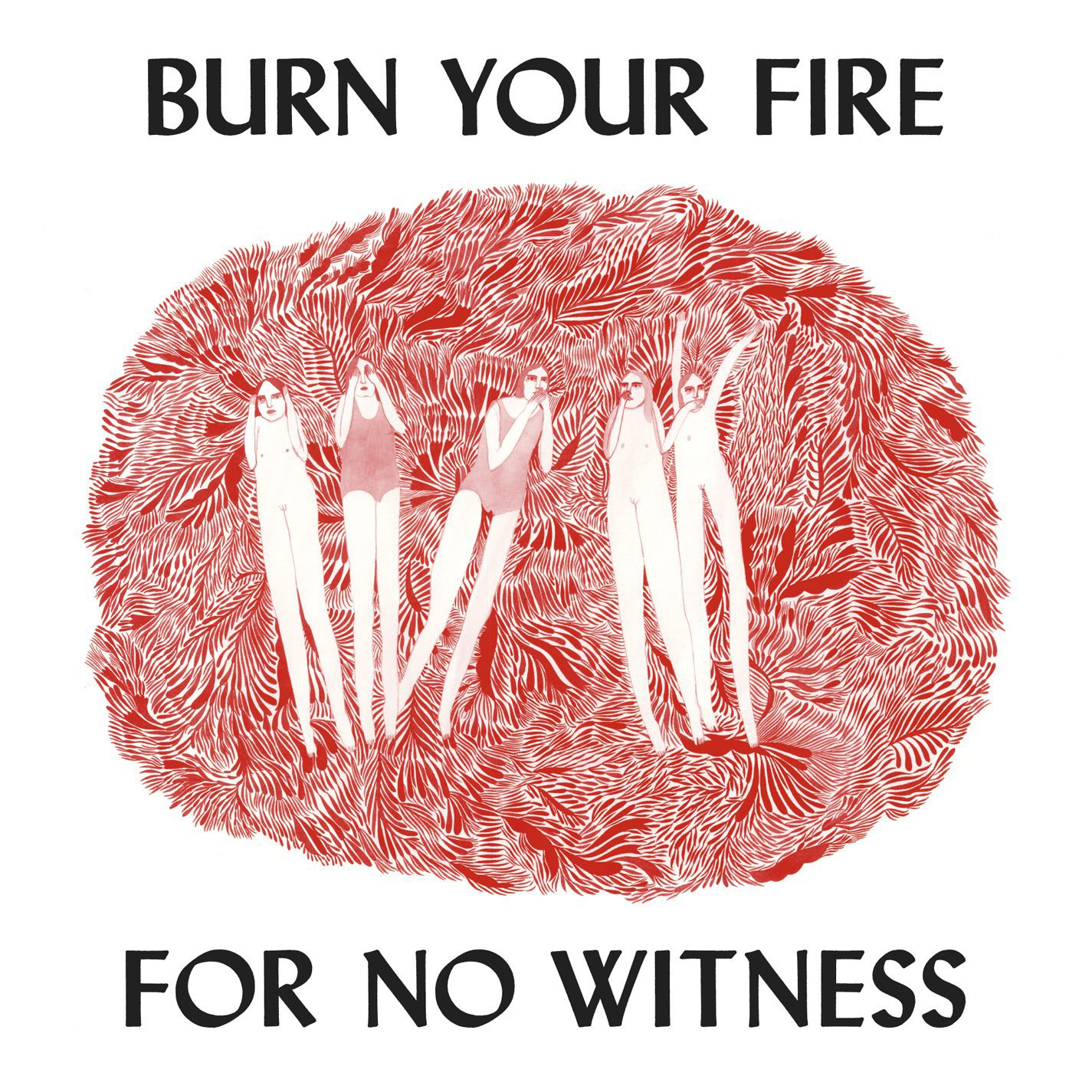
Burn Your Fire Album

She’s the one with the haunting warble, sometimes menacing or self-deprecating, but always a bit fragile and always a bit bold. Angel Olsen is a singer-songwriter with a unique talent for forging emotional connections with her listeners—that is, the ability to make any member of her audience freeze, cry, or reach deep into some hollow part of themselves. For her newest album, Burn Your Fire For No Witness, her unwavering self-possession is strong as ever, stretched across more present instrumentation and, of course, her gorgeous crooning.

The album is sensitive, soft, subtle, occasionally sweet, and all together that complexity makes it very human. Her uncertainty about what it means to be lonely, about what she truly feels, is what makes these songs so engaging. This ambiguity makes it easy for the listener to enter that space and recall their own inexplicable melancholy. Her voice is difficult to describe, a bit like folk singer Karen Dalton or Emmylou Harris; shaky, but clear.

Burn Your Fire For No Witness begins with “Unfuck the World.” For such a powerful title, this song is incredibly soft. There’s an immediate sense of interiority, a passiveness: “Here’s to thinking that this all meant so much more / I kept my mouth shut and opened up the door.” But her voice soars in the chorus with a lo-fi melancholy that is just heartbreaking: “I am the only one now / You may not be around,” she repeats and repeats like a mantra, a tiny peek into her aloneness. Normally, break-up songs can get a bit irritating, especially when they harp on a lover’s absence. This song is all personal reflection, rather than a reflection on the other person or even the relationship itself.

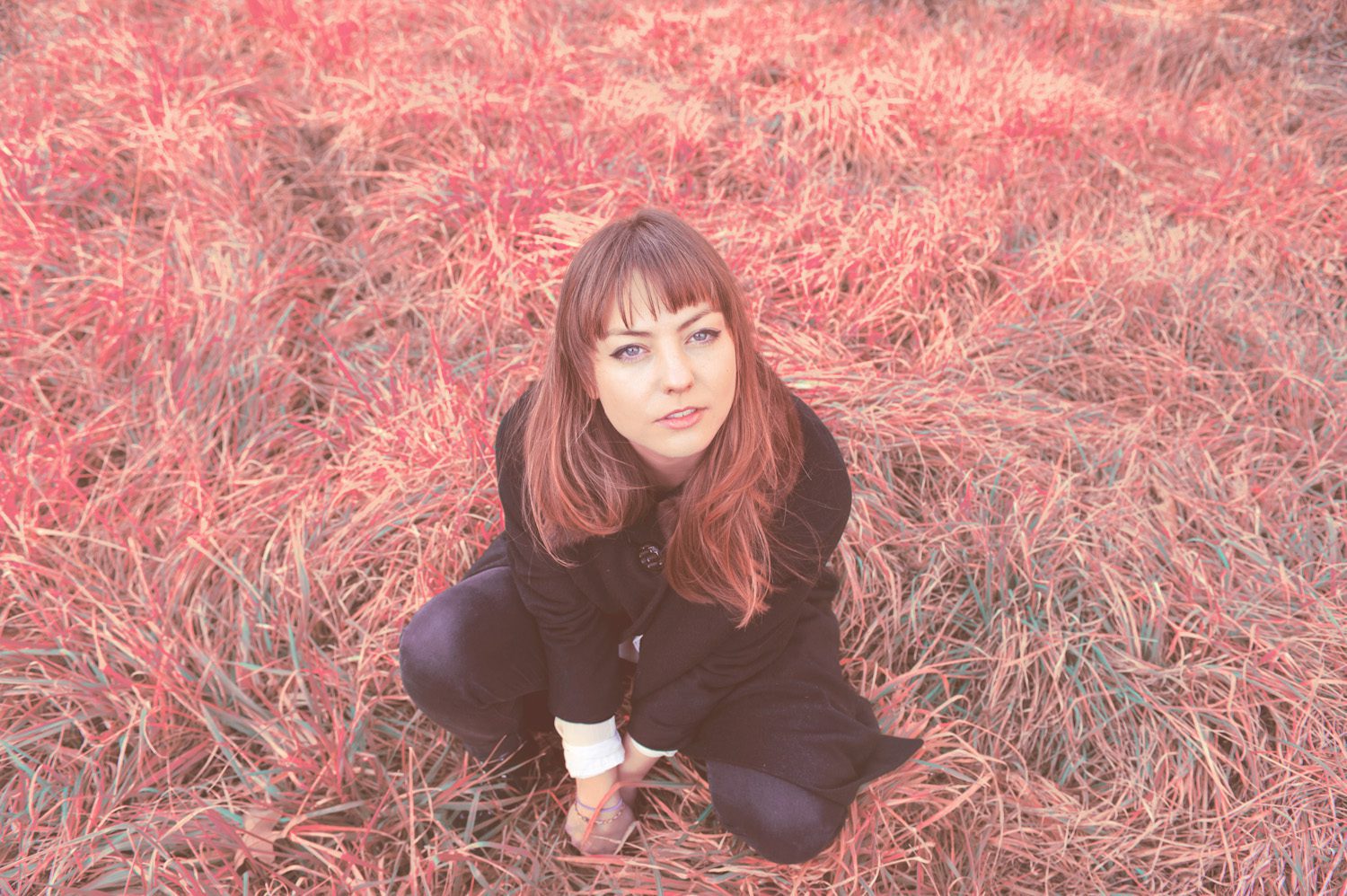
Angel Olsen

In “White Fire,” the track the album is named for, her vocals sound almost dead. The song itself is immediately sad, and there are waves of guitar strumming that paint a dark atmosphere. She tells us herself: “Everything is tragic / It all just falls apart.” From here, we move into an uncomfortably empty mind. Even when she’s singing about anger or bitterness, she’s nearly flat, but it conveys as much as if she’d been shaky or close to tears. In fact, it’s more effective than singing with movement, at least for this song, which describes Olsen’s feelings of disillusionment. You’re only “fierce and light and young,” she tells us, “When you don’t know that you’re wrong / or just how wrong you are.” This may be my favorite track.

Olsen plays up the guitar and drums in “Forgiven/Forgotten” and “High & Wild.” Both songs are forcefully catchy in an unexpected way. “Forgiven/Forgotten” has heavy drums and bass and the words drive you through with repetition. Her voice is bolder and far more scornful in “High & Wild” with its grungy riffs. It’s not as sad as most of the other songs, and there’s a powerful melody that recalls ’60s femme rock. It comes close to being somber, but then she sarcastically sings: “Well, this would all be so much easier / if I had nothing to say.”

“Hi-five” is another song that positions itself outside of the sorrowful, instead tip-toeing on the edge before diving into bitterness. The simple guitar chords and drums go well with the blues-y, old country lyrics: “I feel so lonesome I could cry.” Olsen’s definitely warbling here, reflecting the movement in the instrumentation. There’s such sudden raw emotion when she shouts “someone who believes” that the entire tone of the song turns around. “Are you lonely, too?” she asks. “So am I,” she says after calling for a hi-five. But then, in a completely delicious twist at the very end she reveals herself: “I’m stuck too / I’m stuck with you.”

The whole album is narrative and extremely emotional, with Olsen occasionally throwing in an endearing word like “darlin.'” There’s also a great deal of experimentation here—songs are different in tone, in rhythm, but they all run smoothly from one to the next. If you’re okay with your own feelings lurching out, and maybe shedding a tear or two that you didn’t know was lurking inside, then give this album a good, long listen.

Check out “White Fire” from Burn Your Fire For No Witness:

VIDEO REVIEW: Chet Faker “Talk is Cheap”

Screen Shot 2014-02-12 at 2.49.28 PM

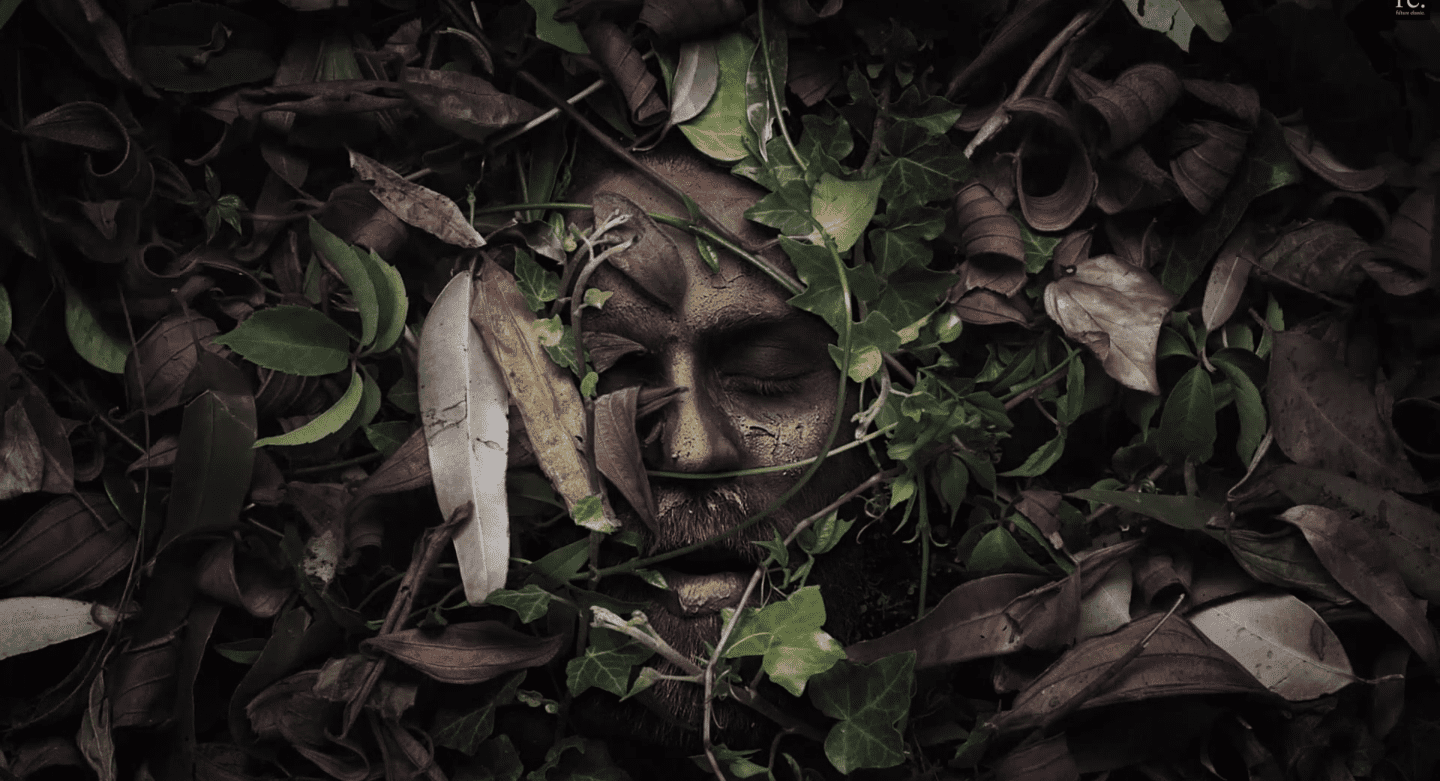
Chet Faker has already made a name for himself with his smooth, soulful voice, particularly through his work with Flume. Built On Glass, his upcoming debut full-length (due out April 15th via Downtown Records/Future Classic), will put the spotlight on his strengths as a solo artist following a string of successful collaborations. In the album’s first single, “Talk is Cheap,” Faker croons over a smooth saxophone and velvety R&B beat, “I wanna make you move with confidence, I wanna be with you alone.” The accompanying video is a gorgeously crisp stop-motion that takes us through the four seasons, with a closeup of Faker’s visage front and center. We watch as he goes from lifeless, frozen figure under the winter snow, to animated and bare-faced as spring arrives, and then again inanimate and decomposing as he’s overtaken by lush greenery, fallen leaves, and eventually snow again.

Watch the video below:

LIVE REVIEW: The Murder City Devils @ Webster Hall

The Murder City Devils Logo by Nate Manny

The thing about going to shows alone is you have to be resourceful and easily entertained.  The thing about going to a show alone, and smart-phone-less in New York is you have to do all of the above while looking like a leper.  The 7-dollar Budweiser that once was a foe has now become your liquid companion, and you sip it as slowly as possible to keep your hands occupied before the band goes on.  God knows you can’t just slip out a notebook and jot a few things down.  So instead you master the facial expression that says: “No, truly, I am just fine here drinking my shitty beer, without the sweet escape of Instagram.  I promise.”

So there I was again, stag at Webster Hall, rationing my alcohol for the evening, when a familiar sound jostled me out of my masturbatory introspection.  It was Cincinnati three-piece Tweens.  Their sound vibrated with nostalgic, snotty punk riffs that touched on The Buzzcocks and early Donnas.  They were incredibly energetic, and most importantly, loud.  Sometimes it’s nice to be reminded that three people with a bass, guitar, and drum kit can kick up so much noise.  Lead guitarist/vocalist Bridget Battle provides a hefty supply of the band’s energy with her steady playing and impressively shrill screaming that punctuates her bratty shouts.  The band considers themselves Trash Pop, but their punk influences are more than apparent.

I finished my beer just as they wrapped up their set, and I wouldn’t be getting another.  This is because the second The Murder City Devils crawled out from backstage all liquid would become airborne shortly thereafter.  I knew to reposition myself to the outermost periphery of the floor so as not to be swept into a perspiring vortex of limbs.  As the crowed waited for the setup to be complete, the floor grew more cramped and agitated.  Like being within a ball of tense potential energy, I planted my feet far from on another in preparation for when it burst.  And sure enough, at one glimpse of lead vocalist Spencer Moody’s ginger beard, the room went manic.

The set opened with pleasers like “Rum and Whiskey” and “Idle Hands.”  There wasn’t much banter on the band’s part, but the MCD fan base is so fanatic that it wasn’t necessary: the crowd missed not one lyric.  Everyone was in such ecstatic spirits that I began to wish I hadn’t stopped at one beer.  I could be anywhere between mildly tipsy to drunk, hurling myself around recklessly like the good old days.  But when you have to write about something later, sobriety is rewarding, if only for a handful of humorous observations the drunken gaze would have passed over.

I would have never noticed the girl in the Godfather t-shirt, who certainly goes to Burning Man, undulating through and on top of the crowd.  The buff and shirtless man with Calvin Klein underwear would have been more difficult to avoid.  And, the man who stage dove right over me would have probably crushed my neck had I not employed an intuitive ducking reflex.

This isn’t to say I was too distracted to enjoy MCD.  They put on a great show every time I see them.  Their live sound is on par with, if not better than their recordings.  They play tightly as a band of 18 years should, and are gracious and aware of their loyal fan-base.  I must admit that part of what excited me so much about seeing them again was their Seattle origin.  Hearing Moody sing about Bellevue Square is both humorous and comforting for a Washingtonian like myself, and when you’re at a show solo, that’s a hell of a lot more comfort than a $7 Bud can offer.


VIDEO REVIEW: Casket Girls, “Chemical Dizzy”

Casket Girls Audiofemme

“There’s nothing more dangerous than a wounded heart.”

Indeed. We’ve all been there. This new video from Casket Girls, whose album True Love Kills The Fairy Tale came out today on Graveface Records, visually encapsulates the sensation of heartbreak-induced vertigo. Although the narrative arc is unclear–who the protagonist is, exactly, and what strange journey they’re traversing–the intention is obvious: ominous imagery of cityscapes, secret stairwells and cloudy skies much of which captured with a hand held camera elicit the distinct emotional response of…well…chemical dizzy if you will.

Check out the video here via Youtube:

INTERVIEW: Bearstronaut on the 2013 BMAs, synth-pop, and their influences

bearstronautBoston “tank-top pop” band Bearstronaut is taking the New England dance scene by force. Known for their active, beach party-like performances, they’ve performed at the Boston Calling Music Festival and recently won electronic artist of the year at the Boston Music Awards (2013). They’ve described themselves at “part new-wave, part britpop, part electro, part r&b, but for the most part synth pop”. We asked guitarist David Martineau, keyboardist Paul Lamontagne, and bassist Nate Marsden a few questions about what it’s like to be a break out pop group.

AF: Some of the songs on Paradice are great party anthems – “A Better Hand” and “Moniker”, for example. Others, such as “Birds of Prey”, are more like love songs. Can you tell me a bit about the story or context behind the EP?

Paul – Our idea of “Paradice” was a great way for us to make these very bright and extravagant productions while leaving a tinge of darkness around the edge with a lot of the themes in the lyrics. I liked thinking of Paradice as the place you want to escape to, but when you’re still have to deal with all the same complicated life stuff as before. Kind of a “careful-what-you-wish-for” scenario.

Dave- We had some ideas for songs that we needed to reign in a bit in order to fit the concept we had for “Paradice.” We like the songs to have a contrast between the music and lyrics. Where either the song is bright and happy sounding but the lyrics deal with a darker concept, or vice versa. So “A Better Hand” is a dancier track, but the lyrics are about someone’s last days on death row.

Nate-  I tried to reflect the themes of the EP in the album art. We got the opportunity to use a photo taken by our friend, Emily Knudsen, from her recent trip to Peru. It’s an amazing photo of this beautiful desert scene at night, but there’s also this ominous looking shack in the foreground that draws you in. Her photos have this incredible juxtaposition of being beautiful but also sad, or dangerous at the same time and I think that works perfectly with our music.

AF: How about the musical inspiration? Do you all collaborate when writing?

Paul – It’s a collaborative thing. We have worked out  our individual roles a little bit so we each bring something new to a project. A lot of times we’ll work out sketches and demos of musical ideas and they get chewed around and mangled and shaped to support the context of what we’re trying to pull off. Designing the song idea is a pretty collaborative process.

Dave- I do my best to come up with a lyrical concept or story to apply to a demo or idea. Then present it to them in context I think is a good start. But they’re awesome at pointing me in a strong direction and helping me steer the focus of whatever I’m working on lyrically/melodically.

Nate- Living together definitely makes it easier to write. I love when someone knocks on my door and goes ‘Dude, you have to hear what I just did’ then a few hours later, we have the basis of a song.

AF: You self-released your first EP in 2009. How do you feel you’ve grown as a band since then?

Paul – Speaking for myself, I definitely felt like a novice putting that EP together. I learned a hell of a lot about making a record and what it takes to build a song. Songwriting has remained very challenging, mostly because I feel like we have no other option but to top ourselves. I barely knew anything about synths, samplers, production when we started, but the nature of those instruments is very exploratory. As we began to get creative with song ideas, it kind of unlocked new ideas from the instruments. It was very exciting to start from square one and have production skills and keyboard techniques come as a result of learning how to write songs.

Dave- That record was incredibly necessary for us as a group. We learned a lot about writing as a group and how to push ourselves creatively. At the same time, we figured out how to step back and listen critically at what we were doing as a whole. Now, we are trying to make themes more prevalent between songs and what will be on our album. The first ep will always sound like songs by 8 different bands in a way, but I think work ethic was what we took away from that experience the most. Nowadays, we’ve all gotten pretty good at being each other’s critics and knowing how to take that criticism as encouragement to keep working.

AF: The kind of music you write is made for dancing. I’ve heard and read great things about your live performances. Do you do anything special on stage to engage the audience?

Nate-  I just always try to look like I am having fun, no matter what. If it doesn’t look like we’re having a good time and dancing, how can we expect the audience to do the same? That’s my philosophy.

Paul – My hands are always stuck on a keyboard the whole show. I’m not exactly running around the stage but I do my bit.

Dave- We try to give our audience a bit more than just playing the album live. With “Paradice,” we added some auxiliary percussion to our live set up in order provide a more engaging aesthetic. We streamlined some transitions between songs in order to keep the momentum up. As a front man, I do my best to try and make people feel comfortable with breaking out a bit at our shows. You have to walk the line between being annoying and encouraging. So I make an effort to try some new moves on stage to show them I’m ok with letting my guard down in front of them.

AF: What was it like to be nominated (and awarded) in a couple of categories at the 2013 Boston Music Awards?

Nate-  Being nominated is a great feeling. It’s a weird sort of verification for everything we’ve done in the last year. Once I found out we were up for a few awards, I immediately reflected back to figure out why we were nominated and it reminded me of some crazy milestones we reached as a band in 2013. It’s nice to see that other people take notice of the hard work we’ve put in as a band. As far as winning Best Electronic Act, that’s kind of mind-blowing. With crews like Zone Def, HNDMD, and M|O|D all in Boston, we are like nerdy kids in gym class. Overall, it was a crazy night. We got to see some of our best friends win awards, and we got drunk while wearing ties, which is what it’s really all about.

Paul – It was a great night and I got to see so many friends there. It does feel great to win an award but I felt very proud to be among a lot of people I respect. We won an award for Best Electronic Act and for that category in particular, there’s a lot of amazingly talented electronic artists in the area who are so fluent and skilled with electronic production that it does feel like we are a bit of mis-representation haha. We’ve got drums, bass, and guitars just like every other band. Shout out to Tone Ra, Soul Clap, GMGN, Tide Eye, Tanner Ross, Andre Obin,

Dave- It is such an honor to be a part of the BMA’s. We had such a good time partying with everyone that night, basically to celebrate everyone’s hard work from the past year. My favorite part was definitely playing our set right after we won. We were all so excited to play at that point, it was one of my favorite sets of ours this past year.

AF: How did your friends and folks at home react to the Awards?

Nate- I think since we are all so close to our families and friends, it felt like they won as well. At least I hope that’s how it felt, since we truly couldn’t have won without them.

Dave- Our friends and family are incredibly supportive; always have been. They knew how much it meant to us to win this year. It felt great to bring something home this time to show them the fruits of our labor in a way.

AF: Many reviews mention a “human” quality to your work. People have called it “grounding humanity” and, more simply, “honesty”. What part of your music lends this quality?

Paul – That’s the trick, making music the way we do, it is very easy to get carried away. There’s always got to be a way to connect with people. We always try and tether our songs with that human element. I heard someone talking about the Strokes and how they always tried to make their guitars sound like computers played them. I sort of want to do the opposite, make computers feel like humans are telling them what to do and making mistakes. At the end of the day though, it’s all about trying to express something that feels real, even in the unnatural environment we put it in.

Dave-  When it comes to lyrics or stories, I try to create a balance between vivid imagery with accessible hooks. Some songs take longer to get there than others. But we want the hooks to be accessible, and for our audience to want to hear them again.

Nate- A lot of the human element also comes from our live show. Since we are all actually playing instruments, we tend to make mistakes. We’re not just standing up there pretending to be doing stuff.

AF: What are your favorite synth-pop bands, from the 80s and today?

Nate- Bow Wow Wow and that song ‘Electric Avenue’ by Eddie Grant

Paul – The Tough Alliance, Talk Talk, Delorean, Blancmange, Hot Natured, Saint Etienne

Dave- From the 80s: ABC, Human League, Duran Duran. From today: Hot Chip, Cut Copy, Polica, Painted Palms

AF: How many of them are influences?

Nate- 6, to be exact

Paul – I’m generally more interested in the songwriting and how clever they are at using their instruments to capture a feeling. Synth-pop bands are lucky to not have to exist in an actual environment. What I mean is, they can be as stark or lavish as they want and be as personal or as larger than life as they want. That’s a pretty attractive advantage.

Dave- All of them for sure. It’s really interesting to see how many of them cross paths or borrow from each other. When we analyze influences, we like dissect what parts we like and dislike to see what we want to draw from.

AF: Do you come down to New York often for live performances? How do you like it here?

Paul – I never know what to expect out of New York. We played Glasslands a couple weeks ago with the Hood Internet and Pictureplane and it was incredible. I loved it.

Dave- Yeah, we’ve definitely had a tough go of it in NYC. But the Converse show we did at Glasslands gave me some new found hope.

AF: What’s your favorite thing about Boston? What’s the best thing about Massachusetts?

Nate- Mo Vaughan and clam chowder.

Paul – The Greek Corner on Mass Ave. in Cambridge

Dave- The ability to escape the city fairly easy. All of our families are in CT, so it is nice to have home close by.

AF: It’s been freezing down here these past few weeks. It must be even worse up in Massachusetts. If you could live in one season forever what would it be?

Nate- Definitely Spring right before it becomes summer. We New Englanders work hard for that nice weather.

Paul – That first week in October is the sweet spot.

Dave- I’m all about the beginning of spring. Let me put on some shorts and bust these gams out already, please.

Check out Bearstronaut’s “Passenger Side”, off of their new Paradice EP:

VIDEO OF THE WEEK: NONONO’s “Pumpin Blood”

NONONO

The Swedish have always had a knack for pop, particularly of the electronic-dance variety.  There was of course ABBA, who pioneered the genre in the early ‘70s with the help of the synthesizer.  We all remember Ace Of Base, and if we don’t, our older sisters certainly do.  Of course Robyn and Lykke Li have been latest and most irresistible members of the Swede-pop invasion.  Recently we’ve been fed yet another confection from the land of dance: electro-pop trio NONONO.

NONONO consists of lead vocalist Stina Wappling along with producers Astma and Rockwell.  Wappling has an interesting history behind her.  Though she’s been writing songs her whole life, she studied to be a psychologist and spent time working at a mental institution.  If that’s not writing material, I don’t know what is.  It surely makes some sense of the emotive video accompanying the group’s big hit “Pumpin Blood,” the title track of their four song EP.

The video is full of cold tones and washed-out shots that bring to mind a bleak summer.  A couple violently disputes among broken ceramic mugs, deciding who will take care of their pet rabbit.  The verse is mellow and peppered with the high-pitched whistling that has made frequent appearances in folk-pop as of late.  The chorus jumps into optimistic, visceral dance pop, and the setting alters to the same mode.  The shots rangee from a man getting thistles caught in his winter sweater to a dark and smoking beachscape with strobe lights and Wappling dancing vivaciously.

By the its end, our bunny-toting protagonist has surrendered himself to the only form of catharsis appropriate for such a song: shameless public dancing.  I suspect fans of NONONO will partake in the same therapy while the group is on their upcoming U.S. tour.

See tour dates and the video for “Pumpin Blood” below.

04/03     Bijou Theatre – Knoxville, TN
04/04     Bellarmine University – Louisville, KY
04/05     University of Cincinnati – Cincinnati, OH
04/08     Cat’s Cradle – Carrboro, NC
04/10     The Tabernacle – Atlanta, GA
04/13     Bourbon Theatre – Lincoln, NE
04/14     The Blue Note – Columbia, MO
04/16     Majestic Theatre – Madison, WI
04/17     Skyway Theatre – Minneapolis, MN
04/18     Riviera Theatre – Chicago, IL
04/19     Egyptian Room at Old National Centre – Indianapolis, IN
04/21     The Opera House – Toronto, ON
04/22     Town Ballroom – Buffalo, NY
04/24     House of Blues – Boston, MA
04/26     Springfield College – Springfield, MA
04/27     The Dome at The Oakdale Theatre – Wallingford, CT
04/29     The Paramount – Huntington, NY
04/30     Starland Ballroom – Sayreville, NJ
05/06     Marquee Theatre – Tempe, AZ
05/07     Brooklyn Bowl – Las Vegas, NV
05/09     The Wiltern – Los Angeles, CA
05/10     The Fox Theater – Oakland, CA
05/11     Ace of Spades – Sacramento, CA
05/13     Knitting Factory – Reno, NV
05/15     In the Venue – Salt Lake City, UT
05/16     Ogden Theatre – Denver, CO


TRACK OF THE WEEK: Neneh Cherry & Robyn “Out Of The Black”

Neneh Cherry

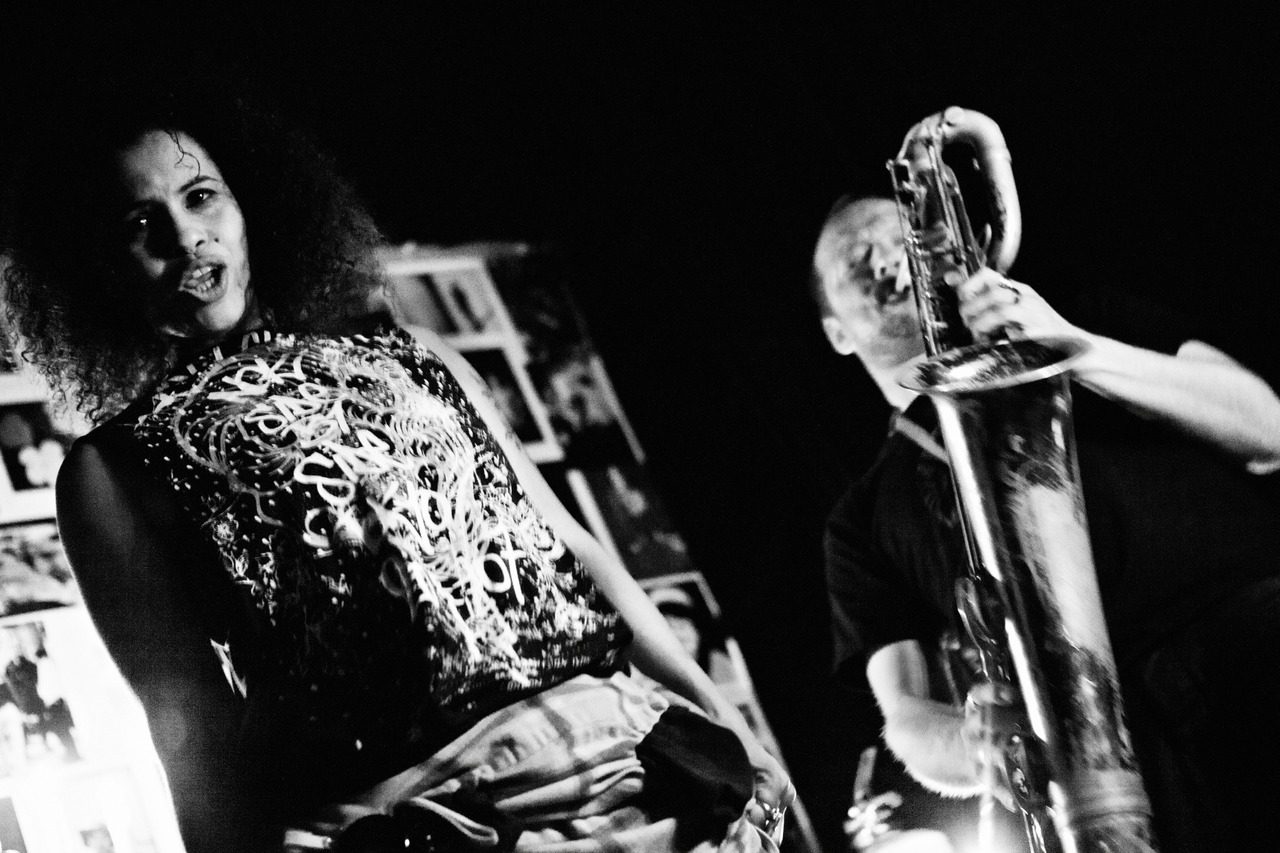
Swedish singer-songwriter, rapper, and all around renouncer of musical restrictions Neneh Cherry has returned with her first solo album in 18 years, Blank Project, due to be released on February. She is joined by fellow Swede and pop star Robyn on the song “Out Of The Black”- a beautifully produced, minimal piece that combines their voices into a declaration of self.

“Out Of The Black” begins with a breakbeat, recalling Cherry’s many dalliances with trip hop. Minimal synth and bass pick up, altogether forming simple, easy instrumentation. The music glides over you, pulls you along, but not forcefully. We hear Cherry’s strong, personal, and critical vocals first: “Just trying to mind my business // I see the wolf packs congregating on the corners”. It’s easy to recognize her acuity and wisdom in these lines. She doesn’t want to involve herself in what she observes, but by observing she’s forced to, anyway. Robyn comes in with the chorus and the song changes. There’s something dissonant about their voices together. It doesn’t sound right at first. But by the end of it you realize it’s actually completely brilliant.

Cherry and Robyn have different vocal stylings, not necessarily regarding disparate ranges, but certainly in terms of tone. Robyn is a pop singer: bold, sweet, feminine. Cherry is subversive, even in her singing, and more breathy than Robyn, even fragile-sounding. Robyn’s voice complements the electronic elements with its clarity and her enunciation. Cherry takes it out of the electronic and into the personal. I’m vaguely reminded of Dirty Projectors’ harping. If this song was all Robyn it would be unusually calm for her. If this song did not feature Robyn it would be an unusually mellow Neneh Cherry song. But the two of them together hold it in a space that’s entirely new.

Robyn

“Behind our backs”, “Face the pack”, they sing.  The bass follows these lines of thought with an evident, electronic pulse, but not one that is overwhelming or obnoxious. Though music is well composed, it seems almost secondary to the vocals. Robyn and Cherry are making statement of self: affirmations, declarations as successful, experienced women. “I’m Robyn on the microphone into the speaker”, she sings and it’s catchy and it’s true. She is Robyn with a capital R. She and Cherry come together with confidence as the song goes on. While the chorus begins: “Out of the black/ Out of the blue / I just want you / To want it to”, by the end of the song it has changed to: ‘“There are the facts / This is the news: / We just want you / To want it, too”. A melancholy conclusion, perhaps, but a sweet comedown nonetheless.

Pick up Neneh Cherry’s new album on February 25th and if you’re in Europe look out for her tour:


ALBUM REVIEW + ARTIST PROFILE: New Bums

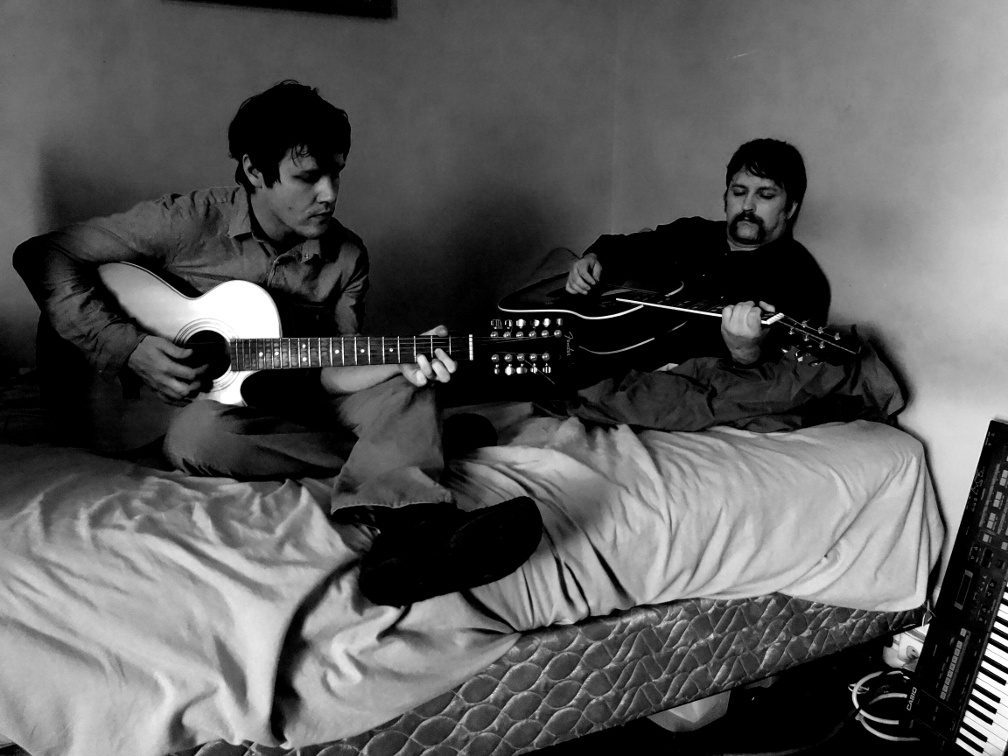
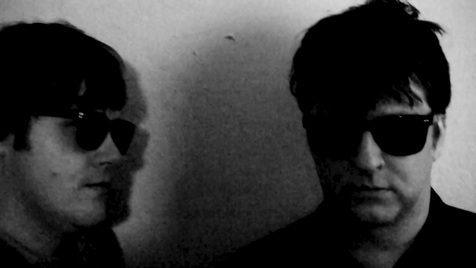
Although Ben Chasny and Donovan Quinn’s initial dislike for each other when they met, a few years ago, was personal–not musical–it’s tempting to talk about, because their work together now is so dependent on their bond. They always liked each other’s music (Quinn released albums with Skygreen Leopards, Chasny with Six Organs of Admittance, Rangda, and Comets on fire, to name a few). When the pair formed New Bums, they entered into a collaboration that uniquely fused each member’s skill set into a partnership that couldn’t be broken in half. On their debut album together, Voices in a Rented Room, the group wears its intent on its sleeve: Quinn’s trademark folky lyric imagery seems to be emitting simultaneously and from the same point of origin as Chasny’s delicate instrumental ramblings.

The low-lit, husky vocals of the first song on Voices, “Black Bough,” immediately conjures a backdrop of moodiness and melancholy, and that aura stays strong throughout the album’s twelve tracks. Acoustic guitar-based melodies, bearing tight-knit likenesses to their lyrical counterparts, emerge over this backdrop, waxing and waning as the songs wear on. It’s dark, sparsely-laid stuff, with lots of chilly backup oohs and ahhs, that also brings some catchy phrasings–like the ones on “The Killers and Me”–that have kind of an old-time cowpoke feel. “The longest train I ever saw..” one line begins on “Town on the Water,” in un-showy evocation of the traditional–and great–“In The Pines.” In other spots, too, New Bums tip a quiet salute to Old, Weird America with ragged vocals and guitars that trill like mandolins. The band side-steps a direct descendant-ness from American folk, though, with switched-up rhythmic weight and a modern approach to lyrical metaphor. Though the music emerges from a couple different songwriting traditions, New Bums’ tracks are too interior, and too personally crafted, to really resemble anything but themselves. The influences are visible, but none will smack you over the head.

Separately, Chasny and Quinn have been associated with the new folk and acoustic-leaning psychedelic schools of music-making. This project’s most apparent deviation from their other lives as musicians is how dialed down the impulse to push into new, extreme turf feels on Voices. The music demands attention the way a whisper makes you quiet down to hear it. “I don’t know if anyone will notice it or care about it, but I like it because it’s sweet,” Quinn told AudioFemme last week, explaining “Town on the Water” is one of his favorite tracks off the new album. A lot of the songs on Voices, sweet or not, are like that, quiet enough to slip by unnoticed. Whether sighing like a woodsier, and slightly less devastated, Elliott Smith on “Mother’s Favorite Hated Son” or tracing the feathery, high-register melodies of “Black Bough,” Quinn and Chasny’s vocals yield more the more–and the closer–you listen to them. If you like your folk low and slow, your guitars sweet and your lyrics bleak, try Voices in a Rented Room on for size. The album’s out February 18th on Drag City. Check out the music video for “The Killers and Me” below:

Last week, I called up New Bums to talk about the recording of Voices and get some insight into their collaboration process. Turns out, there’s a mystery man named Willem Jones behind the duo, and he started it all–even directing the video you see above. The story of their initial dislike for each other became even funnier when, since the two band members were in different parts of California and I kept losing one or the other’s line when I tried to put them on conference call, they started ragging on each other like Jewish mothers. “I don’t think he has service,” Quinn said first. “Let me give you another number. Once Chasny was on the phone, Quinn dropped out. “He has a land line,” Chasny insisted. “Ask him why he isn’t using his landline.” The pair had clearly overcome their differences, and then some. Read on to discover how New Bums write their songs, where they got their name, and which of them is secretly a malevolent space alien just biding his time before pursuing world domination.


AF: We’ve heard your band is a “grudging match-up.” How did you guys meet?

Donovan Quinn: We had a mutual friend named Willem Jones and he brought us together. At first we didn’t get along for various reasons, but over time we started talking about music and different writers and found that we had a lot in common, but there are also a lot of differences to our approach. I’ve always been a fan of Ben’s music. I just jumped at the opportunity to work with him.

Ben Chasny: We had crossed paths at festivals before we started hanging out with Willem, and I think [fusion_builder_container hundred_percent=”yes” overflow=”visible”][fusion_builder_row][fusion_builder_column type=”1_1″ background_position=”left top” background_color=”” border_size=”” border_color=”” border_style=”solid” spacing=”yes” background_image=”” background_repeat=”no-repeat” padding=”” margin_top=”0px” margin_bottom=”0px” class=”” id=”” animation_type=”” animation_speed=”0.3″ animation_direction=”left” hide_on_mobile=”no” center_content=”no” min_height=”none”][Quinn] had a dislike for me from then. Apparently we had already met once, and then I ran into him while I was at Amoeba Records shopping, and he tells me that he came up to me and I didn’t recognize him. So he got offended and wrote me off forever.

AF: So you just got off on the wrong foot? Your differences were always personal, not musical?

DQ: Yeah, I think Ben is easily one of the best guitar players in the world. He’s a shredder. But he’s also a great songwriter, and songwriting has always been my main interest. We tried to make that the focal point of the group—as opposed to the other projects we’ve each been a part of—so we always try to start a song by having the lyrics and melody together, and then work from that.

AF: You guys are both veterans, you’ve each been involved in a bunch of different collaborations.

DQ: Yeah, we’re old. We’ve both been around for a long time and have done a lot of music. When we got together and decided we wanted to start New Bums, we really wanted to come up with an idea and an aesthetic that we hadn’t done before, that would be its own thing. We do benefit from having done different albums, been involved with different bands, but it was important to make sure we were doing something new with this project.

BC: An interesting thing I’ve noticed throughout the years, is when two people get together to collaborate, they kind of always want to do what the other person is doing. So if you have some guy—not me, but if I take this out of my perspective—who was doing a lot of heavy metal, and he got together with someone who was doing dance music, the heavy metal guy would start wanting to do dance music and the dance guy would be like, ‘Oh, no, I want to do what you’re doing!’ That’s what always happens to me when I collaborate. With Donovan, it was apparent pretty immediately that there was a certain middle ground we were going for. I mean, what we do separately isn’t so different in the first place.
large_NewBums_KillersStill3

AF: Where does the name New Bums come from?

DQ: I don’t know if Ben will remember this differently, but that’s another Willem Jones thing. We would get together at his parties, and we were the only people there under sixty years old, and we were called the new bums. It just stuck. I really like the name. I don’t know if it’s the best name, but for better or worse, we just became the New Bums.

BC: It came to the point where we’d try to come up with other names. When we tried to do that, nothing else made sense, because that’s what those guys were calling us. We don’t see each other that way, but we thought it was funny.

DQ: It’s really a partnership. We wanted to have a band where, with anything we put out, we couldn’t do it without the other person. Especially because now, if you meet a band, every single person in the band has their own thing, too. They’ll play drums, or whatever, but also have their own project. We wanted to try to get away from that auteur thing and have it really be truly collaborative.

AF: Do you write songs totally collaboratively?

DQ: Usually, one of us will have an idea, and then try not to develop it too much, so that the other person can have some input. It might just be a chord change or a couple of lines, a lyric idea, and then the other person will just jump on. An example would be “Your Girlfriend Might Be A Cop,” I started with the idea of hanging out with a new friend and getting the crazy paranoid idea that this new friend of yours actually might be a cop who’s gonna turn you in. Ben saw that in a notebook of mine and came up with a melody around it. He came up with this idea of the unreliable narrator, and it being somebody’s girlfriend. That’d be an example of how we would work—somebody comes up with an idea, the other one rearranges it, and it goes back and forth.

BC: Donovan’s really lyric-oriented, and I’m more driven by chords and music. He doesn’t work on chords as much, and I definitely don’t work on words as much. But it’s funny, on the record, the songs came in every different way. Some songs he wrote all the lyrics, some songs I wrote all the lyrics, on some songs the verses are half mine and half his. The music is written mostly by one person, though. Every song seems like it was created in a different way. Which is pretty exciting. We don’t have a template.

AF: Is that an example of what you were talking about before, about picking up on what the other person in your group is doing and wanting to get into that?

BC: Yeah. That’s the reason why I’m in this band. I’m in a bunch of bands, doing different things, but the reason why I’m in this band is because of the word stuff. This is my band to work on lyrics. Also, to have a good time.

AF: Even if you did get off to a bad start, you seem to have gotten very close. Is the music you’ve made a byproduct of your friendship?

BC: Yeah, I moved away from San Francisco for a while, and we would use the band as an excuse to get together. He’d say, ‘I’ll fly up to Seattle,’ where I was living at the time, ‘We’ll finish this record!’ And he’d come up and we wouldn’t even work on it, we’d just hang out. In that way, the band was more of a vehicle for friendship, but now we’re doing it more seriously.

DQ: Like I said, I was a fan of Ben’s. I think he has a great aesthetic and a great mind for music. We’d go to the bar and talk about Townes Van Zandt for hours. I just get excited about working with someone I can see eye to eye with, and who also has ideas I never would have. Even if there was no record, or shows, we would still have become New Bums and it would have been a secret band for our own enjoyment.

AF: It sounds like a really fun and easy experience for you, making music right now.

DQ: Our idea of fun may be different than some peoples’. Both me and Ben—we aren’t known for, uh, a relaxed demeanor when it comes to music. We’re both liable to have a total meltdown during any given moment at a show, but it does help to have somebody with you who you can kind of rely upon. It is really fun. Ben says that it’s kind of like a buddy film. We try not to be ever at all lazy with the music—have space and all that, yes, but we also take a lot of time to make sure that we can listen back to a song a thousand times and there’s not something in there that we think is shitty.

AF: How did that come through on your new album, Voices From A Rented Room? What were your goals for the record?

DQ: Every step of the way, the way we came up with the songs was a product of all these ideas and dreams we had and that we had talked about for years. We tried to get the feeling of the two of us in a room playing the song together, very loose and late-night feeling. I feel that a lot of new music is really built up. Whether it’s pop, or heavy music, or whatever, it’s really pushed up to ten—armored, in a way. I think that’s because it’s hard to get attention in the music world, because there’s so much music, and so many ways to hear it, that people really want to immediately make a big impression. We kind of want the opposite of that. We want to come across naturally, the way we would if you were in the room listening to us come up with the songs and jam.

BC: I was just happy to have songs with more of a narrative—an apparent narrative—as opposed to the kind of material I usually work with, which has more of a hidden narrative and fewer words. I think if New Bums has any philosophy, it’s just…um, to record songs ourselves and not spend a lot of money. True to our name. We tried not to be very extravagant, and at the same time, we wanted to take a lot of care and pay a lot of attention. I don’t know that we have a philosophy beyond that. If we do, it’s still in the works.

AF: The first track “Black Bough,” which you’ve released already, feels very pared down and sparse.

DQ: That was the first song that we wrote for the project. After we came up with “Black Bough,” it gave us a lot of confidence to go forward with the band. That song, maybe more than any other on the album, has all the ideas that we wanted to get across with the band. It’s sparse, and has a lot of space, which we always enjoy. It’s got the kind of space you hear in seventies outlaw country music, and early hip hop, too, where the beats are really spacious.

AF: What was the process of recording that song like?

BC: We were just trying to figure each other out, at that time. We lived really close to each other, and he would come over late at night. He had that song, and I remember just playing it my garage, because I was lucky enough to have a garage in San Francisco at that time. I remember drinking a lot, and not remembering how to play the song. It was a pretty fun song.

AF: It’s funny you should say that, because the song—and the whole album—also seems very melancholy. Do you both prefer darker stuff?

DQ: Yeah, me and Ben have that in common. We tend to do dark music. Different people have different things that make them want to write, and usually I write when I’m looking back on something. I write a lot of songs about relationships—romantic, family, friendships—but the point of view I find it easiest to write from is when it’s over, and you’re looking back on it, which is inherently sad. So that leads me into darker territory more often than not.

AF: What’s your favorite song on the album?

DQ: I have a couple. I really love “Your Girlfriend Might Be A Cop” and “Black Bough.” “Town on the Water” is kind of a band favorite. It’s one of those songs where I don’t know if anyone will notice it or care about it, but I like it because it’s sweet. It’s a kind-hearted song, which is hard for our band to write. We’re better at the dour, shattered songs. “Town on the Water” is about combing your hair to go out on a date, dancing in the hallway and stuff. I was really excited to have a song like that, that I thought my mom would like. In fact, Chasny gave his father the album and he said that was his favorite song. We were pretty excited about that.
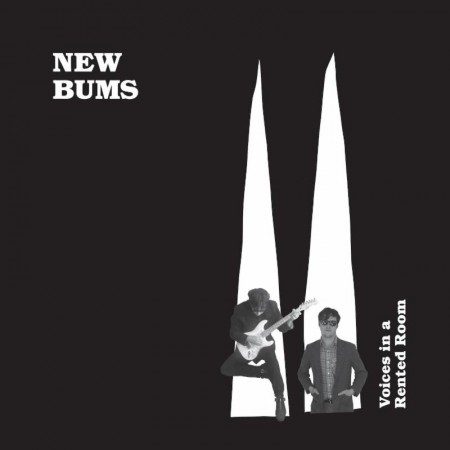
New-Bums-Voices-in-a-rented-room-450x450

AF: Earlier, Donovan, you mentioned that Ben kind of thinks of your band as a buddy film. If we were watching “New Bums” The Movie, how would that buddy film end?

BC: Well, I would hope it would be a sci-fi buddy film. Donovan would definitely end up being an alien. Or one of us would, at least—much to the surprise of the other one. Not a nice alien. A real mean alien. But an alien that wouldn’t harm the other band member. It would be like—oh wow, here is this creature that’s usually really mean, but it’s been nice to me this whole time.

AF: So Donovan the Alien would wreak havoc on the world, and then spare you?

BC: Maaaaybe. It would be a big question mark. Just like The Thing, at the end. Would I actually be spared, or not? In fact I think there’s a good chance that that’s actually how the band is gonna end. Maybe without the alien part.

AF: Well, that leaves room for a sequel.

BC: Precisely. A big question mark.

Many thanks to Ben Chasny and Donovan Quinn for entertaining our questions! Once again, Voices in a Rented Room is out 2/18/14 via Drag City; you can pick up your copy and learn more about the Bums hereListen to “Black Bough,” the first track off the album, via SoundCloud:
[/fusion_builder_column][/fusion_builder_row][/fusion_builder_container]

APPROVAL MATRIX: 2/2/14 thru 2/8/14

Dum Dum Girls Letterman

We’re huge fans of NY Mag’s Approval Matrix.  Here’s our take on the best and worst in music this week.

HIGHBROW

^^^^^^^^

[fusion_builder_container hundred_percent=”yes” overflow=”visible”][fusion_builder_row][fusion_builder_column type=”1_2″][box type=”shadow”]pussyriot

Two Pussy Riot riot members getting kicked out of Pussy Riot for supposedly abandoning the groups “leftist anti-capitalist ideology.” Kicking girl gang members out of the girl gang seems very anti-girl gang… [/box][/fusion_builder_column]

[fusion_builder_column type=”1_2″_last][box type=”shadow”]dumdumletter

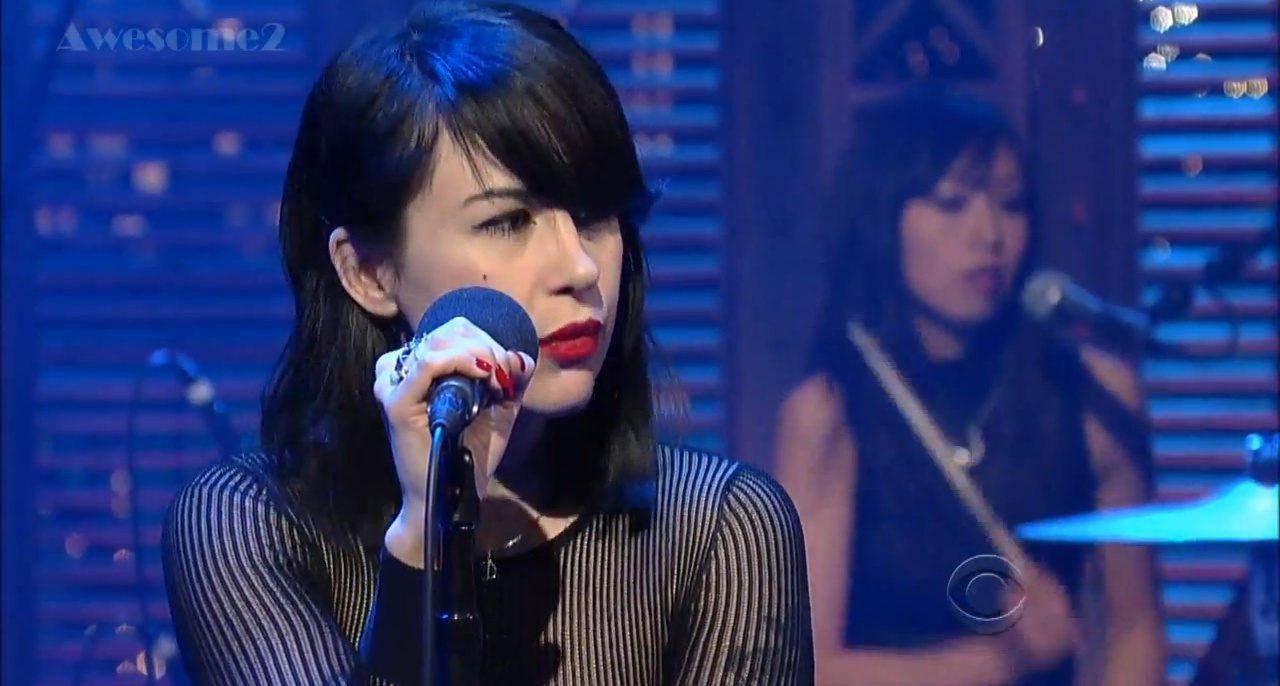
Let us discuss how babelike the Dum Dum Girls looked during their performance on Late Night with David Letterman. So many maneating-gothess vibes. We’re definitely channeling this video this weekend. [/box][/one_half_last]

DESPICABLE <<—————————————————————————– >>BRILLIANT

[fusion_builder_row_inner][fusion_builder_column_inner type=”1_2″][/fusion_builder_column][fusion_builder_column type=”1_1″ background_position=”left top” background_color=”” border_size=”” border_color=”” border_style=”solid” spacing=”yes” background_image=”” background_repeat=”no-repeat” padding=”” margin_top=”0px” margin_bottom=”0px” class=”” id=”” animation_type=”” animation_speed=”0.3″ animation_direction=”left” hide_on_mobile=”no” center_content=”no” min_height=”none”][box type=”shadow”]living_room

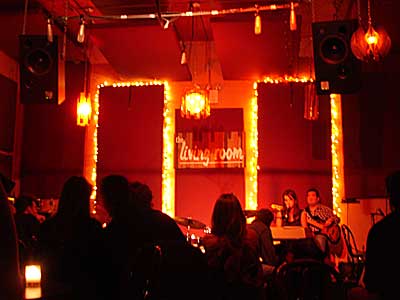
LES venue The Living Room may be moving to Williamsburg… so it can re-close in nine months to make way for another Duane Reade? [/box][/fusion_builder_column_inner]

[/fusion_builder_column][fusion_builder_column type=”1_2″_last][box type=”shadow”] Skaters‘ laid-back response to a shitty review of Manhattan in Vice:

Skaters Vice Response[/box][/one_half_last]

VVVVVVVV

LOWBROW

[/fusion_builder_column][/fusion_builder_row][/fusion_builder_container]
ARTIST PROFILE: Doug Tuttle

dougtuttle

I like the idea of Rootsy music with heavy handed/slightly inappropriate production.”

If ever you want to forget about a breakup, making an album about one may not be the way to succeed.  Fans will surely read into lyrics and song titles, and journalists will bring it up in interviews and critiques (no exceptions here).  Though I suspect for Doug Tuttle, formerly of New Hampshire’s MMOSS, recording a solo record was not only a form of catharsis, but impossible to avoid.

In the past year Tuttle has relocated to Somerville, Massachusetts and written over 30 new tracks.  He plucked out the finest 11 and dropped his self-titled solo debut on Monday via Trouble In Mind.  The result of his ardent focus on songwriting is glaringly apparent on this record.  The album is a close relative of his former work with MMOSS, lingering within the neo-psych-rock-shoegaze revival, though there is a sense of solitude throughout the record far more so than his prior work.  This is in part because the songs would suit a lone listener equipped with headphones more so than a dinner party.

It is not an uplifting record by any means.  The emotional high points could be described as content at best, blissfully miserable at worst.  But more often than anything, the songs render a sweet, dreamy numbness; as if floating through a universe of fuzzed out colors and kaleidoscopic particles and thinking: “well, that’s just fine.”

The record’s first track, “With Us Soon” opens with a mildly bright surge of choral harmonies similar to those of Colin Blunstone and The Zombies.  This is one of the most audibly optimistic gems of the album and it is difficult to not mention its proximity to the sitar-licked songs of The Beatles’ later work.  Though this cheerfulness is short-lived, as the following “Forget the Days” catapults us into longing with a clash of crying effects pedals and drone vocals.

Tuttle’s voice is consistently sweet yet mournful throughout. His breathy pleas never overpower the rich soundscape he’s crafted.  Though this soundscape is difficult to pick apart instrumentation-wise, because the separate elements congeal so seamlessly. Yet the album is not all low-fi-psych-wave void of instrumental prowess.  On “Turn This Love” Tuttle exhibits his high aptitude for lead guitar solos, which are impressive but never overwrought.

“Leave Your Body” is another high point on the album for me.  The opening croon of what sounds like a B-3 Organ (but I imagine is a tape effect or digital embellishment) sets a melancholic gospel mood that melts into the softer side of My Bloody Valentine.  The song drops into minor chords that become pretty and painful all at once. “I Will Leave” is perhaps the most straightforward pop song on the record.  With its tinges of early Simon and Garfunkel, it recounts the inevitable demise of certain relationships, a dilemma we are all too familiar with.

One of the nicest things about this album is its accessibility.  While Psychedelic music can be convoluted, esoteric and alienating, Tuttle’s songs manage to omit strangeness as well as a pop sensibility that most could enjoy.  I’ve heard no official news, but I suspect that with the kind of habit Tuttle has for constant songwriting, a new album is already being fleshed out.  I personally can’t wait.

Check out Doug Tuttle’s “I Will Leave” below:

Audiofemme recently had the pleasure of chatting with the totally lovely Doug Tuttle, regarding his music and the myriad ways in which it influences his life. Here’s are his words of wisdom:

AF: Do you see this record as an extension of what MMOSS would have grown into had you stayed together, or do you consider it something your own?  Perhaps an exploration of sounds you were unable to seek within the group?
Doug Tuttle: I think it’s quite a bit different then where MMOSS was headed actually, in the last days of MMOSS things were getting more and more jammy, and sounding a lot more like the Grateful Dead.
AF: What are the biggest differences from this record and the ones you released with MMOSS?
DT: The big thing is MMOSS records were generally half improvised JAM type songs, my record is half improvised POP songs haha.
 
AF: I read in your interview with IMPOSE magazine that you plucked the songs for this album from a platter of 30 you’d recorded.  How do you crank out so much in such a short amount of time?  Are you the restless, fiendish type who just writes and records holed up in an attic for weeks at a time?
DT: I’m self employed and had just moved to the Boston area, I was insanely bummed out, and happened to me having a really slow work season, so I recorded from the time I woke up, to the time I went to bed a lot of days.
Just killing time really, but also, recording is pretty much my favorite thing to do.
 
AF: It’s interesting to me that Psychedelic Rock’s first incarnation embraced both traditional instruments (Sitar, hand drums, classical guitar, etc) as well as new effects and technology in the Western music industry.  Now in its latest resurrection we are at the pinnacle of digital instrumentation and recording capability.  How has the recent technology within music affected your perception of/involvement with Psychedelic music?
DT: Not too much, I recorded the record on tape, mainly because that’s all I know how to do, I actually had my friend Ben Greenspan give me Protools lessons so I had a way to get the songs into the digital world/sequence them. All the gear I have is either old or home made, for the most part I’m not too impressed by newer stuff, I would really like one of the new digital Mellotrons though.
 
AF: What is the size of your ideal audience?  Are you a fan of playing live, or do you prefer an intimate group at a party, or even to be heard through a pair of headphones alone?
DT: I like playing to anyone that will listen, more the merrier! 
AF: Do you see yourself releasing any future albums (or even a version of this one) on vinyl?
DT: This one is available on vinyl and CD.
 
AF: I read that you recently relocated from New Hampshire to Massachusetts.  Any particular reason you chose Massachusetts?
DT: I grew up in NH and moved to the Boston area when I was 18 (1999/2000) as it was the closest “big city”.
I moved back to NH shortly after MMOSS started. After the break up of MMOSS I needed to get away and this seamed like a good choice….and the Bee Gees wrote a song about it, so there’s that.
AF: Do you feel there is a nurturing music scene regarding your sound in your new location?
DT: Yeah, the Boston music scene is VERY supportive regardless of what kinda stuff you’re playing, it’s rare to go out here and see two bands that sound anything alike on the same bill.
AF: Are you already writing for your next release, or are you taking a break?
DT: I’ve been working on a lot of solo guitar music lately, not sure it will see the light of day though.
 
AF: What do you feel is the most contemporary aspect of your music?  How do you differentiate your work from the period sound of your influences?
DT: Hard to say, I’m not really trying to make 60’s music or anything, I just listen to a lot of it.
I think it’s a lot easier for me to avoid the cheesy aspects of “psychedelic rock” or whatever you want to call it….not that I do….but I could.
AF: As a newly solo artist, do you find that you miss collaborative decision-making?  Or are you stoked to be making the calls?
DT: I like recording by myself more I think, at least if it’s something I wrote, I love playing on other peoples stuff though.
AF: You have some interesting sampling going on at the beginning and end of “With Us Soon.”  They’re a bit animalistic and operatic.  Where are these from?
DT: I recorded the record on used tape, that’s whatever was on there when I bought it, I think it’s someone singing opera, it’s playing at double speed so it’s hard to tell.
 
AF: Of your influences, which ones do you feel came through the most on this record?
DT: Hard to say, I was listening to The Byrds a lot…Shadrack Chameleon, David Hemmings, Pisces, Whistler, Chaucer, Detroit, and Greenhill , The Bachs, The Folklords. Lot’s of slightly twisted Folk Rock stuff, I like the idea of Rootsy music with heavy handed/slightly inappropriate production. I remember Matt form Herbcraft talking about this while I was recording them, telling me to treat every effect like a new toy, and be as heavy handed as possible…I like this ideal.
AF: What new bands have you been listening to lately?  Or are you steeping in the old-but-good for the moment?
DT: I really like that La Luz record, the new Kevin Morby thing is great, Herbcraft…Morgan Delt.
 
AF: What knowledge have you gained from a songwriting and recording point of view as a one-man-band?
DT: Be excellent to one another.

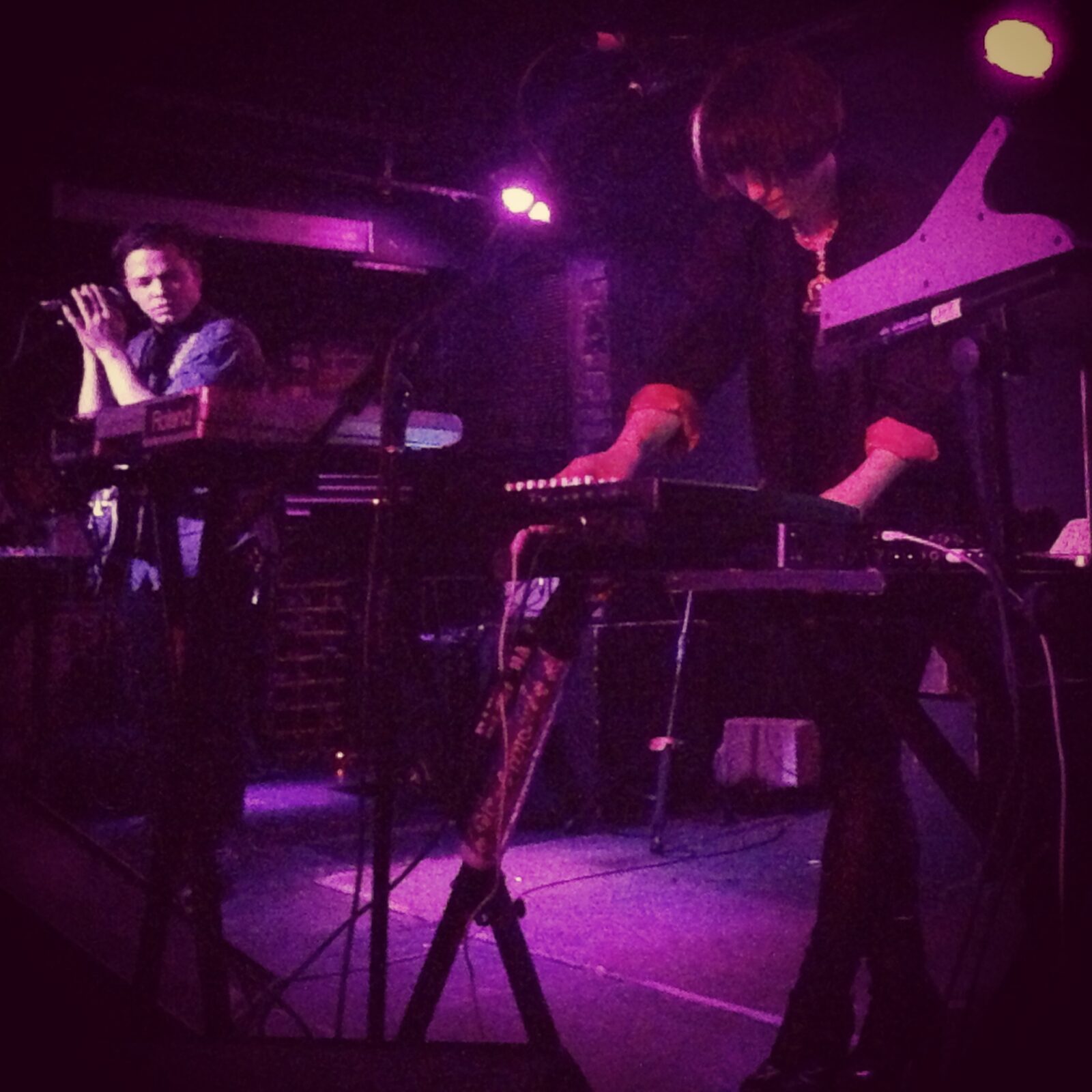
LIVE REVIEW: Ed Schrader’s Music Beat / Future Islands @ Bowery Ballroom

edschraderdevinrice

The word of the night? Engaging. The instrument behind this captivation? Voice.

The Ballroom crowds always linger in the downstairs bar area throughout the opening acts. Such was the case for Guardian Angel, who filled in for Lonnie Walker in a last minute switch. But when Ed Schrader’s Music Beat took the stage people must have been intrigued by the rolling drums that shook the Sierra Nevada in their plastic cups. They flocked to the front of the floor with palpable excitement.

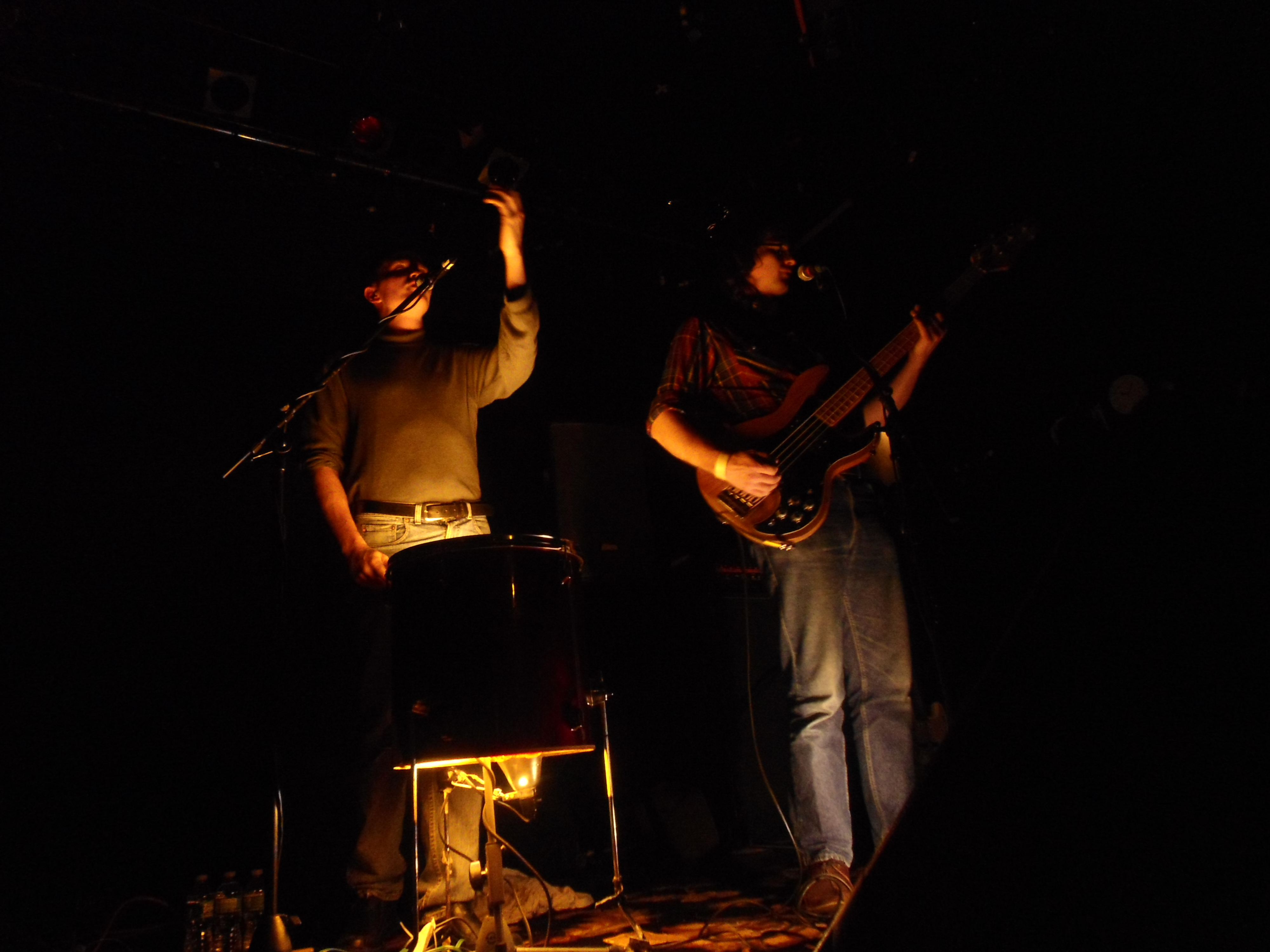
Ed Schrader was just a guy with a drum, until he joined forces with Devin Rice in 2009 and created the occasionally minimalist, almost animalistic, mostly energizing “Music Beat”. Their stage presence was forceful, but accessible. Ed Schrader stood in front of a floor tom with a t-shirt draped over the top, and Rice still with a bass in his hands. Schrader called for the lights to be turned off after making a few jokes. He stepped on a pedal that lit his drum from within, casting his upper body in a spooky yellow light, and making Rice just barely visible.

They started with a heavier punk sound – harsh drum beats, quick, steady plucks on the bass, and repetitive nasal vocals – before smoothly transitioning into softer, more focused melodies. Ed Schrader has a unique, lulling voice. Up on the stage with his shirt torn off and the light of his drumbeats bouncing off his face he appeared like a mystical Ian Curtis. One who makes a lot of jokes.

Future Islands

Future Islands, originally part of the Wham City scene (a group of artists who collaborate, or not, to make performance pieces, music, festivals, books, etc), became one of the most popular, influential synth bands around with their 2011 album On the Water. They’re currently on tour to promote their newest album (coming out March 2014), Singles. As fun as their recorded music is, seeing them live is the real pleasure.

Before Future Islands, when much of the band was part of Art Lord, they were all about theatricality. That charisma has carried over, infused with what can only be described as raw emotion, into a whirlwind of truly danceable tunes.

Samuel Herring has an incredible voice. It’s belting, cathartic, and registers as almost inhuman. The combination of this powerful tone and lyrics that center around anger and heartbreak can be a bit overwhelming. It rides the line between confessional and personal. I wonder how much confession is too much? Though the band is mesmerizing, the crowd may not always be able to enter this inviolate space.

The energy level of the band is out of this world. Herring is constantly dancing, twisting, and contorting himself around the microphone, making it nearly impossible to look away from him. Other band members are so still and expressionless that there’s somehow a balanced atmosphere. The keyboard builds a great sense of atmosphere and the beat is subtler than most dance music, but still manages to work its way into the body. Usually crowds are split between dancers and the too serious or too shy. But everyone seemed to brought together in the spirit of letting loose at the sound of Herring’s voice.

Check out Ed Schrader’s Music Beat’s album Jazz Mind and look out for Future Island’s Singles this March.


LOUD AND TASTELESS: LA LUZ

La-Luz-band-promo

Every Thursday, AF profiles a style icon from the music world. This week, check out Seattleite babes La Luz, who’s pared-down, achromatic duds have always reminded me of Russ Meyer’s Faster, Pussycat! Kill! Their sound is a perfect match to that look: fuzzed out surf rock that rides between 60s girl groups and psych-pop. Check out tunes from their latest EP It’s Alive and browse our style board created with these beautiful chicas in mind!

[fusion_builder_container hundred_percent=”yes” overflow=”visible”][fusion_builder_row][fusion_builder_column type=”1_1″ background_position=”left top” background_color=”” border_size=”” border_color=”” border_style=”solid” spacing=”yes” background_image=”” background_repeat=”no-repeat” padding=”” margin_top=”0px” margin_bottom=”0px” class=”” id=”” animation_type=”” animation_speed=”0.3″ animation_direction=”left” hide_on_mobile=”no” center_content=”no” min_height=”none”][prw username=”audiofemme” boardname=”loud-tasteless-la-luz” maxfeeds=”10″ divname=”myList” printtext=”0″ target=”newwindow” useenclosures=”yes” thumbwidth=”100″ thumbheight=”100″ showfollow=”medium”]


[retweet][/fusion_builder_column][/fusion_builder_row][/fusion_builder_container]

TRACK REVIEW: Ages and Ages “I See More”

Ages and Ages

Ages and Ages

If you’re in need of a soundtrack for your revolution, look no further than Divisionary, the sophomore album of Portland “folkadelic” seven-piece Ages and Ages.  It’s part concept album, part inspirational how-to guide for disillusioned souls intent on bucking stale, prevailing attitudes. “The songs on our first album, Alright You Restless, described a group of people leaving a selfish, destructive society for a place safe from the madness… wanting to establish new rules and a language to put some distance between themselves and the noise outside.”  explains bandleader Tim Perry.  “As the group faces the struggles of actually making their community work, reality sets in and things get more complicated. Divisionary details the second phase of the journey.”

The album is out March 25th on Partisan Records, and so far the band (who consider themselves more of a musical “collective”) have released two singles.  The latest of these is “I See More”, an infectious little ditty that could put a lift in nearly any downtrodden soul.  Stomping percussion, lively acoustic strumming, and group harmonizing give the track a Satanic Panic In The Attic-era Of Montreal feel.  If the tune is rousing, the lyrics are downright uplifting; while Perry sings “Spread out your losses / it’s part of the process / really it’s okay / I’ll be on your side” five other Ages players back him up harmonically and spiritually.

https://soundcloud.com/partisan-records/ages-and-ages-i-see-more

Though it’s certainly not overtly apparent (and never dogmatic), the band does have spiritual influences; Perry spent ten days on a silent meditation retreat during the conceptualization of the record.  That calming influence is deeply felt on lead single and title track, “Divisionary (Do The Right Thing)”. Sonically, it typifies the band’s easy going but restless energy, with sweet strings and hand claps fleshing out the melody.  The words are sung almost like a string of mantras: “Do the right thing, do the right thing / do it all the time, do it all the time / Make yourself right, never mind them / Don’t you know you’re not the only one suffering”.

https://soundcloud.com/partisan-records/ages-and-ages-divisionary-do

While the lyrical content is especially edifying, the messages here would be hard to parlay and might even sound heavy-handed if not delivered in such a carefully crafted, edifying song structure.  Everything feels so organic, and it’s hard not to be moved by the folksy rhythms that underly Ages and Ages’ bold mission statements.  Perry says it best – “These songs reflect optimism, but they don’t do so lightly or try to dodge the struggles we’re dealing with individually and as a band.”  Divisionary is sure to be a complex but invigorating listen.

INTERVIEW: The Wild Feathers on musical process and their US tour

wildfeathers

The Wild Feathers kicked off their 2014 tour in Texas. But they’ll soon be making their way up the East Coast to Washington D.C., New York, Boston and even Montreal. This “four-headed monster” of a southern rock band takes inspiration from all across the musical spectrum. They released their debut album The Wild Feathers in 2013. With four musicians who all at one time fronted their own bands, we were curious about The Wild Feathers’ musical process. We caught up with Joel King to discuss collaborating, tradition and the most interesting cities to perform in.

AF: I’ve heard your band described as very “American” – what does that mean to you? Is that something you strive for? Or is it an expectation you have to live up to?

JK: Well, it just really means the music, the style – blues, country, folk, these all started in America. I guess it’s just the style of music that we come from. It’s the way we were raised. It’s taking emotion from every style in America and putting it all together. We take from country songs with great stories and lyrics and from blues songs with great rhythm and feeling. I think that’s what American music is: the story of cultures coming together.

We’re just a product of where we come from. We didn’t really choose it or set out to write this kind of music. This is what came naturally to us and what feels good.

We have different voices, we each do our own thing in the band, and this is really the only way of bringing them together. I love a good blues song, but I also love a good, sad country song. So, we try to do a little bit of everything. Maybe that’s why it’s such “American” rock and roll.

AF: What’s the process behind the songwriting? Is it always combination effort or do you each get your “own” song on occasion?

JK: It comes together in a whole bunch of different ways. We really try to make the best sound possible. One of the best songs we have we all wrote together and that’s one of the real “Wild Feathers” songs. But there have been a few times where someone will bring a song and it’s totally done. That’s perfect. There’s nothing more to work on. Some of the best songs are also ones we come together with mutual feelings about. It’s always changing, though, always a little bit different.

We always try to go with what feels and sounds the best. We’re not like the Beach Boys, where we can do all these crazy harmonies, we’re more like the Beatles, you know, sometimes they’d just sing the same part, but it sounded really great.

The truth is we don’t sing harmonies very well at all. But we like singing together. If we actually land on a harmony then we’re real proud of it.

AF: Do you think that storytelling plays a part in your music? I know classic rock is an influence, but what about folk music?

JK: Lyrically, I would say it changes on a song by song basis. I still don’t know what “Free Falling” is about, but I fucking love that song. I mean there are songs like that, which are just images or overall premises where the words just fit with the music. Then, some are just straight up stories of heartbreak or something like that. But I really try to make the lyrics fit the song. If it’s really slow the words should make more obvious sense, but if it’s faster you can kind of say whatever you want. But most of the time we try to write to the music.

AF: Speaking of the classic rock influence, I’m really interested in this idea of “preservation” when it comes to the classic tradition. You guys mention it on facebook with the addendum of “evolution”. I definitely hear some contemporary quality to your music and I think that’s what makes it stand out. But the process of blending – preserving, while evolving – sounds really complicated..

JK: We don’t really know. We try to break it down for other people in interviews and things like this. But we love classic rock, we love jamming, and just doing what bands do. We have goals within the group to push ourselves, but as far as doing anything else I don’t know – we have to push ourselves to become better and anything, but we move wherever the music takes us. Who knows what the next record will sound like.

Right now, we sound the way we do because that’s who we are. We didn’t set out to bring anything back or set anything forward. But people say that all of the time. It’s just natural. We all play in certain ways and when it comes together it sounds different and new. We’ve all done our own solo projects and we knows what we can do on our own, not what we can do together.

AF: So maybe not that complicated. .  Four of you were lead singers before coming together as The Wild Feathers – I’m not asking about egos, I know that you guys get along really well – but do you think having the four of you ensures that you’re pulled in different directions? 

JK: Yeah. That’s why we did it. When we first played a few songs together we were like: “Oh my god, this is going to work out.” It was really new and none of us had ever done anything like it before. Sometimes you have to force it out when you’re working solo – I have to write a song, I have to do this or that. With the band it’s almost a sweet surprise. When you’re working on a tune and someone chimes in with something great, you’re always thoroughly excited and impressed.

After we first started jamming we realized this band might be fucking great! So, we just moved on it, trying to find a good label and management.

AF: I read that you got to hang out with Paul Simon a lot – that must have been really incredible!

JK: Yeah, that was our first really big tour. It was intimidating. But it was a blast. He sounds unbelievable. A lot of older guys sound different. We got to open for Bob Dylan which is a lifelong dream, but the difference between Dylan and Simon is Paul Simon always sounds spot on. Dylan is always morphing and evolving, I don’t know if he’s the same person he used to be, or even the same person he was two years ago. Paul Simon is pro all the way. His voice is amazing.

AF: What are some of your favorite contemporary artists?

JK: My Morning Jacket, Wilco, Ryan Adams, Jack White, the Black Keys, Kings of Leon, Band of Horses. I’m a big fan of just guitar, bass, and drum rock and roll. There’s also Foo Fighters. I still haven’t met Dave Grohl. That’s on the list.

AF: What are some of your favorite cities to play in? Do crowds receive you, specifically your music, differently in different parts of the US?

JK: In different parts of the country there are diverse crowds for us. As far as having fun: we’ve only played twice in the DC Area at the 930 Club, but that’s probably one of my favorite places. It’s great. DC is really a brand new one. I love that.

New York City’s always good, too. The shows are amazing. But just getting in and out of the city with all of our gear is a pain in the ass.

We’ve played Boston a few times. The whole East Coast is cool for us because we don’t get up there too often. Actually, both of the coasts are really fun. We’ve toured throughout the South and the Midwest, even with our old bands. So, when we get out West we love the scenery and the whole vibe out there. The East Coast is all new to us. We don’t know too many people on those coasts so we can really get involved, let loose, and have a good time.


The Wild Feathers are playing a sold out show, tonight at Mercury Lounge in NYC. Until then, Check out their video for “The Ceiling”, off their debut album:

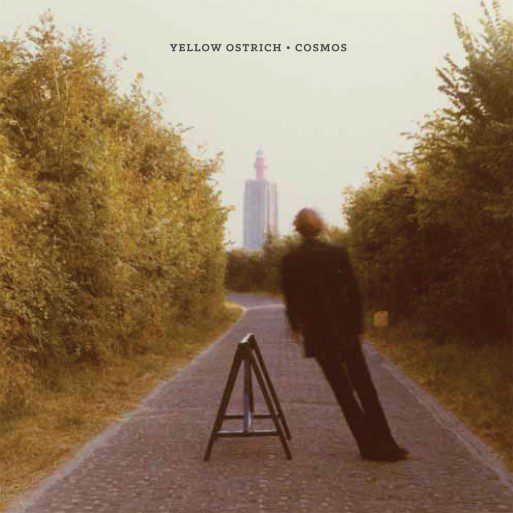
ALBUM REVIEW: Yellow Ostrich “Cosmos”

Since beginning his solo project Yellow Ostrich, singer-guitarist Alex Schaaf has been making music prolifically and with fanatical focus. Within a couple of years of its inception, while Schaaf was still a college student, Yellow Ostrich had recorded two full-length albums and three EPs, each of which barreled with blinders on in a direction that had little in common with that of the previous release. In 2009, one of Yellow Ostrich’s earlier releases, The Serious Kids EP, consisted of a six-track foray into acousti-fied electronic dance music. The same month, a Morgan Freeman tribute EP surfaced on the group’s Bandcamp page. Suffice it to say that Schaaf doesn’t shy away from experimentation, nor the prospect of devoting an entire album to that experimentation.

Yellow Ostrich has grown since those days. Having added drummer Michael Tapper, and then, later on, bassist Zach Rose and Jared Van Fleet on keys, Schaaf remains the center of the band. Though as a solo artist, the sheer amount of sound Schaaf was able to orchestrate was impressive, it’s difficult now to imagine Yellow Ostrich without Tapper’s drum work. But though beefier instrumentation makes Schaaf’s penchant for big, unpredictable themes a bit less obvious, those deeply delved-into concept albums are by no means an outgrown phase for Yellow Ostrich.

By way of preparation, Schaaf moved into the band’s windowless Brooklyn practice space for nine months before writing the songs on Cosmos. There, he studied astronomy, and artificially recreated of the cycle of daylight and night in lieu of going outside. When he did start to write, the album developed an obsession with darkness and light. “Pull the shades down and never let go,” Schaaf intones on “Shades,” and then inverts the image in the following track with the wearily repeated line “hiding under the brightest light.” Less poppy and more violent than anything the group had so far put out, Schaaf’s vocals cycle over delicate electronics and heavy guitars like waves crashing unenthusiastically against a wooden dock at nighttime.

YellowOstrich_Cosmos-513x513

For all its well-researched complexities, Cosmos retains the element that’s been threaded through all of Yellow Ostrich’s deviations: it assumes, for lack of a better term, a sense of wonder in its audience. It’s easy to find sections of Schaaf’s vocal track precious, his looping melodies boring. The group has, in interviews, expressed preference for playing college campuses, and it’s easy to see why: the ideal Yellow Ostrich fan is deeply enthrall-able and eager to suspend disbelief. Even if the group’s grand, far-flung scope won’t appeal to all listeners, the prospect of being invited to dig deep in this album adds an allure to the deceptively catchy, pulsing echoes of Cosmos.


Walk, don’t fly, over to Facebook for more Yellow Ostrich. Listen to “Shades,” off Cosmos, below:

LIVE REVIEW: Weeknight @ Mercury Lounge

Weeknight Mercury Lounge

Darkwave, coldwave, new wave, no wave, disco-punk, dance-punk, synthpunk, post-punk.  As the music industry strives to coin new terms that will effectively pigeonhole each and every grouping of human beings making sounds with instruments, these vague definitions start to sound like some twisted Dr. Seuss book.  Enter Post-Everything; it’s not a genre, but a cleverly-titled record by emerging Brooklyn duo Weeknight, aimed at obliterating the lazy classifications so often used to explain what we think we’re hearing.

Weeknight Mercury Lounge

It’s not that Weeknight don’t fit in to any of the above-named genres; in fact, they borrow heavily from more than a few.  They don’t seem particularly concerned with crafting a wholly original sound, nor are they attempting to reinvent any wheels.  In the two years they’ve been bouncing around the Brooklyn music scene, they’ve established something much more compelling.  With Post-Everything, Weeknight have crafted something bigger than genre itself; they have curated an entire atmosphere.  This is music that takes on a life, splashing through wet neon reflections in gutters or echoing through misty caves rimed in crystal formations.  Ethereal synth washes, hollow drumbeats, and distant, hazy guitars unfold layer by layer, revealing the dual voices of Holly and Andy (who have withheld their last names, perhaps in keeping an air of the mysterious about them).  The two share a beautifully removed method of delivery, almost always singing in breathy unison.  Andy’s voice is not unlike the somehow spacious deadpan of The National’s Matt Berninger, while Holly’s laconic, whispered counterparts are a bit more feathery and harder to pin down.  The lyrics read like a nihilistic but earnest love letter – tragically cursed scrawlings inspired by fatally unrequited adoration, less desperate but more impatient.

Those dark elements are conveyed as successfully live as they are on the record, which comes out March 4th via Hand-Drawn Dracula subsidiary Artificial Records.  In support of its release, Weeknight are heading out on a two-month tour that kicked off last night at Mercury Lounge.  Moments of fuzzy ecstasy, like their rendition of “Tonight”, were tempered with lush comedowns like “Whale”, each track perfectly articulated by deft synth patches and taut movements.  The band’s sultry first single, “Dark Night”, offered just the right kind of slow build, bathing the rapt audience in a swirl of bleary reverb.  Andy and Holly have toured tirelessly in the time that it’s taken them to piece together their brooding tunes – both headlining and supporting acts like Phantogram and Besnard Snakes – and in so doing have honed a perfect choreography, a seamless give-and-take.

The band’s moody aesthetic extended to the bill’s supporting acts; sets from BK dream-pop duo Courtship Ritual (who invited black-clad belly dancers to the stage), the slithering glitch of Certain Creatures, and carefully culled goth gems from DJ Mar Bar of Rituals NYC, all longtime friends and collaborators with like-minded sensibilities who helped Weeknight celebrate the past year’s successes and transport Mercury Lounge into another world.  It happened to be the 20th anniversary of the East Village venue but the party was solidly for Weeknight.  Post-Everything is poised not just to become one of the most talked about albums of the year, but also to redefine the way we talk about music in the first place.

ALBUM REVIEW: True Love Kills the Fairy Tale

 GRAVE107CasketGirlsCover_1400_zpse35d90cd

“It feels as though we found each other, when we reflect back on the myriad of minutia decisions that were made to cross paths at that exact point in time,” says Phaedra Greene of the fateful day when she and sister Elsa met producer/songwriter Ryan Graveface. The story goes that Ryan stumbled upon the sisters singing and playing autoharp under a tree in a park in Savannah, GA, and the trio have been collaborating as The Casket Girls for the two or so years since. Phaedra continues, “it begs the question, was it the first time we met?”

This mystic sensibility is what the group have become known for, to an extent, and it colors the sound of their upcoming sophomore album, True Love Kills the Fairy Tale, out Feb. 11th via Graveface Records. The ten-track record comes with its own bizarre backstory: allegedly, all of the lyrics were written in one night while the sisters were in some sort of semi-conscious dream state (“Elsa was sobbing and reciting poetry while Phaedra was just staring straight ahead and writing it all down, like catatonic,” according to Ryan) and they have no recollection of it at all. But despite these questionable origins, the final product is a rather focused and lush sounding album.

True Love Kills The Fairy Tale begins with a winking electronic beat and the sisters’ haunting, harmonious “oooh”s. As the album progresses, the production becomes ever more dense. “Day to Day,” for example, has a distinct shoegaze-y wall of sound quality to it and a slow tempo that lulls you into a haze. The title track features a lot of fuzz and some interesting instrumental work—acoustic guitar? banjo?—near its end, which is refreshing to hear midway through the electronically inclined album. “Holding You Back,” on the other hand, has a quintessentially pop sound to it, with ‘80s influences to boot. The lyrics, meanwhile, explore the tension and balance found in dichotomies (as in “Chemical Dizzy,” in which the girls sing “Opposites only exist with each other”) as well as more metaphysical themes (like the concept of “unrequited reality” from the first track, “Same Side”).

Though the album is pretty purely pop, it remains instrumentally grounded in Graveface’s mechanical blips. A straight-shot listen might make some of the tracks come off as repetitive, but The Casket Girls have a pretty specific sound which they do very well. Droning and entrancing, True Love Kills the Fairy Tale leaves you blissed out and bobbing your head along to the catchy riffs.

OP-ED: You Can’t Always Get What You Want: When Legacy Artists Return

pixiesThe last year or so has seen a number of legacy bands returning, whether they were making new albums and EPs or just going on tour. The Pixies. Boards of Canada. Mazzy Star. My Bloody Valentine. David Bowie. Neutral Milk Hotel. The Breeders. Not even necessarily confined to indie rock, both Wu Tang Clan and Lauryn Hill returned to the forefront of the musical scene in some form. OutKast seems like the latest duo to join the ranks of reawakening and there’s more than I’ve even mentioned here. The return of these legendary acts felt exciting at first, then a little overwhelming, and finally, predictable. We watched them struggle to adapt to the digital world of Twitter and Youtube streams, festival headlining slots and internet backlash. It felt disorienting to see a band like The Pixies—who most already consider an established part of the indie rock canon—go through petty band changes and lackluster EPs. Certainly not all of the artists disappointed in their return, but often the question went deeper than whether the new album, song or tour was successful or not. Rather, the reemergence begs the question: why now? What is the intent? Do these artists really feel they are adding to their legacies, or are these returns based on financial concerns? In some cases, it seems that the latter might be the primary motivation.

Some music attains critical and commercial success in one fell swoop, setting a bar for the sound of an era, and decisively changing music itself. Artists like David Bowie and My Bloody Valentine certainly fit this mold, as do Wu Tang, The Pixies and Mazzy Star. It’s not just that these artists were great and beloved by their fans, it’s that their effects are being seen, felt and heard, even now a decade or more later. The impeachable nature of a band like My Bloody Valentine feels precarious when a new album comes out—will it hold up? Will they maintain the myth? The ways in which legacy artists challenge their own reputation by releasing new material is fascinating, especially given the factors that have changed the way we consume music. For example, mbv wasn’t eligible for the Mercury Prize because the group chose to put it out independently—James Blake’s album garnered the award. Or, how about the fact that David Bowie’s album elicited barely a scratch from critical pens, while Arcade Fire’s triumphant Reflektor can be found in the top tier of nearly every year-end list? When The Miseducation of Lauryn Hill came out, there was no Tink or Rapsody—and no Nicki Minaj or rhyme-spitting Yoncé either. These newer artists might just interest us more at this point, partially because they’ve built on the foundation that Hill herself laid. In a way, she’s fallen behind these emerging artists due to the doors she herself opened, and where newer artists have gone from there.

It says something, too, about our attention span that the news of these artists return often trumped our actual interaction with their art. How many people gave the new Mazzy Star album a proper chance? Did it even matter at this point? The artist who raised the most eyebrows in their return was probably The Pixies. Not only were their new EPs rather banal, but the fact that founding member Kim Deal wasn’t involved, and that they kicked their replacement bassist (also named Kim) out of the band created a situation fraught with drama and embarrassment. Was this really the band that helped shape the indie rock canon? It’s in situations like this that great bands sometimes tarnish their place in our hearts by trying to stretch their relevance into ungainly lengths. Or is it that we’d rather have the drama than the new music? The idea of a new David Bowie album interests us, but not the effort it takes to delved into it. We’ve been craving Neutral Milk Hotel’s return for what feels like eons, but when we get it, it feels more like a let down than a victory.

Seminal artists—and the art they make—have their place in a specific time and rarely can they make the jump forward to continue their legacy after so many years. As new artist build on the sonics and precepts of stalwarts like The Breeders and Boards of Canada, they do become more intriguing to us than their forerunners. And when legends come to life in our own time, sometimes their reality, their very humanity ruins the magic patina that age and our reverence have coated them with. Will hearing In the Aeroplane Over the Sea live really make me love it more, or will it ruin the larger-than-life presence that album had over my adolescence? So when OutKast goes on tour this year, I won’t be going to see them—I can’t fully believe they’re doing it for anything other than the money Same goes for The Pixies and Neutral Milk Hotel. I can’t take the chance that I’ll lose their magic, even if they have.

Besides, it’s 2014 and I’m more interested in watching Chance the Rapper and Vic Mensa. It’s their time.

LIVE REVIEW: Yvette @ Death By Audio

Yvette Audiofemme

 Few things lure me from the warmth of libation and my couch on an icy weeknight. If a band can convince me to endure sub-freezing temperatures, the company of myself and a trek to the Williamsburg waterfront, they must be pretty damn good.  Brooklyn duo Yvette were more than worth my wet boots when they played at Death By Audio last Tuesday.  They weren’t headlining but they were the reason the show caught my attention in the first place.  I had been scrolling through weeks of show listings and their name kept popping up, often highly recommended on some calendars.  Typically skeptical of things suggested or not suggested, I suspended my suspicion and streamed some of their music .  What I heard not only delighted but surprised me, as I don’t know of many current bands even walking the road Yvette is barreling down.

Their sound is a nod to 80s post-punk from London, gothic industrial via Berlin and the aggressive proto-punk of our very own New York City.  Think Throbbing Gristle, Suicide, Joy Division, Psychic T.V., Nurse With Wound, Death in June, and The Birthday Party, to name a few beats resonating from Yvette. Given that those are some of my all time favorite bands, it’s no shock that they excited me.  It’s also nice to hear someone depart from the sunny folk revival and the pleasant ambient noise of late to bring a darker sound to the table.  Yet despite Yvette’s aggressive and ominous feel, their presence didn’t determine the rest of the show.

 If there was a common thread running through the lineup of the evening, it was far too thin to detect.  First up was Rat Attack, a duo wielding only a laptop, microphone and effects pedals.  I liked their sound, which was more aggressive and distorted than that of Yvette’s.  It was their live presence, though, that I wasn’t so fond of.  The music was perfectly jagged and malevolent but it was compromised by the ridiculous image of two dudes rocking out with a macbook pro.  There was no interaction with the crowd and they may as well been in their own living room.  I’d say Rat Attack would be best heard on headphones so the listener can pick up the intricacies of their mixing.

Second on the bill was Seven Teares, who embodied the most extreme outliers of the evening.  Their sound is difficult to pin but consists of down tempo ballads with vocal harmonies reminiscent of medieval songs.  The band’s members are all impressive vocalists and multi-instrumentalists.  They were swapping basses for guitars, accordions for microphones, and drums for what looked like a xylophone.  Most bewildering was a strange wooden instrument on top of one member’s knee that looked like a organ-accordion hybrid and everybody in the crowd was trying to figure out what it was.  Fortunately I could employ my acclaimed eavesdropping skills as the man standing next to me explained to his date that it was a portative organ.  These herald back to the 12th century and were typically used for recreational music.  Somehow the band trumped their own oddness when the drummer whipped out a violin bow and a chunk of Styrofoam, a foe far worse than nails on a chalkboard.  The only thing they were missing was a lute.

Finally Yvette came on, and they put on one hell of a show.  Despite their music being heavily reliant on digital embellishments and effects pedals, they consist of a guitarist/vocalist and an energetic drummer who supplied the vitality desired at a live performance.  This was not two dudes and a laptop, but two very capable musicians who are exploring sonic possibilities beyond the traditional scope of their respective instruments.  There was an interaction between the duo that seemed enthusiastic and concentrated.

The headlining band was Aa (a nod to Crass pronounced Big A, little a), who were releasing their record that evening.  Consisting of three drummers and one vocalist/keyboardist, the bands sound is simultaneously soothing and aggressive.  They are considered post-punk on a critical level, but tout influences reaching back to prog-rock.

I hope and expect to hear more from Yvette and Aa in the coming future.  Maybe when it’s warmer out.

Check out Yvette’s “With Fangs”below:


VIDEO REVIEW: Together Pangea “Offer”

togetherpangea

Together PANGEA just released this music video to promote their new album Badillac and kicked off their tour around the US. They created it in the spirit of friendship it would seem. That is: it was created with their friends to be watched by others and their friends.

A sense of community is apparent from the opening scene of an energetic crowd chanting “One more song!”. The music begins mildly and the close shots of people’s faces bathed in colorful light syncs really well. These scenes change quickly into more lively interactions and the color gains some lens flares and blinking disco lights. We see friends partying together – laughing, drinking, dancing – in private, in public, and, of course, at a Together PANGEA show. There’s boob-flashing, shotgunning of beers, a dark shot of a Del Taco, and a dude blowing beautiful smoke as two people make out in the background. It’s a very active video, but in tiny spurts that draw attention to a larger lifestyle, and the California they are attempting to capture. What stuck out to me the most was the sense of affection that bleeds through every clip, whether people are shooting beer into each others’ mouths or making funny faces as they rock out. This isn’t just a showcase of debauchery and silliness. It’s a showcase of togetherness. We see a man and a woman hungrily kissing each other, until a guy steps in, drags the man away, and proceeds to hungrily kiss him. Love is just in the air.

You can infer that it is the music and California itself that brings all these people into this drunken, stumbling, potent fun. As the words “Get wasted / And lose best friends” are sung, we see two people clearly enamored with each other. Crowd-surfing. Panties. A gorgeous view of Los Angeles at night from above. The lively, low-fi music and William Keegan’s nasal, scratchy vocals were made to accompany a video like this one. These are scenes and feelings we can all recognize and, more so associate with this band.

Together Pangea goes on tour February 1st. They’ll be at the Knitting Factory in Brooklyn on February 14th. Until then, peep the video here:

TRACK REVIEW: MT WARNING “Midnight Dawn”

Mt Warning

“How would a song sound from a man sinking into the ocean?”

This is the question that prompted MT WARNING’s Mikey Bee and Taylor Steele to write the story of life, from beginning to end, into all of their music. They put particular care and thought into making songs emotive – relaying the sweetness of youth and the disillusions of growing old – and engaging – through intimate moments Mikey shares with his audience.

MT WARNING’s new track “Midnight Dawn” begins with a soft, potent twang out of an Old Western. When the guitar and drums kick in they pick the song up out of its ambience. But its the vocals that really transform it into a delicate, but relentless chant (even when Mikey is just “ooh”-ing). There’s some nature imagery that keeps the Old Western feeling fresh. “We don’t know where we’re goin’ / But we know where we’ll end up” is the line that’s repeated. This has the double effect of seeming positive (in that this journey “we” are on is difficult and confusing, but we have a place to be, which is comforting and satisfying), but also incredibly dark (well, we’re all going to end up dead, aren’t we?). At three and a half minutes in a female singer enters, crooning gently, only for the lead vocals to return fiercely with a strain, an overwhelming ache that provides it an emotional context that catches the listener off guard.  At four minutes and some seconds the vocals slowly trail off into echoes.

I’m not a big fan of anthems or epic songs (especially after F.U.N.’s boom), but, though this song is dynamic in a fairly obvious  way, there’s an emotional quality to its turns that is very endearing. There’s a delicateness, a rawness underlying everything that goes back to MT WARNING’s original idea of sinking into the ocean. With some knowledge of that in mind, this song is equal parts lovely and daunting.

Listen to “Midnight Dawn” off of MT WARNING’s debut album Midnight Set, to be released this March:


LIVE REVIEW: Kim Gordon closes out Mike Kelley’s Retrospective at MoMA PS1

Kim Gordon Mike Kelley MoMA PS1

[fusion_builder_container hundred_percent=”yes” overflow=”visible”][fusion_builder_row][fusion_builder_column type=”1_2″]
Mike Kelley Kim Gordon
Mike Kelley & Kim Gordon in August 1985, shot by John Harnois

[/fusion_builder_column][fusion_builder_column type=”1_2″_last]

Kim Gordon Jutta Koether
Kim Gordon & Jutta Koether

[/one_half_last]

Sometimes the most provocative art is that which is pieced together from various, unusual mediums and outcasted found objects, speaking as it does to obsolescence, alienation, and a crush of cultural detritus.  This can apply to music as well as visual art very easily in the right hands, where signals are mixed and symbols are meshed to examine the tenuous relationships we have to the things and people that inhabit our lives.

Nothing proved that better than the Mike Kelley retrospective at MoMA PS1, the largest single-artist exhibition the museum has ever curated.  Collecting video works, installations, sculpture, drawings, paintings, and assemblages spanning Kelley’s entire career as a visual artist, the show opened in October and closed yesterday with a thought-provoking set from Kim Gordon and Jutta Koether.

The performance took place inside a dome centered within the courtyard, surrounded by the former school’s various galleries.  An image of two tanks, one blue and one red, both swirling with bubbles, was projected behind the stage; the imagery was borrowed from Kelley’s more recent Kandor series in which he used varying representations of the Krypton city from Superman comics to explore feelings of disconnectedness.  Though the hermetically sealed contents of the tanks highlighted separation, it also suggested a synergy, a transfer of materials.  This conclusion might have been drawn in part to the connection that Gordon and Koether formed during the performance, as well as Gordon’s connections to Kelley himself.

Before Gordon founded Sonic Youth with Thurston Moore and Lee Ranaldo, she studied visual art and worked in SoHo galleries, curating shows of Kelley’s work.  Kelley had been in a no-wave band called Destroy All Monsters, making the kind of music that would later inform Gordon’s.  In 1985, Sonic Youth composed a live score for Kelley’s performance Plato’s Cave, Rothko’s Chapel, Lincoln’s Profile.  The bashful orange doll from 1992 Sonic Youth album Dirty is one of Kelley’s hand-knit creations, included in his photography series Ahhhhh, Youth!.  When Kelley committed suicide in 2012, Gordon eulogized him in a moving piece for Artforum, providing a tender look at the decades of collaboration, mutual admiration and friendship between the two.

For the bulk of the performance, Koether and Gordon chose to reinterpret selections and ideas Kelley presented in his 1996 album Poetics.  Between washes of Gordon’s guitar noise, looped sounds from a small boombox (a nod perhaps, to the visual cues that appear in several of Kelley’s works) and Koether’s nebulous synths, the two women read excerpts of a conversation that Kelley and Gordon had in Interview shortly after “Kool Thing” had been released as a single; the interview discusses at length Gordon’s transformation from librarian/art nerd into rock star/sex symbol as well as identifying racial appropriation in the the video that sounded particularly prescient in light of last year’s most criticized music videos.  Gordon initially read Kelley’s questions with Koether responding as 90’s-era Gordon; halfway through the set they flipped identities again.  After each of these intervals, the pair would recite a passage from Kelley’s ’93 fax-essay PSY-CHIC in unison describing a woman’s profile, crescendoing with the phrase “The sideward glance that says FUCK YOU.”  At one point, Koether tossed handfuls of xeroxed copies into the audience.

Kim Gordon Mike Kelley MoMA PS1
Kim Gordon performing at Mike Kelley’s MoMA PS1 retrospective, shot by Laura Wyant (@MsLDubbs)

In this way, Gordon used Kelley’s methods of raking the flotsam from the surrounding world, imbuing it with meaning, and repurposing it through a completely different medium.  She blended text with noise much the same way that Kelley often used words in his visual works to create a contextual anchor.  The cassette tapes Gordon played from her tinny boombox stood in for the stuffed animals or yearbook photos that Kelley used in various installations.  The approach was mirrored brilliantly, and both uncovered awkward truths about art-making, identity, and sexuality.  For Kelley, that meant exploring the perverse and the grotesque and the repressed; for Gordon that meant reconciling her responses to questions answered over twenty years ago with the woman and artist she’s become.  How fitting that she was able to do so while paying tribute to a dear friend whose work grows more prolific and seductive with each passing year, whose work we have barely begun to cherish for the melange of half-truths and false memories and rejected consumerism and offbeat language that it is.[/fusion_builder_column][/fusion_builder_row][/fusion_builder_container]