TRACK OF THE WEEK: Bizarre Sharks “Tremendous”

In middle school, soon after I started to play guitar, I would go to my friend’s house who was learning to play drums. We would invite a couple people over, order Dominos and proceed to attempt songwriting for about half an hour and then spend the next two hours arguing about what our band name should be. These one-off pizza party bands never recorded anything and we usually just ended up finishing the practice by jamming on whatever Misfits or Nirvana song we had learned that week.

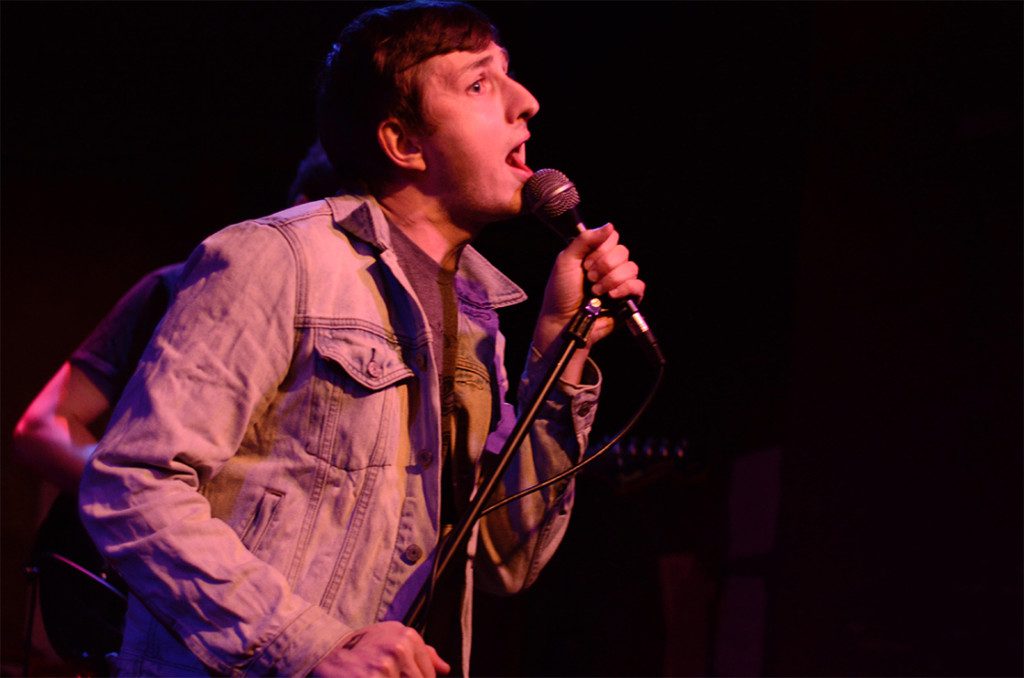
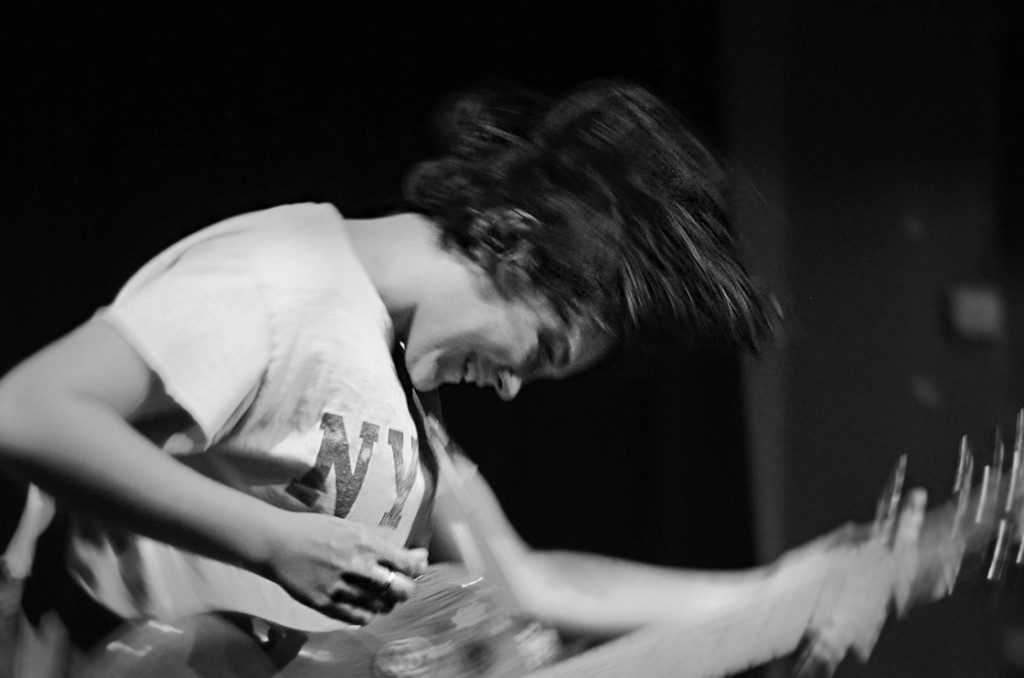
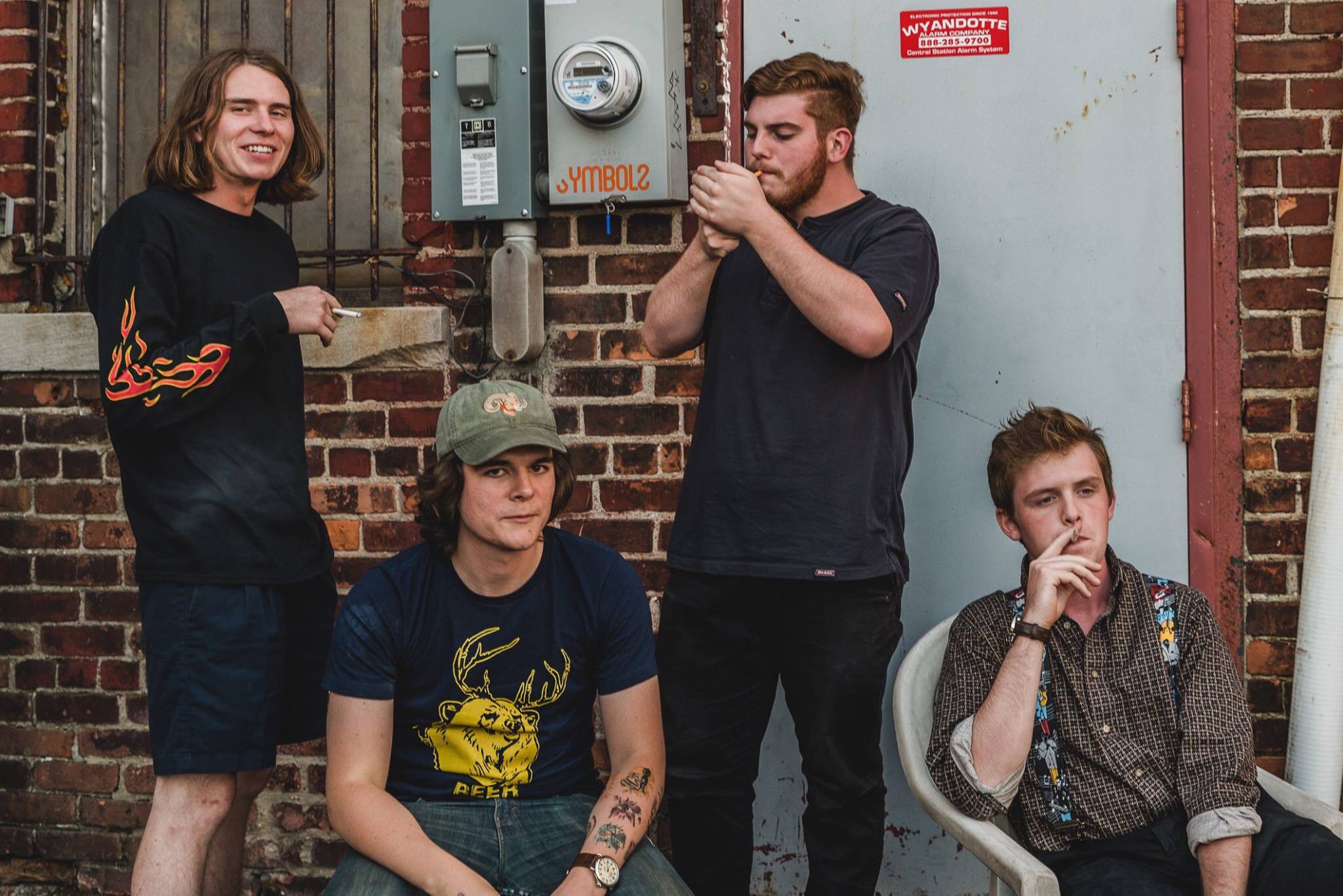
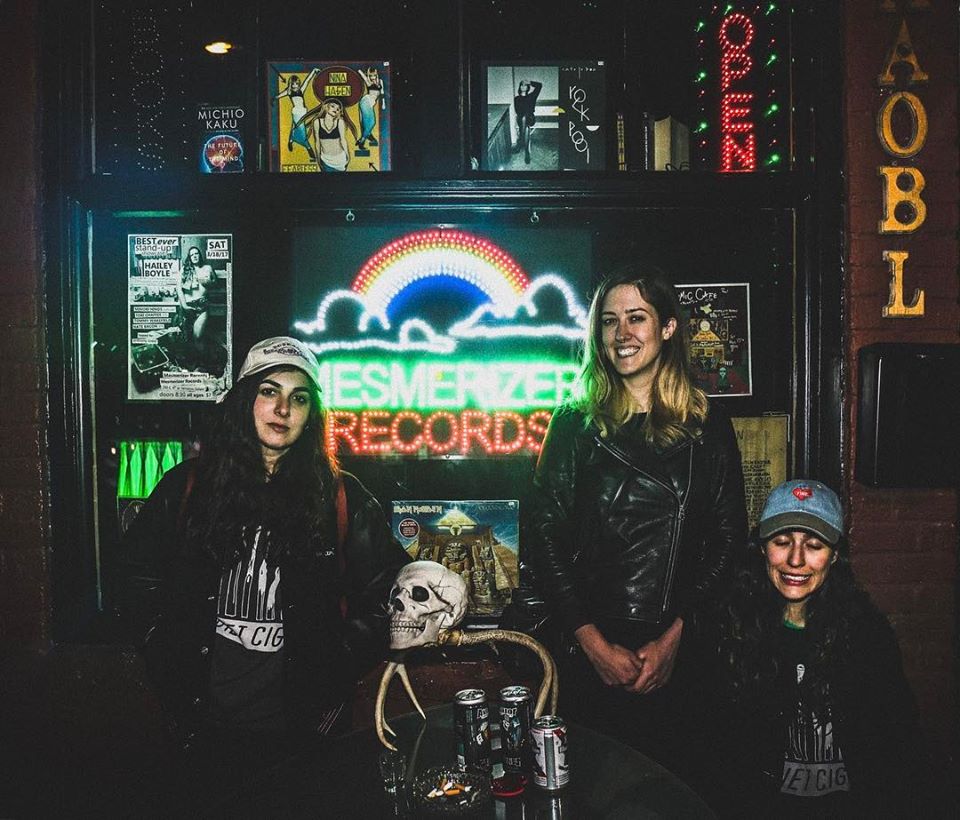
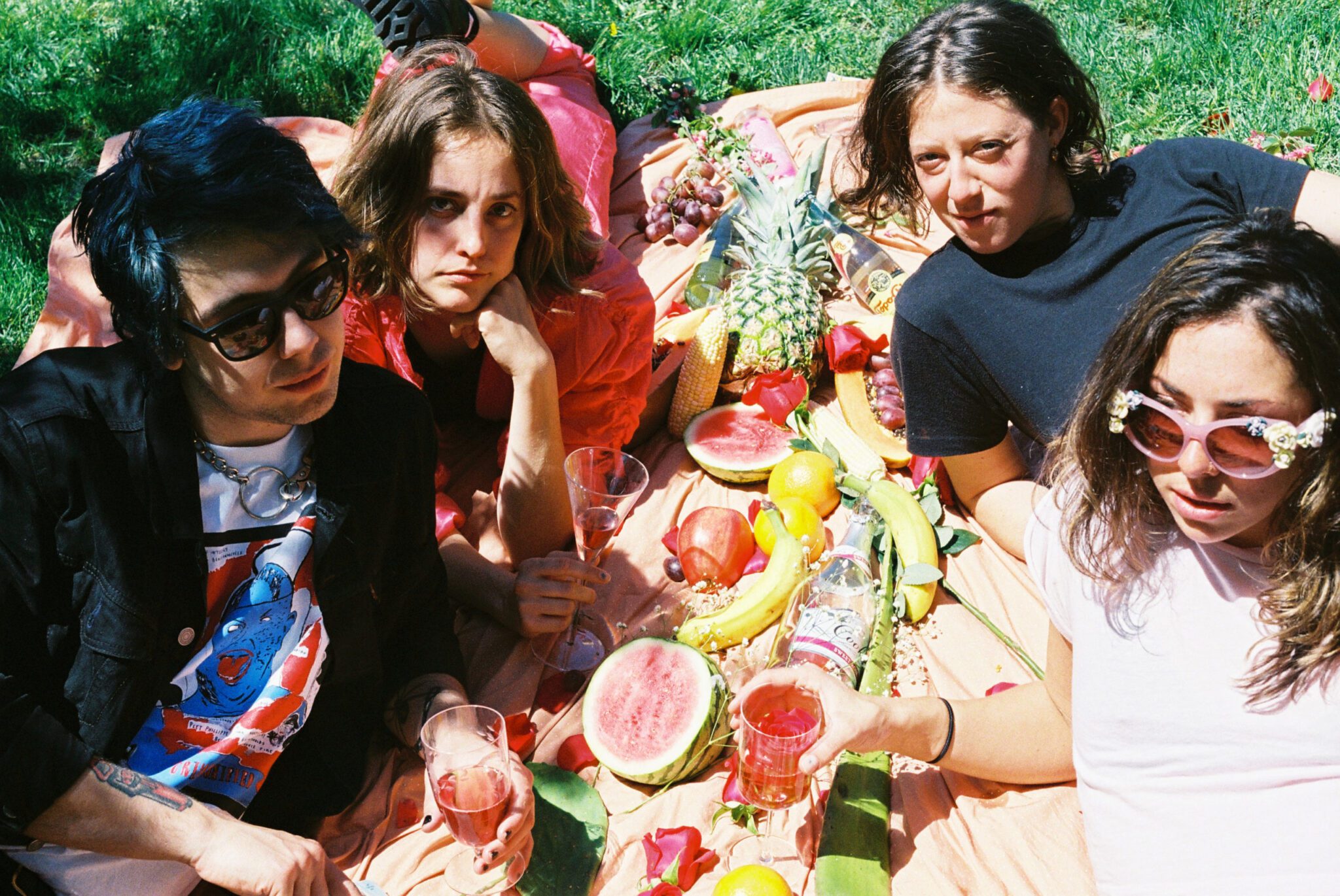
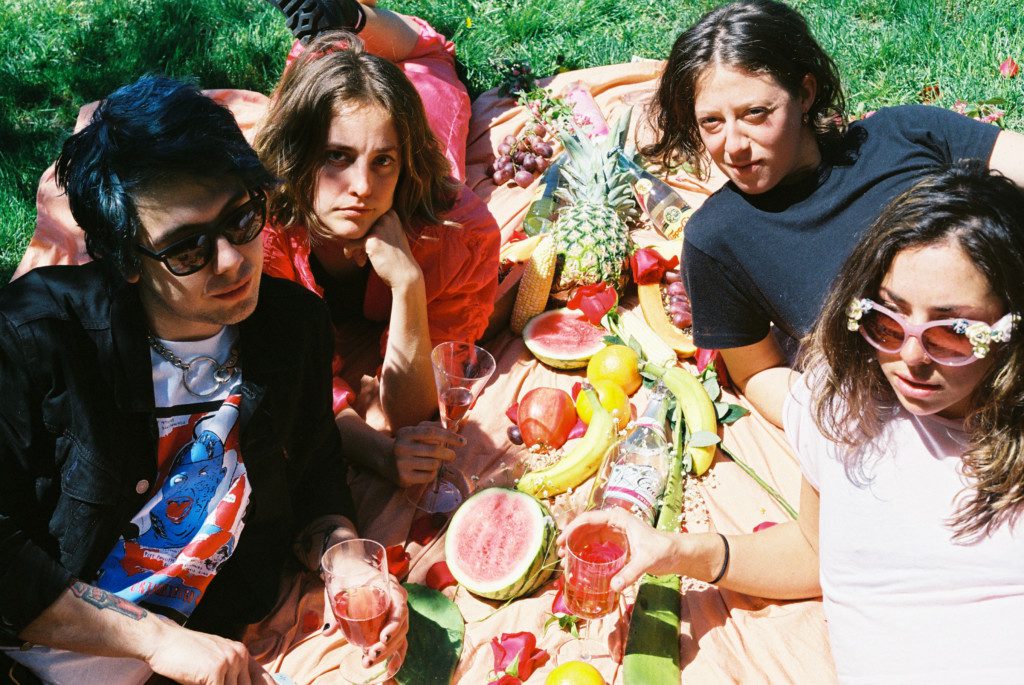
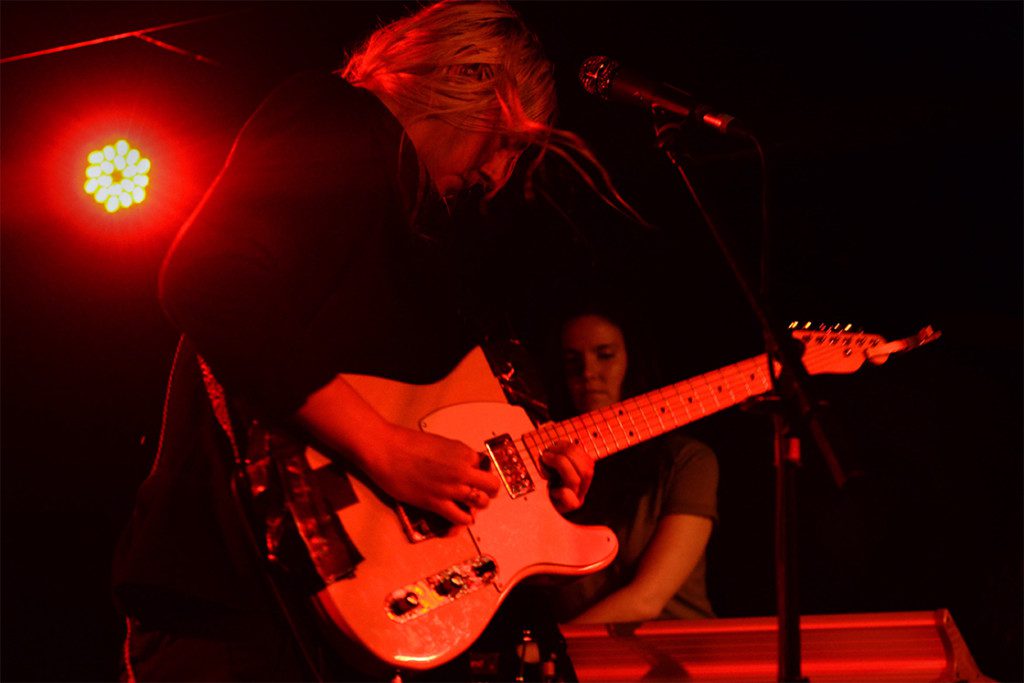
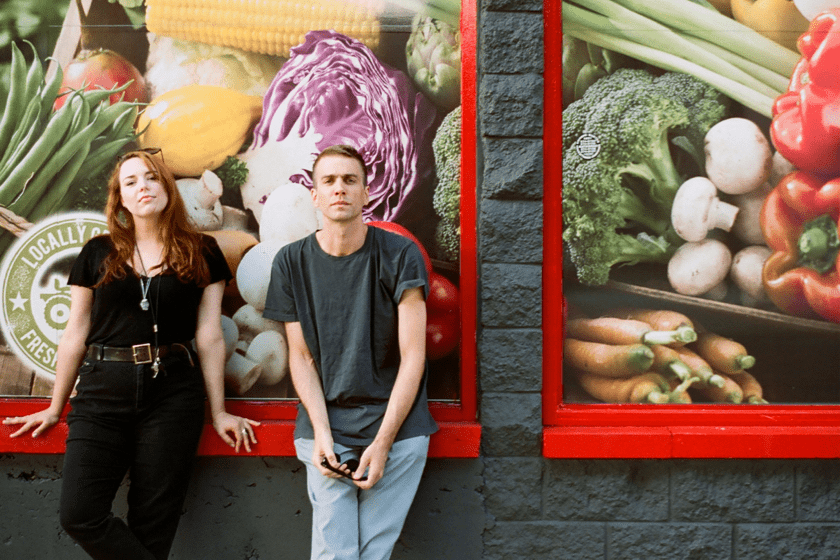
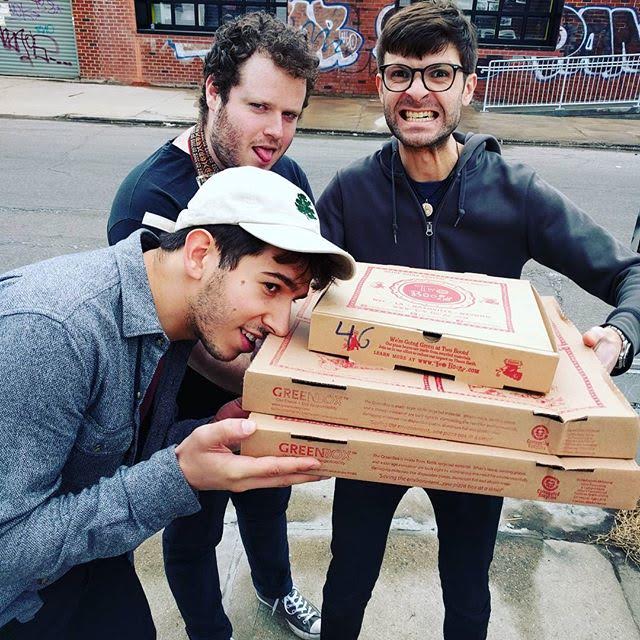
Bizarre Sharks has a similar origin story but have succeeded in creating a real band that sounds exactly like what my middle schooler self dreamed of. “Tremendous” is the first single from their EP, which was written and recorded in only one day by a group of five friends after ordering some pizza. It’s a familiar sounding Pixies-esque pop rock anthem that features Jake Becker (of  El Silver Cabs) and Laura Gwynn (of  Sirs&Madams) on vocals, Mike Seidenfeld (also of El Silver Cabs) on drums, Darrel Dumas (of The Royal They) on guitar and bassist and producer Terry Edelman (of Lost Kingdoms) who recorded, mixed and mastered all the tracks at his Brooklyn basement studio SpaceJam. “Tremendous” is super addicting and has one of those guitar solos that you’ll eventually sing along to. I’ve been playing it on repeat at the pizza place where I currently work throughout this past week and I am so excited for their release show (which may be their only show ever) at Elsewhere on December 8th.

Check out the rest of our Track of the Week playlist below…

ONLY NOISE: Christmas Wrapping

I’m not one to jumpstart holiday season. For the previous nine years, I’ve left Christmas shopping until December 23rd – and if it weren’t for my annual Christmas Eve flight, I’d likely wait another day. As of now, I haven’t even begun making my Christmas list, on which I assign gift ideas to relatives. This usually occurs on December 22nd. Fortunately, my unquestionably kinder and more responsible older sister texted me earlier this week, asking if a certain member of our family would or would not like a couple of albums she was considering gifting them (I can’t get too specific for obvious reasons, unless I want a lump of coal for Xmas for ruining surprises).

In 2017, buying an album for someone’s Christmas present is a little weird. A staggering number of listeners can find the music they want via streaming services, and though the vinyl industry has made a robust comeback, my sister is not talking about vinyl.

In my family, a CD is still a 100% acceptable gift to give and receive. My dad still has two wooden shelves of them, towering next to his vinyl collection in the dining room-cum-office. His collection is growing, too, as a favorite weekend pastime of his involves visiting the bargain bins at the local Silver Platters. He typically gives me a report of any new purchases, including how big of a deal he scored.

In a way, the CD has simplified gift giving in my family. It’s cheaper (and more flight-friendly) than vinyl. Sure, it’s more expensive than an MP3, but you can’t exactly wrap an MP3, now can you? Regardless of your family’s preferred musical medium, here is a shopping list of new albums for the whole family: from moms to dads, brothers to cats.

Mom: Not Even Happiness by Julie Byrne

My mom would probably prefer the new Quiet Riot record, but I’m not going to recommend that for your mom, who is probably a far classier lady. Julie Byrne’s sophomore album Not Even Happiness is, dare I say, indisputably gorgeous. Byrne’s lyrics are devastating and poignant, formed from her wind-song voice. Mom can do about anything to this record: drive, read a book, sip some wine, or simply listen intently on a Sunday evening.

Dad: Semper Femina by Laura Marling

I’d say it’s a pretty good time for men to listen to overtly feminist music, and this is a great feminist record by brilliant songwriter Laura Marling. Marling’s writing expertise matches her guitar playing and steely-sweet voice, of which she has astonishing control. She can reach soprano heights in one bar, and plumb the depths of early Fiona Apple in the next. Songs like “Wild Fire” and “Nothing, Not Nearly” codify Marling as a master of the craft, weaving soul, folk, and pure poetry into accessible pop melodies.

Sister: Ash by Ibeyi

A record of, by, and for sisters, brought to you by Naomi and Lisa-Kaindé Diaz. The French-Venezuelan Afro-Cuban twins give a whole new meaning to the word “sisterhood” considering their highly collaborative songwriting process. Ash, the duo’s sophomore LP, is steeped in messages of racial equality and female empowerment, the later shining through in cuts like “No Man Is Big Enough for My Arms” which features samples from a Michelle Obama speech. “The measure of any society is how it treats its women and girls,” Obama insists. I’m sure your sister (and hopefully your entire family) will agree.

Brother: DAMN by Kendrick Lamar

This record needs no introduction, nor explanation. Kendrick has done it again! Plus, gifting this to your brother ensures great one-liners to pen inside the corresponding card. For example: “Why don’t you already own this, are you living under a rock?” and “Bitch, be humble.”

Aunt who’s into crystals: A Common Truth by Saltland

One of my all-time favorite joke-news headlines read: “Local Woman Believes In Crystals But Not Herself,” a hilarious dig, but one you have to shelve during the holidays. In all seriousness, Saltland’s atmospheric A Common Truth is both a stunning record and a perfect present for someone who’s into “vibes.” Cellist Rebecca Foon collages rippling soundscapes atop sparse vocals extolling environmental preservation. Also, there is literally a crystal on the album cover.

Uncle who rides a Harley: Villains by Queens of the Stone Age

I’m not going to lie, I’m not a big Queens of the Stone Age fan, and I don’t love this record… but your uncle will. Just imagine him ripping open the wrapping paper to find a dude in a motorcycle jacket and the devil himself riding on the back of his bike. He will undoubtedly shout “bitchin’!” and take you out for a spin before dinner.

Your significant other Your Ex: ÷ by Ed Sheeran 

Step one: burn Sheeran’s insufferable third album onto a blank CD. Step two: write, “Best Bands of 2017” on the disk in sharpie, mixtape style. Step three: send it anonymously. Hopefully it will take your ex a while to realize he’s been listening to Ed Sheeran unwillingly.

Your Cat: Music For Cats by David Teie

A record designed to please Mr. and Ms. Kitty. David Teie, a soloist with the National Symphony Orchestra, developed Music For Cats with animal scientists. The result is a lovely mélange of string swells, birdsong, and of course, purring. Though it’s “for cats,” it’s a score I’d be happy to listen to with or without a feline companion. The standout track? “Katey Moss Catwalk,” of course.

PLAYING COLUMBUS: Kizzy Hall & Diet Cig @ Ace of Cups

All photos by Kaiya Gordon

“Y’all Ohioans know how to do rock bands in a way the rest of the country is trying to catch up to,” said Caleb Cordes of Sinai Vessel on Sunday night at the Ace of Cups. The band was following Columbus’ own Kizzy Hall, who opened the show with a fast-paced set that, yes, did reek of rock-and-roll.

It was clear that the crowd took pride in their Ohioan roots, cheering as Cordes gave his shout-out, and dancing with vigor throughout the night. As the night opened, hometown fans crowded the stage to sing Kizzy Hall’s lyrics back to the band, taking selfies and, later, collecting set-lists.

[fusion_builder_container hundred_percent=”yes” overflow=”visible”][fusion_builder_row][fusion_builder_column type=”1_1″ background_position=”left top” background_color=”” border_size=”” border_color=”” border_style=”solid” spacing=”yes” background_image=”” background_repeat=”no-repeat” padding=”” margin_top=”0px” margin_bottom=”0px” class=”” id=”” animation_type=”” animation_speed=”0.3″ animation_direction=”left” hide_on_mobile=”no” center_content=”no” min_height=”none”]

Kizzy Hall

When headliners Diet Cig finally took the stage, Ace of Cups was vibrating with enthusiasm.

“I feel like Ohio gets a bad rap,” said singer Alex Luciano, as she opened the set. “But every time we’re out here, I [/fusion_builder_column][fusion_builder_column type=”1_1″ background_position=”left top” background_color=”” border_size=”” border_color=”” border_style=”solid” spacing=”yes” background_image=”” background_repeat=”no-repeat” padding=”” margin_top=”0px” margin_bottom=”0px” class=”” id=”” animation_type=”” animation_speed=”0.3″ animation_direction=”left” hide_on_mobile=”no” center_content=”no” min_height=”none”][think] this is the best place in the world.” She continued: “We’ve played at the Ace of Cups a few times and each time has been dreamy…y’all are so nice and cool here, and good looking, and punk!”

Diet Cig is notorious for their high-powered live performances, and though Luciano was hindered by a torn ACL, the duo still played with force. On drums, Noah Bowman is unassuming but relentless, driving Luciano’s guitar riffs to their peaks. And Luciano, regardless of dancing ability, is magnetic onstage. As she sways, twists, winks, dips, and–of course–makes her signature high-kick, it’s hard not to look on with glee.

“Raise your hand if your crush is here,” said Alex, at the beginning of  “Maid of the Mist.” “During this quiet song you can look at them and wink. Or, if you can’t wink…blink twice.” Later in the set, during what Luciano called the “makeout interlude,” she said: “if you blinked at someone earlier, now is the time to kiss them.”

Though critics of Diet Cig find fault in the band’s saccharine qualities, I found it moving to be in a space where I could trust the musicians onstage to go to bat for each other, and for the crowd.

“A lot of times women, and queer folks, and trans folks, and non-binary folks get told that their voice doesn’t matter,” said Luciano at the end of their performance. “But it does matter. Thank you for coming and for taking up space here.”

Luciano also thanked survivors of sexual assault, saying, “It’s a radical act to be out at a show right now.”

Space, or lack of it, is a constant theme in Diet Cig’s work, and while I think it is all too easy to step on somebody else’s toes in the name of taking space, without considering the ways that one is structurally set-up to inhabit that space already, watching Luciano move freely around the stage is joyful. And I am grateful for the attention that the duo pays to creating a “safer space” at their shows.

Standing in the crowd, relieved to be done with the pressured social niceties that come with Thanksgiving, and thankful to be watching a band that is always so entirely themselves, I felt prepared to take on the world for the first time in a week.[/fusion_builder_column][/fusion_builder_row][/fusion_builder_container]

PLAYING DETROIT: Brother Son Debut Young & Pretty LP

A little over a year ago, Francis Harrington and Chris Pecorelli met on their first day working at Westborn Market. Last weekend, their band, Brother Son, released their debut album, Young & Pretty. The album is a youthful slice of rock-pop pie, dancing between shiny Brit-pop and classic rock n’ roll.

Harrington, lead vocalist and guitar player, says that he feels fate has a lot to do with the rate and trajectory in which the band has progressed so far. Once he met Pecorelli (drums) at work, they quickly started playing music together and it was an instant match. The duo added Jimmy Walkup (bass) and Drew Gijsbers (keyboards) to the mix and thus, Brother Son was born. “We all have the same mindset and vision in our minds on where we want to take our music,” says Harrington.

That mindset pretty much entails enjoying life, not taking themselves too seriously, and definitely wanting you to know that they smoke a lot of pot. While the record harbors a few coming-of-age heart-wrenchers like “Growth” and “Truth Inside,” it also makes room for carefree slacker anthems like “Blue Dream,” where the main chorus lyric is “I’m such a fucking stoner.”

“All four of us are indeed mother fucking stoners,” says Harrington. This would explain the band’s admiration of psychedelic-alt artist, Mac Demarco, whom they cite as one of their heaviest influences. Alabama Shakes, The Beatles, and The Strokes are among other artists that Harrington says influence the band as a whole when aiming for a “happy, beautiful, and inviting” sound.

Harrington’s voice easily glides between brooding rock n’ roller and pleasant falsetto, giving the songs an Arctic Monkeys-esque feel. A promising debut full of hooky guitar licks and a healthy amount of “oh-oh’s,” Young & Pretty is pretty much exactly what you would expect from four earnest early twenty-somethings with a penchant for feeling good.

Brother Son is headlining El Club in Detroit, Michigan on December 30th and plans to head out on a Midwest tour in Spring of 2018.

PET POLITICS: Shari Page of THICK

[fusion_builder_container hundred_percent=”yes” overflow=”visible”][fusion_builder_row][fusion_builder_column type=”1_1″ background_position=”left top” background_color=”” border_size=”” border_color=”” border_style=”solid” spacing=”yes” background_image=”” background_repeat=”no-repeat” padding=”” margin_top=”0px” margin_bottom=”0px” class=”” id=”” animation_type=”” animation_speed=”0.3″ animation_direction=”left” hide_on_mobile=”no” center_content=”no” min_height=”none”]

photo by Devon Bristol Shaw

I hope everyone is sufficiently stuffed from Thanksgiving and had a chance to cuddle up with some fluffy friends over the long weekend! Make sure you chop up some of those leftovers for your pets to show your appreciation. If you don’t have a furball bestie what the heck are you waiting for?! November is Adopt-A-Senior-Pet Month; if you’re in NYC, check out one of the many great rescue programs for senior and special needs pets we’re very fortunate to have, or find a local no-kill shelter to support near you.

For this month’s column, I had the pleasure of talking to the lovable Shari Page, drummer of THICK, before the holiday weekend. THICK has been crushing the music game more than ever, recently opening for Cherry Glazerr and receiving a mention in The New York Times. I had the chance to watch them in action again a few weeks back when Sharkmuffin played a show with them. As usual, they were vivacious and fierce – a melodic but explosive live act. Shari is tough on the kit, but also one of the most affable personalities in the Brooklyn music scene. Check out her spirit animals, those she assigned for her band, and her history of pets!

AF: What is your favorite type of animal?

SP: I love dogs, and all animals, but I have such a soft spot for mutts.

AF: How would you say your personality correlates to this species?

SP: I think dogs are very goofy, loyal, and compassionate. I hope I am also! Growing up, I sort of felt like the mutt amongst the bichons. My town wanted to breed people to all go to the same colleges, have the same jobs and interests, so I found myself trying to always do the opposite.

AF: What is your spirit animal?

SP: Bloodhound.

AF: What do you think your bandmates’ spirit animals are?

SP: I think Nicole’s spirit animal is Tails and Kate’s is Sonic (from the video game).

AF: Where did you grow up and did that have any bearing on the types of pets you were able to tend to?

SP: I grew up on Long Island, and we always adopted cats and dogs. Since it was the suburbs, we were able to have a cat that could go outside and come back. I used to jump with my dog Bud on the trampoline in my backyard. My cat Rockey would eat mac and cheese with me.

AF: Who was your first pet? What type of animal was it and how did you come to care for it?

SP: My first pet was a dog named Apache. He’s the childhood mascot for my friends. He was a bloodhound mutt mix. I used to always walk him, and play with him. I took him everywhere. He was the sweetest animal. He used to open the fridge when no one was home, and take all the food out. We would find cold cuts all over the living room floor! He was famous for drooling on everyone.

AF: How many pets have you had over the course of your life?

SP: I’ve had four dogs and two cats, who were all adopted.

AF: Is there any “dream pet”—real or fictional—that you always wish you had?

SP: I always wanted to have Yoshi as a pet. I feel like we would go on a bunch of adventures together. I also would love to have a magical pug named Townes.

AF: What are your current pets named, how old are they, and what type of animal are they?

SP: I have two dogs named Raine and Rocket. Raine is 10 and Rocket is 4. Raine is a dalmatian/pit bull mix. Rocket is part brussels griffon/mystery.

[/fusion_builder_column][fusion_builder_column type=”1_1″ background_position=”left top” background_color=”” border_size=”” border_color=”” border_style=”solid” spacing=”yes” background_image=”” background_repeat=”no-repeat” padding=”” margin_top=”0px” margin_bottom=”0px” class=”” id=”” animation_type=”” animation_speed=”0.3″ animation_direction=”left” hide_on_mobile=”no” center_content=”no” min_height=”none”]

Rocket is a little snuggle bear!

AF: Do you have a favorite animal-themed song?

SP: The Wishbone theme song, and not just because I had the coolest Wishbone lunch box growing up!

AF: When did you start drumming?

SP: I started taking lessons in third grade. I went to an event where you sign up for activities, and my mom suggested drumming. When I couldn’t afford a drum set, I would pretend a chair was a drum set and learn Blink-182 songs. I would just play the beats by hitting the chair. I finally saved up babysitting money when I was 13 and got a used drum set!

AF: Was there anything in particular that you can point to as an “a-ha!” moment in your life that launched your career?

SP: I think playing shows and having anyone there is an amazing feeling. I was playing in bands for 10 years, and all you want as a band is for someone to be at your shows. We recently played a show with Cherry Glazerr, and there were a bunch of people moshing and going crazy. I was once that kid at shows in the mosh pit, watching bands, and going “ I want to do this one day.” I don’t think of the launch, but the next positive thing for THICK, and anyone and their mom or dog who will listen to our music.


AF: How did you come to meet Nicole and Kate? Tell me a little bit about the history of THICK.

SP: I was randomly on craigslist, and saw a post that said “two girls, one drummer.” It said they were around my age and into Blink-182. This was everything I’d dreamed of! Making a pop-punk all girl band. Nicole and I would see Kate in the air at every show (she was always crowd-surfing or moshing). When our old bassist left, Kate joined, and the rest is history!

AF: What do you consider your greatest accomplishment to be as a musician thus far?

SP: Having a band that works as a team. I feel so happy to be able to play music with genuine people who I can call my best friends. I’m so proud of Nicole and Kate for all the hard work and rock n’ roll that they keep doing. I’ve been in bands since I was 17, and my college band must have had 100 different members. I really never gave up on myself or music, and I hope we can influence anyone to do the same… that’s the real accomplishment!!

AF: Any big plans for THICK this year?

SP: One of our goals as a band was to play with Diarrhea Planet, which is happening on New Year’s Eve. It’s very surreal. I think Nicole said she would retire if we ever got to play with them. We were also featured in the New York Times this year, I’m still pinching myself to wake up…

AF: Are you anticipating seeing any animal pals over the holidays?

SP: I’m going to be visiting my parents in Florida, and seeing my dogs. I’m going to be spending my birthday and Thanksgiving watching TV with my dogs, and feeding them pretzels (don’t tell anyone). They like to binge watch Lock Up with me on Netflix.


AF: Have any animals or pets ever influenced your songwriting?

SP: Having pets taught me everything about connections. We can’t speak the same language as our pets, but we feel the same love, loyalty, compassion, and connections. I feel the same way toward music.

[/fusion_builder_column][fusion_builder_column type=”1_1″ background_position=”left top” background_color=”” border_size=”” border_color=”” border_style=”solid” spacing=”yes” background_image=”” background_repeat=”no-repeat” padding=”” margin_top=”0px” margin_bottom=”0px” class=”” id=”” animation_type=”” animation_speed=”0.3″ animation_direction=”left” hide_on_mobile=”no” center_content=”no” min_height=”none”]

Have a snoot boop courtesy of Raine, Shari’s dalmatian/pit mix!
[/fusion_builder_column][/fusion_builder_row][/fusion_builder_container]

#IndigenousWomenRock: 5+ Contemporary Artists You Should Know

How many Native women have you supported today?

If the answer is none, think about why that might be. Do you interact with Indigenous populations? Are you spending time and energy learning about Native organizations and movements?

If Indigenous women aren’t popping up in your timeline or on your street, it isn’t because they don’t exist; rather, the lives of Native Americans, particularly Native American women, are specifically overlooked by institutions of power, including media outlets, health organizations, universities, and more. But whether we are looking or not, Native Women are living and creating in the current day. Contemporary Indigenous art is filled with innovative women making work worth watching, reading, and listening to.

Whether you are spending today with family or friends, take some time to invest in the lives of Indigenous women by viewing, sharing, and paying for their art. Aren’t sure where to start? Check out our list of five contemporary Native American artists to watch below.

Raye Zaragoza

Zaragoza released her debut album in June of this year, but she’s been playing and writing music since childhood. Fight For You is a breezy eight-track collection, brilliantly highlighted by Zaragoza’s clear, relaxed voice. The album’s content is deeply impacted by Zaragoza’s multi-ethnic and national background, as well as the Native Peoples’ fight for clean water and against the Dakota Access Pipeline. Of the album, Zaragoza says: “My goal with this album is to inspire people to fight for what they believe in. Our voices can be heard – we just have to choose to use them!” A portion of the album’s proceeds will be donated to Indigenous rights organizations.

Miracle Dolls

Twin sisters Dani and Dezy are based in Southern California, but they regularly tour the country to mentor youth through the Native American Youth Music Program, which they founded. The two strive to bring guitars to every Native American reservation, alleviating the pressures of historical trauma on Native youth by providing a creative outlet. Their recent video “Sweet Grass / Water is Life,” influenced by the impacts of oil pipelines on their Hidatsa Waterbuster Clan community, was screened at the 42nd American Indian Film Festival in San Francisco.

Princess Nokia

Destiny Frasqueri, known as Princess Nokia, recently went viral when she was filmed throwing soup at an aggressive man shouting slurs in a New York subway car. But Frasqueri’s advocacy work goes far beyond subway intervention. Outside of her work in the studio, Frasqueri heads “Smart Girl Club,” a collective which seeks to provide safe space for and encourage collaboration between women of color, through the lens of “urban feminism.” Her first studio album, 1992 Deluxe, reflects this message of informed and inclusive feminism: tracks like “Brujas” highlight Frasqueri’s connection with her Afro-Indigenous family and their traditions, while breakout hit “Tomboy” centers her experiences as a New York youth. 1992 Deluxe, which was released in September of this year, is already making year-end lists, and for good reason.

Samantha Crain

Crain’s 2017 album, You Had Me At Goodbye, is decadently instrumental: confessional and emotionally compromising music which devastates at the same time that it uplifts. Next time you feel like treating yourself to a good cry without, you know, having to listen to Sufjan Stevens, take a trip through Crain’s oeuvre. Crain is barely 30, but You Had Me At Goodbye is her fifth full-length album; after recording music for more than ten years, her album notes state that she “wanted to have some fun.” Though You Had Me At Goodbye isn’t exactly dance music, there’s a noticeable level of play within the artist’s enigmatic lyrics and sound choices.

Laura Ortman

An accomplished composer of independent film scores, Ortman’s own music is visceral and compelling, drawing on her skill as a classical musician as well as a love of experimental sound composition. She’s a prolific artist, with 22 releases on bandcamp alone, as well as a number of prestigious awards under her belt, but manages to make each release pleasantly surprising. Her latest album, My Soul Remainer, was released in June of this year.


And because the “Americas” extend north of the border as well, here are a few Canadian artists I can’t stop listening to.

Tanya Tagaq

Tagaq has been making waves since winning the Polaris Prize with her 2014 album, Animism. Her latest, Retribution, is breathtaking. It’s the type of album you listen to once, and then send to everyone else you know.

Sonia Eidse

Eidse’s bandcamp describes her music as “mellow alt-pop,” but frankly, I don’t find anything about her voice to be mellow. Her self-titled EP, released in 2016, is dreamy; with each note stretched as far as possible, Eidse’s vocal performance lands like a silk parachute, or a slow-rolling fog.

Iskwé

On The Fight Within, released earlier this month, Iskwé pairs modulating vocals with lush, electronic beats. Dissect it or dance to it–Iskwé’s music is moving, both in its content and message, and in the music’s heavy, visceral sway.

ONLY NOISE: Thanksgiving Dinner

Thanksgiving is a controversial holiday with a wretched color scheme. The Hallmark credo of thankfulness is thin when stretched against this country’s historical relationship with Native Americans. The shirking of materialism is undercut when Black Friday rolls around. To many, Thanksgiving is merely a day to get tanked, watch college football, and shout about politics with Uncle Larry.

Holidays are hard for me. I’m not religious, my family lives 3,000 miles away, and if I did live closer to them, I’d have to decide which half to celebrate with. I don’t like the premise of most holidays either – the fact that we need a nationally ordained day to eat a meal together and be thankful has cynical implications – as if we aren’t thankful for the food we share together the remaining days of the calendar year. As you know, I could easily play the curmudgeon and pick these things apart to forever, but there is one thing Thanksgiving has going for itself that I just can’t knock: the food!

A delicious meal is a delicious meal, and I’m thankful for all of them, but Thanksgiving dinner is a particularly iconic spread of dishes only Americans can understand – like, say, canned cranberry sauce and mini marshmallow encrusted sweet potatoes. The Turkey Day smorgasbord is vast and overwhelming; gluttonous and nap inducing. In fact, it is so immense that I’ve put together a soundtrack to help us waddle through each course.

The Turkey

We don’t call it “Turkey Day” for nothin.’ You don’t have to hang your kids hand-traced paper turkey art on your fridge each year for nothin’ either. The turkey is the main event on Thanksgiving, and whether you’re the one butchering it, cooking it, or simply eating it, the big bird that goes “gobble gobble” is going to affect your life this week. So why not give the poor bird a song? “Stuffy Turkey” by Thelonious Monk is a great place to start – a classy jazz number to score the bird’s arrival, all glazed and brown and stuffed. Follow it up with the frantic “Turkey Chase” by Bob Dylan as you and your family members squabble over precious dark meat morsels. And finally, blast Butthole Surfers’ “Turkey and Dressing,” which will provide the necessary aggression to finish your plate of food, and weather Uncle Larry’s xenophobic rants.

Stuffing

When Peaches sings, “I see you sittin’ and stuffin’ your face/Why don’t you stuff me up?” on 2003’s “Stuff Me Up,” she is clearly personifying the Turkey in your kitchen, begging to be filled with breadcrumb dressing, aka “stuffing.”

See also: “Stuffy Turkey.”

Mashed Potatoes

What would Thanksgiving be without a vat of butter sodden mashed potatoes? Just another Thursday, that’s what. There are a lot of songs that pay tribute to the “mashed potato,” referring to the wildly popular 1960s dance move. Rufus Thomas’ “Mashed Potatoes,” however, is a tune that rightfully exalts potatoes in their many forms, be they “French fried potatoes” or the titular, macerated kind. For purists, The Ventures’ ode to the side dish, “Mashed Potato Time” has but two lyrics: “Mashed” and “Potatoes.”

Gravy

It appears that Dee Dee Sharp’s “Gravy (For My Mashed Potatoes)” may be a grotesque sexual innuendo, but at least it’s spot on for Thanksgiving Dinner. Like Sharp, we likely won’t get through the evening without shouting, “C’mon baby/I want some gravy!”

Rock n’ roll has been good to gravy, as there are countless songs that reference the rightful sidekick to turkey and mashed potatoes. Gravy grooves range from the instructional (Paul Kelly’s “How To Make Gravy”), traditional (George Benson’s “Giblet Gravy”), and of course, the addictive (“Nicotine & Gravy” by Beck).

Sweet Potatoes

The idiosyncratic orange cousin of russet potatoes, sweet potatoes come in many forms. Baked whole, sliced au gratin, glazed, and of course: mashed and smothered in tiny marshmallows. In the music world, sweet potatoes seem to have as much clout – and erotic overtones – as gravy. As Lonnie Johnson sings in the searing “Sweet Potato Blues,” “If you want sweet potatoes/Bake it in my pan.” For a less raunchy take, check out Pete Seeger’s family-friendly “Soon As We All Cook Sweet Potatoes.”

Green Bean Casserole

There is an unjust deficit of green bean songs on the Internet, and even fewer that mention the congealed, Turkey Day staple we refer to as Green Bean Casserole. What I have found in the musical spirit of hericots verts has been pretty dismal. Especially “Green Beans,” a warbled electro cut that slanders its namesake ingredient by repeating, “I don’t like green beans” through a vocoder too many times. The most practical application of this song would be as a punishment for children who don’t eat their vegetables. Weary parents of picky eaters should make them listen to it fifty times in a row.

Cranberry Sauce

If you thought there weren’t enough songs about green beans, then you’ll be horrified by the dearth of cranberry sauce ditties. Such a peculiar condiment deserves to be memorialized in song. Alas, the closest we can get to an aural rendering of that red, gelatinous cylinder is ‘90s Irish alt-group The Cranberries. Their catalogue may be pretty food-reference-free, but songs like “Ode To My Family” and “No Need To Argue” fit perfectly with the relatives-around-the-table theme of Turkey Day. And who could forget “Linger” – the band’s biggest hit, which could very well reference the relentless food coma that looms post-feast.

Pumpkin Pie

Last, but certainly not least in our festive meal is dessert. Though different tribes may take their coffee with a variety of sweets, pumpkin pie is the poster pudding for Thanksgiving. It is also (much like mashed potatoes, gravy, and sweet potatoes before) a euphemism for genitalia. Look no further than The California Honeydrops’ ditty “Pumpkin Pie” (off of the subtly titled Spreadin’ Honey LP), which begs in a brazenly possessive manner, “Won’t you save all your pumpkin pie just for me, girl?” A similar winking nastiness can be found in Bob Dylan’s 1969 number “Country Pie,” which nods to pies of pumpkin, and many other flavors. Let’s just pretend these songs really are about pie for one night, what do ya say? Your family will thank you for it.

PLAYING DETROIT: Snoh Aalegra Captivates El Club

Masses of R&B junkies flocked to Detroit’s beloved El Club this weekend to see Toronto’s Daniel Caesar. However, if the crowd came for the heavenly vocals, hooky chorus lines and earnest lyricism that Caesar has come to be known for, they were pleasantly surprised by his opener, Snoh Aalegra – the Swedish R&B-soul singer who was discovered by none other than Prince four years ago when she first came to the States to pursue her music career. With Prince as a mentor, Aalegra began to create her unique sound, inspired by Swedish pop sensibility, American R&B legends and Persian poetry.

“I always knew that I had to come here because R&B and soul is rooted in the states and I had to come here and work with the people who do it the best so I can become the best I can be,” saya Aalegra. So, she moved to LA in 2014 and signed with Sony almost right away. It wasn’t long before Aalegra realized the label was pushing her in a direction she didn’t want to go. Luckily, as fate would have it, The Purple One came to the rescue.

“Literally the day after I signed, Prince called Sony and was like, ‘Can I get in touch with this artist?’’’ Snoh reminisces. “I couldn’t believe it because he’s one of the major idols in my life… he was one of the biggest voices telling me to get out of my deal.” Free from the confines of a major label, Aalegra was able to write her music the way she wanted to, infusing the elements that make her unique – her multicultural background and love for classic R&B.

“I speak three languages and each language – Swedish, Farsi, English – has so much beauty and depth to it,” Aalegra explains. “Farsi is very, very deep. There’s certain things you can’t even translate.” Despite her diverse background, Aalegra says she was surrounded by American R&B from an early age. “My mom didn’t play so much Persian music at home,” says Aalegra. “She played Shirley Bassey and a lot of Whitney Houston and soul music, so I discovered that kind of music at home. But then, I got really into Persian poetry and I think that has affected my writing a lot.”

When writing a song, Aalegra pulls on the influence of her idols – she cites Prince, Michael Jackson, Whitney Houston, Stevie Wonder, Mariah Carey, Brandi and Lauryn Hill – along with the emotional depth of her native tongue. Her efforts have paid off -in October, she released her debut full-length, FEELS, the follow-up to her 2016 EP Don’t Explain.

These multicultural muses and the fact that she writes all of her own music are what set Aalegra apart from other R&B divas. Performing on El Club’s modestly sized stage with a four piece band, Aalegra shone in a stripped down set that would otherwise expose the less talented. More traditionalist songs like “Fool For You” and “Nothing Burns Like the Cold” nod to Aalegra’s admitted Stevie Wonder and Whitney Houston obsessions, while “You Got Me” and “Time” serve as a tribute to 90’s R&B. Throughout the show, Aalegra’s sultry voice floated through the decades with ease, creating a timeless sound that won’t soon be forgotten.

CHECK THE SPREADSHEET: Band Vans

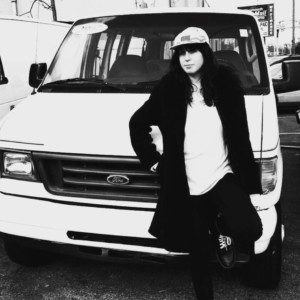
Every band who tours frequently has an unspoken member who doesn’t play on any records, yet is instrumental in reaching fans’ ears in far away places. I’m talking about the vehicle responsible for getting the band to their next show, and hopefully, the show after that. If you want to go on tour you have a few transportation options: renting a vehicle, borrowing a friend’s vehicle, or buying your own vehicle. I personally believe buying your own tour van is the best investment for a band whose intent is to tour often. I have found two semi-reliable used vehicles within my budget (less than $6000) that we have put 60,000 miles of touring in the past 3 years. There’s Patrick, a 1995 Dodge Caravan, and Abby “The Abyss,” a 2007 Ford 11-passenger Econoline E-150.

First, the important stuff: how does a band van get its name?

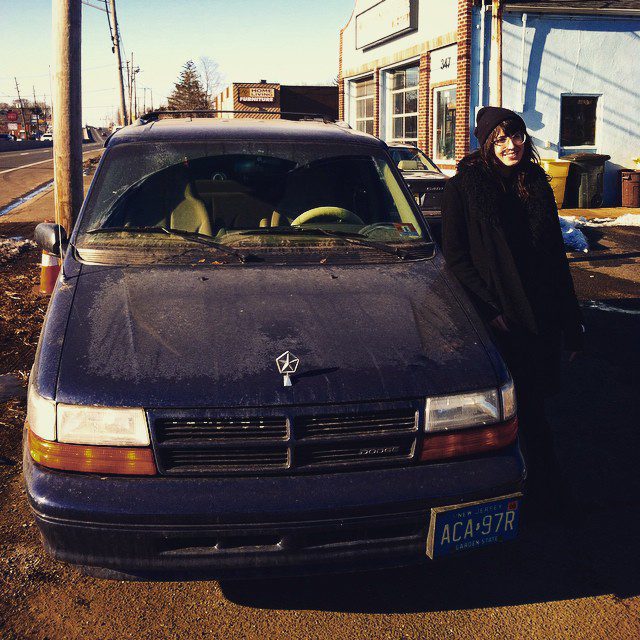
Sometimes it’s obvious. I found my first minivan at a mechanic in New Jersey for $1500. It was given to the mechanic because the owner had passed away. The previous owner’s address and name, Patrick, were still on the van key chain. There was a bottle of wine in the trunk and a little handwritten notebook of the dates of every oil change the van had ever gotten in the glove box.

The bottle of wine exploded in the trunk before I had a chance to open it and the radio/cassette tape player worked very erratically, leading us to believe that Patrick’s spirit was still with us. The van had relatively low millage for a 20+ year old vehicle (under 100,000) and the mechanic told us Patrick didn’t leave NJ much, so it made sense that his spirit would want to go on adventures with a three piece girl rock band.


Sometimes it takes a tour. The next vehicle I purchased was an 11 passenger Econoline in January 2017 for $5,500. Chris Yaniack from Little Dickman Records spotted it at a used car dealership in Asbury Park, NJ. Ex-Girlfriends did tri-state area gigs in the minivan, but it was a tight squeeze for 5 fully grown women. The first tour we did in the Econoline was a double Sharkmuffin/Ex-Girlfriends tour in March 2017 to SXSW and back, and naturally everyone’s belongings kept disappearing. For this reason, it was lovingly dubbed “The Abyss” or “Abby” for short.

[fusion_builder_container hundred_percent=”yes” overflow=”visible”][fusion_builder_row][fusion_builder_column type=”1_1″ background_position=”left top” background_color=”” border_size=”” border_color=”” border_style=”solid” spacing=”yes” background_image=”” background_repeat=”no-repeat” padding=”” margin_top=”0px” margin_bottom=”0px” class=”” id=”” animation_type=”” animation_speed=”0.3″ animation_direction=”left” hide_on_mobile=”no” center_content=”no” min_height=”none”]

Inside of Sylvia (Photo by Jay Malone)

In February 2017, before we took Abby on the road, Ex-Girlfriends did a cross country tour with Brooklyn surf-noir babes Fruit & Flowers in their 1994 party bus turned band bus. We made it from Brooklyn to San Diego in four days with stops in Carborro, NC, Nashville TN, and Armallio, TX, then toured up the west coast to Seattle and after our last date together Fruit & Flowers drove it straight from Seattle, WA to Austin, TX for SXSW.

Here is their bus origin story…

FRUIT x FLOWERS: buy a bus by Thomas Ignatius.

Starring Caroline & Ana (role of Ana is played by Caro’s friend Nikki)

We chatted with Ana of Fruit & Flowers about Sylvia the bus.

[/fusion_builder_column][fusion_builder_column type=”1_1″ background_position=”left top” background_color=”” border_size=”” border_color=”” border_style=”solid” spacing=”yes” background_image=”” background_repeat=”no-repeat” padding=”” margin_top=”0px” margin_bottom=”0px” class=”” id=”” animation_type=”” animation_speed=”0.3″ animation_direction=”left” hide_on_mobile=”no” center_content=”no” min_height=”none”]

Photo by Jose Berrio

AF: How did Sylvia get her name? How did Sylvia get so much graffiti? 

Ana: Sylvia got her name from her former owner, Dave Lotito, who sold her to us. The naming process kind of reminded me of my old pet cat, Herman (RIP). We adopted Herman thinking the name was goofy and we’d think of another one – “Hermes” was one suggestion that I liked. But at the end of the day, Herman was just a Herman. Nothing else really worked. Same went for Sylvia.

Sylvia got the graffiti over time – the first big piece got added in Chicago. 1-UP. After that, it was like the floodgates opened. Now there are layers on layers of graffiti pieces. The big 1-UP on the side is covered up now, but I liked that one a lot. The big skull with a watermelon hat that currently graces the side is my favorite piece to date. Caro says that piece is by Kool AD. It’s really pushed me to embrace transience. You can’t get attached to any of the art, because it may be gone tomorrow.

AF: What’s the craziest story involving Sylvia that has happened on tour?

Ana: The absolute craziest Sylvia experience we ever had wasn’t actually while we were on tour. We were coming back from a show in Manhattan, and giving a bunch of friends a ride back with us. Caroline was driving, and we realized we were dangerously low on gas as we approached the Williamsburg Bridge. “There’s always a reserve gallon, just go for it,” one of the acquaintances yelled from the back.

The rest of that story goes about as wildly wrong as you might imagine. I won’t go into the details because it’s mildly traumatic, but you can ask Micah or Bill from Grim Streaker. I’m sure they’d gladly relate the tale.

The craziest tour story is from when she broke down in Canada, two hours from the Michigan border. We had to cancel two shows, because Sylvia flatly refused to leave Canada. But it all worked out because we met our Canadian mom and dad who let us stay in their lovely home, in a serenely beautiful place, and took care of us. Tour angels for sure.

[/fusion_builder_column][fusion_builder_column type=”1_1″ background_position=”left top” background_color=”” border_size=”” border_color=”” border_style=”solid” spacing=”yes” background_image=”” background_repeat=”no-repeat” padding=”” margin_top=”0px” margin_bottom=”0px” class=”” id=”” animation_type=”” animation_speed=”0.3″ animation_direction=”left” hide_on_mobile=”no” center_content=”no” min_height=”none”]

Photo by Jose Berrio

AF: What’s happens on a good bus day? What happens on a bad bus day? If you could change one thing about Sylvia what would it be? 

Ana: On a good bus day, she carries us safely and comfortably from city to city. The bank seating is really nice because there’s room for the passengers to lay down and nap. Sylvia also gets a lot of compliments and admiration, and we wind up meeting and talking to a lot of rad people who are curious about the bus.

[/fusion_builder_column][fusion_builder_column type=”1_1″ background_position=”left top” background_color=”” border_size=”” border_color=”” border_style=”solid” spacing=”yes” background_image=”” background_repeat=”no-repeat” padding=”” margin_top=”0px” margin_bottom=”0px” class=”” id=”” animation_type=”” animation_speed=”0.3″ animation_direction=”left” hide_on_mobile=”no” center_content=”no” min_height=”none”]

Photo by Jose Berrio

On a bad bus day she is very temperamental and expensive. My least favorite is when we have to cancel shows – I find that super upsetting. At least so far though she’s kept us safe, which I’m very grateful for. But I also have a $700 bill for repairs sitting on my credit card that I have no idea how the band is going to pay off.

AF: What advice do you have for bands looking into buying a tour van or bus?

Ana: First, I would say to have a clear idea of which band member(s) will take care of the vehicle, especially if you live in the city. It’s a pain to deal with. Caroline has really done the lion’s share of taking care of Sylvia, for which I am super grateful, considering I am somewhat clueless when it comes to cars.

I’m kind of a wet blanket on this one – I love Sylvia but I wish we had a vehicle that was more designed for this kind of long-distance use. Sylvia has had a ton of battery and electrical problems, and it seems like she always has to go to the shop for something or another. The repairs have really added up. I’m also not very knowledgeable about cars, so maybe that’s just the way it always is — but it doesn’t seem right.

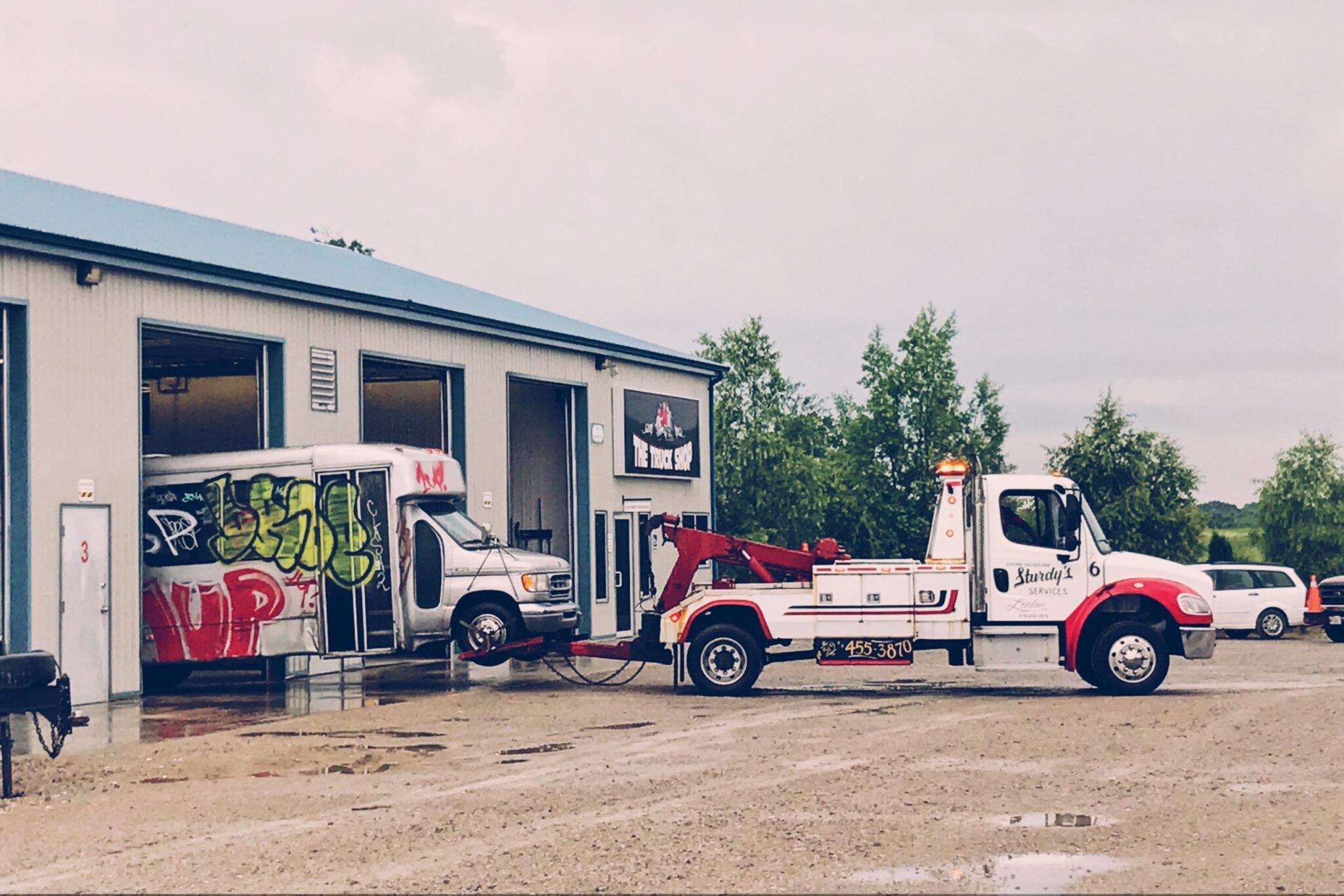
I would make sure the gas mileage is good, and that AAA services the vehicle. We found out in one unfortunate moment that our bus is too big to be towed by regular AAA, and that’s left us in the lurch, and many hundreds of dollars lighter.

I would also recommend finding a really good auto shop that you trust. I think we’ve probably wasted a lot of time and money taking Sylvia to a sub-par shop for the first year or so that we had her.

I’d probably forego the fancy stuff, and prioritize a vehicle that will do what you need it to do— get you from point A to point B as reliably and safely as possible. Then maybe get someone awesome to spraypaint some badass art on it!

[/fusion_builder_column][fusion_builder_column type=”1_1″ background_position=”left top” background_color=”” border_size=”” border_color=”” border_style=”solid” spacing=”yes” background_image=”” background_repeat=”no-repeat” padding=”” margin_top=”0px” margin_bottom=”0px” class=”” id=”” animation_type=”” animation_speed=”0.3″ animation_direction=”left” hide_on_mobile=”no” center_content=”no” min_height=”none”]

Caroline lounging on the bus, Photo by Jose Berrio

Below are some practical tips for buying, driving, & taking care of your tour van:

  • Expect the Unexpected. The main disadvantage to buying a used van is that they are unpredictable and it can be expensive to fix them. But there’s something romantic about being stranded on the side of the road peering into the engine, possibly not making it to your next gig, right? No, of course it’s not. Get AAA and always have a van repair emergency fund or credit card!
  • Be reasonable. Gas efficiency and space are main concerns in choosing your vehicle. Ask yourself: how many band members and gear can you comfortably fit in the most fuel efficient & reliable vehicle? Three and four piece bands can generally squeeze into a mini-van, but if you have a crew (tour manager/merch person/roadie/friend craving adventure), consider purchasing a full-size van.
  • Buy a Cargo Carrier. Great for luggage, air beds, extra band merch and a perfect place to hide your weed.
  • Make at least 10 copies of that van key. One of my biggest tour breakdown triggers is when someone loses one of the only van keys. Make sure each band member has two copies of the key and keep two spares with reliable friends or family.
  • Get an EZ Pass. You save so much on tolls, especially around NYC. A lot of the bridges in NYC now have “cashless tolling” where they send you a bill in the mail if you don’t have an EZ Pass. These tickets can pile up and if you don’t respond they tack on $50 late fees to each ticket. If you have a few of these these bills & fines, once you register to EZ Pass, they will charge the tolls to your account and waive the late fees.
  • Avoid parking tickets & losing your vehicle. Parking restrictions can be confusing in bigger cities, and it is more common than you think to totally forget where you parked after your show. The easiest way to avoid this is to always take photos of the parking and street signs that are next to your vehicle and text the pictures to your band group chat. That way, everyone can be responsible and helpful keeping track of the tour van.

[/fusion_builder_column][/fusion_builder_row][/fusion_builder_container]

PLAYING COLUMBUS: Double Happiness to Close After 7-year Run

It’s been a short but meaningful run for Double Happiness, which will close its doors on November 25th after seven years of music, drinks, and community-building. Opened and run by Yalan Papillons, with additional booking by Jenny Donaldson, the bar and venue hosted DJ sets, electronic music shows, and local artist showcases, as well as niche events like “Manicure Monday.”

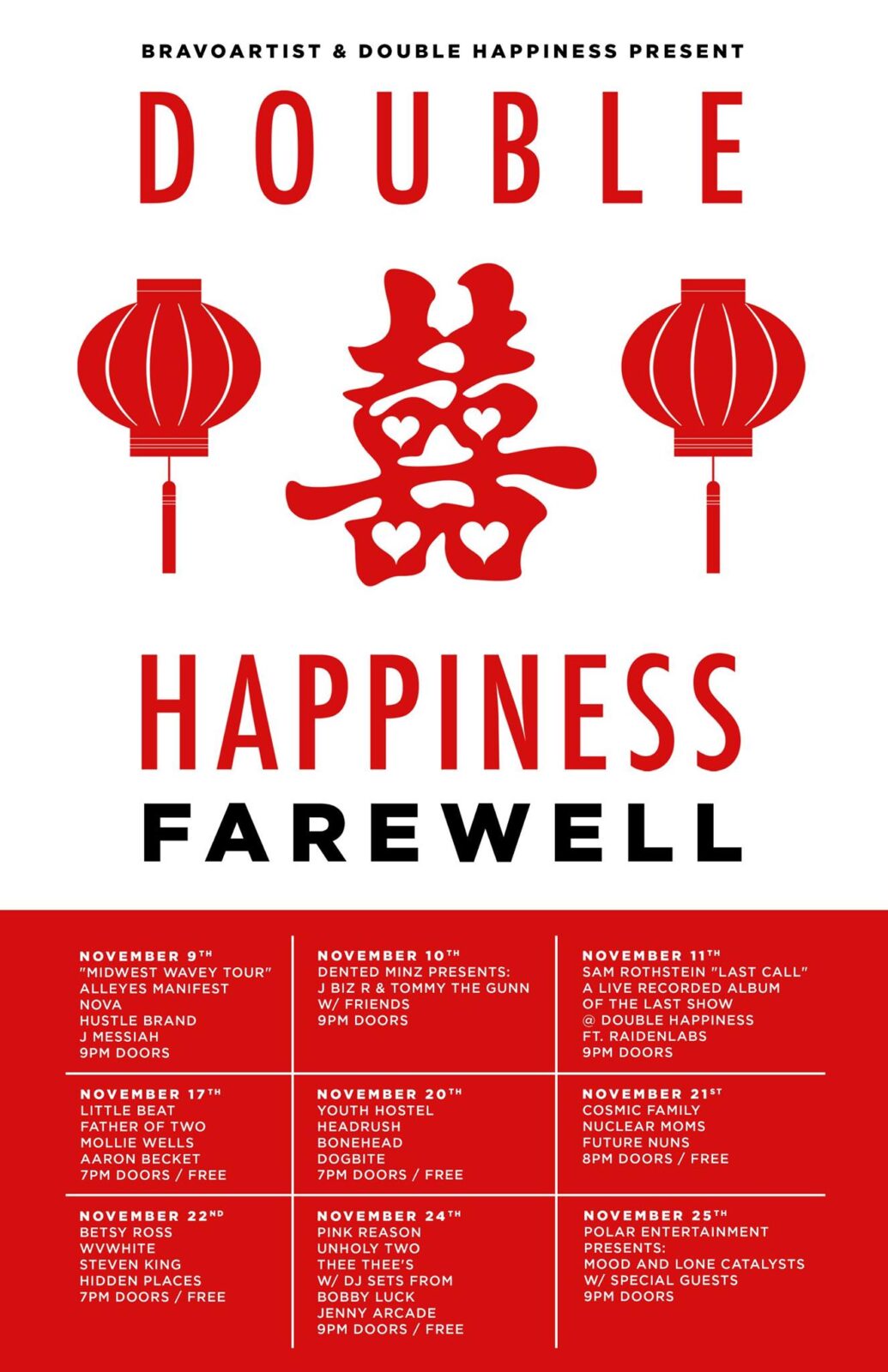
Double Happiness will be played out by a run of free shows at the end of November, hosting sets by Columbus locals Youth Hostel, Dogbite, Nuclear Moms, Pink Reason, and more. It’s a line-up which, frankly, highlights the ways in which white men dominate the punk scene. One departure from this slew of bro-punk, however, is Betsy Ross, whose emotive vocals by Charity Crowe are refreshing in their clarity. Double Happiness’ last and final show will migrate away from the theme of white men as well. On November 25th, hosted by Polar Entertainment, the night will feature “special guests,” joined by Columbus Hip Hop artists Mood and Lone Catalysts.

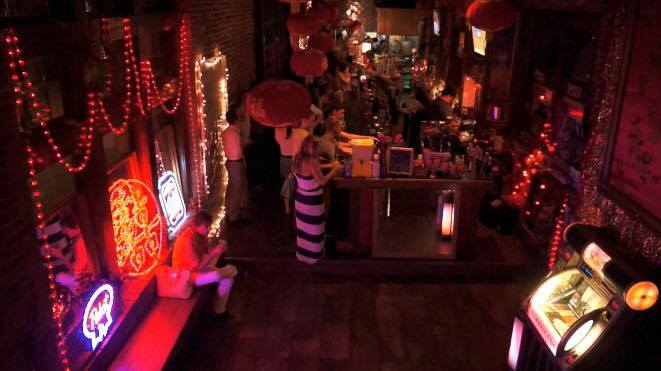
Many have noted the venue for its Chinese decor, inspired by Papillons’ family, but what is truly significant about Double Happiness is the role it has played as incubator for many of Columbus’ local bands. More mainstream than a DIY venue, but smaller than other, more commercial spots, Double Happiness served as an outward facing door to the Columbus music scene, and a portal for those who would otherwise be out of the loop.

Along with local acts and EP releases, Double Happiness has hosted nationally touring artists like Angel Olsen, Helado Negro, (Sandy) Alex G., and Half Waif. Their catalogue of artists–the entirety of which can be found on their website–is an impressive mix in terms of both genre and popularity. Large acts have never shied away from the venue, despite its close quarters. One of the bar’s first publicized shows, in fact, was the official after party for Bright Eyes, after the cult favorite played at one of Columbus’ larger venues, Express Live.

It’s also worth noting that Double Happiness is one of few bars and venues which is both run and booked by a woman of color. Papillons highlighted community within the space, running the venue as all-ages, and limiting sales of national beers. And while no safer space is truly safe, it’s sad to see a venue which strove to center at-risk audiences be shut down.

Columbus will miss Double Happiness’ unique approach to booking, as well as its warmth and locality. To get in your last goodbyes–and maybe a few drinks, as well–catch one of the venue’s “farewell” shows, detailed on the calendar below.

All photos courtesy of Double Happiness’ Facebook Page

PLAYING DETROIT: Double Winter Announces 7-inch and New LP

Since last year’s EP Watching Eye, psychedelic doo-wop rock outfit Double Winter has been relatively silent – but that doesn’t mean they’ve been still. Lead vocalist and bassist Holly Johnson says the band has been hard at work, writing and recording enough material for a 7-inch and full album release. While Johnson couldn’t give an exact date, she says all the songs are mastered and ready to go, so it’s only a matter of artwork and time.

Based on the band’s unconventional tastes and writing style, the record will not be a run of the mill  “indie rock” album. In fact, Johnson says she prefers to describe Double Winter’s music based on the band’s unique tastes rather than in terms of a single genre. “We’re all coming from very different places musically, but we all very much appreciate each other’s favorite genres – even if it might not be our own.” Some of these genres include Motown, doo-wop, psychedelic rock, funk and avant-garde.

While the band members’ musical backgrounds differ, geographically they are all from the same area – Detroit. Johnson met Vittorio Vettraino (lead guitar) and Augusta Morrison (electric violin) while in school at Michigan State University. While in East Lansing, Vettraino and Johnson were in a garage-rock outfit called Half Bodies, where Johnson’s love affair with the bass first began. “I always connected with the instrument and I really like writing – I was writing poetry well before I even picked up the bass,” says Johnson. “I wanted to combine the two and just kind of went with it.”

Shortly after moving to Detroit in 2014, Morrison and Johnson connected with drummer, Morgan McPeak, and Double Winter was formed, with Vettraino joining the trio shortly after. Since then, the band’s genre-bending sound has garnered the attention and admiration of many, including the Detroit label Palm Tapes, which put out Watching Eye digitally and on cassette. As far as who will be releasing their full-length album, Johnson says they are still shopping around. “Ideally, we put out a full length and get signed to a label and see what happens from there.” 

Johnson says that the band uses their eclectic music tastes as a gateway to creating their own. “Most recently Vittorio brought this incredible Italian waltzy disco song to us,” says Johnson. “And we were all like ‘woah this is amazing… let’s interpret it.’” How does one interpret an Italian disco waltz? You’ll have to see the group live to find out.

While no music has been officially released since Watching Eye, the band has been previewing their new songs at local shows in Detroit. For those lucky enough to reside in the 313, you can get your own sneak peak on November 22nd at Trixie’s Bar in Hamtramck, or on December 21st at the third annual Double Winter Solstice at Outer Limits.

MORNING AFTER: Chicken, Biscuits & Bottomless Mimosas with No Honeymoon

I’m lost picking out my outfit to see No Honeymoon, just anxiously pacing in black tights while “Don’t Want To” glides through the apartment. I’m digging the ‘80s movie vibes it’s blessing my morning with, Cait Smith’s haunting, hooting voice gently complimenting the sparkling verses, which battle the fuzzier, heavier choruses. “And it gets great aroooound this part,” I mumble to when the guitars truly gut you, backtracking to the 2:30 mark and refocusing my gaze on the cover of their EP It’s Whatever.

This cover owns me, guys. The white dress, the heart on fire, the mournful staring at the skyline from Transmitter Park – it’s almost hilariously emblematic of my city anguish. Even the title, It’s Whatever, is my go-to closing line (“And then he moved to LA and sold the car we made out in, but it’s whatever.”)

No Honeymoon feels like the whole gloomy New Yorkian package, the beautiful cry in the din and all that jazz. Of course I dig it, that’s my image. So I go with the leopard-print-on-stripes combo, the tortured Brooklynite classic. That’ll work.

…right?
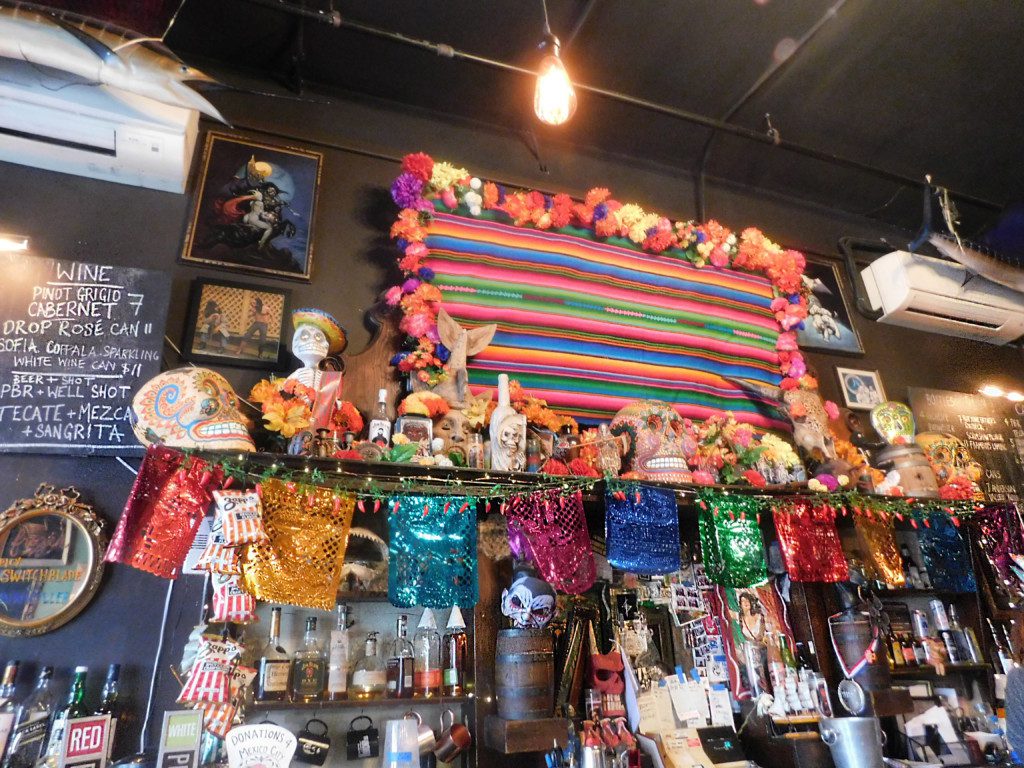
THE SCENE: So between The Anchored Inn’s floating swordfish and Buck Owens & His Buckaroos blasting, I’m bemused. It’s a venue-turned-ironically-garish-Tex-Mex joint that apparently goes metal after dark. But I learn this later (“So did we choose the place just because there were a lot of shows here at one point and now it’s like…a ranch?”), after they explain that their practice space is nearby, in the heart of that Meserole Avenue hub. 

Anyway, the Edie Sedgwick look was the wrong move, but hey, there’s bottomless mimosas!

I recognize Nate sitting alone because of this iconic green-haired junior year photo, and deliver the helpful line, “Hey, are you like, in a band?” I also recognize Cait with a cute, new short haircut (her bangs are still on point) and Ryan and Rob arrive shortly thereafter.

After two table migrations and one mimosa refill we talk about the start of our day and the end of all times.

12:06 Every day feels like the end of the world, so I’m dying to know how No Honeymoon would defend themselves, and I get right to the point. “If you guys had any weapon that you could use to battle against the apocalypse, like mutant zombies or something, what would it be?”

“Can I do like, mind control?” Cait asks, but we agree that’s more of a super power than weapon.

“I think my instinct is just fetal position. Does that count as a weapon?” asks Ryan. Still not a weapon, although it’s relatably viable self defense.

“I really think it depends on the nature of the threat,” Nate says. “If it’s a zombie threat versus apocalyptic meltdown, that’s totally different.”

“Apocalyptic meltdown,” I specify. “Nobody’s a zombie, but everyone’s brutal AF.”

Nate very seriously considers his options. “Well, if you have a shotgun in the end times, people will be afraid of that shotgun, even if they don’t know how many rounds you have,” he starts. “But zombies won’t be. So even by racking your shotgun it’ll be like, ‘Get the fuck out of the way.’ Whereas if you had a bat or a sword or something and you have five guys that are much larger, you’re going right down.”

“I love the aesthetic appeal of a bat, though. I feel like I’d look really great with a bat,” I interject. “But aesthetics won’t matter in the apocalypse, so…”

“Right, with nails and shit,” Ryan adds.

“Nails and glitter – I want it to be feminine.” Everyone laughs at this. Why does everyone always think I’m joking?

“That’s where my brain went first, because you can smash things to shit with a bat, but I’m definitely going to be outmoded with a gun,” Cait considers. “I hate guns, I don’t like them, and I think if the apocalypse meltdown happens I’m not going to be competent enough with guns to be a threat to anyone.”

Ethics and aesthetics will definitely doom us if the world ends. So it goes.

12:15 Cait is trying to purge the olives from her Bloody Mary, which she thinks makes her a bad half Sicilian, although I assure her that I’m half Greek, hate olives, and am a subsequent disappointment to 3/4ths of my lineage. Ryan can’t eat his mom’s lasagna, which we all cringe at automatically.

“But why is that?” I ask.

“I can’t do –”

“Dairy?” Yeah. “But that’s just like your biology, that’s not, ‘I hate my mom’s lasagna,’ which would break her, I’m sure.” You know, Italian moms, and all.

“There was like a really brief period where I was a vegetarian…” Ryan starts.

“Oh, that’s no good at all,” Nate interrupts.

“And my mom was like, ‘But you can still have meatballs, right?’ ”Meat’ is literally in the word.”” We all laugh good-naturedly at this.

“‘They’re literally balls of meat, mom,'” Cait adds.

“My mom who’s five foot nothing and sounds like Joe Pesci, she’s an angel.”

It’s super cute, but the point is that everyone’s fucking up on the Mediterranean front.
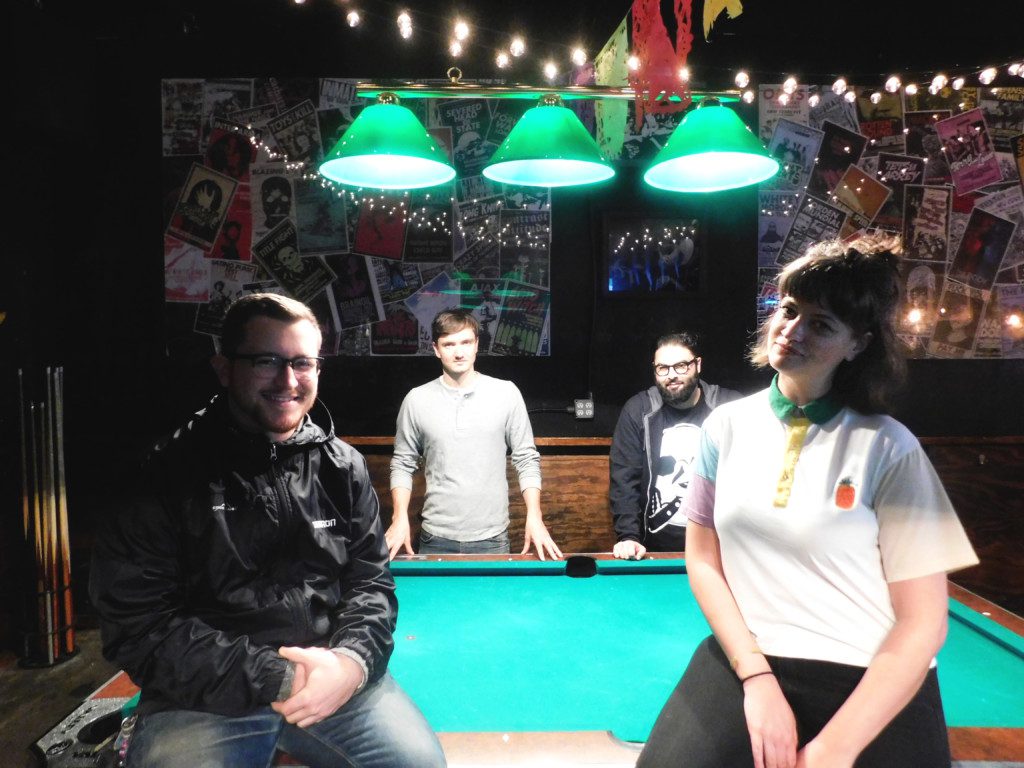
12:26  We put in orders for chicken and waffles, biscuits and gravy, chicken and biscuits, and a breakfast burrito. The mimosas are already hitting hard, ’cause I’m anxiously looking up Taco Bell’s Kit-Kat Quesadilla on my phone, as well as the most recent Taco Bell wedding.

“That’s like going to White Castle on Valentine’s day,” Cait remarks.

“Well if you go to White Castle with someone it is romantic because White Castle’s disgusting.” I determine, lost in my phone. “And that’s…that’s true love.”

“They call them rat burgers. How can you eat them knowing they’re called rat burgers?” Rob says, before changing the subject. “You ever been to Max Brenner’s?”

“Chocolate by the bald man,” Ryan adds, and of course most of us have; Max Brenner is like the Willy Wonka of New York. Someone you can trust to make a chocodilla.

And Nate drops a bombshell. “You know there is no Max Brenner.” After a half-second hush the group goes into a flurry of multi-emotional reacts:

MG: Why would you fucking say that to him?

Cait: That also makes total sense.

Nate: Smashing the grand illusion.

MG: Are you going to say Santa Claus isn’t real now?

Rob: EVERYTHING I KNOW IS A LIE.

We’re all pretty shaken by this conspiracy theory and finally deduce that there must be comfort in the illusion of a bald man making chocolate.

“Everyone knows that the best chocolate comes from bald guys,” Cait says. Obviously.
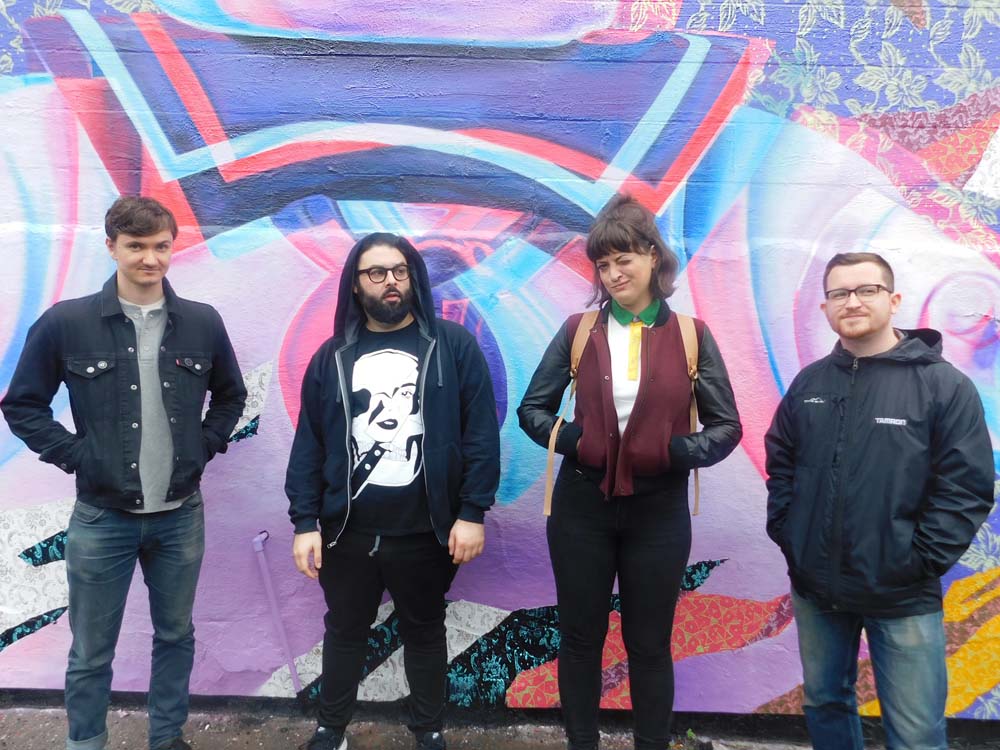
12:42 When I moved here I thought it an amazing and rare happenstance that other people liked David Lynch. And then I lived here for two more minutes and I realized we’re all just pretentious. I’m recounting this because Nate is watching Dune right now, which, even for a Lynch fanatic, is insufferable (based on hearsay).

“I watched the first hour! I’m gonna finish it,” he insists. “But I watched the first hour and I was like, ‘What in the sweet hell…’ No wonder nobody liked this. It’s so difficult to follow. And it’s also insane.”

“So what’s it about?” I ask.

“…like…just spice, mostly.”

“I’ve never read Dune, but I’ve had, like, Dune explained to me 69 times in the last month,” Cait says, to more laughter. That sounds right. She also talks about how she hasn’t really tapped into Twin Peaks (she saw a handful of the original episodes) and it’s cool, because I jumped ship on the “new” one.

“I can’t do it,” I confess. “I love [fusion_builder_container hundred_percent=”yes” overflow=”visible”][fusion_builder_row][fusion_builder_column type=”1_1″ background_position=”left top” background_color=”” border_size=”” border_color=”” border_style=”solid” spacing=”yes” background_image=”” background_repeat=”no-repeat” padding=”” margin_top=”0px” margin_bottom=”0px” class=”” id=”” animation_type=”” animation_speed=”0.3″ animation_direction=”left” hide_on_mobile=”no” center_content=”no” min_height=”none”][David Lynch], but I don’t love him that much.”

“Oh, I do,” Nate says.

“Nate owns a shirt that says, ‘Thank you, David Lynch.'” Rob adds. “And it is fantastic.”

“I think I went for a job while wearing it, just a caricature of myself,” Nate says. Respect.
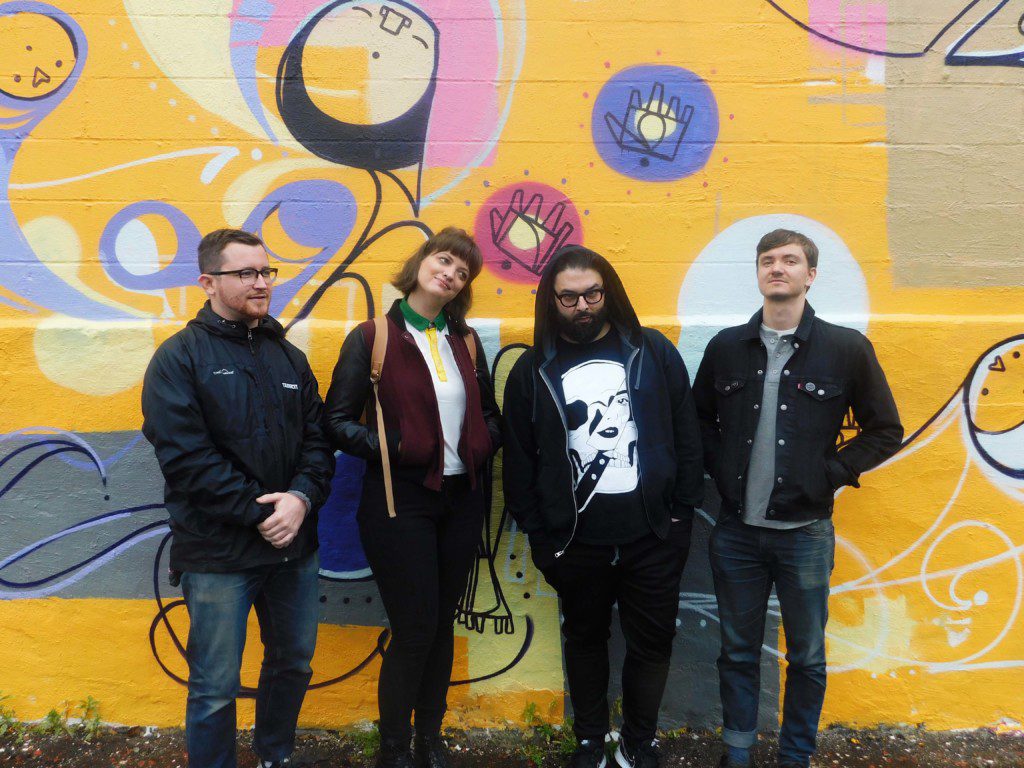
12:53 The New York marathon is happening today and we spend a lot of time going “Fuck fitness.” Cait mentions in passing that it goes through her neighborhood, and connecting the dots I realize she lives in Greenpoint.

And I have to break my “I don’t care about anyone’s new EP” interview policy to ask about the cover: “Is that…?”

“Transmitter Park,” Cait finishes.

“That’s where I go when I’m depressed!” I feel super validated. “It’s like I look out into New York and I think” *mock-dreamy voice* “‘this is what I’m fighting for.'”

“Same, it’s the best,” Cait says. “Exactly, exactly dude, I feel the same way.”

“I wanted to ask you about that, because I saw it and I was like, ‘This is everything that I’m about aesthetically.’”

“Rob shot it,” she mentions casually.

“It’s real fire, too,” Rob says, even more casually.

Is it?” No, Mary Grace.

“People thought that it was, though. People said that to me,” Cait explains.

“I got the shot right before it before it blew up,” Rob says.

“We were like, literally trying to blow up the balloons with fire,” Cait says. “And then I started Googling it and I was like, ‘This is not scientifically possible.'”

“Also wildly dangerous,” adds Ryan.

“I didn’t think it was real,” I lie. “But the fact that I had doubts means it didn’t look stupid…”

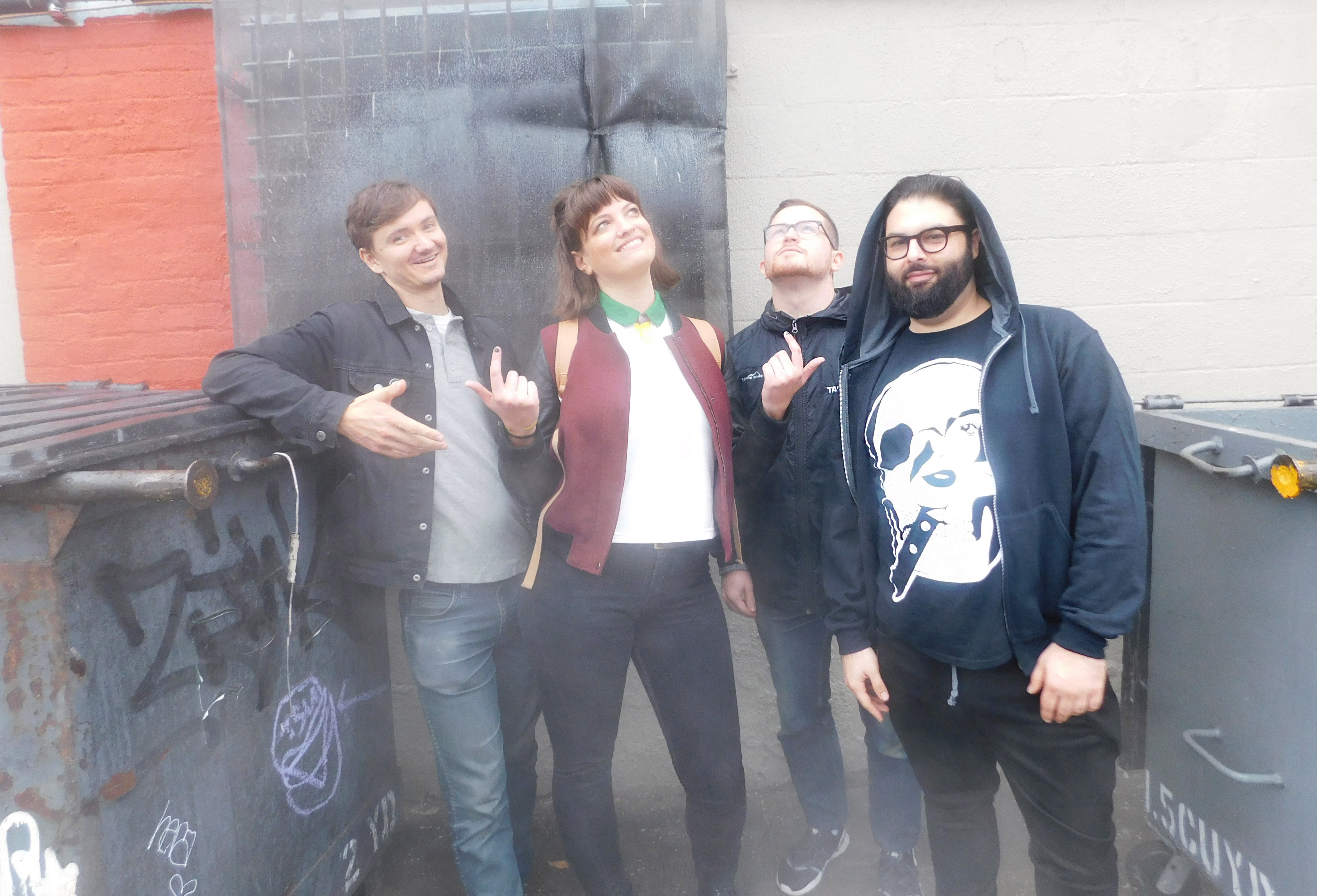
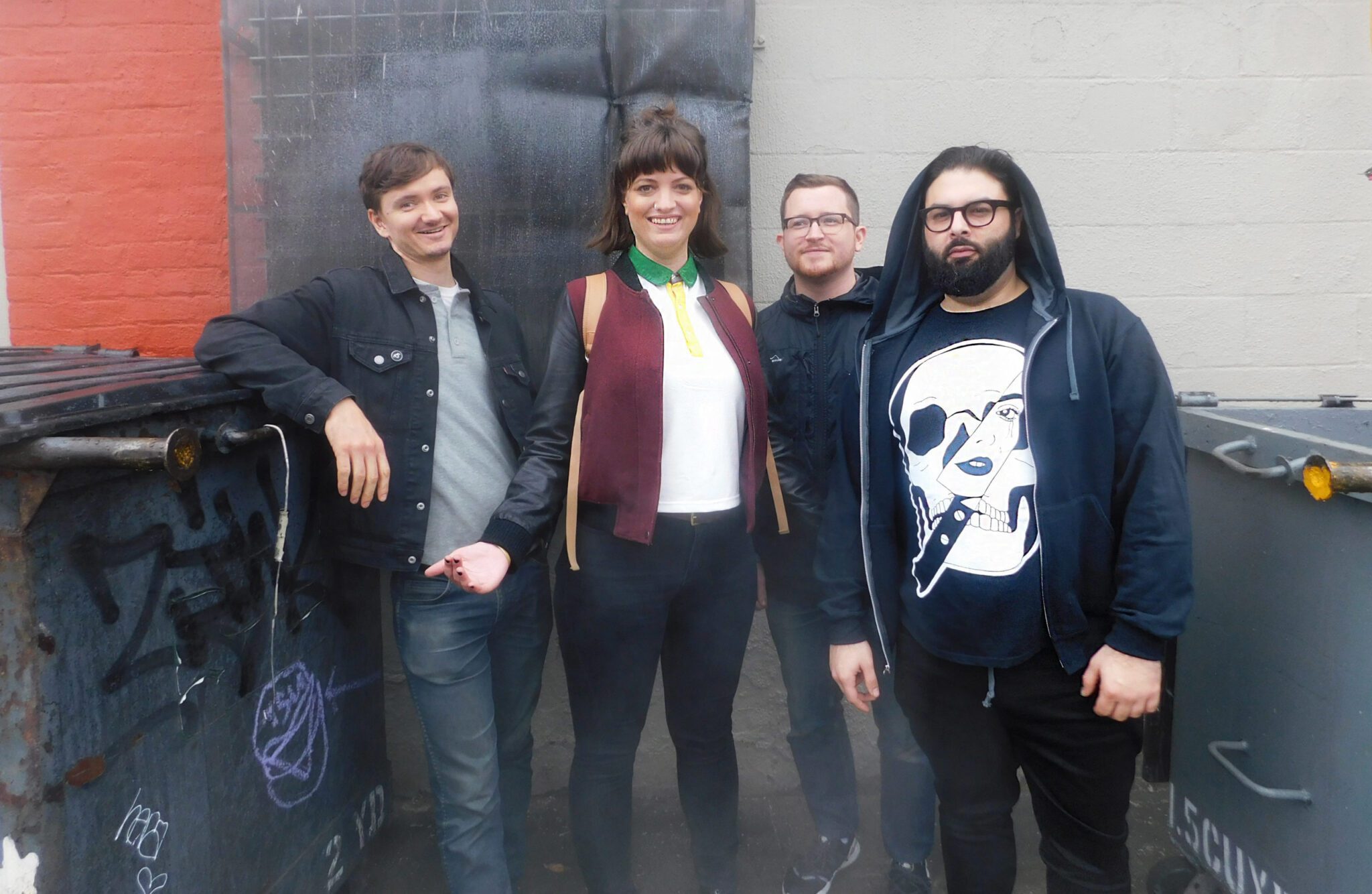
Anchored Inn is conveniently along a row of photoshoot-friendly murals, so after brunch we capture a few shots along some Saved-By-The-Bell-intro graphics. But by happenstance we pass some foggy dumpsters and take a few impromptu shots there instead. Cait jokes that the steaming trash look is more on brand anyway.
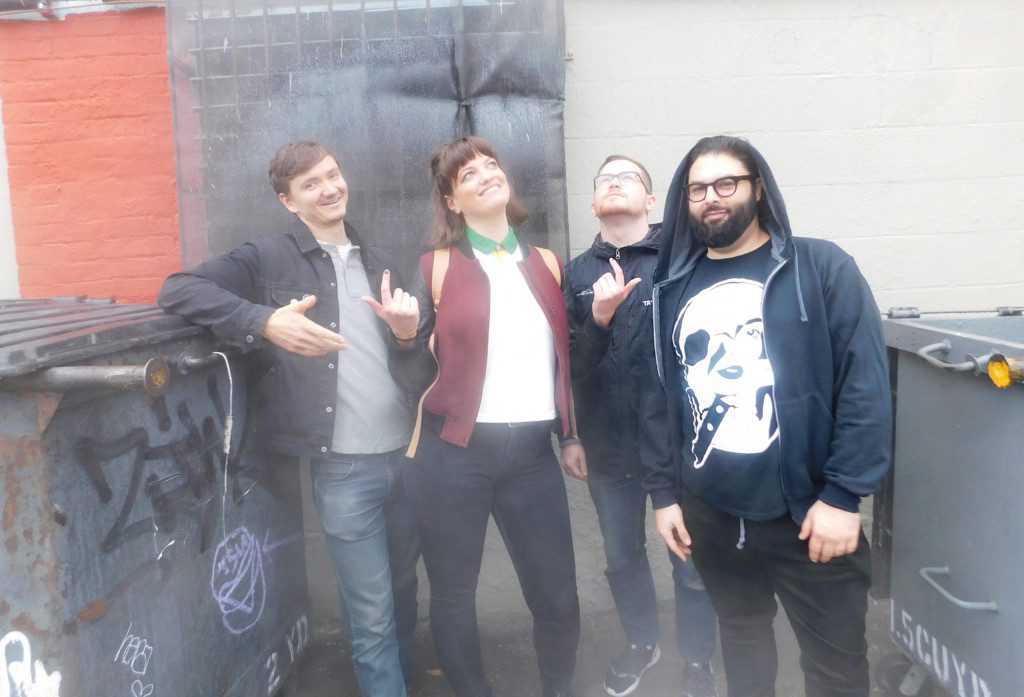
Sometimes, like whenever I’m breathing, I worry about looks. The look I’m projecting, the images projected to me, whether we’re all being visually faithful to our art and identity. As far as I’ve learned, it’s never as simple as “the owls are not what they seem.” Sometimes the owls are owls. The mistake is in assuming they’re just owls.

Peer deeper into what’s projected on stage and online and you get a complex kaleidoscope view, the various components of people clashing prettily together. Irreverence and drama. Beauty and garbage. A genuine sense of humor and acknowledgement of the ache that guts you when you stare at the New York skyline. Get you a band that can capture both.

I consider this later, but not, if you wanted to imagine it, walking back in the mist.

I stumble back home to my room and fall into a mimosa-induced coma instead.

It’s Whatever is now out available on Bandcamp and for purchase, and you can follow No Honeymoon on Facebook.[/fusion_builder_column][/fusion_builder_row][/fusion_builder_container]

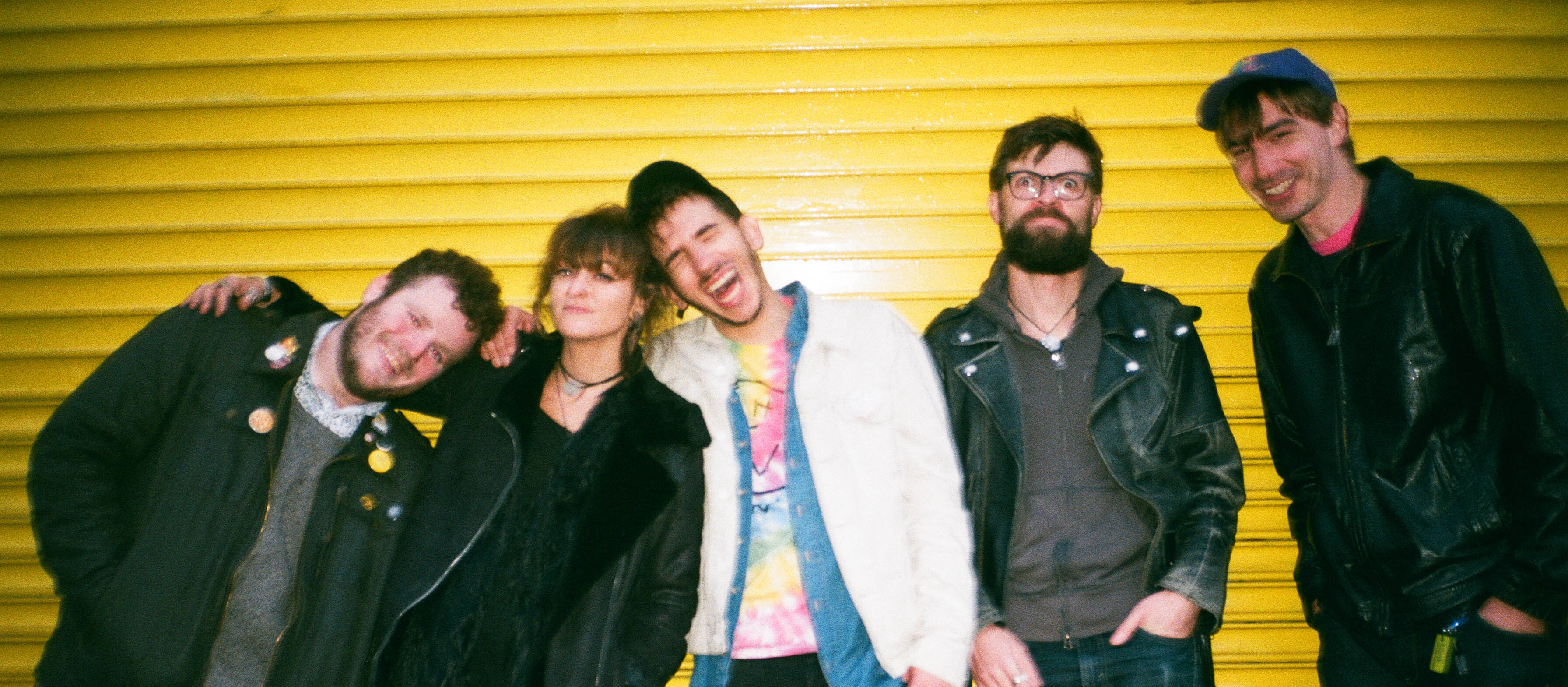
NEWS ROUNDUP: Musical Candidates Win Big, TSwift’s Reputation & More

Metal Musician Danica Roem becomes first transgender legislator in Virginia

[fusion_builder_container hundred_percent=”yes” overflow=”visible”][fusion_builder_row][fusion_builder_column type=”1_1″ background_position=”left top” background_color=”” border_size=”” border_color=”” border_style=”solid” spacing=”yes” background_image=”” background_repeat=”no-repeat” padding=”” margin_top=”0px” margin_bottom=”0px” class=”” id=”” animation_type=”” animation_speed=”0.3″ animation_direction=”left” hide_on_mobile=”no” center_content=”no” min_height=”none”]

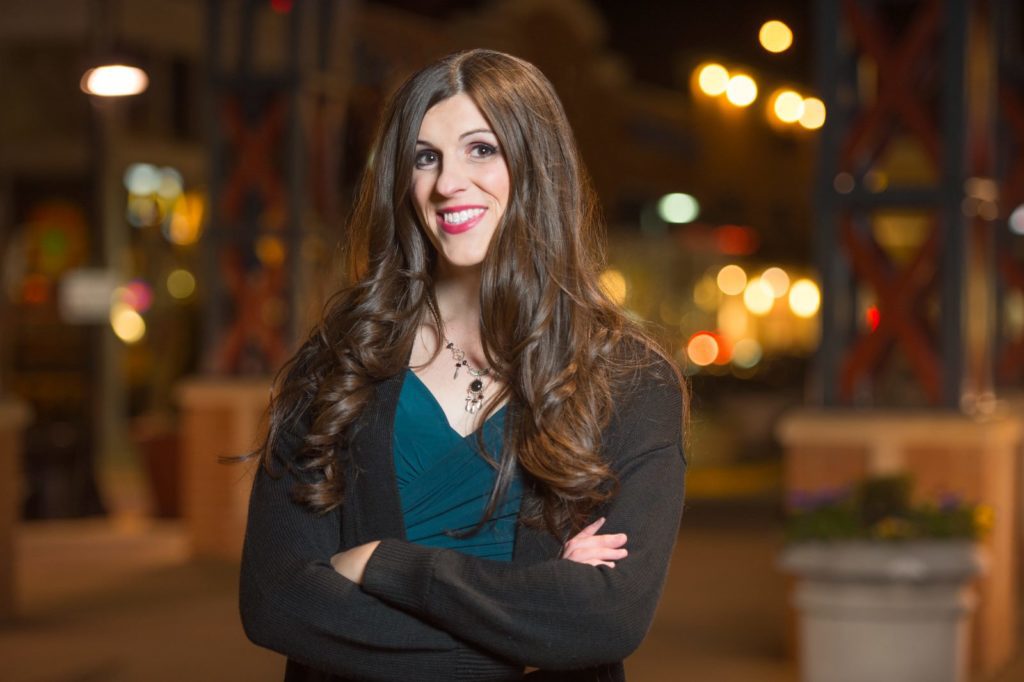
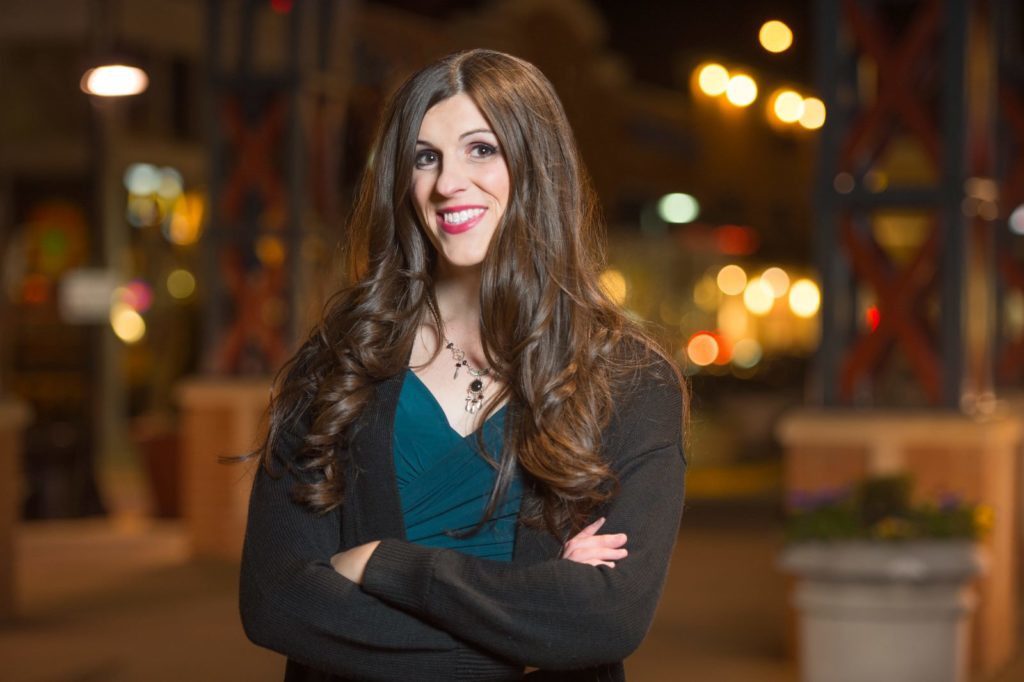
Metal musician Danica Roem becomes first transgender legislator in Virginia

  • The Musicians Who Won This Week’s Election

    On Tuesday, Danica Roem became the first openly transgender woman elected to state legislature with her win in Virginia, replacing a 13-year incumbent Republican who held an anti-trans bathroom policy. While her platform was pretty great – she wants to achieve health care accessibility, fix traffic issues, and raising teacher salaries – she’s also a musician who sings in the trash metal band Cab Ride Home. In New York, Justin Brannan, the former guitar player for hardcore groups such as Most Precious Blood and Indecision, won a seat on the city council. His campaign focused on issues like public schools, eviction protection, and improving public transportation. 

  • Taylor Swift’s Lawyers Threaten Blogger 

    Taylor Swift’s long-awaited and much-discussed sixth album Reputation is out today, and as usual, the pop star is mired in controversy. Earlier this week, her overzealous lawyers threatened PopFront blogger Meghan Herning with a heavy-handed lawsuit for a two-month old post which mines Swift’s “Look What You Made Me Do” for alt-right Easter Eggs. It’s not the first time media insiders have drawn a parallel between Swift and white supremacists, some of whom uphold the singer as an Aryan idol; outright, Swift hasn’t done much more than participate in a little cultural appropriation, but she hasn’t gone on record to denounce white supremacy either, as Herning pointed out. Still, Herning’s piece was essentially an op-ed, hardly presented as fact, and may not even have had significant readership if not for the lawsuit threat, which claims the post is “provably false and defamatory.” It looks like a cheap scare tactic meant to ward off bad press for Taylor; the ACLU made a statement in support of Herning.

  • Other Highlights

    Madonna covers Elliot Smith, Tegan and Sara cover Hayley Williams of Paramore, Erykah Badu curates a Fela Kuti set, Jon Stewart flaunts his drumming skills with No Wine for Kittens to benefit Suicide Prevention, there’s a Jawbreaker auction for gun control, music streaming services get their own lobbying group, watch Angel Olsen perform “Sans” from forthcoming rarities release Phases, Rihanna will co-host the Met Ball this year, Ozzy is retiring, Brad Paisley and Carrie Underwood skewer Trump in a CMA Awards parody, Kimbra partners with Safe Horizon to raise domestic violence awareness, Priests’ Katie Greer on being heckled, Bikini Kill reunited last weekend, JAY-Z on Meek Mill’s sentencing, and a Stella Donnelly song that sums up recent events.

https://www.youtube.com/watch?v=hHgVY0x8uUs[/fusion_builder_column][/fusion_builder_row][/fusion_builder_container]
ONLY NOISE: One Ball to Rule Them All


The town I grew up in didn’t have a roller rink. Sure, there was a five-lane bowling alley and a one-screen movie theater, but roller rinks were too big for the bite-sized britches of Arlington, Washington. There are many consequences of a town with no roller rink – namely that it becomes by default a town with no disco ball, and that is no place to live, my friends. Marysville, Washington, the next town over, was no place to live either, but it had something we Arlingtonians did not: a roller rink. With skates, and shakes, and a disco ball.

Songs by Bee Gees, Chic, and Donna Summer did not score my first orbit around the glitter ball. I was miles and decades removed from the wonder years of Studio 54 and Paradise Garage, but the tidal pull of the mirrored globe translates across time and space. With its galaxy of glittering infinity, the disco ball’s only message is: keep moving.

Today marks yet another internet-spawned holiday you didn’t know about: National Disco Ball Day. But before you deck the dancehalls with balls of disco, or flock to Pinterest for mirror ball cake recipes, let’s consider the disco ball in all its pop culture glory. Oddly never out of fashion, disco balls have been spinning for around 100 years, though under varying monikers. Mirror ball, glitter ball, and “myriad reflector” were runner-ups to the genre-specific name that stuck.

An early and particularly odd usage of the sparkly decoration can be found on the Wisconsin Historical Society’s website. A 1912 image of a “Sun Parlor for Tuberculosis Patients” (which was located in the Milwaukee Hospital for Insane, might I add) appears pleasantly mundane – until you glance up at the photo’s topmost edge, and see a mirrored sphere shining down on the vacant room. The image is jarring with its backwards anachronism, giving off a A Kid in King Arthur’s Court feeling of displacement; I scratch my head upon seeing this objet de disco thrust into a pre-disco atmosphere.

The disco ball traces back even further than that however, as Vice’s thump outlet details in their in-depth history of the ball. The disco ball’s first reported appearance cropped up in an 1897 issue of the Electrical Worker, which referred to a “mirrored ball” hanging over the attendees of a N.B.E.W. electrician’s union party in Charlestown, Massachusetts.

Despite the disco ball’s varied history, it goes without saying that the glitter globe is not known for its psychiatric hospital tenure, or electrician’s party debut. Rather, it was the flame that “burn baby” burned its way through “Disco Inferno.” While its roots dig much deeper, the dance floor ornament’s cultural capital skyrocketed in the disco days, and at that time, Louisville, Kentucky manufacturer Omega National Products had already been the unofficial home of the disco ball for 20 years, making 90% of the world’s spheres at their peak. This boom in bling balls was surely due to disco fever, as every New York discotheque worth its salt had one. Paradise Garage, Crisco Disco, The Loft, and many other disco havens were bathed in specks of light cast by their own mirror balls, dutifully twirling above the heads of boogying regulars.

[fusion_builder_container hundred_percent=”yes” overflow=”visible”][fusion_builder_row][fusion_builder_column type=”1_1″ background_position=”left top” background_color=”” border_size=”” border_color=”” border_style=”solid” spacing=”yes” background_image=”” background_repeat=”no-repeat” padding=”” margin_top=”0px” margin_bottom=”0px” class=”” id=”” animation_type=”” animation_speed=”0.3″ animation_direction=”left” hide_on_mobile=”no” center_content=”no” min_height=”none”]

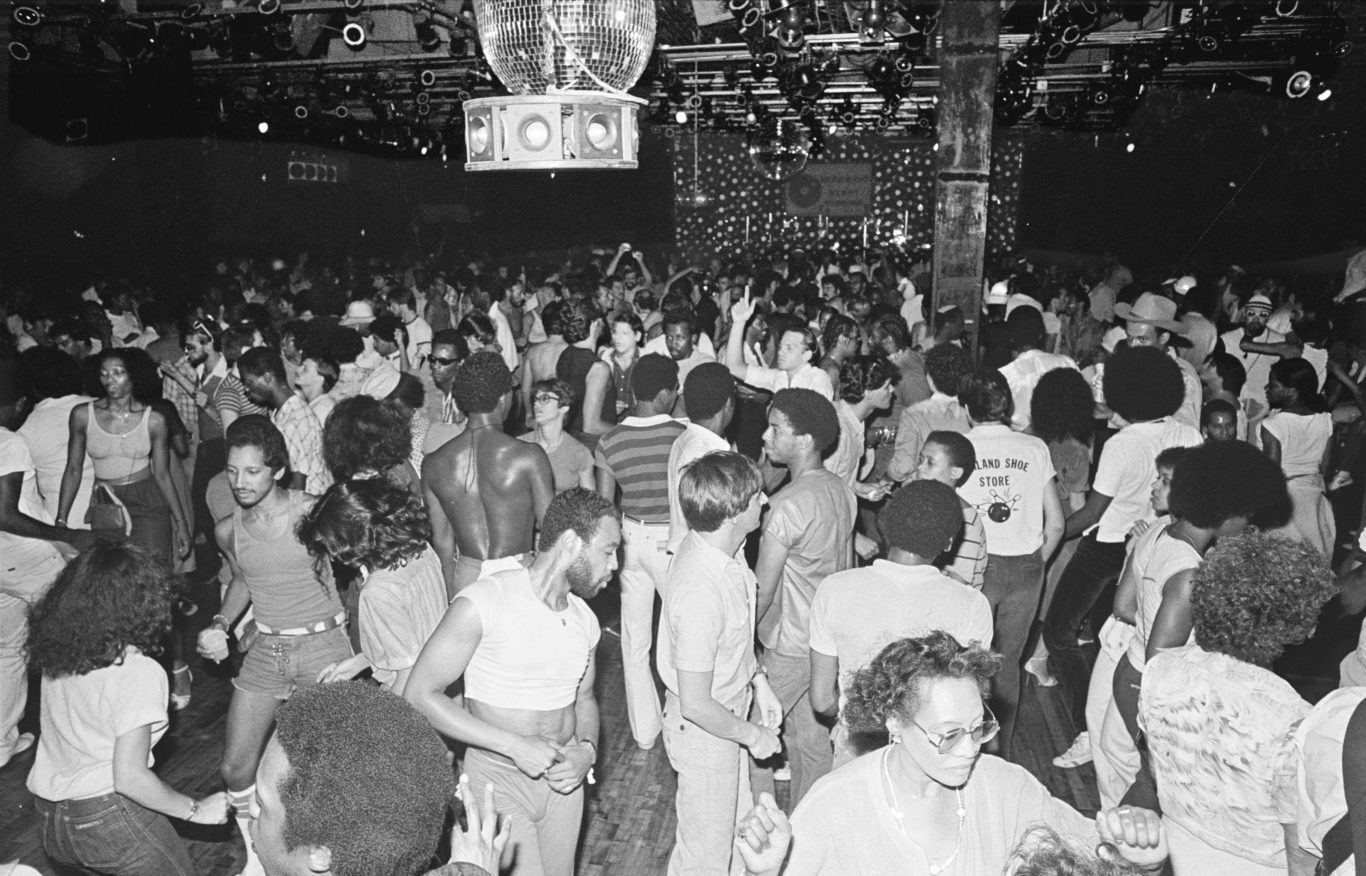
The Paradise Garage, 1979. Photo by Bill Bernstein

Back in ‘90s Marysville, we weren’t snorting snow in gilded bathrooms or shacking up with Bianca Jagger. We were eight, and while it wasn’t a New York City night club, the Marysville skating rink was just about the coolest place an eight year old could throw a birthday party in a 20 mile radius. We didn’t have drugs or Halston dresses, but we were rich with ice cream cake and the flavored roll-on lip-gloss the rink sold for $3 (I’m still convinced it was fruit-flavored vegetable oil). The DJ? Certainly not Larry Levan or Frankie Knuckles. I’m fairly sure there wasn’t even a human behind the music programming at all, but a CD that favored acts like Shaggy, LeAnn Rimes, and Hanson. Such were the times.

Naturally, there’s no comparison between the glamorous disco clubs of the ‘70s and my barely-local roller rink, but they both boasted that mirrored mosaic sphere that is the disco ball; and that’s one of the most magical things about it. Aside from its overwhelming ability to *sparkle*, the disco ball is a remarkably democratic piece of party paraphernalia. Even if you aren’t among the rich and famous folks about town, chances are you can afford a seat at a bar with a disco ball overhead, or better yet, your own for home use. This may not have been the case in the early 1970s, when manufacturers like Omega were charging around $4,000 for a 48-inch ball. These days you can nab one second-hand, buy an inflatable version, or even make your own. The possibilities are endless, and the emblem is timeless.

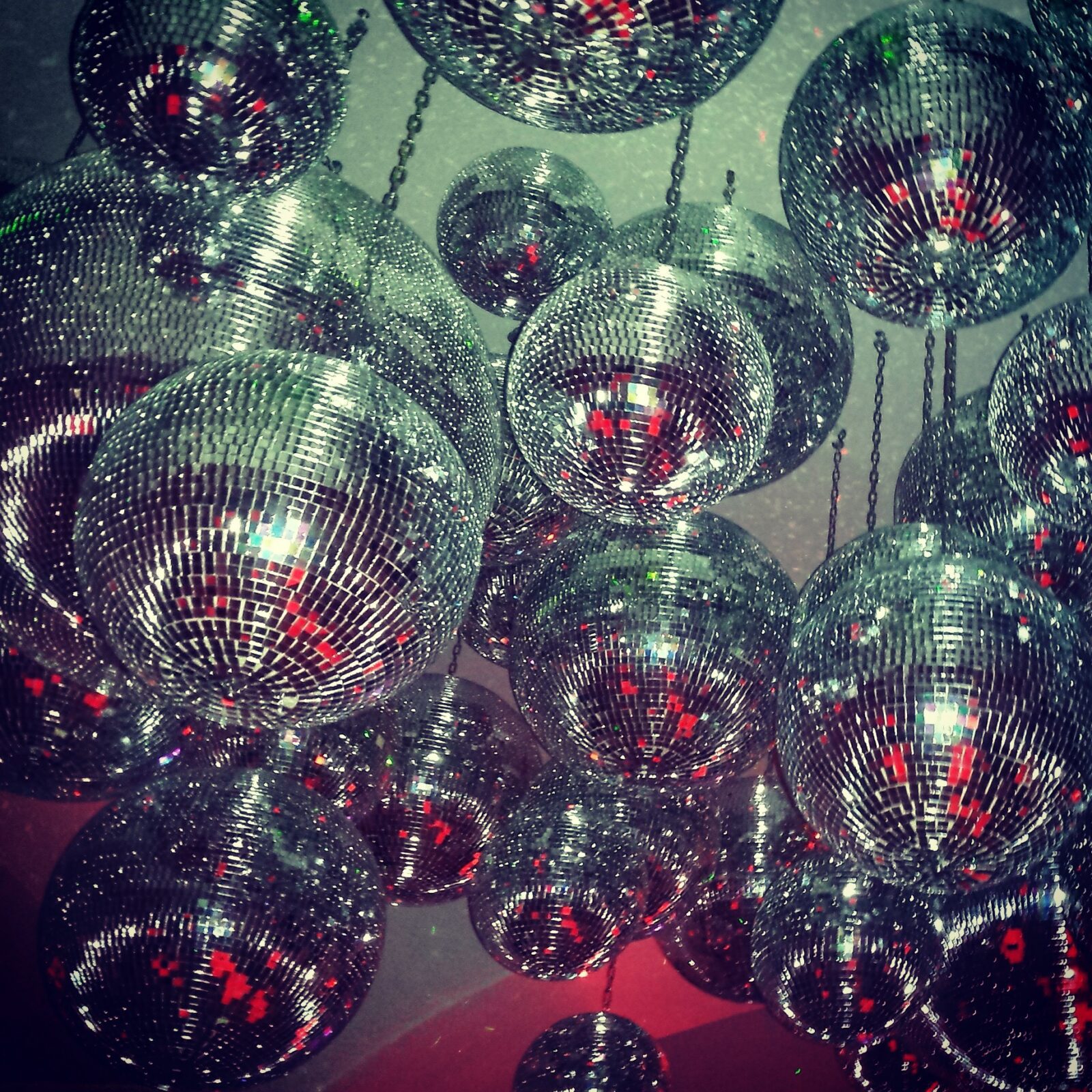
New York’s own Museum of Sex recognized this timelessness; the museum has enshrined the disco era in Night Fever: New York Disco 1977-1979, a collection of photographs by Bill Bernstein, who captured iconic nightlife images at joints like Studio 54, Xenon, Electric Circus, and more. Bernstein was the man on the scene, and to honor his exceptional work, MoSex didn’t go the normal route with regards to museum curation. Instead of white walls, frames, and text panels, MoSex transformed their bar into a disco itself, playing nonstop cuts like “Boogie Oogie Oogie,” “Ladies Night,” “A Fifth of Beethoven,” and all the Bee Gees hits you can strut to. According to MoSex’s website, Night Fever includes a “an original Richard Long Audio System (infamously associated with clubs like Studio 54 and Paradise Garage) along with guest appearances by disco-era DJs” and “a retro ‘70s cocktail menu” to enhance the experience. Oh, and a total of SEVEN disco balls. One large ball in the center of the ceiling, and six smaller ones clustered around it, like planets surrounding the sun.

The lasting presence of the disco ball is perhaps its most fascinating quality. It remains a completely relevant symbol (as proven by acts like Madonna, U2, and the English music festival Bestival) despite being completely analog. At the end of the day, the disco ball is merely a sphere covered in mirrored squares of varying size. And yet it is so much more than that. It is a silent choreographer, keeping the room in perpetual motion…an egalitarian beacon, showering everyone with a little bit of spotlight.

 [/fusion_builder_column][/fusion_builder_row][/fusion_builder_container]

PLAYING COLUMBUS: Jay Som @ Ace of Cups

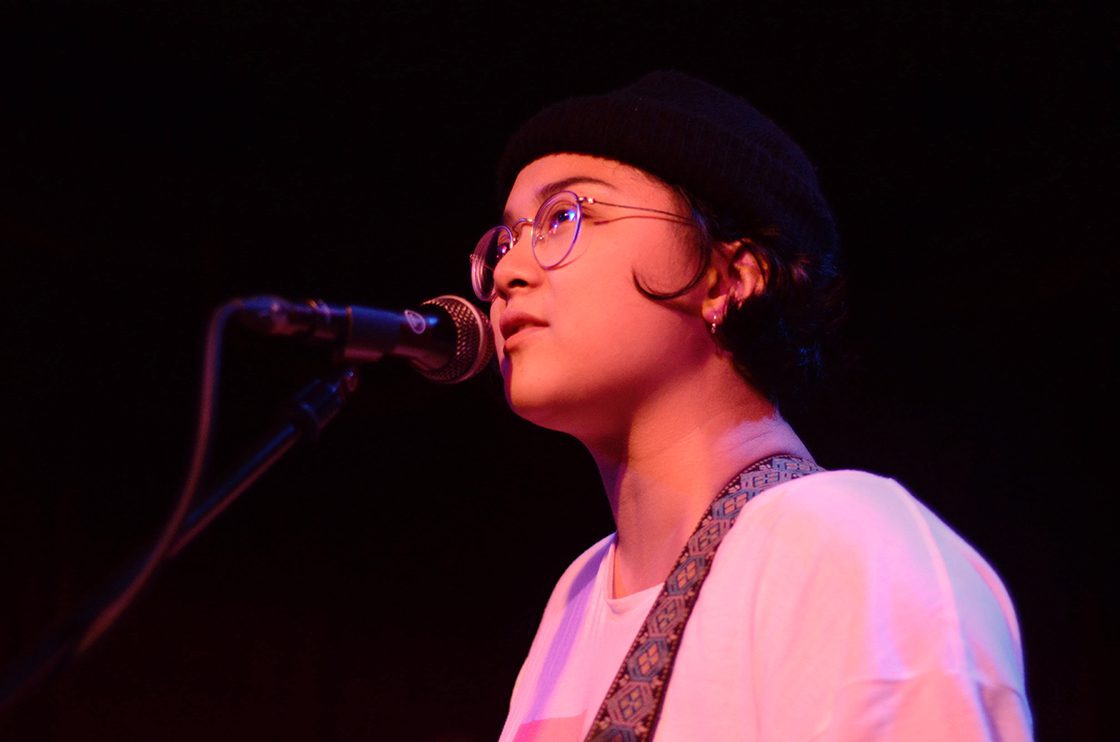
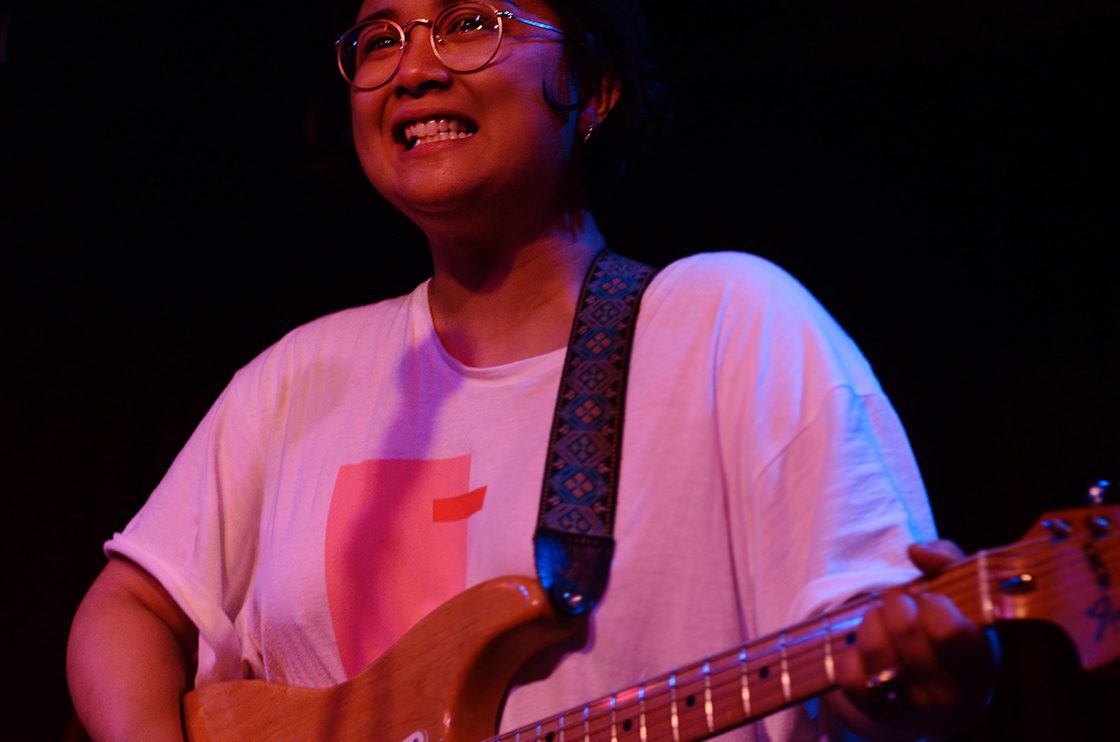
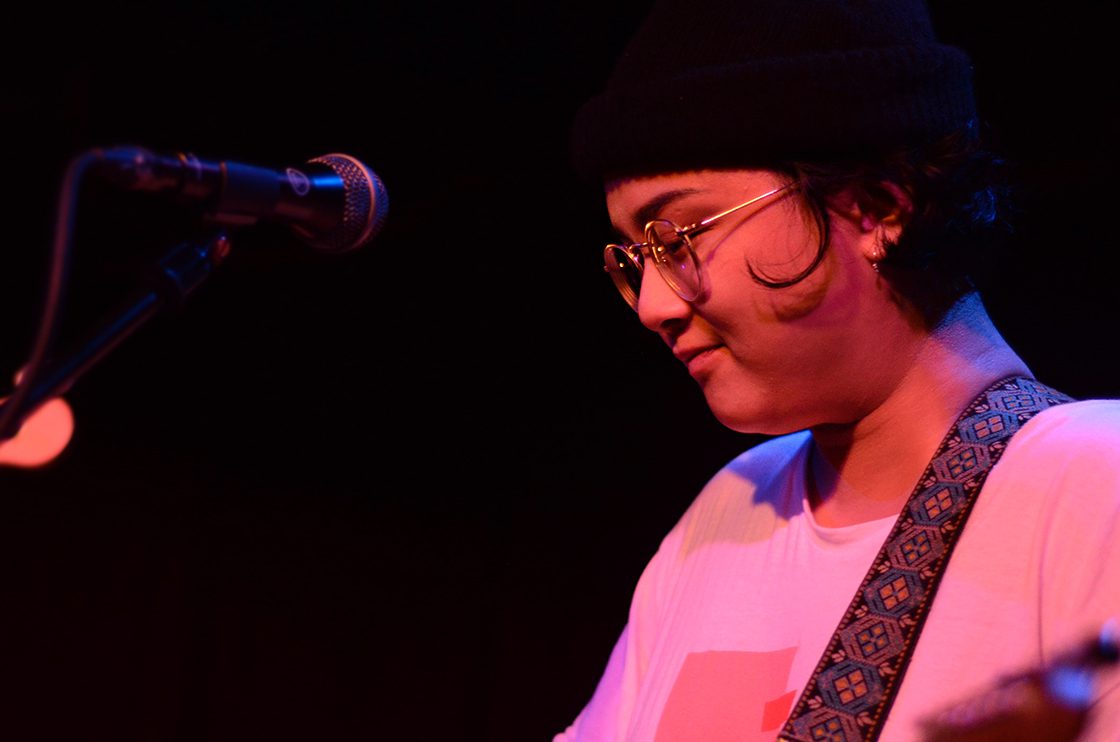
Jay Som has had a big year. Since Polyvinyl picked up the project – conceived and led by Oakland’s Melina Duterte – in 2016, Duterte has released a second full-length album (Everybody Works), toured nationally, played a tiny desk concert at NPR, and received extensive coverage by major media outlets. In other words, Jay Som has outgrown Duterte’s Bay Area bedroom.

At the Ace of Cups last Sunday, Jay Som played a set which drew from both the old (“I Think You’re Alright,” an enduring hit for the band, was first released in 2015) and the new (a video for “The Bus Song,” directed by Japanese Breakfast’s Michelle Zauner, was only released a few weeks ago). It’s probable that I’ve seen the band play live more times than anybody else in Sunday night’s crowd. And it was interesting to encounter Jay Som in Columbus, especially because this might be the last time I hear Duterte play for a while – she and her bandmates are moving to LA in a few weeks, and I’m staying in Columbus for the next few years.

Much has been made of Jay Som’s success in regards to the Bay Area music scene. Duterte is young, Philipinx, gay, and hard-working. She stands within the intersections of identities which are often pushed out of the music industry. But it’s these identities which should, frankly, be populating the Bay Area’s stages more often – POC, especially black folks, make up far more of the East Bay’s demographic than is represented within artistic spaces. As is the case everywhere, DIY and other music spaces in San Francisco and Oakland often prioritize white artists on their bills, making room for loud, cis, white punk boys before creating space for queer folks, women, and people of color.

So it’s encouraging to see Duterte carving a place for herself in the music industry. Encouraging too is seeing artists like her blow up: Kehlani, Xiomara, and Spelling, to name a few, have all made waves far beyond Oakland and San Francisco in the past few years. And Duterte has certainly earned her success. Both Turn Into and Everybody Works are carefully considered, lushly arranged albums. Duterte’s vocals, attention to lyricism, and weaving melodies are remarkable in their precision and vitality.

When performing, Duterte and her band – the bulk of which she grew up with in Brentwood, CA – animate the songs with long diversions into musical riffs. They’ve all known each other a long time, and it shows in their comfort onstage. But that comfort comes with the potential cost of excluding listeners. “There’s nothing I like less than seeing white men jam onstage,” a friend told me during the show, referring to Duterte’s bandmates. That frustration seems to be tension with Jay Som’s success as a Bay Area band. If we are to understand Jay Som as Duterte’s project – and Duterte certainly crafts her records alone – how should we evaluate the musicians that accompany her on tour? Does the backing presence of white, cis men not make an impact on the audience, just as Duterte does?


Jay Som was joined on Sunday by didi, another band intrinsically rooted within its musical community. At this point in their career, didi is a Columbus staple, regularly playing shows with other locals, as well as opening for queercore favorites like Aye Nako and Sad13. The band’s self-titled album, which was released in 2015, is dynamic and well-considered, weighing squealing guitars and sleepy vocals against steady melodies and bass lines.

Like Duterte, didi is vocal about making space for themselves where they can, and are open about the struggles POC and trans folks face booking shows in DIY communities. As well as being accomplished musicians, they’re significant advocates for themselves and others in Columbus.

It’s important to evaluate music within the context of its community. But how do we gain enough access to musicians to make those value judgements? In other words, am I, a recent Ohio transplant, truly able to place a band like didi within the historical and social contexts of the Columbus music scene in the same way I can with Jay Som? How does that change my approach to seeing either band live?

At the end of the show on Sunday, I watched as crowd members lined up to talk to Duterte. Some posed for a picture. Others milled about, finishing drinks or buying merch. It’s striking how much trust we each must have, in each other, and in the musicians onstage, to fill a music venue. To enter any space of entertainment is to re-negotiate the safety of your body in a crowd. That negotiation has higher stakes for some than others, just as being visible onstage is riskier for systematically marginalized folks than it is for those in power. We all take up space in different ways.

ALBUM REVIEW: Willow “The 1st”

Willow Smith isn’t afraid of discourse. Over the last five years, Willow has made the internet rounds again and again, for waxing poetic about prana energy, extolling the virtues of underground quantum mechanics classes, and calling herself a “light worker.” All of which could induce eye-rolling, until you listen to those themes play out on her newest record The 1st. A 17-year-old’s grasp on the world doesn’t normally cause this 30-year-old to take pause, yet I found myself challenged by the material and stunned by the delicate interplay between celestial and worldly motifs again and again.

The voice that enters into Willow’s opening track “Boy” sings with a confidence and maturity beyond her years. If the song is indicative of teenage relationships nowadays, the kids have grown up: “Anxiety attacks when he wakes up in the morning/And I can’t help the thought he thinks I’m boring.” Though Willow’s concerns are specific to her famous parentage (“I come from a cluster of super bright stars/And probably to him it feels scary to reach that far”) she makes them universal all the same (“Down on Earth there’s so much pain/But way up here we explore galaxies”). It’s a tone-setter for sure, separating this album from Willow’s 2010 hit song “Whip My Hair” and further exploring the themes set on her 2015 record ARDIPITHECUS.

While ARDIPITHECUS often felt like a kid fiddling around with Ableton Live, The 1st relishes its choices and takes its time, allowing the listener breathing room throughout. “Awkward Life Of An Awkward Girl” provides a pleasant piano interlude before sliding into the album proper, fearlessly flirting with the cusp of adulthood – first loves, those romances solidified over long philosophical talks after class, establishing a sense of self, encouraging new friends to do the same in a powerful voice. On the swooning “And Contentment,” for example, her vocal stylings reverberate with echoes of Tracy Chapmanand Lorde alike, swinging in the dichotomy between raw openness and youthful airiness. Overall, The 1st inspired settings within my mind: “Boy” was a cold New York City apartment; “Ho’ihi Interlude” a Hawaiian island overrun with volcano ash; “Israel” a diner on the outskirts of a small town.

“Warm Honey” is a turning point in the record, a place where Willow really hits her stride. A little sexy, a little 90s, a little woo-woo: “But then we fall back to earth / Fall back to life, fall back in strife / But then we come back to us / Learn how to love, bask in new light / I’ll be walking for miles, searching for miles / Trying to find myself / But then I realized I don’t exist.” “Human Leech” follows, its rock edge feeling fresh and retro all at the same time. These two songs are like the sides of a coin, the soft nature of human love versus its inevitable casualties.

The 1st leaves us with “Romance,” a song that parallels the album as a whole, speaking to how our everyday actions have reverberations. She sings, “Morality doesn’t exist/It’s a construct we breed into children who see/We create our paradigms/We create all our lives.” Willow is interested in love songs, but her innate ability to translate those concerns into a broader language that speaks about self-love, women’s roles in society, and our broader view of the universe lend a poignancy to her work – for her own generation and beyond.

Willow’s album The 1st is out now. See her open for Jhené Aiko on select tour dates starting November 14th.

HIGH NOTES: How Ketamine Became a Club Drug

[fusion_builder_container hundred_percent=”yes” overflow=”visible”][fusion_builder_row][fusion_builder_column type=”1_1″ background_position=”left top” background_color=”” border_size=”” border_color=”” border_style=”solid” spacing=”yes” background_image=”” background_repeat=”no-repeat” padding=”” margin_top=”0px” margin_bottom=”0px” class=”” id=”” animation_type=”” animation_speed=”0.3″ animation_direction=”left” hide_on_mobile=”no” center_content=”no” min_height=”none”]

photo: Scott Houston

At a Manhattan club in 1997, Jenna*, 42, snorted speed she was told was laced with ecstasy. A few minutes in, her body felt frozen. For the rest of the night, she alternated between paralysis and “dancing like a madwoman.”

“I would sit on the steps and wait for the feeling that my limbs were too heavy to move to pass,” she recalled. “It was scary because I was basically at the club alone.” It wasn’t until she told someone this horror story that she learned the “ecstasy” was probably ketamine.

Adrian, 28, took K while watching 30 Days of Night at a friend’s house. “I believe it only lasted an hour but felt like it lasted much, much longer,” she said. “Rather than everything feeling colorful and vibrant, as in a mushroom trip, everything felt darkened with black and blue. People’s faces started to look very cartoonish and grotesque, like masks. … Everything seemed all that much more visually horrifying, and yet I felt very removed from the horror I felt.”

Ketamine seems like the odd stepchild of the club drug family. In most nightclubs, you can expect to find cocaine, MDMA, and, of course, alcohol. But even some of the most experienced drug users steer clear of ketamine. As one psychonaut friend told me, “It’s not a drug you fuck with.” Another recounted falling into a “K-hole” — a ketamine-induced state where you lose control of your body and mind — and believing he was the carpet.

Steven Levine, MD, founder of Ketamine Treatment Centers, gives people with depression and PTSD ketamine in dark, undecorated rooms that block off sound. Noises, lights, colors, social interactions — basically everything you’d find in a club — can make someone on ketamine anxious, he says.

Given this effect, and given the scary and isolating experiences some have with ketamine, how did it ever become popular with club-goers?

Developed in the 60s as a anesthetic drug for surgeries, ketamine is now more often used in animals than humans. Its main property is as a dissociative: it makes you feel detached from yourself and your surroundings, the extreme of which is the dreaded K-hole. In medical settings, though, it often just knocks you out, so you’re unlikely to experience any of this, according to Glenn Hartelius, PhD, professor at the California Institute of Integral Studies and co-editor of The Ketamine Papers.

During the Vietnam War, soldiers experimented with ketamine used to treat them on the battlefield, said Hartelius. Some brought it back home, and though hippies’ psychedelic of choice was LSD, a few tried K in the 70s, according to Levine. But it wasn’t until the following decade that it popped up in clubs, and it wasn’t well-known until the 90s. Since then, it’s taken off in the UK, China, and parts of southeast Asia, though users in the US are still relatively cautious.

Whenever I’m out in a social setting and people ask what I do, the subject of ketamine comes out, and people say, ‘Oh yeah, I took that in the 90s in a club, and it was horrible. I was so anxious,’” said Levine. It can be a very different experience, however, in a peaceful setting, he added. In fact, when it’s been used to treat depression, 63.8 percent of people who didn’t respond to any other treatment saw relief within 24 hours, according to a study presented at the 2013 American Psychiatric Association annual meeting. 45.7 percent were still better after a week, and patients didn’t report any big negative effects.

Ketamine’s musical effects are equally all over the place. Levine said the people he treats with ketamine often develop hearing superpowers, detecting noises from across the building. But it can also make music sound garbled so that you can’t make out the notes or lyrics, said Hartelius. As with any psychedelic, the effects are extremely unpredictable, he explained. Two of the biggest factors, though, are your mindset and your environment.

While ketamine’s use may be spotty in the US, the fans it has garnered are loyal. Daniel Saynt, who runs New York nightclub NSFW and organizes the physician-led responsible drug use class “Just Say Know,” knows people who swear by it. “You just have to be careful with it and not go crazy with it,” he said.

Saynt describes the ketamine experience very differently from Jenna and Adrian: “You have warmth that starts filling your body — starts from the head and goes down. You might wobble a little bit when you walk. Once you get settled, you’re usually good with ‘I wanna dance, go party, be on the dance floor.’ … You want to explore how your body feels, your way of movement.”

Ketamine makes deep house music and “anything coming out of Burning Man” more evocative for Saynt, but techno won’t do much for him. “It’s not something for top 40,” he said. “Not something for hip hop. Anything that’s high-beat and high-energy, I’m not a fan of mixing ketamine and those two.”

With its hallucinogenic and “spiritual” properties, Saynt likens ketamine more to mushrooms or ayahuasca than molly or coke. While the latter drugs might make you more attentive to your surroundings, ketamine prompts you to turn inward. Nevertheless, it can heighten your feeling of connection to others — and maybe even the universe — particularly in smaller doses, when the risk of sliding into the dreaded k-hole is less likely. “More chanty type stuff feels really good on ketamine,” he said. “It feels like a much more spiritual drug because of how you feel on it and how it makes you appreciate slower things and slower movements.”

Perhaps for that reason, Saynt sees more ketamine use among burners than ravers. “Cocaine is a drug people tend to use when they’re younger,” he explained. “They’re new to the drug scene. You take cocaine so you have energy to party all night. K is more around that 25-35-year-old group of people who are professionals, aren’t looking to have a major hangover, aren’t drinking alcohol as much. They’re not buying cocaine because they’re a little more socially conscious, and a lot of the people I see using it are people who are fairly educated and just aware of the dangers of drugs… the intellectual drug user.”

Nadia, 36, similarly finds ketamine to be a lower-key alternative to other club drugs, since it just lasts 20-60 minutes and doesn’t give her hangovers. “As a working adult, K is a great option — in the right quantity,” she says.

So, maybe Special K is the odd stepchild of the club drug family; for some, that could be its main appeal.[/fusion_builder_column][/fusion_builder_row][/fusion_builder_container]
NEWS ROUNDUP: NYC Cabaret Law Repealed, CMA Gag Order & More

  • NYC Cabaret Law Officially Repealed

    Established in 1926 to prevent unlicensed dancing in NYC bars, New York’s “Cabaret Law” is finally on its last legs after City Council voted Tuesday to end it. Many have been quick to point out that the antiquated law is like something out of Footloose, inappropriate for such a progressive, cosmopolitan city. While the law has been less strictly enforced since Rudy Giuliani used it to crack down on “rowdy” nightclubs nearly two decades ago, it still a red-tape nightmare for venues, bars and clubs – especially, say its critics, those run by and for marginalized groups, such as LGBT, Black, and Latinx communities. Now that City Council has voted to repeal, Mayor Bill de Blasio needs to approve the measure to officially end the 91-year old restriction.

  • The Country Music Association Bans Questions On Gun Rights, Then Rescinds its Gag Rule

    Next week is the annual Country Music Association Awards, and the organization drew criticism this week when it warned reporters covering the event not to ask artists about so-called sensitive issues – specifically, “gun rights, political affiliations or topics of the like.” They threatened reporters who defied these guidelines with loss of credentials and removal from the event, but eventually rescinded the gag order when taken to task by artists and media via Twitter – including the show’s host, Brad Paisley. While the country music scene has often touted gun ownership rights, a deadly mass shooting in Las Vegas at a country music festival last month has caused some musicians to reverse their opinions and call for stricter gun control. To compound to issue, the head of the powerful country music PR firm that represents NRA Country (as well as artists like Dolly Parton and Kid Rock, who have since severed ties) is embroiled in a sexual assault scandal

  • Other Highlights

    Elsewhere opens and Market Hotel re-opens on opposite ends of Bushwick, Beyoncé will play Nala in Disney’s live-action Lion King, Blind Melon’s Bee Girl gets married, Brooklyn grunge-rock darlings Sunflower Bean release new song and sign to Mom + Pop records, Southwest Airlines wants to torture travelers with in-flight concerts, see the LES mural dedicated to Charles Bradley, the 50 most requested lyrics on Alexa, check out Bjork’s bold new publicity photo, Maroon 5’s unfortunate album title, “Oldies” are official public domain, Wilco shares twangy new “old” song “Myrna Lee”, Lana Del Rey weighs in on Harvey Weinstein, Shamir Bailey takes down his music video (his latest LP Revelations is out today), and forget guitar – this woman plays the scissors. Plus new videos from Benjamin Clementine, Black Rebel Motorcycle Club, and Stef Chura.


ONLY NOISE: Say What?

Somewhere in a parallel universe lives a Karma Comedian, a Cheerio Girl, and a one-winged dove. Dirty deeds are done by Thunder Chiefs, and Tony Danza holds us closer…so close. This is the Land of Misheard Lyrics, and it is a silly, silly place. Yet it is a place we are all familiar with, having suffered varying degrees of humiliation during our visits there.

For this installment of Only Noise, I reached out to my friends and fellow music journalists to ask: what lyrics have you tragically misheard in the past? And oh, how the gems rolled in. Some misinterpretations were almost universal in their familiarity. Take one colleague’s aural rendering of a Manfred Mann mega hit: “The best one has to be ‘wrapped up like a douche,’” she said. “I thought those were the lyrics to ‘Blinded By The Light’ for half my life.” I’m still convinced that’s what he’s saying, personally. In fact, if you played that song through text dictation, I bet five dollars the “douche” version would end up on your phone.

Some misinterpretations directly correlated to the age of the listener. For instance, a friend of mine admitted: “I used to think, as a child, that Prince’s ‘I Would Die 4 U’ was ‘Apple Dapple Do.’” Another pal misheard ABBA during “Take a Chance on Me.” “I used to think, when I was a kid, that the lyric ‘Honey I’m still free’ was ‘Olly oxen free.’” And perhaps my favorite instance of pop-music-through-the-ears-of-a-child: Madonna’s chart topping smash hit about a balanced breakfast: “Cheerio Girl.” Madonna wasn’t wrong (she rarely is) when she sang, “We are living in a Cheerio world/and I am a Cheerio girl.”

Similar such nonsense insisted that Steve Miller was not in fact singing “Oh, Oh big ol’ jet airliner” in “Jet Airliner,” but rather, “Bingo Jed had a lina,” whatever the hell that means. Who is this “Bingo Jed” anyhow? Some kind of gambling tycoon at the local retirement home? And what in God’s name is a lina? Only parallel universe Steve Miller can tell us.

The Land of Misheard Lyrics can be goofy, for sure, but it is also a realm of longing, proven by groups such as TLC, who once pleaded, “Don’t go, Jason Waterfalls!” And we must never forget the picturesque isolation painted by Stevie Nicks when she sang, “Just like the one-winged dove/Sings a song/Sounds like she’s singing/Ooo, ooo, ooo.” Those “Ooos” were merely the painful cries of a newly one-winged bird. Now she’ll have to apply for bird disability, and I don’t even know if that’s a thing.

If sad and silly are high rollers in the Land of Misheard Lyrics, then absurdity is king. Remember when Mick Jagger swore he’d never be “Your pizza burnin’,” or when ‘90s dance sensation Eiffel 65 confessed: “I’m blue and I beat up a guy”? Me too. Or what about the time all those “Dirty Deeds” were done by “The Thunder Chief”? Or how ‘bout that darn Karma Comedian, who was perpetually coming and going, for six choruses and a bridge? Ugh. Comedians.

But that’s just the PG side of things. Some folks heard lyrics that Freud would have a grand old time picking apart. Take Nick Cave & The Bad Seeds’ love ballad, “Sweetheart Come,” which a fellow music writer heard as, “Sweet Hot Cum.” To be fair, I don’t blame her for thinking that. I mean, have you ever listened to the lyrics of “Stagger Lee”? Pervy-ness abounds in the Land of Misheard Lyrics, where Ziggy Stardust can be found “Making love to an eagle,” and Sir Mix-a-Lot likes “Big butts in the candlelight.” Not fluorescent. Not incandescent. Specifically, only in candlelight. To Sir Mix-a-Lot’s nonexistent point, candles are the sexiest light source.

My personal best example of misinterpreted lyrics occurred at age 10, upon the release of “Jumpin’ Jumpin’” by Destiny’s Child. “Ladies leave your man at home,” Beyoncé and the other three sang, “the club is full of ballers and their COCK is full grown.” Say huh? How did this get past the FCC? I wondered. Did my mom, from whose car and therefore radio we were listening to such filth hear what I heard? Furthermore, if the club was full of ballers, and “their” cock was full grown, did that mean that these ballers possessed one, collective cock? The peoples’ cock? I needed answers. All I knew was one thing: you can’t say “cock” on the radio! Or could you? Was this profanity Beyoncé’s fault? Or the DJ’s for not bleeping out the “cock” word? Or was it as the great Jimmy Buffett once sang: “Some people claim that there’s a walnut to blame”? We may never know.

INTERVIEW: How Briana Marela Finds Balance With Music

Catch her at Baby’s All Right this Wednesday when she headlines our showcase at Baby’s All Right with Gold Child and Wilsen!

[fusion_builder_container hundred_percent=”yes” overflow=”visible”][fusion_builder_row][fusion_builder_column type=”1_1″ background_position=”left top” background_color=”” border_size=”” border_color=”” border_style=”solid” spacing=”yes” background_image=”” background_repeat=”no-repeat” padding=”” margin_top=”0px” margin_bottom=”0px” class=”” id=”” animation_type=”” animation_speed=”0.3″ animation_direction=”left” hide_on_mobile=”no” center_content=”no” min_height=”none”]

Photo by Eleanor Petry

Seattle often seems like a mystical place for those of us who have never visited: tall trees surrounding a beautiful city on the edge of the ocean. From within this wilderness, this place where the concrete meets dirt roads, native musician Briana Marela weaves a tapestry of sound meant for what some in Japan call forest bathing.

Marela’s newest record Call It Love is a delicate mix of ethereal vocals and ambient beats. Its overall tone brings to mind other artists whose music paints a transcendental portrait of time and space – Purity Ring, Sigur Rós, even Bon Iver’s newest album come to mind. Marela’s background in audio production and music technology shows itself in layered synths and soaring vocals, yet the shape of the album feels spontaneous in nature.

We spoke with Briana about how she navigates the tenuous relationship between production and organic sound:

AF: Tell us about your upbringing in Seattle. What kind of music were your parents listening to? What did you grow up hearing?

BM: I grew up in North Seattle. My family of five lived in a two bedroom apartment; my sister and I shared a room up until I moved out to go to college. I’m very close to my siblings, although we grew up in close quarters. My grandma lived in a different part of Seattle in a house that had so many tall trees and plants and land to run around and let our imaginations run wild. I’m POC mixed race – my dad was born in Peru and I grew up hearing so much Spanish and indigenous music. I love the Quena and love traditional Peruvian folk songs and Spanish ballad artists like Raphael and Nino Bravo. My dad also loves salsa and cumbia and was really the parent who dominated music I remember hearing when I was young, though it was my mom who could see my musical interest and talent and helped nurture it any way that she could, put me in choirs, helped me get vocal lessons. I remember sitting with her in my grandma’s house and I’d put on countless old 78s on my grandma’s record player.

AF: You studied audio production and music technology at Evergreen State College in Olympia, Washington. What’s the best advice you got during school, in regards to creating music and manipulating sound?

BM: I don’t think I can think of any specific overt advice I received. I think I learned a lot just by doing and making and taking risks and chances! I think it’s so important to try new things, and to always be pushing yourself. I feel like in school I was really pushed to try new ways of making music and thinking about what sound and music are and mean to me. To think about abandoning song structure and then at the same time trying to build something abstract into something cohesive.

AF: Your music feels organic, very otherworldly, yet clearly has many intricate production layers. How do you strike a balance between the two?

BM: I am always seeking that balance – it is a challenge! Especially with this last record, I wanted it to be very produced, very intentional, but not stifle the sort of airy carefree spontaneity that the songs blossom from. I try and just be very open to whatever may come, and not critique myself in the creative process as much as possible.

AF: Do you draw writing inspiration mainly from experiences in your own life, or from outside material?

BM: Mostly from my own experiences, though some from experiences of friends and family close to me, and on this record, one song in particular, “Farthest Shore” is very tied to inspiration by a book of the same name.

AF: Originally this album was meant to have two distinct sides, like a coin: ambient & pop. Instead, you ended up blending the styles together. When did you come to that decision and how it affect the recording process?

BM: I mentioned how I love finding balance and I originally wanted to have every pop song have a sister song that was its ambient counterpoint. Honestly I was a bit discouraged by my label to try attempting that completely. After sending over demos, they thought maybe that would be too confusing for a listener. I could see what they meant, but I still think it is a cool idea I might try in the future. A lot of the songs that were duos were either combined into one song, or were split into two separate ideas. And some of the ambient counterpoints to other songs were thrown away. “Be In Love” and “Give Me Your Love” are examples of songs that combined [/fusion_builder_column][fusion_builder_column type=”1_1″ background_position=”left top” background_color=”” border_size=”” border_color=”” border_style=”solid” spacing=”yes” background_image=”” background_repeat=”no-repeat” padding=”” margin_top=”0px” margin_bottom=”0px” class=”” id=”” animation_type=”” animation_speed=”0.3″ animation_direction=”left” hide_on_mobile=”no” center_content=”no” min_height=”none”][two parts]. “Farthest Shore” and “Rise” were [one song] split into two separate songs. I came to the decision mostly before I took all my songs into the studio, so it was premeditated before recording mostly.

AF: This album feels intimate and even a little voyeuristic, like peeking into a friend’s bedroom. How do you transition this ambient feel to a live setting?

BM: I try and create space for the ambience and my voice to live in, to sneak in the ambient moments around songs with louder beats, so that I find the right time to let them have their moments to shine. I think I’m still a performer working on their stage fright a lot of the time, and as a naturally shy and introverted person, it is pretty voyeuristic of me to share intimate songs with strangers. When I perform live I try my best to lose myself in the music so I am unaware of my surroundings.

AF: Lightning round: Song you have on repeat right now.

BM: No Trespassing by The Roches.

AF: Musical instrument you don’t know how to play yet (but are dying to learn).

BM: Harp.

AF: Dream venue to perform in.

BM: An old church with lots of natural reverb.

AF: You’re playing our Audiofemme showcase this Wednesday, Baby’s All Right in Brooklyn. What do you hope the audience feels after the show?

BM: I hope they smile and feel light, feel something in their hearts and are able to let go of the parts of themselves that are critical of themselves and others. We all need each other so much as humans; I think that music is a bridge to help create understanding. Our hearts must be open.

Are you in the NYC area? Come hang out with the Femmes! Buy tickets HERE to see Briana Marela LIVE at Baby’s All Right in Brooklyn this Wednesday at 8PM. [/fusion_builder_column][/fusion_builder_row][/fusion_builder_container]

NEWS ROUNDUP: RIP Fats Domino, Alice Glass Alleges Abuse & More

  • Fats Domino Dies At Age 89

    The singer and pianist from New Orleans penned a number of hits, like “I’m Walkin'” and “Ain’t That a Shame,” that defined 1950s rock ’n’ roll by blending occasionally the sounds of his hometown with R&B. His part in the genre was highly influential; Elvis referred to him as the real king of rock ’n’ roll, and he was one of the first to make it into the Rock & Roll Hall of Fame. After news of his death on Wednesday, New Orleans honored him by throwing a street party. In Texas, artists such as Elvis Costello, Dr. John and Trombone Shorty covered his songs at the Austin City Limits Hall of Fame induction. Watch below:

  • Alice Glass Alleges Abuse Against Bandmate

    In a harrowing post on her website, Alice Glass revealed why she actually left Crystal Castles in  2014. She details a history of both emotional and physical abuse by bandmate Ethan Kath, starting when she was just 15, before the band became successful. Kath has denied the allegations, but the new iteration of Crystal Castles (which includes Edith Frances in place of Glass) was dropped from upcoming show and festival dates. An old article from 2008 appears to back up many details of her statement. Read the full thing here.

  • Other Highlights

    Julia Holter also speaks out about Matt Mondanile, Eminem donates lawsuit money to hurricane victims, Franz Ferdinand announce new song/album, listen to Gord Downie’s final albumSam Smith opens up about gender, watch new videos from Morrissey, Spoon, Angel Olsen and War On Drugs, Billy Corgan covers Miley Cyrus, an all-women music festival, let Beyonce tell your future with Beyonséance, and a Buffy The Vampire Slayer inspired video from Charly Bliss.

PLAYING COLUMBUS: Torres @ The Basement

[fusion_builder_container hundred_percent=”yes” overflow=”visible”][fusion_builder_row][fusion_builder_column type=”1_1″ background_position=”left top” background_color=”” border_size=”” border_color=”” border_style=”solid” spacing=”yes” background_image=”” background_repeat=”no-repeat” padding=”” margin_top=”0px” margin_bottom=”0px” class=”” id=”” animation_type=”” animation_speed=”0.3″ animation_direction=”left” hide_on_mobile=”no” center_content=”no” min_height=”none”]

All photos by Kaiya Gordon

As I watched Torres’ show last night at The Basement in Columbus, I drafted what I thought might be the opening lines of my review in my head. Before getting to the show, I thought, I felt like I needed to either cry publicly or get in a fist fight. But Torres, the project of Mackenzie Scott, utterly transported me. Though it nearly blew out my ear drums, Torres’ ruthless live performance left me feeling weightless and renewed, as though I had opened myself up in some radical way, drinking in newfound grace and energy.

I thought of phrases I might use and lines I might write. Perhaps I’d say that I felt lucky to see Scott play guitar live, or that hearing Torres’ latest release, Three Futures, in person gave me a newfound appreciation for the album. I thought I knew how my review was going to go all the way up until the end of the set, when a fan lurched forward and kissed Scott on the lips, and I watched Scott’s shocked expression through the lens of my camera.

My stomach dropped. My chest clenched, and I could feel all of the muscles in my body buzzing with anger, shame, and remembered fear. And Scott kept playing. And the fan kept cheering and singing along.

It is truly exhausting to be confronted with assault on a daily basis. I hate waking up and scrolling through my Twitter timeline, bracing myself for the latest admission of hurt. I hate having to Google  each artist I interview, or photograph, or otherwise support, trying to discern whether or not they’ve been outed as an abuser. I hate having to rationalize that search to those who don’t understand why it is needed. I hate seeing reminders of my own assaults, and my friends’ assaults, every single day. And I hate that those reminders simultaneously confirm for me what I already know – that those most marginalized by systems of power are most susceptible to abuse – while highlighting how often those voices are excluded from the conversation.

It’s likely that Torres’ fan didn’t think of what they did as assault. Perhaps Scott didn’t either. But it’s horrifying to think that, regardless of where you are, and regardless of what protections you think you may have created for your body, it is unreasonable to ask that you only be touched with your consent.

Mackenzie Scott gave so much to the stage on Wednesday night, and I felt truly in awe of her sheer talent – of how she manipulated her guitar pedals, of how her hands ran up and down the guitar’s neck with apparent effortlessness, of how orchestrated the entirety of the set felt. I was amazed by how much she moved onstage, and by the way that her band used their instruments in new and interesting ways to fill in the gaps of each song with unexpected and illuminative sounds. When, at the beginning of the show, Scott apologized for having to fix her pedal board – “We’re removing the veil up front,” she joked – I was thankful for the moment to look behind that veil, because it only made me appreciate more the immense effort that went into making the set sound so tight.

But I’m angry that, in the giving, in making herself visible, she was touched in a way that, at the very least, surprised her. I wish that it was possible to be both safe and a live body.

“To be given a body / is the greatest gift,” Scott sings on the last track of Three Futures. It’s a song that Scott says she avoided writing until the end of the project. And frankly, it’s tough to write about bodies. Perhaps, some days, having a body really is a gift. Other days, it doesn’t feel like that. But always, we are bodies, and to be embodied is to be vulnerable to harm.

When I left The Basement, I was shaken. But I also recalled something that Scott had said to the crowd in the middle of her set: “I’m very honored,” she said, “to be here sharing with you.”  I am thankful that, despite everything, there are artists like Scott sharing their work with the world.

 [/fusion_builder_column][/fusion_builder_row][/fusion_builder_container]
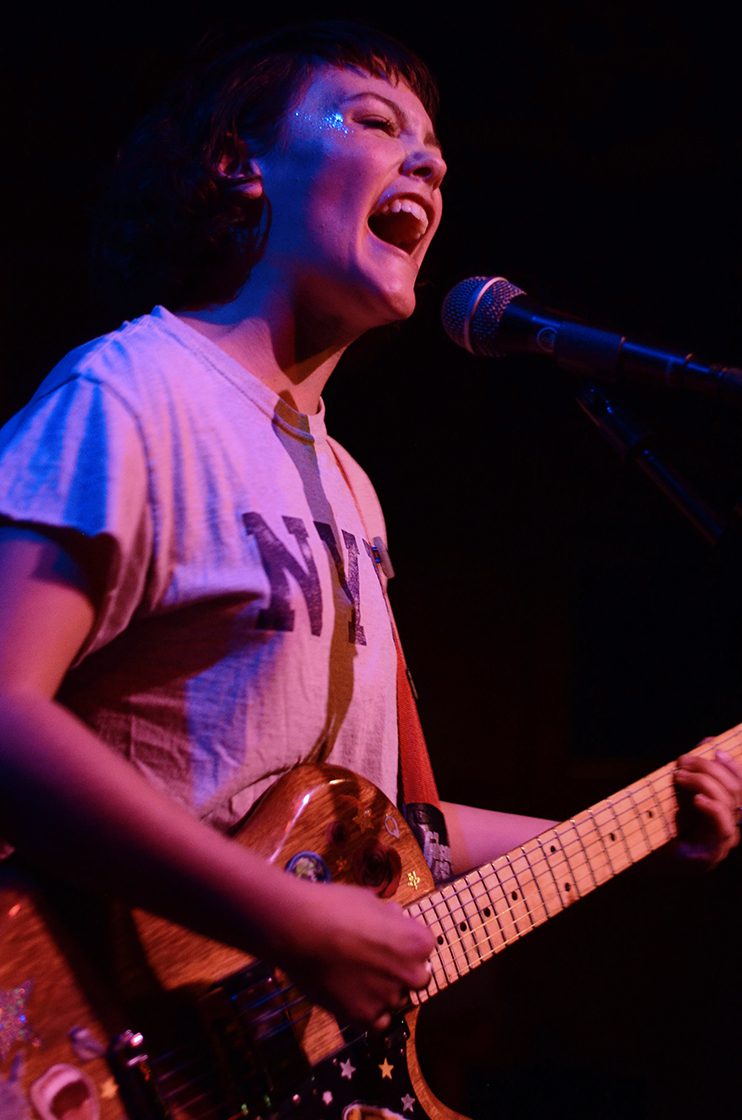
ONLY NOISE: The Queen of Halloween

Don’t let the weather fool you; it’s the right time of year for chills, and I’m not talking about temperature. ‘Tis the season for screams, and witches, and all things terrifying, and personally, I can’t get enough of it. In the lead up to Halloween (or as I like to call it: The Greatest Holiday on Earth), I have been on a steady diet of horror movies, scary books, and spooky music. It’s Bauhaus for breakfast, Stephen King for lunch, and Wes Craven for dinner – a well-balanced meal plan on any given day in October.

While watching The Thing recently, I was thinking of the wonderful interplay between sound and scare factor. Aside from fake blood and screaming teenagers, a crucial element of horror films is the horror score. Music and terror are deeply intertwined, and movies such as Jaws, Halloween, and The Exorcist would be entirely different films without their respective scores. What would Alfred Hitchcock’s Psycho be without the shrieking strings in the shower scene or the manic theme of its opening credits? Would we fear the great white shark in Jaws so much if it weren’t for John Williams’ sinister compositions?

Sound and fear are related in the most primordial way. In 2012, UCLA evolutionary biologist Daniel Blumstein conducted a study to further explore this relationship. His findings were published in the science journal Biology Letters, the study’s abstract claiming that, “Humans, and many non-human animals, produce and respond to harsh, unpredictable, nonlinear sounds when alarmed, possibly because these are produced when acoustic production systems (vocal cords and syrinxes) are overblown in stressful, dangerous situations.” In other words, the aforementioned nonlinear sound we respond to so viscerally in horror movie soundtracks registers the same as a scream on a deep-rooted, biological level. The more jagged, sporadic, and a-melodic, the more humans tend to react to the aural stimuli.

If screams, sharpness, and a disregard for linear form are the key ingredients for frightening music, and frightening music is key for a good horror film, then look and listen no further than the rapturous Goth operas of Diamanda Galás. For over 30 years, Galás has pushed the limits of music and performance, as well as the underworldly depths and mountainous heights of her multi-octave voice. At a glance, the virtuosic singer and pianist could easily snag the thorny crown for Queen of Halloween – but listening to her records is a far more sinister experience. Her 1982 debut album The Litanies of Satan is one of the most unsettling pieces of music ever recorded. Forget “The Monster Mash;” The Litanies of Satan is thirty minutes of despair, demonic possession, and pure audio insanity. Play it at your Halloween party and just see what happens.

Throughout the decades Galás has produced a body of work as versatile as her vocal range, releasing piano-driven jazz and blues records like The Singer and All the Way, as well as experimental fright-fests such as Plague Mass, Divine Punishment, and Saint Of The Pit. All the while the singer-composer has never lost her razor-sharp edge, exuding perpetual cool with her wild, jet-black mass of hair and a wardrobe that makes Morticia Addams look like Undertaker Barbie.

In addition to her prevalence in the music world, Galás has been recruited to supply disturbing audio for many horror films. She created the voice of the dead in Wes Craven’s voodoo-zombie flick The Serpent and the Rainbow. In 1992 she lent her shrill cries to a pack of female vampires in Francis Ford Coppola’s adaptation of Bram Stoker’s Dracula. Movies like The Ring Two, The Conjuring, and Schrei 27, Galás’ own collaborative effort with film director David Pepe, have the Diamanda mark of terror; their creepy soundscapes elevated by her textured and frenzied compositions.

Strangely, the artist’s direct musical influences are far less ghoulish than the films she is associated with. In a profile for The Quietus,Galás listed her thirteen (naturally) favorite albums of all time, and the selections were predominantly jazz records by the likes of Miles Davis, Albert Ayler Trio, and Fats Waller. She must have heard something far more primeval in these recordings, however, as she mentioned “the one thousand names and sounds of animals and supernatural beasts that are part and parcel of any decent artist,” while discussing her favorite Ellen McIlwaine record, We The People.

 Galás music is inhabited by droves of such beasts, stampeding through hailstorms and hellfire, careening off serrated cliffs and plunging into the heart of human fear. What could possibly be more frightening than Ms. Diamanda Galás? I’m afraid to find out.

Don’t miss Diamanda Galás performing on Halloween night at Murmrr Theatre in Brooklyn. Tickets here.

EP PREMIERE: Pollens “Mr. Manufacture”

When I was in college, listening to Animal Collective’s track “Bees” felt like a revolution in sound. It was the first time I was really confronted with challenging music, music that took me out of my norm and landed me in a universe unexplored. Likewise, NYC-based duo Pollens craft a sound that engages (and often confounds) the ear. Their new EP Mr. Manufacture explores the buzz, crash, and timbre of the city.

From its opening, Mr. Manufacture promises to provoke. There’s a playful, childlike quality to Jeff Aaron Bryant and Elizabeth “EMay” May’s voices; it’s a startling mix when laid against a metallic, rhythm-based background. Songs like “J Train” so perfectly describe the robotic, humorous morning that is a Brooklyn commute: bodies rushing past one another only to stand in close formation on a moving bullet. My mind filled with images, movies, pieces of my own life in NYC while listening to this EP; it’s a strange soundtrack to wake up to, yet I’ve found myself coming back to it in the morning, steeling my mind against the day.

We talked with Bryant about navigating a shifting band lineup and what writing a song for Pollens really looks like. You can stream Mr. Manufacture exclusively below.

AF: You’re​ ​a​ ​Seattle​ ​band,​ ​now​ ​based​ ​in​ ​Brooklyn.​ ​Has​ ​living​ ​in​ ​New​ ​York​ ​changed any​ ​of​ ​the​ ​themes​ ​or​ ​sounds​ you gravitate toward in Pollens?​ 
JB: New York is trash and media images and lots of humans. I feel like we indulge a kind of ‘edge’ that’s not super encouraged on the West coast. Like, it’s kinda spiky here. I feel like the West coast vibe is more concerned with beauty than performativity or being weird.
AF: The​ ​band​ ​has​ ​gone​ ​through​ ​a​ ​lot​ ​of​ ​iterations​ ​since​ ​2008.​ ​Do​ ​you​ ​find​ ​the​ ​writing process​ ​more​ ​challenging​ ​with​ fewer band​ ​members?​ ​Or​ ​is​ ​it​ ​streamlined?
JB: When Pollens was a larger ensemble, there was sometimes this burden of finding something for everyone to do. A big band wants a big sound, even if the idea is small or stupid. With a tiny band, we’re totally free to explore sparse, dumb, over-committed ideas without a lot of risk or investment.
AF: And​ ​when​ ​it​ ​comes​ ​to​ ​performing​ ​live,​ ​do​ ​you​ ​find​ ​a​ ​lot​ ​changes​ ​when​ ​you’re down​ ​to​ fewer ​members?
JB: Yeah. Making records is cool, but EMay and I love performing. When we’re working on new material, we’re not thinking about songs, we’re thinking about situations, bodies, talking. EMay is an actor and is super comfortable taking up space and being engaged and talking to humans. Sharing the stage with EMay, I’m learning that being antic and outgoing are not the same thing. We’ll maybe try other ensembles in the future, but our shows are so fun right now, and it feels like a big factor is having the whole stage to run around and be silly.
AF:​ Can​ ​you​ ​give​ ​us​ ​some​ ​background​ ​on​ ​the​ ​song “Dinosaurs”?​ ​The​ ​lyrics​ ​are​ ​funny [fusion_builder_container hundred_percent=”yes” overflow=”visible”][fusion_builder_row][fusion_builder_column type=”1_1″ background_position=”left top” background_color=”” border_size=”” border_color=”” border_style=”solid” spacing=”yes” background_image=”” background_repeat=”no-repeat” padding=”” margin_top=”0px” margin_bottom=”0px” class=”” id=”” animation_type=”” animation_speed=”0.3″ animation_direction=”left” hide_on_mobile=”no” center_content=”no” min_height=”none”][“I​ ​don’t​ ​believe​ ​in​ ​the​ ​ocean​ ​floor (no, I don’t) / ​There’s​ ​nothing​ ​down​ ​there​ ​/​ ​Don’t​ ​try​ ​to​ ​show me​ ​(I​ ​won’t​ ​even look​ ​at​ ​it)”]​,​ ​but​ ​the​ ​cadence​ ​in​ ​which you​ ​both​ ​deliver​ ​the​ ​words​ ​really​ ​adds​ ​to​ ​the​ ​effect.
JB: “Dinosaurs” is just us being dumb and flirting with points of view. I think we both have a lot of time for magical, conspiratorial, prankish ideas… and like, what’s the difference between clowning and willful ignorance? And how can play disrupt unhelpful ideas like ‘progress’?
AF: There’s​ ​a​ ​really​ ​stripped​ ​down​ ​feel​ ​to​ ​this​ ​record;​ ​the​ ​vocals​ ​are​ ​straightforward, even​ ​monotone​ ​at​ ​times,​ ​with​ ​the​ percussion​ ​pulsing​ ​and​ ​consistent​ ​throughout. How​ ​did​ ​the​ ​songs​ ​for​ ​this​ ​record​ ​begin​ ​to​ ​take​ ​shape?​ ​Did​ ​you​ ​start​ ​with​ ​lyrics​ ​or build​ ​from​ ​a​ ​beat?
JB: We’re pretty focused on text lately… words first. We usually work from lists. We’ll put on whatever beat, who cares, and then take turns reciting items in the list. A certain rhythmic feeling will emerge from saying things in funny voices. Like, if it makes us laugh then [we say] wait, that’s silly, we should do that. And once it feels like we’re on to something, we start trying it against different drum patterns.
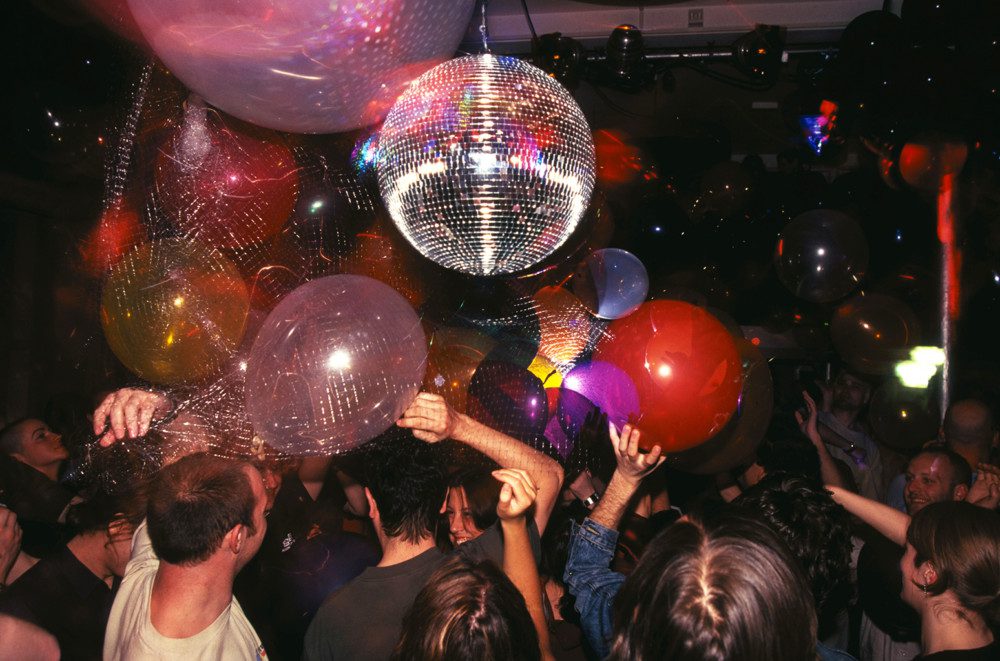
AF: Question​ ​speed​ ​round!​ ​Record​ ​you​ ​can’t​ ​stop​ ​listening​ ​to​ ​right​ ​now.
JB: Talking Heads, Remain in Light.
AF: Favorite​ ​NYC​ ​music​ ​venue.
JB: The Glove.
AF: Favorite​ ​quiet​ ​place​ ​in​ ​the​ ​city.
JB: That exists? I hope not.
AF: What​ ​do you​ ​want​ ​people​ ​take​ ​away​ ​from​ ​listening​ ​to​ ​Mr.​ ​Manufacture?
JB: We just want folks to feel cool when they’re drying dishes or brushing their teeth. Maybe your bus is late. Maybe you’re working out or making lunch. Whatever. Humanoids, we support you.

Pollens new EP Mr. Manufacture is out tomorrow (Friday, October 27); it will be available for FREE on Bandcamp.  The band will be giving away limited edition cassette tapes at their record release celebration show on November 16 at Secret Project Robot in NYC. They’ll be joined by Operator Music Band, Salt People and a special guest (to be announced); full details on Facebook HERE.[/fusion_builder_column][/fusion_builder_row][/fusion_builder_container]