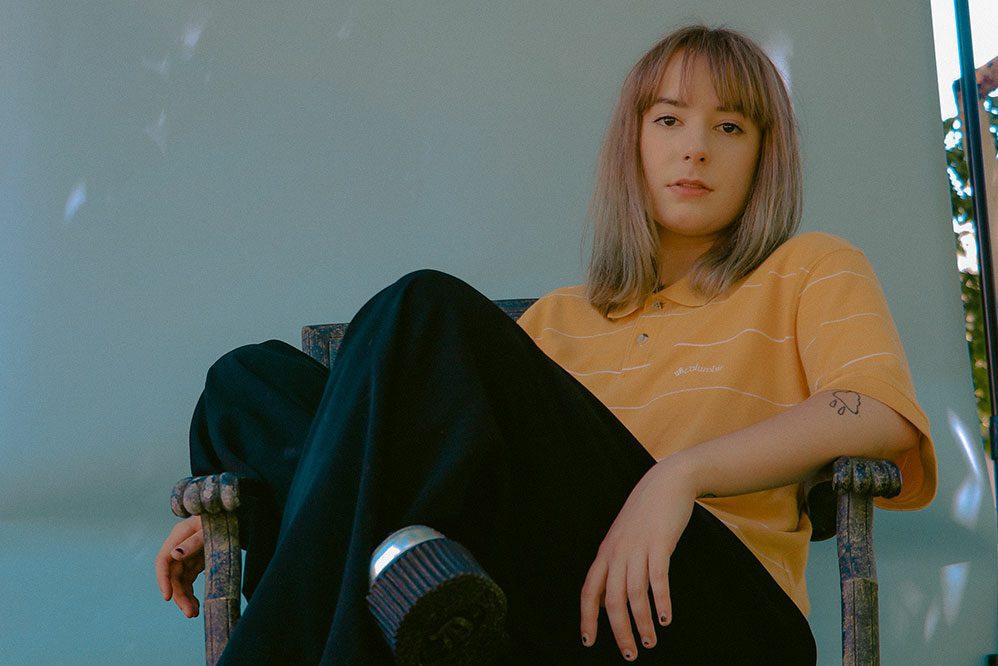
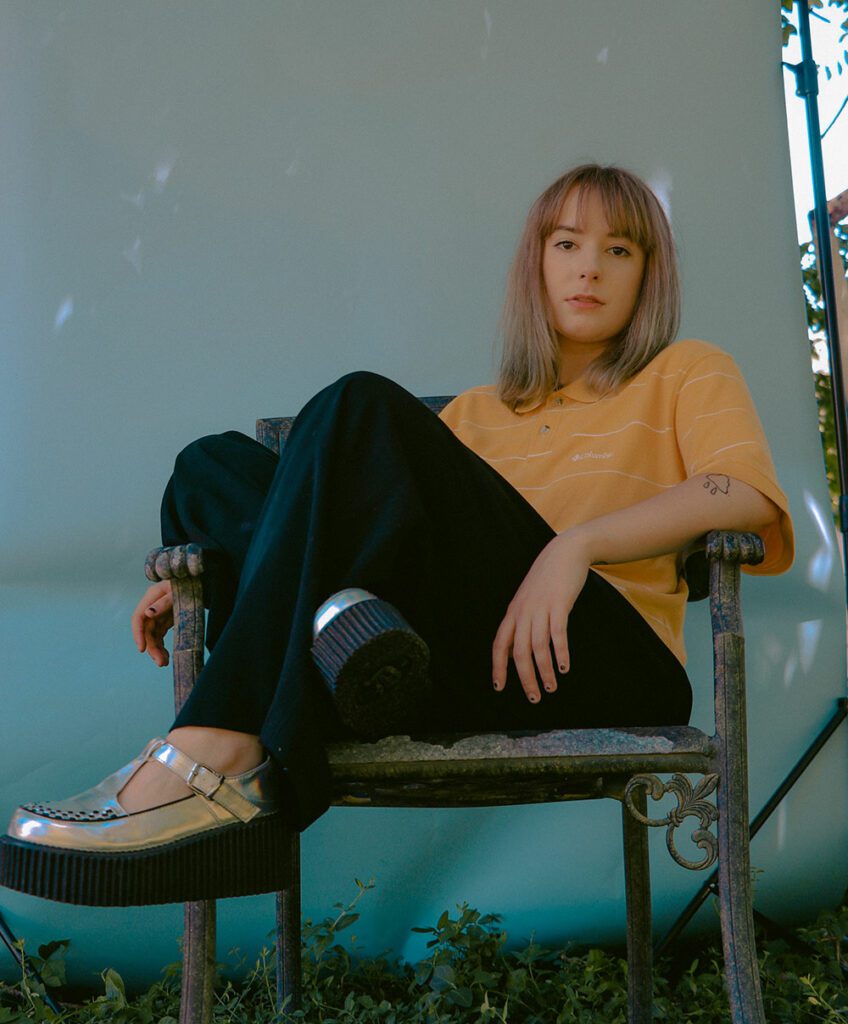
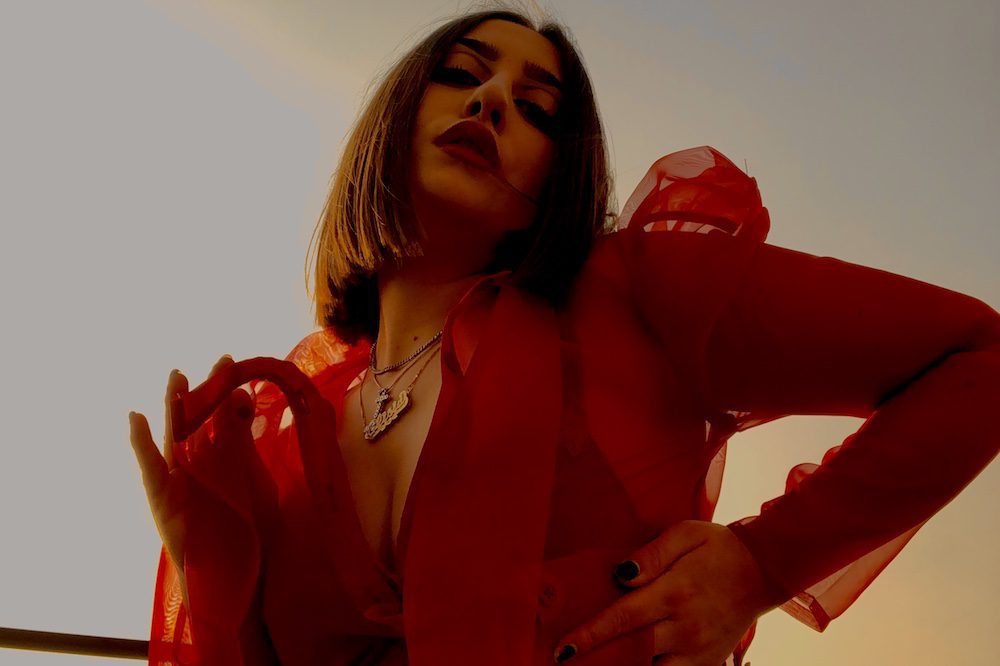
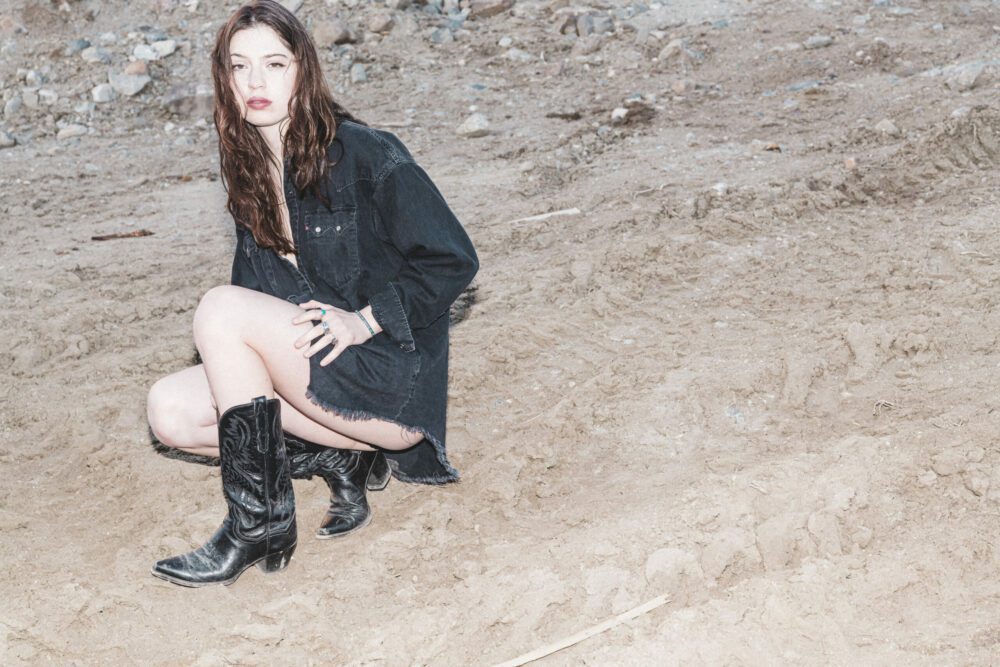
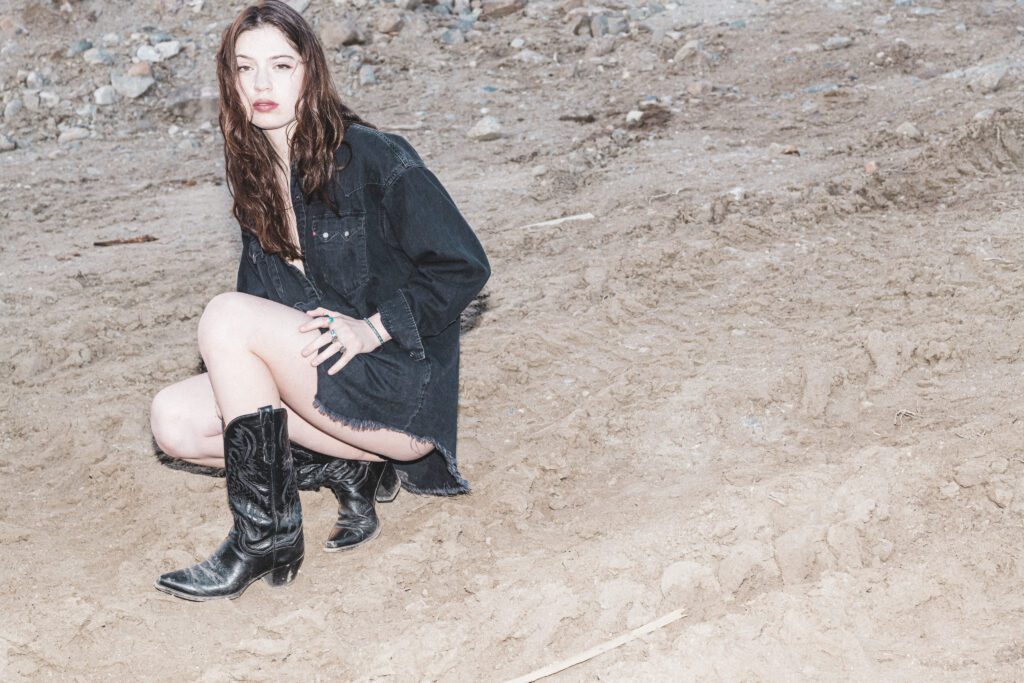
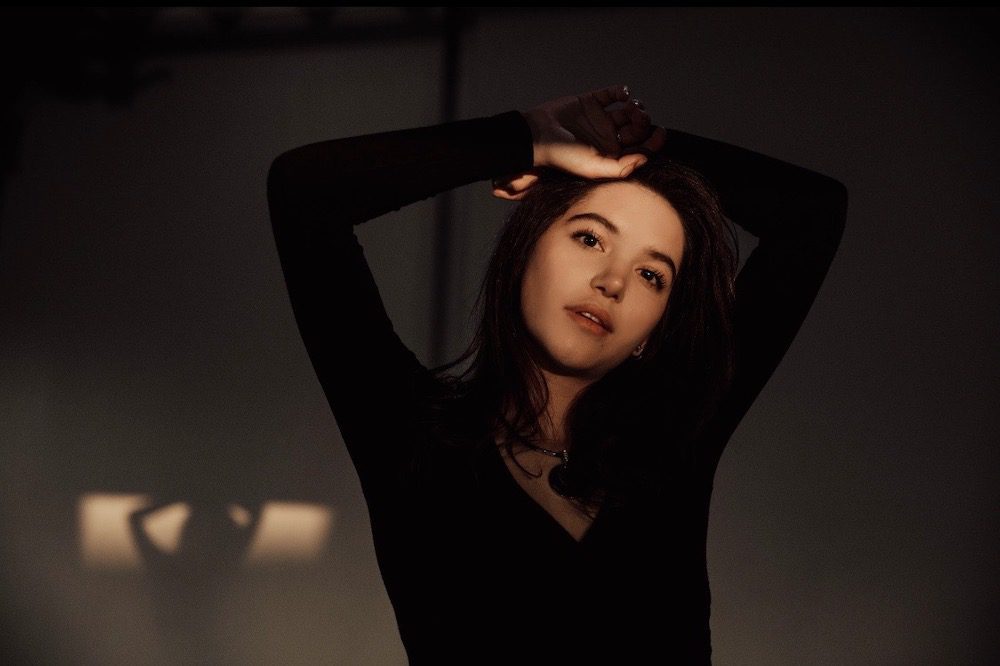
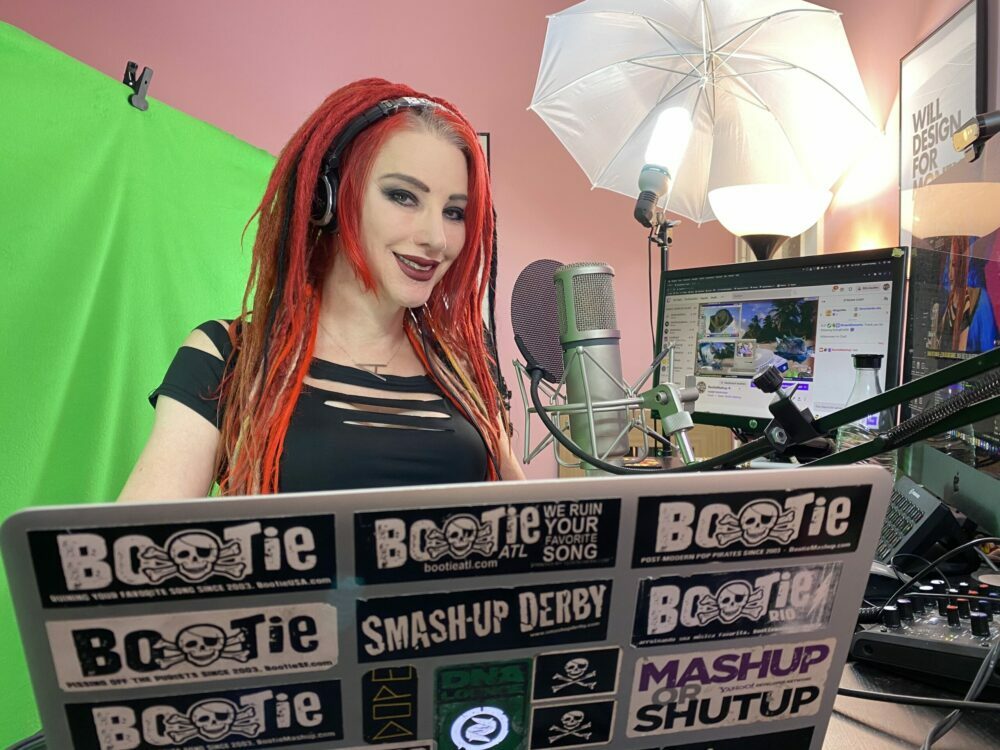
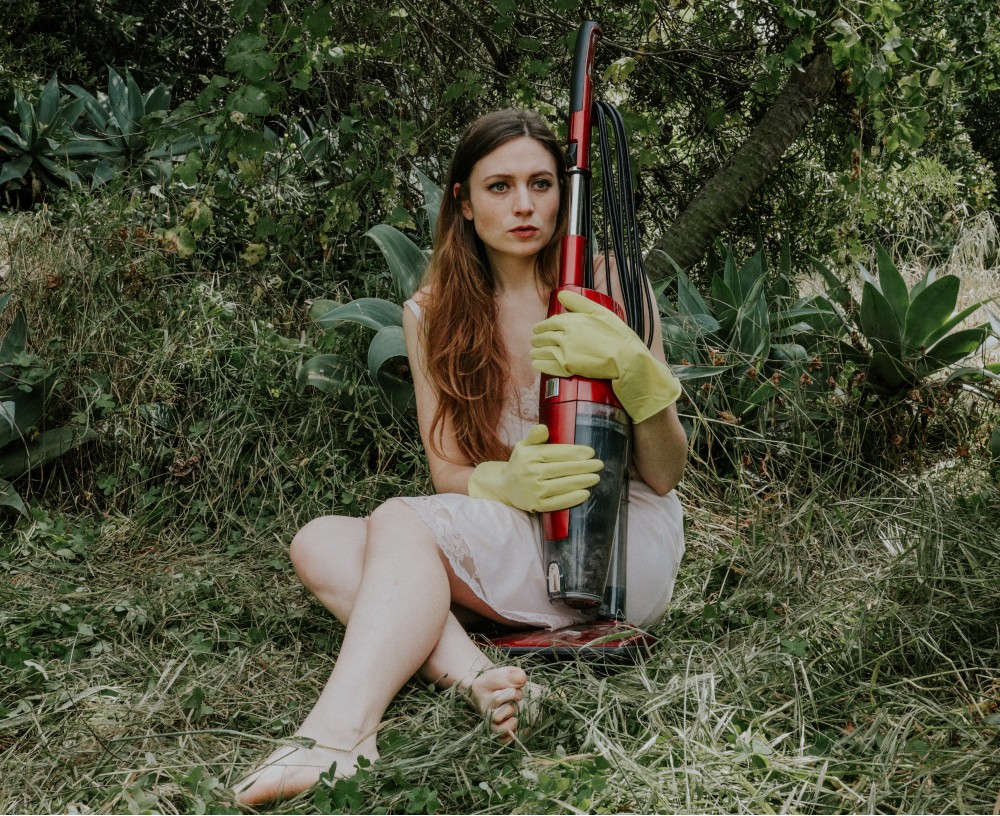
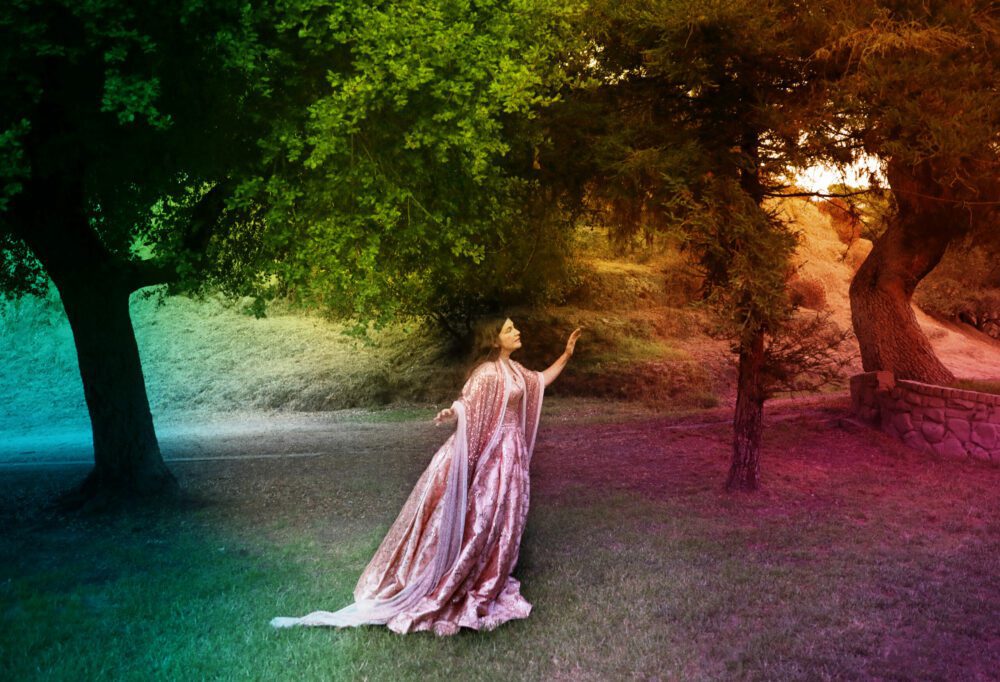
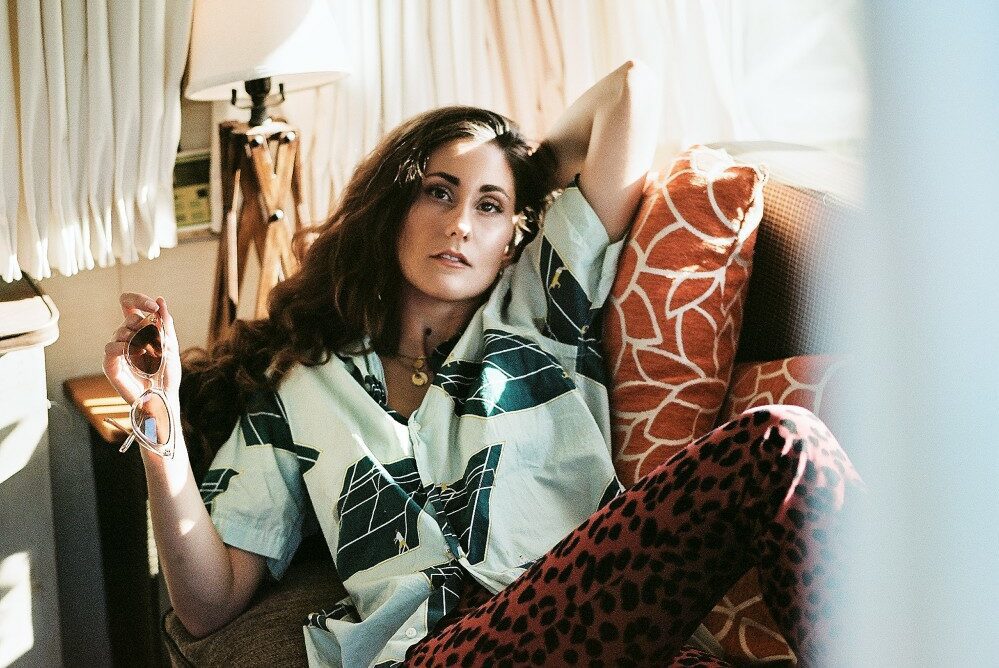
Booming production can’t drown out Reyna Roberts’ awe-inspiring vocals. With fire-red hair and a voice to match, Roberts is coming for her country crown in 2021. Case in point: her latest single, “Stompin’ Grounds,” with its rollicking guitars and spellbinding blend of hard rock and country. Her rock influences – ranging from Jimi Hendrix to AC/DC – become apparent the second you press play. Roberts’ fierce voice is wild and free, yet she knows how to tame it as she wails on the spitfire lyrics, “Boots down/Flames up from dawn to dusk/Drowning in that whiskey river/But too damn high to sink.” It’s the type of song that’s tailor-made for a live show and one she’s bound to light up on stage with.
Roberts moved from LA to Nashville in March, just before the COVID-19 pandemic shutdown swept across the country. A few months later, in July 2020, she unleashed “Stompin’ Grounds.” In an interview with Rolling Stone, she shares that the song is partially inspired by her military background. As the stepdaughter of a Marine, Roberts lived in Alaska for a period of time during childhood before calling California and Alabama home, noting that while writing “Stompin’ Grounds,” she thought of the servicewomen and men who have to make stomping grounds for themselves when they’re stationed around the world, her thoughtfulness adding a layer of compassion to an already striking number.
Roberts debuted with “67 (Winchester)” back in the beginning of 2019, then spent the next few years networking with songwriters and industry reps and honing her craft. But it was her vocal talent that propelled her into the spotlight this summer, when she uploaded a cover of Carrie Underwood’s “Drinking Alone” to YouTube. Poised at a piano in her home, Roberts voice flies as magically as it does in a professional studio. Her rendition won over the approval of Underwood herself, who praised “Looks AND sounds great!” after Mickey Guyton retweeted a video of Roberts slaying the song with her arena-ready voice.
On top of her electrifying vocals, Roberts has proven that she’s just as willing to be honest in real life as she is in her music. In a series of Tweets, Roberts is sharing her recovery journey with fans from a recent eye surgery she had to correct cross-eyed vision impairment she was born with as a premature baby. Whether she’s revealing to Billboard that she lost every high school wrestling match her first year, yet refused to give up the sport, or sharing her truth on social media, Roberts says she was raised to be fearless, and so far, it’s proven to be true.
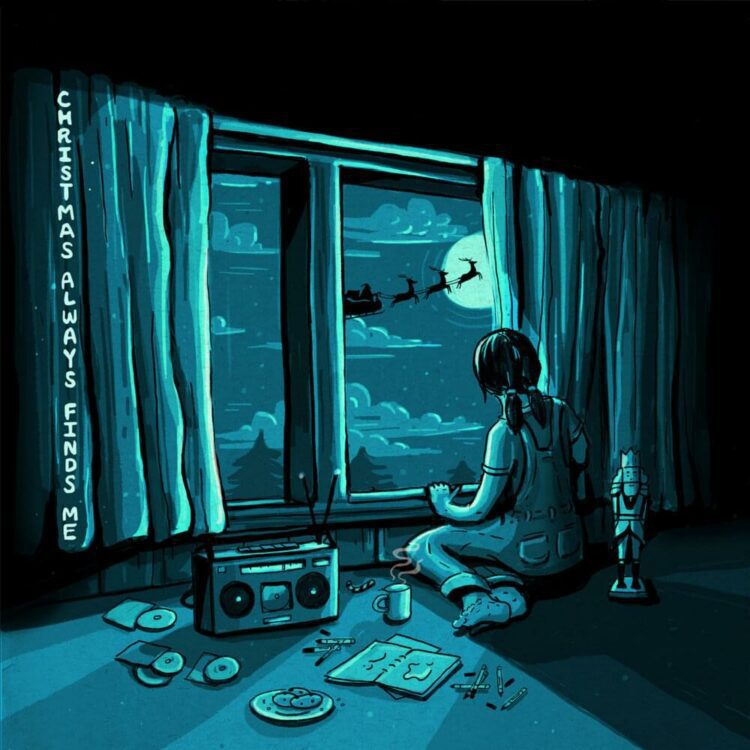
Roberts will perform on Brandy Clark’s holiday special, Christmas From Here There And Everywhere, alongside Clark, Melissa Etheridge, Cam, Ashley McBryde, Shane McAnally and Charlie Worsham, when it airs on Circle All Access on Dec. 22 at 10 p.m. ET.
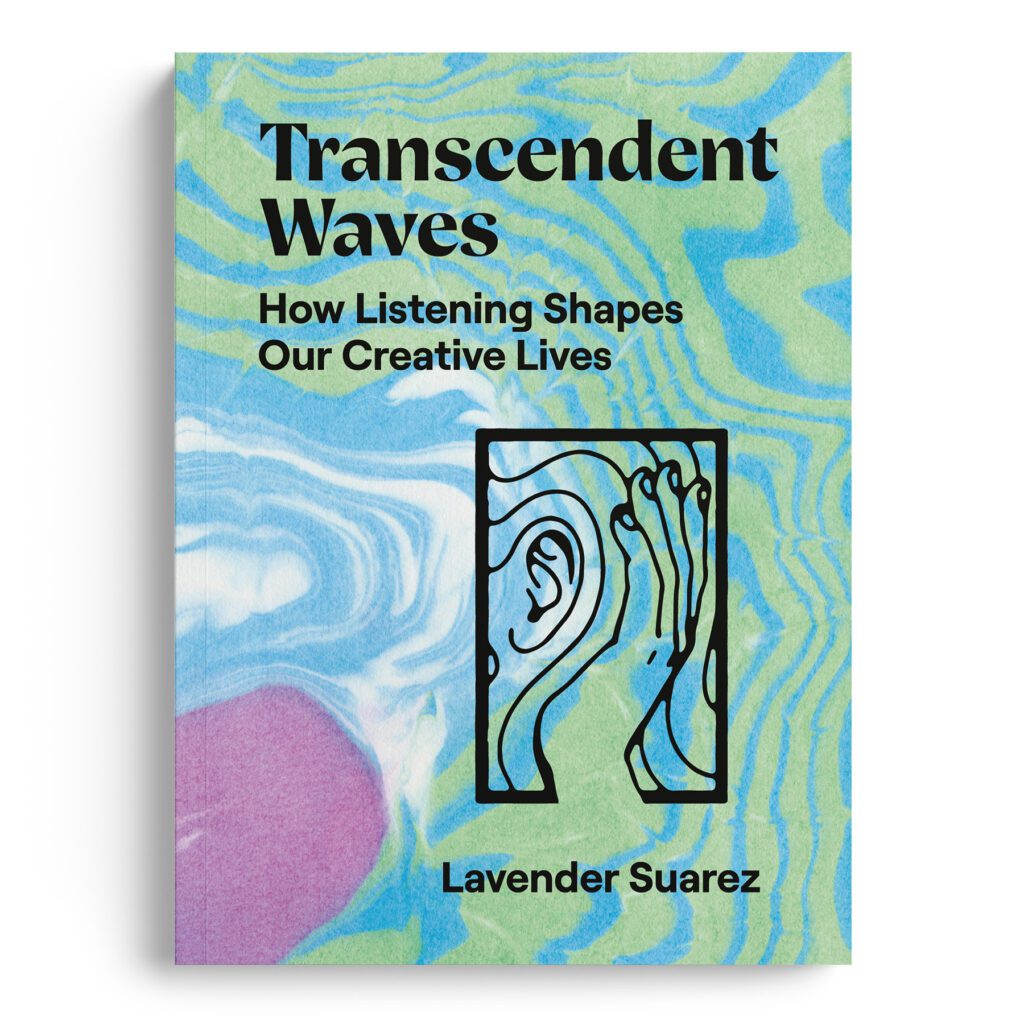
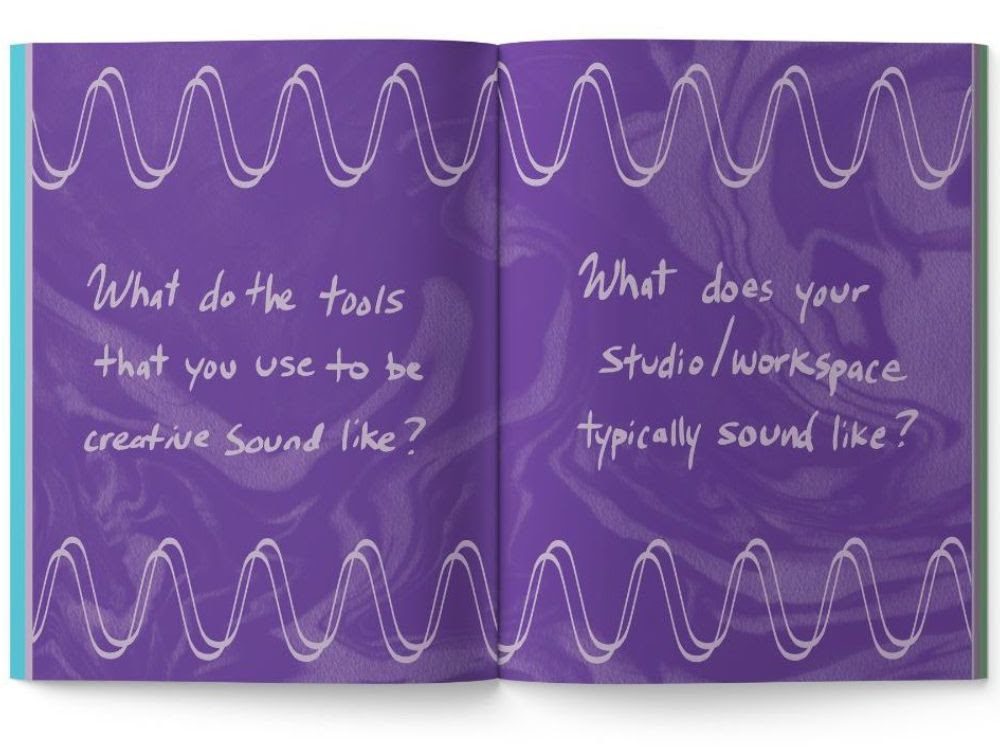
from TRANSCENDENT WAVES, Published by ANTHOLOGY EDITIONS
Prior to the pandemic, sound healing – a practice that utilizes relaxing vibrations in the hopes of easing participants’ anxiety, insomnia, or other ailments – usually took place in person, on a blanket or a mat with a real life human being playing gongs, Tibetan singing bowls, tuning forks or other esoteric instruments right there in the room. Since March, sound healing has moved to the virtual domain, though its practice still hinges on vibrations and frequencies tuned specifically to help people emote and relax. If you’re new to the experimental world of sound healing and meditation, Transcendent Waves, the debut book from healing practitioner, meditation teacher, and artist Lavender Suarez, has arrived just in time for your new found exploration.
Out December 15th via Anthology Editions, the hybrid how-to guide stretches beyond sound healing as a trend, and deep dives as an immersive artist’s workbook. Rooted in scientific evidence, the anecdotes and spontaneous writing prompts open up new perspectives listening can bring to our inner lives and creative bubbles. It also outlines how listening can unlock moments of creative spark, self-awareness, and mindfulness.
When asked about the transition from analog to virtual, Suarez commented, “I think it’s really great to experience a sound healing treatment from the comfort of your own home.” Certain frequencies can activate our body’s healing system, and increase clarity, energy, better sleep, focus, and tranquility. For that reason, says Suarez, some folks may explore sound healing right before bed, or at the beginning of their day. “You can cater it to exactly your schedule, avoiding any commute, which can be stressful,” she adds.
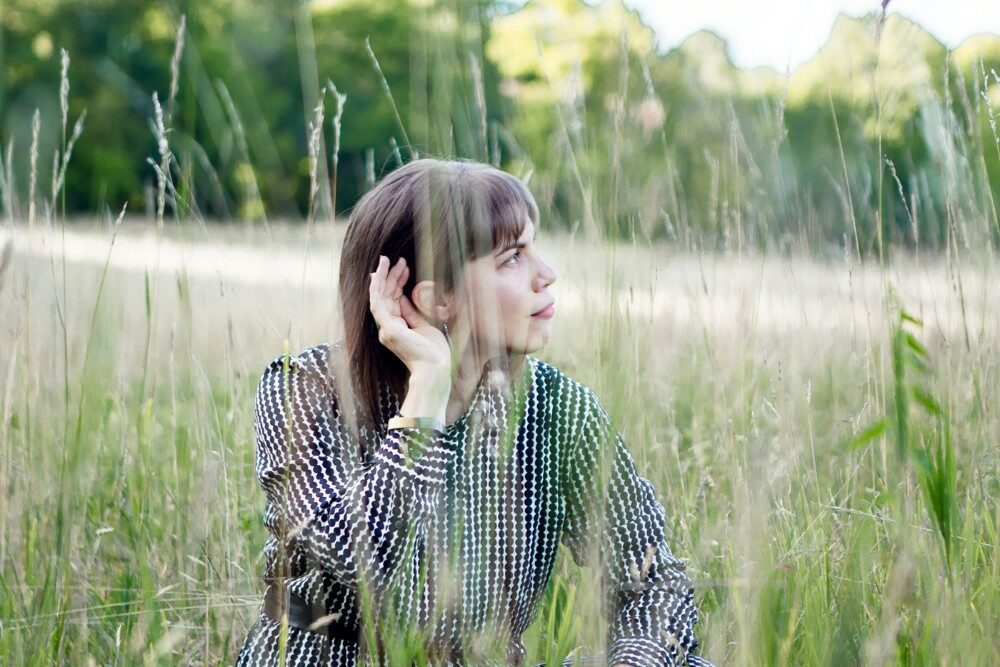
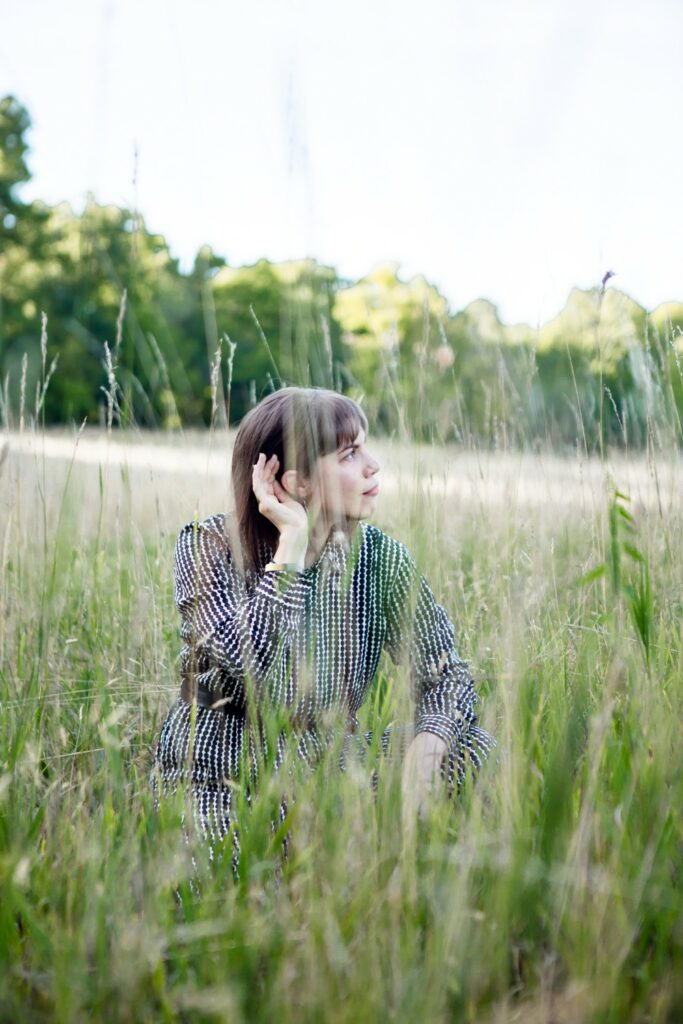
Photo Credit: Jenn Morse
Suarez’s relationship and connection to sound developed in early childhood. As an eight year old, Suarez serenaded her neighbors with her beloved companion – her saxophone. “I didn’t like the feeling of the neck strap, I just liked holding the saxophone,” she says. “I don’t have distinct memories of this, but my mom would tell me I would just walk around the street in my neighborhood playing the sax. I just had so much fun with it.”
Her study expanded from her passion for the tactile feel of the sax, into electronic synthesizers, and bass and percussion during her teenage years. “I just wanted to absorb sound in my own way. I’ve always had a very intuitive and therapeutic relationship with music,” she explains. “In school I was glued to my discman. Even if I had just 30 seconds between walking to another class in school, I would throw my headphones in and listen to part of a song before my next class.”
During college, Suarez found herself studying psychology and art therapy, eventually configuring a way to fuse these passions with her personal connection to sound. “When I learned the methodology of sound being used therapeutically with people, I thought, ‘Wow, that’s exactly what I want to do.’”
Suarez has hosted educational and meditative listening experiences and workshops at MoMA, the Guggenheim, the Whitney, the Hirshhorn Museum, and the Rubin Museum of Art. The Rubin was one of the first major museums to approach Suarez to speak on sound and movement. Initially asked to lecture on how brain waves sync with sound and movement, Suarez decided to speak on how the power of sound specifically aids in relaxation. The event evolved into a 45-minute presentation about neuroscience and the powers of sound on the mind, closing the talk with an electro-acoustic sound bath (she felt it would be a tease to explain, but not offer, the experience). This became a stepping stone in her career, and opened the gates to the expansive world of museum programming. “A person may never think about walking into a yoga studio, but someone wandering through their favorite museum may see a free meditation class advertised in a space they already love visiting and give it a go,” Suarez says.
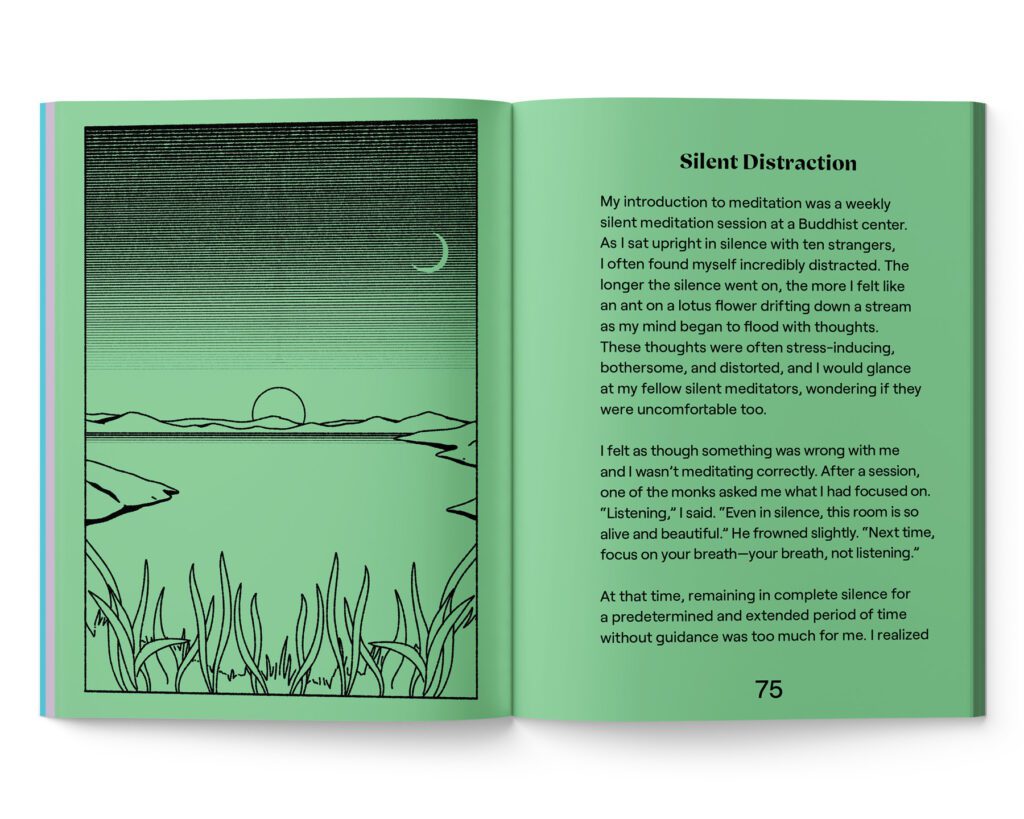
from TRANSCENDENT WAVES, Published by ANTHOLOGY EDITIONS
Suarez teaches an ongoing hybrid art therapy sound bath workshop called Meditation for Creative Expression. “I’ve always had a strong mission to help artists and musicians, particularly with my therapeutic practice. These communities are often uninsured, and don’t have access to certain health resources,” she says. “I had a lot of friends who were on extreme touring schedules, and suffered from anxiety and exhaustion. Not everyone is necessarily seeking out healing methodologies, but I really wanted to provide a healing service.”
It began as an in-person four week workshop at the Brooklyn Public Library in January, and has continued virtually at Pioneer Works. After a guided meditation, participants are given time to free write or free draw while Suarez creates meditative music in the background. At the end, people share what came through to them, and what they created.
“We feel more fluid creating art, when we can clear our minds,” Suarez explains. “I love it, because it’s for people of all levels of artistic practice. This book came out of teaching many workshops since 2014, it’s accessible, and catered to all creative people, age groups, and backgrounds, not just artists. Even if we don’t think that we’re artists or creators, we express ourselves every day. There’s always a creative process going on in our minds; this workshop is meant to let that process come through in the most fluid way possible.”
The book’s remarkably relatable tone sets it apart as a dynamic, accessible and enriching read. It guides the reader to discovering their sonic sanctuary, where the sound quality of the space provides you with the emotional state you desire within that moment. “A sonic sanctuary might be a quiet park that you return to when you need to clear your head. Or a bustling coffee shop if you want that caffeine energy bustle to finish a term paper,” Suarez says. “During the pandemic, a sonic sanctuary for me has been riding my bike through Prospect Park. I love riding the trail, and the sensation of hearing little bits and pieces of all the different things going on. There’s the element of nature, but then you catch people talking, or a jazz band in the distance. I love the sensation of riding my bike straight through, hearing the ducks, birds, sometimes small private parties. I’m moving through so much sonic stimulation that I otherwise don’t necessarily get when I’m at home.”
from TRANSCENDENT WAVES, Published by ANTHOLOGY EDITIONS
Too often, wellness providers set the tone of having secret knowledge that they’re going to share with you, as a form of gatekeeping. This book shares knowledge, with a friendly, open-minded approach. Suarez effortlessly displays the interconnectedness of clinical science with inquisitive philosophical ideas. “I wanted to create a book that really appreciates how much goes into what happens when your ears hear a sound,” she says. “I wanted to spark inspiration to give options for people to go down their own rabbit holes and paths with sound – what happens when you’re standing in a certain building, and you can hear a whisper from the other side of the room? Those phenomenon are fun, and bring us into the listening world in a way where we’re really understanding what’s happening.”
Suarez found narrative inspiration from Yoko Ono’s book grapefruit, deriving from The Fluxus movement, an avant-garde art movement of the late 1950s which emerged from a group of artists who had become disenchanted with the elitist attitude they perceived in the art world. “These abstract poems are about the ways you interact with your art. They could be taken literally, or they could just be philosophical. Make a painting, leave it in the moon overnight, the next morning, burn it,” Suarez says. “I wrote this book to counter the visual-centric world we live in. I wanted to share my belief that all artists of all types can be inspired by sound and listening. A lot of the time, sound likes to stay in the corner of music, and then visual art is in a different realm. It doesn’t have to be that way. I would like readers to walk away with a deeper connection to the impact of listening in their lives, and listening to themselves and the world around them, and how that can open up creative possibilities for them.”
Follow Lavender Suarez on Facebook and Instagram for ongoing updates.
Jordana Nye doesn’t mince words with her latest, eponymously released LP Something to Say To You – but musically, it provides a soothing and intimate experience, with its lightly-sung melodies and anecdotal lyrical compositions, manifesting an auditory sanctuary to listeners. The Kansas-based bedroom pop artist explores relationships, coping mechanisms, and the search for happiness through the lens of a 19-year-old creative. In her own words, the album compiles “messages to people mixed with storytelling” and is an illustration for her progressive path in music production.
Mesmerized by music from an early age, Jordana naturally picked up a wide range of instruments, from the keyboard to the violin to ukulele and guitar, kicking off her musical journey essentially as a one-woman band. Her allure for alternative rock and indie folk music sparked the urge to make use of her instrumental skills. In her early years, tunes from groups like Grizzly Bear and Vance Joy regularly vibrated through her “chunky headphones, sitting on the bus” as she remembers. Consequently, over the course of three years, Jordana avidly covered songs from her favorite artists with her ukulele and guitar in hand. “In 2018, I just decided to try and make something of my own,” Jordana remembers. “I didn’t think I could do it – I was like, I’m not interesting, I’m just taking all of these other songs and playing them. But I was like, there has to be some originality there, there’s got to be something – little did I know I would be here.” The young multi-instrumentalist went on to play and collaborate with fellow musicians she encountered on Twitter, including members of the local Wichita group The Cavves while also touring with indie-pop group TV Girl.
Jordana soon began cranking out self-produced tracks and plastering them on the vast music library of Soundcloud, swiftly catching the attention of NYC-based record label Grand Jury Music. After she was signed, Jordana began reamping her sound, in collaboration with producer Jeffery Melvin (aka MELVV). She says that her existing work, ability, and potential was intensified through the guidance of experienced talent. “My creative freedom really is pushed out working with Jeff, because he knows what I’m capable of… It’s refreshing. I know that I’m there to work on my music and to focus on that, and these people are kind enough to take the time to help me,” she explains. “I was so in this headspace of recording on my own that I had to make something perfectly suitable for me, or else I wouldn’t feel proud of it, like it wouldn’t feel worthy. [It’s] fucked up that your brain tricks you out of working, and out of going to the limit that you can actually go to. But yay! We’re here now.”
Something To Say To You is the artist’s second album, initially released as two EPs – Something To Say on July 31st and To You on December 4th. The album follows Jordana’s self-released 2019 debut, Classical Notions of Happiness, also re-released by Grand Jury earlier this year. The rapid onslaught of music serves as an example of the artist’s progression, in particular with the combination of these two EPs. Something To Say To You demonstrates the musician’s development, flowing from a minimal, harmonious sound in her early discography to a more complex one with the incorporation of experimental elements and genres throughout the production process.
Jordana carries on with coming-of-age themes in this latest release, which has been a continual theme in her work – sharing stories inspired by events in her life and laying out her own emotions and internal thoughts. Each song tells a different story as the artist navigates the world from her perspective while also indirectly aiming personal notes to significant people in her life, yet it’s as relatable as if reading an excerpt from one’s own journal. “A lot of the songs on this LP are messages to people I know personally, but it’s not direct. There are negative aspects of it, like ‘Fuck You,’ but also positive ones like this,” Jordana explains, pointing to her pittie mix comfortably lounging next to her. Her furry friend was the inspiration behind “Interlude,” and also appears on the cover of “I Guess This Is Life,” released as a single in October this year.
Diversity is also evident in the album’s mix of sounds. Continuing to take a folk-pop approach, Jordana manages to intertwine different styles from a variety of genres. Songs like “Hitman” and “Big” let out some frustration with distorted guitar riffs and grunge-like motifs, while “I Guess This Is Life”, “Reason,” and “Forgetter” suit a more floaty, meditative state. The simple drum beats and airy echoing of Jordana’s vocals singing, “I couldn’t tell you in words how I’m feeling” in “I Guess This Is Life” offers a great sense of comfort despite her uncertainty, while the track “Divine,” takes a more upbeat approach, with its bell-like percussion suitable for jamming out to.
Whatever sonic notion of Jordana’s work attracts fans, her music offers a form of escapism from the unpleasant realities of our world. Multiple coping methods are conveyed within the lyrics of “I Guess This is Life” as she lightly sings, “the burn of a cigarette with a good, good friend – it made me forget.” The reliability of coping mechanisms is also hinted in “Forgetter” with the lyrical phrase, “I just want to feel better – I want all of these thoughts just to mellow out.” The musician’s narrative lyrics coupled with the delicate twangs of her musical expression soothes audiences into a tranquil state, providing a form of therapy for all.
“I really saw my music from that perspective,” she says. “Going into the studio and getting those emotions into a song – it’s therapeutic.” The album is both intimate and personal, but speaks to a variety of individuals on myriad levels. “As far as my discography now, I think I might have something for everyone,” Jordana says. “That’s my goal pretty much… figuring out the big mystery of life.”
As for the future of her music, Jordana expects to stay within the realms of folk while incorporating a bit of classic jazz styles, finding inspiration in artists like Nat King Cole and Bob Crosby. Driven to create music inspired by her own introspective thoughts, more narrative approaches can be expected in her discography to come.
“That’s going to be all of my music, just writing about life. I don’t know how to not write about that,” she says. “I’m just giving all I’ve got and putting it into one place and hopefully people like it or find comfort in it.”
Breakups are difficult — some more than others. But often, even after the hardest breakups, we realize we’re better off without our exes. In hindsight, we see problems we’d overlooked in the relationship, and we start to enjoy our newfound freedom. That’s how LA-based singer-songwriter Elisia Savoca came to feel after her last relationship, which she channeled into her latest single, “Do Re Mi.”
The sassy, danceable, R&B-inspired song is an ode to new singlehood, encapsulating both the ups and downs of a breakup in poetic, fleeting vignettes: “Speaking words with our tongues/Let go of what we just won/Plans of lovers commit/Damn you make feel shit/Paradise and city on bliss/Nah, don’t wanna forget this/Sunset on my lips high and lows with this.”
“It’s definitely about somebody getting out of a relationship – that freedom when you leave a relationship, just doing what you want and saying what you want. That’s what my message is,” she says. “When I write a song, I say whatever’s on my mind, and it’s like a diary to me. I was trying to get the point across that I don’t need anybody, I can do this myself, and ‘Do Re Mi’ is about that liberation of speaking your mind and saying what you want.”
Savoca and her producer and co-writer Maestro wrote the song in just 10 minutes. “I will never forget the producers working with me that day — we were all so happy to be working together, and the synergy there was just amazing,” she remembers. With Rihanna as its inspiration, the track includes classical piano, guitar, bass, and synths.
Savoca made the video herself during quarantine, using footage of herself singing in a black outfit against a black backdrop. “I just wanted to create this sexy, dark, mysterious vibe,” she says. “It was just a sensual little video I made in like an hour.”
The song will appear on an EP she plans to release next year called Act 1: Manifesto, much of which is about “coming into being a woman and learning responsibility and looking back on my past,” she says. “Every time you kind of leave something in your past, you grow into this more developed being, and it’s so interesting to see these records symbolize that.” In “Falling,” her last single off the EP and the subject of another quarantine video — she sassily tells someone off in a catchy chorus: “Sit down with your ass/You’re gonna get smashed.”
Manifesto is the first of three upcoming EPs, followed by Act 2: Fiasco and Act 3: Vendetta — names inspired by Italian operas. “I really wanted to tap into my Italian side,” she explains. “I was getting into the movie side of things, so I thought it would be interesting to have this medieval times 1700s vibe, incorporating some Latin-rooted words into a project.” Each act represents a different side of her and stage of her life: Manifesto centers on the wide-eyed version of her that first moved to LA; Fiasco portrays her “going through a hard time, smiling through the pain, just kind of hiding it all;” and Vendetta depicts “a really strong, independent woman who is not letting anybody mess with her.”
All the EPs are finished, along with a number of videos — Savoca channeled her quarantine boredom into making 12 videos in a month. “Quarantine really gave me that time to be as creative as I wanted to be and direct my own music videos,” she says. “I never would have been able to do that before, so I’m definitely so happy that I was able to create all these videos during that time and had the chance to figure that part of myself out.”
The 19-year-old was born to a Sicilian family in San Diego. Inspired by the local punk and ska scenes, she taught herself piano and guitar and began singing with local bands. She started playing at talent shows in San Diego when she was 15, working up to a spot in the large punk and alt-rock venue SOMA, then moved to LA and began appearing at more big venues. She released her first EP, One of You, in 2018, following it up her second, Glitch, in 2019.
Even with three EPs on the way, she’s as prolific as ever in making new music. “I’m the kind of person that pumps out five songs in one day — I got to get it out,” she says. “I’m an emotional human being. It gets to the point where I can’t let this go, I’ve got to get this on paper. As a writer, your job never stops. You’re continuously trying to do better than the last song you made. So for me, it’s not a job. I’m trying to do what’s in me. I could never stop making music every day.”
Follow Elisia Savoca on Instagram for ongoing updates.
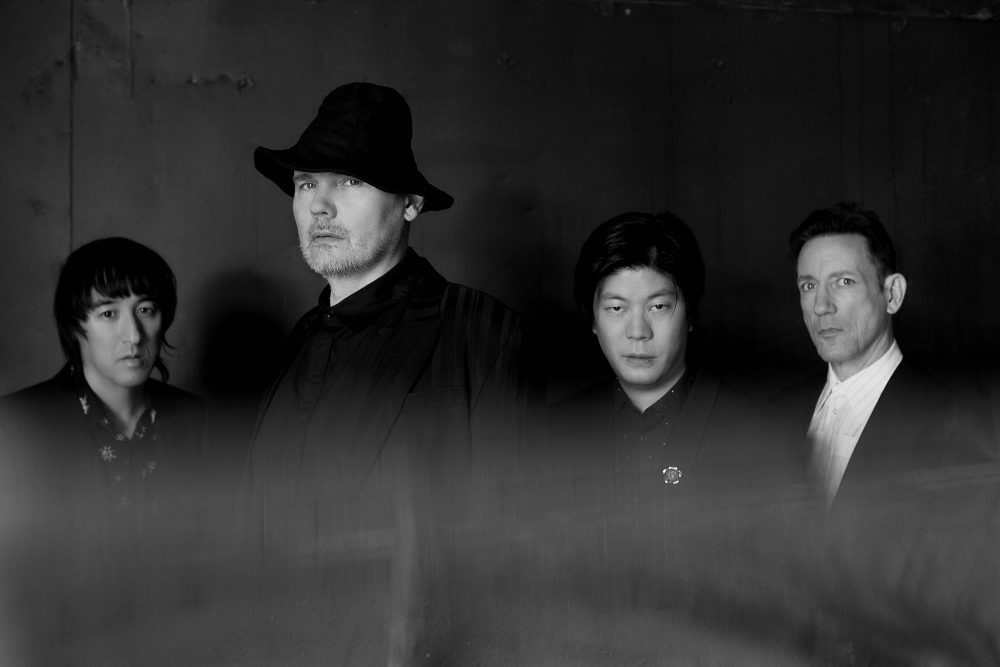
Twenty-five years ago, the Smashing Pumpkins released Mellon Collie and The Infinite Sadness, an epic double album packed with ferocious industrial-style rock like “Zero” and “Bullet With Butterfly Wings” but also with nostalgic, sentimental tracks, fuzzy with youthful romance, like “1979” and “Tonight, Tonight.” It entranced a generation of teenagers seeking escape from the daily ordinariness of their lives.
Mellon Collie, released in October 1995 – the third album for the foursome, following 1991 debut Gish and 1993 breakout Siamese Dream – debuted at number one on the US Billboard charts, still the only Pumpkins album to do so. It would go on to be certified Diamond by the RIAA, meaning it has sold more than 10 million copies. Produced by Flood and Alan Moulder, the sound was – as Flood is known for – anthemic, authentic and huge.
“We were just so focused on being successful on our own terms…we weren’t seeing much past 1995, honestly,” recalls Corgan, 53. “The label had pushed other people, more ‘successful’ rock producers, and I turned them all down. Flood was my personal choice. His work with Depeche Mode, U2, Nitzer Ebb, PJ Harvey – he’s a great human being and a great producer. He’d suggested Alan Moulder, since they were very close friends, so that’s how we ended up with the triumvirate of me, Flood and Alan.”
Corgan had announced to the label, Virgin Records, that he intended on recording a double album; they immediately tried to talk him out of it. Unsuccessfully, obviously. The fame that followed the success of Mellon Collie was a surprise to the band, which then consisted of Corgan, guitarist James Iha, drummer Jimmy Chamberlin and bassist D’arcy Wretzky.
“I don’t think we were really prepared for that level of attention,” says Corgan. “We’d come from the indie world. To be famous in the indie world, you’d play to a thousand people and your friends knew who you were. Suddenly, you’re on the cover of the most mainstream magazines and they’re asking you the dumbest fucking questions. Anyone who’s wise goes along with it because they want to get more famous, but we, of course, thought it was all kinda stupid, so we resisted it and probably made it more complicated for ourselves.”
Touring behind Mellon Collie created strain for the band; Chamberlin was fired after suffering a heroin overdose in New York City with the band’s touring keyboardist, Jonathan Melvoin, who died. Though Chamberlin returned to the band in 1999, Wretzky was replaced by Hole bassist Melissa Auf der Maur that same year, before the Pumpkins broke up “for good” in 2000. Various reunions and side projects in the years since have reconfigured the lineup with some original members, though Corgan has been the group’s only constant.
While Wretzky has rejected offers to reunite with the band, Corgan and Iha have remained especially close. “We were friends early on and connected very deeply on music,” Corgan explains. “As we’ve grown into very different types of people, it’s more like brothers. You don’t totally understand your brother, and I don’t think he totally understands me, but the thing we really connect on – the music – is the thing that’s always brought us back to the table.” Rather than the excesses of rock stardom, conversations are tame these days. “We mostly talk about family,” says Corgan. “He has two children, I have two, and Jimmy Chamberlin has two. It’s mostly like ‘elder dad talk’, or something.”
I saw Mellon Collie performed live in Melbourne in the late 1990s, where the album songs translated effortlessly to the live environment, I tell Corgan.
“It was actually Flood who insisted that the band who made Mellon Collie was more like the live band than the studio band,” Corgan says. “He wanted the live ferocity on record. He insisted that we try to capture that and we went out of our way to try to do that. Performances of the Mellon Collie album were an extension of that philosophy, which was: the darker and heavier we were, the better.”
The cost of the darkness and heaviness was a burden though, which Corgan can reflect on in the clarity of time.
“I think if you go out in front of ten thousand people and you create chaos, just because you stop playing the concert, it doesn’t mean the chaos in your head ends,” he says. “I do think it opens the door to a lot of bad behavior. You end up self-medicating to try to control something that really can’t be controlled. To go into that kind of energetic chaos on a routine basis makes for good art, but it’s definitely not healthy.”
Corgan admits he was in therapy for years, took “many spiritual journeys,” and yet maintains that there’s no way to truly understand what that kind of fame does to you until you’ve been through it.
“Human beings, at least in the 20th and 21st centuries, have come to worship fame as the ultimate currency,” says Corgan. “There’s no psychological manual for that, so only God can translate that, in my experience, into something more powerful and potent and less dependent on whether or not you’re being approved of or loved.”
To that end, the newest Smashing Pumpkins release, Cyr, has received mixed critical responses.
Corgan’s intention for Cyr was to invite listeners further into his imagination – beyond purely music-enabled communion – via a visual and animated dimension to the album. The album’s 20 tracks were released in increments over three months.
Notably, Cyr is the first Smashing Pumpkins album since Mellon Collie that unites the trio of Chamberlin, Iha and Corgan. Far from the angst-fueled, exploding hormones and extraordinary dream-like world of Mellon Collie, Cyr is almost a throwback to ’80s synth-glam pop. It’s not quite the darkness and romance of Depeche Mode, nor does it recall the gothic influences Corgan loved as a teen. What it’s not matters, because it seems to have cut off the limbs of a body of music that Corgan and Iha grew up obsessed with: Bauhaus, Joy Division, The Cure. Cyr is sugar-coated in digital wizardry: The synth samples, the handclaps, the perfectly aligned tempo, melody, and harmony that is made easy when watching a timeline on a computer. It is the sound of Corgan discovering and delighting in technology, so that some of the tracks sound like old Apogee games.
In comparison to the vulnerability, the clashing and contrasting beauty and rage of Mellon Collie, Cyr is glossy, glitchy surfaces that, while catchy, fall a bit short of the brain-tingling, synapse-exploding miniature universes that Mellon Collie surprised us with 25 years ago.
But fear not. Corgan and the two remaining members of the Smashing Pumpkins are currently in the process of recording a double-album sequel to Mellon Collie, that, like the original, offers 33 songs. Iha is recording his parts in Los Angeles, while Corgan and Chamberlain are recording theirs in a studio near Corgan’s home just outside Chicago.
What will the double album sequel to Mellon Collie reveal? Does Cyr give an indication that the next iteration will be digital, algorithm-driven and animated? Or is Cyr a red herring, designed to lull listeners into a safe place before Mellon Collie 2.0 smashes all our assumptions and predictions? We won’t know until it arrives, likely some time in 2021. But Corgan is at peace with how fans respond to his work, past, present, or future.
“If I create something that you love, and the next person hates, it’s kind of the same thing to me,” he says. “The human mind always wants approval, but I don’t operate on those precepts. Of course, I’d prefer you to like the record and what I’m doing, but it doesn’t have anything to do with why I do it.”
That’s between Corgan, his guitar and his God.
Follow The Smashing Pumpkins on Facebook for ongoing updates.
Lots of important moments take place on couches. They’re where we enjoy (or tolerate) our families’ company when we’re growing up, where we bring back dates to get to know them better, where we disclose intimate details of our lives to therapists, and now more than ever, where we spend much of our alone time. This multifold significance of couches inspired Vancouver-based singer-songwriter Jenny Banai’s latest album, couchwalker, as well as the accompanying 22-minute video, couchwalker on film.
The phrase “couchwalker” came to Banai as she was reflecting on how many of our experiences on couches involve emotional tightrope-walking. “It seems like ‘oh, couch, that’s a comfortable place to be — you should feel comfortable being close to this person on the couch because it’s casual and cozy,'” she says. “But what I’ve experienced and what I imagine a lot of people experience in the beginnings of relationships, when you’re trying to understand one another, is this sense of imbalance inside, this sense of risk, more like you’re walking a tightrope, like you’re gonna fall off.”
The album was released in September, featuring unconventional sounds such as shells for percussion and key changes to accentuate Banai’s crisp, clear voice. Collaborating with co-producer Scott Currie and engineer John Raham, she took on a bigger role in production than in her previous work, intentionally stretching the bounds of convention with tracks ranging from the sweet-sounding “Intermittent Heart” to “Couch Walker” (a title track that’s not quite a title track), which is infused with hints of alt-rock and jazz.
The decision to make a short film rather than typical music videos was something of a contrarian act. “I am one to kind of want to push the boundary of conventions. I had never made a music video thus far, and I kind of am very thoughtful of ‘why do I do this?'” she says. “I guess all musicians make music videos, and it’s usually assumed because you want to get your music out there, but I wanted to have a deeper creative meaning or purpose behind why I’m making this.”
She was also thinking about how to bring her fans close to her in the absence of live performances during the COVID pandemic. What better way to bring people close, she thought, than through that trusty piece of furniture we so often rely on to do so?
The star of the video is not so much Banai as her couch, which she occupies alongside several dancers throughout the film. They sit on it, lie on it, and eventually move to the floor with expressive hand motions, giving off the impression of a slumber party as they roll around with pillows. Toward the end, you only see their silhouettes dancing to Banai’s soaring voice.
“Using a couch as the centerpiece, it’s almost like I’m interacting with the couch,” she says. “I want the film to convey the complexity of being human and how we have to move through all these emotions and, whatever decisions we make, it’s ultimately your decision. You have the freedom of choice when it comes to loving, when it comes to figuring out how people fit in your heart. Nobody is controlling that, and the aim is to be able to love well. So it conveys the wrestling match within ourselves, but also that desire to love well, and that there’s grief over that.”
She edited the album down to 20 minutes to capture the most poignant moments of each song, adding voice memos to provide context. It opens with a memo of her singing a prayer, and at the beginning of “Couch Walker,” she includes a memo she recorded when she first wrote the song. For two of the songs, she sang live to bring that missing magic of live performances to viewers. Spoken words give the video a candid feeling: at one point, the music pauses and you hear one of her band members ask, “Do you want me to play?”
Collaborating with director Mataj Balaz and choreographers and dancers Joanna Anderson and Kezia Rosen, Banai brought the idea to life over the course of several meetings and rehearsals despite her initial apprehension. “It was this whole idea, this thing in my brain,” she remembers. “It felt fun to imagine, but I felt like, is this really gonna become something or is it just gonna be a flop?”
The costumes, which she says were intended to give off a “’90s kid” vibe and represent different parts of herself, helped her to envision the flow of the film, and when her collaborators signed on, it felt more real. “There was just a profound satisfaction in seeing something coming to fruition,” she says.
Banai was first discovered by a producer while she was in a community Christmas production and released her first album, Flowering Head, in 2015. couchwalker on film isn’t actually her first foray into visual mediums; she released a three-minute film accompanying her single “Intermittent Heart” in May. It centers on her songwriting process – she hums a melody out in the trees and by the water, jots down lyrics at a table, and plays guitar and violin from a bedroom.
“We wanted to film something that showed the creation of a song — less about the final product, more about the process,” she says. “With everything I do, I want it to be so reflective of who I am. With that comes a sense of awareness of how vulnerable I’m being, which can be hard, especially when you invite strangers into seeing that. It’s something I’m trying to figure out still, but being an artist, my goal is to give something to people that makes them feel known and makes them feel heard and makes them feel human, and that it’s okay to be human — not so much about ‘I’m a star, here, watch me be a star.’ I just want it to be as connectable for people as possible.”
Purple Witch of Culver is a new collaboration between baritone saxophonist, vocalist, poet and activist Sarah Safaie, and producer/multi instrumentalist Evan Taylor. Both Safaie and Taylor have spent a lot of time in the NYC music scene, but began their project after making their Westward migration and meeting in Los Angeles.
Their first two tracks have complementary vibes that show the broad spectrum of what they’re musically capable of. “Trig” is full of biting East Coast attitude, with a groove perfect for a sarcastic walk down the sidewalk. “Eulogy of a Sunbeam” has all the chill California atmospherics, full of ascendance, hope and love. Both tracks were recorded at Taylor’s studio and released on his label Loantaka Records.
Their first-ever livestream is Friday 12/11 at 7pm EST via popdust.com, where they will be opening for Laraaji! We chatted with Safaie and Taylor about their favorite recording gear, the NYC Poetry project, and the importance of realizing our collective power in 2021.
AF: How did Purple Witch of Culver come to be?
SS: Originally Evan was producing a solo track for me, but it became such a collaborative process that we decided to start a band!
AF: What was the writing and recording process like for your two singles “Trig” and “Eulogy for a Sunbeam?”
SS: “Trig” came together super spontaneously. It was originally going to be a sax feature but I decided to put some fragments of my writing together last minute. I wrote most of those fragments while I lived in New York, and they really fit the vibe of the track. The sax bits came together pretty seamlessly after I did the vocal take. The whole process just flowed so well.
“Eulogy for a Sunbeam” was a bit more involved since there are so many layers, but it was once again another one-day venture. Evan recorded all the parts besides the flute, saxophone, and vocals, which I layered on top. I did the entire vocal in one take; I had spent about a week writing and assimilating my work to reflect my typical stream of consciousness.
Our third single “We the Sun” is being released next week, December 14. We’re excited for that one; it is a departure from our two previous tracks. I sing. It’s a vibe.
AF: Do you have any favorite pieces of gear you used while recording Purple Witch of Culver?
ET: Our favorite piece of gear is our 2″ tape machine. We also love all of our analog echos, delays, and countless synthesizers.
AF: Sarah, what drew you to the baritone sax?
SS: I first picked up the bari when I was 17. I had been playing mostly alto and tenor since I was in 4th grade, but I found my high school’s baritone and decided to take it to my sax lesson. I played it for my teacher and he surprised me with his enthusiasm; he said it was definitely my main axe. The tone and execution of the bari is so satisfying to me, and it has been my primary instrument ever since.
AF:Evan, can you tell us a bit about your studio and record label?
ET: My studio, Loantaka Sound, is an offshoot of my record label, Loantaka Records. It is a predominantly analog (yet with digital capabilities) studio stocked with what I consider all the tools necessary to make a compelling record. As a producer I hold about 80% of my sessions there these days. It’s become a second home and laboratory for Purple Witch. As for the label, Loantaka Records, I refer to it as an “artist-curated boutique community label.” It’s comprised of some of my favorite artists from the scene who also happen to be incredible inspiring individuals. Our current roster includes Jess Cornelius, Sofia Bolt, The Chapin Sisters, Easy Love, and of course Purple Witch of Culver. We have some big plans brewing for 2021 which I’m thrilled about.
AF: What poets, jazz musicians and activists have influenced your work?
SS: I spent a lot of time at the Poetry Project in NYC over the last few years, which is where I found out about Eileen Myles, Alice Notley, Bernadette Mayer among countless others. They have been an incredible inspiration, enabling me to feel like I can write again. Jazz musicians I am influenced by of course include John Coltrane and Charlie Parker, the two saxophonists I listened to mostly while growing up. Charles Mingus is my favorite composer; he was always very political and his works have been blowing my mind since I was ten years old. Mingus is the reason I got into jazz, and he was a heavy activist. Pretty much anyone I look up to has been outspoken about the political landscape. Right now I am looking towards the BLM movement as well as the BDS movement (Boycott, Divest, Sanction) for their leadership.
AF: Are there any other non-musical things are you inspired by?
ET: Psychology and folklore.
SS: Nature and astrology.
AF:What can we expect from your first ever live-stream?
ET: It will be an opportunity to expand upon all the parts we overdubbed ourselves as we have a band all adding their influence to the tunes. At the end of the day we just want people to dance.
SS: Purple Witch, live band style! We’re super psyched for this. Tune into popdust.com for details, this Friday around 7pm EST. We hit right before Laraaji.
AF:What would you like to see change in the world in 2021?
SS: It’s time for people to come together and help each other. We are going to need to realize our collective power if we are to topple the powers that be and take the measures necessary to ensure a livable planet for all beings. We must keep fighting.
RSVP HERE for Purple Witch of Culver’s first livestream on 12/11 at 7pm ET.
More great livestreams this week…
12/11 Jhariah, A Day Without Love, Queen of Swords, Oux, Long Neck via Around The Campfire. 7pm ET, RSVP HERE
12/11 Primus via Primus’ website. 9pm ET, RSVP HERE
Alaska Reid is already an industry pro. By 14, she was performing her songs in clubs on the Sunset Strip, and by 20, she’d released Crush with her band Alyeska and veteran producer John Agnello (Kurt Vile, Dinosaur Jr., Sonic Youth). Three years later, she’s stepping back into performing solo. Big Bunny, the singer-songwriter’s first solo EP, drops today, December 11, from Los Angeles imprint Terrible Records.
Infused with a free-spirited sense of whimsy and wisdom beyond Reid’s years, Big Bunny transcends genre labeling. Reid brings elements of her childhood listening—narrative-driven country—into her songwriting, and combines it with tender folk-pop melodies and raw, electronic-influenced indie rock production.
In anticipation of the EP she calls a diary of her life so far, Reid had a chat with Audiofemme about growing up splitting her time between small-town Montana and bustling L.A., her feelings about leaving the band to perform solo again, and how it’s all shaped her ever-evolving musical vision.
AF: I read that you grew up in Park County, Montana, with an approximate population of 15,000, and that you went to a one-room schoolhouse and took lessons from one of the only music teachers in town. What was it like growing up this way?
AR: Yeah, it was interesting. I actually think the most interesting thing about it is that I feel often like I grew up in between two places. [I felt] like an outsider in cities and here, too, because I grew up here and spent so long here and yet I was also away from here during high school and I didn’t go to the high school in town. I think that provided [me] a [different] perspective. If you just grew up in one place and you didn’t leave, you don’t really question it all that much.
AF: So you were able to get perspective by moving away? Tell me more about that.
AR: Yeah, because I started going back and forth to L.A., sometime in the end of middle school through high school. So, I really got that shift. I have these really distinct memories of leaving the school I went to and going to school in L.A. and feeling sick because I couldn’t even fathom the fact that the schools [in L.A.] I went to kind of looked like a prison and it [had] a lot of students. I mean, it was a nice school but it’s just the way big cities look. If you look at the schoolhouse I went to in comparison it looks like a little red and white church and it has a steeple with a bell on top.
AF: What pre-empted your going back and forth to L.A.?
AR: I’m from a really big family and my dad, he just needed to start working another job so he went to L.A. and then my mom had twins. My parents were still together, but it was winter, and this is one of the moments when my mom was like, “We need to go to L.A. and be with your dad.” Then she fell outside on the ice, it was really bleak out and she fractured her arm, and she was like, “I can’t handle it, it’s too much.” So we started going to see my dad. There’s a lot of us kids – I’m one of five.
AF: Do you still live in Montana?
AR: You know, because of COVID everything is pretty scrambled. I’m living here now but before I was living and working in L.A. and going to Montana to see family and friends and stuff and for breaks. Now I’m just here, which is pretty funny.
AF: Can you remember some of the contrasts you noticed after being in L.A. and coming back to Montana?
AR: First of all, I think L.A., no matter where you come from, grows on you. I don’t think you’re immediately hit with love for it, at least in my experience. Montana has such pristine nature and hiking is totally different here. I think when I went to L.A. I was really shocked by the grittiness of it—the city grittiness—and the strip malls. I was living way far out on the outskirts of L.A. so I wasn’t in like the Hollywood parts, but so many things were different.
Another thing: I missed a lot of cultural references – not because people in Montana aren’t informed, but because of the proximity L.A. has to the movie business and movie stars. That was really different. Everything is just bigger. I really love L.A. now though, it grew on me. I think just the broadness of L.A. makes it so different to me.
AF: Do you remember when you first realized you liked to sing and write music?
AR: I’ve been singing since I was really young so I never really thought about it. There was one voice teacher in town and she was like an angel to me. She taught me from when I was I think 5 or 6 until I was 20 maybe. I started singing with her and I sang classical music and opera-y stuff and I wanted to be an opera singer when I was really young. I performed here in town, did a lot of community things. It was so natural, the singing thing. I really didn’t second-guess it.
Plus, my dad listened to a bunch of music so that was always in my life. I remember the first time hearing The Breeders going to school and Dinosaur Jr., and being infatuated. And then the guitar – I honestly think my parents were just like, “Why don’t you play guitar because you constantly are listening and remarking on the guitar in songs?” I was forced to practice and then fell in love with it and I started writing. I didn’t know that people covered songs really. I thought if you were going to play you were going to write your own songs, so that’s why I started doing it.
AF: You knew from that young that you wanted to do music full time?
AR: Oh yeah, I was gigging on the Sunset Strip when I was 14. My parents got me my first guitars and drove me to gigs and waited outside with me when I couldn’t go in because I was too young.
AF: What are some of the clubs you played on the Sunset Strip when you were really young? Where did you cut your teeth?
AR: Oh my god, I played all over L.A. I played the Pig & Whistle, I played the House of Blues, and the small rooms, like during bar nights.
AF: I read that you were kind of frustrated in L.A. because of the way you were perceived as a woman songwriter or a young girl songwriter. Can you elaborate on that?
AR: Oh yeah. I don’t know. I can’t speak for everyone, but being a woman is really important in my music and I love writing about young women and women in general. I grew up in a kind of matriarchy as a household. I don’t like people labeling people first by their gender and then secondly as their art. That really irritated me – I was like, I just want to be taken seriously. It’s gotten so much better but it was really hard to be taken seriously and when I was playing all those clubs as a 14-year-old girl. I got a lot of support, but I also did get a lot of people that were assholes to me because I was a girl, like sound guys and stuff like that. Or creepy people. That’s kind of why I started the band, because it was like, I don’t feel like I can be alone out there because people don’t take me seriously. That’s changed a lot.
AF: Tell me about how that’s changed for you.
AR: Well, A) I’ve gotten older, B) the world has realized a lot of things and C) I think you’re just seeing a lot of women now playing music and kicking ass. Not that they weren’t before.
AF: Was your music back then like the music you write now? How has your music changed?
AR: To be honest, I really think all the pieces were there and it’s just me actually sanding them down and putting them together in the right way, where I am right now. At that point in time I wasn’t playing electric. I was really into country music because I grew up on Americana, and I’d wear Patsy Cline dresses, stuff like that. I love Merle Haggard, I love George Jones, Patsy Cline, Loretta Lynn, Guy Clark. A modern country person I love [is] Miranda Lambert. I think she’s so cool. I love Lyle Lovett too. He’s a mentor of mine, he’s the greatest.
AF: You know him personally?
AR: Yeah, I do actually. He’s been a sort of angel in my life. He’s an amazing songwriter. I met him through my dad’s work.
AF: Does country influence your new EP? I can definitely hear the influence; is that intentional? Or just something that pours out of you because you were around it when you were young?
AR: The thing I absolutely adore about country music is that it’s narrative-based songwriting, and that’s really important to me. I think that’s the biggest thing I take from country. Also I love the guitars, and I love the musicianship. To me that’s really rock ‘n’ roll, just how dexterous everyone is both in narrative songwriting and in the musicianship.
AF: How did connect with producer/engineerJohn Agnello for that first Alyeska release?
AR: I always loved Dinosaur Jr., one of my favorite bands—I cry at the shows. I started getting really interested in electric guitar and whatnot. That kind of started my band and, you know, the early iterations of it. Then I had this manager, I said I wanted to connect with Agnello to him, and he was like, “You’re not going to be able to contact John Agnello.” Yeah. So I was kind of like, “Fuck you,” and actually went on Facebook and found John and messaged him and was like, “Hi John, I love all of your work, let’s meet up, I want to play you songs, I’m going to be in New York at this time.” And he wrote me back, like “Come hang out at the mixing studio, I’m mixing this record.” I went there with my mom, and he thought I was a guy, which is really funny. Like he didn’t look at my Facebook profile, I don’t think.
AF: What then prompted you to go solo for this EP? Have you parted ways from your band, or is that still existing in the background and you just decided to do a solo project?
AR: I parted ways with my band. I was the band, but I had people play with me and it was too messy. I was so grateful because again, I’m going on about John, but John is also another angel in my life, he’s amazing, and doing that record with him, I wouldn’t have changed anything. I just felt so proud and so happy and so supported by him and he taught me so much with songwriting and everything, so I was really grateful for that experience.
AF: Zooming in more on your EP, what does the name Big Bunny come from?
AR: I just love bunnies. I used to chase rabbits when I was younger, when I lived out in what we call “The Valley” in Montana. We had a little bit more property and a field, and the title track of the EP is about me and my sister and our childhood. You know, when you don’t have anything to do and you run around… I always wanted to find this big bunny and stuff like that so it kind of comes from that. I think it’s just been a theme in my life.
AF: It’s kind of whimsical too! Another song I loved on the album was “Warm” – the production is slightly different and it seems to be more of a pop song so I’m wondering what the story is – how did it come to life?
AR: That song is really funny because I had never written with anyone else before a year or two ago, maybe, and that was one of the songs I wrote with my friend Max Hershenow, and he also did some of the production on it. He’s been an amazing part of my life too because he has really taught me about pop song writing, and not being afraid of that. I was afraid of stuff. I had so many rules.
AF: Where did the rules come from?
AR: I had rules that I hated pop. At one point—now I own so many fucking guitar pedals—but at one point I was like, “If you have a guitar pedal, you’re an asshole.” I just made rules. I think too, it comes from the fact that I’ve had to be really tough in indie rock so [with Max] I relaxed a little bit. Max is really sweet; we wrote that song together, so the pop sensibility comes from him.
AF: Is your songwriting autobiographical, usually? A lot of your songs are from the perspective of a young woman, or young women – do you usually draw on your own perspective or do you think about characters? How do you write?
AR: I definitely write about myself but it’s really hard to write honestly about yourself and be okay with singing that every night to strangers. So, I think I also kind of combine bits of myself with fictionalized characters or people around me. It makes it more of a blend, it’s less close to home in that way.
AF: What are some silver linings that have come out of quarantine for you? Where is your music career right now?
AR: I think it’s been really productive. I’ve learned Logic and it’s blown my mind, because I thought I couldn’t do that. So now, because I produced two of the songs—”City Sadness” and “Big Bunny.” That’s a really big thing.
AF: Were a lot of these songs written during COVID, or prior to the pandemic?
AR: A couple of the songs are from my band days. “Oblivion” actually has the chords to the first song I ever wrote and then I re-wrote it. So this EP is really a comprehensive picture of my music in general. I either had pieces of the songs or ideas of the songs since I was younger and then ones I did with people, excluding “Oblivion,” I wrote as I was recording and the others have been songs I’ve written on my own. Big Bunny is really the diary of my life up until this moment.
Indie-pop artist Viviana Rincón gets nervous on flights. When the plane encounters turbulence, she can feel her heart sink into her stomach. Reflecting on this fear, she realized she didn’t have it when she was little; it developed during adulthood, as she began to ruminate on the possible significance of the bumpy ride.
Her latest single, “Turbulence,” uses this insight as a metaphor for the excessive caution and trepidation toward unpredictable circumstances that we develop as we get older, exploring “this idea of self-sabotage and not letting myself reach my full potential because I have too much anxiety or overthink,” she says.
The structure of the song mimics that of a flight itself, opening against simple, comforting guitar chords that seem to reflect what Rincón sings about: “childlike innocence/celebrating turbulence/celebrating life and all the little things that make no sense.”
She annunciates each word of the verses clearly, in a way that makes the song sound conversational and almost theatrical, describing the anxiety that sets in as a plane takes off, her voice soaring like the aircraft itself as she observes, “I don’t let myself fly.” The tempo picks up, conjuring the image of a plane zooming through the clouds, when she belts about “intricate mazes created by aliens,” then the ending settles back to gentle guitar, as if she is landing.
It’s unsurprising, given the trajectory of the song, that she wrote it on a plane, attempting to capture the wonder she’d feel on flights when she was younger. “I wanted it to feel dreamy and a little childlike because I wanted to juxtapose the idea of self-sabotage with the childlike energy that the song evokes,” she says. She plays a meditative guitar pattern to anchor “rambly” lyrics that reflect the childlike sentiment of the song. Her producer, Tony Ascanio, added the bass and drum parts after she played him a recording of the guitar and vocals.
Rincón started off her career as a dancer and planned to go into musical theater, but dancing became detrimental to her mental health, and she began focusing on music, releasing her first album I Mean What I Say, which was written in her mid-teens, in 2019. Her last single, “Weather,” is about struggling to come out as gay to her father – they distracted themselves with discussions of mundane topics instead.
Like “Turbulence,” “Weather” has a conversational sound, narrating a scene and commenting on it in a stream-of-consciousness, almost rambling manner: “Avoiding critical conversation/emotional isolation/temporary sensation/I’ll make the same pretty face I’ve made all my life/and I won’t cry because that’s overdramatic/it’s safe to say I’ve overestimated my ability to lay it all out there/it’s too cold to care.”
Currently a songwriting student at the Berklee School of Music, Rincón has been experimenting with new ways of writing songs. The latest ones she’s been working on are from fictional characters’ perspectives, intentionally exploring situations that aren’t her own. For instance, she recently challenged herself to write a breakup song, even though she’s in a relationship.
“It’s kind of freeing and liberating because I used to think I had to be 100 percent real and honest about absolutely everything,” she says. “I didn’t realize how limiting that actually was. When I can write in the form of a character, I almost feel like a storyteller. I can pull from experience in the past that maybe is not exactly what I’m writing about, but it can still have a sense of realness.”
While she doesn’t have an album release planned as of now, she’s written a number of new songs that speak to childhood themes in a similar way to “Turbulence” and “Weather,” as well as music tackling more adult topics like mental health and sexuality. While her earlier songs were pop-oriented, she considers her new music to fit more into the indie folk genre.
Though separate from her professional work, her class assignments have included prompts like writing about random objects, and continuously motivate her to push the bounds of how she writes songs. “It taught me that anything can be inspiring, not just what’s going on in my brain,” she says.
Follow Viviana Rincón on Instagram for ongoing updates.
As founder of The Artist Advisory, Marina Granger has pioneered a company to demystify the art market and offer support, guidance, and honest answers to enable artists to take their careers to the next level. Based in New York City, she works with artists by teaching them the backbone of the art market through digital sales, networking tips, and even art world politics. Canning the old-world starving artist cliché, Granger consults with a grassroots business approach to guide artists into their full potential.
Coming to the U.S. as a child with her Soviet Jewish refugee parents, Granger is no stranger to the trials and tribulations of building a career from the ground up. “I say I’ve been doing studio visits since I was born in 1984 – my parents collected a lot of art in the Soviet Union. We were able to bring some over with us, but we completely started over from an economic standpoint,” Granger remembers. “Instead of studio visits for collecting, my mother began taking me to The Metropolitan Museum of Art. I remember being a curious little critic, and looking around and thinking, well why is this here? Who decides what has enough value to go on these walls? This seed of curiosity that was planted inside of me as a young girl kept me going through college, and into a graduate degree in art history. That’s how I got into art. Now I’m working with artists, helping them realize how they can get on those walls. I haven’t figured out everything, but figured out a lot after working in the New York art world for fifteen years.”
Imbued with an inexorable work ethic, Granger certainly put in the effort, finding herself in the seemingly unending professional maze that so many creative and ambitious New Yorkers have had to navigate. In order to succeed in the New York Art World, she had to sacrifice work-life balance. “I would go above and beyond and overextend myself, working for people who wanted me to do fifteen jobs at once,” Granger says. “I noticed a lot of people in positions of power were not only giving me, but the artists we were working with, the major run-around.” Granger felt disenchanted and frustrated by the hierarchical nature of the industry, and felt it needed a major cultural power and perception shift. The power needed to return to the artists fueling the industry.
Granger ventured into unchartered territory and directly and independently began consulting and advising artists based on her education and extensive art world experience. “I thought, I’m going to offer a different kind of service for artists breaking into the art world, like an art world guidance counselor. I wasn’t thinking of The Artist Advisory as a business; it was a service I knew I needed to do, and it came from my heart,” Granger explains. “I was a bit overwhelmed at the idea of overhead, so I thought, the internet will be my office space – sky is the limit.” As she started this business, she realized an even greater demand for guidance and practical marketing skills than she had first imagined. “All of a sudden, everyone was contacting me, and it was very much word of mouth. I was known for teaching artists how to get connected on the internet, but really, my first batch of clients came from my connections, from people in real life,” she says.
During her gallery girl days, before it was standard, Granger started utilizing Facebook as a platform for online sales. While working in a museum she noticed major budgets were being allocated for Social Media Marketing. At her next stint at a smaller gallery she brought this awareness to her manager. “I convinced a gallery owner I was working with to let me create a Facebook page for our gallery,” she says. “I said, everyone’s staring at Facebook, so why not? We’re a business. That week, he sold a painting that he posted, and was enthralled!”
Through the power of mindset and perception, Marina Granger firmly believes the lingering trope of the “starving artist” will vanish. “In realms of creativity, we live the reality we tell ourselves. There are artists out there – they don’t have to be as famous as Jeff Koons or Damien Hirst, you may not even know their names – but they’re making multiple six figures selling their work. There are plenty of homes out there, plenty of collectors looking for work,” Granger says. “You don’t need to be a starving artist – it’s okay to be an artist and make a living. And also, you don’t need to be extremely famous to make a living as an artist. If you want to be, you can be. But those people are just people too, they’re not superhuman. Ultimately what stands between you and them is your mindset, your vision of possibility.”
Granger says the first step is changing your perception. “Our brain believes whatever it is that we’re saying to it,” she explains. “So if you’re reading this, look for a heavy object. I have this giant Amethyst crystal; if I tell myself I’m going to try to pick up this heavy object, and then I pick it up, I can feel its weight. But if I say, ‘I’m going to pick it up with no problem,’ I don’t feel the weight. It’s an interesting experiment you can try.”
It takes a specific kind of grounded person with a firm vision and sense of self to actively work as a business strategist; Granger believes that to grow in your business, or in your life, you need to make sure you have a growth mindset. Her infectious warmth and passion aids in her work as a creative mentor and community organizer. Aside from The Artist Advisory, Granger leads regular Art Walks and Studio Visits for members of Soho House in the Lower East Side. Her innate sense of community plays hand in hand with her optimistic art world philosophy that orbits around the power of mindset. Granger has rituals and practices that enable her to refuel – and consistently offer this critical backbone of support to guide artists. “To ensure I’m present for my clients, I make sure that I’m happy, and I’m growing,” she says.
This understanding stems from the work of Stanford psychologist Carol Dweck, synthesized in her remarkably insightful Mindset: The New Psychology of Success. The book offers a window into the power of our beliefs, both conscious and unconscious, and how changing even the simplest of them can have a profound impact on nearly every aspect of our lives. A fixed mindset sabotages or stunts by creating obstacles, and focuses on feeling threatened by the success of others, rather than finding lessons and inspiration.
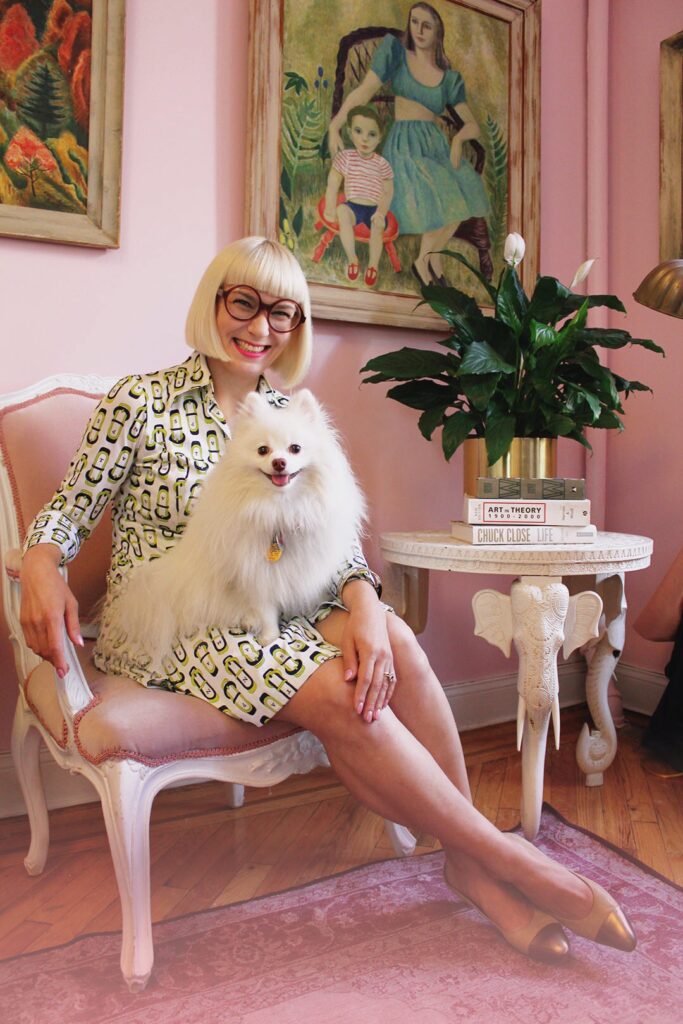
Aside from her lovable, fluffy cloud of a puppy, Odette The Pom, Granger enjoys personal development podcasts (Oprah’s SuperSoul, Natalia Benson’s podcast, Chakra Girl Co., anything Gala Darling does, and Manifestation Babe).She also helms her own, The Artist Advisory Hotline (tailored specifically for artists, of course), with honest answers from leading experts in the art world. “A lot of people shy away from saying that they like to do personal development, or, ‘self-help.’ I really enjoy listening to podcasts that are going to help me remove blocks that I’ve put on myself, because of the context of my backstory,” Granger says. “My family came here as refugees with zero money, and that feeling of scarcity, anxiety, and lack, I deeply understand. It’s a high priority on my personal list of blocks and triggers. I work actively every day to remove that money block. In turn, it helps me remove that from other artists that I work with, whether they’re struggling from the context of their upbringing, or mental setbacks they’ve inflicted upon themselves.”
Granger also has a daily gratitude ritual: the first thing she does when she sits down at her desk is acknowledge what she is grateful for, and says her daily goals out loud. “It takes two minutes, but boy, let me tell you, if you talk for even one minute about everything you’re grateful for, you are going to feel good,” she gushes. “I’m not gonna lie, meditating is very hard for me because I am a busy body, but I always make time to practice gratitude. The vibrations of the words are powerful.”
Granger has a four-part method she walks through with artists. The first step is gaining an understanding of the intention behind their work, and what their goals are. The artist needs to know what they want, and how to communicate it. The second part is mindset, because each artist needs to build their confidence in communicating what they want (and to whom). The third thing is developing the presentation of the work through building, or revamping, their online presence. She often tells artists to approach marketing their work as though they’re the merchandise. “It sounds clinical, and I hate to say that, because it’s a living, breathing thing,” she says. “When you think of merchandise, do you want to put yourself in Neiman Marcus, or Target? Both of those are fine, they just need to be presented in a different way.”
The fourth part of Granger’s method is the actionable steps artists need to take once their presentation is down. “In my method, there are three steps that are very tangible, but one is not, and that is mindset,” she says, adding that she always recommends artists read The Big Leap by Gay Hendricks, which posits that our ego operates between two parallels: a baseline (making sure your rent or mortgage is paid, you’re able to eat, essentially the non-negotiables) and an upper limit (giving a TEDtalk, becoming the next Oprah, having a solo show at MoMA). Fear comes from not knowing what’s beyond these extremes, and ego kicks in – sometimes to protect us from dipping below our baseline, but also to sabotage us as we approach our upper limit.
“When we want to reach a big goal, and oftentimes artists really do, they have an upper limit that’s kind of low, because of their societal conditioning,” Granger explains. “When we want to reach that big goal, it’s so important to figure out how you can take the ego out of it. Try to give instead of wanting to receive. When you take the ego out of it, it can no longer sabotage these big goals.” Recently, she put this into practice when giving a talk to over a hundred artists. Having never spoken to that many people at once, she felt her ego kick in. “I was terrified… and I squished my ego by saying, ‘I’m not doing this for me, I’m doing it for them. I’m giving them something.’ I ended up giving away three free sessions to really scorch my ego, but it really helped. Next time you’re thinking about a big project you want to finish, think about how you can take the ego out of it.”
There’s a shift happening in the art world, with power returning to the artists. Granger’s guidance rides the new wave of artists gaining agency and learning to manage elements of their practice as digitally-based creative entrepreneurs. She offers interesting strategies for driving sales, too. “Don’t tell people that you’re selling stuff in your stories on Instagram – a really cool way to do that would be to just say, ‘Hey, here’s a picture of my work of art in [someone’s] collection.’ And then people’s gears start turning. They’re like, ‘Oh my god, we can buy this!'” she advises. “Put it on your grid already installed in somebody’s home. Tell us every time you’re selling something, instead of when you want to sell something.”
Granger says Instagram is doing for art what radio did for music. “Listening to a song on the radio, you get a taste of it, but you can still buy it. The same thing is happening on Instagram – you get a taste of the artwork, but you can still buy it,” she points out. “I worked in galleries before social media and this is a profound change that’s happening in our culture. And I’m really curious as to how it’s going to play out in the economy of the art industry.”
Due to the pandemic, a lot of exhibitions have moved online, as part of the ‘online viewing room’ trend. Granger strongly feels this showcasing format should stay relevant in the art world ecosystem post-pandemic. “We have a taste of super globalization right now. By living our lives online, you can connect with people from all over the world,” she says. “It’s important not to limit yourself by only having an exhibition in person – put it online, do a virtual viewing room. It’s what a lot of really high-end galleries were doing before COVID. Now, because there’s such a demand for it, virtual viewing rooms are so much more accessible to everyone.”
Next month, Granger launches her sixth online summer course, The Artist’s Academy. The program entices artists interested in joining a community that helps them navigate the art world (it’s a close knit group of about 20 artists) and also helps individuals present their work in the best possible light online. “If you have 10 works of art, you can sign up for this, and if you don’t have that yet, you can still sign up. I love to have a variety of different levels of artists in this course, because even mid-career artists who take this course learn something from the emerging artists, and vice versa.”
Marina Granger says that she’s always listening to and learning from her clients, as well. “Since there aren’t many businesses like mine, there isn’t really an example of what a business like mine should provide,” she says. “I couldn’t have this business without the inquisitiveness of my clients. They teach me everyday about new ways I can help them develop their careers.”
Follow The Artist Advisory on Instagram for ongoing updates.
Angelo Gambatesa conceptualizes his work through a poetic lens. Even the name of his new creative endeavor, cherishes ( a self-described “synonym for keepsakes”) relishes in such grandeur, as a mechanism for him to remain grounded. “The name is present. It’s not something that configures in past tense,” he says.
Gambatesa introduces this new chapter with video for a song called “Gaslighting,” directed by Natalie Panacci, whose adeptness behind the lens is felt throughout the full runtime. “I am changed in the thought of you/And I’m confused about how I should feel,” he sings. There’s a plump sweetness to his vocal, perfectly pairing against lush, pastel imagery.
“Gaslighting” anchors cherishes’ self-titled debut EP, a three-track project firmly fashioned in a similar singer-songwriter style, due to arrive December 18th. The song was originally written two or three years ago, but was put on the backburner when “all this stuff happened in my life. I was going to put it out and things stopped feeling right,” Gambatesa tells Audiofemme. Notably, the title came after the song had been written. “At the time, I had never heard the word before. I was talking to a friend about things I was going through at the time. She brought up the term to me.” The emotional weight of the song immediately came into focus. “Maybe it was a bit serendipitous,” he adds.
When he sought out Panacci to direct, the concept initially blossomed from the definition of gaslighting and its super-charged connotations, but it soon took root with themes of “longing and loss. Rather than take the lyrics into a literal visual representation, Natalie conceptualized an idea around loss, grief, and bereavement ─ and a sense of place that can be guided by absence,” Gambatesa explains.
The artist’s presence in the video is merely ceremonial, and he moves about almost like a specter caught in purgatory. Actors Justine Christensen and Rhonda Warkentin play two unnamed women who struggle to make sense of various emotional and traumatic knots of human existence, seemingly wandering through their lives without purpose or drive. It all leads to the video’s profoundly moving scene in which it is revealed Gambatesa’s character has actually been dead the entire time.
Out of Toronto, Gambatesa showed an early proclivity toward music, taking lessons at just ten years old after tinkering around with guitar when he was very young. “I knew from the get-go it was something I wanted to do,” he says. He also grew up hooked to Much Music, the Canadian version of MTV, and would watch the channel for hours and hours after school.
Through his groovy indie rock aesthetic, he possesses an obvious admiration for classic rock acts like AC/DC, but it has been Canadian acts who have impacted him most. From such bands as Alexisonfire and Moneen to Circa Survive, he is a professed “guitar geek” and often harkens back to classic structures and ways of writing in his own music. Gambatesa attended Berklee College of Music in Boston, and that’s where he gained local street cred as part of indie rock band named Hit Home.
The group met as most college bands do, quickly realizing their similar interests and love for jamming out. Within a week or so, they began playing together and released their debut EP in 2013. Three years later, they split up, due to unknown reasons, and Gambatesa set about carving out his own artistic future.
Looking back, now nearing 30 years old, he describes that version of himself ─ a bright-eyed 19-year-old. “There’s a certain level of heightened naivety that comes with that age,” he remarks. He was “unrestrained and fearless in some ways. That time was full of certain merits but [I was] a bit of a mess. It was kind of an exhausting time, and I had a lot to navigate. It wasn’t a particularly fantastic time in my life.”
In the band’s aftermath, Gambatesa found himself “still indebted to the idea of being a full-time musician. It wasn’t necessarily discouraging, but it was inevitable. I had a desire to push through and start another project,” he continues. He “was at a juncture where I had to decide” what road to take next; he played in at least one other band, but it quickly dissolved, as well.
Cherishes emerged out of a deep desire to create, and he soon learned it was perhaps better to do so on his own terms. “Gaslighting” works as a somber, moving piece of music because of its beautiful simplicity; guitar chords embroider words that cut deep without being superfluous or overwrought. In his attempts to go leaner in songwriting, he quips that he’s still trying “to understand songwriting better.”
“I overthink everything. I’m bothered that on this EP, the first chord of every song has the note A in it,” he says. “I know it doesn’t matter, because they’re distinct songs.”
“Crutches of structure might inform some of the stuff I do,” he admits. “Then, there are certain tempos I find myself always stuck in. They can be good guiding principles, and sometimes, I’m like, ‘Man, can I only write songs at 85 bpm that have this same chord in it?’” Truth be told, if cherishes keeps releasing tracks as achingly gorgeous as “Gaslighting,” that may not be such a bad thing.
When Emily Edrosa moved to Los Angeles 2016, she left a lot behind in New Zealand: a partner in a committed relationship; the early acclaim she’d enjoyed with Street Chant, a band she’d started as a teenager; government-subsidised healthcare. “I could just see the rest of my life. I don’t know if you’re into astrology, but I was about to go through my return of Saturn,” Edrosa says, when she began to feel inexplicably drawn to the American West Coast by some force larger than herself, like a current, or a wave. The force of that feeling inspired the title of her debut solo LP Another Wave Is Coming, and eventually – once her green card came through – she rode it to LA, where she dedicated herself more fully than ever to her career as a solo musician, despite the immense challenges the change of scenery posed.
That new emotional and physical terrain is fully explored on Another Wave, which whips through eleven fuzzily punk-inflected garage-rock tracks, a stream-of-conscious meditation on queerness, adulting, culture shock, and the general absurdity of human behavior. Edrosa began writing while still in New Zealand, after breaking up with her then-partner and moving in with her mom to save money for the move. “I was just kind of sitting there going, What the hell am I doing, have I just destroyed my life? That was when I started writing and I just didn’t really stop until I had a record,” she explains.
“It’s a bookmark for this period of my life. The last few songs I wrote were about the difficulty of suddenly being in LA, the culture shock… missing my community at home. I just felt so out of place. I was basically having an anxiety attack the whole time. I can’t drive, and the political anxiety [of Trump’s 2016 win] got to me. It was definitely overwhelming,” she adds. “I go on Twitter all the time so I think that probably informed it because I feel like that’s what a lot of people [tweet about]: I’m in the supermarket, and I am having a meltdown. Everybody’s having a fucking episode.”
That being said, Another Wave is Coming only sounds dramatic on paper. Frenetic album standout “Action” starts off, “No time to walk around or find a heartlands sound, singing poverty and mental health” to ultimately conclude, “Should we feel so bad getting up in the evening, when there isn’t a lot that we can do? Sometimes it’s not enough, but we’re in love.” Her deadpan delivery and audible accent won’t easily avoid comparisons to Aussie Courtney Barnett, but Edrosa’s lyrics have a diaristic specificity that communicates both their heartfelt origins as well as a wry surreality.
“I walked the streets and they walked me,” she sings on “Springtime’s Stranger in a Strange Place,” her dreamy post-punk ode to arriving in LA. “A fresh start into the blue/I’m loose and chewed and out of tunes…It’s best to never look them in the eye in a strange place.” On “A New Career,” one of several songs on the album that subtly explore the nuances of long-term relationships once the dopamine wears off, she sings, “Like ghosts that just won’t leave this town/We were born upon our burial ground/So what did we expect?”
Nowhere is Edrosa more straightforward than on album opener “She Agreed,” which recounts the true story of her first love, whose homophobic parents broke up the relationship because their daughter was “not allowed to be gay.” The first three verses sprawl out over sparse guitar, laden with bitterness and nonchalance in equal measure until distorted feedback obliterates both. “It was nerve wracking to put it first, because I feel like people could get the wrong idea about the record,” Edrosa admits. “Some people really love it, but some people could be put off by how open it is. I had mixed feelings about that experience for a lot of years. But after I wrote that song I was like, okay, I don’t care anymore. It was cathartic.”
She still sees the person it was written about around Auckland from time to time, and knows they don’t appreciate the song. “I feel bad about that,” she says. “But as far as my being shy… I’ve never hid my sexuality and I can be quite brash about what I’m feeling or who I am.” In part, she says, that’s because of the experience she depicts in the song. “It is formative for you to feel really happy and then for quote-unquote society to tell you that the way you’re feeling is wrong. Maybe I need more therapy, but… I guess, in a way, it sort of made me be like, well fuck it, here I am.”
Coming to terms with who she is included owning up to the fact that she’s meant to be a musician. She tackles feeling left behind by schoolmates with normal lives on power-poppy single “NCEA” (named for a New Zealand program similar to the United States GED). “I lost, but at least I never had a boss,” she snarls, pitting herself against those with “cell phone plans” and “university common sense.”
“I wrote it about five or six years ago, I guess maybe because I was more fresh out of high school. I would go on Facebook and see people with business degrees or whatever,” she recalls. “I think being an artist, you’re always going to wonder if you should quit, because it is difficult. So I guess that was me [asking], am I barking up the wrong tree here? But now that I’m older I’m just like, oh well, who cares? I’m just gonna be an artist until I die. I couldn’t not be an artist, that would be like asking me to not be myself.”
Edrosa leans fully into that identity on Another Wave – not just with clever observations and personal storytelling in the lyrics, but by writing, playing, and producing almost every part of the album. “I wanted to do everything, but I can’t physically play the drums that well, so I did all the drums in midi and sent them to drummers and said, can you learn this?” she says, getting some initial help from Bosh Rothman (Kim Gordon, Santigold). “I would take the drum stems back and overdub the guitars and the bass and the vocals, and I did it all in my home studio.”
This meticulous approach is one of Edrosa’s trademarks. “A lot of artists write and have throwaway songs, but I work on a song until it’s done and it’s good,” she says. “I really like working in the DAW – I used ProTools at the time and now I use Logic – cause it’s fun; you open up your computer and it’s like, a project you’re working on and you can just mess around with it forever.” Unfortunately, working on a record forever means it never sees the light of day, so she set a deadline with producer John Agnello (Kurt Vile, Sonic Youth, Dinosaur Jr.), working remotely to mix the record in a five-day long-distance session.
Still, she wasn’t completely happy. “You get demo-it is, which is when you like really like the demos you’re listening to unmixed, and then suddenly there’s all this compression and reverb on them and you’re like woah, that sounds so overdone, I can’t handle it,” she says. “I wanted to make a record that sounds like a band, but it’s just me on my computer. That was the end goal – I was like, I’ll make an album and I’ll put it out really quickly, and it just took forever, cause I go deep.”
Though she wanted the album to be lighter and more rhythmic than Street Chant’s grungy, heavier vibes, Another Wave ended up being relatively “dense” as Edrosa pushed herself into new territory. “I tried to be a shredder in Street Chant just to prove that I could, and then on this one I kind of stepped back and was like, I already proved it,” she says with a laugh, noting how much fun she had playing bass and “tapping away on those midi drums.” Her confidence and joy in playing music is hard fought; Edrosa confides that she was bullied in school for being the odd “girl with a guitar.”
“Every year I would play in the talent quest, and every year they would laugh at me. And every year I would come back,” she remembers. “It was my moment to be like, well fuck you. I mean, they laughed the first year, they laughed the second year, you know, they kept laughing. But eventually, I did win it. You just keep going.” That’s part of the reason she gravitated toward mentoring young women in New Zealand’s Girls Rock Camp.
“Since I was like sixteen, I’ve always been a guitar teacher. I can’t read music, but I can teach someone how to play their favorite song and how to read tablature. Working with teenage girls is cool cause I feel like I perpetually am one,” she says, noting that her teenage years were formative in that it’s when she fell in love with music, learned to play guitar, and realized she was queer. “I was so painfully shy, and so unsure of myself… I wish I’d had [Girls Rock Camp] for myself because when I was bullied, music became something that I did in my bedroom alone, and played really quietly; it wasn’t really like a community thing and it wasn’t something to be proud of.”
Like the Carrie-referencing character in her video for “NCEA,” Edrosa got her particular revenge when Street Chant took off. “I just wanted to be in a band cause I was watching other people do it, but I didn’t think that I could do it and it kind of made me annoyed,” she admits. “It’s not like I started music for the sonic experience – it was just about songwriting and getting out there and doing it. The first Street Chant record, we went into a studio and just sort of banged it out; that was more of a live-sounding one.”
Released in 2010, Means won the inaugural Critics Choice Prize at the 2010 New Zealand Music Awards, was shortlisted for the Taite Music Prize, and nominated for “Best Alternative Album” at the 2011 New Zealand Music Awards; a tour opening for The Lemonheads’ It’s a Shame About Ray 20th anniversary American tour commenced the following year, and in 2013, they released a follow up EP, Isthmus of One-Thousand Lovers.
By then, Edrosa had bought her own recording gear and started making songs at home. She wrote a solo EP “really quickly, cause I just wanted to learn how to record better” and released the lo-fi DIY affair in 2014 as Street Chant was finishing up its second LP Hauora; it wasn’t released until 2016, and by then Edrosa had already started planning her move. “Not to sound arrogant, but Street Chant did kind of hit a ceiling here where the critics really liked us. But to get three people to tour around America or England or Europe several times a year was quite expensive. So I was like, I’ll just move to America.”
Four years later, a different wave – the second spike in the ongoing COVID crisis – has returned her to the blissfully pandemic-free Auckland, where Edrosa’s planning real, live shows, which she confesses was difficult at first, having gotten used to people in the States keeping their distance. “When I first came back I really just wanted to go straight back into it which I think was a mistake, because I was going to bars, and people were standing really close to me, and it was really strange. I do sort of miss not hanging out with people, as strange as that might be, because people are so lonely… I can be a bit of a hermit,” she says. She hunkered down, putting the finishing touches on her record – Liz Stokes of the Beths engineered additional drum sessions with Alex Freer behind the kit, and Edrosa got a friend to mix the album one more time before Another Wave is Coming finally washed ashore in late November.
“I feel like when you’re working on a record you love listening to it, and then once it’s done, you need to give it like, two to five years before you can listen to it [again],” she says, noting how bizarre the concept of a career in music really is. “If you’re writing a song that you want people to hear, it’s silly. It’s silly to get up on stage and sing a song about your feelings, and expect that other people are gonna want to hear it. I try and add a little bit of my sense of humor – silly and dark, yet relatable.”
As humans, we crave being seen and acknowledged by other people — but the irony is that often, once someone else’s eyes are on us, we dodge their gaze out of fear that they won’t like what they see. Atlanta-based indie-pop singer/songwriter K Michelle DuBois gives a sound to this debilitating self-consciousness with her latest single, “On the Run Again.”
The song has a fun ’90s college rock vibe, with dramatic pauses exuding a fierce attitude, powerful guitar hooks giving it a mischievous feel, and guitar and keyboard solos that add a haphazard, chaotic energy. DuBois’ angst is palpable in the catchy pre-chorus (“Your words put me on trial/put me on trial/asking too many questions”) and reaches a climax with an explosion of electric guitar at the end.
DuBois wrote the music first without knowing what the song would be about. Then the phrase “on the run again” came to her, and she began writing lyrics about avoiding other people. “It’s just that feeling of someone having you under a magnifying glass, and you don’t want to sit still long enough to let them have you under the magnifying glass because it’s too close, it’s too intimate,” she explains. “You don’t want to be looked at too closely, so as soon as someone’s paying too much attention to you, you kind of run and hide.”
As a musician, DuBois tends to experience this feeling when she’s playing in front of small crowds, which feel more intimate than large ones; she remembers her fingers trembling as she played guitar in one performance. “I tried to take deep breaths and just sing my heart out and maybe closed my eyes a little bit,” she says. “But then honestly, probably by the fourth song I was into it, I felt good, and by the end of it, I was like, ‘Oh, I could do this again.'”
The song is off DuBois’s fourth LP as a solo artist, The Fever Returns (out February 5), which takes inspiration from the Divinyls and other favorite ’80s bands of hers. Some of the songs, like the title track that opens the album, have a slow, almost classic rock sound, while others, like “Heaven” and “Waves Break,” are full of ’80s-esque electronic effects. Metal influence is audible on tracks like “Southern Gothic Dream,” and the album takes a poppy turn on the catchy “All Night Glamour.”
DuBois recorded many of the songs herself using drum loops, then she’d take them into the studio to further develop them, her drummer Chandler Rentz adding live drum parts. She played the keyboard, and though she plays guitar, her producer Dan Dixon supplied the guitar parts for the album, improvising solos. “I’m trying to bring back the guitar solo,” she says. “I’ve heard people say the guitar solo’s dead, but no.”
Thematically, she considers The Fever Returns “very much female-centric, kind of encouraging my sisters out there to be free and wild and empowered and to find that thing inside you that you want to live for and really make it blossom,” she says. “The title track is kind of about leaving your comfort zone and spreading your wings, and when you have even a glimmer of something that might excite you, to let it go ahead and give into it and let it rage.”
“Southern Gothic Dream,” for instance, is a play on “Knoxville Girl,” a murder ballad popularized by the Louvin Brothers, and re-recorded by various musicians, from The Lemonheads to Nick Cave to Okkervil River. It’s about a man who beats a woman with a stick and throws her in a river; singing from the perspective of the victim, DuBois imagines coming back as a ghost and making the murderer’s life a living hell. “I wanted to write a murder ballad — I have a fantasy of kicking his teeth out on the mountain — so in a morbid way, that’s a female empowerment song as well,” she says.
DuBois grew up with a family of songwriters in Nashville and formed her first band, Ultrababyfat, with a high school friend. The pop punk group was around for 10 years, opening for Pavement and PJ Harvey and performing at Warped Tour in 2001. She formed her next band, Luigi, with a childhood friend in Atlanta, then began releasing solo music in 2012. Currently, she’s at work on a new, experimental EP called Vitamin 3 with her friend Paul Curry, who’s been sending her music and having her add the vocals.
“I just kind of stream-of-consciousness vocalize over it and see what happens, and then the little jewels that happen, I pick those out and build on those,” she explains. “It’s been a really fun exercise in trying to see a different way to [write], almost like painting with words.”
Follow K Michelle DuBois on Facebook for ongoing updates.
All-female, multilingual folk fusion band Ley Line is based in Austin, Texas, but the quartet formed in Brazil, where founding members Kate Robberson and Emilie Basez first met and began playing shows together in 2012. Five years later, after twins Maddy and Lydia Froncek joined the band and they’d released their 2016 debut Field Notes, they returned to their origins, embarking on a four-month van tour through Brazil.
Their latest album, We Saw Blue, is an amalgamation of Brazilian songs they learned on the trip, songs they wrote on the road, and songs inspired by the people and places they encountered there. Listeners are able to experience the tour vicariously through the LP, from the rich pieces of Brazilian culture the band picked up to the adventures they experienced there.
“All the songs were kind of anthems of that time, because it’s the songs we connected to while traveling and when we came back and were processing it,” says Maddy Froncek.
Since none of the band members are Brazilian themselves (Basez is of Argentinian descent, and Robberson is married to a Brazilian), they wanted to become better acquainted with the culture that was already influencing their music and pay homage to it. This was behind the decision to include covers of Brazilian folk songs, which they put their own spin on.
“Ciranda,” for instance, was written 50 years ago by a man named Capiba, telling the story of someone who spots a fish and thinks they’re seeing the goddess of the ocean dancing on the water. Maddy Froncek added English lyrics that retell the story in a mesmerizing melody: “The moon she calls to her daughters/come swim in my waters, and I’ll take you home.”
Water is an overarching image that ties the album together. “Oxum,” full of infectious drums and energetic Portuguese chanting, was inspired by a poem about the Afro-Brazilian deity of fresh water that a woman in Brazil read to the band members. “The Well,” which sounds almost like an old American hymn, describes emptying oneself like a well to make room for something new to pour in.
For Ley Line, water serves as a symbol of humanity and how people are like many drops in the same ocean. “We decide what we focus our attention on. Seeing what connects us moves us forward together. Like water moving to the ocean, we’ll be guided on our journey,” Robberson explains. “It’s an idea of always looking for what connects us and finding a lot of peace in that.”
The title We Saw Blue is a nod to this theme, though its origins are multifold: it was inspired by a host the group had early on their trip who assured them that they would be protected by a “manta azul” — “blue blanket” in Portuguese — over the course of their travels. It also stems from a line in a poem Robberson wrote years ago, which is on the CD’s inside cover.
Other songs on the album recount the trip itself. The simple, mellow, ukulele-driven “Slow Down” narrates intimate moments the band members shared together, giving off an oldies vibe as spoken words alternate with repetitive harmonies. The first track “To the Sky” describes the journey in poetic terms: “I remember all that it takes to build from dust/how many times a day do we wake back up/as we break from the city like clouds/break as we descend to the ground/everything the pavement holds/everything we leave on the road.”
The members consider We Saw Blue the most collaborative of their albums, as they were all involved in the songwriting. This spirit is embodied in the harmonies throughout it, the women’s voices blending together sweetly. They started the recording process two years ago, then toured all of the songs and came back to the studio, which inspired the album’s feeling of live performance; they recorded all the vocals together in one big room rather than tracking them separately to emphasize that sound. The last track, “Sounding Sun,” is sung a cappella, and the title track “We Saw Blue” was originally done a capella before Basez added a guitar part that gives it a magical sound.
To capture the feeling of being in Brazil, many of the songs include the pandeiro, a Brazilian hand drum that Basez plays, in addition to Portuguese lyrics. The album also contains a French song, “Tous Que Je Vois,” though it still has a bossa nova vibe. “There’s such a different tone, and it’s a whole paint set of colors to use when you write and sing in a different language,” says Robberson.
“It’s made sense to sing in multiple languages because music is a universal language,” Lydia Froncek adds. “When we were singing in Brazil in English, it would be just as impactful as when we were singing in Portuguese. So it’s profound to see how people can understand the meaning no matter what language we’re singing in. We’re making a point by showing how we’re more connected than the world and the media would have us think.”
Nainnoh (pronounced nine-oh) knows what it means to run. Originally from Georgia, formerly a USSR-held territory, she came to America nearly 20 years ago ─ to not only escape a restrictive government but to fulfill her childhood dream. Her song “Run” celebrates severing toxicity from your life, in whatever form it may take, with rhythmic production and sweeping strings. “Remember how I was treated, feeling so low,” she sings. “Even though you have thrilled me, I’m letting you go.”
The accompanying visual stars champion dancers and choreographers Kristine Bendul and Abdiel Jacobsen, known for helping break gender boundaries as a gender-neutral couple in ballroom dancing. They’re also known as frequent collaborators with Twyla Tharp and former principals in the Martha Graham Dance Company. In the video, Bendul and Jacobsen sculpt an evocative dance piece that fully embodies the song’s fluid and ethereal motions.
“I didn’t know it would be a dance piece [at first],” Nainnoh tells Audiofemme, but when she started thinking about doing a video, she turned her eyes to the fledgling artist community of New York City. A close friend originally suggested she star in the video herself, but that didn’t feel right. “Why should I showcase myself when I can actually support and give life to other people?” she offers.
Nainnoh met Jacobsen and Bendul last year at Stepping Out Studios, a central Manhattan space, home to dance, Zumba, and bootcamp. “I was so impressed by them. They’re such beautiful people. I read about their story, and it was so heartbreaking and symbolic,” she says. “I’ve always been passionate about supporting minorities, Black Lives Matter, and LGBTQ+ rights.”
“I gave them creative freedom because they’re both choreographers and they’re very good at what they do. I trusted them,” she adds. “They did an amazing job. It’s an emotional song, and they just crafted it beautifully.”
“Run” is the second single from Nainnoh’s forthcoming self-titled debut record, which took nearly a decade to complete. One thing after another, from personal tragedies to a hectic schedule, kept putting the music on the backburner. Appropriately, the collection cultivates personal turbulence with spiritual awakening and results in a true testament to her growth as a human being. “[The album shows] how we all are connected and should cherish each other,” she notes.
Looking back, she sees herself as quite “sincere and kind. I didn’t know how to face darkness. I didn’t see other people. But I started to and started to feel what they were feeling. That was a major discovery for me.” Many of the songs were written around the time she had these revelations, so the record really is a celebration of her evolution. Musically, there’s an air of transformation, as she veered away from pure pop in those early days to folk, rock, and psychedelia. “People can feel how I’ve grown as a musician, too. I feel like songwriting is some kind of stream and I have to download it,” she muses with a laugh.
Album opener “Cambium Rings,” for example, harkens back to her airplane ride from Georgia to the United States. “I actually wrote it on the airplane,” she says. “I was like ‘Oh my god, I don’t even have an instrument here. What am I going to do?’” She kept pen to paper, however, and the song sprang from her soul.
Nainnoh’s debut record is very much her liberation movement. Her childhood in Georgia – a country known for its suppression of individuality – instilled within her strength and endurance in the face of adversity. “Growing up there, it was so hard for me to express myself, artistically,” she says. It was even difficult to obtain any vinyl records from America. “Somehow, my parents secretly obtained these records, and I was listening to so many artists like Nina Simone and Ray Charles. These extraordinary sounds really inspired me,” she remembers. “I think it’s very important at the early stages of a child’s development to develop a musical taste ─ to introduce them to these great artists and musicians. I was lucky.”
With restrictions around who she could even hang out with, she longed to immigrate to America, where “you could do whatever you wanted to do. Right now, the country has changed and is completely different, thankfully.”
Nainnoh also loved and studied the work of such novelists as Fyodor Dostoevsky and poets like Shota Rustaveli, a Georgian writer from the 12th Century “who was in love with Tamar, the female king of Georgia, at that time. He was a Shakespeare before Shakespeare or before Hafez or Rumi.”
Her curiosity led her deep into songwriting when she was only 11. “My grandmother gave me the biggest gift of my life when she purchased a piano,” Nainnoh remembers. “After a couple weeks, I started writing music. I didn’t want to sing what other people were singing from TV like all my friends in my circle. I wanted to write songs myself and what I felt.”
Her album, expected in 2021, pieces together themes of strength and power, while also imparting the listener with their own understanding about the world. “I hope the listener takes away the knowledge of existing in the darkness and still finding love and kindness,” she says. “We can survive, and we’re going to be okay.”
Noelani Petero is on a mission to bring back early the iconic 2000s R&B sound. The Melbourne-based singer-songwriter is unabashedly old-school in her approach to hip-hop and super-smooth R&B in the vein of Janet Jackson, Lauryn Hill and Aaliyah. Under the stage name NOE (pronounced “Noii”), which includes a loose collective of beat-makers and producers, Petero just released debut single “Sweat.” With a string of new tracks set to drop in 2021 in the lead-up to her debut EP, NOE’s bold sensuality fairly oozes out of the speakers, even while the beats threaten to blow the bass.
NOE stands for New Old Experiment, and in its clever channeling of ’90s hip hop, funk and R&B into the 2020 world of streaming 24/7, where only the catchiest tunes will survive, it does indeed combine the Old and New.
“I’m a ’90s kid, so I always revisit artists like Ashanti, Ja Rule, Aaliyah and Janet. R&B from the early 2000s was so dominant, but it was only three or four years before it became really poppy with artists like Britney Spears,” says Petero. “After Aaliyah died – and she was meant to be the future of R&B – it stopped with her. That’s my motivation, to bring that back. That early 2000s R&B has such a drive and energy to it. I feel like it’s much more chilled and relaxed, the R&B these days.”
Over the years, Petero has been working as a producer, an artist, a dancer and a writer within the Melbourne improvisational hip hop and R&B community. She was vocalist of Killah Hurtz, an early vocalist of acid jazz collective Zeitgeist Freedom Energy Exchange (now based in Berlin), and a singer with LOGO.
Her emergence as a solo artist happened along with her new role as a mother. Petero has a 18-month old son who is “going through the annoying toddler phase early, but [is] the most fun.” Even so, becoming a mother has posed challenges to NOE as an artist. “My content is very sexually driven. I like to be very empowered in my sexuality, but I kind of lost that with having a child and not going to gigs anymore,” she confesses. “I reached out to Michael Cooper, also known as Mikki From Preston, and producer 2Point0, and said I feel like I’m stuck, I need something to drive me to write.”
2Point0 (aka Myawae Tarwo Sonkarlay) sent NOE some beats, which she listened to for weeks while at home or walking. “When I heard the bass beat for ‘Sweat,’ I went ‘yep!’” she remembers. It mattered very little to Petero that 2Point0 is still in high school.
“He’s so beyond-his-years as a producer and an artist. He’s very shy, he’s very quiet. He’s one of those kids who can just absorb so much knowledge. I was sending him opera, classical and country samples and he just absorbs it and puts it into his bass beats,” Petero gushes. “We were giving him a lot of information, so I’m really excited to see what he does. Mikki and I were just like, ‘We have got to keep working with him.’ It’s a collaboration. That’s why [we call it] NOE: it’s a New Old Experiment with a whole bunch of collaborators.”
Growing up, Petero was able to pick up music very easily. Her mother was a classically trained in piano, her brother played cello, and her sister played clarinet. She attended various band camps, though her school wasn’t strong in its musical offerings (to this day she says she feels let down by how boring their curriculum was).
After graduating from high school, NOE modeled in Queensland for a couple of years; she moved to Melbourne when she was 21, and modeling took a back seat to musical theatre, songwriting and performance. “It was an overwhelming feeling when the plane landed in Melbourne. It’s hard to explain,” she recalls. She knew this was home, though, and the arts scene embraced her as enthusiastically as she embraced it.
Ten years later, the arts scene is looking much different – certainly quieter under pandemic conditions. “The arts sector really got hard done by. After the bushfires, a lot of artists donated their time and funds towards the victims, and then COVID-19 hit. A lot of artists were left behind when they really needed it,” NOE points out. “A lot of musicians I’m around weren’t able to get government support because of all the red tape involved with being sole traders. A lot of artists slipped through the cracks in the system designed to support the arts.” Though more than $250 million worth of emergency funding to arts and culture in Australia was announced over the summer, Prime Minister Scott Morrison has yet to disburse much of the money. “We just haven’t seen it. I’m concerned about how artists and venues will continue their work to the same standard,” Petero says. “Not one dime has been spent. They couldn’t even answer public questions about it. The arts, especially in Victoria, is relied upon for revenue, so it’s disappointing that this has happened.”
Though the Australian government has left many artists and musicians unaided, artists in Melbourne are resourceful. They’ve embraced online performance and collaboration across genres. Like many other projects this year, “Sweat” was recorded at home, mixed and finished all within the space of a month during the pandemic. NOE usually has an early dinner with her husband, then heads up to the studio for two hours to “smash out” lyrics and vocals.
“I get the bass beats from 2Point0, then I record the vocals at home,” she says. “When I realised we were going into lockdown, I got some really good equipment. After recording the vocals and backup vocals, I clean it up and send it to Mikki. Then, Mikki adds the synths, fine tunes the vocals – which he’s really good at – and then we send it to another producer and good friend, Amin Payne. Amin Payne is a DJ and makes his own music. He can hear things Mikki and I can’t necessarily hear through the speakers when a song is turned right up, but Amin does his own little mix on it to tweak it. Then we send it to Choi Productions to do the mastering.”
NOE intends to do a music video for “Sweat,” but at the moment her focus is on putting music out regularly – and promoting it on her own. She hopes to release a song every two to three months, with the debut EP slated for July 2021. “At the moment, I want to get my songs out to prove to myself that I’ve been productive in lockdown,” she says. “I want to come out on the other side showing I’ve been busy.”
Bootie Mashup founder Adriana A. broadcasting her “Mashup Listening Party” on Twitch. (Photo Credit: Jupiter Gatling)
On Wednesday, March 18, Adriana A. Roberts, best known in nightclub circles and amongst mashup fans as Adriana A., launched her weekly “Mashup Listening Party” on Twitch with an iTunes playlist loaded with Fleetwood Mac. “I needed the comfort food of Fleetwood Mac,” she says on a recent video call from Berlin. For Roberts, who founded the multi-city party Bootie Mashup back in 2003, that show was the culmination of a week adapting to an uncertain future and the start of a new DJ adventure.
The previous Wednesday, she learned that both Bootie’s flagship party at DNA Lounge in San Francisco, as well as the brand’s Seattle event, were canceled. Two days later, the same thing happened to Bootie’s L.A. bash. Between those cancelations, though, the popular club night’s team of DJs began work on taking the party to Twitch. They did their first livestream on Saturday, March 14. Roberts spent the weekend learning the ins and outs of DJing online. When she played the following Wednesday, she hadn’t yet set up her DJ gear to work with the livestream, hence the iTunes playlist.
“We were so used to this routine that we’d all been in for so long,” she says of throwing parties. With everything canceled at the dawn of the pandemic, Roberts and the Bootie crew opted to move online. Now, with a core group of six resident DJs (including Roberts) and another six DJs who are frequent guests, Bootie’s “genre-fluid” mix is satiating its fans nine months after the clubs closed – as well as attracting new listeners. On Twitch, they host nine regular shows and have amassed a following of 12,700 followers with a bounty of subscribers to boot. They’ve also relaunched the club’s presence on Second Life and created a Patreon that offers perks like exclusive and pre-release access to mixes.
All this has allowed Bootie to keep the party going in the year of social distancing. But, there’s another advantage to Bootie’s expanded online presence. “I feel more connected with the mashup scene, in general, than I have in years, which is kind of amazing,” says Roberts.
At its most basic, a mashup is when you layer the vocals of one track over the instrumental of another. This style of remix has its roots in hip-hop, where DJs would often blend a cappella and instrumental tracks, and a type of sample-based experimental music known as plunderphonics, notably Evolution Control Committee’s 1994 track “Rebel Without a Pause (Whipped Cream Mix),” which juxtaposed Public Enemy and Herb Alpert.
By the early ’00s, with the rise of both home production software and and file-sharing, mashups became a cult phenomenon. Producers delighted online audiences, DJs and club crowds with unexpected pairings, like Whitney Houston and Kraftwerk or Christina Aguilera and The Strokes. It was during this enthusiastic moment that Bootie was born in San Francisco in 2003.
Roberts describes the crowd in the early days of Bootie as a “Noah’s Ark of nightlife,” with two people from every scene. But, at the core of it were those who were steeped in technology. “Tech nerds are the first ones that really gravitated to mashup culture, latched on to it and fell in love with that,” Roberts recalls.
Over the years, Bootie Mashup spread far beyond San Francisco. As of early 2020, there were regular parties held in Seattle and Los Angeles as well. There have also been Bootie Mashup nights New York and Boston, as well as at events like Burning Man, Southern California’s Wasteland Weekend and Atlanta’s DragonCon.
Over the years, the popularity of mashups ebbed and flowed. Some went viral. Others became party staples. As people became more accustomed to hearing mashups, Roberts says, the crowd at Bootie grew more mainstream. On Twitch, though, they’ve been able to draw in the sort of regulars that originally frequented the parties, people who are passionate about hearing songs of disparate genres layered together.
Twitch isn’t like a club. You’re watching at home. You can adjust the volume to suit your tastes and bounce around your bedroom in your pajamas. Instead of trying to shout something to the DJ or find a corner where you can catch up with a friend, you might have conversations in the chat box.
“The community building has been the most shocking and surprising part of all of this,” says Roberts. It meant relearning how the DJs communicate with the crowd. On Twitch, the DJs are actively educating as they play. They’ll get on the mic and talk to those in the chat, maybe answer some questions and give some details about the tracks they’re playing.
On the Saturday night of Thanksgiving weekend, Roberts dives into the new music that she’s been collecting; a mashup of Aretha Franklin and Dua Lipa is stellar. She also drops “Edge of Midnight,” a Miley Cyrus/Stevie Nicks mashup from YouTuber Kelexandra released last summer, and notes that it’s the precursor to the official “Edge of Midnight (Midnight Sky Remix)” released by Cyrus in late November. “Because of the interactivity and because of the format, it actually allows us a deeper dive into this culture,” says Roberts.
While Bootie Mashup has made a smooth transition to live streaming, Roberts stresses that it wasn’t easy. “We did work our asses off to get to this point,” she says, adding that they’ve tried to “reverse engineer” their successes to figure out what works. “We’re making it up as we went along,” she says. But, Roberts adds, that’s not so different from throwing an IRL party, and maybe it’s why Bootie Mashup has been around for so long. She says, “We just continually keep adapting to changing things.”
Los Angeles-based indie folk artist Hayley Johnson used to go on shopping sprees to numb her insecurities, always chasing the next item that might help her feel good about herself. It took a lot of therapy — and a lot of time spent poring through feminist Instagrams — to break this cycle of self-loathing and consumption. Ultimately, she arrived at the conclusion that she already had everything she needed to enjoy self-confidence and happiness; she didn’t need to purchase anything.
Under the stage name The Little Miss, Johnson articulates this revelation in her latest single, “Spring Cleaning.” A very folky, almost country song condemning patriarchal consumer culture with incisive lyrics against dynamic guitar, steady tambourine, old-fashioned piano, and choir-like backup harmonies, the bridge builds to a climax where “all of that self-loathing is channeled into anger that is no longer directed inwards but rather outwards,” she explains.
The verses provide a cutting critique not only of consumerism but also of conventional definitions of success, her Americana style contrasting with her denunciation of stereotypically American values. “Oh, maybe we’ve all just got it tough/but we’ve all been told the same dumb stuff/like if we just get one more success/we’ll stop feeling less and less/and maybe if we all just do our best/we’ll finally get that week of rest,” she sings. “Maybe we’re all just falling down/on our way up to some made up crown/oh, I don’t know nothin’, no I don’t know much/but if there’s one thing I do, it’s that you are enough.”
This is what Johnson hopes listeners take away from the song: that they are enough, intrinsically, just by existing. “We’re all deserving of good lives,” she says. “We’re all deserving of love. We’re all deserving of basic rights, protection, shelter, etcetera, without needing to be perfect first, without needing to be at a particular place on some ladder first. We don’t need to improve ourselves to be deserving of love or any fundamental sort of rights or necessities. We deserve those things, now, as we are.”
In keeping with the song’s theme of self-worth, Johnson affirmed that her own voice deserved to be heard by singing for a full seven minutes. “I’ve listened to dudes doing really long guitar solos my whole life,” she says. “It makes me a little happy that I made such a long song. I’m like, hell yeah, if you can listen to a guy wail on the guitar for twelve minutes, you can listen to a woman talk about her feelings about society for seven.”
The song will appear on the upcoming debut album from The Little Miss, Best Self, which uses this phrase ironically to critique capitalist definitions of self-improvement and self-worth. The album was recorded in her bassist and producer Daniel Grimsland’s living room with her band, the Cactus Kissers. “It all felt really just like play and experimentation, so that was a lot of the recording process, us tinkering with stuff,” she says. “You think recording would be really serious, and everyone has to get their take perfect, but it was more loose than that.”
In the first single off the album, “A Week Into New Year’s Resolutions,” for example, they largely winged the backup vocals. The song, which recounts buying running shoes, books, and other items then never using them, was intended to sound silly, and backup vocals with redundant phrases like “she buys books, so many books” contributed to this tone, as did the bottles clanking in the background, conjuring up a New Year’s party.
Growing up in San Diego, Johnson started her first band back in high school with her dad, then got burnt out on music until she picked up a guitar in college and became excited by the prospect of learning to play her favorite folk songs. After graduation, she moved to LA to give her music career a shot, dubbing herself The Little Miss based on a nickname her dad gave her for being “really prim and proper from a really early age.” She released her first EP American Dreamin 2018, followed byJam in the Van — The Little Miss and the Cactus Kissers, a collection of live recordings released earlier this year.
Outside of her music career, she does administrative work and is studying to become a high school history teacher, which has given her music more universal themes. “I have been up my own butt for a long time, looking at my own life, and I’m really happy to be studying history and working toward teaching history because I want that perspective and long view on my role in the universe and in human history,” she says. “I feel like it’s easy to feel really self-important, especially in today’s age where we all have a platform, and it makes me unhappy to put so much focus on myself. I’m really excited to learn about how insignificant I am.”
Follow The Little Miss on Facebook and Instagram for ongoing updates.
In the ’00s, Los Angeles-based band Lavender Diamond earned fans and critical acclaim for their folk-tinged indie pop. They toured with The Decembrists and played events like ArthurFest in Los Angeles and SirenFest in New York. On December 4, the beloved band returns with its first album in eight years. Now Is the Time is a stunning collection of baroque pop that delves into issues of healing both nature and humanity.
The album’s evolution came as a result of singer Becky Stark’s work on environmental projects. Following the release of the band’s sophomore full-length, Incorruptible Heart, in 2012, she turned her attention towards the crises facing Earth.
“I didn’t want to keep giving concerts in the same way,” says Stark on a recent phone call from her home in Los Angeles. Instead, she wanted to bring the enthusiasm that people have for music and cultural events to gatherings where the planet took center stage. “There’s so much energy, always, for concerts and people gathering and ideas being shared and magnified through music,” she says. “And, I felt like, where is the energy for healing our relationship to the earth?”
Stark says that she wanted to build “a new system” to show that you could bring together people for an event like a concert and also encourage people to work on projects like habitat restoration. And she did get involved in efforts around Los Angeles, like soil restoration and building a habitat for monarch butterflies. Stark explains, “It also came out of my desire to heal my own femininity and my own relationship to elemental femininity.”
In the late ’00s, the singer co-founded Los Angeles Ladies Choir with Aska Matsumiya, which brought together singers from various creative worlds in the city for performances and released a now sold-out EP Sing Joyfully in 2010. “It was for the purpose of creating community, and healing our femininity,” says Stark of the project, “and I realized that I really wanted to combine that with actually healing our relationship to the actual Earth, which is the actual feminine elements.”
But, in this work, particularly when raising awareness about Los Angeles’ dying trees and the impact of that phenomenon on the city, Stark grew frustrated. She was also taking note of the city’s racial segregation and growing wealth disparity. “I’ve always felt like Los Angeles has the possibility of being the greatest city in the world,” says Stark, who was born in L.A. and returned to the city in 1999. Yet, she says, “it started to feel very heartbreaking to me that there was this huge influx of prosperity that was not moving in connection with building a city of peace and justice.”
It became clear to Stark that she needed to sing with Lavender Diamond again. “Lavender Diamond has always been this channel, this really clear channel, for songs that are like prayers, like healing codes, like anthems for healing, for the revolution,” she says. So, Stark reunited with bandmates Steve Gregoropoulos (piano) and Ron Rege, Jr. (drums).
“It was a great relief for me to let the music sing and let it resound in my heart,” Stark says. She and Gregoropoulos wrote together with what Stark describes as a kind of spontaneity. “When we write for Lavender Diamond, it really is like a channel and it pours in pretty instantly,” she says.
The ensuing songs speak with an urgency for social and environmental justice. On “Please Plant the Seeds,” she calls for listeners to “please plant the seeds of peace with me.” In “New Religion,” she looks to the future, singing, “This is our new creation/the world responds to imagination.”
“Ocean and Ground,” a song that Stark initially wrote years ago, is particularly poignant in its reference to the Greek myth of Persephone, who was kidnapped by Hades and whose life split between the Underworld to Earth’s surface represents the seasons. “This is the moment like in the myth of Persephone in the Underworld. We’re in the Underworld also,” says Stark. And, like in the myth, there’s hope of brighter days ahead.
Now Is the Time was made prior to the pandemic, but its messages have become all the more relatable in light of COVID-19. Says Stark, “I think that the cruelty of this moment, of not caring for our most vulnerable, is heartbreaking.” But, perhaps there is something to learn in the darkness of 2020. “I really hope that we that we can proceed now with a different consciousness,” says Stark.
And if listeners do take away something from Now Is the Time, Stark says she hopes it’s that “it is entirely possible for us to heal our world and entirely possible for us to heal our hearts and our communities and our society.”
She adds, “And I hope that the record gives people strength to continue in that path, and to understand that what every person does is valuable and sacred and everyone’s experience and everyone’s healing is in perfect relation to the whole.”
Follow Lavender Diamond on Facebook for ongoing updates.
A few years ago, Israeli-born, LA-based pop artist Yarin Glam was battling an eating disorder. Now, she’s singing about her experience to help others who are in the same dark place she once was.
Glam’s latest single, “Free,” is a catchy, upbeat, motivational song about battling your demons and making peace with yourself. “I used to change my shape so that I could feel some power/I thought I killed that voice, but it’s trying to come back louder,” she sings powerfully in the poppy chorus against playful guitar and snappy percussion.
“I suffered from anorexia for years, and I was in denial for a long time; I didn’t get the right help for my whole life, basically,” she remembers. “And last year, I went into recovery at the same time that I started working on this project, so both have been extremely therapeutic for me.”
She was afraid to talk about this with her writers and producers when she went into the studio, but she wanted to be as real and vulnerable as she could be. “A lot of the time, people go into recovery, and it’s not a smooth and straight path. There’s a lot of ups and downs, and people relapse and go back into their disorder. You reminisce about the stuff you used to have and think, ‘Oh, it wasn’t that bad,’ and you go back to the old, dark patterns,” she says. “I told them how my whole life, I wanted to be free of the disorder and free in my own head of the self-doubt and the bully in my head.”
Visually representing the inner freedom she describes, the video shows her singing from mountaintops, destroying a pillow, and dancing as feathers fall around her.
Despite the heavy subject matter, the sound is intentionally fun. “I was like, how do I talk about the struggle I have and have deep and meaningful lyrics but, at the same time, if you don’t look at the lyrics, you’re just having fun with the song and jamming to it?” she explains. “Sometimes, people can steer away from songs that are too dark-sounding.”
Glam met her first producer at age 17 and released her first three singles in 2017: “Mr. Calvin Klein,” a flirty ode to a budding love interest; “Before I Go,” a song mourning the end of a relationship; and most recently “Alright” featuring Kodie Shane, a sassy breakup song incorporating EDM and hip-hop elements. After that, she took a step back and rethought how she wanted to present herself as an artist, realizing she wanted to put out deeper, more meaningful music.
“Free” is the first single off an upcoming four-song EP out early next year, whose tracks all deal in different ways with embracing who you are and shutting down self-criticism. The project functioned almost like a diary for Glam. “I was in a dark place still when I was writing those songs and was struggling, and I felt like it was very therapeutic for me to open up about stuff I’d never talked about before to my own family,” she says. Some of the songs make use of Middle Eastern instruments, drawing from her Israeli roots.
Through the openness and vulnerability in her new music, she wants to show people they’re not alone and inspire them to share their stories as well. Eating disorders in particular can be very isolating experiences, since survivors face a lot of judgment and misunderstanding, so she hopes “Free” can provide a compassionate voice for these people. “I talked about that in hopes to get more people talking about it and have more people going through it feel less alone,” she says. “I wanted to be that voice for others who may be suffering and feel scared to talk about it and feel misunderstood.”
She also wants to show others that recovering from an eating disorder is possible. For her, the key was recognizing that the part of her that engaged in disordered eating patterns was not really her. “When you get your team behind you to remind you you’re more than a number on a scale, you get to get out of your head and be like, it’s not me. What am I doing this for? It’s not worth it. It’s not the life I want to live. It’s not the life I would want for my loved ones,” she explains.
Having music to focus on gave her another, healthier identity – and she aims to inspire others through her career, as well. After moving to the U.S. at age 14 from a small town in Israel where people doubted she could make it big, she’s now realized what once felt like an unrealistic childhood dream. “I always tell people to dream big,” she says. “I don’t feel like any dream is too big. And if I came from such a small town in Israel to LA to make music, I feel like I can give hope to others who may be doubting themselves to chase their dreams.”
With the 2020 holiday season comes a bounty of festive music straight out of Nashville. Stars across Music City have been getting into the holiday spirit with new Christmas albums, and while many offer sound renditions of the classics, they’ve also contributed their own perspectives with holiday originals. From a music legend to a bright newcomer, this collection of holiday tunes from some of Nashville’s finest provide comfort in their own unique ways during a time we need it most.
Dolly Parton (featuring Miley Cyrus) – “Christmas Is”
Dolly Parton has a monopoly on Christmas this year, and frankly, the world is better for it. When she’s not funding research for Moderna’s COVID-19 vaccine, Parton is offering up her first holiday album in almost 30 years, A Holly Dolly Christmas. It’s the gift that keeps on giving, as the icon shares stellar covers of Christmas classics poised alongside a handful of Parton-penned originals that make the season bright, including the tender-hearted “Christmas Is” featuring her goddaughter, Miley Cyrus. During a tumultuous year, leave it to Dolly’s graceful nature to bring us back down to earth with a reminder of what’s truly important not only during this time of reflection, but all year round, with her message of kindness and the joy of giving over receiving. Her words are destined to bring a smile to your face – one of the many gifts from the national treasure that is Dolly Parton.
Best lyrics: “It’s all about kindness/Love and compassion/Better to give than receive/That is a true fact/But those who don’t know that/Well, they are the poorest indeed”
“Christmas is a time for caring/Being at your best/Christmas is a time for sharing/Knowing you’ve been blessed/Christmas is a time for giving/Love is made of this/That’s what Christmas is”
Ingrid Andress – “Christmas Always Finds Me”
2020 was a major year for Ingrid Andress. While her debut hit “More Hearts Than Mine” and corresponding album, Lady Like, scored the breakout star multiple Grammy nominations, Andress still managed to cut through the hype with the tear-inducing “Christmas Always Finds Me.” Backed by a piano and intimate string orchestra, Andress delivers a timely message for those feeling lonely this holiday season. The songwriter has a gift for visual storytelling, and these lyrics (co-written with Derrick Southerland and Sam Ellis) find her clinging to warm memories of the past that follow her wherever she roams the earth. Delivered with breathtaking vocals that speak right to the heart, Andress offers a message of comfort with this gentle holiday lullaby.
Best lyrics: “And even if I’m all alone/A million miles away from home/It shows up in warm memory/Another year older/Getting harder to believe/But somehow Christmas always find me”
Carrie Underwood ft. John Legend – “Hallelujah”
One can only expect greatness when two of the best singers in music team up for an original holiday song, and that’s precisely what Carrie Underwood and John Legend deliver on the gorgeous “Hallelujah,” which appears on Underwood’s first-ever holiday album, My Gift. The lyrics, co-penned by Legend, evoke beautiful imagery ranging from a choir of angels to embers burning bright, and one can feel the crisp winter-kissed air the Grammy winners sing of as their brilliant voices unite. The song is wrapped in a feeling of calm and serenity they bring to life on this cinematic number, all while offering a message of peace and hope that feels like a warm embrace. The video is clip from My Gift: A Christmas Special from Carrie Underwood which begins streaming December 3 on HBO Max.
Best lyrics: “Let there be peace on earth/Let the lonely join together, let them know their worth/Let the children know/There’s a brighter day ahead/Let’s hold on to hope/And on the coldest evening in this December/Let us pray the spirit of love will linger”
Dan + Shay – “Take Me Home For Christmas” and “Christmas Isn’t Christmas”
Quenching fans’ thirst for Christmas tunes, Dan + Shay offer a sugar and spice blend of holiday originals with “Take Me Home For Christmas” and “Christmas Isn’t Christmas.” The crossover duo, featuring Dan Smyers and Shay Mooney, offer a pair of festive songs that reflect the current time, juxtaposing the happy and the sad. “Take Me Home For Christmas” is a banjo-laden bop for new lovers spending their first holiday together, injecting the listener with a dose of Christmas cheer as the narrator beckons their partner to take them to their hometown where they established holiday traditions and memories. But Dan + Shay bring us back to reality with the pandemic-friendly “Christmas Isn’t Christmas,” the two serenading those longing for the person they love during a time when many are separated from family and friends on a holiday of camaraderie.
Best lyrics: “And those songs wouldn’t sound the same/Home wouldn’t feel like home/I’m thankful you’re here tonight/‘Cause all I know is/Christmas isn’t Christmas if it’s not with you”
Louis York ft. Jimmie Allen and The Shindellas – “What Does Christmas Mean”
Bust out those jazz hands – Louis York and The Shindellas shoobie-doobie their way into the holiday season with Jimmie Allen on “What Does Christmas Mean.” Originally released in 2017, the Grammy nominated duo of Claude Kelly and Chuck Harmony called on hit making country star Allen for a re-imagination of the track that finds them painting their ideal Christmas scene with snow on the ground and loved ones all around. Allen’s buttery-smooth voice and The Shindellas’ sparkling harmonies add flair to the already bouncy track, the three acts instantly igniting Christmas spirit the moment the song starts. But the real star of the show is the way Harmony tickles those ivories, creating a jazzy Christmas melody that’ll hit you in all the holly jolly feels.
Best lyrics: ”There’ll be snow on the ground/There’ll be lights in the trees/There’ll be love all around/But if you’re not with me/Tell me what does Christmas mean without you?”
London-based pop singer and producer Laurel has been releasing music since 2014, but she considers her latest EP, Petrol Bloom, the start of her career in a sense. “As an artist, I’ve been around for a while and made albums, but I felt like it was my time to bloom,” she says. The EP came out December 3 via Communion Records.
After self-producing her previous records in her bedroom, she branched out and collaborated with producer Jeremy Malvin, a.k.a. Chrome Sparks, on this one — a decision born from a sense of increased security in her career. “With my last record, I thought I had to produce everything, I had to mix everything, I didn’t want anyone else to touch it because I felt like I had to prove my credibility, prove my talent, prove my independence, and not need anybody,” she explains.
A lot of this feeling of needing to prove herself in the past stemmed from people’s attitudes toward female producers. “People didn’t really think I produced my stuff. It took me a really long time to get the recognition that I was producing my own music, and I did write everything, and I created the instruments,” she says. “I think people are still kind of shocked to find out I did that. I don’t think people are in shock to find out a male musician has produced it.”
Now that she’s established herself as an artist, Laurel has felt freer to take risks. Petrol Bloom has more of an electronic sound than her past work, and she believes Malvin added a funkier flavor to the EP, particularly with his guitar and bass work. “I felt like he had something new to bring to the guitar. I was exhausted by the style I created with my guitar parts,” she says, having played those parts herself on her previous record, 2018’s DOGVIOLET.
Laurel and Malvin had been friends for a long time, then began working together after bumping into each other on the street. For the first two songs they made together, “Scream Drive Faster” and “Best I Ever Had,” they were just messing around, but had so much fun that they decided to create a whole project. They started recording the EP in New York last year, then finished it this year in LA, which she thinks gave it a hot, summery feel.
The title Petrol Bloom is meant to capture the two opposing energies of water and fire, calmness and passion. “My last record was DOGVIOLET, and I liked how you had this ugly word against a beautiful, natural word, and I wanted to do that again because I feel like my songs encapsulate the ugly side of the emotion and how beautiful emotions can be,” she says.
Accordingly, the EP runs the gamut, from “Lose My Appetite” (a groovy ode to a dysfunctional relationship) to the dreamy yet angry breakup song “When You’re Walking Away,” to the light, airy “Best I Ever Had,” a happy love song of the sort she’d always wanted to write but didn’t feel inspired to until recently. “It was never easy for me to write about how happy I was,” she says. “Usually, [my music] stemmed from my deeper, darker emotions, but I started finding happiness, and this was about letting go of my demons and falling in love in a healthy and happy way.”
The EP’s first single, “Scream Drive Faster,” gives off chill ’80s vibes as Laurel paints a vivid, almost fantastical picture of frantic thrill-seeking: “Race through the valley of the stars/Run like a river through the heart/Why can’t I feel it when I fall?” The single is about being numb and chasing adrenaline rushes just to feel something, she explains. “I was just starting to seek that thrill, the magic in life, and I was chasing it — but you can’t find it, you have to wait.”
Laurel’s rich voice and powerful, catchy beats give her music a sound similar to Florence and the Machine, which she credits among her influences, along with unlikelier acts like The Talking Heads, who inspire her with their nuanced and sometimes cryptic lyrics, as well as their poppy but alternative melodies.
In addition to her music, Laurel published her first book, The Mutterings of a Laurel, a collection of journal entries documenting her process creating DOGVIOLET, in 2019. “It gives people the chance to know me for real rather than just through lyrics,” she says. She’s currently working on another book that goes along with her latest music, as well as another EP she’s creating in collaboration with Malvin, which she considers a continuation of the new chapter she started with Petrol Bloom.
“I feel like I’ve grown as a person quite significantly in the past year, and I feel like my head’s screwed on more than it’s ever been,” she says. “I really know what I want right now. This record is not hiding behind anything. It’s just really what I wanted to make.”
For pop-Americana singer-songwriter Cf Watkins, 2020 has been a catalyst for big changes. She left New York, where she’d lived for nine years, to ride out the pandemic in her North Carolina hometown with her parents. Six months into the ordeal, her relationship began to unravel – but Watkins quickly met someone else: her dog, Clara. “The day after he left North Carolina, Clara just kind of showed up,” she says with a smile. “I was sitting on the porch, you know, post-breakup crying. [My parents] live in the middle of nowhere and she just appeared out of the woods and sat next to me and, long story short, never left.” Clara was the perfect sign – it was time to move forward. She headed to Nashville, where she’s currently holed up with her pup and a guitar, contemplating her next moves.
In the midst of it all, Cf Watkins released her latest album, Babygirl, in October. She worked with producer and multi-instrumentalist Max Hart (The War On Drugs, Katy Perry, Melissa Etheridge) on the record for three years, over many trips back and forth from New York to LA, where Hart lives. They met through friends in Brooklyn; Max wanted to record some country covers and was looking for a singer. Watkins jokes that she wasn’t the brash, brassy Southern voice he’d originally envisioned, but during recording, her more subtle approach grew on him.
“That kind of connection with someone, it is almost as mystical as a romantic connection,” she says. “It’s just as rare to have a creative partnership where it just feels like you get each other. You get how to challenge each other and you get how to bring out the best in each other. We are so different in the way we think and create but it just works.”
Babygirl is all about personal connections, particularly those outside of romantic relationships, which are rarely examined in song. But there’s one outlier – “Come Around.” The song digs into feelings of inadequacy, something Watkins hesitated to bring to this album. “I felt really conflicted about putting it on the record, only because it didn’t feel like it fit with my vision for what I wanted the record to be; which was empowered,” she confesses. “That song was coming from not feeling in my power.”
The video, shot in a warehouse in North Carolina, echoes the sentiment of powerlessness. Watkins drops, seemingly from a dark sky, into nothingness. She roams quietly through empty white voids, which echo her words back at her. Griffin Hart Davis produced the music video, pulling Watkins into his world of ethereal spaces, where lighting grabs focus, allowing the audience to meditate almost solely on the focal point: Watkins herself.
“How do you feel about trampolines?” Griffin asked her before the shoot; the video was planned as a production “extra,” created in between snapping Babygirl press photos. Watkins says the challenge was to “make something beautiful with a short amount of time and a short amount of funds,” and they didn’t waste time on set. “Come Around” reveals a feeling of tenderness, a soreness to the touch; the delicate, complicated nature that anchors Cf Watkins’ music.
“I write songs when I am longing for something, for better or for worse,” she says of her work. While those themes remain pretty subtle on Babygirl, “Come Around” is more overt in its examination of love gone awry. “Come around, come around/I been to all my friends and I think things could be different if you come around, come around,” Watkins croons. “Tell me baby, what can I do?”
Her music is seemingly autobiographical, but she doesn’t agree with the label. “What is autobiographical?” Watkins muses. “It is coming through me, it’s my perspective of it. It is how it made me feel. When are you playing a character and when are you not playing a character? Sometimes I feel like in my day-to-day life I’m playing more of a character than when I’m performing. I definitely play certain roles in my friend group, at my day job. It’s almost harder to divorce yourself from the characters we play in our daily life so that you can actually be more honest in the music.”
Watkins grew up running around back woods in North Carolina, humming music to herself as she whizzed past pine trees. The landscape, wild and rural, shaped her personality, and allowed her to explore identities beyond any one defined character. “A name is given to you and you put on your personality. You create a personality throughout your life to find your place in the world and in a conversation and in a friend group and in school. I’ve never really loved my name: Caitlin. I’ve never fully connected with it. I don’t feel like it reflects how I feel about myself,” Watkins says candidly. “I think, for me, Cf Watkins got be who I am when I’m, as cheesy as it sounds, my more pure self, who I am when I’m alone.”
Watkins says there’s a hidden benefit to using her initials, too. “I did appreciate the androgyny of it. I appreciated that if someone heard, ‘Have you listened to Cf Watkins?’ they wouldn’t immediately know what my gender was,” she explains. “[It] takes away that unconscious bias – which may be a reflection of my own insecurities – but I think it was also helpful to separate who I am in my day-to-day life from who I am as an artist and as a performer. It does allow me to let go of some of my insecurities and to think of it as who I am to be, rather than just who I am every day. I don’t know why names make a difference, but it does feel different.”
Watkins has been performing since her mid-teens, finally releasing her debut album, I Am New, in 2016. Though New York’s city streets inspired her, she was surprised at how much her writing bent back toward home, particularly songs on Babygirl like “Changeable,” “Dogwood,” and “Westville.” “A lot of the album came from a place of homesickness,” Watkins said. “I love New York so much – I’m so grateful for it, and it’s magical – but I do feel like a visitor in it in a lot of ways. And I think that is what makes it so beautiful. It doesn’t matter how long you’ve been there – it doesn’t belong to you. It’s something that’s constantly changing and there is a comfort in that as well, but I think that moving to New York made me feel more connected to North Carolina in a way. You don’t realize that connection stays with you.”
Watkins’ songs almost never start with words. “It’s too cerebral for me then – I get too in my head and it becomes a puzzle,” she says. “Most of my songs start with a feeling.” She plays guitar until she finds something that naturally matches that feeling; she hums, recording variations of sound on the voice memos app on her phone. “Come Around” is the oldest song on the record, something Watkins feels is a reminder of progress. “It is this piece of my past. Maybe it’s helpful to see the growth – going from a person who wrote ‘Come Around’ to writing ‘Baby Girl’, the last song on the record,” she says.
She and Hart are already discussing a new record, but it’s hard to pinpoint when they’ll be able to get to work on one. For now, Watkins is trying to write without an end goal in mind; she’s returned to writing for herself, like she did when she was a young girl humming to herself in the backwoods of Carolina. Back then, the songs were just a part of intuitive therapy, a way of working through emotions. They didn’t have a finish line. She feels much the same about her current home, set in a strange city where she knows no one.
“I am here because everything else sort of just fell apart and [Nashville] is where I landed,” Watkins says. “I don’t know how long I’ll be here. I think the beautiful thing about the pandemic is, you have to be in the present moment. I feel a little anxious that [I’m] completely unable to plan for my future or to know what I want… if I want to live in Nashville or if I want to go back to New York or if I want to go to LA… I don’t know. But for now I feel grateful to have a backyard.”
If you’ve been through a difficult breakup, you may have been advised to think about what wasn’t working in the relationship so you could move on without regrets. But on her single “The Good Stuff,” LA-based pop artist Amanda Lindsey Cook, known by her stage name Falcon, advocates the opposite: remembering and cherishing all the gifts the relationship gave you.
Her voice is warm and comforting as she sings about the process of getting over a breakup and eventually feeling good about both the relationship and its ending, concluding, “The pictures hold the memories/I’ll keep them close, and I’ll set you free.”
Today, she’s releasing a video of herself performing an acoustic version of the song live. In contrast to the original recording, which is full of harmonies and electronic percussion, this version is stripped down and heartfelt, with Cook sitting alone at the piano and singing. She performed the song on her own piano to provide an intimate glimpse into her life and a feeling of “my home to yours,” she says.
The song is based on Cook “searching for and finding the gold shimmery thread that very runs through all these different life experiences that we can have with people,” she says. “I wanted to create a soundtrack to the feeling of bright sadness, like nostalgia. We wanted a song that felt bright but was able to be honest about both the beauty and the brokenness of a relationship.”
The new video was a way to give people the experience of live music in an era when live performances aren’t always feasible. “I think the immediacy of live performance is still such a beautiful, precious thing,” she says. “I wanted to be able to communicate it in a way that felt immediate and felt connected, and I think that’s what live performance does — it creates a space for music to happen in a way that feels like we’re all in the room for it.”
The original version of “The Good Stuff” opens Falcon’s most recent album Nova. The title references the astronomical phenomena in which the gravitational pull between two stars causes a sudden increase in energy that we perceive on Earth as a burst of light; it can last anywhere from a few days to centuries, reflecting the album’s theme of appreciating relationships regardless of their length, as well as being honest about why they might not last. The vocoder-filled songs range from the dreamy, upbeat “Young Love” and the dramatic, string-enhanced “Grateful” to the slow, sad “Closure” and the wistful, nostalgic “The Way You Do.”
Cook collaborated with her friend and producer Jason Ingram, bringing him ideas and working together to turn them into full-fleshed songs. “I wanted to have songs that felt like poems set to music, and I wanted to have songs that I could move to and dance to and move through different emotions with,” she says. “Musically, we went after a contemplative pop sound.”
Cook is an avid reader and says books often influence her music more than musical artists themselves; her favorite authors lately are Anne Lamott and Mary Karr. “A lot of the music I end up writing is an ode to whoever I’m reading at the time or a ‘thank you’ note to them,” she says. “I’ll sit down at the piano and let it digest and let myself interpret what they say and be affected by that.” She’s currently at work on some creative writing projects herself, along with more piano compositions.
Growing up in Canada, Cook was first discovered by a producer while playing piano at a church in her hometown. She began releasing music at age 19 and now has three albums under her belt. Nova is the first she’s released as Falcon, a moniker based on a maiden name in her family. This change of identity “felt free, and it felt like a clean canvas, and it maybe felt a little bit like reclaiming a piece of family history in my own way,” she says.
She’s been playing piano since she was five, though, and has always viewed music as therapeutic. “Music became my way of expressing things that I didn’t know how to express,” she says. “Music became the energy and the outlet to be able to find what I’d repressed and what I was feeling, so music has been a bit of a guide to me. I’ve never considered not making music. I’ve made music and played music whether anyone is listening. I play a lot for my own sanity and my own expression and healing as much as I do for anyone else.”