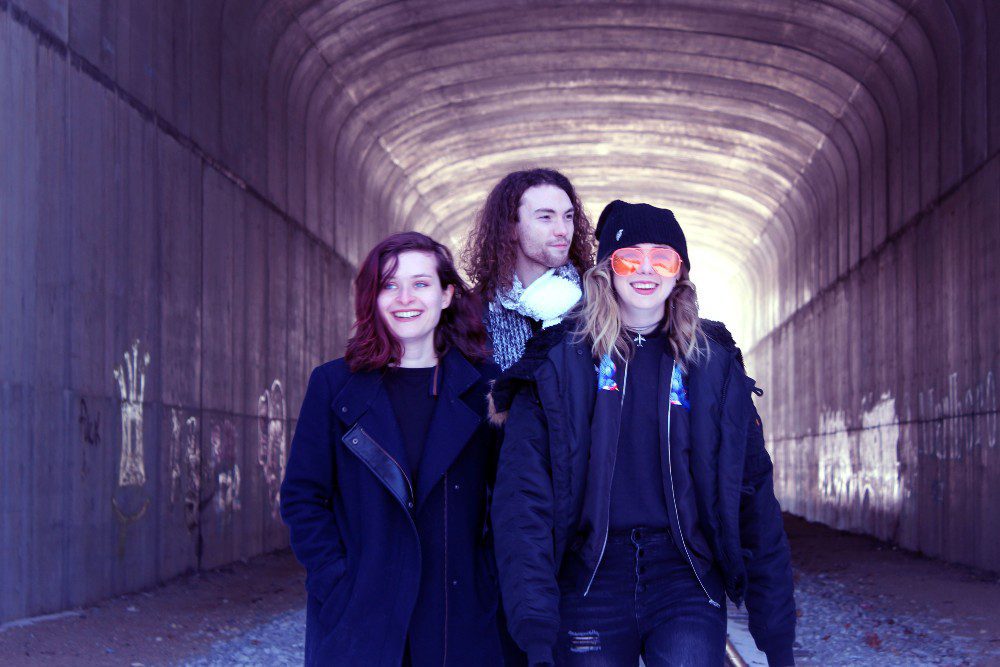
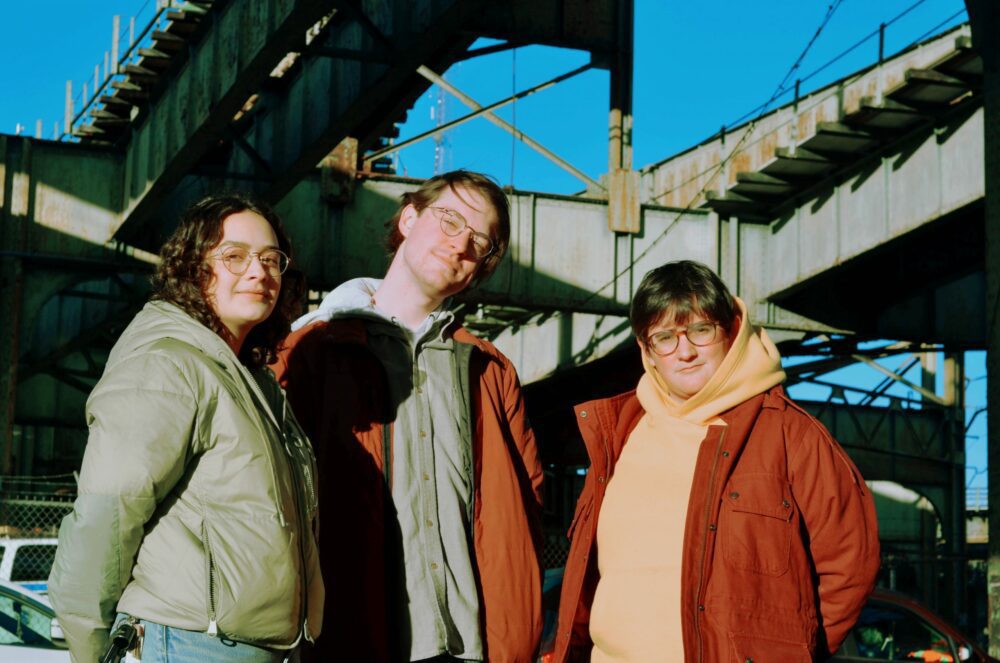
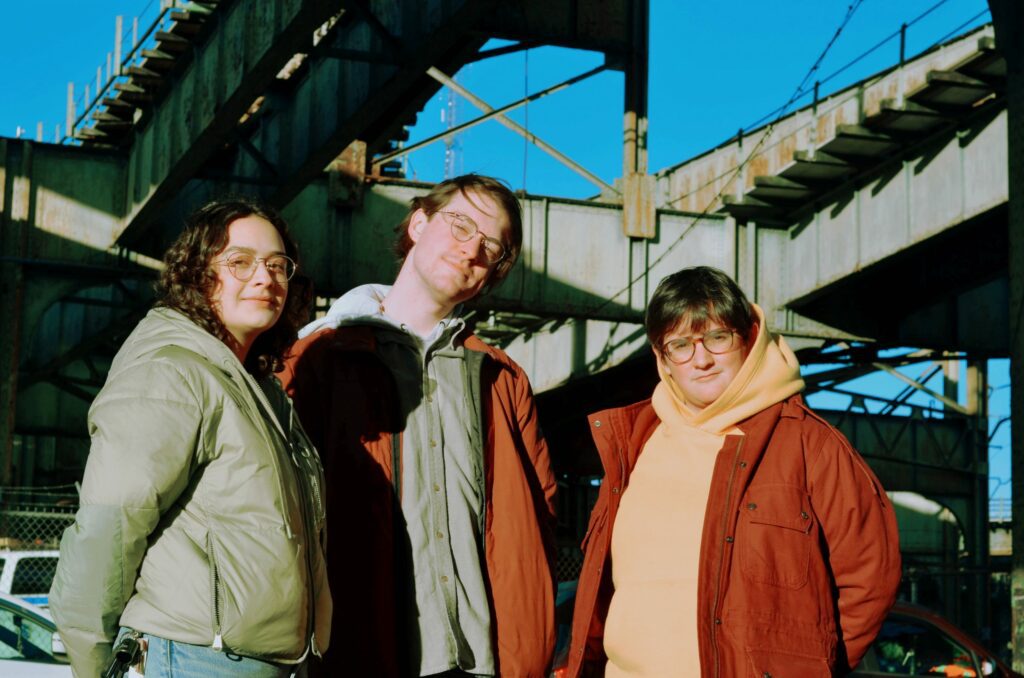
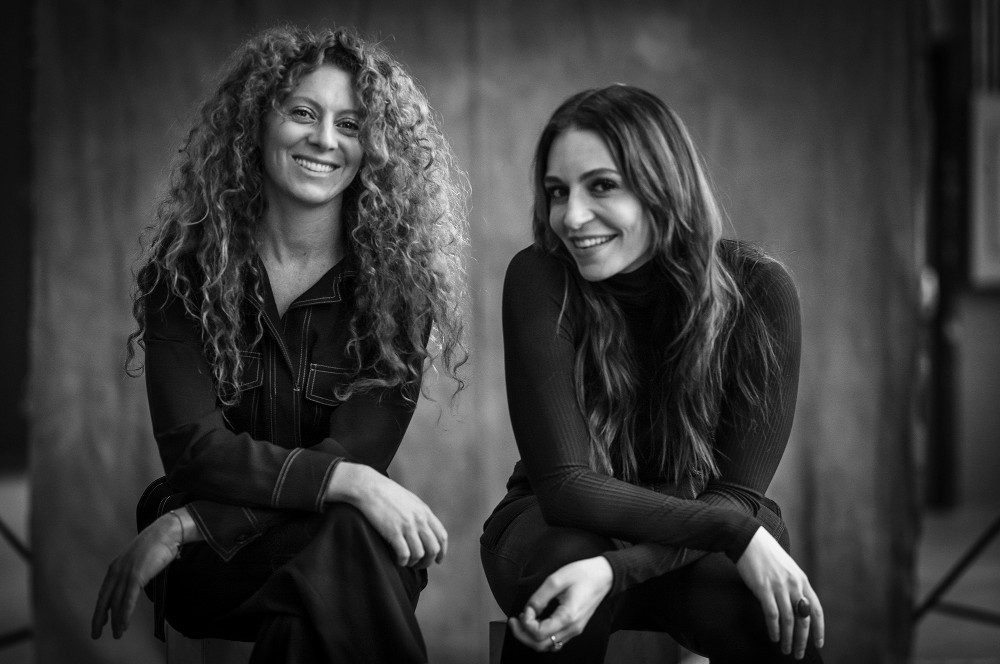
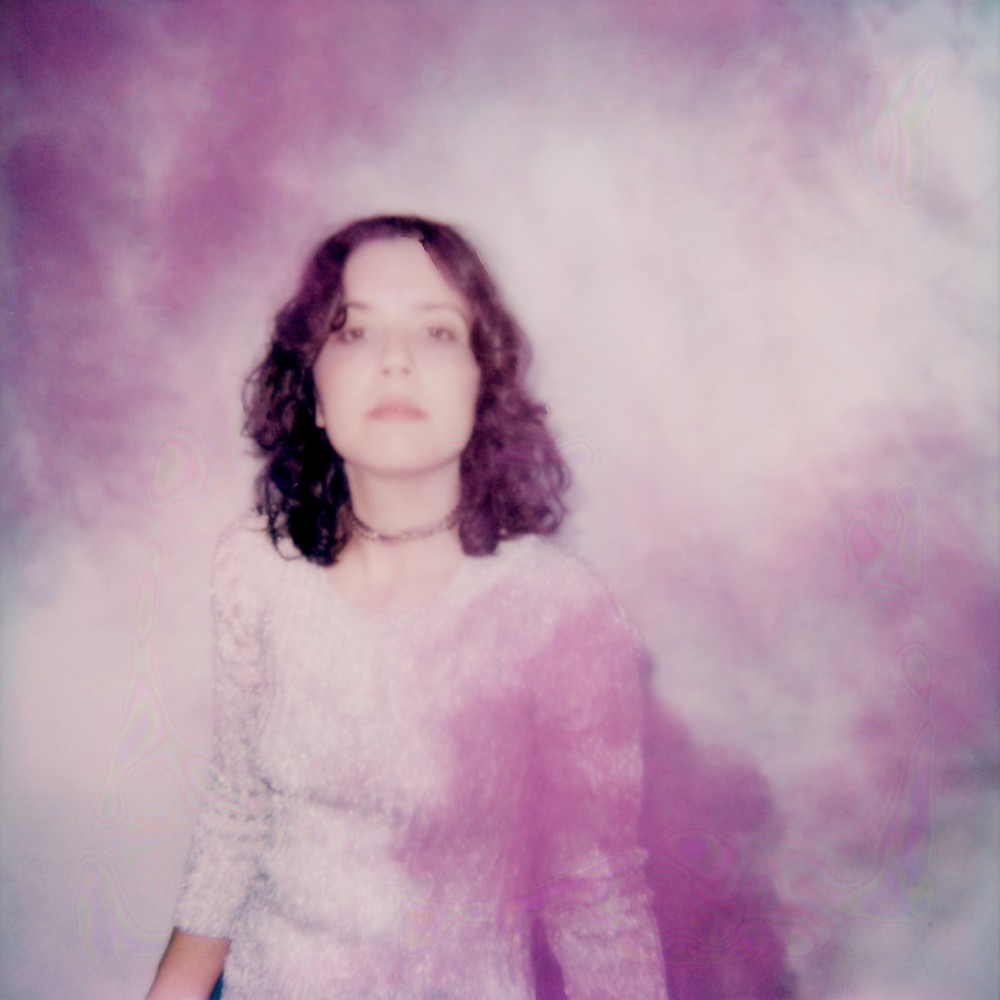
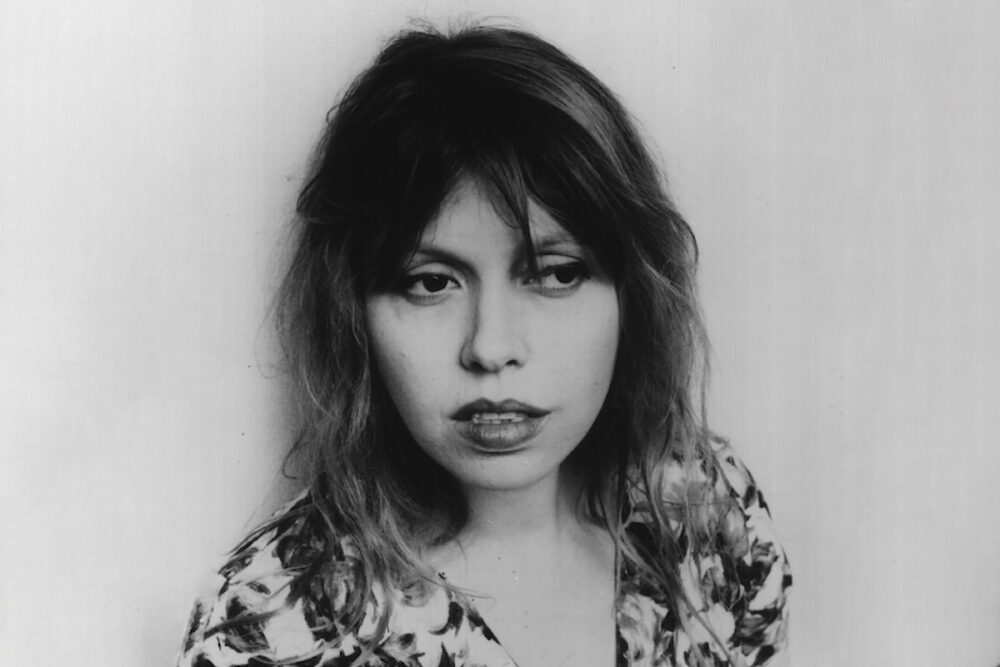
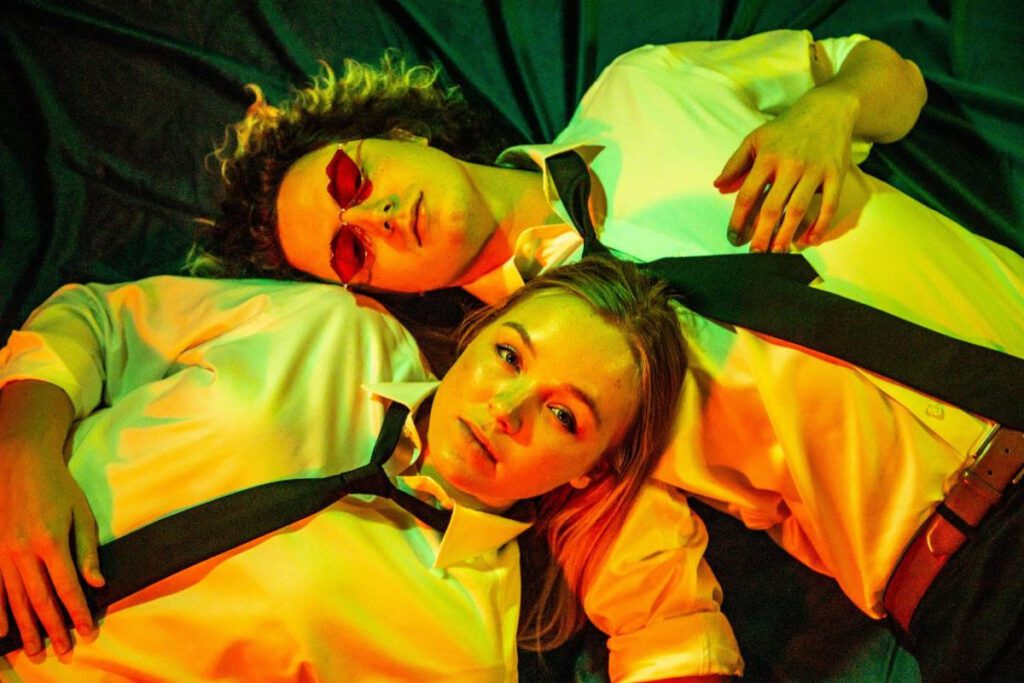
In the midst of non-stop touring, on their way to play multiple SXSW appearances in 2020, everything changed for Nashville-based trio The Accidentals. Thrown into the abyss of pandemic uncertainty, they didn’t consign to the nightmare of that initial moment when all forms of normalcy rapidly disappeared. Faced with chaos and turmoil, the trio turned to the art of songwriting, taking their grief and turning it into a beautiful and memorable collection of melodies with a lyrical focus on Americana storytelling. Learning how to navigate not only the trying times, but their own craft as musicians, the band self-produced their EP Time Out (Session 1), released May 7th.
Time Out marks the first opportunity the band has had during their whirlwind career to collaborate with some of their long-time songwriting heroes. Savannah (Sav) Buist and Katie Larson met in their Michigan high school’s orchestra class; when they both volunteered to perform in a club meeting, they knew they’d met their musical matches. As a duo, they released their debut Tangled Red and Blue in 2012, followed by Bittersweet just a year later. But the addition of percussionist Micheal Dause in 2014 brought more vibrancy to The Accidentals’ sound, as heard on 2016’s Parking Lot EP and 2017 LP Odyssey.
The Accidentals had recently relocated to Nashville and were in the midst of co-writing and session work on their next record, Vessel, co-produced by John Congleton and Tucker Martine. Shaken by the sudden onset of lockdown, the group shelved their touring plans and preparations for Vessel. They narrate the unforeseen halt on “Wildfire” with lush, harmonic vocals: “In late September, we’d just moved into town/We were on a mission lost and broke/Just as all the pieces started falling into place/All our plans went up in smoke/Who knew we were drunk on borrowed time?/Waiting on a wildfire.”
Having the rug abruptly pulled out from under them, the group questioned their next steps moving forward and reevaluated ways to sustain their music careers. “It was like starting anew in some ways,” Buist says. “Luckily we had the resources to try and start figuring out live streaming, so that was a huge element of what we did right after the pandemic started.” The group quickly threw together what digital skills and resources they had and put them to use, creating virtual tutorials and workshops with respect to the use of OBS and Streamyard. Swiftly gaining attention from venues such as Club Passim and Bluebird Cafe, Larson and Buist were subsequently connected to a handful of well-respected song-writers, including Kim Richey and Dar Williams.
Club Passim connected the Accidentals with Kim Richey, and “Wildfire” was born out of that first co-writing session. “Once we wrote ‘Wildfire’ we were like, ‘Oh, these are timely songs – maybe we need to keep the collaboration going forward because there’s something really joyful about working for other people, even in an isolated space,’” Buist remembers thinking. From there, the group connected with other artists, such as Maia Sharp (“Might As Well Be Gold”) and Tom Paxton (“Anyway”). In just a few co-writing sessions, an EP began to take shape. Heavily impacted by the weight of 2020, the group focused on those emotions and set aside Vessel. The EP came to represent “a culmination of the different stages of grief that everybody went through over this time,” as Larson describes.
Each track warrants its place on the EP, walking listeners down the emotional path so many experienced during the pandemic. Dar Williams co-write “Night Train” takes a long, hard look at our broken country while poetically searching for ways to fix it. “Anyway” essentially pertains to the struggles with mental health some experienced upon realizing this frightening and anxiety-ridden reality would likely last longer than expected. The hushed lyrics, braided with tranquil harmonies, a weeping violin and folk-style plucking of the guitar, offer an intimate reminder to keep going: “We’re at a point we’ve never been/I can’t say we’ll be okay/Just have to take it day by day.” “Might As Well Be Gold,” inspired by the group’s move to Nashville prior to the pandemic, tries to reframe negative thoughts with a positive outlook, and takes stock of what’s important in times of crisis.
“All Shall Be Well” closes the EP on a lighter note, giving listeners a sense of hope in the midst of the hardship. “That was one of the easiest co-writes we’ve ever done,” says Buist. “It was right before Christmas, before the election, and everybody was so tense. It was just four women ready to take a deep breath.” In collaboration with Mary Gauthier and Jaimee Harris, the songwriters hashed out their thoughts in a stream of consciousness flow. “We were just saying stuff that we were all feeling in the moment,” Buist recalls. “[We were] acknowledging that it’s not a perfect world and that we’ve been through a lot this year. This song is like a bookend to a very long year, saying it’s time to look forward and all is going to be well.”
In retrospect, music served as an important component of coping for the group, noting that their strong friendship pulled everyone through the tough times. “I think being able to create with each other was really therapeutic, and it really helped us hone in on a lot of different skills that we had all been beginning to learn,” Dause says. That included building a makeshift studio in Buist’s house by stacking CD boxes and thumb-tacking blankets to the ceiling; in this little cocoon, the Accidentals self-produced Time Out, and finished up their work on Vessel, intended for release this fall.
The band hopes that the soothing nature of Time Out will help fans heal from this collective trauma and emphasize the idea that no human is alone. “I think one of the best things is just being able to acknowledge that we had this shared experience,” Larson says. “I hope that people can really heal through the music and find at least one song that resonates with where they’re at in the moment. We’re all coming out of this process so differently. We want people to walk away with some aspect of healing.”
Follow The Accidentals on Instagram and Facebook for ongoing updates.
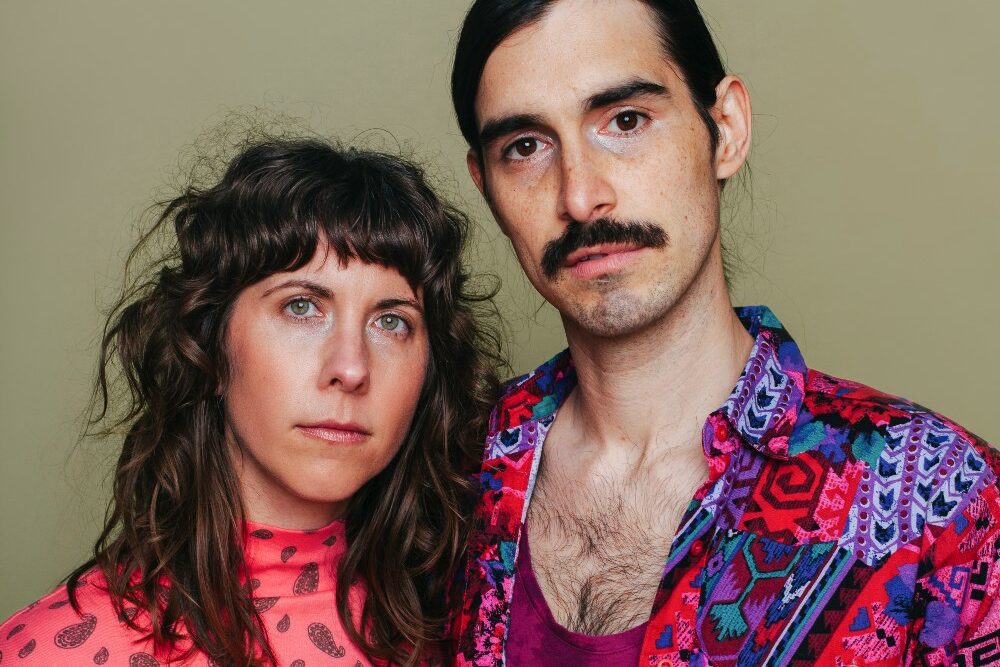
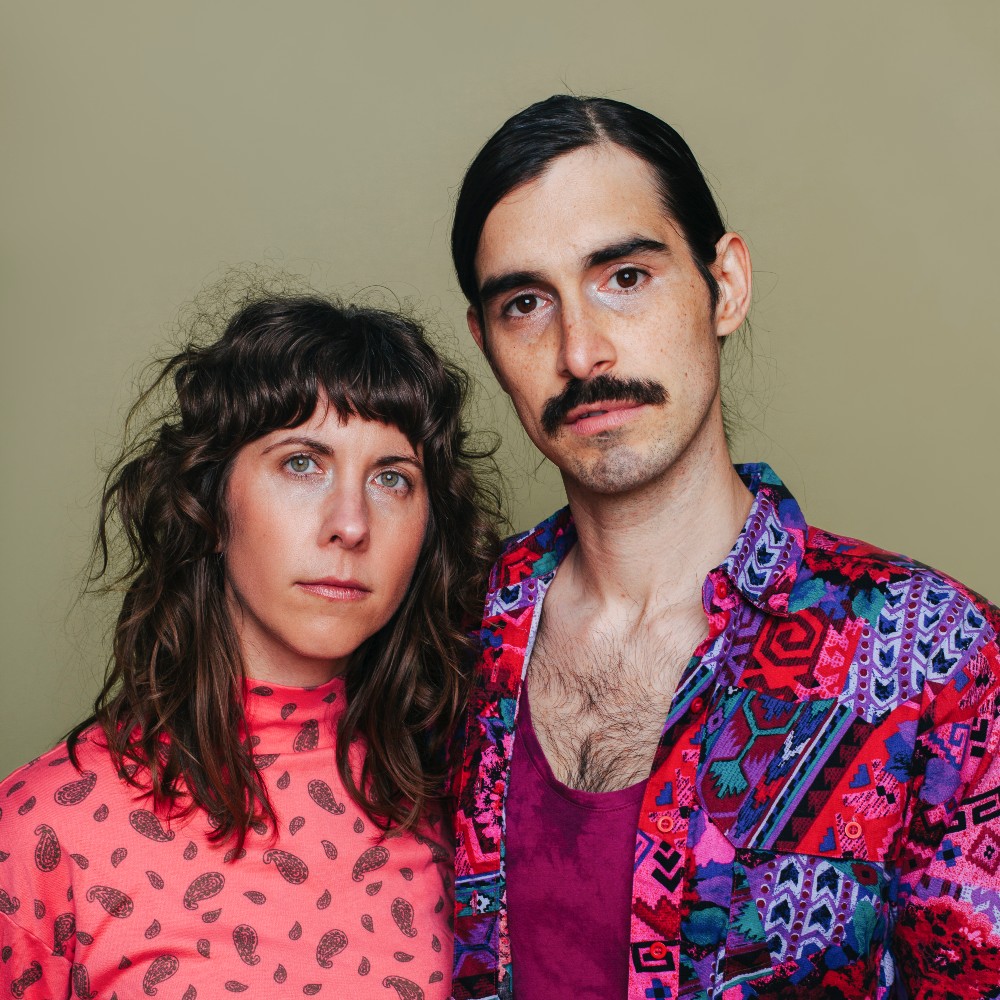
Back in 2019, as their sophomore record was starting to take shape, Steph Stewart and Mario Arnez, the core members of North Carolina-based country act Blue Cactus, questioned how the record was coming together. “I remember talking about this after we knew what songs we wanted to put on the record; we were hanging out by the pond where we used to live, and I was like, I don’t know how these songs that we’re writing right now are connecting,” remembers Stewart. It was a tumultuous time for the two of them; they had both ended long-term relationships and were settling into a relationship together after years of touring and playing music as friends. Though their thoughts, emotions, and the resulting songs seemed scattered at the time, Stranger Again, the album they released last week via Sleepy Cat Records, would come to be a meditation on preserving relationships as both musicians took stock of the shortcomings and strengths that had gotten them to that point.
“We did not sit down and say ‘we want to write a relationship album’ or anything, but I think it was a by-product of what was going on for us personally. That’s how we were living and what we wrote about – we were realizing how important our relationship was and wanting to make sure that we were actively participating in it so we didn’t repeat mistakes from past relationships,” Stewart says. “It was almost like we had to get out of our immediate lives and look at it from above.”
“We definitely couldn’t see it in the moment,” adds Arnez, “but after seeing all the songs laid out in a list of what we were excited about having on the album, it became pretty clear that there was a thread running through them for sure.”
In particular, the title track became a thematic touchstone. “It’s about having to put in work to keep things fresh and new regardless of the circumstances,” Arnez explains. “I think, in a way, that is creative work in itself, right? You’re living your life and you’re going through your day to day and you gotta keep things fresh and exciting regardless of what’s going on.”
That didn’t just apply to settling into romantic partnership – it applied to their creative partnership as well, translating to a major expansion of their sound into an amalgamation of rock, folk, and Americana they think of as “cosmic” country. It’s quite the departure from the over-the-top, carefully studied Country & Western twang of their 2017 self-titled debut, which made liberal use of tongue-in-cheek song titles – like “I Can’t Remember (To Forget You)” and “So Right (You Got Left)” – that would hardly be out of place in a honky-tonk jukebox alongside ’70s classics.
“Our approach to songwriting was really different on the first record. The parenthetical titles were very much a starting point for a lot of the songs, and that was a new way of writing for us; I had a little notebook of just song titles that we were spit-balling,” Stewart says, citing George Jones’ 1974 LP The Grand Tour as a major influence. “Even though we had various things going on in our personal lives that maybe played in to the type of songs we were writing, we were trying to do the country thing.”
“The self-titled album was us geeking out on different country music elements really, and having a lot of fun playing with each other and with writing,” Arnez says, though he notes that constructing punch lines ultimately began to feel too predictable. “After getting an album’s worth of material out, and a little bit extra I’d say, I think we sort of were feeling we wanted to step away from playing with tropes.”
“This record’s very different – these songs were from a very emotional place. Introspective. I wasn’t really thinking about the song title until it was done. A lot of them wrote themselves, I think for both of us,” Stewart says. “We were looking at all the tracks and [‘Stranger Again’] seemed like it spoke to the overall theme that we had realized was running through these songs, and also really showed that shift in our sound.”
The duo learned some things along the way – mainly that their collaborative songwriting process could benefit from solitude during its initial stages. To that end, they’ve built occasional creative retreats into their schedules. They also began collecting band members who have had significant impact on the Blue Cactus sound, like bassist Alex Bingham. “Alex co-produced the album with us, and loves trying new things with the songs, so even if we come to him with what we feel is like a complete version, he brings some interesting ideas to try that I think Mario and I wouldn’t always come up with on our own,” says Stewart.
One such example was “Worried Man,” originally a bluegrass track that got an impromptu revamped groove at the time of the recording. “Working with Alex, that song shifted into this really cool seventies country disco kind of beat that just happened right in the moment of recording it,” remembers Stewart. “It felt so jarringly different than what I was used to that I actually did not like it at the time.”
“We were deep into the session at this point so there wasn’t any time to back up at all,” Arnez adds. “That was probably the second or third time we had actually played that groove on the recording. The whole thing still feels really exciting to me because that energy is there, where we don’t know what’s gonna happen. We’re all flying by the seat of our pants in a pretty fun way.”
“In the moment, it wasn’t really something that I thought I liked, but I stepped away from it and revisited it,” Stewart admits. “The song is about appreciating the things about someone when they’re gone that you didn’t at the time when they were alive – it really celebrates that in a different way with the new vibe and groove that Alex suggested us trying out. I really love Whit Wright’s pedal steel on it, the way it kicks off right at the top with him playing that lick. HC McEntire did the high harmony on it, and I really love the blend of all three of us singing the chorus.”
“In general I think we have a process of finding answers quickly for certain things creatively, seeing the simplest answer to a certain kind of song we wanna write, and then figuring out different ways to subvert it along the way, do something that’s musically satisfying but less predictable,” explain Arnez.
Equally as important has been the support – on multiple levels – from Blue Cactus drummer Gabe Anderson. “He’s also the co-founder of Sleepy Cat Records which is putting this album out, so he’s really this essential backbone, and such a good friend, and he just naturally knows what his role is in these songs,” Stewart says. “It’s pretty incredible.”
In fact, North Carolina’s Research Triangle – Raleigh, Durham, and Chapel Hill, where the band lives – has been an altogether supportive scene since the earliest iterations of Blue Cactus. Stewart grew up nearby, singing Patsy Cline and The Cranberries at Golden Palace karaoke every Wednesday with her family, while Arnez goofed around with tape recorders and mini Casio keyboards in Southwestern Florida, where his mom was a media specialist at his school. One of Arnez’s college friends, Omar Ruiz-Lopez, had moved to Chapel Hill and happened to be playing in a string band with Stewart; once he convinced Arnez to move, Arnez made Steph Stewart & the Boyfriends a four-piece, and they’d all sing around the same mic. Their bandmates’ priorities shifted to raising families and leaving the Triangle, but the musical magic they made as a duo couldn’t be ignored – and Blue Cactus formed, sticking close to the scene that nurtured them.
That magic is still at the root of this latest batch of songs, because everything Arnez and Stewart write has to pass a litmus test of sorts. “We start the song as a duo, before it goes to a band, essentially. From the natural process of making sure we can deliver it as a duo, I feel like that’s sort of the proving ground in a way, from a performance and arrangement perspective,” Arnez details. “Feeling like our vocals and two guitars can make it feel complete, it always feels like a pretty easy, natural process to add a whole band on top of it from there.” He cites iconic duos like The Everly Brothers and Gillian Welch and David Rawlings as a jumping off point, but from there, Blue Cactus wrangle an astonishing variety of sounds, from the nostalgic sway of “Rodeo Queen” to the rollicking stomp of “Rebel” to the cinematic crackle of “Radioman” to the subtle sensuality of “Stranger Again.”
In early 2020, Blue Cactus released a few singles, fully intending to put out Stranger Again soon after. But as the pandemic tightened its grip on the music industry, the time never felt right; they decided to hold the album and as lockdown wore on and civil unrest rocked American cities, the songs, too, became strange to the people that made them.
“[It] was pretty weird sitting on this album. Music had been our full-time commitment,” Arnez says. “Obviously [with] no way to do it the way we had been doing it, we started feeling estranged from music in a way. It felt hard to even be creative for months.” The couple got part-time jobs at a local co-op grocery and began, in some ways, to re-evaluate their priorities as musicians.
“Before the pandemic we felt like we had to take every opportunity that presented itself, and play a bunch of gigs – not really be very critical of what we were doing, just work very, very hard. And I think that can work for people and it could work for us potentially, but it just doesn’t feel like an authentic existence,” says Stewart. “We’re going to play shows when it’s safe, but we’re not just gonna play a bunch of loud bars, and honestly, we were doing that quite a bit on tour before. We can be a little more choosy in the shows we’re playing and not just sort of go everywhere all the time.”
“It’s fun to drive up to New York and [play a gig], but… that was about as far as some of the planning went, you know? A show gets booked and then you drive all the way to go do it, and not much else happens other than burning a lot of gas,” adds Arnez.
As Blue Cactus returned to the Stranger Again tracks that sat on the shelf for so long, many of them began to take on new meanings, too. “I Can’t Touch You,” once about falling short of expectation, took on a very literal meaning as social distancing became the new normal. While Arnez says hearing the recording transports him back to the studio, Stewart points out that playing it for a backyard full of friends post-vaccination took on “this whole new level of relevance.”
“The pandemic and everything gave us the chance to put our music down and just tap into the world around us and be a part of it in really meaningful ways. So then, when we came back to these songs… I feel like I fell in love with them all over again. They’ve revealed themselves to be about other things to me that I didn’t even realize they were about, so it’s been a really nice process actually, to get to know them again,” she explains.
Stewart can also appreciate the new meanings that listeners bring to each of the songs, particularly the raw honesty of “Come Clean.” Shortly after it was written, Stewart shared it amongst some friends, and one of them, who stars in the gorgeous visual for the track, had an unexpected take on the song’s message. “He just came up to me, in tears, and told me how he remembered when he came out to his family as a teenager and what that was like for him, and that’s what the song meant to him. I never really thought about it meaning other things to other people – I just knew where it came from for me,” Stewart recalls. “I think everybody has a kind of universal experience – we grow up, and we realize that a lot of times we’re not the person we were raised to be or were told we were. You hopefully get to become who you really are in your lifetime.” To reflect that poignant message, Stewart wanted to tell a variety of stories with the music video, which Anderson shot and Arnez edited. In addition to Stewart’s friend and his partner, it stars Chapel Hill’s poet laureate CJ Suitt and dancer Anna Maynard, who add choreographed movements to illustrate the narrative further.
At the end of the day, the biggest hope Blue Cactus has for Stranger Again is that folks will find new meanings every time they listen to it, imbuing each track with their own perspective. “A little something that we sort of have in the back of our minds when we’re writing is that there is this little bit of space that is left for the listener to insert themselves into it and complete it, in a way,” says Arnez.
“I don’t have a specific takeaway I want them to get out of it other than some significance for themselves. I want people to connect with it in their way, whatever that means for them.” Stewart adds. “When I fall in love with an album, the meaning will totally change depending on the context of what’s going on in my life, and I hope that’s the case for people who listen to this record – that they’ll put it on the shelf for a little while and then come back to it when they feel like they need it, and it will be there for them.”
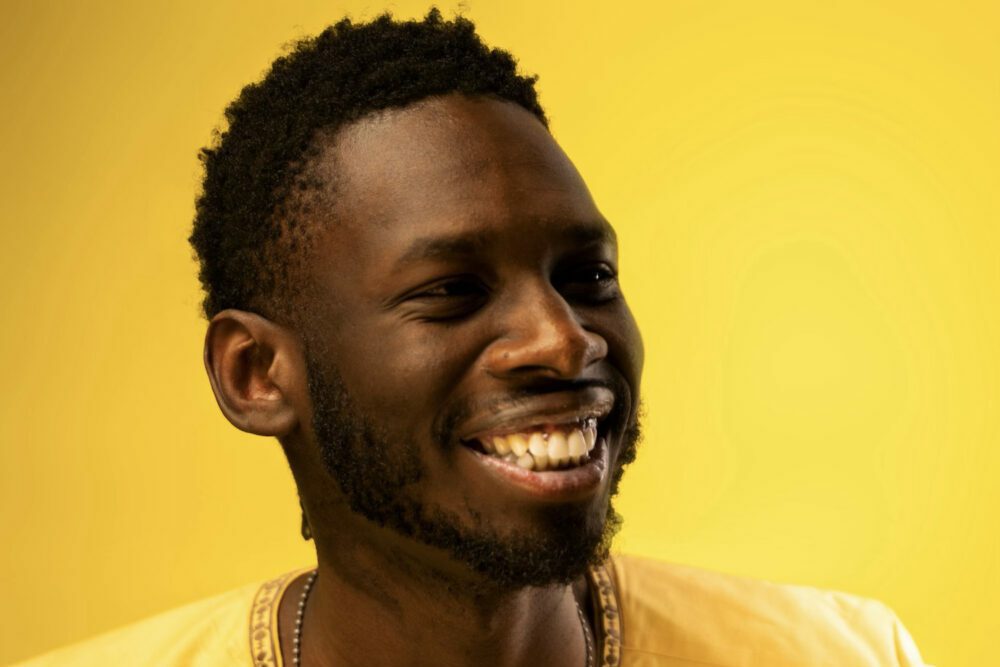
For Papa Gora, everything comes down to timing. The Cincinnati native has been working hard the past few years to emerge as a rising star in the city’s hip hop scene and released his latest album, The Feel (An Album by Papa Gora), earlier this year. The project was initially meant to drop in 2020 – a year that seemed bleak for many local artists. However, Papa Gora decided to delay the album, which ended up bringing on a host of new opportunities, remote performances and organic collaborations.
“Everything with this album was based on a feeling; I wanted to make sure that I expressed myself so people could feel something from the music,” he tells Audiofemme. “This one started with production – the beats. The intro song [‘The Best’] was the first beat that I got, and from there, more producers were sending me different sounds.”
“Nothing was forced, it came about really naturally,” he adds. The feelings he wanted to capture shine through on every track on the album – from the spiritual highs of “Testify” to the raw emotion on “Violence,” which features Cincinnati rapper Jay Hill.
“I had ‘Violence’ sitting there and was like, who can bring that emotion in? Jay Hill,” he says. “Shalom, same experience. He’s more of a poet and he was transitioning into songwriting at that time, and we ended up making ‘Divine Timing’ maybe in 20, 25 minutes. And also Harmony [Haze], her vocals are just amazing. I needed that texture to add an extra layer to that song, [‘Truth Will Set You Free’], and she did amazing.”
Papa Gora’s visceral vocals also stand out on “Too Wild,” which, like “Violence,” speaks vulnerably about police brutality, systemic racism and loss.
“I can’t say there was a particular thing that triggered those songs, but they came from a soulful place; a place of this keeps happening,” Papa Gora says. “Even before 2020, stuff like police brutality, violence, people getting murdered… I actually had a coworker whose son got killed, and I’m not saying she was the reason I wrote the song, but it is something that constantly happens and myself, as an artist, I feel like I have a responsibility to speak out about it.”
Papa Gora also recently wrapped up a remote performance series called “Live-N-Direct,” for which he was able to virtually perform several of the album’s solo tracks as well as collaborations.
“It was awesome. I honestly did it because I miss performing,” he said about the series. “I miss that, and it’s not the same as performing in front of people, but performing in general is just my favorite thing to do. And I was able to include Shalom and Jay Hill on the performances, and we did the season finale at a clothing store in Cincinnati. It was a great experience and it came about naturally.”
Later this month, Papa Gora will head to Texas for a string of live shows. He’s also performing at the Thompson House in Newport, Kentucky on May 28. Currently, he is putting the finishing touches on a new music video for album cut “Open Your Heart,” which is slated for release at the end of this month.
“I always say the album is done, but it’s not finished,” he reflects. “I’m really big on visuals and I feel like I need to take my time and push out visuals for almost every song on this album. That’s one thing I’m really focusing on right now, but my studio is also in my house, so I’m always creating.”
Follow Papa Gora on Instagram for ongoing updates.
Photo Credit: Daniel Boud x Giulia Giannini McGauran
Alt-country, nu-folkie Imogen Clark is possibly the hardest working musician you haven’t heard of. She wrote her first song at 13 (“I loved writing my own music,” she admits), going on to tour Australia, release two albums, and work with some well-known Australian talents. Lately, she’s been keeping busy preparing for a national headline tour and the drop of her EP Bastards on May 21, 2020. The EP and the tour are named after the track of the same title, a vehicle for Clark to exorcise the demons of misogyny that had haunted her career and her confidence.
“’Bastards’ is a song about really struggling with patronizing people in the music industry. I’m sure every industry has people like this – people who just underestimate you at every turn and make you feel like you don’t know how to do your job,” says Clark. “I just felt like I was encountering it a lot, and that comes with the territory of being a young female artist.”
She calls it her “fire in the belly song” – one which she hopes will give other female artists the strength and sustenance to know that they’re not alone, and that they can use their music and voice to call out bastard behaviour.
Clark chose to work with LA-based producer Mike Bloom after their successful partnership on her acclaimed 2020 EP, The Making Of Me. Clark and Bloom (who has worked with Jenny Lewis and Julian Casablancas) initially met at an Elvis Costello concert; her manager had a hunch that the two would work well together, and that forecast that proved true.
Though The Making of Me happened unexpectedly, creating Bastards was an organic process. “We started making what we thought were just a handful of demos, but as we were moving along with them, we realized we were putting so much effort into these, we cared about them, and we were having so much fun,” she recalls. “We realized we were making a record.”
On their second outing together, Bloom provided Clark with the comfort and confidence to do things that scared and challenged her, resulting in her most confessional work to date. Leading up to the anticipated release of the EP, she has shared four singles, including the just-released “First Class Man” and a candid behind-the-scenes video; the yearning, sweet “Forget About London;” heartfelt “Eat You Alive;” and confessional, vulnerable “Never This Time.”
“Never This Time” was co-written with none other than Taylor Goldsmith from Dawes and Jason Boesel of Rilo Kiley, who also plays drums on the track. In the studio, Clark had casually mentioned to Bloom that she loved a song by Dawes, only to discover that the world is really very small; Goldsmith and Bloom are friends, so the producer offered to set up a writing session.
Clark’s “jaw hit the floor,” she says. Other than Taylor Swift, she believes that Goldsmith is one of the best contemporary songwriters around. Together with Jason Boesel, who often writes with Goldsmith, the trio gathered at Clark’s little Airbnb in Silver Lake and wrote “Never This Time.”
“They were so wonderful,” she says. “They really helped me bring to life a topic that I’d wanted to write about for a long time but hadn’t quite known how to. They made me feel comfortable enough to do that with them, and I really loved the result.” In the wholesome, unfussy rock tune, Clark reveals the many chances she’s given someone close to her, only to be disappointed over and over again. It aligns very much with the exploration of relationships and Clark’s position in the world relative to the push-and-pull of people around her.
Where Bastards is an exploration of her relationships with the external world, her earlier work was more inward-looking and very much created within Australian borders. She released her first album Love And Lovely Lies in 2016, following the success of her 2015 song “While Women Wait,” which received national and US radio attention.
Her second album, 2018’s Collide, was produced by guitarist/singer-songwriter Mark Lizotte – best known to Australian and international audiences as Diesel. Clark had supported Diesel on tour over a couple of years, so it was a natural fit for the Lizotte to transform Clark’s live energy into a studio album.
Clark has made big choices her whole career – and much like Taylor Swift, she has recognized the power of surrounding herself with people who share her vision and give her the tools to sculpt it her way. “Taylor’s just one of my all-time favorite artists,” she says. “I think she’s unparalleled when it comes to the success of a modern-day songwriter who has been able to so successfully reinvent themselves countless times and has never really dropped the ball when it comes to creating consistently good art.”
Creating good art and performing for an audience are in Clark’s blood, and especially after the prolonged hiatus from touring due to the pandemic, she’s ready and excited to take Bastardson tour this month. After all, home for her is not the four walls she’s known throughout 2020; stuck in her house, she’d wondered whether home might not be a physical address; the sense that home is not a place, but a feeling is perhaps most indicative on Bastards track “Forget About London.”
“The pandemic made me realize that home is definitely more of a feeling, because I was in my house so much, but I didn’t feel comfortable in my own skin because I wasn’t touring and I wasn’t doing the thing that I love and the thing that I dedicate my life to, which is music and performing for people,” Clark says. “I realized that, for me, home is on the stage, wherever that stage may be.”
When she first wrote “Perfect Love,” Dorothea Paas and her friends jokingly referred to it as a Phil Collins song. “I could just imagine the song being arranged with the full Phil Collins treatment – chorus, guitar, big reverb tones,” the Toronto-based singer-songwriter says by phone. When Paas wrote the song, she was actually inspired by Celine Dion’s rendition of “The Power of Love” and imagined “a big Phil Collins drum fill on that second chorus.”
The version that appears on her debut full-length, Anything Can’t Happen, sounds nothing like that though. Instead, it’s become a somber folk number that builds to a rich choral arrangement near its end – something more in line with the British folk group Fairport Convention, using an acoustic guitar with a “sparse and vaguely eerie arrangement.”
One of the challenges that Paas found with working on Anything Can’t Happen, released May 7 via Telephone Explosion Records, was that her songs could have been performed in various different ways. “Maybe that’s why I like the idea of redoing old songs,” she says, “because there’s just so many possibilities.”
Anything Can’t Happen might be Paas’ debut album, but she’s actually been performing, recording and releasing her music for about a decade. Her first recording was a MySpace-era CD that she burned in her living room. Afterward, she started releasing cassettes here and there, particularly when she was set to play on the road. “I love tapes because they’re affordable to make and affordable to buy,” she says. “I think they sound really good also, but, even if you don’t listen to them, they’re just a fun object to have.”
Paas isn’t the sort of artist who likes to debut her songs with the recorded version. She prefers to play them live for a while to grow comfortable playing them. Maybe too, she’ll decide on her favorite arrangement of the song through live performance, although, she adds, sometimes there’s “weird improvisatory magic” in the studio.
Paas started playing shows while attending college in Kingston, Ontario. “Starting out in that scene, I really wanted to fit in, but also maybe blend my sound that into that,” she says. “And then, over the years, I’ve wanted to carve out a specific niche for myself in terms of owning the things that make me different.” For Paas, that means leaning into her voice and bringing elements of classical, folk and rock influences together in her work.
Born and raised in Toronto, Paas gravitated to music as a child. In her youth, she was in a Christian worship band – that’s where she learned to play guitar and harmonize – and learned choral singing through Canadian Children’s Opera Company, where she met young singers who she would work with as an adult, like Robin Dann of the band Bernice, who lends her voice to “Closer to Mine” and “Perfect Love.”
Plus, the choral background continues to be an influence on Paas’ songwriting. “I try to use it as inspiration if I’m feeling like I want to create or introduce some variety into my writing,” she says, “because I think my songwriting practice pretty much grew out of my time in Kingston playing in the post-punk scene.”
In Kingston, she met a few of the musicians with whom she would continue to collaborate over the years, including Paul Saulnier from PS I Love You and Liam Cole from Little Kid, who played bass and drums respectively on Anything Can’t Happen. It’s also how she connected with artists from outside of the city. Paas and her pals were often local support for bands coming through Kingston. And, she notes, because the city is between Toronto and Montreal, they would get a lot of tours. “As a result, I made a lot of friends in the music scene,” she says.
Paas, who has also collaborated with artists like Jennifer Castle, U.S. Girls and Badge Epoque Ensemble, began writing the material that would become Anything Can’t Happen back in 2016, and the most recent songs on the album are about two years old. She chose to organize the tracks in a loose chronological order to reflect how her influences and style have evolved during that course of time. “I like the idea of moving through that experience through the track list,” she says.
There are no “true oldies” on her debut album, but she’s considering redoing one song she wrote more than five years ago on her second album. “I don’t want to put it to waste,” she says of some of her catalog material, “especially because my older songs have been heard by such a small audience.”
This process also presents an interesting situation for an artist who has played a lot in her hometown, but hasn’t toured as extensively. “My friends have heard them and people that are really avid show-goers in the city, who go to a lot of independent shows, have heard them,” she says. “Most people have never heard them and, through having a label and being able to put stuff out in a way where it can be heard more, I have to remind myself that this is going to be new for a lot of people.”
Follow Dorothea Paas on Instagram for ongoing updates.
The video for “Refraction Overdrive,” from Japanese duo Crystal’s latest album, Reflection Overdrive, is so unabashedly ’80s that you might, for a second, think that you’ve been transported to a wood paneled living room, where you’re drinking wine coolers while flipping channels between MTV and Night Flight. It’s a clip filled with keyboards and fog, plus effects that might recall The Cars’ video for “You Might Think.”
Two of the big influences for the “Refraction Overdrive” video were actually “The Number One Song in Heaven” from Sparks and Hall & Oates’ hit “I Can’t Go For That.” They aren’t flashy videos, but they have distinct vibes with their subdued choreography and musicians decked out in blazers. In “Refraction Overdrive,” you can see the similarities in the dance moves, the costumes and the close-ups of hands tickling keyboards.
When the subject of the video comes up during our Zoom chat, Tokyo-based Sunao Maruyama and Ryota Miyake start to mention other artists that have influenced them in the course of making the album, released on May 7. Maruyama notes that J-pop had an impact on the duo. Miyake mentions Pet Shop Boys, as well Fancy, the German singer of ’80s disco jams like “Slice Me Nice.”
On Reflection Overdrive, the idea was to fuse various styles, amongst them ’80s J-pop, future funk and new jack swing. When mixed through Crystal’s aural aesthetic, it’s an album that sounds neither retro nor completely like 2021. It exists on its own plane.
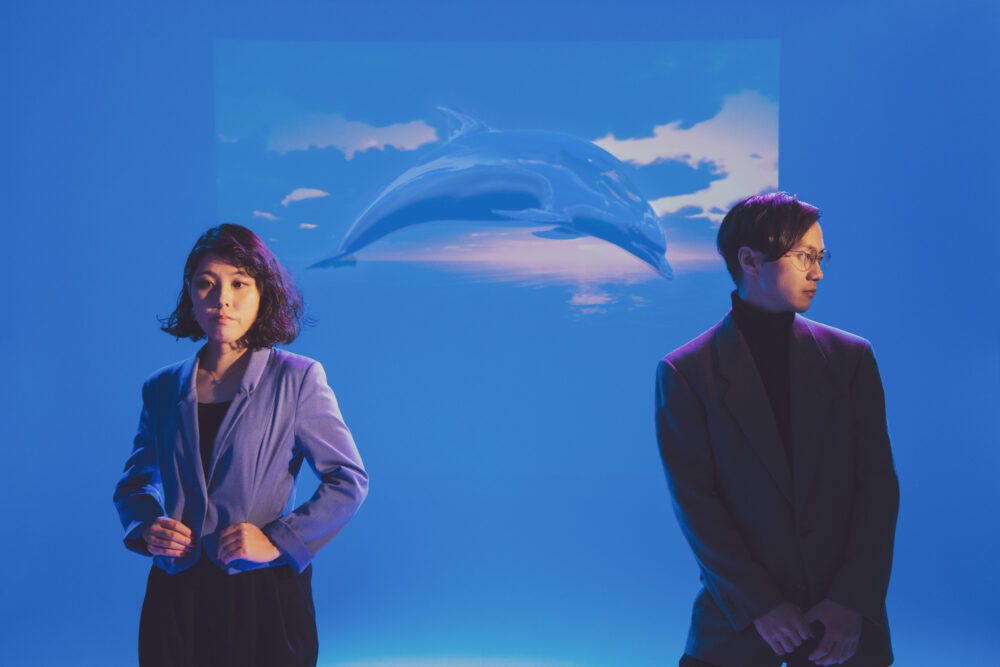
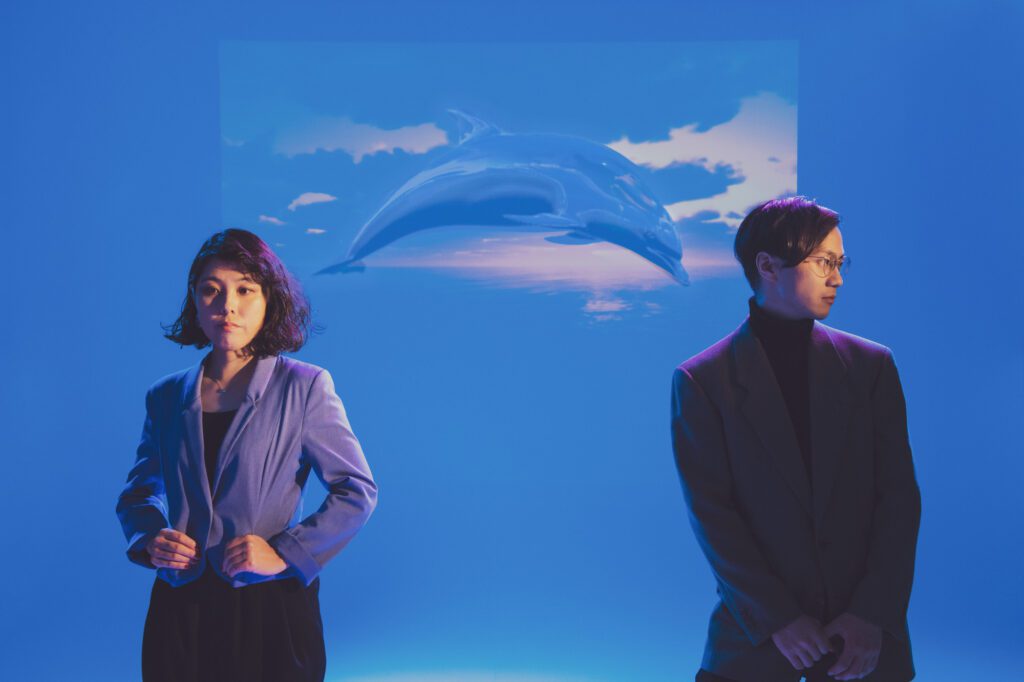
Visually, Crystal pulls from multiple pop culture sources as well. The dolphin that appears on the album’s cover is inspired, in part, by the dolphin in Johnny Mnemonic. Their take on the creature, though, is far more whimsical. On the cover of Reflection Overdrive, the dolphin is caught mid-air, practically shimmering against a purple-and-pink sky that’s reflected on the water below. Held in the dolphin’s mouth is a compact disc. Miyake worked with Shinya Sato, who also directed the “Refraction Overdrive” video, on the artwork and design, while Maruyama provided the calligraphy on the cover.
Crystal first gained cult popularity in the MySpace era, when their music caught the attention of Gaspard Auge from Justice. Their debut full-length, Crystal Station 64, came a few years later, in 2015.
Reflection Overdrive had been in progress for about five years. “It took so long to make this album,” says Miyake, who adds that he began developing the songs while attending Red Bull Music Academy in Montreal back in 2016. During the course of making the album, though, Miyake did release music from other projects, including the Flash Amazonas album Binary Birds and Other Rubbish Surreal Things and an EP for his solo project Sparrows, Gold in the Tide.
Reflection Overdrive includes several collaborative tracks: “Taxi Hard,” features bass from Copenhagen-based Vincent Ruiz; Julián Mayorga, who previously worked with Miyake on the project Flash Amazonas, lends a hand on “TV Fuzz;” DJ/producer Matias Aguayo sings on “Kimi Wa Monster.”
“I wanted to collaborate with him, but he told me that he wanted to sing in Japanese,” says Miyake. “We made up this song.”
Plus, Miyake sings more often on Reflection Overdrive. He says that the intent was to perform more like Japanese pop singers of the 1980s. However, he adds, “I’m more like an indie musician.” He likened the experience of trying to mimic pop singers to karaoke. “I made melodies, but it was so hard to reproduce it with my voice,” he says. Despite the challenge, he adds, “it was good to experience that.”
All of that has lent itself to an album that’s a bit of a departure from its predecessor. Where Crystal Station 64 was very much a synthwave album with a good dose of electronic funk, Reflection Overdrive taps into a pop sensibility. There are still plenty of moments that feel like an ’80s film score, and some tunes, like “Phantom Gizmo,” seem perfect for breakdancing, but there are also a good amount of sing-a-long moments here. “Our last album has more machine-machine-machine, very tight,” says Miyake, “but this one has more deep feeling.” It’s also a feel-good album, one that can instantly transport listeners to an imaginative alternate universe that draws from past fiction, but looks towards the future.
In music, the unequal representation of women is an industry-wide issue with a lasting ripple effect. There’s no sector of the industry with a more pronounced gender gap than in engineering and producing. According to reports by the Audio Engineering Society, women make up just 5% to 7% of audio engineers and producers. Organizations like Women’s Audio Mission, report that the number is probably even lower.
Rampant sexism is the cause—and the effect— of such poor representation on the tech and production side of music. Most women don’t even get into sound engineering because it’s so male-dominated, which then perpetuates the inequity. If a woman does manage to survive school and become sound engineer or producer, they can then expect to be continually mistaken for something other than the engineer (usually the singer or a roadie) and to have their engineering or producing abilities consistently questioned and ridiculed.
This dejecting reality is one that Washington-bred queer roots artist McKain Lakey knows well, both a graduate of Berklee School of Music’s mostly-male audio engineering program and as a live sound engineer who’s toured with bands. In fact, it was the unsavory experiences she had as an audio engineer that inspired her new single, “Decibel Jezebel,” which she premieres with Audiofemme today in anticipation of her upcoming debut full-length album, Somewhere, out May 14, 2021.
“Decibel Jezebel” begins with what Lakey calls “audio nerd jokes” and then dives into a biting criticism of the sexual objectification and under-appreciation she experienced as an engineer.
“You’ll notice the difference if I increase by three/My voice doubles at ten – if I do that again, will you stop stifling me?” Lakey sings. “That decibel jezebel, she couldn’t possibly hear in those jeans/But you can’t scare me straight cuz I know that no one listens linearly.”
Though the song is specifically addressing what she experienced as a femme audio engineer, Lakey also found it grew into a larger commentary of “women and non cis-dudes in the service industry being in this position of having to conform to ways of being in the world that are placed upon us rather than being given the agency to present as we want to and as we are. [It] morphed into a commentary on the patriarchy.”
In service of the broader relatability of sexism in music, Lakey invites her close friend, saxophonist Jane Covert-Bowlds, to appear on “Decibel Jezebel.” Covert-Bowlds performs a goose-bump-giving solo that exudes solidarity and sisterhood and exhibits her command of an instrument that is been typically associated with men.
“Jane was someone – we connect as friends, but I knew she had a really special take on that song as an [woman] instrumentalist and I really wanted to feature her,” says Lakey. “I knew specifically that I wanted Jane to play on it because we have talked a lot about experiences being queer women musicians and what that looks like and the struggles that go along with [our] identity.”
With Somewhere, Lakey also contributes to the growing visibility of queer-identifying artists in country music, a genre that is typically associated with two forces that typically harm, hinder, and exclude queer folks—conservative politics and rural America. But, as Lakey, who grew up just north of Seattle in the rural town of Bow, Washington, points out, that’s not the entire history of roots and country music.
“The more that I learn and go back and research the beginnings of country music and the class and racial history of country music and roots music in general in the United States, the more I think there was this turning point in the history of recorded music where all of a sudden music went from being something you played in your living room to being something that was sold and marketed to specific audiences,” says Lakey. “That was the point at which country music… created these lines. When in fact, there are many amazing, radical, queer, Black blues singers from like the ’20s and ’30s. You know, I think about the history of music in the US and think like, actually, queerness has a place in this and always has had a place in this. This isn’t so much a radical new thing. This is just saying, ‘We’re here. We’ve always been here. And it would be nice to be seen for who we are.'”
In that way, Lakey highlights and subverts forces in society that work to suppress her identity, purely by sharing vulnerable, arresting stories from her life as a queer person on Somewhere.
“I have benefitted a lot from the privilege of being a white person, a straight-passing, cis-passing person, and have not had to bear the weight of mistreatment that so many of my LGBTQ+ siblings have. But I did spend a long time feeling unsettled and unseen,” says Lakey. “And it feels important to me to represent queerness as something that has as many expressions as there are queer people, and that queerness is about your relationship with yourself, not about who you have sex with or how others define you.”
There is perhaps no song on the album that does the latter better than “Queer AF,” Lakey’s take on classic country twang with a rainbow twist. With the bold chorus—”Queer as fuck and cute as fuck,”—Lakey highlights queer love in the face of persistent anti-LGBTQ sentiment.
The song was written during Lakey’s time in Mountain View, Arkansas, where she lived above a music store and taught old time music to kids from 2018 until the fall of 2020. Since then, Lakey’s hit the road and stopped in Seattle—where she recorded the new record at Seattle’s Crackle & Pop! Studio—New Orleans, and now, Indianapolis. Lakey’s travels lend her lyrics a searching quality and put a variety of sonic tools, from old time banjo to the Seattle rock grit, in her toolbox. She draws on each with creativity and ease, following her philosophy about roots music.
“I’m definitely simplifying this narrative, but the history of roots music in the US is very diverse and represents a lot of different people bringing a lot of different things to the table and referencing each other and learning from each other,” she says. “I feel like for me it’s not so much being radical as it is saying, like, hey actually let’s look back at the history of this music and be true to what the history of this music is, which is representing working-class people of all different backgrounds.”
Lakey says her travels also contributed to her landing on the title Somewhere, which was produced Johnny Sangster (Mudhoney, The Posies, Neko Case) and features a cast of Seattle mainstay artists like fiddler Annie Ford, guitarist Bill Patton and bassist Aaron Harmonson. “[Somewhere] is about searching for home. [I’m wondering] what is home? What is the culture of this country? It’s all these different things that I’ve been learning and digging into that hopefully translate to this…idea of where are we going? Oh, somewhere.”
But even as she wonders where she’s going, Lakey is clearly someone who knows who she is and what she has to say in her music. “Decibel Jezebel”—with its fierce self-possession and dismissal of those who’ve underestimated her—is proof of that, as is the rest of her brave forthcoming album.
Peter Ricq and Robbie Slade, the Canadians behind indie-electronic act Humans, are back. The band’s latest single “Let Go,” a previously unreleased song from the sessions that produced their 2018 LP Going Late, features their signature mix of electronic soundscapes and Slade’s tactile, chill-wave vocals. It’s a more subtle form of their usual club-ready fare, a song meant for clandestine camaraderie under diffused lights.
The single features fellow Canadian musician Cayley Thomas, a collaboration that the band’s producer Nik Kozub (Noontide, The feels EP, Water Water, and Going Late LP) brought in. The song takes a full minute to boil: Slade’s voice enters the scene around the one minute mark, Thomas following suit around four minutes in. “Enjoy your life/And hold your breath for a minute/We’re gonna roll/If you’ve a car, go get in it/We’ll take a ride, but make sure there’s room for two,” Thomas sings sullenly, giving off the aura of the cool art school chick smoking a blunt on the back porch of a party. The conversation between her and Slade is like a dance down a narrow hallway, tightly wound with little release.
It’s a single that Humans fans could easily imagine playing very differently on stage. The duo is known for their live sets, shows where the often subtle nature of their work spirals out from itself – beats deepening, patterns fracturing, creating a kaleidoscope performance that reverberates with richer color and sound with every loop. It’s an aspect of the band that makes every single feel like a first date, and the show itself third base.
“Our whole writing style has been a bit of a gut feeling,” Slade says of Humans’ creative process.
“At first it was really to engage with the crowd and get people dancing and then we started experimenting more, doing really long songs. We’re both into songs that are over ten minutes; we’re always trying to make the longest [song] possible,” Ricq says.
The two musicians met in 2008, at Ricq’s art show at Ayden Gallery in Vancouver. Ricq and Slade immediately bonded over a love of male voices singing in falsetto. After that meeting, Ricq moved to Vancouver and Humans was born. Much of their early work centered around Ricq’s upbringing as the child of French and German parents.
“French people are very sad and romantic. Like low-key Russians,” Slade laughs.
“Robbie was like, ‘What do you want to write about? Tell me a story about one of your family members,’ and I was like ‘Okay, let’s go’,” Ricq recalls.
Both musicians took up an interest in music at an early age. Ricq reluctantly learned piano, but once he started creating his own music, he found himself at the keys with no need for pushing. For Slade, it was a similar story; he was trained in singing from a very young age, but took little interest in it until one night at a party with his parents.
“One of my friend’s moms had this [party] – and you know when you look back on it and you think, ‘Those adults were super wasted’ but you didn’t know it at the time? I didn’t know it at the time. Someone pulled out a bunch of home hardware, these large buckets, and everyone started a drum circle. Everyone was losing their minds. My friend Gavin, his mom Bonnie was doing spoken word and I was like, this is the most lit thing I’ve seen in my life,” Slade remembers. It was the kind of party that Humans would later replicate in their live shows, a feeling of natural progression, of improvisation within a theme.
The band usually tackles an 8-16 bar idea, then builds everything around it. “Let Go” was written in an hour or two in the studio, then Thomas came in for an hour of vocals.
“Now, because we’re old, we’re totally cool with the idea that whatever you have in mind may fundamentally change when you go through that process,” Slade says. “I miss working in the studio; it’s a great little corner of everyone’s brain. I think everyone should write an album.”
In addition to Humans, the duo has been at work on some side projects (Ricq will release some singles this summer from a forthcoming album he’s putting finishing touches on with his band Gang Signs; Slade released an EP with his band Sabota last year). But the musicians also stretch themselves in other creative directions. Ricq published a children’s book called Ghosts are People Too, full of creepy illustrations sure to delight the most devious of toddlers; he also composed the score for the theatrical motion picture Dead Shack in early 2018 under the Humans moniker.
“If we had just focused on Humans, Humans would have been a lot bigger. We kind of fucked up,” Ricq jokes. “But us doing these other projects, I think we’ve made Humans better.”
“I agree with that. Maybe now we should drop everything else and just focus on Humans,” Slade says. The duo is at an impasse of sorts; Slade is moving back to his hometown, a small hamlet in British Columbia, to renovate a house for his young family. Ricq dryly jokes that he should “drop the baby” so they can return to Vancouver together. But he’s got plans of his own to spend eight months of the year in Bali with his girlfriend, who runs a handbag business on the island. Slade says he wasn’t aware of that, but it’s hard to tell if he’s being sarcastic.
Humans has always been a passion project for the pair, each music video ornate and detailed in its scope. It took quite a few iterations to find the visuals that now define Humans’ style, but there’s always been a vein of hedonism running through the project. For instance, they named their 2015 album Noontide, which was the name of Ricq’s first band and “means you’re at the peak of elevated happiness,” he explains. The band’s red-eyed Cyclops logo, with long fingers covering its mouth, was inspired by a tic of Slade’s: when he gets excited he wiggles his fingers over his face.
“Right now we’re taking it really easy and if we have the money we will record new stuff,” Ricq says. “That’s why I’m trying the NFT game, because it’s been successful for some artists. I’m hoping that it will help us to get back into the studio.” He’s referring the band’s latest NFT offering – the single was made available as an early download with NFT purchase on Rarible. Ricq likes that the money raised from NFTs goes directly to the artists, bypassing labels and corporations. “Robbie and I, we’ve always tried to try new things: our light setup when we play live, the gear that we use, the music videos we’ve done. We’re always trying to do new things, but it doesn’t always work.” Fans will be happy to learn that Ricq is hard at work on a new custom jacket for the single; each piece is usually one of only 30 or 50 made.
In the meantime, Slade has a new Gibson J-45 and is planning on building a studio in the backyard of his new home. “We wrote a lot of early stuff on the guitar and I feel like you could come over, Pete, and I’d say ‘Check out all these tunes’ and you’d be like ‘oh my god!'”
“Let Go” is a little piece of the band’s past, a digital polaroid of where they once were. Both musicians are focused on the here and now, exploring new aspects of their lives, and driving in different directions for a while. The line “All you’ve gotta know is when to let go” repeats like a mantra for reckless abandon, but there’s no doubt that Humans still have their hands on the wheel.
Artistic evolution takes many forms, and for Philadelphia-based pop-punk quartet Remember Sports, that growth is represented in their latest LP Like a Stone. Released April 23 via Father/Daughter Records, the album signifies the next stage in Remember Sports’ development from friends with shared interests to becoming mainstays in the basement-rock scene.
“I think this album represents us finding our groove as not just a band who plays for fun but as one who takes things seriously,” Carmen Perry, the band’s lead vocalist, tells Audiofemme. “Not that we didn’t before! It’s just that we’ve been doing this for a while now and we’ve become more comfortable with the process.” The album was recorded at The Honey Jar in Brooklyn, with help from Carlos Hernandez and Julian Fader (of Minneapolis indie pop trio Nadine). They’ll celebrate with a release show via Bandcamp Live on May 22.
Initially called Sports, the band has seen numerous variations of members, and added Remember to their name in 2017. But the constant within the band has been the friendship it grew out of. “So much of our music is about memories and being nostalgic and sentimental,” says Perry, who formed the band while at Kenyon College in Ohio with Catherine Dwyer – who’s still in the band – and Benji Dossetter and James Karlin. “We were friends since the first day in freshman year; we liked the same kinds of music and really liked playing music together so it felt pretty natural to play in a band. We’ve gone through a lot iterations in the band since then, but its been me and Catherine since the beginning.” Currently, Remember Sports is comprised of singer-songwriter and guitarist Perry, bassist Dwyer, guitarist Jack Washburn, and drummer Connor Perry.
Like a Stone starts off with the punchy, pop-rock bop “Pinky Ring.” Utilizing their staple musical diet of rollicking drums and raw guitar chords, a quick, two-beat intro sets off the melody, fully immersing the listener into Remember Sports’ world. Tugging on themes of self-doubt and the inevitable self-imposed pressure that we tend to exert on ourselves, the melody captures that frantic emotional state. “It speaks to the themes of the album and is a good mix of the pop punk music we started out playing and what else we can do as a band,” says Perry. “Usually when we’re writing a new album I go through some dry periods where I’m not writing much and I think ‘I’m never going to write a song in my life!’ I think I then wrote ‘Pinky Ring’ in an afternoon. I don’t really write in minor keys a lot so this was outside my writing style but I like that it opens the album on this confusing note.”
Following the fast-paced chaos of “Pinky Ring,” “Coffee Machine” plays as an interlude in both a literal and metaphorical sense; it demonstrates the band’s experimentation with sound after “Pinky Ring” revisits their signature style, while the lyrics “Stay here ’til it don’t hurt anymore,” could read as a plea directly pointed at listeners.
The laid-back “Sentimentally” follows with electric guitar evoking a feeling of a nostalgic summer haze as Perry’s vocals paint a bittersweet picture detailing the trepidation that comes with change as we grow older. With “Easy,” Perry pulls on a thread of destruction and the breakdown of a toxic relationship, combining it with strong guitar riffs and a rapid drum beat. “Eggs” and “Materialistic” see Remember Sports break new ground as they change gears and come down, letting the energy and angst of the previous track settle before the title track picks up the pace again. Perry’s vocals command attention in a quietly confident manner throughout the album, while the band’s ’90s grunge influences and atmospheric guitar solos shine through as well.
Standout track “Out Loud” is a somber, yet inspirational listen that diverges from the album with pop elements. “It’s sort of a pop song that I always really wanted to write. When I was working on a popsicle truck one summer in Philly, the melody popped into my head and I had a lot of free time so I just sort of came up with the lyrics and was singing it to myself before I could get home,” Perry remembers. “I was watching Euphoria that summer and I felt really inspired by the camera work, the glitter and the make up of that show that just reminded me of being young and really feeling things very deeply.” The intensity of emotions that come with being a teenager is depicted in lyrics like, “Won’t stop/Never give up/Trying to get everything out/Of your head, into your mouth/We can make this last if you say it out loud,” Perry letting loose and letting her vocal soar at the titular words, which are then repeated back by each band member in turn during a mellow outro.
“Odds Are” ties up Like a Stone in a similar way to the final scenes of a coming-of-age film. Discussing themes of change and moving on, the track begins with the crystal clear notes of an acoustic guitar as Perry’s twangy lyrics recount a complicated relationship in cheeky lines like “I spaced out and walked past my street/I got lost in thinking something/Though the thoughts were cheap.” As more instruments and vocals gradually materialize, joining forces for the final verse, the album ends with the cautiously hopeful lines “Well I don’t know why but I think we all deserve another try/Yeah, I don’t know why but I think my odds are good this time.”
Perry might as well be talking about Remember Sports’ trajectory. Previous work, such as 2018 LP Slow Buzz, zeroed in on the breakdown of a relationship and as a result communicated an overall feeling of unbridled frustration. Like a Stone, on the other hand, emanates a sense of cathartic closure, and represents a marked departure for the band both in their sound and storytelling.
This shift owes itself not just to the investments they’ve made in new equipment but also the shift in their outlook. No longer interested in creating the “perfect” track, Perry has allowed herself to feel her way through the lyrics. “When we were writing Slow Buzz, recording it and putting the finishing touches on it, I really tried to make sure I put everything I was trying to say in it, to the point of reworking lyrics and taking things out,” she recalls. “It worked for that album, but this time around… I put less pressure on myself to say everything that I needed to say or wanted to say and being less definitive in the process, because this isn’t going to be the last album that I’ll make in my life. I just took some of the pressure off and wrote what was in my head.”
Remember Sports have a knack for capturing both a peppy wistfulness and an all-consuming emotional intensity. Partly a result of Perry’s diaristic style of song-writing and the musical rawness of the band’s sound, the combination of the two strikes an unexpected chord.
Throughout this album there is a sense of evolution, of looking at the parts that make us who we are and acknowledging all their effects on both ourselves and our environment. Like a Stone holds nothing back as Remember Sports use the album as a vector to tackle themes of self doubt, insecurity and self hatred, turning them on their head in the process.
Follow Remember Sports on Instagram and Facebook for ongoing updates.
Audiofemme first encountered the otherworldly “doom pop” of Death Hags back in 2018, when we interviewed the project’s mastermind Lola G. in anticipation of her debut LP. Since then, the Los Angeles-based artist has been chipping away on her prolific Big Grey Sun series, self-released on her own imprint of the same name. 2020 saw installments #1 and #2, and Big Grey Sun #3 drops on May 13. Today we premiere single “Future Now,” off a limited edition Bandcamp-only lathe-cut 7-inch that’s available for pre-order this Friday, May 7.
Lola describes the Big Grey Sun series as “an ongoing experience, a sort of quest or underworld journey.” Initially she intended the third installment to espouse a more hopeful, spring-like energy to follow #2, which she described as “nocturnal, like the darkest moment before dawn or the Balsamic moon,” but the pandemic threw a wrench in that vision. While she says she works well in isolation, the pandemic forced her to reevaluate all her work-in-progress tracks to make sense of what the third volume should be in light of our new context. The result was far more existential.
“In the end it coalesced around the idea of a sense of place, the land, belonging,” Lola explains. “We’re living in a time of great technological change with new space exploration, the metaverse, synthetic biology, and yet we have a powerful longing for a simpler world, with everyone baking sourdough bread or nerding out on cottagecore. There’s something fundamental going on. If we do colonize the moon or Mars, at some point people will be indigenous to that land – but will they feel that they belong there? And once we successfully create synthetic beings, will they have a sense of place? That’s what #3 is about.”
While she intended to include “Future Now” on Big Grey Sun #3, she ultimately felt it didn’t align with her new vision of the release. “I’ve had the bass line forever and the lyrics came together last summer, when it felt like we had finally entered the 21st century,” she says. “People are ready to create a new future and they want it now. I have a lot of affection for this track and I think it will probably be on Big Grey Sun #5 or #6, but I didn’t want to wait to release it – it felt like a 2021 track.” And besides, who knows what our world will look like by the time we make it to volumes 5 and 6?
On the track, Lola’s characteristically haunting, layered vocals float above grungy, almost psychedelic riffs. As she soars into the chorus, the tempo picks up in such a way that we feel as though we’re zooming into the new normal at supersonic speed. She writes and records nearly everything on her own except for drums, which she outsources to a friend. “I’ve toured by myself and also with a band,” she says. “The last tour I did was a hybrid, part band, part solo electronic set. I think that might have been too weird for most people.”
The weirdness is crucial for Death Hags, however, as Lola remains true to her unique vision and commitment to a DIY ethos. With the exception of one single released on Burger Records, she’s put out everything herself. “The DIY process is important to me. I need to be in control,” she explains. “I think labels can be wonderful but I haven’t felt the need to look for one yet.” The one downside, she notes, is the lack of access to physical distribution in record stores, but says that “Self-release is a very empowering thing to do for an artist. I saw a funny tweet the other day that read ‘you don’t need to get signed to Warp records bro, you need to drink more water.’”
If anything has changed in the last year – and a lot has – it’s that many consumers have begun to shop more consciously, to intentionally seek out and support independent artists, artisans, and creators. So do yourself, Death Hags, and DIY culture in general a favor and cop a pre-order of this new 7-inch on Friday, in anticipation of the Big Grey Sun #3 later this month. With your help, we might just make it to a better future. Or, at the very least, Big Grey Sun #5 and #6.
Follow Death Hags on Instagram for ongoing updates.
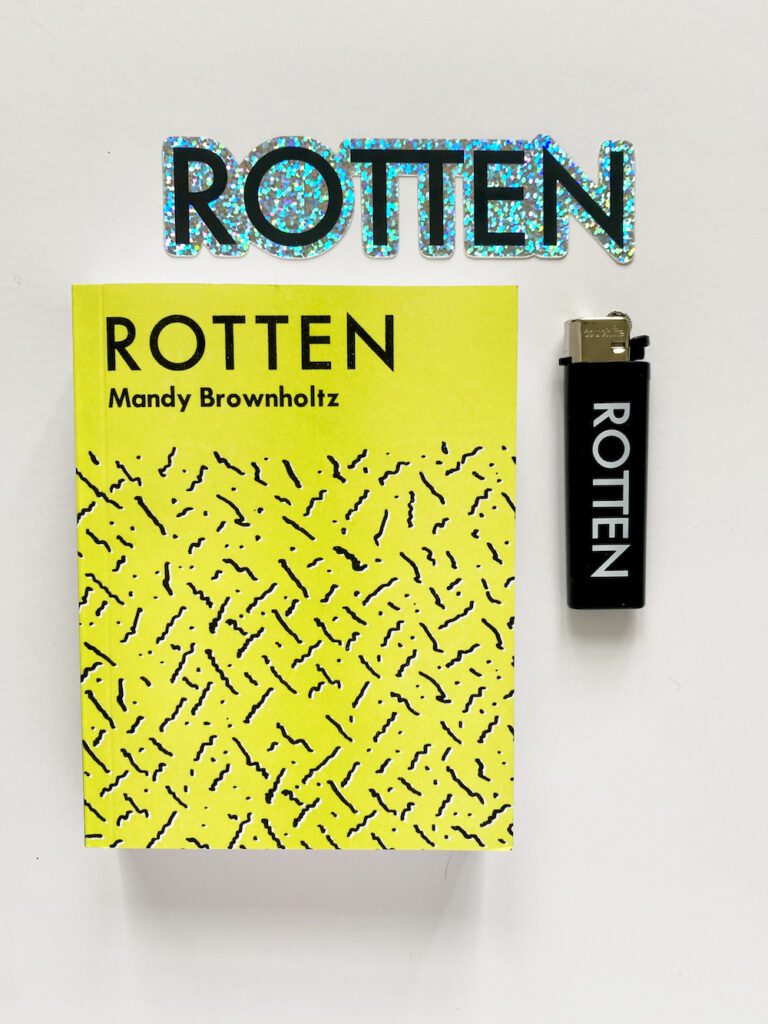
“I’ve spent my whole career promoting other people’s work,” says Mandy Brownholtz. “Now I’m in this position where I have to talk about myself and things that I’ve created; it’s this peek into my brain that I’ve never really allowed people to have, and it’s scary.” Brownholtz has certainly been indispensable to us here at Audiofemme, coming on board in 2017 to write album reviews, eventually expanding her incisive music coverage into her role as our Marketing Director after working for some of Brooklyn’s best known concert promoters. But this week, Brownholtz has announced her own epic endeavor – her self-published debut novel Rotten (edited by yours truly) is now available for pre-order, with limited-edition physical copies and some extra swag shipping June 22.
“This book is very, very personal to me, and the fact that I’m putting it out in the world for everybody to consume and have opinions about, it’s a lot of nerves,” she adds. “But nerves indicate that what you’re doing is important and that you care about what you’re doing. Nerves are a good thing.”
Rotten is a story that’s overdue to be told in fictional format. Set in Washington DC’s DIY scene – the same scene where Brownholtz came of age and cut her teeth in the industry, working at the legendary 9:30 Club – the story centers the experiences of freelance writer Viv Taylor, a hapless, haunted early-20-something tasked by City Paper with chronicling the history of Fort Rotten, the kind of party house that anyone who’s been to a basement show anywhere in the United States will recognize. But she has a complicated history with the venue and its residents – including one who sexually assaulted her during a night of hard partying. Grappling with the trauma of that event in a series as flashbacks, as well as the difficult childhood that led her to seek out “people who smelled bad and wore leather in ninety degree weather; ones with pieces of metal lodged in their faces and relentless tinnitus,” there are simply too many women who will find Viv’s story relatable, even if the specific setting is new to them.
“I wanted to write this book for women who have experienced these types of things. I wanted them to feel seen and I feel like I’ve succeeded in that, because almost every woman I know has a story like this and every woman I know that’s read it has been like, this really spoke to me and it resonated with me,” says Brownholtz. It’s been through many iterations – the setting evolved from a webseries she was working on in an MFA screenwriting class, and in its first form as a novel was more conceptual, examining the illusion of choice for women from all walks of life in a country that had just elected Donald Trump.
“I was mad. Everybody was mad; there were like five million things to be mad about. But I wanted to examine what choice and consent really mean when you’re making a choice based off of these circumstances that oftentimes you have no control over,” Brownholtz recalls. “And what really kind of put the idea in my head was that after Donald Trump became president I went and got an IUD, because [women] were like, ‘We’re all gonna lose our birth control!’ And the IUD was not good for me. I went and did this thing that I didn’t really wanna do, I made this ‘choice’ that I didn’t really wanna make, because I thought that I didn’t have a better choice.”
Combining these ideas, and interrogating free will from the perspective of a vulnerable young girl exploring her city’s tight-knit DIY scene, proved to be a perfect vehicle for Brownholtz to introduce herself as a novelist. Building on her own experiences and that of friends adds a layer of authenticity and dark humor to the accurate portrait she renders in Rotten – not just of the DIY scene itself, but also to the archetypes that populate millennials’ lives.
“I wanted it to be as much about what it feels like to be in your early twenties right now – the sexual politics of it, the confusion, and our struggle to communicate in a good way – as it was about heavy #MeToo stuff,” Brownholtz explains. And if you’re a Boomer who’s never been in a basement mosh pit, well, “that’s what fiction’s about – transporting you to a world that you normally wouldn’t have access to.”
Brownholtz doesn’t see DIY scenes as inherently predatory, though she certainly recognizes that some aspects of the lifestyle can lend themselves to problematic situations just as easily as they can uplift otherwise lost souls. “It’s more intimate. It’s people who know each other very well, it’s relationships and friendships, it’s small and close-knit,” she says. “You’re paying with a crumpled five dollar bill at the door, and it’s about supporting bands that are traveling. It has this heart to it that’s a little different than the corporatized music industry machine.”
Last summer, everyone saw the flipside of that when the Instagram account @lured_by_burger_records outed the wildly popular SoCal tape label/record store as a predatory institution that had harmed dozens of young girls, either through grooming, gatekeeping, or outright assault (in the aftermath, Burger Records folded). Teenagers can hardly be blamed for failing to recognize that the subculture niche they’ve discovered can turn into a trap just as easily, particularly when drugs and alcohol are involved. Though some might feel capable of engaging with adults, the situation can change rapidly or evolve into trauma over time, once they begin to reflect on those years with some maturity.
“When I was seventeen and going to shows in places like [Fort Rotten] and hanging out with people who were a couple years older than me, I didn’t think anything of it. I was like, I’m an adult, I’m grown up. But then you get older and you’re like, wow, it was like mad inappropriate that I was hanging out – I was seventeen, I was a kid!” Brownholtz says. “I think it’s important that young people [have access to DIY] communities because I don’t think I would be the person that I am today if I hadn’t. But we have to somehow achieve this balance between welcoming younger people and making sure that people are not taking advantage of them.”
While the sense of community and creative energy a DIY scene fosters can be positive for the many, it also serves to obfuscate abuse – or potential for abuse – only discussed in whispers, and its perpetrators rarely suffer consequences, especially if they have clout. “It’s uncomfortable for men to have to disrupt their business arrangements, whether it’s something as legit as the Bowery Ballroom or some shitty DIY venue. It’s like, that guy is important, he’ll book my band, so I don’t wanna cause any strife with him – he’s only ever been nice to me,” Brownholtz says, adding that another function of Rotten‘s narrative, hopefully, will be creating insight and empathy in men.
“This book gets pretty cerebral and it’s pretty much in this girl’s head and you’re really seeing her anxieties and her fears and reservations about things,” she says. “I wanted them to see how damaging something can be, that they might think is kind of innocuous, just a ‘misunderstanding.’ It wasn’t a misunderstanding to her, and it’s gonna haunt her for fucking ever. I want them to get in the headspace of understanding that.”
That understanding needs to happen, Brownholtz says, because “men are the solution moving forward. Women getting angry is not gonna do anything but make men defensive. It needs to be men calling out their fucking friends when their friends do disgusting shit or say disgusting things. It needs to be about men shaming other men into line. That is gonna be the saving grace of the music industry.”
Viv Taylor may not be a sympathetic character to all, and that’s what Brownholtz intended. “I wanted her to be imperfect and I wanted her to be, at times, unlikeable. I wanted her to make bad choices because I wanted to show how so many things in our lives that are formative to us are things that we have no control over, like who are parents are, what our family is like, all this stuff. All of those things cause the wounds that cause you to seek out problematic people, that put you into these kind of situations,” Brownholtz says. “I also wanted to emphasize that just because she does kind of suck sometimes and makes bad choices, it doesn’t make her any less deserving of being believed or respected.” She never places the blame on her narrator’s shoulders; instead, we see an arc that turns her from a victim to a local hero as she gains back some of her agency from her abuser, her family relationships, and her friendships to emerge with a more holistic view of herself.
And ultimately, that’s Brownholtz’s personal narrative as well; after small publishers gave positive feedback, but balked at the touchy subject matter, she decided to self-publish. “I was shopping it around and then the pandemic hit,” she says. “It’s hard enough to get a book published as it is – most publishers only put out a couple titles a year. Even if I had gotten in at a small independent publisher, it might not have seen print until like, 2022 or 2023. I’d been working on this book since 2017, and I was like, you know what? I’m just done.”
She enlisted Jonny Campolo (a musician and designer she’d worked with at PopGun Presents, but never met) to put the book together while they were both out of work during lockdown. “Jonny and I shared a very unique vision; since it’s such a small run of books, we wanted them to feel like a nice object, like an art book. It was kind of cool to do it that way because it made it more personal and unique than just using the Amazon self-publish tool,” she says. “I’ve had a couple people be like, I wanna write a novel, and it’s like, okay, so fucking do it. That’s all that writing is – if you sit down and do your pages every day, you’re a writer, even if nobody has published it or read it. It took me a long time to be comfortable referring to myself as a writer because it seems so lofty and kind of silly, but then like it got serious and was like, no, that’s what I do right now. I kind of feel like I’m like bludgeoning myself to some sort of relevance, because I don’t have the MFA or the ‘right’ connections – I’m just sort of forcing my way into people’s heads and making them pay attention to me.”
“Self-publishing was mostly just a result of me getting tired of waiting for someone to give me permission. And tired of waiting for someone to tell me that I’m good enough,” she adds. “I realized that printing a book costs less than pressing a record, and bands press records all the time with no institutional help. More people should just publish their own books; it’s not cheap and I don’t expect to see a complete return on investment. This was an investment in myself, honestly, and it was an investment in my community too.”
The members of brand-new Detroit trio decliner can’t decide if they’re a punk band or not. “I don’t consider decliner punk,” says bassist and beat-maker Steve Stravropoulous. “I think there’s a difference between Tim and I because Tim thinks it’s a punk band and I don’t… the more he thinks it’s punk the more I try to make it not that.” Genre label aside, the group – made up of Stavropoulous, Rob Luzynski (vocals), and Tim Barret (guitar) – certainly embodied the punk lifestyle whilst making their debut EP, Remember, out today on FXHE records.
The recording process, which is generally known to be long and arduous, took decliner about four hours and was produced and engineered by notable Detroit producer and techno artist Omar S, aka Alexander Omar Smith. The experience boiled down to two distinct lenses for the members of decliner. “I was drunk and having fun so I wasn’t stressed,” says Luzynski. “I was drunk and stressed,” adds Stavropoulous. The stress element was mostly due to the shock of the fact that the band was actually recording. They went into the session with the idea that they were going to show Smith a couple songs, see if he liked them, and leave. Instead, they went in, recorded one track of each song live to a Tascam 16-track recorder, and had an EP. “I was like, ‘damn, I’m not sure how I feel about this,’ because it’s just not how Steve and I usually work,” says Barret.
Without the ability to add overdubs or edit the tracks after the fact, the band had one shot to get it right, and they laid everything on the line. “You can hear in some of the tracks that my voice is giving out basically,” says Luzynski. “Like, in ‘Know,’ that’s me almost passed out…like I almost passed out from doing that.” For someone whose entire musical career up to this point has been making rap music, it makes sense that Luzynski felt winded after a few hours straight of deep, guttural singing. But despite that it was his first time dabbling in this uncharted vocal register, Luzynski’s disquieting vocals sound like they’ve been brewing in the depths of his soul all along, waiting for the right time to come out.
On “Burn,” the first and only single from the EP, decliner encapsulates the isolation of dead winter and the destructive paths we can go down to try and escape it. Barret’s whirring guitar and Stavropoulous’s unabating bass-line paint a vivid picture of quotidian mundanity. January in Detroit, when this EP was recorded, is always one of the most desolate months, especially during a pandemic. Plagued with iced over streets and sparse sunlight, a stillness sweeps over the city, making it easy for loneliness to make its bed in your home. Luzynski captures this bleakness with his blunt lyricism: “Man this weather’s really something/I can barely feel my face/I keep falling, someone catch me/Before I go up in flames.”
Luzynski explains that the song is a capsule for how he was feeling at the time they recorded, and also serves as a vague warning for the things that lure us in at times of darkness. “It’s thinking about the moth to the flame… things that can save you but also be your demise,” says Luzynski.
The video for “burn,” out exclusively via Playground Detroit last Friday, personifies this sentiment without allowing the band to fall too deep into despair. It starts by introducing the band hanging out in an attic, getting ready to record. Luzynski drinks a mysterious liquid and is transported into another realm, presumably by the UFO that makes frequent appearances. In this barren realm, Luzynski is found alone and desperate, climbing to nowhere and constantly being set ablaze. It honestly just kind of seems like an acid trip gone terribly wrong. But we find moments of levity when the camera pans back to the attic, watching the band play while Luzynski sits in a trance state, or finding the friends clinking beers on a sunny day. These brief moments of reprieve serve as a reminder that the dark times don’t last forever.
In that same vein, decliner don’t aim to take themselves too seriously. As musicians with multiple projects, the artists started decliner more or less on a whim, prompted by a few texts from Omar S. “Omar was texting me like, ‘I wanna record your band,’” says Stavropoulous, “and was simultaneously texting Rob, ‘I wanna record your band.’” Luzynski adds, “We didn’t have a band yet.” So, the two thought it was the perfect opportunity to join creative forces, because when Omar S. says he wants to record your band, you show up with a band. The preparation for the actual session was minimal. Stavropoulous and Barret had skeletons for the tracks and thought that Luzynski’s energetic stage presence would be a good match. Again, having only used his voice for rapping previously, it was a bit of a process for Luzynski to finalize his vocal style. But he had Smith to guide him in the right direction. “He said ‘I want you to sing like you’re watching your house burn down or someone just put out a cigarette in your eye,’” remembers Luzynski.
Up to the challenge, Luzynski said he used his trademark method of “kush and push” – smoking a joint and doing some push ups – before recording, and it more or less worked out. “I totally did push ups in Conant Gardens party store to get ready as I was relatively inebriated on PBRs,” says Luzynski. His straining vocals make a novel pair to the undulating instrumentation and four on the floor techno beats, marrying the sensation of dissociating at a basement rave with the relentless energy of moshing at a hardcore show. The group describes the project as an “exploration of sound” that pulls from their varied musical backgrounds. Put simply, Stavropoulous adds, “We’re just dumb boys doing our thing. We’re doing our best and we’re gonna try.” Sounds pretty punk to me.
Growing up in the musical melting pot of the Bay Area, neo-soul singer-songwriter Simha gained an ear for both western and eastern musical influences. He seamlessly weaves elements of the Indian classical music of his heritage with jazz and soul sounds, the result being a lush, ethereal vehicle through which he expresses his emotions. He premieres single “Losing Focus” on Audiofemme today.
The song deals with the idea of “imposter syndrome,” a term that’s entered the popular lexicon to loosely mean doubting your abilities and feeling like a fraud. Simha says that for himself, it manifested as “feeling like doing music was not really something I was good at.” Collaborating with others in the past has helped keep that feeling at bay, but the pandemic forced him to adapt, to look inward and write alone. Though his imposter syndrome initially saddled him with a bad case of writer’s block, “Losing Focus” helped him dig out of it.
“I ended up writing the whole song by myself, and it was a lot of just sitting with myself, and trying to be as honest with myself as possible,” he says. “I still deal with it…but I think now rather than it being, ‘Oh no, this isn’t good enough, no one’s gonna like this,’ it’s more leaning into it and just saying, well maybe the fact that I feel insecure about this might change something about the way I write, or create something new in the music that might capture a different feeling for me.”
And it worked! The solitary time helped Simha to dig into his roots in Indian classical music in a way he hadn’t before, inviting his mother to play the tabla, an Indian percussion instrument, on the track. Simha’s mother had enrolled him in Indian classical music classes as a child and practiced with him at home, but collaborating together as two adults was a new experience for them both. “Being able to recreate that experience [of making music with my mother] was really important for me, because it pulled me back to the idea that music isn’t just work for me, it’s fun for me, you know? It’s something that really grounds me to my heritage,” he explains. “We were charting new territory together, and it was really fun, because I think she also discovered new things about herself when it came to her creative process and her expression, just this new thing she’s never done before. It was really insightful and really a beautiful process.”
The result is profoundly unique. The tabla rhythms weave in with jazz and soul sounds, all layered under Simha’s smooth vocals and deeply personal lyrics. A lifelong fan of jazz, soul, and neo-soul, he lists Donny Hathaway, Stevie Wonder, Lianne La Havas and Erykah Badu as major influences. They all shine through, but spliced with Simha’s beautifully intentional cultural injections it becomes something all his own.
He’s working on an EP to hopefully drop late in the summer, and seeking opportunities to perform outside under remaining COVID restrictions. As a queer artist of color, he says that the “biggest thing for me on this EP, that drives it, is mental health, and specifically mental health awareness for queer BIPOC in the music industry.” The EP will emphasize these themes, and while he works on it, he’s collaborating with artist Emma Timberlea Brown (who designs his cover artwork as well) and an organization he started with some friends called The Humxn Collective to drop a merch line where 50% of proceeds will go to an organization that connects queer BIPOC creators with therapists in their own communities. “I’m really excited about that because the biggest thing I really want to do with this project is give back to the community that has basically raised me,” he says. “For the longest time, if it wasn’t for this community, I would be so lost. The influences I get, the support that I get, is really through how tight-knit this community is. I can’t stress that enough, and I’m really grateful for it.”
There’s no doubt that Simha’s community plays a role in quashing that pesky imposter syndrome by allowing him to see the beauty he is capable of offering to the world. He notes that “there’s so much amazing art that has come out during this time, which has been inspired by so many different things, so it’s really beautiful.” Simha’s art was part of this, and even if he doesn’t always see it, it matters.
The past year has added deeper dimension to that old adage about making lemonade. In other words, life has thrown a lot of lemons our way since last March, for better or for worse, and what to do with them is up to you. Such was the case with Rachael Pazdan and Loni Landon of Four/Four Presents, a new NYC-based curator platform that seeks to bridge the gap between the live music and high-art dance communities through linking independent musicians with seasoned dancers to create collaborative performances. What began as a live venture pre-pandemic quickly pivoted to accommodate our new style of living with recorded video performances, and is slowly transitioning to a live performance model that meshes with our new normal.
Their combined experience, long friendship, and well-earned clout in their respective industries intersected to make them the prime candidates to take on such a challenge – in general, live music and dance are both separate, niche communities. Pazdan danced growing up, and though she still considers it a passion, she is best known for her work in NYC’s live music scene. She’s worked as both an in-house talent buyer at venues like LPR and The Bell House and a freelance events presenter in her own right, producing The Hum, a concert series celebrating female and gender-nonconforming artists. Landon is a Juilliard-trained dancer and highly sought-out choreographer, having produced work for The Joyce Theater, the American Dance Institute, and more. Prior to collaborating with Pazdan on Four/Four, she co-founded The Playground, an initiative designed to give emerging choreographers the space to experiment while also allowing professional dancers to participate affordably. In other words, these are two women passionate about entrepreneurship in the arts and celebrating female and otherwise marginalized creators, themes central to Four/Four’s mission.
The name comes from the 4/4 time signature, something utilized by both musicians and dancers, to further emphasize the pair’s shared vision. “We wanted to create a space for dance and music to co-exist in a contemporary, cool way that’s not on like, a Proscenium stage, that’s not at Lincoln Center,” Pazdan explains, add that the end goal here is “making dance way less esoteric and super-accessible in the way music is really accessible. The thing I’ve said a few times is that we want people to watch dance the way they listen to a record.” And while they seek to make dance something less intimidating to outsiders, they also want to introduce dancers to new music, combining these separate audiences into one larger, more supportive arts community. “It’s connected us with so many artists. I’ve learned about so many new musicians and composers and people, and that’s what it is,” Landon adds. “We wanted to connect people and artists, even if it’s online. I think it’s important that we can create new connections and make new art.”
The concept came about nearly four years ago, when Pazdan and Landon collaborated on an LPR-presented performance by Landon’s company at Knockdown Center. They found a space and began plans for the first live Four/Four event in February 2020 – in the final weeks before our lives changed indelibly into what they are now. Once the lockdown hit they realized they needed to adapt in order to bring their vision to life, or to take these unprecedented lemons and make the lemonade, as it were. They ended up with Tethered, a video compilation of recorded dance performances set to curated music, which they presented projected on an outdoor screen at Public Records in Gowanus this summer. “It was kind of serendipitous because Public Records got in touch with Rachael, and they were moving all their content online,” Landon explains. “There were so many amazing artists just sitting around, out of work, including both Rachael and myself, and we were both like ‘Okay! Let’s just do this!’”
As far as lemons go, the pandemic offered up one unexpected benefit in particular – dancers who would normally be unavailable due to busy touring schedules suddenly found themselves sitting at home, stationary. “So many artists that we were probably never going to be able to get to do stuff were just available, and at home, not doing anything,” Pazdan says. “So we were connecting with artists literally all over the world. We had dancers in Israel, and where else? Spain, Amsterdam, Norway… That was kind of the plus side to the pandemic, that we had access to artists we normally wouldn’t have access to.” And on top of that, they did not have to factor in the exorbitant cost of flying these performers into New York City, a constant albatross hanging around the necks of all independent events producers.
In other words, their optimism in the face of an otherwise hopeless situation is what ultimately made their project a success. They could have sat watching the news in those first few dire weeks of the pandemic, so soon after they decided to move forward with the project at all, and decided it wasn’t worth the trouble. But they chose to think on their feet, combining the best aspects of high art with a DIY ethos to produce something new and entirely unique. They worked together to assemble choreographers and contributing musicians, gathering the music first and sending it to the dancers with some instructions, then collected all the videos, which Pazdan learned to edit and patch together in light of budgetary limitations. “Being a freelancer I’ve learned how to create my own opportunities. You can’t wait for people,” Landon says. “If you want to create something you just have to do it… It’s not going to be perfect in the beginning but you learn by doing and just putting the energy in, you see that energy come out.”
As the weather warms and vaccination becomes available to all New Yorkers, Pazdan and Landon are already making moves for Four/Four’s sophomore summer. In collaboration with Audiofemme, they are producing a series of outdoor events called Open Air: four live, site-specific performances in New York City from June through September of this year. Utilizing spaces like Greenwood Cemetery and Brooklyn Bridge Park, among others, these events will bring to life – quite literally, as they are live events! – the original shared vision of Pazdan and Landon. They will be free to the public in line with Four/Four’s mission of creating accessible, equitable, and joyful events for everyone. Each performance will begin with a traditional music set, followed by a presentation from the choreographer and dancers, and conclude with the premiere of a new, original collaboration between both.
Ultimately, they want Four/Four to work with music and dance presenters alike, an unprecedented intersection of these communities. As we enter the New Normal of live performance, it would seem there’s no better time to challenge our perceptions of what live entertainment can be.
There’s a running gag that Tristen likes to close out her shows with: “If you need advice, I’ll be at the merch table.” As someone who studied relational group and organizational theories of communication in college, the parting line is less of a joke and more of a sincere offering to fans; Tristen is a devotee of psychology, admitting that she often plays the role of therapist in friendships. She even hosts a segment called “Dear Tristen” on Partners in Crime with The McCarltons, a radio show hosted by fellow Nashville residents Vanessa Carlton and Carlton’s husband John McCauley. Her interest in the human psyche is an extension of the thought-provoking paradigms she presents through her music, exemplified in her new song “Wrong With You,” from upcoming LP, Aquatic Flowers, out June 4 via Mama Bird Recording Co.
Tristen tells Audiofemme that she was intrigued by the concept of someone being attracted to a mess they can clean up, the cycle of “liking someone less the more they like you because you, underneath it all, have a self-hatred that makes you suspect something’s off if somebody would like you.”
The song’s defining line, “there must be something wrong with your for loving someone like me,” which reprises twice in the chorus, is inspired by a real-life argument from a friend’s toxic relationship. The line stuck with her for years, and eventually Tristen built a song around it – one that happened to align perfectly with the themes on her fourth album, the follow-up to 2017’s Sneaker Waves.
In the video for the song, premiering today exclusively with Audiofemme, the singer takes to the woods in a vintage wedding dress. With tear-stained cheeks, she walks alone in the lush green forest, her train dragging in the mud and getting caught on the branches as she slowly strays from the path. “So deep are the grooves/I’m sinking into/No love could ever wash away,” she sings, shooting dramatic looks at the camera all the while.
“I don’t necessarily try to define myself through my music,” Tristen shares. “I do take first person a lot because I see myself falling into the same mistakes everybody makes. I think that a song is worthy of writing when it’s something that I feel like people can relate to…and it’s common enough so you can distill some behavior or pattern or trait.”
The 11 tracks that comprise Aquatic Flowers resonate on varying psychological levels. The singer spotlights a frustrated emapth on “Die 4 Love,” while the character in “I Need Your Love” has taken many partners, yet longs for the feeling of falling for someone. Meanwhile, “Hothouse Flower” follows a comfortable and privileged artist who is ironically envious of others’ artistic suffering. “I do believe that everybody has these range of emotions whether we were taught to avoid them or we don’t acknowledge them,” Tristen observes. “Part of the enjoyment of writing, for me, is that you can relate to people by pointing out some kind of behavior pattern.” She will celebrate the release of Aquatic Flowers with a livestream on June 11 at The 5 Spot in Nashville. She’s also slated to appear alongside Kesha’s mother, songwriter Pebe Sebert, for a music and motherhood Q&A on Twitter Spaces on May 9 at 9:30 p.m. ET, where she’ll likely dispense more sage advice.
Tristen’s psychological approach to the music process has made for some interesting songs, but it’s also in her nature to want to help those who are struggling. “I feel like I have a hopeless optimist in me, like we can solve that – there’s a way to solve it with creativity,” she says. “The problems are fun. I think that there’s underlying patterns happening for everybody’s problems and there’s ways to pick them apart. For me, writing songs is a way to analyze things and put all that thinking energy into lines and soft words, and then the melodies and the music and all that is easy for me.”
In her daily life, Tristen dedicates herself to saving vintage clothing via Anaconda Vintage, the Nashville shop she runs with her sister. In her songs she captures characters with individual flaws that all embody the human experience in their own unique way. Both reflect Tristen’s desire to fix what feels broken. “I don’t really take a lot of responsibility for the writing and the music. I feel like it just happens and it’s a very natural, untouched thing for me. I have worked really hard to keep that untouched,” Tristen says of her artistic process. “I keep it pure.”
Anita Lane was an exceptional talent – a songwriter, a singer, a creative powerhouse. The greatest pity of her lifetime and now, after her passing, is that she is often referred to only in relation to the men she co-wrote and duetted with, but in the interests of karmically restoring the universe to rights and doing justice to Anita’s legacy, here is why you ought to spend a few hours at least indulging in her prolific work.
Born in March, 1960 in Melbourne, Lane was clever and musically gifted. While a student at the Prahran College of Advanced Education in Melbourne’s inner south, she began writing songs and singing in her mid-teens. This was also where she befriended Rowland S. Howard – the iconic post-punk guitarist most commonly associated with The Birthday Party and The Bad Seeds.
Still a teenager, Lane met Nick Cave in 1977 when he was fronting The Boys Next Door, a seminal Australian post-punk band featuring Cave’s schoolmates from Caulfield Grammar: Mick Harvey on guitar, Tracy Pew on bass, and Phill Calvert on drums. The two began an on-off romantic relationship that lasted another 10 years, but it was their powerful co-writing relationship that was epic and memorable. The following year in 1978, Lane’s schoolfriend Rowland S. Howard joined the band on lead guitar and, riding the popularity of post-punk, frenetic guitar and furied lyrics over immense walls of feedback fuzz, the band moved to London in 1980, freshly renamed The Birthday Party.
Their debut 1981 album Prayers on Fire featured “A Dead Song,” co-written by Lane and Cave. She also co-wrote “Dead Joe” and “Kiss Me Black” on their sophomore album Junkyard(1982), released the same year the band and Lane moved to Berlin just before breaking up in 1983.
“Kiss Me Black” epitomises the best of The Birthday Party – clattering percussion like starving cats released into a drum set, Cave’s gothic baritone shifting between hollow cries and frenzied, almost shouted pleas and accusations. Chugging bass drives the whole bloodied, brilliant body of a song while snaggle-toothed guitars take savage bites into the melody.
Lane went on to join Nick Cave and the Bad Seeds on keyboards and vocals. The band comprised ex-Birthday Party member Mick Harvey, Barry Adamson, Hugo Race and Blixa Bargeld. Most notably, she co-wrote the beautiful, tragic “From Her To Eternity,” also the title of the band’s 1984 debut album. She left the band soon after, but would continue to co-write with Bargeld for both the Bad Seeds and Bargeld’s other band, Einstürzende Neubauten. She would later feature on Einstürzende Neubauten’s sixth album Tabula Rasa (1993) both as a co-writer and vocalist on a couple of tracks, including “Blume.”
In 1986, she co-wrote “Stranger Than Kindness” with Bargeld, which appeared on Nick Cave and the Bad Seeds’ Your Funeral… My Trial. It is a glorious, jangling, delicate beast of a song that reveals the significantly mellowed yang to The Birthday Party’s frenetic yin. The same title was given to an exhibition of Nick Cave’s life and work in 2020 and to a book released to align with the exhibition.
In 1988, Lane sang vocals on the soundtrack to Australian gothic western movie Ghosts…of the Civil Dead, which Bargeld, Cave and Harvey scored. The same year, she also provided vocals on the German post-punk band Die Haut’s Headless Body in Topless Bar album. She’d also duet with Kid Congo Powers on Die Haut’s Head On album of 1992.
One of her most wonderful collaborative outings was with Mick Harvey on his Serge Gainsbourg tribute album Intoxicated Man in 1995 and again on his second Gainsbourg-inspired album Pink Elephants in 1997. She sounds so gorgeously young and louche on “Harley Davidson” when she claims to be a “hell hound.” “I don’t need anyone on my Harley Davidson,” she sings, “If I die tonight, it’s my destiny, I’m alright.”
All the while, Lane had been in the process of recording her debyut solo album; Dirty Pearl was released in 1993 after a decade in the making. It opens with another devastating and beautiful Harvey co-write, “Jesus Almost Got Me,” a divinely gothic ballad in which the country-folk guitar is tempered by solemnly poetic lyrics (“Love is cruel/Love is truly absurd/Jesus almost got me/I don’t know how many prayers he overheard”).
Four of its tracks were originally released on a 4-track EP called Dirty Sings in 1988. Adamson, Cave and Thomas Wydler (of both the Bad Seeds and Die Haut) perform on these, along with Mick Harvey, who also produced it. She sounds breathy, sad, like there’s only a thread holding her to this earth and yet, there’s something primal and sacred in her shameless femininity. Even surrounded by men, or perhaps because she is, she embraces the elements of girlhood and womanhood in her voice, her writing and her videos. One moment she is delicate and complicit, the next she is scarily knowing, determinedly solitary.
The album also features her solo versions of some of her best co-writes, like “Blume,” along with a brilliant, quite creepy, cover of “Sexual Healing.” You’ll never hear the song the same again; the same is true of her 1991 collaboration with Barry Adamson on their version of “These Boots Are Made For Walkin’.” Anita Lane put an indelible mark on everything she touched.
Her second solo studio album was also produced by Harvey. Released in 2001, Sex O’Clock was a little less jangly, primitive and arty. Instead, it embraced greater melodic hooks and pop elements, though Lane’s deadpan, sardonic approach to lyrics and vocals was ever present. Pop Matters referred to her as “the female Leonard Cohen.” Track names like “Home Is Where the Hatred Is,” “I Hate Myself” and “The Petrol Wife” contrasted with the almost sunny, laidback album cover image of Lane swinging an umbrella as she gazes, smiling, to the horizon.
Lane was a bit of a nomad, as many musicians were in the ‘80s and ‘90s, and still are. She moved from London to Berlin, then later lived in New York and Sydney before returning to Berlin in the late 1980s. She married a German man, Johannes Beck, and had her son Raphael in 1990, before that relationship ended four years later and she moved to Morocco. She had two sons to her Italian partner, Luciano (born in 1995) and Carlito (1998).
Melbourne reclaimed her in 2008, when she returned to live in the suburb of Glen Iris, where she’d grown up. Last year, she moved to Collingwood at the same time that I was packing up to leave it, and remained there until her death in April, aged 61. She isn’t the first nor will she be the last woman to be shrunk down, becoming merely the “muse” to the men around her, but let’s hope, at least in this case, that Melbourne names a lane after her, or erects a statue, or both. Vale Anita Lane.
On her debut EP, I Hate Spring (out April 30th on Arts & Crafts), Toronto-based artist Charlie Houston collects candid thoughts about the vulnerability of growing up and all the in-betweens that come with entering adulthood. The music, although largely undefined by any specific genre, is as tender as the time she’s navigating; each of the songs on the album touches on the experience of learning how to be authentically yourself beyond the confines of childhood expectations.
Houston uses familiar pop formulas that make for easy, fun listening while also sounding fresh and unexpected. She worked closely with producer Chris Yonge to find the right sound for the music, and although Yonge is more heavily influenced by artists like Mac Miller and Juice WRLD, they were able to create a sonic world that is Charlie’s all her own. “I think it’s a hybrid of indie, electronic, R&B, and a whisper of bedroom pop as well. When I’m writing songs I’m thinking more about if it sounds good than if it’s in a specific genre,” Houston says. The production on the album, which utilizes quirky sounds like telephones ringing and curling guitar riffs, leaves room for an unfiltered joy that belies the difficult topics addressed in the lyrics.
While I Hate Spring centers on her personal growth during her first prolonged period away from home – the five months she spent studying at NYU’s Clive Davis Institute – there’s an element to it that speaks universally about difficult transitions, particularly for young people. At NYU, Houston struggled with her mental health while at the same time exploring her sexuality and self-expression; leaving her small town in Canada and venturing into New York, a far more diverse and expressive atmosphere, Houston was given room to break down societal expectations. “I wasn’t around anyone who I grew up with so I wasn’t tied to any person that I was before moving there. In New York I could be whoever I wanted to be even though I was having a hard time 90% of the time,” she says. “I was existing in New York and trying to deal with myself. My sexuality was a huge thing that was coming to play in New York; I had my first experience talking to a girl there. I was very focused on that and exploring that at the time.”
Unfortunately, two weeks into her program, a negative experience with a pot brownie “unleashed this batch of anxiety that I never knew was possible,” Houston says. “People in the past had talked about their anxiety with me, but I never really understood what they were experiencing. I took this edible and it completely ruined my brain – I haven’t been the same since.”
Houston wrote I Hate Spring once leaving NYU and returning home, beginning with “Honey” in the spring and summer of 2019. It utilizes smooth riffs and down tempo percussion to portray the feelings of rejection and yearning. Houston croons, “Fucked up babe when you left/I’ve been calling you’ve been stalling/Because you know/I’m a mess,” exposing the subtle nature of desiring a love interest’s attention while acknowledging you’re not in a healthy place. The rest of the songs deal directly with her experiences, good and bad, at NYU.
“I’ve realized that I can’t write a song about an experience that I’m presently going through. It’s always a retroactive experience I’ve had in the past that I’m then writing about,” she explains. “19,” the focus track from the album, epitomizes all of the delicate experiences of being young and unsure. Opening the song with slow and smooth guitars, Houston describes the experience of feeling alone for the first time up until reaching the chorus: “I’m sure you’ll be just fine is what my parents say/They don’t know what it’s like/19 in modern day.”
The loose sound of the song reflects the recklessness escape she seeks via desire and drink, slurring the lines, “So let’s just go back to the party/Kiss each other like we’ve never kissed someone before/I’m just tryna clear my mind/I’m fucked up/Just enough to clear my mind.” Houston says the track is about not knowing how to deal with all the newness of being in a different environment, surrounded by a diverse array of people while navigating strange and unfamiliar spaces. Her social anxiety is visualized best through the line, “I’m freaking out/Can you tell/My hands are shaking in my pockets so I hide them well.”
Houston references Uber Eats and seeing people’s vacations on Instagram, which places her in a GenZ context, so while there’s certainly a discomfort with online relationships as is portrayed in “Calls,” Houston embraces her audience’s experience with ease. Meanwhile, the artist doesn’t use pronouns for any of the people she’s singing about, giving the songs a more universal relatability. “My main goal for music is to have it be as universal as possible and as inclusive as possible,” she explains, although she does admit that when she wrote the songs, she felt hesitant to explicitly acknowledge her forays into the queer experience.
“I wasn’t ready to sing about my relationships and let people know they were about women,” Houston says. “The songs I’m writing now use pronouns but that’s because I’m at a different place now than I was in then. I wanted those songs to be accurately representative of that time in my life.” As a result, the EP subtly touches on being closeted and not knowing how to navigate the coming out process. “Everyone in the LGBTQ community I think can understand that feeling of gay panic, where you don’t want someone to know you’re gay and you don’t know what to say,” she says. Being in this grey area of outness can be complicated, and making art about it pairs well with the idea of partial adulthood she discusses throughout the album.
Houston has just turned 20, she’s working through trauma and mental health and first loves, and she’s doing so in a world that’s just beginning to make space for voices like hers without questioning their authenticity. It’s not that she outright rejects genre, androgyny, or the use of pronouns in songs; rather, Houston allows the intersectional aspects of her identity to influence her music, embracing an organic and honest process that is authentic to her. Like so many other people of her generation, she displays herself genuinely, and it’s our responsibility as consumers to take her at her word. Charlie Houston asks us to “delete TikTok,” implores us to “do whatever the fuck you want with your life,” and she says she “wants to make music where everyone from a fetus to a 90 year old lady can enjoy it together.”
Follow Charlie Houston on Instagram for ongoing updates.
It’s regrettably easy to get sucked in to the cycle of surface-level validation we get from scrolling through social media – but Eleanor Rose Lee, aka Fever Queen, has a simple solution: “The world’s gone shallow/Find the ones who care.” It’s the opening line of her latest single “Taste of What It Is,” premiering today via Audiofemme. “We live in a time where people are almost praised for being self-absorbed,” Lee points out, adding that the pandemic, in some ways, made everyone realign those priorities. “It becomes very clear what’s no longer serving you and what relationships are deep and meaningful and what are just kinda vapid ones.”
On “Taste of What It Is,” intimacy, vulnerability, and honesty act as antidotes to cure a culture obsessed with self-image. “I wanna know your feelings/Don’t swim upon the surface,” Lee implores in a languid, bewitching tone. She validates the fear that comes along with opening up, but low, pulsing synths give a feeling of sinking into something comforting, the percussion sparse and relaxed. There’s nothing harsher here than a few washes of guitar reverb after the second chorus, most of the sounds a syrupy echo through an icy cavern. Lee’s primary goal was to evoke the feeling of sharing a deep secret with someone, and the metaphor of plunging into freezing water is particularly apt; in both situations, it’s necessary to brace yourself against the frigid shock before jumping in, before you change your mind.
It’s no surprise that the Great Lakes region’s intense winters were a primary inspiration behind the song’s subject matter and sonic palette. Lee grew up in Northwest Indiana, and has called Chicago home off and on for most of her adulthood, though she recently moved to a quaint lakeside town along Lake Michigan. “I feel like the seasons really effect my writing,” she says. “I definitely kept calling this my ‘deep winter single’ before I had a name for it. It’s now spring, but I feel like it’s a good song to thaw out, back into real life, as people re-enter society.”
Indeed, as a newly-vaccinated public sector reunites in re-opened restaurants and bars, we’re likely to skip the small talk, opting instead for candid catch-ups. Fever Queen envisions these moments beautifully in the song’s lyrics: “Like a wave that’s frozen/Thoughts suspended in the air/A language thawing/Words will spill out somewhere.” She’s nervous – we all are – so she “breathes in the salty mist” for a “taste of what it is,” her shimmering vocal overdubs calling back to her like sirens.
Lee says that the song, too, is a taste of what her sophomore album will be like; this is the first song she’s released since putting out her September 2020 debut The World of Fever Queen (via First To Knock, the same label releasing the single). “With the first album, I do feel it’s like a lot of different moods, kinda like a quilt – just a bunch of stuff going on,” admits Lee. “The next record is definitely more of a cohesive vibe, and this song just feels relevant and I definitely think it’s more of a similar vibe.”
The World of Fever Queen toys with off-kilter pop, doo-wop covers, surprising lo-fi rock moments, and even name-drops Phoebe Bridgers on the excoriating “You, You.” But one thing both the record and the latest single have in common are the distinct quality of Lee’s touch – she has a home recording set-up and for the most part, Fever Queen is a one-woman effort, as Lee writes, records, performs and produces with very little input from outsiders. By day, she’s a hair stylist, but once she learned the basics of recording (from a film score producer who lived across the hall from her during a brief stint in Los Angeles), she “started recording and actually building on songs, and at that point I was like, okay I’m never gonna leave my house again – this is so fun!”
Now, she’s living in a “time warp” of a lakeside town, driving back to Chicago two days a week to do hair, and is about halfway toward the completion of the sophomore album on which “Taste of What It Is” will appear. She’s in no rush to get back to the stage though. “I didn’t get to do a release show [for The World of Fever Queen] obviously, which would’ve been fun, but I feel like it also took a lot of the stress away for practicing and leading up to that,” she says. “I think with the next record I’ll just have to go extra big release show wise.”
Follow Fever Queen via Instagram for ongoing updates.
Ashley Monroe and engineer Gena Johnson were sitting on the front steps of historic RCA Studio A, located on Nashville’s iconic Music Row, where the two were recording Monroe’s 2018 alum, Sparrow. Nursing a bottle of Mexican Coke, Monroe handed Johnson her pair of rose gold sunglasses as she told her, “‘the world looks so much better through these. You have to put these on for just five minute and embrace it, take it in.’” Unbeknownst to the friends and artistic collaborators at the time, the seed for Monroe’s new album, Rosegold, was planted. Those seeds come into full bloom this week with the LP’s April 30 release.
Not long after Sparrow was made, new melodies began coming to Monroe’s mind that were a far cry from the traditional country sound the 34-year-old established since moving to Music City from her native Knoxville, Tennessee as a teenager. Intent on creating a “very specific sound” that deviated from her critically acclaimed 2013 sophomore album Like a Roseand Grammy-nominated 2015 follow up, The Blade, the songs took form after she left her record label, allowing her an artistic freedom where she deeply connected to the songwriter within. “Something was inspiring me in the songwriting core of myself of ‘create this feeling that you’re feeling and amplify it and freeze it and reverb it and layer it and harmonize with it.’ I wanted it all to be very different,” Monroe defines to Audiofemme in a joint phone interview with Johnson. “I wear rose gold sunglasses, so I feel like that’s what it feels like when you put this record on.”
Replacing her signature twang with synthesizers and strings and adding pop beats where bluegrass-style instruments used to be, Monroe called upon trusted confidant Johnson to engineer the project. Johnson, whose extensive credits include serving as engineer for Chris Stapleton’s 2020 album Starting Over and Brandi Carlile’s Grammy-nominated By the Way I Forgive You, along with assistant engineer on the late John Prine’s Grammy winning 2018 album The Tree of Forgiveness, made history at the 2021 ACM Awards by becoming the first woman nominated for Audio Engineer of the Year.
Johnson recalls getting a phone call from Monroe early on in the album’s writing stages, and that Monroe described the new songs as “full of joy” and “full of love.” “I was blown away,” Johnson recalls of hearing “Flying,” the first song of the new batch that Monroe sent to her. “I was hooked from the very beginning.”
After penning the songs, Monroe would take them to Johnson’s “lab,” the two spending hours dissecting the songs and adding the right effects to bring them to life. The longtime collaborators trusted the process throughout, allowing the creative energy to take force – like adding a melody to “Groove” that came to Monroe in a dream days before mastering was complete, or Johnson going so far as to purchase new sound equipment to elevate the melodies. They also added little tricks along the way, such as the sound of a camera flashing on “See,” or whale noises layered over a hip-hop beat on “I Mean It.”
Each song was given a treatment that emphasized its meaning; for instance, the pair consciously made “Flying” feel exactly like its namesake when the piano and strings meet the pop bass. “I really work with emotion and experimentation,” Johnson explains of her process. “It was inspiring to be able to go out of my comfort zone and what I wasn’t used to doing as much and really go 100 percent in what feels good and not what it is right for a specific genre. Not having those limitations was epically creative and opened a door for me, too.”
Perhaps just as distinct as the sonic evolution is the lyrical one. Monroe was intentional about leaning into lightness with Rosegold, a contrast to the heartache and sorrow that was wrapped around her angelic voice on her previous records. Many of these darker tales were inspired by Monroe’s real-life tragedies, such as when her father passed away from cancer when she was 13 years old. “My life was bad, and I’m not saying that lightly,” she says with a slight chuckle. “Shockingly, it went from great to bad times, and then I held onto music in a different way.” The East Tennessee native was adamant about making a “joy-based” record this time, a by-product of becoming a mother to three-year-old son Dalton in 2017, whom she was pregnant with at the time of making Sparrow. “I think that my last record opened the door to this new part of me,” she says. “This love switch has been turned on inside of me and set on fire in a sense that I haven’t felt in a long time.”
Monroe brought this joy-based mindset into the lyrics, a direct reflection of the quiet moments she experienced at home with her husband and son during the COVID-19 pandemic, sprinkled like gems across the project. “There were a lot of moments of stillness with the sunshine shining in the windows that I was trying to hold on to,” she details. “Lyrically, I wanted all of the words and all of the things I was saying and all the melodies to line up to take people away and freeze time for everybody for a second. I was hyper-focusing on words and talking about love that also provided the feeling that we were going after, that warm feeling, that moment in time when everything is okay and you’re just drenched in joy.”
Those moments of pure joy shine through in such potent imagery as “you’re a California/Pourin’ that sunshine on my soul” on “Gold” to the love-soaked “I Mean It” where the singer feels deeply present, Johnson purposefully accentuating all aspects of her voice as she sings, “I’d be in the dark without your light/When I tell you I can’t live without you baby/I’m not talking crazy/I mean it/Your love’s the only breath I’m breathing.”
Then there’s the gentle “Til it Breaks” that Monroe wrote with a friend in mind who was going through a challenging time. Though written pre-pandemic, Johnson says she was brought to tears by the encouraging number that feels like a hopeful hand extending through the darkness, as Monroe reprises in a meditative manner, “let it melt away.”
Monroe brings her own inner odyssey to light in the introspective album closer, “The New Me.” Co-written by Monroe and her longtime friend and songwriting collaborator Brett James, she spent hours re-working until her distinct vision was met. “Take a peak inside my soul/All the rust has turned to gold/It’s different now/I can’t wait ’til you see,” she beckons, the eclectic ballad serving as a symbol of rebirth. “It means reborn on the inside,” Monroe says. “Once you truly understand how to love, and the power of love, and once you are humbled by it and surrender to it in a way, you’re a different person.”
It’s no coincidence that an album built on purity and light ends with a choral of angelic vocals leading into the words “I’m alive and on fire/Now that I’m ready to love,” sending the listener out with the chills that Monroe and Johnson felt while making the dynamic project. “We both know what a gift is and what something you’re born to do is, and we both feel like we’re doing what we’re born to do,” Monroe reflects.
“I think setting our intentions and being really intentional about having joy and leading with positivity, and knowing where we’re at and having big conversations and getting in the right mindset, was huge. It’s all emotion to me. Anytime we could get goosebumps ourselves, we knew we were doing it right,” Johnson observes. “The record to me feels like love through and through. From the beginning to the end in different stages, it embodies it.”
Monroe initially believed that Rosegold would only be a collection of five songs. But it later doubled in size to encompass 10 tracks as experimental as the woman who created them, one who embraces the artistic process at every step. “I always like to give people chills. I think that’s a good sign. That means that you’re connected to the spirit when you can supply a set of chills to someone. I wanted all of these to be constant joy chills,” Monroe proclaims. “I felt like it was telling a complete story.”
Follow Ashley Monroe on Facebook for ongoing updates.
In the world of pop music, it’s easy to get put in a category; the “edgy” one, the “hot mess,” the “Queen.” Or, if you’re Karli Morehouse of Grand Rapids indie-pop outfit Lipstick Jodi, the “gay” one. The non-binary songwriter and artist has spent years being labeled and pigeonholed because of their identity and is more than ready to break the constricting molds embedded into the foundation of pop music culture. On their latest single, “Take Me Seriously,” premiering today via Audiofemme, Morehouse brings their frustrations and anxieties to the forefront and gives listeners the chance to do the same. Following the band’s previous single “Notice,” as well as a remix by Now Now, “Take Me Seriously” will appear on the band’s sophomore LP More Like Me, out June 4th via Quite Scientific.
As one of the only openly queer kids in their Midwestern high school growing up, Morehouse has grown accustomed to standing out. And as hard as it was to find people like them in their community, it was even harder to find pop artists that reflected them. Aside from one of Morehouse’s all-time favorite artists, Tegan and Sara, it felt like every big pop star adhered to a very specific set of aesthetic and sonic standards. Nevertheless, Morehouse fell in love with everything about pop music. “This is all I’ve wanted to do since I was a kid,” they explain.
Raised on ’80s icons like Prince, Cher and Pat Benatar, Morehouse’s songwriting is imbued with nostalgic synths and infectious melodies, as is evident on “Take Me Seriously.” Marrying their power pop instincts with a desire for inclusivity, Morehouse’s lyrics are intentionally vague, leaving room for people to imbue the song with their own meaning. “They’re specific to me, but… they’re kind of vague statements that can give whoever is listening something to hold on to,” says Morehouse.
They explain that this elasticity is inspired by seeing themselves and other queer artists get tossed around in an echo chamber instead of breaking through to larger audiences.
“I’ve always found that a lot of queer artists just end up playing to queer people, which is fine,” says Morehouse. “But I wanted to reach across the board and just play to whoever wants to listen.” They explain that well-intentioned playlists and charts highlighting “women in music” and “LBGTQ+ musicians” can further isolate marginalized musicians rather than integrating them into the pop mainstream. “If anyone calls me a ‘female artist’ one more time, I swear to god,” says Morehouse. “Not only am I non-binary, but it doesn’t matter, I’m a musician.”
And as the lead singer/songwriter for Lipstick Jodi, Morehouse flexes their lifetime of diverse musicianship. Aside from absorbing the romance and robustness of ’80s pop, they were interested in piano and guitar from an early age. Their grandfather, a career musician, gave them their first kid-sized piano and encouraged them to explore other instruments. “My mom didn’t want to commit me to anything and make me hate it, ‘cause that’s kind of what happened to her,” says Morehouse.
From there came countless performances, including a LeAnn Rimes cover, forming their first band in ninth grade and hitting up the Grand Rapids, Michigan coffee shop and brewery circuit. They founded Lipstick Jodi back in 2014, but only started honing in on their sparkly, synth-driven sound in the last few years. Starting out, Morehouse was quickly introduced to the closed minds of certain audience members or talent buyers. “They would call us the gay band and the girl band all the time,” they say. “I was just like, good job for recognizing a haircut? I don’t know why you’re upset.”
In “Take Me Seriously,” Morehouse distills a universal angst, applicable to anyone experiencing heartbreak, setbacks or haters. Razor sharp guitars, bold percussion and potent vocals deliver their cathartic message of pain and resilience. “I’m able to put whatever anxiety, whatever depression I’m feeling into a statement,” says Morehouse, “and kind of hide behind it and give it to somebody else.”
Gabby Bianco is exactly the kind of friend you want in your corner – stylish and cool, equally down to provide the soundtrack for a night on the town or give you some pointers on how to make music in your bedroom. And when you need a reality check, she’s the type to tell it like it is, boost your confidence, and help you move on.
That’s the idea behind the LA-based producer’s latest single (released under her eponymous stage name BIIANCO) “that’s what friends are for.” Though she’s lived on the West Coast for over a decade, she still rocks her ride-or-die Italian New Yorker roots, best heard in ball-busting lines like “Screw you ex/He’s a bitch and so are all his friends/I wouldn’t say a goddamn thing to them/’Bout who you are or where you been/Thick or thin.” Atmospheric synths and a slow-burning beat give the track a cinematic, ’80s horror-redux vibe, so it’s only fitting that the video for the track take that motif a step further; in it, she and her gal pals fend off a series of exes who have come back from the dead – quite literally.
But this isn’t just a music video. It’s a music video game. Via BIIANCO’s website, you can test what kind of a friend you really are by helping the characters choose whether to give their exes a second chance, or slay their proverbial relationship demons (the version below is the “winning scenario,” but playing for yourself is much more fun).
BIIANCO had been percolating the idea for a while. “This was one of the first songs I had written and produced and I thought to myself years ago, this has to be a zombie video – like us destroying zombies in slow motion and stuff. But I was like, how do I nail this concept in a way that doesn’t just feel like a cliché horror kinda thing?” she recalls. “At the same time, over the past two years, I’ve watched my friends and also felt myself go through some really toxic relationships and breakups and [seen] people, especially in quarantine, not acting themselves or exes doing horrible things. Everybody has a relationship that ended in a way they’re not proud of – no one’s perfect. People become the worst versions of themselves, almost like they’re fucking zombies or something. It’s kinda this affliction of people just not having basic coping mechanisms in breakups, where no one’s the best version of themselves.”
It’s a salient metaphor, one that makes very clear that we shouldn’t indulge our desires to rekindle relationships that don’t serve us – but it’s a lot easier to make that decision when our exes’ flesh is rotting right before our eyes. Still, incorporating a decision-making element for the viewer felt central to BIIANCO’s concept – even more so as a self-professed “video game nerd” with a penchant for classic RPGS like The Legend of Zelda and Final Fantasy. Working alongside longtime friend and director Scott Fleishman, she combined the nostalgia of Choose-Your-Own-Adventure Goosebumps novels with the modern tech of Black Mirror interactive movie Bandersnatch into an interactive, but streamlined take on the pitfalls of dating, even calling out bi erasure, a subject near and dear to her heart as a gender-bending, queer pansexual femme.
“When we realized what would be required in order to achieve this I was like, holy fuck! We basically shot eight music videos, and had to plot the whole thing out beforehand, and then had to edit eight music videos and code an entire website. It was wild,” BIIANCO laughs. “I’m such an Aries that if anything sounds hard, I probably wanna do it at some point.”
Being a loyal, trusted friend certainly paid off for BIIANCO – pooling her talented circle for everything from direction to motorcycle rental to special effects to building the website that allows viewers to play along, she was able to create what looks like six-figure shoot on a shoestring. “I basically have found myself in this fucking amazing collective of friends, where people are all in the creative industry in some way,” she explains. “Literally my best friend since friggin’ kindergarten is an incredible programmer; he coded the website. He wanted to buy a new motorcycle, so he rented a Ducati for the weekend [but let me] ride it for five minutes for the video.”
By casting her friends and styling the shoot straight from her own closet, she was able to allocate a bigger budget for special effects. “I was like, if we’re doing this, we’re doing this for real, not like shitty Frankenstein makeup. We’re getting makeup artists from The Walking Dead. Everybody knew somebody who was really great at what they did, and it’s such a passion project for everyone that you end up in this really amazing situation where everybody’s willing to work on a budget or work within the confines,” BIIANCO says. “It always goes multiple ways – I’ll help somebody set up their whole tour rig, or somebody will come to me with an idea and want to co-direct something. I try to be as supportive as they are to me. Get you a pod, a group of friends, where you have something to contribute to their lives and they have something to contribute to yours.”
BIIANCO doesn’t stop at contributing to her friends’ creative projects; on TikTok, she offers production pointers with a good dose of her exuberant personality. She started doing mini-lessons on how to achieve certain effects on a whim, but ended up amassing thousands of views, building her audience from there. Demystifying her process as a producer is essential, she says, to getting more women involved in the production side of music.
For her part, she started off as a classically trained pianist, eventually adding singing, guitar and drums to her repertoire before studying film scoring at UCLA. She’d been an early adopter of GarageBand and later, Ableton, expanding to production and musical direction for live shows as a member of Smoke Season. But a women’s Ableton retreat in Joshua Tree changed everything; not only did she meet talented women producers (some of whom, like Madame Gandhi, would eventually become collaborators), but it shifted her perception of herself as an artist in incredible ways and opened up her next creative chapter.
“That was such a pivotal moment in my career because I left that retreat like, I’m a producer, from that moment on. I came out of that like, I have a new solo project, I’m gonna use my last name, and I’m gonna produce everything myself and just lean into that. That was the birth of BIIANCO,” she says. “It’s been a really fluid thought process because it’s all coming from my brain. It tends to be really undiluted and actually very consistent. I’m just going for aesthetics I love. My music is darker, it has some creepy undertones; my aesthetic is darker so that ends up just coming very naturally. It sounds like it’s always in the same world; it’s very easy to write in it and create in it because it’s just basically in my head.” BIIANCO plans to release a mixtape combining some of her previous singles later this year; it will tie in thematically with a book of poetry she published in February titled ThisWill Wreck Your Heart, which centers on unpacking the four stages of surviving toxic relationships.
BIIANCO felt she needed to be “as loud as possible” to get more women involved in production, not only to earn her own respect, but so that other women, particularly younger women, could envision themselves in that role, too. “When I first started producing there was an emotional element kind of like despair, because subliminally and subconsciously, culture and society teaches [women] that’s not really your role,” she explains. “I never even thought about it being a viable route, so I never was in the room at the age of 21, or the age of 16, learning what a vocal chain should look like with a pre-amp and how it goes into a DAW and using an interface. I just realized the gap is so fundamentally huge in experience and it’s because of this very subconsciously perpetuated idea.”
Lately, she’s noticed an uptick – partly due to the pandemic – in women producing their own work, and though that’s heartening, she points out there’s still one huge hurdle for women producers to jump.
“We might have more exposure, but when it comes to money, like when it comes to getting in the room, the labels and the publishers and the big time managers are still fucking choosing the men to produce. I don’t blame the artists, though I hope that the artists start to understand that is where women are completely devoid from the conversation, except when an artist like Taylor Swift intentionally chooses a woman producer,” BIIANCO says. “That’s where the money is, really, like being a Mark Ronson or a Benny Blanco, getting called to do a Selena [Gomez] track. We have placated the issue into thinking like, this is really not that big of a deal anymore, cause don’t you see on Instagram so many women are producers? And I’m like yeah, but they’re not making the same money, they’re not given the same opportunities.”
Just like the no-nonsense advice she gives on “that’s what friends are for,” BIIANCO has a reality check for the music industry. “Don’t think that just because Fader put out a list of the top five women producers to keep an eye on, don’t think just because Grimes has made a couple of records, that you have fixed the problem,” she says. “We are devoid from the conversation in those big money moments. Labels don’t see us as viable options or they just don’t think about it, and that is the next frontier that I think we’re all trying to fucking blow up. Honestly.”
Bella Blasko started her music industry career as a studio intern, but a decade later, she has paved her way as an internationally traveling audio engineer, producer, and mixer, working with some of the biggest names in music. Her approach of intuition and flexibility has led her into rooms recording not one but two records recognized at the 2021 Grammy Awards: Bonny Light Horseman’s self-titled release, nominated for best Folk Album; andFolklore, Taylor Swift’s collaboration with Aaron Dessner of The National, which took home the award for Album of The Year.
Blasko’s accomplishments are particularly noteworthy considering that women only make up 5% to 7% of producers and audio engineers, as reported by the Audio Engineering Society. Throughout the setbacks of 2020, Blasko has remained an in-demand studio wizard nestled in the Catskill mountain region of The Hudson Valley. I Zoomed with Blasko to discuss her humble beginnings, learn some tips, and walk her fantasy-like journey navigating and succeeding in the competitive, male-dominated world of audio engineering.
AF: How did your musical path lead you to the world of audio engineering?
BB: I grew up in New Hope, Pennsylvania, outside of Philadelphia. I started playing piano when I was really young, around six or seven, and then studied classical piano all the way through college. I didn’t really expect to do that, but at some point, I realized it was the thing that I loved the most. I transferred to Bennington College in Vermont my sophomore year, and was interested in taking recording classes with Julie Last. When I met Julie, she was super inspiring to me and made me realize it was what I wanted to do. At the time I didn’t realize having a female role model in that position was so rare. I was so lucky to study with someone I really connected and related to. She made me feel like audio engineering was something I could do, and envision a place for myself in that world.
AF: How would you describe your first professional studio experience?
BB: My first studio internship was at the Clubhouse in Rhinebeck. It’s an awesome studio and it was a really great place to learn and get hands-on work. It can be difficult and competitive getting an actual job out of an internship because there aren’t many positions at a studio, and most artists bring in their own engineers for sessions. The timing worked out for me because an assistant engineer was leaving as I was arriving, so I worked really hard to learn everything so I could take over their position. I also worked at another studio outside of Woodstock called Dreamland. It was a pretty quick transition for me to go from intern to engineer. Being an assistant is all about making things happen the way the artist wants it to happen. You have to learn to be flexible in your approach, while knowing the gear and console inside out. I guess I just learned everything hands-on by paying close attention.
When I was first an intern, I remember going into the studio, seeing a giant patch bay and thinking, how am I going to learn that? What even is that? Early on, I’d stay in the studio after the session and look at how everything was patched and how different engineers or producers would have things routed, then try to study and internalize it. A lot of assistants might just set something up for someone without thinking about why they’re doing it that way, or what’s good about it. It’s so important to pay attention to details like microphone placement, because a slight angle can make a huge difference. Paying close attention over time gave me a set of tools. Once I started running my own sessions, then I could try to figure out from that toolbox, what’s my own style? What do I like? Which sounds do I prefer?
AF: What’s your preferred digital audio workstation?
BB: I primarily work in Pro Tools. That’s the standard in most professional recording studios these days. It’s what I’m really comfortable in and that’s also a helpful part of becoming an engineer, getting really fast and proficient in your program. I also do a bit of Ableton, which I’ve just gotten into more in the past few years when I was helping build some Ableton rigs for live shows.
AF: Can you talk a bit about your work with live shows?
BB: I was helping Aaron Dessner from The National a lot with his band with Justin Vernon of Bon Iver, called Big Red Machine. I designed an Ableton set for them which was interesting because a lot of their work is improvisational, over different sets of ideas and loops. It was pretty fun to work on because I got to design it to be a tool that could help them be creative. The session I built has different tracks on different faders, so Aaron can launch loops at different times and effect them with delays and reverb and filters on pads. It was fun to figure out a way an artist can be engaged with their playback instead of just playing to a pre-recorded track. Once you know a lot of the concepts, you can move back and forth between different audio programs. Ableton makes you think in a less linear way in terms of song structure, which I liked learning because it made me change the way I was thinking. The program led me to not just think in a timeline from left to right, but to think of how you could match different beats and elements that you wouldn’t have thought to put together from different sections, because you’re not looking at it in a horizontal, chronological way.
AF: What do you consider the most basic foundation of audio engineering?
BB: The first thing that comes to mind, that sounds kind of broad, but I think is really important, is the general concept of signal flow. You might learn how compression works, or EQ, these different main elements that we incorporate into manipulating and recording sounds. Signal flow is one of the most important because that’s where it can be easy to get lost when you’re starting off. I think that’s something that people think they can kind of skip figuring out in a really concrete way, because so many things are digital these days, and it makes it seem easy. But when you really have a good grasp on that, then I think you can make almost any setup work, understand how to work in any studio, and be able to move around to any home setup.
AF: Can you talk about your work as a traveling audio engineer?
BB: One thing I love is being able to record anywhere in any setup and not be fussy about it. Before COVID I was on tour for the past few years with The National. We travel with a mobile recording rig in a couple Pelican cases. Just the idea that you can record anything you want, anywhere you want, and with pretty minimal gear, I think that’s really incredible. We’ve ended up recording things that ended up being parts and songs on great records, just backstage at a show, or in a hotel, or any different, weird situation, like the back of a bus or in someone’s office.
AF: What else can you tell me about working with The National?
BB: I love working with those guys so much. I first met them when I was at the Clubhouse probably about ten years ago now. They came in to record their album Trouble Will Find Me and I was the assistant engineer on the record. And they were there for a pretty long time, a couple months I think, and we got to know each other really well. They had some ties to the Hudson Valley, and I continued working on several other projects with Aaron at Dreamland after that. He built a studio in the Hudson Valley, where I work a lot these days. It’s where the Taylor Swift Record was made. I’m the National’s band coordinator and also the touring recording engineer. I don’t do front of house, I do remote studio work because all of the guys have a lot of side projects they work on while they’re on the road. We also record a lot of the live shows, and we’ll set up a studio backstage at a venue or in a hotel room. On tour days where there’s no show, I’ll research ahead of time so we can go into a studio nearby. It’s been wild to end up in studios all over the world on a random day off. I wasn’t super familiar with the band’s music before we started working together, but now they’ve become such a huge part of my working life, and my musical family. I feel like I know their catalogue like the back of my hand now.
AF: Can you talk about your contribution as an engineer on Folklore? It just won Album of The Year at the 2021 Grammys!
BB: The track that I worked on, “Cardigan,” I actually started recording that song idea with Aaron when we were on tour with the National. We were recording backstage in Germany somewhere when he started it, and it grew from that. He’s one of the hardest working people I know. He’s constantly making new music. It’s been really cool to be a part of these different projects that come up working with him.
AF: Can you discuss your work with Bonny Light Horseman?
BB: The relationship with their label 37d03d came through The National, and it enabled me to be involved in a bunch of cool artist residencies. At this amazing 37d03d festival in Berlin, I ended up setting up a makeshift recording rig in a random room where people could just come in to record with me and work on different projects. Out of that experience, the Bonny Light Horseman record started to be made. I’m super excited about it being nominated for Best Folk Album this year at The Grammys. I also contributed some vocals to a song on the record. It’s just super fun to go anywhere, and be in a room recording and find collaborators. And because you can run into different people in different places, suddenly you get new ears on stuff you’ve been working on. Whenever people come and play on things like that it can lead to parts on a track you might not have anticipated before.
AF: Do you feel that being a classically trained pianist supports your role in engineering?
BB: I think my classical background definitely contributes to why I get satisfaction out of being able to make something perfect in the studio. Instead of doing live sound, and problem solving on the fly, I love having the time to try out different microphones and find the perfect one for any given part or voice. I enjoy going down that rabbit hole. I think that’s what drew me in – it probably has to do with being a classical musician, and practicing for hours, really obsessing over one little passage in a piece, or getting the fingering right on just a few measures. That’s contributed to my attention to detail, and feeling at home more in the studio side of things over the live performance world, you know? Being a musician is a big part of what I do, because it informs how I approach things in the studio. It definitely helps to have a stronger grasp on everything that’s going on.
I’m still writing music, and I have an album that I’ve been working on for a while that I’m hoping to release soon. My passion for music never changes, even though sometimes it kind of shifts towards focusing on helping to create and realize other peoples’ visions. I’d say a big part of my approach is just trying to be flexible and musical. Flexibility and vibe is really important to make people feel comfortable. I think sometimes, if you’re in a studio and get too caught up in the technical details, people just aren’t going to deliver in the same way. I think recording should be really fun. I know some engineers try to have a more neutral presence around artists they work with, but I can’t help but be myself in the studio. Anyone I’m working with ends up feeling like such a close collaborator to me. It’s really important to me to create a nurturing and safe environment.
AF: How do you feel the direction is evolving for women in the audio engineering and music tech world?
BB: Being a woman has been a pretty important part of my journey in a lot of ways. When I was first starting to work in studios, I felt like I was really lucky to have Julie Last as a mentor for getting into this industry. But that was rare, and as time passed I didn’t see many other women in studios at all. It made me wonder if there really was a place for me in this world. Early on, I definitely had moments of questioning that. But then seeing that there wasn’t much representation made me realize that that’s why I needed to do it. And that’s why I wanted to work harder to be more successful and be able to create spaces for people who don’t like the typical, kind of more male-dominated studio space that people often think of. I think we need more alternatives to that. I’d love to try to help create those different types of environments where people can have a really safe-feeling space, and just be less intimidated and feel more empowered. I think it’s really exciting to see more and more women getting into music, and I think with the younger generation, it’s becoming more accessible in terms of technology. I see younger women who are not intimidated to walk up to a patch bay and be like, I’m gonna figure this out. Definitely, in touring, I have seen a lot more women working in live sound than I had seen in the studio world, and that’s also really encouraging.
I don’t shy away from talking about the divide because it was one motivating factor for me. And I think it’s not just female artists who want those safer spaces and different types of recording experiences. I think there are many artists who need and want that in studio environments, so it’s definitely one of my personal goals to help create those spaces. If I can be inspiring to anybody else, like Julie was to me – someone who might think, “I don’t know if that’s really a world I could exist in” – just to be able to be an example of a woman doing this job in such a marginalized world, makes me feel happy and proud. I’d love to inspire anyone else to feel they can achieve that feeling.
Like your personal life coach, Audiofemme favorite Madeline Mondrala has returned with a new That Brunette jam called “Capricorn Moon,” and it’s all about rebirth, reframing negative thought patterns, and tapping into creative energy. “The sign of Capricorn is known for its practicality, self discipline, ability to build strong foundations, and impeccable work ethic,” she explains. “New moons mark the beginning of new cycles so I think the combination of those energies in tandem with the state of my personal growth at the time allowed me to see my negative thoughts for what they were; thoughts. It felt like a veil was lifted and I was able to interpret my life and myself from a perspective of love rather than judgement.”
Written during a new moon in Capricorn, and recorded with her friend and producer Ariel Loh (Yoke Lore, Drinker, Cape Francis, Gold Child) at his home studio in Queens, “Capricorn Moon” bursts with positive, motivational vibes. “All I needed was a little time,” repeats That Brunette’s breathy vocals before detailing the steps of her emotional growth: “Excavation/It’s the death of old perception/Took the long way/Wasn’t easy/Trusted in my intuition.”
That Brunette says the song is about shifting your perspective from negative to positive in the wake of a personal failure. “It tells the story of my path to forgiving my past self in order to love my present self. I learned when life pulls you apart, it’s an opportunity to put the pieces back together in a new, beautiful way,” she says.
“It describes a mental shift that took place for me when I decided to move away from self loathing and into self love and acceptance. Something about the Capricorn energy at the time gave me so much clarity and motivation to turn the page and enter the next phase of my life with confidence and joy,” she adds. “When I hear the song it reminds me of how far I’ve come. I hope it can do the same for others.”
Xylophone chimes, throbbing synth, and handclaps give “Capricorn Moon” a non-traditional, organic beat; its meditative moods are driving, rather than calming. “The percussive upbeat energy of the drums propelled the song forward and informed the playful nature of the melody,” says Mondrala. “The song excited us so much that we finished it in only a day or two.” “Capricorn Moon” is the first single from That Brunette’s upcoming EP Dark / Cute, also produced by Loh.
That Brunette is something of an astrology buff – this isn’t the first time she’s looked to the stars for songwriting fodder. As a triple Gemini, she says she engages with the world and with creativity from a heady, intellectual place. “I’m always looking for mental stimulation in the form of wit, humor, originality, or outrageousness. Those preferences make my taste very eclectic and camp, with an undertone of contemplative introspection,” she explains. “I feel that my music totally embodies that vibe. I love to speak truth with a wink. That’s what makes my songs both lyrically interesting and danceable.”
In honor of the release of “Capricorn Moon,” That Brunette put together a playlist for Audiofemme composed of twelve tracks – each one chosen to correlate to a certain sign. For her part, she says, “I think the ultimate Gemini anthem has to be the 1997 hit ‘Bitch‘ by Meredith Brooks. The lyrics ‘I’m a bitch, I’m a lover, I’m a child, I’m a mother, I’m a sinner, I’m a saint, I do not feel ashamed’ embody the duality of being a Gemini.”
Luckily, Mondrala adds, “The people who are closest to me and who I cherish the most are able to handle all the facets of my personality that somehow manage to starkly contrast one another and exist all at once. It can be a bit exhausting sometimes but it’s never dull!”
Charlotte Sands – “Dress”
Inspired by Harry Styles’ Vogue cover, Charlotte Sands went viral on TikTok with “Dress” in December 2020. “The overall vibe of this song along with the person the lyrics describe give me major Aries vibes,” says That Brunette. “It’s super punchy, flirty, upbeat and badass!”
That Brunette – “Platonic”
“I wrote this song about a Taurus in my life who moved to another city,” explains Mondrala. “Their energy had grounded me so much that when they left I felt like a balloon floating out into the ether.” When Audiofemmepremiered this song at the end of last year, she pointed out that “platonic love… can be just as profound and transformative as romantic love” – a message Taureans can certainly appreciate, since they’re ruled by Venus and known as one of the most loyal signs.
girl in red – “Serotonin”
Norwegian singer-songwriter Marie Ulven is brutally honest as she rattles off her darkest urges on her alternative-tinged tune “Serotonin,” co-produced by Billie Eilish collaborator/sibling FINNEAS. That Brunette can relate to girl in red’s almost frightening rawness. “I struggle with intrusive and negative thoughts and when I heard this song I felt seen,” she says. “Since Geminis are so word-oriented, a lot of time our anxiety can manifest itself in words too. It feels like your brain is using its own nature against you. This song embodies that dissonance perfectly.” girl in red’s anticipated debut album if i could make it go quiet drops April 30th via AWAL.
SOPHIE – “It’s Okay To Cry”
SOPHIE was nothing short of a musical visionary, and her fatal fall from a tower in Greece in January 2021 was especially shocking. But the lead single from her first (and sadly, only) proper studio album, 2018’s Oil of Every Pearl’s Un-Insides, provided a powerful, almost prescient message to embrace our most uncomfortable moods. “RIP Sophie and thank you for this beautiful song. It always makes me think of the sensitive Cancers in my life,” says Mondrala. “I’m drawn to their watery emotional energy because I have none in my chart!”
Young Baby Tate (feat. Flo Milli) – “I Am”
“This is the ultimate self-empowerment song,” says That Brunette. “Leos are amazing at asserting themselves confidently. This song helps me get into that manifestation mindset that comes so easily to them.” In fact, the Atlanta-based Tate Sequoya Farris told Rolling Stone that her latest EP, After the Rain (on which “I Am” appears), was written as a way of talking herself through a difficult breakup – so feel free to put it on when you need some affirmation, no matter your sign.
Qveen Herby – “Sade In The 90s”
“I’m allergic to the bullshit,” claims Qveen Herby in her 2018 ode to iconic smooth jazz singer Sade, going on to prescribe orange soda and Deepak Chopra as essentials for her self-care routine. “Virgos are so good at living in the flow,” Mondrala says. “This song is all about filling your own cup and taking good care of yourself inside and out so your light can shine as bright as possible.” Qveen Herby’s “I keep it moving/Put that shit behind me” mantra definitely reflects that practical Virgo nature.
Taylor Swift – “gold rush”
“Libras are my kryptonite – effortlessly cool, beautiful, charismatic, just out of reach,” admits Mondrala. “The person Taylor describes in this song has such Libra energy to me.” Swift characterizes that person as someone that everybody wants on the evermore fan favorite, so much so that she has to remind herself not to be charmed by their magnetism – a trait Libras are definitely known for.
That Brunette – “Coolest Girl”
Scorpios can be very beguiling – independent, emotional, ambitious, and intense, they’re one of the most misunderstood signs, and they actually prefer to remain mysterious. “I wrote this song for a Scorpio in my life,” says Mondrala. “They really are the coolest aren’t they?” That Brunette’s slinky synths meet a surprising twang on the track, almost like the seemingly contradictory characteristics of those Scorpios who always keep us guessing.
King Princess – “Cheap Queen”
The surreal video for “Cheap Queen” tells you everything you need to know about a Sagittarius – their curiosity and quirky sense of humor make them irresistible and fun to be around. Mondrala says, “Listen, Sags can hang! They know how to take care of themselves and those around them. This song song gives off that chill, self assured, yet slightly lonely Sagittarius vibe.” As it turns out, King Princess is actually a Sagittarius – but told Vulture that the song was more an homage to the queer community than an autobiography: “We are all cheap queens. It’s a drag term for someone who is resourceful, who makes something out of nothing, who is a creator on a budget. That’s how I feel.”
That Brunette – “Capricorn Moon”
“This song is all about learning from your past and taking failure as an opportunity to rebuild a better more fully realized version of yourself,” Mondrala reiterates. “Capricorns are masters of practicality. They look at everything logically which can be very helpful when you’re in the process of evolution.” On this song, That Brunette acts as a conduit for that redirection, whispering “Do you feel it too?” like your reliable Capricorn friend might.
Vagabon – “Water Me Down”
Brooklyn singer-songwriter Laetitia Tamko, aka Vagabon, is a bit of a kindred spirit when it comes to pulling inspiration from the zodiac; she opened her 2019 self-titled debut with a track called “Full Moon in Gemini.” Also from that record, “Water Me Down” hinges on the indignation of being misunderstood – a definite Aquarius trait. “Aquarians do not compromise who they are for anyone,” says That Brunette. “This song has a subtle strength to it that definitely reminds me of Aquarius people in my life.”
Olivia Rodrigo – deja vu
The latest track from “the Pisces queen herself” packs all of the emotional punch Rodrigo’s sign is typically known for. Pisces often fall fast and hard when it comes to relationships, and can have a hard time letting go. Telling the story of an old flame who has moved on to a new relationship only to go through the same motions with someone oddly similar, “deja vu” seethes with heartbreak and bitterness. But belting “So when you gonna tell her that we did that too?” – maybe while driving through your exes’ suburb – is perfect for indulging in a little Pisces-style catharsis.
In a time when Taylor Swift is in the midst of re-releasing her entire catalogue, nostalgia is reigning supreme. Millennials long for the days of screaming “Love Story” with the windows down on the way to soccer practice or crying into their diary to “You Belong With Me.” Let’s face it, high school sucks, but it’s looking a lot better than most of our current situations. Toronto-based duo Babygirl harnesses that same raw Y2K teen pop magic on their debut EP, Losers Weepers.
Kiki Frances and Cameron Breithaupt bring combined influences of Hillary Duff, blink-182, Kelly Clarkson and Alvvays to create self-aware underdog pop for the angsty adolescent in all of us; although their melodies are soaked in nostalgia, their lyrics contain a contemporary exhaustion that feels all too familiar. “Nevermind” encapsulates the residual saltiness that comes with the aftermath of a one-sided relationship. Frances sings, “Thought we were both in the deep-end/But you’re only in town for the weekend,” capturing the non-committal aura surrounding most people in their 20’s. The sun-drenched chorus feels like the sonic child of Sheryl Crow and Avril Lavigne, reminding the listener not to take anyone or anything too serious. “We made an effort to offset some of the bummer lyrics by making the productions playful and sweet, almost hopeful. We always want to make it feel bittersweet,” says the pair.
While most of the songs hover around the context of love lost or found, “Million Dollar Bed” also incorporates a reflection on the futility of chasing money or fame in search of happiness. The lyrics paint a picture of a heartbroken soul replacing love with possessions: “Chasing a daydream to forget we ever happened/Pretty distractions/I’ll be happy when I have them.” This is a deeply relatable sentiment for someone (me) who has turned to online shopping as a coping mechanism during the pandemic, hoping the next box will be the one to restore peace and balance in life.
There is not a line on this record that isn’t perfectly crafted to stick to your brain like that awkward thing you said in 2007. It makes sense, then, that Frances and Breithaupt met in music school and bonded over their obsession with making top 40 music. “We had similar tastes when it came to pop music and that made us want to try working together,” says Frances. “We were just like, how do we write a hit song? You seem to care as much as me. Let’s figure it out,” adds Breithaupt. The band explains that they have to agree on every part of a song for it to make it out of demo-mode, which makes for a long and sometimes arduous writing process. But despite their calculated approach to writing, Babygirl’s songs don’t come off as try-hard or cringe, but more like a conversation you’d have with your best friend, or yourself.
In “Today Just Isn’t My Day,” Babygirl presents a familiar internal monologue — “I’m all out of steam/I’m all out of weed/Today just isn’t my day.” The song allows the listener to stew in self pity while reminding them not to stay there forever. Simple guitars, percussion bells and wells of strings keep the song from feeling too dark, like laying in bed all day in a sunny room. If the band’s organic arrangements set them apart from most modern popstar hopefuls, their intuitive melodies are what bring them back to center.
“One of the earliest physical copies of an album I remember having was a cassette of Backstreet Boys’ Millennium. That was definitely melodically really important for me,” says Breithaupt. The band recreates the accessible lyrics and melodies of late ’90s, early 2000s pop while leaving most of the melodrama behind. There’s something about hyper-cute lyrics sung in a nonchalant falsetto that just works, and Babygirl seems to get that. Although, their “dream band” would not be as low key: “Let’s just take Coldplay, make Lindsay Lohan the lead singer, have Ne-Yo write the songs, have Kanye executive produce them, and call it a day,” says Babygirl.