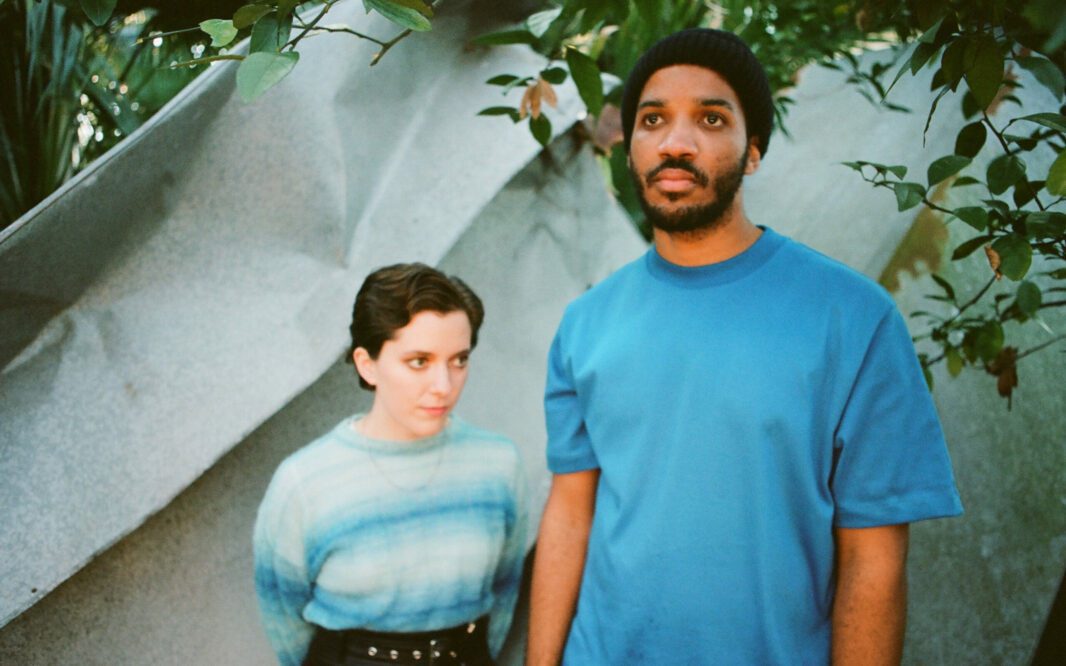
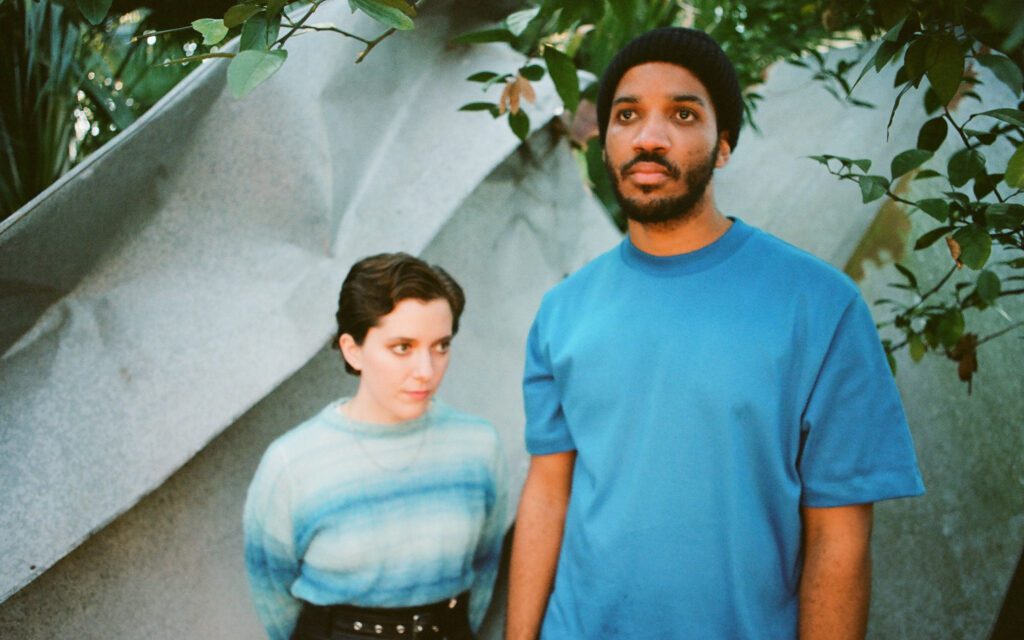
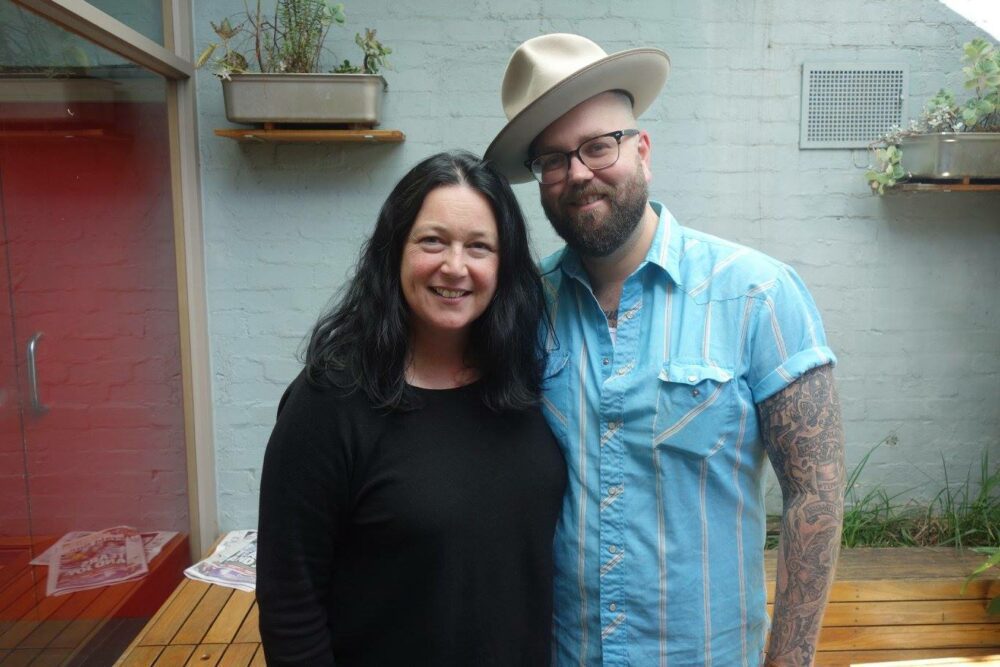
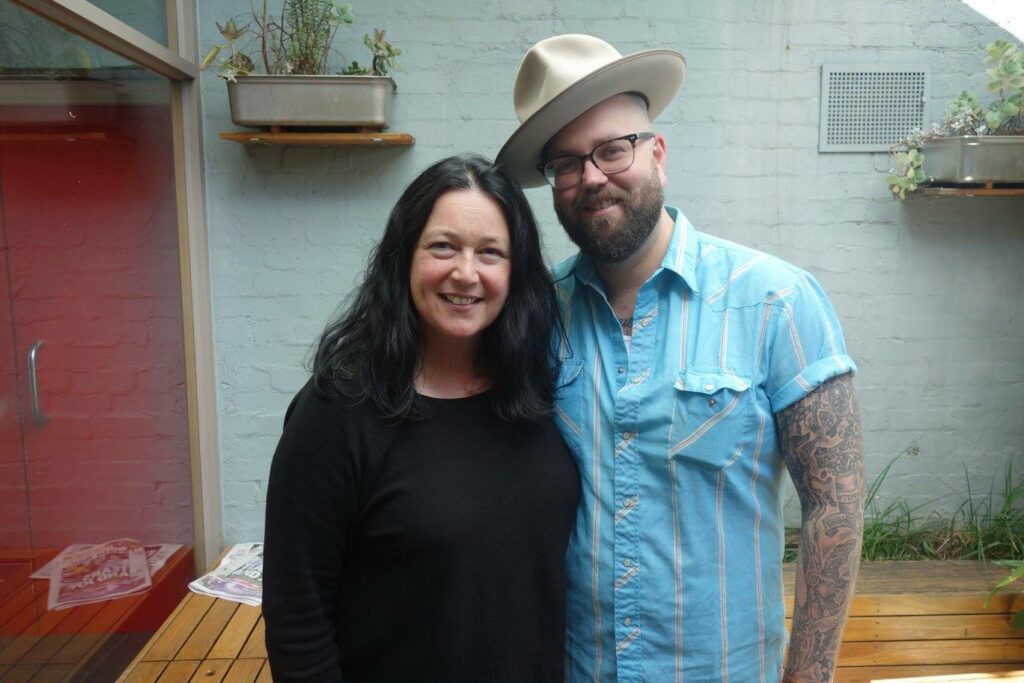
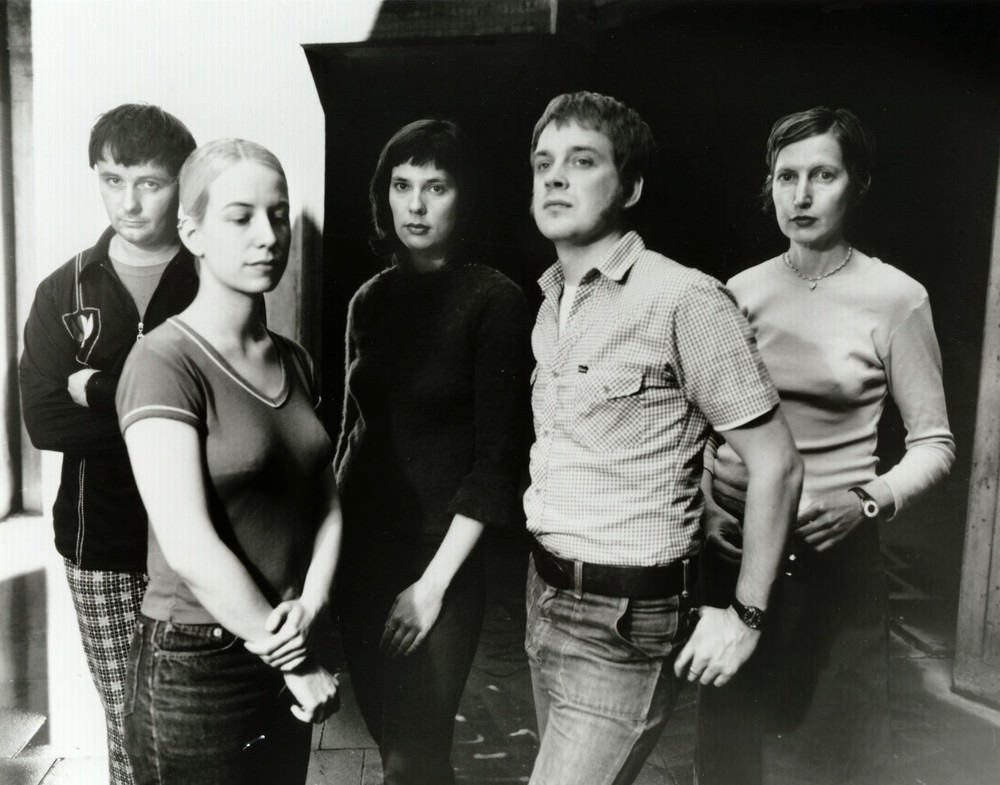
Hailing from a state known for a rich musical heritage, New Orleans electro-pop duo People Museum (Claire Givens and Jeremy Phipps) come from different ends of the Louisiana musical spectrum, meeting in the middle to create something new and entirely unique.
Givens is from North Louisiana, born to a classical pianist and a Baptist minister. Bred on church music and trained classically, she moved on to New Orleans seeking “less structure,” turning to jazz and punk. Phipps comes from what Givens describes as “a very talented New Orleans musical family who never got their due,” the younger brother of No Limit rapper Mac Phipps who cut his teeth playing in the jazz clubs of Frenchmen Street until he began touring with the likes of Solange, Rubblebucket and Neon Hitch. Together, they blend the rich brass sounds of jazz with elements of pop and house music to create what they call “Future New Orleans.” Today, they premiere the video for “Rush” on Audiofemme. The song is from their upcoming debut EP I Could Only See Night, out April 9.
Introduced by a mutual friend, Givens and Phipps began collaborating the day they met in 2015. Their sound was never intentional, born of intuition, but also inevitable in its homage to its hometown. “We were using what we had around us but we didn’t want to make the music that was around us,” Givens explains. “We wanted to make the music that we listened to on our headphones, but if you walk through New Orleans you’re gonna hear jazz, and all your friends are gonna play a brass instrument… we wanted to have that tradition in there but do it our own way, do it new.” The result is refreshing; Phipps’ brass tones are looped and overlaid with house beats, burbling beneath Givens’ otherworldly, layered vocals.
The video for “Rush” is shot in black and white and made to look like VHS tape. They chose the three-frame format in direct response to COVID, wanting to articulate the idea of all their friends being unable to play their instruments without featuring all their friends and exposing them to one another. You see Phipps wandering around with his instruments, unable to play, while Givens sings alone in her room, interspersed with the lone producer sitting in front of a switchboard and monitor at home. They wanted to evoke the loneliness of these musicians, lost without that central part of their identities with all the jazz clubs and venues shut down. “You see these wandering musicians; they just look so lost, because it’s so embedded into everything, and you perform so much. Who are these people now that they don’t have music?” Phipps says. “We’re all trying to figure out who we are outside being musicians, and I think part of that [comes] through in the video.”
As for the rest of the EP, the People Museum aims for a balance between menacing and hopeful, and always danceable. Phipps says that he feels that they “tried to go a little bit harder” than on previous collaborations, saying that his trombone playing felt “a little more aggressive.” Givens says that the most notable change is “bigger production,” and that “it’s darker, but there’s always something you can dance to and there’s always something hopeful about it.”
Perhaps the oddest part of this unlikely sound is that while two of the songs were written and recorded during quarantine, the other three were made back in 2016 – yet they fit together in a cohesive unit. “They kind of came together because the songs that were written in 2016 came out of sort of a very lost time for Jeremy and I,” Givens explains. “We were trying to figure out who we were again. The writing of those songs and the writing of the quarantine songs just felt so intertwined, [it was] kind of fate that they ended up together.”
Phipps concurs, saying that in that period, “it still felt like the same feelings in my body of lostness, and all of the puzzle pieces being scattered, and trying to put it back together, and what does it look like after it’s put back together?” Ultimately, these cosmic parallels aligned somehow and it looks and sounds like I Could Only See Night.
As for what’s next, the duo are beginning to adapt to what live performance looks like in a new normal, post-vaccine New Orleans. The day of the EP release they’ll play an outdoor show, opening for Big Freedia at new outdoor venue The Broadside, and will continue to try to find creative and safe ways to perform after. All in all, they’re staying very present: “It’s funny because I feel like my plans are very short,” Phipps says. “After May? It’s so uncertain, so it’s hard to have a faraway future. We have these shows and that’s all we can depend on.” Given the smooth, hopeful lightness of their “Future New Orleans” sound, it seems it could be bright.
Follow People Museum on Instagram for ongoing updates.
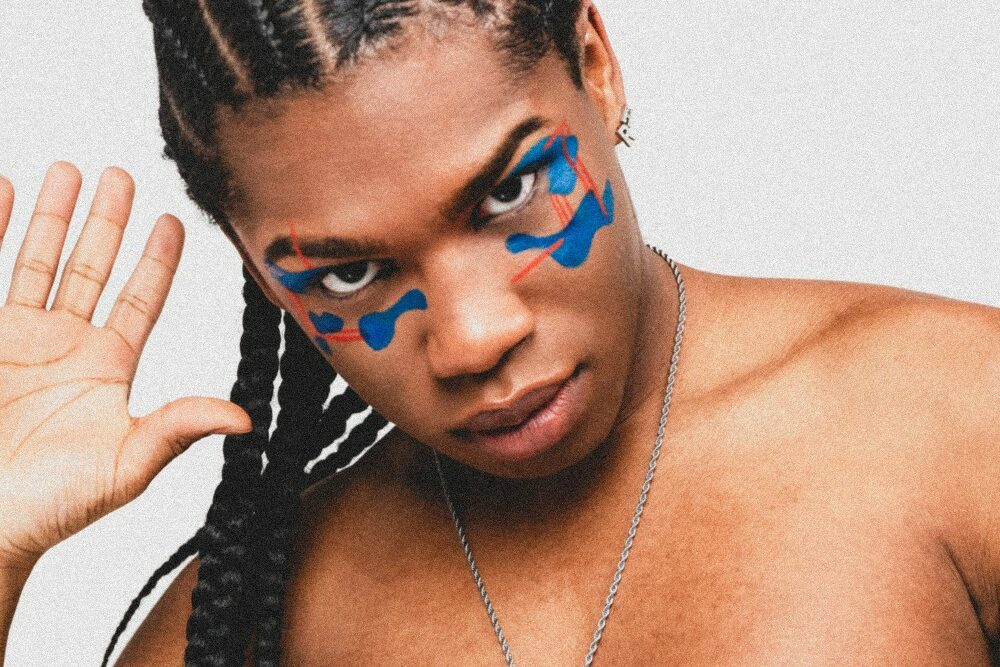
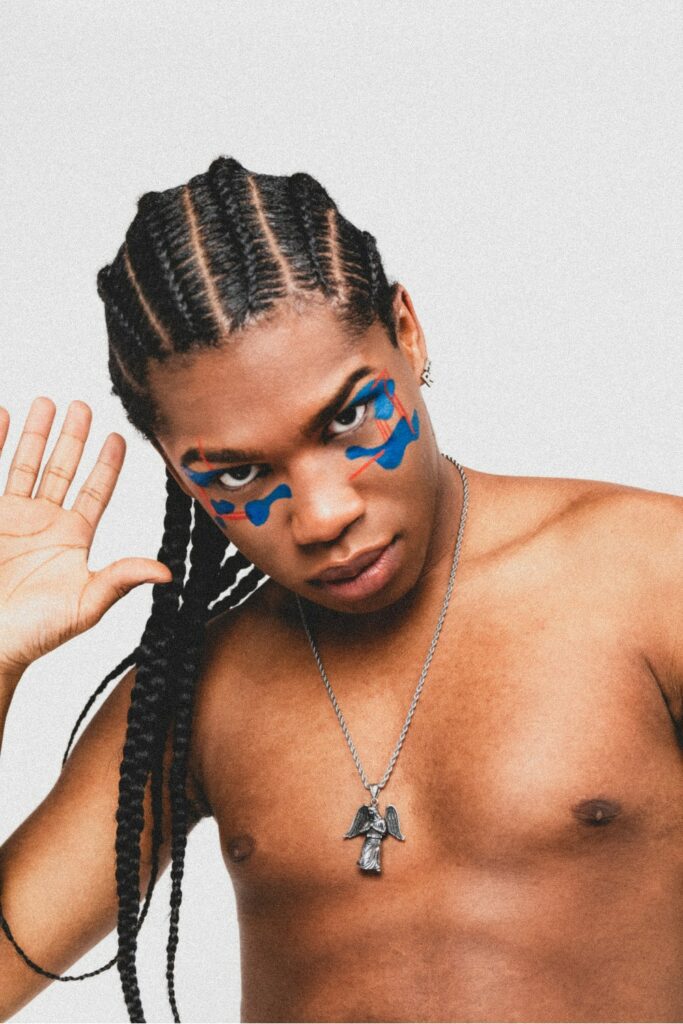
Reginald Hawkins has always wanted to be a pop star. As far back as he can recall, he remembers going by “Popstar Reg” to anyone who knew him and performing at any chance he could. However, it wasn’t until February of 2019 that Popstar Reg was introduced to the world-at-large with his debut single, “Playing for Keeps.” Since then, Hawkins has expanded on his brazen electropop with “FRESH” in 2020 and his latest single and video “Tricks in the City,” released on March 26th. In “Tricks in the City,” Hawkins embraces his sensuality, addresses systems of oppression, and pays homage to Black queer culture.
“Every time I release a song, it’s like a different era,” explains Hawkins, “it’s just really a reflection of who I am right in that moment.” And right now, for Hawkins, that person is an artist in the midst of immense transformation and learning. Growing up in a small suburb of Detroit, Hawkins attended a primarily white high school and didn’t have any friends who were Black and gay like him. As part of two marginalized communities, Hawkins felt himself assimilating to his environment as a means of survival. But since moving to Detroit in 2018, Hawkins has surrounded himself with artists and friends with shared identities and values and created his own community – the Tricks in the City – which catalyzed a period of vast growth.
“This is the first time that I’ve been in an environment that is gay and Black all the time,” says Hawkins. “Being able to talk openly about the shit that we’ve gone through, as gay Black people…that helps me to break it down and just learn more about myself.” The “Tricks” are Hawkins and his roommates, who are all creative forces of their own. The video opens with Hawkins surrounded by his best friends in formation around a sleek Range Rover. With icy glares and impeccable style, the Tricks embody glamor at its purest form. With his crew in tow, Hawkins goes on to outline his ideal man, sparing no declaration of self worth: “If you wanna chance with me you better fly me overseas boy/Take me on a shopping spree/I got some big designer needs boy/Front row at fashion week London to Paris boy.”
Hawkins explains that while this song is, in part, about knowing your worth and trying to find a good man in a small city, it’s also about breaking down oppressive structures and finding his true self. “It’s about understanding how I am being impacted by these systemic issues of colorism and racism and homophobia – internalized and external. And how can I not be an active factor in continuing to make those things happen to myself?” he says. “As you let go of those things that weigh on you, you inherently become a more confident person and learn about yourself and love those parts of yourself more.”
Tackling systematic oppression within the confines of a pop song sounds like a daunting task, but Hawkins does it with ease, weaving cries for freedom between silky synths and pulsating drums – “Decolonize my mind, I am focusing on gettin’ paper/I’m all for that generational freedom that’s all I’m sayin’/I’m here on the right track just a Black man with some education.” His delivery is as fierce as his fine-tuned Voguing that follows in the breakdown. Hawkins explains that it was important to him to incorporate such an iconic part of queer culture into a visual that celebrates his identity.
“I wanted to really highlight gay culture and show this really queer expression of ballroom and voguing,” says Hawkins. “That is our culture – especially as Black gay people in the United States… If this track is about freedom and decolonization and accepting my gayness and my blackness intersectionally, I need to really include that part of what that means.”
In peeling back stifling layers of oppression and connecting with the history of his queer community, Hawkins has begun the journey to becoming his highest self. “As I slowly began to shed those layers, it revealed this more real and truer version of who I am,” says Hawkins. “I’ll never forget the person who I was. That person still defines me and is still in me in a certain way. But that person is freed now.”
Follow Reginald Hawkins on Instagram for ongoing updates.
Italian singer-songwriter Alessia Labate had just finished writing her newest single, “Conversations with Myself,” in Bucharest as the pandemic began to loom large on the horizon, and she knew she was on the precipice of a “spiritual awakening.”
“I locked myself in my house before the official lockdown because I was really aware of what was about to happen,” she tells Audiofemme. “I started to read books about spirituality, and learning about the ego. I was already on that journey.” Labate returned to Milan – one of the first major cities in Europe to shut down – and began honing in on deep reflections about herself, something we’ve all done plenty of this past year. But Alessia Labate translates that reflection into her music, and “Conversations With Myself” acutely represents her new awareness.
She had written all the vocals before recording the single with top Romanian producers RIVIERA at HaHaHa Production, who put their own spin on the single. “All the songs I’ve released were basically written by me. This situation was different. There were five people in the room. Not everyone wrote but everyone was there to build a vibe,” she reveals. At first listen, “Conversations with Myself” has an easy electropop-driven melody, but with a lot of heart. And while RIVIERA mixed the single, they kept Alessia’s message. “The lyrics go pretty deep. But RIVIERA added fun elements. Perfect combination of happiness and sadness. When you mix different tastes, it makes something really unique,” Labate says.
“Conversations with Myself” pits Labate against her own ego. The music video was directed by Mattia Giordano, who helped Labate visualize that inner conflict. “Mattia had this great idea of this one-take scene for the whole video: me fighting with my ego, played by an actress. We are in this beautiful home in Torino, fighting and throwing things around. It’s really heated up,” she explains. Labate wears a vibrant orange skirt and white kitten heels, while her ego sports a black suit. Though she’s standoffish throughout, Labate makes her peace by the song’s end: “Yeah, no more faking I am fine/Cause I am learning how to fly/Finally I found my space/And now I really feel safe in my mind/No more killing feelings that are part of me/I’m happy that I now got conversations with myself.” Labate and her ego hug each other, and in the next scene, only Labate remains, wearing the black jacket, her two sides finally coexisting within one being.
Like so many musicians, Labate has put her career on pause as the COVID crisis plays out. Though Italy has been hit hard by the pandemic, it’s clear Labate has been able to carve out a sanctuary for herself. On our video call, I see her home studio behind her: a keyboard, electric guitars, and a microphone. Labate looks impeccably put together in a blue satin collared shirt, her hair perfectly flipped, curtain bangs pushed to the side. It’s as though she’s just returned from a jet-setting tour, though her most recent set was recorded live at home for Unlock Festival, a benefit for The Prince’s Trust charity initiative Million Makers produced in conjunction with NBC Universal.
Alessia Labate has been preoccupied with music her whole life. Her father was a music producer, and her mother was a dancer; this piqued her interest in contributing to the technical side of music. At just 12 years old, she was discovered on Italian talent showIo Canto; a few years later, she became a contestant on The Voice of Italy. These experiences gave her the opportunity to attend prestigious songwriting school Centro Europeo Toscolano – Mogol, where she began to create her own pop songs. The first of these were released in 2019: “Black Soul,” “Summertime,” and “Kings & Queens.”
2020 was just as productive, despite lockdown; Labate continued to release singles she had in her pocket and created music independently to stay sane during the tumultuous time. Evident throughout her catalog is her natural ability to collaborate – songs featuring Leonail, Josef Bamba, Juze, Jade Key, HZRD, Guy Arthur and more have landed on international pop charts throughout Europe and Asia, while her expressive vocals lend themselves well to features and remixes. She produced an EP for Nicolas McCoppin, and mentors a handful of emerging artists. She has more plans for livestreaming, but Alessia Labate says her heart is in live performances. “Seeing your progress in the music industry is very difficult, especially now during the pandemic. Numbers, shares, and followers matter only so much. The feeling of walking into a room and connecting with everyone is something different.”
Follow Alessia Labate on Facebook and Instagram for ongoing updates.
Jay Madera has unleashed his debut solo album, Anxious Armada. The 12-track LP was fronted by the Cincinnati singer-songwriter’s singles “Curb Appeal,” “OH-126” and his political anthem, “A House Divided.”
“The whole point of the record is to not be so autobiographical, but more try to understand myself through my music and share some of that with the world,” he tells Audiofemme. “The hardest thing to do is put it out there, so anybody taking the time out of their hectic lives to listen to my music is a treat.”
The record ranges in sonic inspiration, from the soul and funk-infused “A House Divided” to the psychedelic “Screensaver.” Most of the instrumentation – guitar, piano, organ and more – was also produced by Jay himself.
“I’ve been writing music for a while and I’ve been involved with various projects, but this full-length solo album is about trying to understand the world and deal with its contrasts and not really look for my own place in it, but put music out there,” he explains.
We spoke with Jay about the inspiration and meaning behind a few of the album’s standout tracks.
“A House Divided”
“To me, it’s definitely an album opener,” says Jay.
The rousing track was released ahead of Election Day and tackles subjects like voting, racial injustice, corporatism, American history and more, many of which were at the forefront of our minds last November.
“That’s kind of one of the concepts that I gathered from a lot of this music; that we are living in a time where we can’t separate ourselves from politics and we ourselves have kind of inhabited a political space,” Jay says. “Even though that song that is overtly political, it’s still… brought really close to home, and even the more intimate songs [on the album] have commentary on society in general, so I guess I’m trying to blur the lines.”
“The Next Great American Novel”
In the bitingly ironic “The Next Great American Novel,” Jay describes the contrast between the lofty ideals we set for ourselves and our reality. Over a slow-tempo guitar, he sings, “I got high, to sit down and write my first novel/And I couldn’t even name my protagonist.”
“That’s me kind of taking a step back – it’s after three very charged, dense songs that start the record,” he explains. “This is the first slower song; it’s a little sparser, and it was me trying to write a song that’s a little less serious and show my lighter side.”
“It’s about a specific scenario, but it’s more about the ability for me to laugh at myself,” Jay continues. “We’ve all had different failures in our lives and learning to kind of laugh at the concept of, and coming to terms with, the things we said we were gonna do. It’s supposed to be a little bit cheeky, a little bit off-the-cuff, but then also hit you with some realness.”
“Half Staff”
The piano-laced “Half Staff” is another song with an anthemic feel to it. The track addresses mass shootings in the U.S. and Jay’s hesitancy to bring a child into the world.
“I was in college when I wrote that song and it was the day after the mass shooting in Orlando in 2016 at the nightclub,” he explains. “I had a lot of LGBTQ friends who were hit hard by it and I just went to a piano the next day and started writing this song.”
Though the song was written five years ago, it’s still, tragically, extremely relevant today.
“I have played that song in probably almost every gig that I’ve done, and I feel the need to keep playing it,” he says. “Each time I play it, I have to remind the audience that it’s about a specific event, because there’s been another several shootings since then. So, it can be easily misunderstood to be about another mass shooting, but that’s also kind of the point.”
“It’s also about kind of how we handle these things that are pretty hard to handle, and we’re expected to go about our day when we shouldn’t be,” he adds.
“A Faithful Foil” / “Janus-Faced”
The album climaxes at the cinematic “A Faithful Foil” and “Janus-Faced.” The two songs seamlessly blend into one another and validate needing others when we have trouble loving ourselves.
“It’s kind of a settling back in to some of the more serious tracks on the record,” Jay says. “Those songs were written as an ode to needing others even when we think we don’t need others. Needing others to show us the best part of ourselves and being okay with that.”
He continues, “There’s this idea that we’re supposed to love ourselves and not need other people for that love. The self-love movement is a very big thing right now; there’s a lot of reclaiming of the self. I personally struggle with that, and so this song is about seeing yourself through the eyes of other people and letting that go.”
“Sertraline”
Anxious Armada ends with a 58-second outro called “Sertraline.” Named after the anti-depressant, the track pieces together different recordings from Jay’s daily life, audio from the album’s recording sessions and more.
“It’s a combination of a few different things, but it’s meant to be a perception of how I hear the world sometimes,” Jay explains. “There’s some recording sessions talk-back, there’s also some embedded audio from my day job and just some of the mundane sounds of life.”
After 39 minutes of analyzing the world through Jay’s eyes, the singer uses “Sertraline” to snap the listeners back into their own reality.
“It’s meant to summate the whole album in a way that makes you almost question the narrator a little bit,” he says. “You get little snippets from each song, and they’re not complete, but at the end you’re hearing little snippets of these songs and you’re reminded that this all just how one person sees the world.”
Follow Jay Madera on Instagram for ongoing updates.
The state of the world can be discouraging for those working toward gender equality, but Calgary, Canada-based singer-songwriter/multi-instrumentalist Clea Anaïs reminds us not to give up, even amid all the setbacks, with her latest single “Powerful Women.” Against snappy drums and synths, her airy voice sings words of encouragement: “If the fuel of that fire ignites/As you stand in its flames/Know I see you/It’s the brave who remain in that light/If the battle lasts long/Know I feel you/We come from a line of powerful women.”
For the video, Anaïs worked with dancer Pam Tzeng to create flowy, emotive choreography and incorporated footage of women from diverse backgrounds and occupations throughout history, using a purple color palette, floral imagery, and a kaleidoscope effect to create beautiful symmetry.
Most of the footage was either donated or found in a collection of films from the Prelinger Archives, which showcases U.S. cultural history. Anaïs had to incorporate some present-day footage in order to showcase a diverse group of people. “As a person of mixed background, something that was notable to me was the type of footage that existed in these archives and how limited it was in terms of ever seeing women of color,” she explains.
“We really focused on trying to find clips of women who were experiencing joy or working on things that they loved,” she adds. “There’s something kind of global about he track itself, and that really brought in the idea of having all these women be a part of this imagery because it’s driven by the universality.”
“Powerful Women” was born from a conversation Anaïs had with her niece and sister about the the decision to swear in Brett Kavanaugh as Supreme Court justice despite the sexual assault allegations against him. She remembers her niece being disappointed by this outcome, and she wanted to write a song with a message of hope for her and other young women.
She describes the song as “a reminder and a call to action for people to continue to fight for what they believe in even if they don’t necessarily see immediate results,” she says. “I wanted to write this song to remind [my niece] not everything has a negative ending, and even if things do have a negative outcome, it’s still worth showing up.”
Alongside its theme of empowerment for women, she hopes the single speaks to all people about the “deep strength that comes before all of us as humans” and how everyone can tap into it. “A lot of what is out there to consume can be very heavy, and a lot of art at this point in time is very reflective on things that have not been great throughout the course of human history,” she says. “A lot of my work is about wanting to give some light in these crazy times.”
Anaïs started off her musical career playing in bands, most recently the Canadian experimental indie-rock band Raleigh; in addition to music, she worked as a flight attendant and recently trained as a commercial airline pilot. When COVID sidelined commercial flights, she took the opportunity to work on solo music she’d been sitting on. During a residency at Alberta’s esteemed Banff Centre for Arts and Creativity, she practiced using music production program Ableton and producing her own songs.
“Powerful Women” was one of the first tracks she wrote on Ableton, then she brought it to an engineer and some other musicians to rework it. She incorporated some unusual instruments such as the tiple, charango, and mellotron along with her usual guitar and vocals and worked with engineer Will MacLellan to add effects like layering.
She also recently released her debut solo single “Hazy Days,” a moody, percussion-driven track about “that feeling when you meet somebody and you’ve fallen in love without having to say anything — you just connect with a person,” she explains. “It’s also a song about impermanence — how life moves forward and you just have to enjoy the moments that are special.”
These two tracks signal the arrival of an upcoming full-length album Anaïs is working on, which centers on themes of self-reflection, resilience, and gratitude. She worked with Tzeng to create a dance piece for each song that will go in the accompanying collage-style videos. Though she wrote many of the songs during a dark time in her life and the lyrics reflect that, she used the production to give the music an upbeat, optimistic vibe. “I wanted it to have momentum, and I wanted it to move people,” she says. “Even the darker stuff, the minor stuff, I wanted it to have some kind of propulsion.”
Sonically, her goal is more to portray an emotion than to project a particular style, and that’s evident in her genre-defying works. “I’m not very good, I suppose, at being like ‘I want to be like this band’ and then working to create that sound,” she says. “That’s never my approach to what I do, which is not necessarily good because then you don’t get to fit into a genre as easily. But for me, it’s so much more about inviting the listener into an experience or a feeling than having a particular sound at the end of the day.”
While the world awaited Lana Del Rey’s Chemtrails Over The Country Club, diminutive Australian singer Hayley Mary tantalised us with a cover version of its title track for Australian radio station Triple J’s Like A Version series. In a metallic gold dress-coat by local designer Alice McCall, fishnets, and knee-high black heeled boots, Hayley Mary is every inch the rock star. Her smoky diva voice recalls one of Australia’s most well-known rock frontwomen, Chrissy Amphlett.
“Covers are hard, it has to suit your voice,” says Mary. “Musically, I’m a Lana del Rey fan; I think she’s a great songwriter and artist. But I don’t follow a lot of contemporary music. My favourite band is still ABBA. I wanted to do something contemporary and what that song had, like a lot of Lana’s songs, was enough depth of lyrics to appeal to me. It was a week or two old when we did it, so it was new. Plus, I’m a huge David Lynch fan and I get that vibe from it. It’s timeless, that’s what I like her about her.”
Hayley Mary fronted Sydney-based indie rockers The Jezabels from 2007 to 2017; in their decade as a band, they released three EPs (The Man Is Dead, She’s So Hard, and Dark Storm) followed by studio albums Prisoner in 2011, The Brink in 2014, and Synthia in 2016. Though they’ve been silent since, Mary hinted to NME Australia last year that there’s always potential to revisit the project, saying, “We never really stopped, we just don’t really have anything happening at the moment.”
Considering the band’s reputation as “volatile, provocative and intelligent” (Jenny Valentish for Sydney Morning Herald), their namesake – the infamous biblical Jezebel, who appears in the New Testament Book of Revelation and is described as “an unrepentant prophetess,” “the bad girl of the Bible,” and “the wickedest of women” – makes sense.
But was Jezebel truly a murdering prostitute hellbent on chaos? Not according to Hayley Mary, who explained to AllMusic in 2012 that in fact, she was misunderstood, an example of how women are misrepresented and maligned. “My dad was raised Catholic but he has pagan leanings, a cynicism for the establishment. [He] wanted to call me Jezebel when I was born, but my mum thought it was a bit extreme, so they ended up naming their cat Jezebel,” she explains. Studying “various ‘isms’ – feminism, Marxism, all that stuff” at the University of Sydney, she began to realize “there was a lot of revisionist history of misunderstood people from the past. Jezebel was a whorish figure in the way I’d been brought up, but when you actually read the Bible, she was a Queen who tried to escape. So, when did she become a whore? She became vilified, and it happens a lot throughout history.”
Also at uni, Hayley Mary met Heather Shannon, Sam Lockwood, and Nik Kaloper, with whom she would form her band. “Heather and I started Jezabels as a two-piece, and my cat was dead by that time – we thought Jezebel was a cool name,” explains Mary. “When the guys joined and we started making more rock music, they weren’t sure about The Jezabels, but I convinced them that it was a reclaiming of this misunderstood Biblical figure and they got on board with that.”
Photo Credit: Jesse Lizotte
Mary’s ongoing struggle with depression and Shannon’s ovarian cancer diagnosis forced questions of existence and purpose upon The Jezabels. Those same questions still challenge Mary, now in her mid-30s. She recalls trips taken across Death Valley (which inspired “Pleasure Drive” from The Brink LP), and living and working in London for a year. A nomad at heart, she is in her element when not anchored to one place, though she doesn’t “need to be overseas all the time,” she says. “I like living in different places for six months or so, finding a new world. I’m half-Scottish so I’m drawn to the UK. I found myself coming back and forth, spending a year in Sydney or Melbourne then returning to the UK again.” So, how did she cope with lockdowns 1.0 and 2.0 in her hometown of Melbourne?
“I ended up in Sydney for six months of the lockdown,” says Mary. “I did the first lockdown here, then went up to Sydney to mix some recordings and got stuck there when the second lockdown happened. It was productive in a way that I couldn’t have been in Melbourne. I was lucky to have the stint in Sydney.” She’s played a few acoustic shows regionally in NSW and Victoria, and has enough songs to form a new record, but is hesitant to “drop an album prematurely in a COVID-19 landscape,” she says. “I think I’ll put it out in a different sort of way.”
Mary’s solo career has seen her pick up a guitar and embrace being an independent solo artist, releasing her debut EP The Piss, The Perfume in January 2020. “I’m still in my love affair with rock, because as old as guitar music is, it’s so exciting to me to pick up a guitar. I’m not trying to reinvent the wheel with this music, but it’s based on the old tradition of songwriting. I care a lot about the lyrics and the feeling,” she says. “There’s influences like Americana, but there’s also some punk in there and ’80s diva pop. There’s a fusion of genres and eras, I guess, like on my first EP.”
Mary explains that while she’s not pioneering anything as far as guitar playing and songwriting, it feels like she’s pioneering in her personal life, alongside Johnny Took of DMA’S. The relationship began when she was trying to find her footing as a solo artist, wondering “Who am I without Jezabels?” Mary says the loss of identity after thirteen years in a band is “still difficult,” and her management encouraged collaborations to help her through it. “Johnny was instrumental in helping me find my strength as a songwriter, and we’ve co-written a bunch of songs together,” she says. “He co-wrote my last single, ‘Would You Throw A Diamond?’ He’s been involved in producing and demo-ing. He’s my key collaborator. When someone can bring the best out of you, that feels like a good sign.”
Hayley Mary’s ideal 2021 involves the announcement of more shows, more videos and the prospect of an international tour by the end of the year. Until then, she’ll be writing, and she’s also studying audio engineering and music production at Melbourne Polytechnic. “I’m empowering myself,” says Mary. “I don’t want to be at the mercy of people so much. I want to take more control, be able to tell producers ‘I like it to be this way, for this reason.’”
In her young life, Sunny War has been through more than most—homelessness, drug addiction, even making her first album in a sober living home as a teen. But when the pandemic hit in 2020, forcing much of the world into sudden, extended isolation—physically, socially, and emotionally—War, like a butterfly, began shrugging off her cocoon in unexpected ways.
“The only good thing I learned from last year is how to love and value my friends and family,” War tells Audiofemme from her home in Los Angeles, weeks before the release of her new album Simple Syrup. “My family started a group chat, and we talk more now than we ever did. I have also reconnected with old friends and talked with them for hours, like we were kids again. I’ve got a new roller-skating crew I meet up with at the park now. Before COVID I really hated people. Now I am more aware of how precious and fragile life is and I feel more connected to everyone [because] we are all trying to overcome this whole thing together.”
War has also been busy founding an L.A. chapter of the non-profit organization Food Not Bombs, which provides vegan meals to community members living on the streets through volunteer-driven services.
Aside from activism, re-connecting and roller skating, War also found a new passion for programming beats. After her tour was cancelled, War initially decided to wait out the pandemic before releasing new music. But the prolific poet and lyricist realized that she needed to translate this moment in history into song.
Simple Syrup was originally intended for release last year, a companion to the EP War released in March entitled Can I Sit With You?The EP centered on those who go unnoticed and uncared for, those lost and without a net when things go awry. An heir to Nina Simone’s legacy of unvarnished, hard-earned truth-telling through elegant, raw music, War brought those quiet emotional battles to the fore by cutting straight to the heart of trauma to speak for the disregarded and unseen.
Now she’s back with Simple Syrup, recorded at Venice Beach hangout Hen House Studios, with producer Harlan Steinberger at the helm. “Some songs were written before COVID and some during COVID. Making the album was a lot of fun because a few tracks we recorded live as a band. I had actually never recorded live with a band before then,” she says. The album includes contributions from War’s live band (bassist Ayron Davis and drummer Paul Allen) as well as guest appearances by several friends, like Fishbone’s Angelo Moore and fellow Venice Beach busker Milo Gonzalez. “The song ‘Like Nina’ is a live duet with me and Milo and we took like a million takes,” War says. “I feel like there were maybe more chances taken with this record. It strays from my typical Americana stuff a bit.”
Simple Syrup captivates from the beginning. War’s voice, lyrics and delivery are packed with wisdom and astute observations, but tracks like “Eyes” hold even greater significance—War wrote the song while “processing a lot of death and mourning,” having lost numerous friends to drug addiction and street life. “‘Eyes’ is about my ancestors and my dead friends. I am very certain they reach out to me and warn me about shady people and situations regularly. I am pretty sure I’d be dead without them. They are the eyes in the back of my head,” War explains. “A friend of mine died and I was up all night, drinking and crying, and then he came and visited me. I don’t know if he was really there or not, but I saw and felt him and I’ve felt him ever since. Then I realized I feel my grandparents and all my loved ones on the other side as well. I have an army and I will see them all again.”
Delving deeper into the spiritual has not only sparked healing, but revealed new musical paths as well. “I feel like I kinda reconnected with my roots on this album,” War says. “Blues and jazz are definitely back in my music and not as subtle as before.” Featuring her folk palette with shades of lush jazz, War was inspired by the works of Joan Armatrading and Nick Drake, as well as the saxophone. And while 2020 saw her less focused on her once ubiquitous guitar, the instrument remains a deep extension of her as a woman and artist. “I turn to the guitar for meditation,” she says. “I like to play trancey repetitive loops. I haven’t found my voice as a guitarist yet, but I think I’m getting closer.”
As vaccinations become more readily available and a summer of love seems possible, Sunny War hopes to return to touring and the people who keep her inspired to make music and tell stories. “I hope [Simple Syrup] can give someone a brief break from our current reality. I hope it can be a relaxing album for folks when they want to listen to something soft and emo,” says War. “I am just honored that anyone would even give me their ears and be interested in checking it out.”
In the video for “Hématome,” released on March 11 by French six-piece disco group L’Impératrice, a gorilla tries to fit into the human world and is broken-hearted when she can’t do that. It’s a devastating and beautiful animated sci-fi clip directed by French artists Roxane Lumeret and Jocelyn Charles, and produced by Studio Remembers.
“The funny thing is that they deliver a very different interpretation of the song,” says Flore Benguigui, singer for L’Impératrice, on a recent video call from Paris. When Benguigui wrote the lyrics in French, she was thinking about breakups, social media and ghosting – “finding that somebody disappears from your life, but at the same time, is still accessible through social media,” she explains.
The team behind the video imagined a different story for the song, but, Benguigui notes, their take also fits the lyrics. “Crazily, it really works and it’s not the same interpretation at all and it’s not the same way that I feel the lyrics,” she says. “For me, that’s very interesting because it really gives another life to the song. It opens it to another audience and another reading. They really did an amazing job with that song.”
For L’Impératrice, aesthetics are very important. “We don’t release many videos,” says keyboardist Charles de Boisseguin, “but every time we have to choose a song, we make sure that the director that we’re going to work with shares our references and influences.”
The same can be said for the cover of Tako Tsubo, the band’s sophomore album, released March 26. Illustrated by comic book and animation artist Ugo Bienvenu, who also co-founded Studio Remembers, the cover depicts the Moirai, or Fates, from Greek mythology with a sci-fi edge reminiscent of the late, great French cartoonist Moebius. “That’s why we work with him, because we share those references – Moebius. Maybe Roy Lichtenstein,” says de Boisseguin.
The album takes its name from the medical phenomenon sometimes known as “broken-heart syndrome,” where the heart’s left ventricle weakens as the result of a physically or emotionally stressful event.
As she was writing for the album, Benguigui noticed that her lyrics were tapping into situations of “being on the edge of things, being different in all kinds of ways.” She heard about the takotsubo phenomenon on a podcast and it struck a chord with her. “The idea of the takotsubo is about creating a rupture in the continuity of things,” she says. “An emotion just gets too big and overwhelms everything and just breaks the course of things.”
L’Impératrice began working on the album in early 2019, while staying in Morocco. Following a tour of the U.S. and Mexico, they continued writing and recording in France. “It took us almost a year to compose,” says de Boisseguin.
That a tour came in the midst of the process impacted the results. “I think that the new album has been fed by all these different places and also by the tour,” says Benguigui. “Probably, this also influenced us a lot because it was a big experience for us.”
“The fact that we discovered new fans, a new audience, in L.A. and New York. D.C., Chicago and then in Mexico, gave us new ideas to compose this album,” says de Boisseguin.
For Tako Tsubo, they worked with producer Renaud Letang. The album was mixed by Neal Pogue (Tyler the Creator) and mastered by Mike Bozzi , who won a Grammy for this work on Childish Gambino’s single “This Is America.”
After the onset of the COVID-19 pandemic, the band opted to write and record one more song for the album, “Submarine,” while the members were situated in home studios in different parts of France. Normally, Benguigui explains, when they write and record, they work in teams, so the process of creating “Submarine” while physically separated wasn’t particularly difficult for them. They were able to send each other parts for the song and build off of them. “That was a really cool experience because it was maybe the only good memory we have of the lockdown,” says Benguigui.
Throughout 2020, they teased fans with material from Tako Tsubo. A video for “Fou” was released in early April. Live clips for “Voodoo?” and “Anomalie Blue” followed in June and December, respectively. They kickstarted 2021 with a killer video for “Peur des filles.” Directed by Aube Perrie, the clip draws from mid-20th century design and campy sci-fi and horror movies, building on the retro-futuristic aesthetic influences that they appreciate. “The costumes, the set design was incredible,” says Benguigui. It was also an intense shoot, she says, with lots of fake blood.
“We spent four or five hours under the table with our heads on some plates with real food. It was really long and really smelly,” de Boisseguin recalls. “I was basically stuck under a table with meat on top and I couldn’t move to scratch my nose or anything.”
The result, though, was impressive, something de Boisseguin likens in style to the Tim Burton film Mars Attacks.
Taking shape over the course of two years, New Orleans-based singer-songwriter Esther Rose offers a different outlook to romantic losses and hardships – unique from the wallowing cries of the average love song – on her third album How Many Times, out March 26 via Father/Daughter Records/Full Time Hobby. Carefully acknowledging viewpoints from both parties, Rose’s personal anecdotes are meant to move audiences both physically and emotionally.
Rose’s sweet alt-country, folk pop twangs and two stepping rhythms originate back to her experience as a fresh New Orleans local. Roaming the noisy streets filled with traditional jazz bands, the singer-songwriter found her niche in NOLA’s own eclectic country music scene. Seeing the parties of joyful folks gathered around lively country music shindigs, Rose joined in on the fun and felt particularly at home.
Other than the two-step dance accompaniment, it was the soft weeping tones of the pedal steel guitar and frantic bowing of the fiddle that particularly piqued her interest, reminding her of a beloved legend Hank Williams. Drawn to his “lonesome voice and three-chord [compositions] on the guitar” Rose felt personally connected to not only these foot-tapping rhythms, but also the warmth and intimacy of songwriting itself. Album single “Songs Remain”reminisces on Williams withthe singer’s intimate vocals accompanied with the slow strums of the guitar.
How Many Times is ignited by the spark of lyrical compositions stemming from little moments in Rose’s life – an exchange of words in arguments, overheard conversations and catchphrases born out of heart-to-heart chats. Representative of significant experiences in her life, her songwriting process served as a means of introspection and self-discovery. “I would say that our experiences as humans really shape us,” she describes. “So I use songwriting to examine my life, experiences and relationships.”
Her affinity for looking outward at life’s circumstances causes her to analyze its meaning and her own perspective carefully and thoughtfully. She crafts her lyrical phrases with the intention of looking at the bigger picture, processing each moment with the proper care it deserves. “It’s a universal experience,” she describes. “Whatever it is that sets up the song is being present in the world and paying attention.” Listeners are given a peek into the intimacy of these referenced conversations in tracks like “Good Time,” where Rose sings “It’s a real good time for bad timing” with conspiratorial inflection, the sort of wink and nudge one might give a close friend during a night on the town.
The idiosyncratic outlook at relationship pain Rose expresses in her songs seems to be more than solely grieving and throwing blame or anger on the other party. Allowing herself to feel the torment of heartbreak, the musician simultaneously expresses her acceptance of the hurt she’s feeling while poking fun at her own negative reaction on “My Bad Mood.” She sings candidly, “You got your new blue jeans and the girl of your dreams/I guess I should go and do the same/Oh, I’m getting pretty tired of me and my bad mood.”
Rather than focusing on blue tones of the average love song, the musician has an interesting way of shaking up the vibes of the gloom through her change in tempo. On the album’s title track Rose keeps listeners engaged with a sudden change in time signature in the middle of the song. Soothed by the sustained wails of the fiddle in the beginning of “How Many Times,” the listener will find themselves tapping out a faster tempo by its end, concluding with a light-hearted touch. Other tracks, like “Mountaintop,” “Without You,” and “Keeps Me Running” carry on as the fast-paced instrumentation allows listeners to forget about emotional turmoil.
Rose’s says her affinity for upbeat tempos helps “iron out [her] nerves,” rather than giving into the emotions of bluesy, dismal sounds as a bandaid for hardship. How Many Times may have the same effect on fans, who can experience her music as the artist herself would, turning painful emotions into songs worthy of dancing to. “What I’m trying to do sonically as a songwriter [is to] explore emotions in a way that by the time I’m done writing it, it has changed the emotion into something that we can all dance to and have fun with,” she says.
With an ever-changing state of mind, Esther Rose is currently working on new music touching on themes of future fear, family, health, and the planet. “I’ve never played it out with my band,” she says of the new material. “So the songs feel really exploratory and kind of goth with a lot of different tangents.”
In the process of making How Many Times, Rose turned to the records of Faustina Masigot and Kiki Cavazos to soothe her emotional state of mind and feel a sense of companionship. “These records were there for me. I love how music is that companion for heartbreak,” Rose says. Understanding the importance of music in our daily lives and the profound effect it can have on others, Rose hopes How Many Times can similarly accompany listeners in times of sorrow, or on lonely nights, or long drives. She adds, “My dream is that my record will do that for other people.”
Among the hordes of New Yorkers who took a hiatus from the city for the last year is singer-songwriter Gianna Alessi. Having spent the last seven years bouncing around Brooklyn and Manhattan and growing her live show at venues like Bowery Electric and Arlene’s Grocery, she gave up her apartment and headed back to her hometown of Nyack, New York. She found the time creatively fruitful, honing her skills as an at-home producer with a microphone and a laptop and leaning into the feelings of anxiety and defeatedness to ultimately produce single “From Within,” which premieres on Audiofemme today.
Alessi is a classically trained theater singer, studying at the Boston Conservatory Berklee School of music, but her training as a musician began much younger. With two classical musicians for parents and the granddaughter of Maria Leone, a soprano in the Metropolitan Opera, Alessi had her first voice lesson with her grandmother at age 9. “I was always kind of nervous to sing around her, because she was very strict and opera is such an amazing art form that takes such control,” she explains. “But from there I started studying, and… just went down that rabbit hole.” Though her grandmother and she sing in very different styles, she says her family calls her the “reincarnation” of her, and often refers back to old photos and recordings for inspiration.
She eventually made the journey from theater to the soulful, R&B-flecked electro-pop she favors today after taking a songwriting class at Berklee and picking up a guitar. “I always loved theater,” Alessi says, “but the part I loved most about it was the music, so once I started learning guitar I just kind of blossomed and I began to write all the time.” Upon graduation she moved to New York City, where she began working as an actor and putting together a live show with background vocalists and a band, sharpening a sound that meets somewhere at the intersection of India Arie and Morcheeba.
“From Within” is a departure from her normal practice, however. Like many musicians lacking their usual resources due to the pandemic – like their band or proper recording equipment – Alessi improvised, setting up a small studio of sorts in her childhood bedroom and ultimately working to finish the song remotely with producer Joey Auch. Alessi turned the disquietude of the moment into lyrics like, “Waking up late/I pull the shades/Oh, did I miss the day?” The verses simmer in a sultry, dark space, and then burst open into a more positive, pop-driven chorus about finding herself amidst all the uncertainty of the present.
Overall though, the track was an experiment in exploring a more quiet place artistically. As a theater student, Alessi says, “I was always taught singing louder means more power, loud is good in performing… but with this song, I was like, ‘What if I make something really intimate?’” That intimacy leant itself to a more honest reflection of the “very dark place” she says she and many other creatives have been suspended in, but that “From Within” helped her meet herself “within this kind of sadness.”
“From Within” is Alessi’s sixth single, and though she doesn’t know if it will end up on a larger collection of her work, she hopes to jump into the studio in the spring or summer to record more tracks, with an EP or album in mind. “I’m just going to keep creating,” she says.
After her self-imposed creative retreat, Alessi feels she’s at a “crossroads,” having considered both moving back to New York City and heading out to Los Angeles. But the themes on “From Within” resonate with the age-old adage, wherever you go, there you are.
“I think the song is like, I’m going to find myself again, and I have – I was always here,” she says. “If I lost myself, it was only for a second, because everything that was still remains, and it’s all kind of within me anyways.” Wherever Gianna Alessi winds up, we’ll be listening.
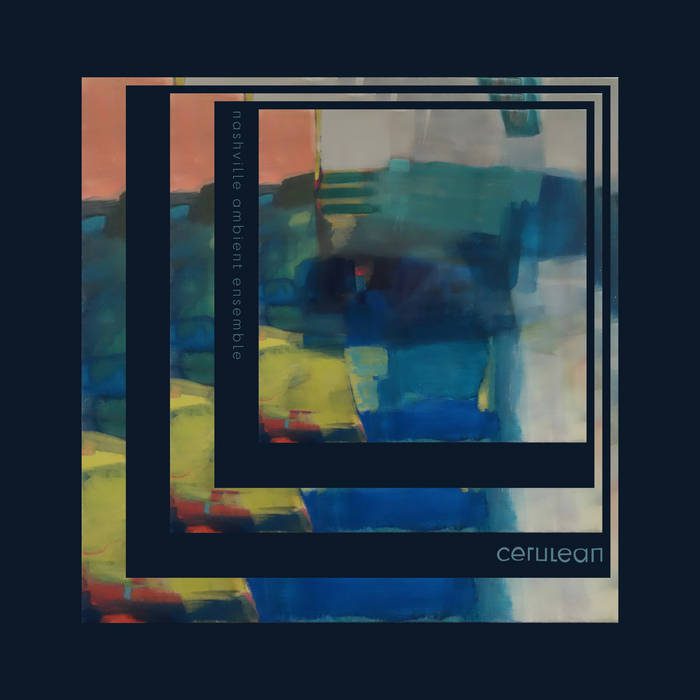
With their debut album Cerulean, Nashville Ambient Ensemble reimagines the art of experimental music. Founded by native Tennessean Michael Hix, who returned to Nashville in 2018 after honing his solo craft in New York’s experimental music scene, the group rapidly expanded into a septet, proving just how rich Nashville’s scene can be. “Moving back to Nashville, I was impressed by how people wanted to make music together,” Hix tells Audiofemme. “It reminded me what is so unique about making music in Nashville, and that is that it’s much more collaborative in nature.”
Hix quickly became a magnet for artists across the city seeking collaboration. After connecting with multi-instrumentalist and vocalist Diatom Deli through social media, the two teamed up for a live show at East Nashville bar The Crying Wolf in 2019, where journalist and guitarist Jack Silverman was in the audience and suggested to Hix that they collaborate. Hix’s longtime friend Timon Kaple was also in attendance and approached him with the same request, presenting the first sign of the community spirit in Music City.
As a self-professed fan of musical improvisation, Silverman says the Ensemble was a welcomed invitation to join forces with like-minded musicians in the experimental music world. “To me it’s about completely losing yourself, and that’s something I’ve always felt about instrumental music and improvisational music. It’s like playing in the purist sense,” Silverman explains, comparing the process of working with multiple musicians to that of walking a tight-rope. “Everyone has to really be patient and listen to other people. I felt like I was discovering a whole new world of musicians who I related to a lot more.”
Hix continued to build the multi-faceted group into a seven-piece ensemble where he serves as composer and plays synthesizer, with Silverman on baritone electric guitar and Kaple on electric guitar. Rounding out the band is Luke Schneider on pedal steel guitar, pianist Kim Rueger, Cynthia Cárdenas helming guitar synth and Deli providing vocals.
Nashville Ambient Ensemble. Photo credit: Jeremy Ferguson
The Ensemble’s debut album, Cerulean, was an exercise in patience and experimentation. The septet only rehearsed twice before heading into the studio for a two-day recording session to create the album, which was released March 19th, 2021 on Centripetal Force Records. Hix provided rough outlines for each composition, along with loose chord structure that was left open to interpretation, inviting the musicians to play off one another’s strengths.
“We all work together very naturally,” Hix observes. “I think one of the things that we achieved as a group was the sense of space that we allowed for each other, listening to one another, along with that semi-improvised setting. That kind of environment that we set up allowed everyone’s personal contributions to be more effective and heard.”
Deli admits she felt a sense of trepidation when approaching the project and trying to find her voice within it. “I viewed it as a challenge for myself,” the self-described “loner” says. ”It felt right to really challenge myself and be a part of something that is out of my element.”
Her calming voice guides the listener through the album’s six meditative songs, offering gentle whispers and simple words that poured from her stream of consciousness, adding as much dimension to the music as the instruments themselves. “The voice is being used as an instrument where you’re hearing and feeling in the way that a guitar would,” she explains of the “subconscious-driven” verbiage that arose from “intently listening” to her peers. “Intuitively hearing how each part was coming in and out was a very ebb and flow feeling, and I was feeding off of that with the voice.”
“It’s almost like a symphony where there’s all these different movements of a piece,” Silverman describes of the project. “There’s this tentative exploring wonder of getting to know people. I think the fact that we were all in that moment [of] ’what are we doing?’ added a certain awe to it and magic.”
That magic is captured in the mellifluous arrangements that allow each musician to shine, Silverman harboring a connection to the title track that he composed and invited his fellow players to improvise on. “Cerulean to me is a shade of blue that is very striking, but very elusive,” he says. “There’s something about that shade and that color that is very mysterious and other-worldly to me.”
Meanwhile, Hix and Deli nod to “Coda” as a personal favorite, with Hix citing “Conversion” as one of the album’s most “effective” numbers in the way that it enables each musician to perform a solo in the span of its nearly 10-minute runtime. “It shows in the most comprehensive way what we were trying to do with the project, that balance between structure and improvisation,” Hix says.
Deli compares the album to a “musical jungle gym” that entices the listeners’ minds to play on the sounds while being open to the messages that apply to their own lives. “You’re just in this moment. There’s nothing else but this image that you’re watching and the world lights flickering on and off at the right moment of a sound coming in,” she shares. “The main message is be here and be here listening.”
“What it feels like to me as someone who participated in playing it is that you’re letting yourself be absorbed into a great whole and seeing what happens when you trust, let go and be in the moment to the point where you’ve lost all sense of self-consciousness. It’s almost like the music is playing you at that point,” Silverman analyzes. “What I’m trying to do is to find beauty in life and the universe and seeing how things connect. But there’s also a scariness in there. Life is intense; what I’m trying to do with my music a lot of times is process that. Sometimes there can be a darkness to it, too. There’s a lot of beauty and prettiness and chill melodies on Cerulean, but there’s also moments where it goes to slightly more mysterious and darker places. What I’m always trying to do is balance.”
Hix makes it a point to recognize the faint sound of laughter in the album’s closing track “Coda,” recorded during the final take of the sessions. It’s a sign of collective release from a group that leaned into trust and experimentation, knowing they conquered the journey with open hearts and pure intentions. Hix hopes listeners feel that same sense of liberation when they experience the music.
“I think everyone brought their whole selves and their whole lives to the music. I think it’s evident in their playing – it has a lot of heart in it. Their performances have a lot of power in them and it’s not just glossy, happy, bright feelings. The music has a lot of dimensions, and I think a lot of that is the result of everyone bringing their whole experience to the music,” Hix reflects. “My goal when making music is to create a space where someone can disconnect from the noise from their daily life and regain a sense of who they truly are. I turn to music for that, so when I’m making music, I’m doing that personally. I try to pass that on for the listener as well.”
On her latest EP Echo Mountain, singer-songwriter/multi-instrumentalist Jenny Owen Youngs uses everyday storylines to dive into themes like powerlessness, self-compassion, and complicated relationships – big ideas rendered in small-scale details from childhood games to natural scenes. The songs give off a stripped-down, whimsical folk vibe, with languid guitar-strumming and mournful strings. Youngs wanted to make Echo Mountain a continuation of her 2019 EP Night Shift, but one more connected to the details of daily life than its predecessor, with a “body of vignettes that kind of melt into one another.”
“I was interested in, rather than a God’s-eye view, kind of a microscope,” she says. “I was excited to explore a sonic space that was a little more intimate.” Youngs pulled inspiration from pastoral scenes and childhood memories, her vocals sung slowly and clearly, painting vivid pictures of emotionally-laden events.
On her latest single “Dungeons and Dragons,” for instance, she juxtaposes the role-playing game she enjoyed as a kid against a far more foreboding reality: “Inside the game, you’re okay/longswords and spellcasting keeps all the bad away/and the monsters look how monsters do/not like neighborhood kids with their hands full of rocks for you/and not like the grown ups who should be protecting you.”
“When you have so little power as a kid to affect your surroundings or circumstances, it’s incredibly powerful to enter the world of a game like Dungeons and Dragons, where you can get wherever you want to be and whatever you want to do and the world can look any way the dungeon master wants it to,” she recalls.
“Sunfish” deals in a different way with escapism, recalling the New Jersey house where Youngs grew up and the woods, streams, and bears surrounding it, where she’d retreat when she needed time alone.
In “Little Bird,” she addresses her teenage self, who was struggling with being in the closet about her sexuality in high school, and offers herself the compassion she didn’t get at the time.
“I think at least for me, it’s very easy to look back on earlier iterations of myself and just kind of shake my head like, ugh, what an idiot! But I think the older I get, the more I’m able to kind of move past that and into a space where I can have compassion for myself,” she says. “I think it’s much easier to have compassion for other people than myself, but once I sort of let myself find some peace and stop stressing out so much about that part of myself, I think it became a lot easier to feel the compassion for somebody else.”
The EP takes a melancholy turn on “Long Long Gone,” a song grieving the end of a relationship with natural imagery, almost whispered vocal layers, and minimalistic instrumentals.
“Follow You,” a meditation on the inscrutable nature of relationships, has more of an indie pop aesthetic than the rest of the EP, with the catchy refrain: “Follow you all of my life/chances I can’t leave behind/I can believe what I want/but I can’t believe what it cost/how’d I get lost.”‘
Youngs’ friend John Mark Nelson remixed “Follow You,” giving it a fast-paced, fun, danceable feel by bringing up the tempo and using synths to add a dreamy vibe. “I sent him stanzas and just kind of said, ‘the reigns are yours, do as you will,’ and I think he has fantastic instincts and I love his sonic tendencies,” she says. “He brought in these elements that make me think of artists like Pale Saints and Kate Bush — there’s a certain kind of jangliness but also this sort of fretless, flighty feel he brought into the mix.”
Echo Mountain was released on March 10th, and in the absence of live touring, Youngs is playing the EP in a livestream performance at 8 p.m. ET on March 25th (tickets are for sale at NOONCHORUS).
Youngs, who is currently based in Southern Maine, released her first album Batten the Hatches in 2005, followed by 2009’s Transmitter Failure and 2012’s An Unwavering Band of Light. Over the course of her career, she has toured with Regina Spektor, Against Me!, and Motion City Soundtrack, co-written songs like Panic! At the Disco’s “High Hopes,” Pitbull’s “Bad Man,” and Ingrid Michaelson’s “Miss America,” and played in the band The Robot Explosion.
Currently, she’s in a new band called L.A. Exes with Sam Barbera, Rachel White, and Steph Barker, which she describes as “a quartet of queer women making kind of jangly Beatles-y surf pop.” L.A. Exes released their first single, “Temporary Goodbye,” in February.
The highlight of her career, though, was having one of her songs, the emotional, key-heavy “Wake Up,” played during the credits of BoJack Horseman‘s season four finale. “I was a huge fan of the show, and when they reached out to me, it was a tremendous honor,” she says. When she’s not making music, she hosts two podcasts centered on popular TV shows: Buffering the Vampire Slayer and Veronica Mars Investigations.
Though her interests and professional activities have been wide-ranging, her goal with her music is simple: “What I hope is that somebody listening to a song that I’ve made will hear something that is true for them in whatever way it can be true for them,” she says, “and for that to make their experience of listening to the song yield a slightly better vibe for them than three minutes ago when they started.”
Follow Jenny Owen Youngs on Instagram and Facebook for ongoing updates.
The pandemic was particularly hard for The Blue Iris. “It left me without a job, afraid to go outside, and generally scared for the future,” they confide. Feeling tremendously “stressed about too many things to name and depressed past anything I had felt in years,” the singer-songwriter grabbed a guitar and wrote the appropriately titled “Stressed and Depressed.” Premiering today, the song detonates with all the anger, loneliness, and anxiety they were feeling. Even their vocal performance is appropriately combustible.
“To me this song feels like a timestamp of those first few months of last year,” they tell Audiofemme. The song also serves as a direct response to the reception of “Body Regardless,” a track that appeared on their Life VS Art LP (released in January 2020). That song depicted “how I felt about coming out as trans and overcoming dysphoria. After its release, I had a lot of wonderful people who came to me and told me how much it meant to them when they heard it,” they explain. “I remember thinking at the time that it was kind of scary to be helping people get through something that I was still struggling with every day.” That’s what inspired the propulsive first line of “Stressed and Depressed”: “How can I write about getting better, when I can’t get better myself?”
“Which of these lines won’t make it off paper? How many songs won’t leave the shelf?” they continue, uncoiling wonderfully graphic imagery. “Spill my guts out as ink on paper/Squeeze dry my heart right on this stage/I’ll clean the blood up later.”
“Most of the time when I’m writing I’ll play a few random chords and start almost free-styling vocals over them until I find something that sounds good,” they explain, and “Stressed and Depressed” was no different. “For [this song], I started with some ‘60s folk guitar progressions. I think some of the best songs can be made using a few simple classic chords. The melody also wasn’t really something that I sat around and thought about; for me, those things usually just kind of vibe out as I’m writing.”
Noticeably, the melody drapes around a more clearly defined punk bravado, rather than folk. The bridge, in which they howl “maybe all that I need is rest,” owes largely to bands like Taking Back Sunday ─ “for showing me that repeating the same thing over and over is the best way to get your point across. Sometimes I just want to play a few chords very quickly and yell about my feelings over the top of them, you know?”
Alongside the single drop, The Blue Iris has announced a brand new lathe cut, double-sided 7” vinyl single with artwork created by Julian Colas and Wren Crain, sold exclusively via the Blue Iris’s Bandcamp. Side A contains “Something’s Wrong,” the first single released late 2020, with “Stressed and Depressed” on Side B. Limited to an edition of 50, 30 will feature standard release art and the remaining 20 will include special-edition b-side artwork.
“The loud electric in your face full band performance of ‘Something’s Wrong’ is met with colorful photos and art,” The Blue Iris notes of the packaging. “At the same time, the mostly acoustic track ‘Stressed and Depressed’ is paired with a colorless dark artwork.”
Originally from Indiana, the multi-instrumentalist first began playing music when they were 12. Bass guitar came first, and then ukulele, acoustic guitar, keys, and harmonica, among a slew of other instruments. To be quite honest, they’re a bit of a musical savant; nothing is off limits, and their creativity knows no bounds. “I think I started writing my own music right away, but I don’t think I really knew what I was doing until I was maybe 16,” they reflect. “It was all about having fun and doing something that felt good with my closest friends.”
“My early writing was not great, and honestly, it’s nothing like what I’m doing now. I think my current writing style really came through when I graduated high school,” they continue. “I was in and out of a few bands throughout my life, but a group/collaborative writing style is a lot different than doing solo music.”
By the time they were 21, they were creating music under the artist name Hollyweed and performed various small shows and festivals in the Midwest. “I feel like I went through a lot of music phases in my life,” they remark. An obsession with ‘90s alternative, ‘70s rock, ‘80s pop, and early-aughts emo all directly feed into their new musical form, flying across melodies with a lion-like pounce.
“If I take a look at the kind of music I feel the most connected to now, there are a few big artists that come to mind,” they offer. Names like Jeff Rosenstock, Ezra Furman, Kind of Like Spitting, Against Me!, and Radiator Hospital rise to the top of the list, alongside a host of others, including Tom Paxton, Phil Ochs Elliott Smith, and Daniel Johnston. “I find them just as impactful as they were when I first heard them. Truthfully, after thinking this over, I find myself taking solace in more artists than I even realized.”
Through the many years writing and recording, the biggest creative shift happened primarily through their “lyrical style and musical ability. The more songs I write, the more ‘me’ they feel. The whole reason I write in the first place is to express my difficult feelings in order to get through them and to share my experiences with others. I don’t think I really figured that out until the last few years.”
Follow The Blue Iris on Twitter for ongoing updates.
Places can have a way of rubbing off on people. The longer you’re in an environment, the more likely you are to soak in its sounds, energy and rhythms. At least that’s what happened to Tammy Lakkis. On her debut EP, Notice (out Friday, March 26 via Portage Garage Sounds), Lakkis meshes her background in more traditional songwriting with her last four years as a DJ, where she spent most of her time expanding her knowledge of Detroit’s deep electronic music history and dancing or spinning at Detroit’s hotbed for underground electronic, Motor City Wine (MCW). The result is a richly diverse set of songs, ranging from a gentle conversation with the void in “Hello?” to a forlorn Arabic love song, “Wen Rayeh,” all set to pulsing synths and complex rhythms.
“I feel like I’ve been living in different worlds genre wise for a while,” says Lakkis, “and instead of choosing one or the other, I just thought, ‘why not do it all?’”
Though the songwriter, producer and DJ has always been interested in expanding her musical skills and influences, her in-depth study of DJing and producing began about four years ago. Lakkis says her main method of learning was just listening to a song – or part of a song – over and over again until she could crack the code on why it made her want to dance. But the best way to learn is by doing, and Lakkis spent many nights at MCW’s “Monday is the New Monday” DJ night, hosted by DJ and producer, Shigeto. Before the lockdown, Monday nights at MCW were a house music lover’s oasis. Untouched by the stain of over-attendance, listeners could go there, bring a glass of wine onto the dancefloor without spilling it, and listen to some of the best DJ sets in the world. This essence of freedom and anonymity bleeds into Lakkis’s music, who both danced and DJed at MCW.
She spent the last two or so years refining her live set, where all of the songs on Notice originated. “I guess this EP is like a snapshot of the best parts of my live set that I was doing,” she says. She also cites DJing as an integral tool in her learning process as a producer. “I think they go hand in hand,” says Lakkis. “A lot of learning to be a producer was just through listening and taking a little bit from different tracks that I was finding when I was DJing and learning from them.”
It makes sense, then, that Notice immediately transports the listener to a dimly lit dance floor, filled with bodies engrossed in their own escapism. The EP’s title track starts with a vibrating, four-on-the-floor beat that introduces the setting and immediately invites movement. Lakkis’s voice cascades over the synths and polyrhythms beckoning the listener into the here and now: “Oh when you walked this way before/I didn’t notice but now I notice/And when the wind howled its song/I didn’t notice/but the destruction I notice.” The simple but poetic lyricism focuses on the importance in being present and the positivity that a mindful existence can bring. Whether it’s really seeing a person who’s been in your orbit for a while or taking the time to appreciate nature, being present can bring about peace or unexpected connection.
Poetry lies at the heart of Lakkis’s lyricism in “Wen Rayeh” as well. The english translation of the first few lyrics reads, “My heart has dried/Under a strong sun/Like the dried mint on the towel,” a strong opener to a sprawling song meditating on the uncertainty of falling in love. Lakkis says writing this song in Arabic was a refreshing experience for her, as her conversations in Arabic with family generally don’t contain poetic vocabulary. “I speak [Arabic] very brokenly but it was my first language I knew before I knew English,” she says. “I thought it would be a cool opportunity to connect with that part of myself that I feel I’m disconnected with here, just speaking in English all the time and not being around my community.”
Lakkis, whose parents emigrated from Lebanon, explains that the pressure to assimilate to “American” culture robs many first-generation folks of a connection to their own. “There’s definitely a disconnect you feel when you’re first gen,” she explains, “and a sense of not really belonging anywhere.” But Lakkis sounds at home on “Wen Rayeh,” her celestial vocals floating over singular, Detroit house-infused production. It’s a pairing you won’t hear anywhere else, and part of what makes Lakkis’s music so enticing and pleasing to the ear.
All of the songs on Notice show the artist at her core – a storyteller, producer and student of Detroit house, weaving the best of her influences together to create something entirely her own.
Life has put Sweetlove through the wringer. In the span of a year, she lost three of the most important people in her life; with her new EP, Goodnight, Lover, out Friday March 26, she sifts through the craggy, ashy rubble of death and tragedy to rediscover hope and what it means to truly live. Finding closure is never easy, and it often comes with a heavy price.
“I think just by being alive and human we are bound to experience hardship, suffering, and heartache. It’s the price of being human in the world,” the singer-songwriter tells Audiofemme. “And I think it’s a hard lesson to learn, especially for Americans. I’ve had the good fortune to travel quite a bit, and I’ve come to realize it’s a very particularly American idea to believe that somehow you can avoid suffering or bad things happening to you by doing all the ‘right’ things.”
Living in Los Angeles has been particularly enlightening in this regard. “There’s a lot going on, and everyone is beautiful, and there’s a great driving energy to it. It’s easy to think that if you do everything right, then everything should go right for you,” she continues. “But I think the price of being alive is that there is always another side to the coin, and no matter how brightly the sun shines on you, it always goes down eventually. There is a great deal of value in allowing yourself to be fully in the moment, even if it’s a bad moment. Let the rain fall, and let yourself grieve what you lost or what you never had in the first place.”
Sweetlove learned this lesson the hard way, beginning with the 2017 death of her oldest friend Matt; he’d been diagnosed with schizophrenia in his 20s, and untreated pneumonia claimed his life on Christmas Day. Less than a year later, family friend and former love David, who’d served as a medic in Iraq, took his own life on Thanksgiving 2018. The final blow came in January 2019, on David’s birthday, when Sweetlove’s cousin Teddy passed away after a long, arduous battle with alcoholism. Knowing all this heightens the brutal emotional pendulum of Goodnight, Lover, swinging between relentless and cathartic as Sweetlove clusters these stories – and every ounce of pain – into six songs, a compact portrayal of some of the darkest times she’s endured in life.
“Honestly, I don’t know that I will ever let go of all of it as long as I’m alive. I think it may be something that lives with me, like a shadow,” she muses. “Not necessarily in a debilitating way, or like I’m always living in the past, but just something that’s always with me, maybe more like a companion. “
Sometimes, you have to step into your misery and write it out before you can move on. As most songwriters can attest, there’s really no other option. “I found my calling as a songwriter, a healer, and a storyteller. I’ve always loved to write, and I’ve always loved songwriting, but as I turned to it out of necessity and grief, I discovered how much I love it too, and that I have an affinity for it. And how incredibly healing it is,” she reflects.
A long-time songwriter by nature, frequently turning to pen and paper “for solace and as a way to make sense of what I was feeling,” something drastically shifted following David’s death. Songwriting became something “that I needed to do,” she says. “It was a place of solace and comfort, and a place where I could not only dive deep into what I was going through in a dedicated and supportive space, but where I could make something beautiful that could move and hopefully connect to others.”
During the creative process, her collaborators — which include such notable songwriters as Jay Stoler (Selena Gomez) and Zach Berkman (Ron Pope) — would toss out lines, and she would soak them in to “decide if it really resonated with how I was feeling. And then I could get really clear about what was true. It was such a gift,” she says. “When you write songs, part of the process is saying things out loud to see if they feel or sound right, not just musically but personally.”
Sweetlove’s deep emotional and psychological work feeds directly into the EP’s fresh vocal approach, as well. Goodnight, Lover, produced by Justin Glasco (The Lone Bellow), contains songs which are “somewhat of a softer, more conversational singing style than I’ve ever used before, and I really like it,” she says. “I feel like I can let the songs tell their stories instead of having to do some impressive vocal performance all the time. And I hope that honesty comes through in the songs.”
Where the title cut sways with a smoldering, ballroom-like quality, “Did You Even Know” gallops and lurches ahead with a sturdy, rhythmic gait. “When your days are numbered, you count them slower,” she unravels, setting up the tremendous guilt and regret still coursing in her brain.
Suicide, as Sweetlove found out, fosters a different kind of grief, one that rips and shreds you into ribbons. “You really spend a lot of time going back and wondering if you could have made a difference in some way. There’s a lot of looking back,” she says. “I don’t know if I will ever shake that off, entirely — that ache of losing what could have been, and the regret of knowing that someone that was so beloved was so tortured and felt so alone. But I do hope that every day I live my life in such a way that I honor his memory and keep it alive. He was one of the most alive people I ever knew; I’d like to embody that more and more.”
“I hope that I can honor David’s memory by trying to live my life every day going forward so that I have no more regrets,” she continues. “I know that’s easier said than done, but it’s a very David thing to do, and I like to think that he’s out there soaring around me reminding me not to take myself so seriously.”
Though the losses in her life left her feeling “unmoored,” Sweetlove gained some perspective, too. “Things that used to matter to me didn’t matter much anymore. I stopped wearing makeup most days because at first I didn’t have the energy and then I just didn’t care that much,” she says. “I didn’t do anything or see anyone that I didn’t want to. And there’s a freedom in that – in letting go of a lot of the things you used to worry about that just don’t seem that big any more in the face of real loss.”
With talk of death, there comes an inevitable discussion on the afterlife. What’s next? “Oh man, that’s the million-dollar question, isn’t it?” Sweetlove shoots back. Having grown up in a religious home, most people in her life “were very certain about what comes next and how you have to watch your step in this life to make sure you get to the right place in the next one,” she recalls. “The more I learned and studied, the less I was certain about any of it.”
To deepen that understanding, she attended Azusa Pacific University, graduating Magna Cum Laude as a Biblical scholar, “not because I was certain about a specific kind of theology, but because I was fascinated with the conversations around life and death and meaning — and making sense of what I was taught and how it ended up feeling so small and fear-based to me,” she says. “I was taught that the world was a certain way, and once I allowed myself to invite other ideas in, the world opened up for me. Maybe that’s the afterlife.”
Her favorite description of the afterlife comes from The Great Divorce, by Chronicles of Narnia author C.S. Lewis, whose works she studied in college as well. “The Great Divorce is an envisioning of the afterlife where once you die, the person you most loved comes down from some version of heaven and tries to get you to let go of anything you were holding on to in your life,” she describes. “If you can do that, you become larger and more solid and a more vibrant version of yourself, and you move into a joyful space.” But if you can’t, well then you simply “shrink down and become very small, and you can’t go any further. In fact, you even have to return to an even smaller space.”
“That seems like a pretty good metaphor for life, no? The great offenses in life and your ideas of yourself that you can’t let go of end up making you smaller and less alive,” Sweetlove says. “I want to be more alive. How that looks when I shuffle off this body is anyone’s guess. I personally suspect it’s more abstract than our minds can imagine, but I’m very curious to see how it turns out. I sometimes wonder what Matt and David and Teddy know now that I don’t know yet.”
Taking a moment, she collects herself. As she reassesses her life, putting her pain on full display, she considers what she’s learned most through her grief. “Beauty and pain come in equal measure,” she offers. “Grief is the great leveler. We should always be kinder than we think we need to be, because we never know what someone else is going through. “
“Life is short — not just because your own passes more quickly than you think, but because you never know how long you will have with the people that you love,” she adds. “If I could see Matt or David or Teddy again, would I care what I was wearing, or if I wasn’t at whatever weight or beauty standard I thought I was supposed to attain, or how many followers I had on Instagram? There’s nothing wrong with finding joy in these things, but they don’t have to define you. These days all that matters to me is love — to be with my friends and family, my nephews, and fellow artists. I just want to be with the people I love, as much as I can. And to make music, which to me is a form of love.”
Members of the Union of Musicians and Allied Workers’ Chicago chapter protesting outside Spotify offices at 225 W. Illinois Street, Chicago, IL on Monday, March 15, 2021.
“We got music. We got rhythm. Don’t exploit us with your algorithm!”
That was just one of the slogans chanted by dozens of musicians and supporters outside of Spotify’s Chicago offices on Monday, March 15. Organized by the Union of Musicians and Allied Workers, Justice at Spotify was an hour-long demonstration calling for the streaming giant to pay artists a penny-per-stream, among other demands and material interests, to help build more sustainable, equitable, and inclusive music communities.
Naturally, the group of protestors did what they do best—make noise. With a drumline, tambourines, horns and more, the crowd wasn’t deterred from its mission by the day’s fierce winds and snow. Throughout the day, the events repeated across the globe in cities like San Francisco, New York, Toronto, Stockholm, Madrid, Melbourne, Frankfurt, and others.
The music and live entertainment industries have been hit hard by the COVID-19 pandemic. Performance venues across the United States have been shuttered for a year now, causing a ripple effect of putting touring musicians, sound engineers and lighting technicians, event photographers, DJs and more out of work. Even with Congress passing the $15 billion Save Our Stages Act as part of the December 2020 COVID-19 relief bill and continuing efforts helmed by NIVA (National Independent Venue Association) and CIVL (Chicago Independent Venue League), concert halls will be the last to fully re-open once we’ve returned to a shred of “normalcy.” While some venues have recently re-opened for bar service in Chicago, this remains the truth despite optimism toward summer festivals from city government.
According to Billboard, the Small Business Administration hasn’t even started accepting applications for the grants yet—meaning funds won’t arrive before May. And though the SBA recently announced venues would be able to apply starting April 8, open doors don’t necessarily equal packed shows making enough to keep the lights on.
For artists, a year without touring—the way most actually make money—further exposed the way they’d been misled and taken advantage of by platforms that wouldn’t exist without them. Last Spring, the Union of Musicians and Allied Workers (and soon after that summer, the Chicago chapter) was born out of necessity, fighting for transparency and fair compensation for those who often work multiple gigs to supplement their music earnings and don’t often qualify for unemployment benefits despite the hours dedicated to their craft.
“Companies like Spotify have savior complexes. They will say they’re trying to save the livelihoods of musicians everywhere and that they invented this amazing new way for musicians to make money when they really are not compensating the workers who create that content they offer,” Andrew Clinkman, member of UMAW’s Chicago chapter and its streaming subcommittee, and anchor for last Monday’s event, explained.
Clinkman plays in bands Marker and Spirits Having Fun, and worked as a guitar teacher pre-COVID. Luckily, he’s been able to continue to do so virtually.
Musicians, he argues, aren’t viewed as workers contributing to the value of Spotify’s platform. Similar to the organizing around securing protections for drivers and delivery persons for services like Lyft and Instacart, currently considered contract workers, Clinkman says there’s a clear division of labor that Spotify is either “refusing to acknowledge or completely oblivious to.”
He believes in the former.
“We’re literally asking for pennies,” he continues. “They love to hide behind the opacity of the algorithms; how everything is determined technologically. The money is there. We all know it. Get it together.”
UMAW launched its campaign focused on Spotify’s exploitation in October last year. According to the union’s calculations, each stream is worth, on average, $0.0038. Spotify, which surpassed revenue targets in Q4 according to Variety, is currently valued over $60 billion–with 155 million paid subscribers and 345 million total users.
When announcing the year-end results, CEO and founder Daniel Ek said, “Despite global uncertainty, it was a great year for Spotify.”
Apart from streaming pay, UMAW is asking that Ek and Spotify adopt a user-centric model that recompenses artists directly (akin to Soundcloud’s new “fan-powered” royalties pay system based on overall listening time instead of streams), transparency regarding closed-door contracts, reveal then end existing payola or pay for play, credit all labor in recordings, and “end legal battles intended to further impoverish artists.”
The platform uses a “pro-rata” model, which pools all revenue and distributes it to artists according to what UMAW calls “a complex scheme;” ensuring that acts with the most resources behind them—the household names at the biggest labels—accumulate a greater percentage of streams. No one’s expecting to get checks of the size the top 1% of artists—Ariana Grande, Drake, Billie Eilish, Cardi B—receive. But that 1% often receives 90% of the streaming revenue thanks to the existing model, even if you never listened to them.
In the days following UMAW’s Justice at Spotify action, the streaming platform unveiled a new effort, apparently months in the making, called Loud & Clear. In a series of tweets, CEO/founder Ek explained the new “royalty transparency” site was launched to “shed light on the complicated economics of music streaming.”
Notably, the company’s flashy graphics boast it’s paid over $23 billion in royalties to rights holders including over $5 billion in 2020 (up from $3.3 billion in 2017). It also notes that 1.2 million artists have over 1,000 listeners—it doesn’t, however, say how many artists total have a presence on the platform—and that 15%, or 184,500, of their catalogs generated recording and publishing royalties of at least $1,000. Buried beneath the positive spin and industry jargon, the company doesn’t directly acknowledge any of the specifics highlighted by UMAW or list long-term plans of action.
In response, the union released a statement which reads, in part, “We are pleased that Spotify has recognized the legitimacy of UMAW and the artists around the world who took action this week to demand better payment and treatment from the streaming giant. However, Spotify has failed to meet any of our demands.”
In a Twitter thread, UMAW continued:
“The company consistently deflects blame onto others for systems it has itself built, and from which it has created its nearly $70 billion valuation. We asked for transparency, but this website answers none of our questions about the sources of Spotify’s income in addition to subscriptions and ads, payola schemes for playlist and algorithm prioritization, or the terms of their contracts with major labels.”
Ahead of these developments, Greg Obis, co-owner of Born Yesterday Records, mastering engineer at Chicago Mastering Service, and guitarist in punk band Stuck, further described the trickle-down effects of Spotify’s measly royalty payments. As Obis points out, it’s the independent artists shouldering much of the costs.
“I’d been aware of this very brutal payment structure that exists in the streaming world,” Obis said on a conference call with Clinkman. “Seeing it from the audio engineering standpoint and the record label standpoint has been really formative. This is where the ‘AW’ (allied workers) of the UMAW comes in because… it’s the musicians who are paying the recording engineers, and need to go on tour and hire these people. The music industry is a whole ecosystem.”
With these artists carrying the weight, the idea of recouping expenses feels impossible. If people are seeking out new music and listening, the artist deserves their fair share of that spin. With the battle over the $15 minimum wage at the forefront of the country’s consciousness, debating what a “living wage” is and who qualifies to be paid one, UMAW co-founder Damon Krukowski put it like this in a recent piece for the New York Times Magazine Music Issue’s 5 Notes From a Quiet Year: “In order to earn the equivalent of a $15-per-hour job, you’d need 657,895 streams of your music per month—for each person in your band.”
“The first band my partner Naomi Yang and I were in, Galaxie 500, sees about three-quarters of a million monthly streams on Spotify,” Krukowski continues, “which earns the three members about $1,000 each. That’s for material we outright own.”
In many cases, “rights holders” are more than just the artists. That $1,000 is whittled down by the time any of it reaches the artist’s bank account. Detractors and skeptics of groups and actions like UMAW’s have questioned its expectations; pointing to long-standing abuses of power by major labels and management firms throughout history and suggesting not just anyone should be able to “make a living” off music; asking what “justifies” it. Cultural commentators like Bill Maher have attempted linking coverage of inequities in music streaming to tired talking points conflating merit, talent, and a world where “everybody gets a trophy,” all the while distorting the context and overall goals of the artists involved. Obviously, those invested in the collective consciousness have considered that.
On the phone, Obis points to a regularly regurgitated talking point many creatives, particularly musicians, hear when first realizing the romance of the “struggling artist” myth is anything but. “I think in this country we’ve so internalized, in different music communities, that making money for playing music is wrong or bad,” he says matter-of-factly. “I get into arguments with friends of mine all the time, and not like I’m a fervent capitalist or something, but it’s very wrong-minded for people to say you have to just be in it for the love or you have to always be an amateur. Eventually I realized it’s using the punk ethos for a perverse reason to never expect anything better for themselves.”
“It’s meager asks that we’re making from Spotify,” Obis concludes. “It’s very possible, it’s very reasonable to want to make ends meet by doing what you’re good at and what you love doing.”
Manae Hammond addresses the crowd at the Justice at Spotify protest on Monday, March 15, 2021.
At Monday’s rally, local artists Sophia Nadia of psychedelic rock outfit Cold Beaches and Indigo Finamore from alternative R&B duo Oux echoed similar experiences.
“Is it normal to be homeless if you’re a musician working 60-70 hours a week sometimes?” Nadia proposed to the crowd, to roaring “No’s.”
“Is it normal to have to fight for the bare minimum to be compensated a cent a stream? I think it’s absolutely embarrassing that we have to stand here today to prove a point,” she persisted. “Spotify’s hiding behind their corporation to try to take advantage of us so they can profit off our hard work, while filling the pockets of musicians who are already millionaires, and I think it has to be stopped.”
When Finamore got on the megaphone, they said that after their band was added to Spotify’s “Best Non-Binary Artists of 2020” playlist, streams of their single “Queer Like Me” passed 25,000. They eventually received a royalty check for $45. A penny-per-stream system would’ve paid the band $250, which could cover costs such as a few extra hours of studio time (some of the city’s most noted studios start session rates at $65/hr), or merchandise printing and shipping costs, for example.
“I mean, how are you supposed to put a dollar value on a song?” Anna Holmquist of the group Ester and host of the Bad Songwriter podcast asked on a phone call the Friday before the protest.
“What makes one song better than another? There are some that are ‘bad,’ but people love songs in different ways,” Holmquist points out. “A song or album that was there for me, that’s worth a lot. So the fact that you’re streaming that song and crying to it and that artist is getting .003 cents for your experience, that sucks.”
Holmquist, a member of UMAW’s accountability subcommittee and national steering committee, senses Spotify has artists in a bind – especially smaller acts like theirs. Without the platform’s discovery capabilities, they argue, it’s as if independent artists don’t exist to promoters or booking agents. Spotify’s ubiquitousness and cornering of the market allow its detrimental practices to succeed, and the Taylor Swift move of removing one’s music from the platform could do more harm than good – especially as the future of live music remains uncertain.
“Not being on [Spotify] just cuts out another revenue stream,” Holmquist sighs. “If you’re not going to be on any of the streaming services, then you’re choosing not to make money, which – with the amount of money you make from being a small DIY musician – feels rough. If you’re putting money into albums – albums that cost money to make, that cost money to promote – then you better try to get as much money back as you can.”
As important to the union’s success is reinvestment in what it means to be a music community. Once COVID-19 vaccine distribution increases and scenes actively rebuild, both Clinkman and Holmquist see it as part of UMAW’s job to facilitate access to appointments (as different opportunities may be available to vaccinated musicians) and other protective measures, connect with other localized groups working toward safer, equal music spaces and opportunities, resources on navigating DIY recording and touring, and address the unnecessary sense of competition propelled by Spotify and others.
It’s part of the industry’s “trap,” Holmquist expressed, to make indie artists feel there’s only x-amount of slots for their type of sound despite claims of “giving a million creative artists the opportunity to live off their art” by the likes of Spotify. UMAW insists on lifting each other up.
“We demand moving to something that is reflective of the diversity of artists on the platform and encourages artists to do their own thing,” Clinkman rebuts. “There’s something anti-competitive, in a positive way, about demanding things in that way. UMAW is a symbol of being able to band together and understand this is all affecting us in the same ways. If we’re all pulling in the same direction and working together, we can make it better for each other.”
Monday’s final artist on the megaphone was Manae Hammond, also of Oux and breakout band Hospital Bracelet, who spoke on behalf of the DIY Chi Mutual Aid Fund. Co-founded alongside Zoey Victoria and Sarah Thomas, the group gave micro-grants to artists-at-risk in the midst of the pandemic last year. Hammond said the mutual aid’s efforts are in “lockstep” with UMAW’s mission; what she described as helping musicians and artists through “building dual power” and organized action.
The global shutdown in 2020 put a spotlight on many things taken for granted—one of them being the power the arts, particularly music, have in giving us hope in dark times. Music has always provided an escape from the chaos and acts as a shared language for discussing some of life’s most difficult, complex topics. For some cities, it’s the largest part of their identity and why they’ve become storied destinations. In a year that saw us sheltering in place, unable to travel or ignore what was unfolding in the streets and in Washington, music (as well as literature, film, television, etc.) proved to be vital to our survival. We need all facets of the music industry to work for the artists committed to this understanding, not against them.
“This is just the beginning,” Clinkman told the crowd before it dispersed Monday afternoon. “We’re going to escalate. We’ll be back. They’re going to hear us.”
Follow Union of Musicians and Allied Workers on Twitter, Facebook and Instagram for ongoing updates.
Welcome to Audiofemme’s monthly record review column, Musique Boutique, written by music journo vet Gillian G. Gaar. Every fourth Monday, Musique Boutique offers a cross-section of noteworthy reissues and new releases guaranteed to perk up your ears.
“Hatred Drove Me From My Home” was the first track I streamed from I’ve Forgotten Now Who I Used to Be (Six Degrees Records) and I was spellbound. This collection of field recordings documents the experiences of women in Ghana who have been forced to seek refuge in “witch camps” after being accused of witchcraft and driven from their homes. The music is like nothing I’ve ever heard before, a first-hand account of the lives of those who have lost everything.
The voices are powerful and resonant, the instrumentation provided by whatever’s at hand — tin cans, corn husks, a tea pot. There’s no translation beyond the song titles, but it’s not needed; the underlying emotion comes through clearly. “I Was Accused,” sung acapella, consists of a single, repeated phrase, anchoring the singer to her identity (though all the performers here are anonymous, to prevent backlash from their communities). The calm, quiet singer of “Everywhere I Turn, There Is Pain” is accompanied by the harsh clang, clang of metal striking metal, as a bird chirps in the background. There’s a sense of anger in “There Are No Promises in This World,” and the heartbreak in the subdued voice singing “Left to Live Like an Animal.” But there are also unexpected moments of joy, as in the boisterous “Love” and with its chorus of women whooping in delight. Born out of hardship and loss, this is music that is unforgettable.
On the verge of her 89th birthday in April, Loretta Lynn returns with her first new album since 2018, Still Woman Enough (Legacy Recordings). The title track is a fun, lively song of strength and resilience, that has Lynn proudly proclaiming, “I know how to love, lose, and survive” in the chorus, with a little help from her friends Reba McEntire and Carrie Underwood. It sets the tone for this spirited, optimistic album, that celebrates women in country music, and sees Lynn revisiting some of her past successes.
There’s a nod to Mother Maybelle Carter and the Carter Family in her fine take on “Keep On the Sunny Side.” Margo Price joins Lynn in the lament “One’s on the Way” (which contrasts the lifestyles of the rich and famous with the more downbeat reality of most women). Tanya Tucker playfully jousts with Lynn over who will ultimately claim the prize on “You Ain’t Woman Enough.” Lynn’s resonant voice is especially suited to rousing numbers like Hank Williams’ “I Saw the Light.” But the most poignant performance is her spoken-word recitation of “Coal Miner’s Daughter,” about her hardscrabble beginnings. And speaking of her signature song, her autobiography of the same name has just been republished, in an updated and expanded edition, taking her remarkable story up to the present day.
Cerulean (Centripetal Force Records), by the Nashville Ambient Ensemble is the sound of the country music capital as might be envisioned by Angelo Badalamenti; there’s a languid dreaminess, but also a sense of mystery. The seven-piece Ensemble was organized by Michael Hix, who drew on the pool of stellar talent available in Music City. The instrumental range blends electric guitar, baritone electric guitar, and pedal steel guitar with piano, synthesizer, and guitar synth, resulting in a lush bed of sound to sink into.
The music is largely instrumental, with occasional vocal contributions from Deli Paloma-Sisk, floating in and out of the music with delicate grace. The mixing and melding also extends to the music’s creation, with the musicians often improvising (it’s why the track “Conversion” runs over ten minutes), allowing a piece to ebb and flow at its own pace. The word “cerulean” refers to the color blue, the color of serenity, something you’ll find in abundance here. This is lovely, ethereal music to chill out to.
Crosby Morgan was a folk-oriented singer-songwriter until she discovered electronic dance music. She released her first EDM work, PRIMAL, in 2018, under the name Leandrul. Now comes the enticing follow up, Psychosis of Dreams (Handsmade).
The album is based on her own experiences dealing with mental health issues, and is crafted as a journey, from the opening track “2010” through the concluding “Redemption.” The song titles are meant to be signposts, leading you on the way. “I know now what they meant when they said that life and death really aren’t so different,” Leandrul sings in “Death by Nerium,” a quiet contemplation of suicide. “You don’t know what it’s like to have your brain fried,” is the devastating observation in the pulsating “Electroconvulsive Memory,” Leandrul’s cool delivery providing a sharp contrast with the horrors she describes. A number of organic sounds work their way into this electronic realm as well; a guitar case used as a drum, the noise of a dryer or power drill sampled and reworked. This is an intensely personal album that nonetheless has a universal resonance. It’s the story of looking into the abyss and the long road back.
Feminism often focuses on the pressures placed on women in society, but men face their own set of pressures as well, and these are very much connected to the oppression women face. Would we have such high rates of domestic abuse if men weren’t taught to express themselves through violence? Would the sexual assault epidemic be what it is if straight men were not taught to view women as conquests? And if men could be free from these constraints, how would the world look different?
Stockholm-based pop artist Elin Blom, known by her stage name FELIN, explores questions like these in her latest single “Dear Boys,” an open letter to men who commit violence and mistreat women. “Dear guys/did your parents treat you right?/or did they teach you not to cry?” she sings against deceptively upbeat drums and bass. The song is intentionally poppy with an edge and roughness to it. Written at an all female writing camp in Stockholm, it utilizes an all-female writing and production team.
With the single, Blom wanted to send her listeners the message that “it isn’t manly to be an asshole and not care about how you treat your children or care about how you treat women,” she says. “It isn’t manly to crack sexist jokes; that’s just rude behavior. It’s way more manly and brave to wear a dress no matter what your friends think, or to speak up against abuse or abusive and sexist language.”
In the video, premiering today via Audiofemme, she looks at the more positive side of the equation, celebrating people who don’t confirm to their gender roles with shots of actors exhibiting a variety of gender expressions and styles. In the beginning, she speaks out loud: “My heroes are those who dare to express who they are, fully, with no holding back. This is about those heroes; this is their moment.”
“It was important for us to find a mix of men in different ages, with different sexualities and backgrounds, to show that it’s okay to wear [whatever] and be whoever you want no matter what you do for work, where you come from, or where you live,” she tells Audiofemme.
Blom, who identifies as sexually fluid, was inspired in part to write the song after dozens of Polish towns declared themselves to be “LGBT-free zones” last year. She hopes she can help work toward a world where “vulnerability will be natural and something beautiful for both men and women” and “everyone’s uniqueness will be celebrated instead of being questioned.”
Her own upbringing, during which her dad stayed at home and her mom worked, also spawned her interest in this topic. “A lot of the women in my friend circle are scared of having kids because it changes the way society looks at you,” she says. “In society, there is an underlying pressure on women where they are somehow expected to be the main caregiver and are often asked questions like ‘how do you balance your career and having a family?’ When do men ever get asked that question?”
“Dear Boys” will appear on FELIN’s upcoming album Heroes & Villains (out this summer), which deals in different ways with various problems society faces and their potential solutions. The previously-released title track is a snappy rock-influenced jam dealing with gender roles, violence, and materialism, while the first single, “C19,” is a slow, dramatic ballad about the loneliness of quarantine life written and produced solely by Blom. The LP also includes “Vultures,” which speaks out against domestic abuse, “Wohoo,” which she describes as a “disguised doomsday song” about climate change, and “No More Sweet Home Alabama,” an anthem for bodily autonomy.
FELIN typically writes her songs on piano or guitar with the help of her writing partner John Strömberg, then gets the melody and lyrics down before producing them. Her album includes live drums, strings, guitar, and bass, along with synths and samples.
Blom started her first band at age 11 with three of her friends, and they went on to play shows around Finland and Russia, including some at rowdy bars where they couldn’t even legally drink. At age 16, she moved to Stockholm to pursue a career in music and ended up landing in the top six on Swedish Idol. After that, she wrote songs for other artists, including Adam Lambert, as her own musical project began to take form.
In addition to making her own music, Blom DJs at clubs, though COVID has prohibited her from doing that in recent times. Instead, she’s spent quarantine learning bass and doing TV and livestream shows as a bass player for other artists, as well as engaging in other creative projects like painting and writing short novels.
As songs like “Dear Boys” illustrate, she takes an activist approach to her work. “I know that my voice alone won’t change anything, but I feel like I need to do whatever I can to speak up and to take part in creating change,” she says. “I think people learn by example, and I think when you educate yourself and challenge prejudices you might have yourself, that’s when you can educate others.”
Every Saturday afternoon, driving home from teaching a Pilates class, I’d hit the freeway right as the theme song for Twang introduced Denise Hylands’ regular 2-hour country music show on 3RRR. I have to admit, I’ve never been a fan of country music, but there’s something contagious about Hylands’ pure passion and knowledge. I never change the dial, never even consider it. Whether it’s a rarity from the ‘50s, or a recent release by an Australian country music artist, Hylands treats every song and artist with so much respect. She’s been in the game long enough that if she didn’t love it, there’d be no point doing this.
“I’m usually the one doing the interviews!” Hylands tells Audiofemme. “I always just want to make people feel comfortable – in fact I just think of it like a chat, a conversation. I love talking to people, getting their story, finding out where they come from so that listeners get the full story.”
Hylands applied to 3RRR as an administrative assistant shortly after completing high school in 1983; landing the job eventually led to doing graveyard shifts and filling in for absent presenters. She presented her first regular 3RRR show in 1984, the Selection Show on Sunday afternoons, showcasing new releases. She was also part of the Breakfasters lineup, a show which still kickstarts many Melbournian’s mornings.
“I was already at 3RRR from 1984 when I was 18, and I did shows for 12 years then approached the program manager and proposed an idea for a country show,” explains Hylands. “There was already High In The Saddle, but I wanted to show off more alternative country, less mainstream. So, I started Twang on Monday nights in 1996 from 10 to 12pm. I did it for a year and by the year end, I was given Saturday afternoons, which I’ve done for the past 24 years. I loved that first year,” says Hylands, then adds with a juicy laugh: “The amount of people who complained!”
Recent episodes of Twang have offered interviews with Calexico, Tracy McNeil, Marlon Williams, Charley Crockett, Slim Dusty’s grandson and a tribute to the late, great, troubled troubadour, Justin Townes Earle and the legendary John Prine.
Hylands raves about McNeil and Dan Parsons, both of whom are performing in Melbourne in May. “Tracy turned up nearly ten years ago from Canada,” Hylands recalls. “She was hanging out with Jordie Lane. He’d recorded an EP in his bedroom and I really liked it, then Tracy had given me a CD when I was hanging out with Jordie and I loved what she was doing. She’s a really great songwriter, and every album she gets better and better. I was lucky to have her and Dan Parsons come to my house and do a concert there. I have an old church in the country and it was just like, wow.”
Hylands prides herself on introducing people to “the dark side” of country music. “That whole alternative country scene, that whole Americana thing which started around 1995/1996 in terms of music charts, has gone a bit crazy, and I’d like to think I’ve had a hand in this,” she says. “With country music, so many people like Hank Williams and Johnny Cash, but they say they don’t love country music.” Hylands has nailed me as a listener; maybe it’s time I re-evaluate my stance.
When she’s not interviewing on air, Hylands writes reviews and stories for both Rhythms and Stackmagazines. It turns out we’ve both reviewed Loretta Lynn’s 50th album.
“When she hooked up with Jack White, I love that she found new people to work with. Even hooking up with Margo Price – I love seeing her with these younger, strong female artists,” Hylands raves. “The last few albums, she brings up different versions of songs she released so many years ago. These are songs that have to be heard. She was a forerunner who spoke up on women’s rights and women’s issues, I mean she spoke about the pill and got banned on the radio. She’s an incredible woman. Her and Wanda Jackson.”
In fact, Jackson is one of Hylands’ favourite international interviews. “Wanda Jackson is in the league of Loretta Lynn, right? She was the queen of rockabilly. She dated Elvis Presley who convinced her to move from country toward rock ‘n’ roll,” says Hylands. “I’ve done two really long interviews with her. I love Wanda Jackson! She’s in her eighties now, and she calls out to her husband during the interviews, Wendell, sitting in the background.”
Jackson also interviewed another royal in the country world, Dolly Parton. “I spoke to her about her biography, and originally wanting to be a bluegrass singer,” she remembers. “I only had ten minutes, so I had to get her engaged. I talked to her about her music and her charity work, and she was just so gorgeous, so appreciative. I also spoke to Porter Wagoner once, and she wrote ‘I Will Always Love You’ about him. Talking to someone so legendary, those kind of interviews are so fantastic.”
Legends are one thing, but Hylands also has a knack for recognizing the legends of the future, like the “extremely good looking” Charley Crockett. He started out as a busker in New Orleans; now he’s released at least half a dozen albums. Plus, “he can wear a cardigan like nobody’s business,” says Hylands. “I was meant to be his tour manager but he had open heart surgery months before the tour was meant to start.”
Hylands has over 25 years of brilliant stories and has made lifelong friends with many artists, including Gillian Welch and Dave Rawlings. “They open their mouths and play guitar, and you just go, ‘oh my god’.” She also goes way back with previous Audiofemme subject and fellow 3RRR alumni, Mary Mihelakos; they’ve known each other since they were teens. “She was hanging around, this incredibly enthusiastic young girl obsessed with music,” Hylands says, whole-heartedly agreeing with Mihelakos’ recent induction into the Melbourne Hall of Fame. “If you’re gonna give an award to someone, give that girl some acknowledgement.”
Hylands can’t have guests for the time being due to COVID-19. But on the horizon, Hylands is very excited about the new album from Southern Culture on the Skids, who are responsible for the Twang theme, and loves being introduced to new albums by the up-and-coming indie artists managed by her friends in the States. She says, “My excitement is discovering new music every week.”
We know how she feels – perhaps that’s what keeps us coming back to Twang.
International listeners can tune in to Twang live or listen back via the 3RRR website.
Carlyn Bezic had a demo on her computer labeled Gem simply because she wrote the chord changes on a GEM keyboard. It had a disco vibe and Bezic, best known as one half of Canadian duo Ice Cream, is a fan of the genre anyhow, so she had a “vague idea” of what the song could be. Meanwhile, there was a lyric stuck in her head – “It’s coming on, baby, like sunlight through a gem.”
It all clicked. Bezic liked the image of light refracting through a gem. It reminded her of the how the self might translate through a camera. It was the camera, specifically, that she was thinking of when she sang “my friend, the lens” over a languid disco groove in “Gem,” the lead track off Number One, Bezic’s debut solo album, released March 19 via Telephone Explosion under the name Jane Inc. The camera, she says, can be “exciting and empowering.”
“Or,” she adds over a recent phone call from her home in Toronto, “it can be really scary and limiting and confusing and create this removal from what is real.”
With “Gem,” she considered both sensations happening at the same time. Similarly, the thought of contradiction is in the music, where Bezic channels the vibe of “late night” disco, “when you’re at the after-hours and it’s not necessarily a good late night feeling,” she explains. But, at the same time, she says, “you also feel a sort of freedom.”
Bezic uses tracks on Number One, like “Gem” and “Obliterated,” to dig into themes surrounding online life; she admits to be online a lot, although she isn’t necessarily posting. “I’m experimenting with trying to be on the internet more, which I think is not a good idea – but, anyway, I’m trying it,” Bezic says, describing her online habits as passive. “I’m just consuming, consuming, consuming. Consuming information. Consuming images.”
She continues, “I found that I can be completely overwhelmed by it and also feel like I’m losing some sort of sense of self just by this overload of information and overload of connection.” That leads to part of the freedom found in “Gem.” The song focuses on the person with the audience, as opposed to the audience, Bezic explains.
Elsewhere on the album, Bezic considers the environment and climate change. “Dirt and Earth” is a reflection on a complicated mix of emotions, including anger and a desire to place the blame for climate change on a single person. “In reality, there’s many people and many events that have led us to this,” Bezic points out. At the same time, she’s wrestling with the notion of being complicit in the degradation of the planet, simply by living life. “I am creating garbage. I’m driving cars,” she says. “You’re a musician, you fly in planes.”
Meanwhile, “Bloom Becomes Me” is also about the environment, but the song’s muse is pottery that Bezic spotted in Mexico. She describes the pots as taking on the figure of a creature that was half-animal, half-human, and they were filled with flowers. “You have flowers and animals and humans all melding together,” she says. “There was something really moving about it to me, this attempt at having everything live inside you at once as it’s all dying.”
Number One had been in the making for quite some time. Bezic tends to write on Ableton and had produced and mixed a set of songs on her own based around some samples, but didn’t feel they could work for Ice Cream. Despite that, she wanted to continue developing them; in the process, she built an album that was fairly complete. It was also one that she thought might be difficult for a label to handle on account of all the samples that would have needed to be cleared. “For practical reasons, I wanted to bring in a drummer to re-record the percussion,” she says. “Also, just for artistic reasons, it seems more exciting to have a bit more energy and reactivity in the drums.”
About a year-and-a-half ago, Bezic went into the studio with Evan Cartwright (U.S. Girls), who played drums on the album. “Everything felt like entirely new songs,” she says. That led to mixing with Steve Chahley (Badge Epoque, U.S. Girls) and some additional work to add cohesiveness to the project. The mixing sessions were completed last year, shortly after the COVID-19 pandemic hit.
“I had started playing in the U.S. Girls live band,” says Bezic, “so I was preparing for what I thought would be a couple years of pretty extensive touring and the album was coming along, but it didn’t feel pressing for that reason.” With the onset of the pandemic, she saw an opportunity to finish mixing; not only had live gigs been put on hold, but social distancing guidelines meant that Bezic wouldn’t be able to write or practice in person with Ice Cream bandmate Amanda Crist.
As Jane Inc., Bezic has been able to explore multiple themes while making music that draws from an eclectic mix of styles, from vibey disco, to the bouncy ’80s-style synth-pop on “Steel,” to the electronic ambience of “Mine/His.” Number One is s a stellar debut and Bezic is excited about the release – though she’s already thinking about what she’ll be making next. “I’m always writing songs,” she says.
Follow Jane Inc. on Instagram for ongoing updates.
Singer-songwriter and ‘She’s Speaking’ co-creator Beth Wood, as photographed by Rodney Bursiel
Last year, during the 2020 Vice Presidential debates, when Kamala Harris silenced Mike Pence with the measured reminder, “I’m Speaking,” three Oregon-based songwriters – Kristen Grainger, Beth Wood, and Bre Gregg – all had the same epiphany. “All three of us felt the lightning-bolt force of those two little words,” Grainger says. “In that moment, one indisputable truth hit home hard: women’s voices matter.”
Stirred by this feeling that women were finally having a moment—and that people were listening—all three individually brainstormed ways they could get their own voices out there. Grainger approached Gregg with an idea for doing a music festival in honor of Ruth Bader Ginsburg, who’d just passed away. Wood had just written a song called “One Step at a Time” honoring the late Supreme Court Justice, and when she reached out about an idea she’d long been brewing, Gregg thought they all should do something collectively, in the vein of Wood’s lilting, melancholy RBG tribute.
“I was inspired by not only her life… She was a tiny woman, she was quiet, she wasn’t an extrovert, but she quietly calculated what she wanted, the change she wanted to see in the world, and she made it happen,” says Wood of Ginsburg. “The song is centered around a quote of hers where she says that real change, enduring change, takes place one step at a time. And I look at her life and — that’s what she did.”
Together, Grainger, Wood, and Gregg decided to meld their ideas into one YouTube channel dedicated to women musicians performing original songs about women that have inspired them. The channel, which they aptly named “She’s Speaking,” officially launched on March 8 with a live, pre-recorded virtual show featuring blues artist Lady A.
Wood, who is credited by the other two women for first proposing the YouTube channel idea, says she’d been considering starting something like this for a year or so. “I can’t believe how many amazing women artists there are in the world and how many I’ve had a chance to meet over 20-something years of touring. So I had this thought, like a year ago, like what could we do to bring attention and lift up women’s voices?” says Wood. “And then I was like, what if we write songs about women who inspire us? And all these things just came together at once.”
“She’s Speaking” is essentially a highly-curated video playlist including material from some of the best women songwriters in a variety of genres, from bluegrass and folk to blues. Along with contributing their own songs and videos, Wood, Grainger and Gregg garnered much of the channel’s content by reaching out to friends they’ve made during their decades in the music business.
“One of the really fun things about this is that each of us operates in a different world,” says Wood. “I’m in the folky singer/songwriter world and Kristen is more in the bluegrass world that overlaps with the folky world, and then Bre is somewhat more in the jazz world – they all overlap, but they all have their own separate orbit so we each made a huge brainstorm list of who could we reach out to.”
The response was tremendous. In a little more than a month they received more than 50 submissions of original content for the channel. Most of the songs are packaged as a video of the artist performing their tribute in a simple, straightforward way, much like how they would appear in a small, intimate house concert.
After one song ends, the next begins, forming this great, endless train creative, celebratory songs about every woman imaginable—from women’s right’s activist Susan B. Anthony to inaugural poet Amanda Gorman to many of the artists’ own mothers and grandmothers.
In the description of each video, listeners can learn information about the songwriter and the inspiration behind the song. As well, ways to support each artist are linked, and Gregg says many are taking advantage of the opportunity to support these independent, women artists.
“I was so heartened by the number of donations we got that there were from men. Probably 50%. And people who watched. This was not all women who were watching and giving,” she says. “So part of me thinks when we talk about how women are ready, this is our time to be heard, I think there are a lot of men who believe that as well.”
Though the playlist already contains more than 50 video performances of original songs from professional women musicians, currently—all three of them hope to continue to add more and more videos to the channel as time goes on, from any woman who wants to contribute. In fact, Gregg says her seven year-old daughter is working on a song she hopes to submit.
“We talked about doing this initial launch with artists that we know and curating it; the hope is to put out the call to anyone, any woman who wants to write a song and have her upload it to her YouTube and then let us know about it and we can add it to a playlist on our channel,” says Wood.
After all, Gregg, Grainger, and Wood hope this channel can be a more inclusive platform for women artists—one that generates visibility for all women musicians, regardless of their youth or appearance, and also a platform that exposes more listeners to more variety and talent than what they might hear on the radio.
“There’s frustration associated with the Americana charts and the country charts in seeing how few women’s voices are represented consistently. It can’t be that they’re not writing as good of songs as these men,” says Grainger.
“She’s Speaking” is also designed as a platform where women musicians can come as they are. No need for high heels and sexy costumes, just bring authentic yourself and submit a good song.
“It’s really great to glorify women artists on based on something other than their beauty. No offense to all the beautiful women, but I mean, there is also beauty in the things that [women] create,” says Grainger.
“These are not produced videos of people wearing fancy makeup and clothes,” adds Wood. “These are just people sitting down and being like, here’s a song. And that’s intentional. We want this channel to be about the song and about the artist.”
Gregg, Grainger and Wood also emphasize how much they want this platform to function as a source of role models for the next generation of women—to show them that they can be in the music industry, and in every other corner of the world.
“You can tell people that they can do anything they want to do, but if nobody like them is doing the thing, it doesn’t mean they can’t do it, but it means it is astronomically more difficult for them to think of themselves in that role,” says Gregg. “And if you think of yourself in a role, that’s where it all starts – it’s all about being able to visualize that even as a possibility.”
Follow She’s Speaking on YouTube and Facebookfor ongoing updates.
Izzy Heltai can be a bit impulsive. “I hate in-between spaces and I hate limbo and I hate non-concrete things,” he admits on a phone call with Audiofemme. Of course, over the past year, we’ve all found ourselves in pandemic limbo, unable to make any kind of plan at all. And Heltai was right there too, as lockdown set in – after living and playing music in Western Massachusetts for years, his lease was up, and he wasn’t sure to do. Leaning on that impulsivity as a cure for his anxiety, he moved back to Boston to live with his mom, but quickly realized that the natural landscape and the freedom of Western Mass was vital to his creativity and mental health. He returned as soon as he was able, and at the start of this year, began the process of recording a series of one-off singles, one of which, “My Old Friends,” arrived last week; today, Heltai premieres a lyric video for the song, which he says is essentially about “searching for a sense of home and physical space that feels good to you, where you feel comfortable.”
Over swirling keys, “My Old Friends” sees wanderlust setting in as Heltai learns to let go. It begins with a realization: “There’s a part of me that always wants the answers/I should just try living in the moment for a change.” By the track’s end, Heltai’s mindset is one of acceptance: “I’m just trying not to lose myself most days/I’m delusional if I think there’s an answer ’round the corner/If it’s there it’s miles away.” In a blush-colored puffy coat, Heltai dances along an isolated forest path, the barren trees and the camera his only audience. But as the viewer, it’s easy to get a sense of how carefree Heltai feels when he’s in his element, and that he doesn’t take himself as seriously as a simple read of the lyrics might suggest. “I’m really trying to be okay with being uncomfortable a little more, though it’s hard,” he says. “I think the song is grappling with that, and not making decisions just because I think a decision needs to be made.”
Along those lines, Heltai’s music is in the midst of an evolution as well. He released his debut LP Father in September 2020, a culmination of folk songs he’d written from his late teens through early twenties and had performed in mostly acoustic iterations in coffee shops and breweries, “wherever anyone would let me play music,” he says. “No one was listening ever; I don’t really know why I had this inclination to do it – I just loved playing songs for people.” Heltai finished writing the album in the summer of 2019, on a “glorified roadtrip” tour that took him through Wyoming and Colorado, where he slept in his car in Walmart parking lots and showered at Planet Fitness.
The album was recorded mostly live-to-tape by Heltai’s longtime collaborators – multi-instrumentalist Micah Katz-Zeiger, bassist and engineer Andy Cass, producer Max Shakun, and drummer Garrett Salazar – retaining a rootsy, roomy vibe as Heltai ruminates on his relationship to the past and future, to his family and friends, and to his identity as a trans man. Even in its more weighty, personal moments, Heltai speaks with a universal sensibility, and earmark of the folk traditions he was first attracted to when he started playing guitar and writing songs in earnest (around the age of 14, after his father took him to Newport Music Festival).
But “My Old Friends” – as well as “Day Plan,” a single Heltai released in February – is altogether different. For one thing, Heltai has expanded his sound in terms of genre, in the vein of indie artists like Andy Shauf and Del Water Gap. “I have been listening to more music, and more different types of music, than I ever have in my life and really being inspired by contemporary songwriters in the indie genre and really wanting to build that way more into my songs,” Heltai says. “It’s not a super intentional thing, it’s more an organic product of what I’ve been listening to – what is coming out right now and what’s exciting me in songwriting.”
Part of that comes from to having more downtime during the pandemic; living alone has been difficult at times for Heltai, but the upside has been a period of huge creative growth, particularly, he says, when it comes to “learning about production on my own and really getting obsessed with that over the summer. And learning how to be super meticulous when it comes to building songs and paying attention to each specific sound and instrument and what creates this amalgamation sonically.” Though he’s recording with the same team that worked on Father, they’re tracking instruments separately rather than playing live, honing in on the exact sonic references Heltai has laid out for each song. “Day Plan” and “My Old Friends” were recorded in January, and the band spent last weekend recording two more in the same fashion; these, along with another single Heltai says leans toward Modern Baseball’s brand of pop punk, will comprise a five-song EP he plans to release this summer, after putting them out as stand-alone singles over the next few months.
“It’s really cool going into the studio just thinking about singles and specific songs, instead of with an album in mind, because it allows us to be so particular and intentional about every sound,” Heltai says. “Every song has different references. And I don’t care about them really lining up in any sort of genre because I’m just gonna take every specific thing for what it is and get excited about that.”
Heltai’s approach to writing lyrics has also evolved in a way that’s evident on “My Old Friends,” with its plain-spoken sentiments couched in Heltai’s own ultra-specific context. “I’m really done with abstraction in my music. I think for a long time, especially as a young artist, I was trying to pander to universals in a way that led my lyrics to be abstract, trying to get at concepts that were big,” Heltai says. “What I’ve leaned into and what I love about songwriting is actually just writing about specific things in my life and allowing other people to tell me if they think they’re universal or they relate to them, instead of me trying to tell anyone what they should take away from my music.”
“Take me out to see the country/My old friends in Western Massachusetts know/It’s the only place I’ve ever called home,” Heltai sings, expressing a certain feeling of being hemmed in, but also, in a way, proudly repping the scene that’s essentially validated his work (like Cambridge folk venue Club Passim, the “first real place that ever took me seriously… brought me into this incredible community of local singer-songwriters… and are such champions for a lot of wonderful musicians in that area that are all now my dear dear friends,” Heltai says. “It feels like coming home every time I get to play there.”)
But Heltai’s favorite line in the song is perhaps even more specific: “I’ve been thinking ’bout my constant need to change/Every month it seems I’m wearing different outfits/And my fashion sense reflects my mental state.” Most of us do this to some extent, but for Heltai, there’s more to it; it’s born out of “this constant unrest, but also my need to be the most authentic me in the moment and be present with that,” Heltai says. Though the practice is presented in the song almost flippantly, there’s no question that Heltai’s trans identity plays into it. “I think about that all the time; for so long, I was told by the world that I could not be authentic in such a big way. Once I realized I had the tools to do that I became obsessed with finding what felt the most present and good in the moment whenever I could.”
In the lyric video, Heltai’s fashion choices were dictated more by warmth than anything, though. “I parked my car on the side of the road near what I’m sure was a state forest or some shit, just like a path in the woods, and it was freezing. I set up the camera on a tripod, and blasted the song for three hours straight through my car speakers and filmed a bunch of shit,” Heltai remembers. He got odd stares from passersby, and at the end of a very cold day thought, “I got nothing good, this was a waste of time, this must look ridiculous.” Fellow musician Sean Trishka, who also does design work, edited the footage down to a charming clip just shy of four minutes. “I know zero things about video, so thank God I had an editor, but also, I just did not realize how hard sending footage through the internet was,” Heltai laughs. “I was like, why is there a hundred gigabytes of footage and this takes eight hours to upload?” Luckily, Trishka lived close enough that Heltai was able to drop the SD card at his house.
Heltai plans to make lyric videos for each of the singles coming out this year, as he has with “Day Plan” and now, “My Old Friends,” inspired by a particular niche of DIY creators. “All these pop guys in LA have been making these weird videos, and I don’t know why but I really like watching them, so I’m like, okay there’s something kind of appealing to this,” Heltai says, citing Jeremy Zucker, Alexander 23, and Quinn XCII as examples. Based on their work, he decided, “I’m just gonna let whatever comes out come out. I was like, I’m doing lyric videos, what about doing a dancing video? I mean, I’m a terrible dancer, so I thought it was great.”
However silly Heltai may have looked to strangers who saw him filming, the end result offers a self-portrait of an artist who is open, confident, and at a creative zenith. “Obviously the pandemic was horrible and was also really hard for me mentally in a lot of ways, but I’ve never been happier creatively in my life; without this growth I really don’t know where my songs would be,” he says, adding that his ultimate goal is to “just be the most authentic person I can be.”
“My Old Friends” is an extension of that philosophy. “What I think you’re seeing show through here is me really trying to do that in my songwriting at this point, because that’s what I love in lyrics,” Heltai says. “I love when they’re fun and concrete, because it’s reflective of what life is to me. I’m not a serious person. I think so much of life is so hard for most people most of the time that you can’t really be that serious all the time. When you can have fun, just do it. I love having fun. But I also love thinking and growing and reflecting and changing.”
Nearly an hour into a 2015 Red Bull Academy interview, singer Laetitia Sadier discusses the lyrics for the beloved Stereolab song “Ping Pong.” It is, she explained, about the “cycle of destruction” within capitalist societies.
“Repair, rebuild and then another crisis,” she says, before adding that the cycle could no longer be called a crisis. “Now, we’re just stuck,” she adds.
I watched this video recently and began to think about the strangeness of “Ping Pong,” from Stereolab’s 1994 album, Mars Audiac Quintet. The meaning wasn’t exactly hidden in the lyrics; with lines like “bigger slump and bigger wars/and a smaller recovery/huger slump and greater wars/and a shallower recovery,” you could say that the message was blatant. In its day, “Ping Pong” was one of the band’s best known cuts. Certainly, it was the first Stereolab song I heard. For much of the late ’90s and into the ’00s, you could hear it on college radio, inside indie clubs or filtering through the record stores and coffee shops. It’s a commentary on the world at the end of the 20th century, but, in retrospect, it also sounds like a warning of what’s to come.
Listening to Stereolab now – in the midst of the COVID-19 pandemic, when it seems like every fault of our modern, tech-centric, capitalist society is on full view – is a revelation. Even for those of us who are longtime fans, the music might hit differently. It’s not just that the passage of time has shown how vast their influence has been across genres (Madlib sampled Stereolab; Iron and Wine and The Editors have both covered them). It’s that the themes peppering a good chunk of their lyrics are more tangible now.
To an extent, Stereolab, who reconvened in 2019 after a decade-long hiatus and recently released the rarities collections, Electrically Possessed [Switched On Volume 4], had a rep as a political band. A 1996 article in The Wire described Sadier’s lyrics as reading “like a Situationist/Marxist pamphlet” and they had a lineage that extended back to the vocally left U.K. indie pop of the 1980s: Tim Gane was an original member of the band McCarthy, which Sadier later joined; they formed Stereolab after the group split. But the message in a lot of their songs was often overshadowed by the sound, an eclectic mix of styles coming together in a unique way that would set the stage for a slew of bands to follow, from Broadcast to Ladytron to Animal Collective.
“Retrofuturism” has been a word used to describe Stereolab often, but, now, it’s clear how inaccurate that description has been. The implication was that Stereolab was mining a vision of the future imagined in the middle of the 20th century. While there are certainly echoes of that era’s music and design throughout their work, Stereolab was also offering a critique of the political and economic systems that would drive the illusions of progress in the middle decades of the 1900s and lead to growing hardships as the century neared its end.
During the band’s heyday – their initial run was from 1990 to 2009 – it was easy to highlight the band’s links to the past. For fans just starting their music nerd journey, Stereolab was a gateway to learning about German groups like Can and Neu!, French singer Brigitte Fontaine and a host of genres considered vintage by the dawn of the 1990s. Listening to them now, though, what stands out is the prophecy in Stereolab’s songs.
They might not have set out to make predictions, but Sadier, the band’s chief singer and lyricist, is incredibly skilled at breaking down how systems work in engaging ways. Because the Stereolab songs viewed as being their most political are more about structures than people or events, they’ve transcended the moments in which they were made and have become more relevant as the flaws in our systems become harder to ignore. These were the issues that were part of the discourse going on at college campuses, in zines and amongst DIY art and music-makers of the time, but were often ignored by the mainstream. Today, they’re trending topics on Twitter.
Take, for example, Emperor Tomato Ketchup, released 25 years ago on March 18. Listening to “Tomorrow Is Already Here” (“Originally, this set up was to serve society/Now, the roles have been reversed that want society to serve the institutions”) in early 2021 is a reminder of how and why a select few have made billions when so many have suffered as a result of the COVID-19 pandemic.
In “OLV 26,” in which Sadier uses both French and English, I hang onto the line “unchallenged myths, they lie heavy” and think about how so many of today’s biggest issues are the result of systemic problems (racism, colonialism, sexism and classism, just to start the list) that have remained largely unchecked for generations, and will stay in place so long as people continue to perpetuate myths of exceptionalism. Meanwhile, “Motoroller Scalatron” asks “What’s society built on?” Maybe that’s a question that’s been on a lot of our minds at a time when our society can feel like it’s on the brink of collapse.
The one Stereolab song I’ve leaned on a lot during the past year is “French Disko,” a fan favorite that began its life as a bonus track for the 1993 single “Jenny Ondioline,” then appeared on 1995 comp Refried Ectoplasm [Switched On Volume 2]. The song is a call to action with the refrain of “La resistance!” that acknowledges the absurdity of the world. In spite of that absurdity, Sadier sings, “Well I say there are still things worth fighting for.”
Ultimately, you need to believe that there’s a way to a better future if you’re going to spend time calling out what clearly isn’t working. When I listen to Stereolab now, I hear answers for the questions that this pandemic life is raising, but, more importantly, I hear hope.
Lindsay Ellyn can describe in detail the moment she became devoted to music. She was a college student working at Satya Jewelry on Bleecker Street in New York City when the store’s curated playlist turned to Lucinda Williams’ Grammy-nominated album, Essence. As a self-professed music lover who played guitar and piano, Ellyn’s perspective changed when Williams’ voice poured through the speakers, prompting her to study Williams’ catalogue and begin “listening to her obsessively.” “I remember this moment because it really changed my life,” Ellyn recalls in a wide-ranging Zoom interview with Audiofemme. “That album inspired me so deeply to the point where I was like ‘I don’t want to do anything else, I just want to write songs.’ That is what really made me want to start picking up the pen and paper and sitting down with my guitar and being like, ‘what do I have to say?’”
After moving to New York to attend Fashion Institute of Technology where she majored in advertising and communications, Ellyn spent years hustling in the city, working in the editorial and advertising departments for major companies ranging from Conde Nast to Bloomingdale’s. In the midst of her demanding career, Ellyn tapped into her love for music in her mid-20s, performing around the East Village and learning to write songs, leading to the release of her single “Gone” in 2010 and debut EP, Shores, in 2012. “It was around that time that I started thinking ‘I want to do this more. I really love this,’” she reflects. As she became “increasingly disgruntled” with New York, coupled with her desire to actively pursue music, Ellyn made the move to Nashville in April 2014, quickly connecting with songwriters who became friends and meeting her future husband while playing a gig, in addition to releasing her second EP, Out of Road, in 2015.
All roads lead to “Queen of Nothing,” the title track to her upcoming full-length album where she reimagines some of her previously released work. “When I wrote the song, I was in a place in my life where things weren’t going that great,” Ellyn describes of the acoustic number. A music career she was struggling to get off the ground, a day job that was detracting time from the music, and complicated relationships with family members were among the struggles Ellyn was facing at the time of the song’s conception. “I was having fun playing with this idea of, what’s the polar opposite to having it all and ‘yasss queening’ in your life? It’s losing across the board or feeling like, I’m going to surrender this feeling. I’m not going to be here forever and it’s going to keep going,” she explains. “I think when you are in the down moments of your life and you sit there and you run the diagnostic: why am I here? What’s my ownership for feeling like this? How did I get here? How can I change? That’s when the change starts to happen and that’s when you can get your life on the track to do the things you want to do and celebrate the things you want to celebrate and have the highs. But you have to sit in the lows.”
Ellyn finds herself embracing those low moments in the song’s opening lines as she professes, “I know about making mistakes/I know how it feels to miss your shot/So close I could feel it burning/And blowin’ out the flame was as far as I got.” “It’s really for better or worse, acknowledging some of my self-sabotaging behavior. I’ve definitely been in a place in my life where I’ve made decisions that didn’t pan out, and you’ve got to make those mistakes to understand that,” Ellyn says. “I think you learn more from the things that go wrong than you do from the things that go right in your life. Those things inform your way forward, so I’m trying to be grateful for that too.”
Nodding to the “self-deprecating” and “cheeky” nature of the song that paints an image of her donning a paper crown and proudly claiming the title of “the queen of nothing,” Ellyn also sees the magic in life’s darker hours that serve as the catalyst for healing and growth. “There’s this magic moment where you feel like you have absolutely nothing to lose, and that’s when you can just go for it,” she declares. “That’s why I think there’s such value in your down moments, because I feel like that’s when a lot of magic can happen. When you can embrace the times when you’re not killing it, that’s when I think you can rise up. That’s what this song is about.”
The album, out May 14 via Hail Mary Records/Queue Records, explores a variety of themes – toxic love, failure, and womanhood among them. Ellyn describes it as a journey of “self-discovery;” songs like “Helpless” capture the feeling of being stuck in a relationship she knew she needed to let go of, while “Mercy Drum” finds her reflecting on the past regrets and painful memories that continue to haunt her.
Ellyn cites the album’s creation as the “last memory” before the world came crumbling down, as a bulk of the project was recorded three days before a tornado ripped through Nashville in March 2020, destroying the office of marketing agency Red Pepper where she works as a senior copywriter, and just weeks before the COVID-19 pandemic altered life as we know it. The singer and her producer Brendan St. Gelais were able to safely finish the project throughout the year.
“I feel like the stars aligned,” Ellyn says of completing the album amidst the chaos. “I had more fun in those three days than I’ve had in a very long time making music. I think it reiterated, ‘I can do this. I love this. I’m having fun. I feel like I’m supposed to be here.’ It felt very validating for me, especially as someone who has a full-time job that takes so much of my life. It felt really nice to make the record.”
The open-minded creator views Queen of Nothing as an re-introduction to herself, and hopes that listeners find their own story in the way that she crafts hers. “I think the hard things in life are the deep canyons that you find yourself in. When people can relate on those levels, I feel like that’s what really bonds you with someone,” she observes. “I think the record overall is really a reflection of a human experience. All of those themes feel very human. I would hope that people could listen to them and relate to these human experiences I feel like we all experience at some point. I hope people enjoy it and can identify with it in some way.”