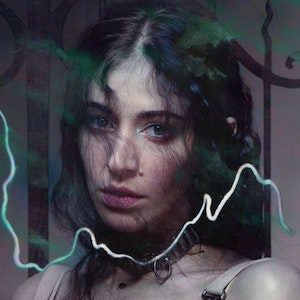


Wing Vilma Lets Nature Guide Self-Discovery on Spirit Practice LP

Photo Credit: Sidd Finch

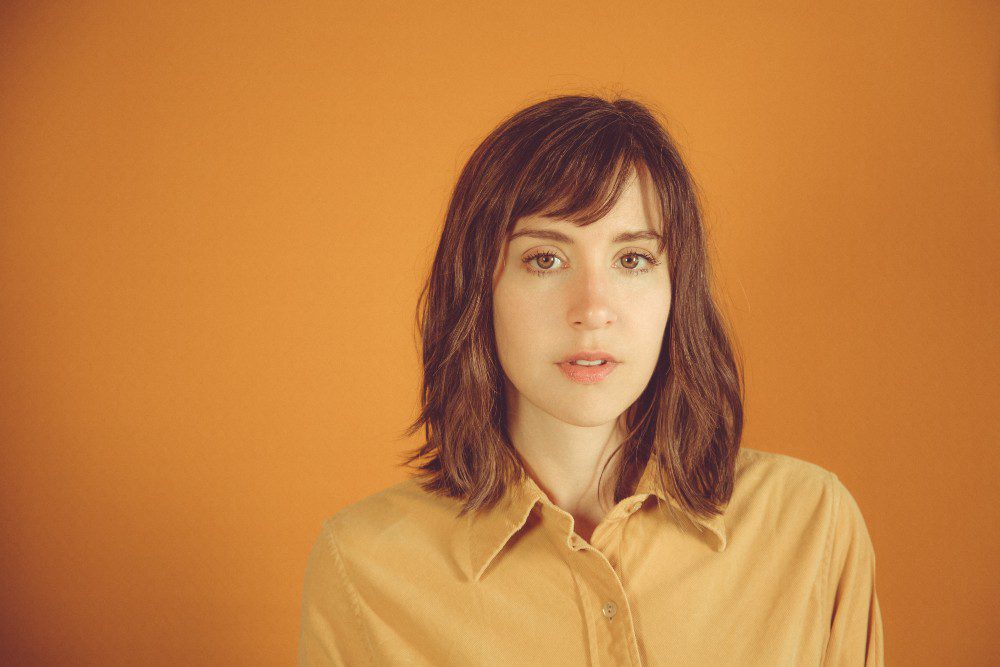
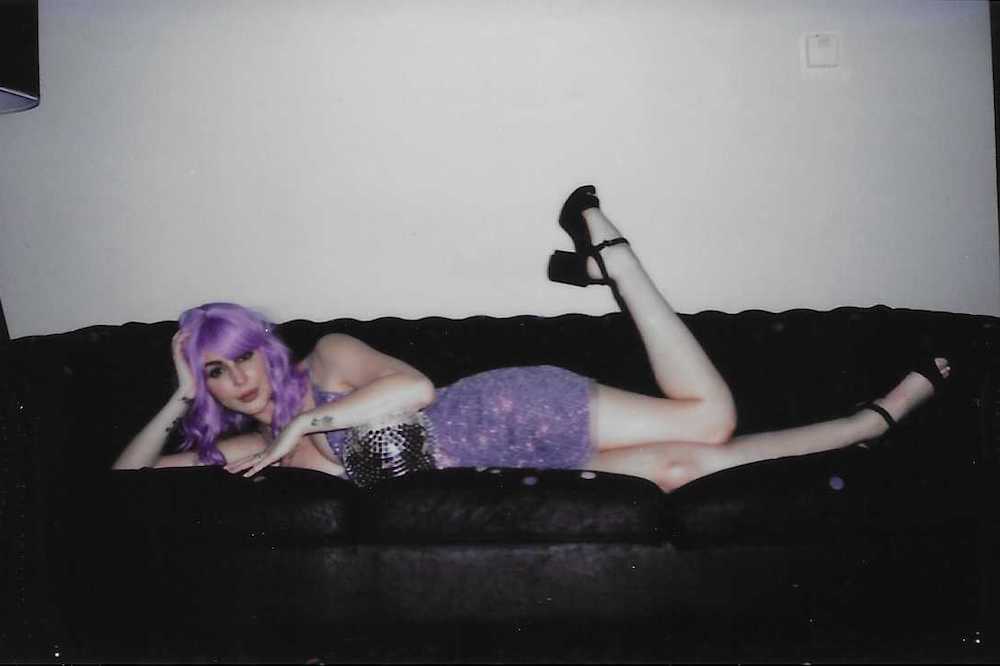
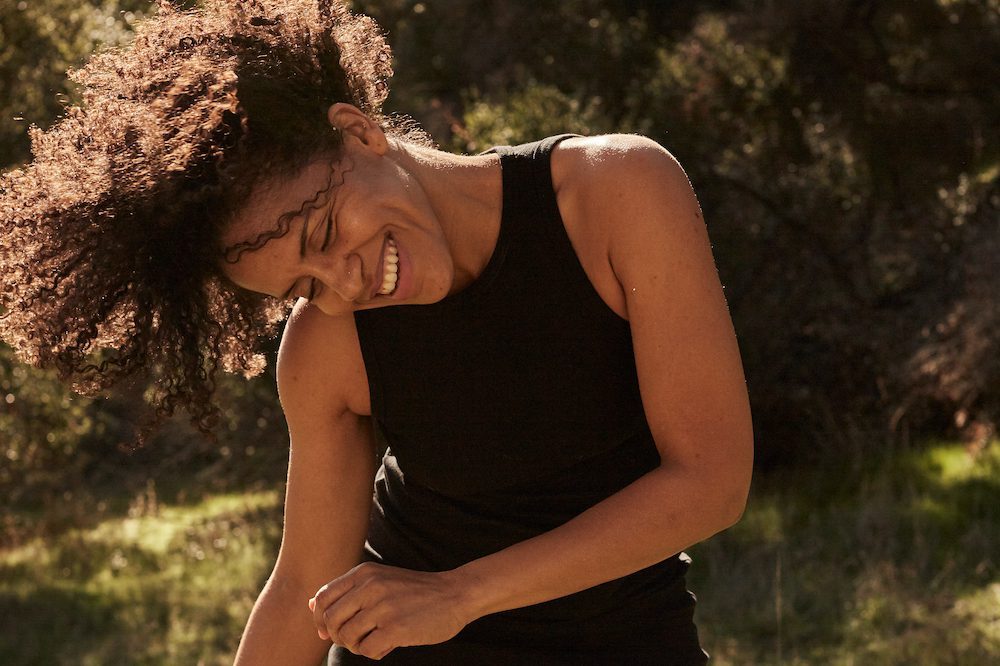
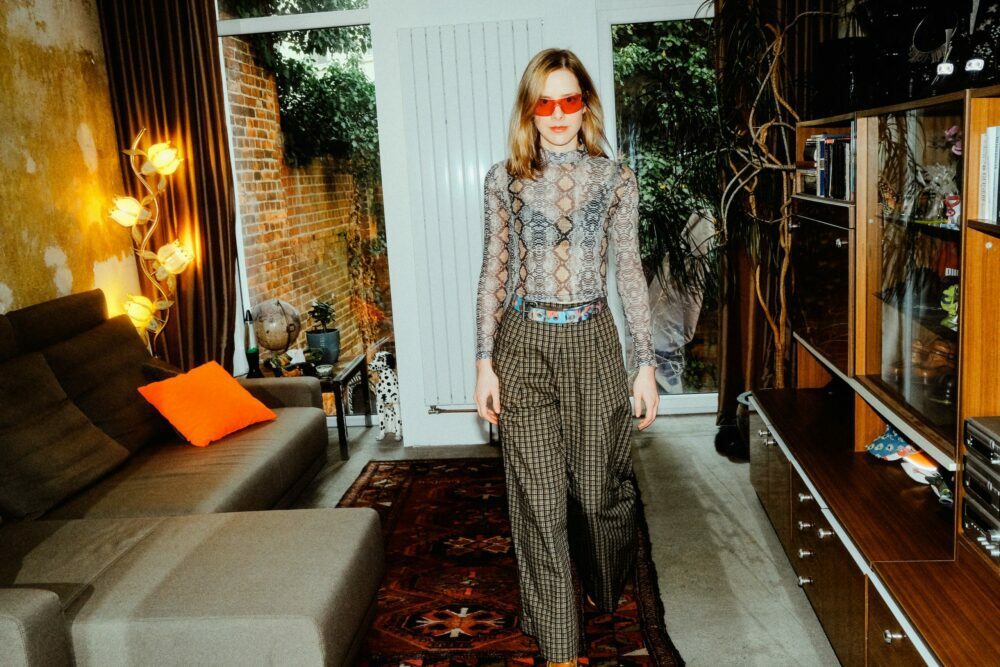
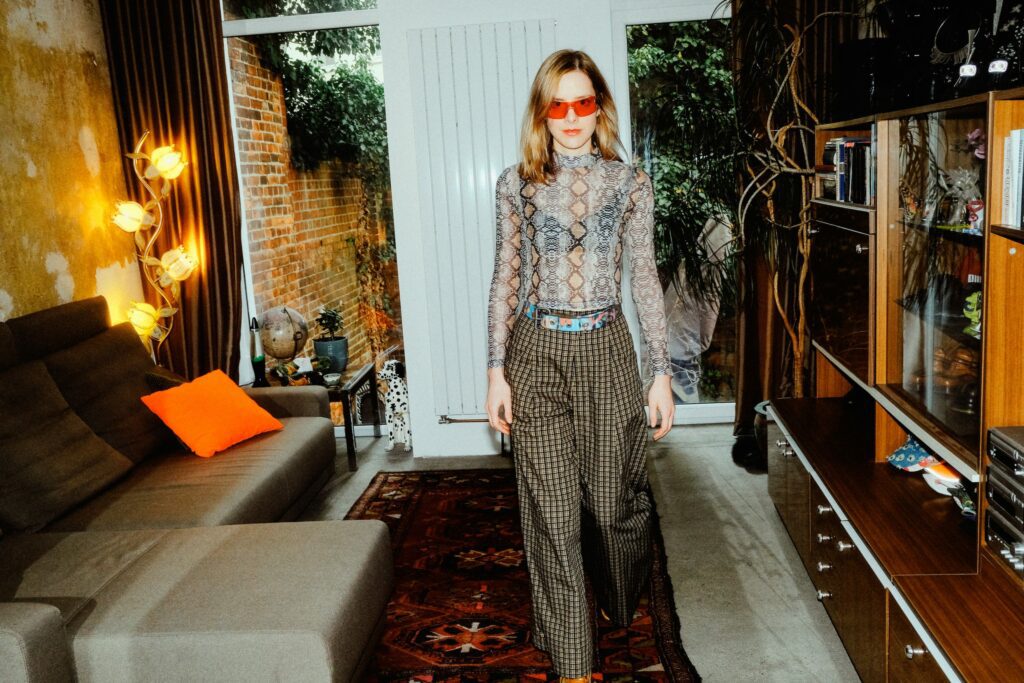
Milly Coleman of Wing Vilma has never been one to fight with nature. Instead, from early on in their life, they found themselves tuning into the complex and ever-present rhythms that nature has to offer – branches of a tree tapping a window, waves crashing to shore, their own footsteps brushing the ground as they walked home from school. On their sophomore LP Spirit Practice – released Friday, August 13th via Young Heavy Souls – Coleman explores how their own connection to nature has acted as a guiding force in both music and shaping their identity. 

Where most people see technology and nature as opposing forces, Coleman has spent much of their life fusing the two to make something beautiful. “I’m just obsessed with synthesizing organic sounds,” Coleman explains. “It’s almost like ASMR for me…I feel like there’s a really physical, tactile sense of pleasure and dopamine release that I have when I take the sounds of a forest and I run it through a loop so that the footsteps become the rhythm or whatever it might be.” Samples of nature can be heard throughout Spirit Practice in nearly every song, whether it’s a heavy rain or the cushion of a soft breeze. 

“Astrology Cup” offers the most outright sampling of nature, with its intermittent sounds of water flowing. The gentle reminder of one of Mother Nature’s most powerful elements builds a tension throughout the song, inviting the listener to meditate on this essential life source. Coleman explains that they approached much of making this record in the same way. “I truly don’t remember writing some of the things that came to define these songs,” Coleman says. “I feel like I’m just very meditative in these moments and I’m channeling something beyond myself.” 

The video, which premieres exclusively on Audiofemme today, gives a visual explanation of Coleman’s subconscious and conscious inspirations, and includes lyrics to a spoken word piece that was instigated by the song. It was filmed, directed and edited entirely by Coleman and encapsulates their DIY approach to making music and art.

A record three years in the making, Coleman says that time was as vital as any other instrument on the album. Giving the music space and coming back to it allowed them to reinterpret and build upon what they had started days, weeks, even months before. The time also allowed them to view their work and what it was saying from a bird’s eye view. “This record… before I even had a conscious realization… was about discovering myself,” Coleman says. “When I started some of these songs, I hadn’t even come out to myself as trans. I was in the deep, deep beginnings of understanding my own identity.” 

They explain that this body of work, more than any other, marked a significant time stamp in their life. They see a continuum of the same person they have always been, but also a marked difference in the identities and stages of their life. Spirit Practice tells this story through an ebb and flow of intensity and calm. The record’s title track welcomes the listener – and its creator – to look deep inside themselves, allowing all the noise to come and go, leaving one’s inner truth at the forefront of the mind. 

Moments of doubt and apprehension are communicated through booming percussion and dissonant tones – most noticeably in “You Don’t Know Arts” and “Thunder” – while effervescent melodies and buoyant rhythms signal lightness and peace in “GO!” and “I Wish.” Coleman uses what feels like thousands of different textures throughout Spirit Practice to tell a story of fluidity, change and self-assurance. And while each song contains a different palette of found sounds and meticulously manipulated synths, they are all tied together by Coleman’s masterful production. 

Though they started taking piano lessons at age six and are proficient on a range of instruments, Coleman has always felt most at home sitting at a drum set or constructing intricate rhythms on their laptop. “I think there’s always been a very strong, innate sense of rhythm in my body,” they say.The more I realized I could just appreciate the rhythms around me, [that] I didn’t have to fight them, I could just take them in… and create with them, that was liberating for sure.”

For this particular project, Coleman didn’t have access to their normal kit set up, and ended up sampling the sounds from their kit – and elsewhere – to create the kaleidoscopic beats you hear on the record. They admit that this method has made it especially challenging to repeat in a live setting, but that it has only pushed them to further expand their skillset as a drummer. “I’m really surprising myself with how far I’ve come as a percussionist,” says Coleman. “I really think I’m doing my best work ever now.”

It doesn’t hurt that Coleman also comes from a long line of musicians. They remember riding in the car with their grandma while she played orchestral music and quizzed them on which instrument was playing and in what key. She was the one to give Coleman their first synthesizer, a Roland Juno-106. “It’s a synth that I’ve heard used on some of my favorite records throughout my whole life, and for her to have been the person to [gift that to me]… is profound. I’m really grateful,” though Coleman says they are just as likely to improvise on pots and pans as they are on a legendary synth. 

This innate ability to merge worlds – artificial and organic, acoustic and electronic – is what gives Wing Vilma limitless depth and accessibility. And while the story Coleman tells through it is completely and wholly their own, their music invites the listener to impose their own life’s arcs and challenges onto it and view them from a meditative lens. After all, who doesn’t want to be the main character?

Follow Wing Vilma on Instagram and Facebook for ongoing updates.
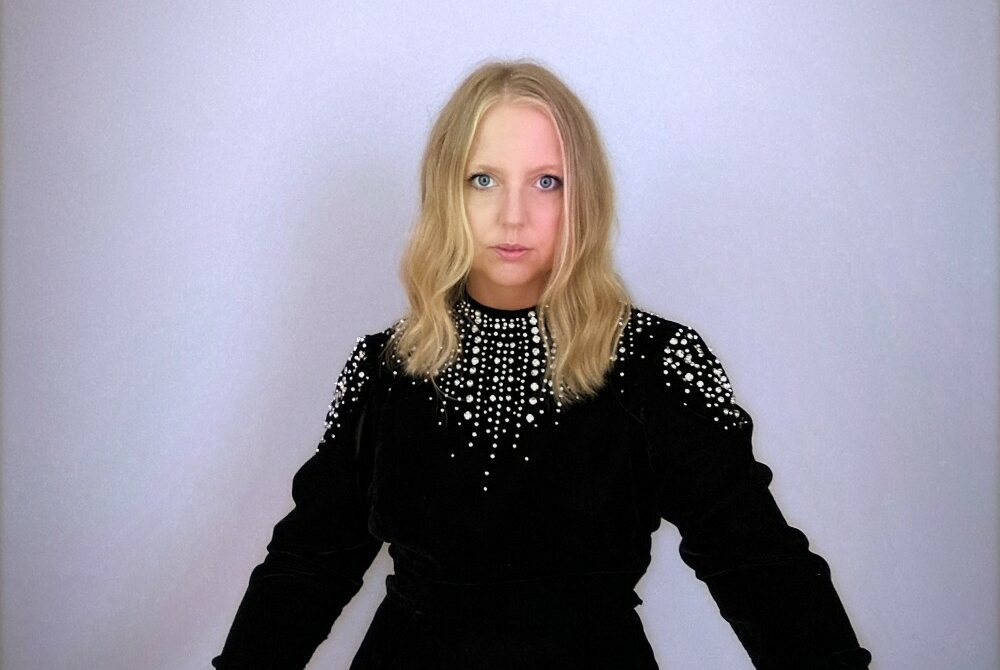
PREMIERE: Polly Scattergood Found Inspiration in Emojis for “Saturn 9” Video

Right before COVID-19 forced the world to lock down, Polly Scattergood had settled into a new recording studio. The warehouse space had been prepared to make and record music and, for the first time in a long time, her synths were all in one place. “It felt super exciting,” the British singer recalls on a recent Zoom call. “Literally, about a week later, lockdown happened.”

Fortunately, Scattergood was able to collect a few key pieces — speakers, a laptop, a keyboard and a guitar — before the U.K. shut down. As the pandemic closures persisted, she also released her third full-length album, In This Moment. While there was some promo to handle, it wasn’t the usual album cycle’s worth of activities, for obvious reasons. So, Scattergood retreated to her studio, now at home, and got back to making music. The result is her forthcoming EP, In the Absence of Light, out on September 15, made with collaborators Jim Sclavunos (Nick Cave & the Bad Seeds, Grinderman) and Glenn Kerrigan. 

Today, Audiofemme premieres the second single from In the Absence of Light, “Saturn 9.” The title is a play on the word saturnine. “Saturnine means gloomy and so we decided to write a song about emerging from this kind of darkness, this kind of gloomy heaviness, looking forward into a bright, hopeful positive space,” Scattergood explains.

“I wanted the video to represent the music in a way that everyone would understand and there were a couple of key lines that jumped out to me,” says Scattergood. One was “The hieroglyphics of our soul/We keep on moving/Time evolves.” The lyrics stuck with Scattergood as she tried to figure out how to represent them visually. 

She found inspiration in an emoji. “The smiley face emoji came into my head,” she says. “That represents the modern day hieroglyphic. It’s what we all send to each other.” Scattergood also wanted to incorporate dancing into the video because it was a song written during the lockdown. “I liked the idea of a group of friends being out, having fun, dancing together and looking to the future,” she says. “That’s where I went with it.” The clip, which she also directed, interjects the smiley face emoji, a symbol that could also serve as a reference to the rave heyday of the early ‘90s, between scenes of aerobics dancers cutting loose to the bouncy, synthpunk track outside in ‘80s workout garb. 

The rest of the EP came together over Zoom sessions between Scattergood and Sclavunos. “We would log onto our computers and just leave them running. Sometimes, I would go get lunch or do things and we would come back,” she says. “It was the closest that you could get to being in the room with somebody.”

The method gave way to a fruitful collaboration. “We wrote it all by the power of the internet, which is just a crazy concept, but it fed into the sound of the EP, I think, because there were these kind of glitchy moments of frozen screens and awkward interactions where you accidentally talk over each other,” she says. “That all added to the feel, I think, of this record. “

Thematically, they looked out into the universe, drawing inspiration from astronomy as well as the mythology that’s related to the cosmos. They wrote more than the four songs that will appear on the EP and, in fact, are continuing to write together.  

As for the recording, Scattergood says, “It was quite DIY, but I tried to embrace that.” 

Living near the sea posed an interesting dilemma for recording vocals. “You have to time it right because seagulls make loads of noise in the morning and the evening,” she says.

But, the ambient sounds may have impacted the EP in subtle ways. Scattergood notes that part of her process is recording sounds on her phone to help generate ideas. “I’m not classically trained in any way. I think in textures and layers. I will hear the hum of the road and use that noise to build upon,” she says. “I love soundscape, and in many ways, if we’re doing a vocal and a seagull squawks it’s annoying, but in many cases, when we’re just recording, I love those sounds.”

Scattergood says that the EP isn’t a major departure from her last album, but the nature of the collaboration with Sclavunos, who co-wrote two songs on In This Moment, evolved. “For this EP, it was very much a project that we embarked on together just to see what would happen,” she says. 

The collaboration has been a learning experience for Scattergood. “I think that having his involvement was very key because I needed somebody to stretch me in terms of the language I use,” she says. “He’s like a walking thesaurus.”

She adds, “I think that was really an interesting thing for me, having his input on the language side of things.”

Follow Polly Scattergood on Instagram, Twitter, and Facebook for ongoing updates.

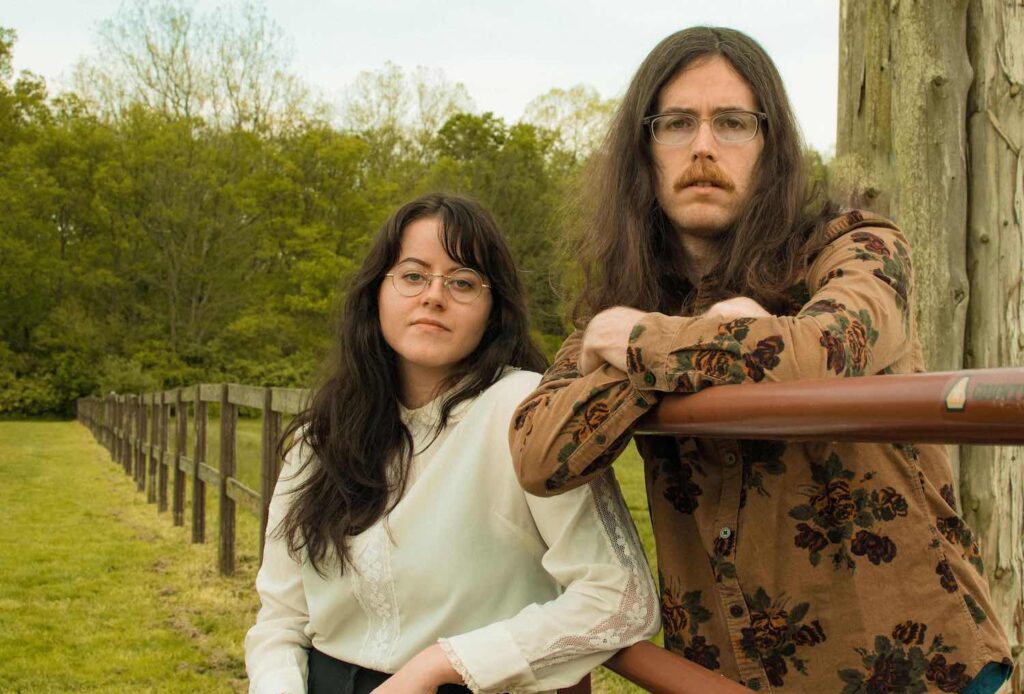
Dream Pop Duo Sungaze Honor Human Connection on Sophomore LP This Dream

Photo Credit: Dana Lentz

Sungaze makes a powerful return with their sophomore album, This Dream. The Cincinnati duo – comprised of husband and wife Ian Hilvert and Ivory Snow – combine cinematic swirls of shoegaze, psychedelic rock and dream pop on their new 8-song offering, released on Friday. Although it was created during 2020 – a year marked by feelings of isolation for many – This Dream is powered by hopefulness, unity in the human experience and the ways that togetherness prevails. 

“I had watched a few videos showing the people of Italy singing to each other from their balconies and found it really moving and beautiful,” Snow tells Audiofemme. “It got me thinking – even more than usual – about what it means to be a human being alive on this planet and what makes it worthwhile to be here. I think the answer is connection—to ourselves, the planet and each other.”

“I don’t know what the world will look like moving forward, but my hope is that it’s less divided, kinder and more loving,” she adds. “That’s always going to be my dream.”

Sungaze began as a four-piece band started by Hilvert, whose years of experience in a metal band shine through ever so slightly on This Dream. Snow joined Hilvert, drummer Tyler Mechlem and bassist Jimmy Rice as a temporary keyboardist, but soon grew into a fixture of the band in her own right. In 2019, the quartet released their debut album, Light in All of It

Now, as a solely husband-and-wife duo, Hilvert and Snow share vocal duties and benefit from their genre-blending influences. Here, Snow talked with Audiofemme about This Dream, the benefits and challenges of being a married couple as well as bandmates, what’s next for Sungaze and more. Read the full interview and stream This Dream below.

AF: Congratulations on releasing This Dream! What was your writing and recording process during quarantine like?

IS: Thank you! As far as recording goes, it actually wasn’t much different from our usual way of doing things—if anything, it was easier. We have a studio space about 10 minutes from our apartment where we do most of our tracking. A lot of other people use rooms in the building for various things and for most of 2020, it was a bit of a ghost town. Ian and I were really the only people there. It was nice to be able to record whenever the inspiration struck and to not have any distractions or other schedules to work around.

Writing was decently different—on the first album, it was mostly collaborative from start to finish, and this time, the collaboration really began in the recording stage. Ian was still working for the first half of 2020, so I had a lot of time to myself at home, and that’s where the bulk of the album was written—from our sunroom couch [laughing].

AF: Now that the album has been released in a post-quarantine world, have the meanings behind any of the songs inspired by or written at the peak of the pandemic changed to you in any way?

IS: I don’t think so! Most of the lyrical content is stuff we think and talk about all the time anyway. There’s really only one specific part that was directly influenced by the pandemic and it’s the section of “This Dream” that goes: “So uncertain/I stay open/To the changes of us/To the will to discover new/Ways of being and relating we/Are not bound by the tides of this time.”

AF: This is also your first album as a duo, as Sungaze was previously a four-person band. How has that changed your process?

IS: It’s definitely opened doors for us to explore new sonic territory. Some of the first album was written in a similar fashion to this one, but a good chunk of those songs came about through jamming out ideas with our previous drummer, Tyler Mechlem. We feel a little less genre-bound this way and were able to work a little quicker, since we can pretty much head into the studio at any time and start recording without needing to make sure other members are on board with whatever we’re working on. I do miss having a full band, but it’s also been enjoyable to work in this stripped-down, more intimate way. It feels kind of sad and kind of freeing at the same time.

AF: What made you choose the title This Dream, and what role did dreams play in the making of this album?

IS: We chose the title shortly after the song “This Dream” was written, sort of on a whim. Some people have assumed we’re talking about sleep dreams, but the dream we’re talking about really has nothing to do with being asleep and everything to do with being awake. It’s the dream of people coming together, having what they need, being cared for and finding a stronger path forward that is more in sync with the planet we live on. It’s also a nod to our personal dreams and goals for this project: “Every dime I have in me/I’ll gamble on this dream.” Maybe someday we’ll share just how true that line ended up being. 

AF: What are some of the challenges and some of the benefits of being a husband-and-wife duo?

IS: The biggest challenge is it’s sometimes hard to compartmentalize the different sides of our relationship. When we’re working together, we do our best to be professional and objective, but sometimes feelings can get hurt and that can leak over a bit into our romantic life together. We’ve done a lot of work, over the last year especially, to separate the two. Also, lots of practice at being straight up and honest with each other, which is something I’ve tended to really struggle with in general because my least favorite thing in the world is disappointing people. 

Benefits – we’re very comfortable around one another and trust each other’s judgment. We know how to motivate and inspire each other, and we usually have a lot of fun while working on things together! 

Another big one is since we spend so much time together, we understand each other’s communication style very well and often just sort of know what the other is wanting. If I tell Ian that I’m hearing a specific guitar line, but I don’t have the vocabulary to describe it exactly, I can just give him a few words or a general feeling for direction and nine times out of 10, what he plays is exactly the thing I was hearing in my head. 

AF: Which instruments did you both play for this album, and were there any unique sounds/instruments featured on this album that you hadn’t used before? 

IS: Ian sang and played guitar, percussion, keys and bass, and I sang and played guitar and keys. Prior to this album I hadn’t written anything using guitar, so that was new for me. Besides that, there’s a squeaky sound towards the end of “Look Away” that almost sounds like a synth, but is actually the sound of my microphone rubbing against the pair of leggings I was wearing when I recorded my vocals for that track; it was initially an accident but we liked the way it sounded so we ended up adding in a few more.

AF: Are you planning to release any more videos in support of the album?

IS: We are working on a lyric video for “This Dream,” which will probably be out in a couple of weeks. 

AF: Do you have any shows coming up?

IS: We’ll be at the Hi-Fi in Indianapolis on October 29 to support our friends Fern Murphy for their album release, very excited for that! We may have a few local shows between now and then and are looking forward to eventually returning to touring.

AF: You recently signed with BMI to license your music for commercial and film use – are there any specific shows you’d love to see your music featured in? 

IS: It’s not a show, but I saw that there is a Legally Blonde 3 in the works and I would love to have “Body in the Mirror” on the soundtrack for that. Our favorite sorts of shows are usually in the coming-of-age, drama, fantasy or mystery categories, so pretty much anything that falls under any of those would be really neat—if it were fitting, having a song in Stranger Things would probably be at the top of the list. And if we could time travel, being a part of the Twin Peaks soundtrack would be a dream come true. 

Follow Sungaze on Instagram and Facebook for ongoing updates.
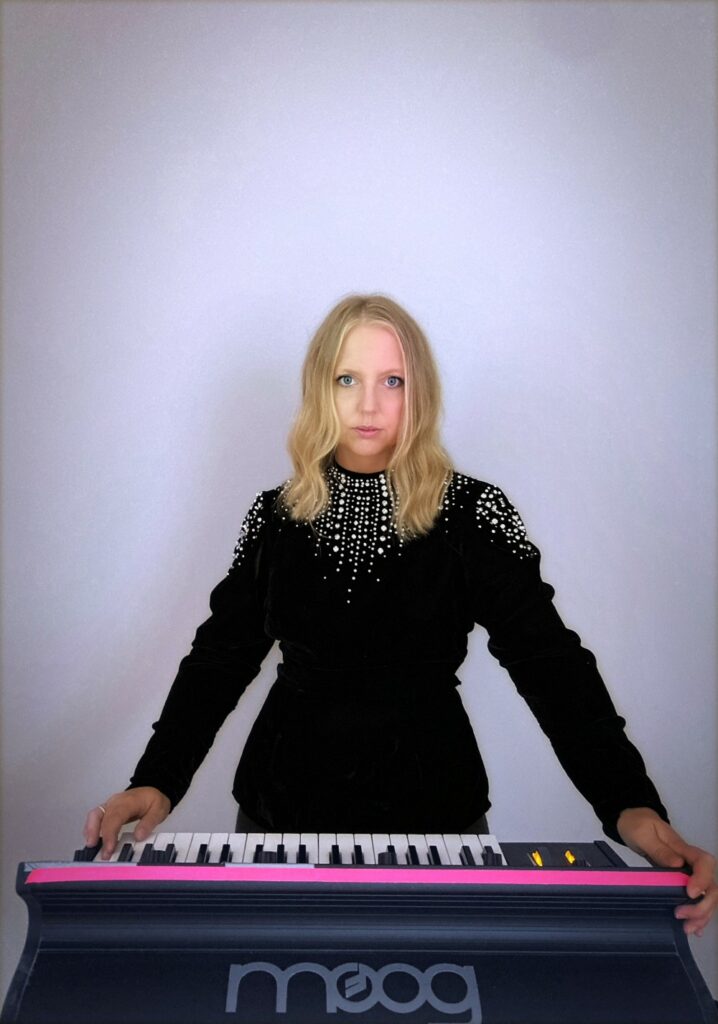
Queer Acceptance and Electronic Body Music Meet on Forthcoming Brixx EP Conversion Therapy

Photo Credit: Nicole Reed Photography

Sabine Brix – best known as Brixx – isn’t afraid to plunge into the dark and embrace the sense of being lost and alone in the moments it takes to adapt to a new reality. The Melbourne music producer, composer and DJ repeatedly disorients and recalibrates herself – and listeners – on her forthcoming EP Conversion Therapy, out September 20 via Heavy Machinery. Despite the title, it’s not specifically about the brutal, enforced measures taken to try to deny people their sexuality, but it definitely addresses the liberation in accepting queerness in a world that is mostly designed for, and by, the heteronormative.

“I’ve had absolutely no experience with conversion therapy,” Brix clarifies. “It’s about transformation… I suppose it’s about embracing queerness and moving away from the perception of who we think we should be to evolve into who we actually are. So, it’s a transformation and a conversion of self.”

Born and raised in Melbourne to German parents, Brix’s queer identity emerged in her formative high school years. While other girls had plastered their school diaries with images of muscle-bound men from Manpower (“Australia’s Thunder From Downunder”), Brix’s choice of adornment provoked questions from fellow students.

“I had Drew Barrymore and thought it was strange that they all had men on their covers and I’ve got a half-naked woman on mine,” she recalls. “What’s wrong with that? But I remember a friend asking me, ‘Are you gay?’ and I said, ‘Well, no’ but I was quite defensive. Why was there this defensiveness, why wasn’t there more an openness? Like, maybe I am?”

It wasn’t until after high school that she understood and embraced her sexual attraction to women, freed of the claustrophobic ideas of what a gay woman might look like, or act like, since the only openly out girl at school was androgynous-looking and there were no other evident role models. Eventually, music became a tool for expression.

“I’m quite influenced by Electronic Body Music, techno, New Beat, breaks; anything with heavy percussion and a heavy bass line, that’s always at the forefront of what I do,” she says, adding that she’s constantly asking herself, “How do you express yourself emotionally without using the voice? I think that’s why I was interested in cutting up samples and having some references to homosexuality and pain, different little bits and pieces so that it’s audible that this is a queer release, so they dig a little deeper. Often with electronic music, if there’s no vocals or samples, you don’t know what that person is trying to achieve.”

In May last year, Brixx unleashed five tracks of darkwave-meets-New Order ferociousness via Parfé Records, in the form of her debut EP Corporate Punishment. If the Cocteau Twins were asked to DJ a warehouse rave in a dungeon, it might sound something like the icy stab of synths on “Mansplainer.” The robotic voice that injects its unwelcome opinions sums up the experience of being the victim of mansplaining perfectly.

Conversion Therapy is much more lush, atmospheric and dynamic than its predecessor; its first single “Double Axe” is immediately more inviting and enveloping than the snarling chill of Corporate Punishment. Though Brix’s signature dark undercurrent courses through, snaking invisibly around the basslines, there’s also a sense of romance and brief glimpses of ecstasy. Fans of Depeche Mode, Belgian electro act Front 242 and Ministry might hear remnants of those influences in the reverberating, haunting synths, that repeat like a mantra – hypnotic and somehow soothing.

The EP came together in three months, which was the time frame demanded of her by Flash Forward, an initiative of the City of Melbourne and the State Government of Victoria, in which 40 musical acts were partnered with a visual designer each to release a vinyl album through Melbourne label Heavy Machinery Records. Physical copies of heavyweight 12” black and white marble effect vinyl EP featuring original cover art by Bootleg Comics will be available in limited edition of 300. 

“The Flash Forward project came up really quickly. I had to create an EP within three months, when my previous EP took two years. I thought, ‘I have no idea how I’m going to manage this!’ becauce I only had one track,” Brix says. “It really forced me to push myself and… I think people would be surprised at what they can do when they’re faced with a challenge.”

Brix relied on her abilities as a storyteller – she studied film scoring in Sydney for a year, and her professional background is in journalism and writing, though she left full-time writing work five years ago – to communicate ideas and create a narrative within sound. Over four tracks, Conversion Therapy tells a story with an overriding theme of acceptance and celebration of queerness.

Beginning with “Shock of the New” – a cinematic ode to exploring sexuality for the first time – the story doesn’t follow a clear trajectory, exemplifying the “rollercoaster ride” of coming out and embracing the self. A fan of David Lynch’s ambiguous masterpiece Mulholland Drive, Brix made some elements crystal clear, but there’s so much left up to interpretation, too. The final track on the EP, “Metamorphosis,” features her friend, DJ and producer Black Dahlia. The track is eerie, driving and dark. Brix was aiming to instill a sense of uneasiness in the immersive and hypnotic drone that reverberates through the track.

“I really wanted it to be a journey in terms of coming out and then going towards self-acceptance. There’s a sense of hope closing it out, so that it’s not all kind of dreary,” Brix says. She met Black Dahlia last year, connecting over their mutual love of Electronic Body Music. They began to send each other WhatsApp voice mail messages, which they still do: snippets of vocals, found sounds, snatches of basslines.

“We like to create music where we’re making ourselves vulnerable,” says Brix. “I sent her a particular bassline, and told her some of the themes of the album, and she just came up with these vocals. She kept repeating this one line, ‘You tried to bury me, but I’m the seed’ and I just thought that was really beautiful and really played into the ways that I felt about coming out… burying toxic relationships… or homophobia. But then there’s also this uprising that can occur once you discover who you are.”

Follow Brixx on Instagram and Facebook for ongoing updates.
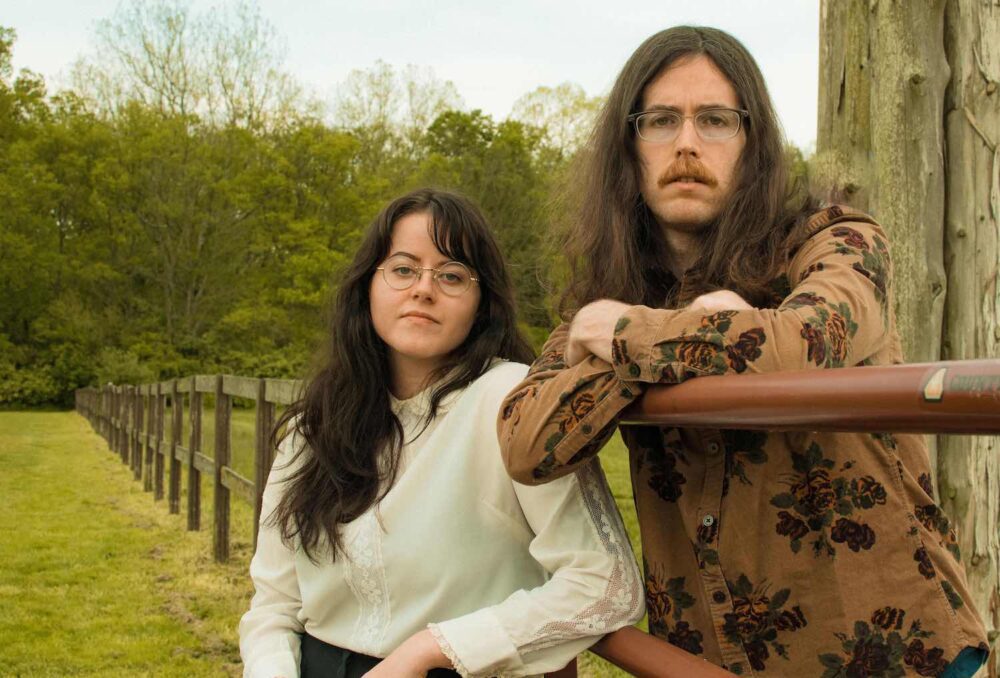
Seattle Hosts Its First-Ever International Reggae Festival

Seattle-based reggae artists Black Puma and Clinton Fearon. Photo courtesy of Black Puma.

This Saturday, August 14th, The Canal in Ballard hosts the First Annual Seattle International Reggae Festival. Founder and promoter Jeremiah Blake, known in the music world as Andrew Hype, promises a fun, family-friendly experience of reggae music, art and culture and, if all goes well, hopes to make it an annual tradition. “It’s like the new birth of a new baby. We going to watch it grow, you know?” says Blake. “Just expect great food, great music, great artwork.”

Hosting this festival shows just how far Seattle’s reggae scene has come. When Blake first moved to Seattle in 2001, there were hardly any Jamaicans in the area, except for a few pioneering Pacific northwest reggae artists like Clinton Fearon, who helped establish a local scene. But in the last twenty years, the number of Jamaican immigrants in Seattle has grown steadily, and as a result, Afro-Caribbean musical styles like reggae have become more prevalent.

“Everyday I see more Jamaicans coming to Seattle. Seattle’s a good place to live so you find more people gravitating to Seattle,” says Blake. “I got here in 2001 [when] the reggae scene was a bit shaky, like, you could find one reggae spot. It’s grown massive, huge, since then. You can find reggae actually every day of the week now at places like Red Lounge and Havana.”

Still, Blake had never planned to do a festival until the pandemic hit, forcing everyone to quarantine. Blake says the inability to get together and perform took its toll on the community reggae musicians and promoters had been building, so when restrictions on gathering loosened, he was inspired to put on a new festival and offer artists a fresh way to be together.

“The artists, they are having cabin fever right now, they’re trying to do their thing,” says Blake. “And we promoters are so in the same mode. We’re longing to see artists on stage and getting back to normal. As we get opportunity now for events and stuff like that we going to take this first opportunity to bring forward a reggae event.”

This isn’t just any reggae event, either—it’s truly international, and Blake says there will be opportunities for festival-goers to meet and greet with certain artists. For instance, international reggae star AJ Brown, of the legacy Kingston-based reggae band Third World, will be performing, as well as New York-based reggae artist Taj Weekes, Portland’s Jubba White from Dubtonic Kru, and Trinidad’s Dakeye are all slated to perform.

Additionally, the festival will feature a solo performance from Seattle-based reggae artist Nkrumah Miller, also known as Black Puma, and a member of local reggae band Irie Lights. Similar to Blake, Miller moved to Seattle in 2001 and, with his soulful blend of hip hop, fusion, reggae, dancehall and Reggaetón, has found a sizable following here in Seattle.

“The reggae scene at this point in time is alive. There’s a lot of bands out there and a lot of people loving it, especially the roots and reggae music, it’s booming,” says Miller. “And it’s not only happening here, but across the state.”

Music starts Saturday night at 9 pm, but starting at 12 pm that day, AJ Brown, who is also an accomplished visual artist, will be leading art classes for all ages called “Paint n’ Sip.” Ticket pricing for the festival is offered at different levels depending on whether you attend both the painting class and the show, or just one part of the festival. Additionally, there will be Jamaican food and vendors for attendees to enjoy.

“I am also a chef. We do catering and pop-up Jamaican cuisine,” says Blake. “Most of the [reggae] events and shows in Seattle you can find my food there.”

Regardless of how much of the day you decide to spend at the festival, Blake and Miller promise there will be plenty of “positive vibes” to go around.

“I’m excited to see the people, the interaction of the people, the kids, the families, and the good vibes after this Corona virus and quarantine keeping us from enjoying the natural music of life,” says Miller. “Now we have an opportunity at this event that’s bringing us together. It’s a blessing, mon, and I’m looking forward to performing.”

Follow Andrew Hype on Facebook for ongoing updates about the First Annual Seattle International Reggae Festival and other events.

At Nashville’s National Museum of African American Music, Culture is an Immersive Experience

Photo credit: National Museum of African American Music

“Music is a part of someone’s identity.” This message is one of the first to greet visitors upon entering the Roots Theatre inside the National Museum of African American Music in downtown Nashville. It’s a message that can be felt throughout the museum, beginning with a film introduction that explores the deep roots of music from its origins in Africa, tracing its evolution to present day as part of the museum’s purpose to “tell the story of how a distinct group of people used their artistry to impact and change the world.” At video’s end, the doors to the theatre magically open, inviting visitors into a vast world of music and culture that lives behind its walls.

Inside the “Rivers of Rhythm Pathways,” interactive tables allow you to explore Black music by decade, learning how music was used as a tool by slaves to communicate with one another, as demonstrated by “Wade in the Water,” a spiritual that Harriet Tubman would sing as she helped slaves escape on the Underground Railroad. Music acts as a thread, connecting generations to the Civil Rights movement in the 1960s through the hip-hop movement of the 1990s; patrons can even take the music home with them via a digital bracelet that compiles the songs you listened to into a playlist.

At any given moment, music will start bouncing off the walls – literally. A video displaying live footage of an incredible blues guitarist performing at B.B. King’s Blues Club guided us from “Rivers of Rhythm Pathways” into the other exhibits covering their own piece of history, ranging from “Crossroads,” which chronicles the history of blues music born in the Mississippi Delta, to the music of the Harlem Renaissance and Civil Rights Movement, completing the journey to modern day hip-hop and rap. While exploring these individual moments in history, as a country music reporter by trade, I couldn’t help but notice the cross-genre connections, particularly when seeing a photo of Academy Award nominated actress and hit blues singer Ethel Waters in one of her extravagant outfits, calling to mind the lavish ball gowns later worn by Loretta Lynn and flashy costumes Dolly Parton is famous for. 

The “Rivers of Rhythm Pathways” exhibit at NMAAM. Photo credit: National Museum of African American Music

What makes NMAAM particularly compelling is the interactive element of the exhibits. In the “Crossroads” gallery, visitors have the chance to play a choose-your-own adventure game where you’re presented with a story of a woman living in rural Mississippi who must make a fight-or-flight decision as a flood threatens to destroy her home, or you can choose to follow the blossoming love story of a young couple in Chicago in the mid-20th century, the power lying in the user’s hands as to what decisions the characters make, with music guiding the story along all the while.

One interactive feature that became a personal favorite was a digital wheel displaying prominent artists throughout history including Billie Holiday, Nat King Cole, Ma Rainey, Sister Rosetta Tharpe, and Elvis Presley among several others, revealing what musicians they were influenced by and how they inspired other artists. It’s here I got to take pause and absorb the haunting melody and words of Holiday’s powerful “Strange Fruit,” yet feel a sense of calming and peace hearing King Cole’s soothing “Smile” and “Unforgettable,” becoming fully immersed in their timeless voices. 

While NMAAM mostly focuses on the brilliance of Black artists and how the music they created moved culture forward, there are still glimmers of the pain and strife inflicted upon Black Americans, as told through a photo of a young woman screaming in terror as she escapes a riot in NYC in the ’60s, while another picture of a threatening sign that reads “we want Whites in this Whites only community” with an American flag perched next to it was particularly chilling, serving as a stark reminder that we still have a long way to go as a country when it comes to racial healing and equity.

But perhaps the best part of NMAAM is the makeshift dance club that’s at the heart of the museum. One can’t help but stop and join the crowd gathered around the room where patrons inside are dancing to Michael Jackson’s “The Way You Make Me Feel,” Montell Jordan’s “This Is How We Do It” and “Love On Top” by Beyoncé, their digital profiles projected onto a screen so they can see their moves on playback in real time. A few steps away, guests can keep their creative juices flowing in a music studio where they have the opportunity to become an artist themselves, creating their own beats and raps in a mock recording booth. It’s these types of feel-good elements that makes NMAAM stand out from other museums. Going beyond the typical format of objects displayed behind glass, instead bringing the history of the artifacts to life, all while creating a sense of community, elevates the experience. The soul of music can be felt inside this institution that conveys how Black music is not only an integral part of America’s identity, but that of the world at large.

Follow the National Museum of African American Music on Facebook, Instagram and Twitter for ongoing updates.

PREMIERE: Oompa Celebrates “Feeling Like a Bad Bitch” With “Lebron”

Photo Credit: Ally Schmaling

Boston-based rapper Oompa makes music as empowering as it is energizing and sonically unique, and her latest single “Lebron” is no exception. In the beat-driven track, her powerful voice raps about independence, confidence, and trusting yourself. “I’m the judge/And the jury/And I call it how I see it,” she declares in the first verse, going on to interweave biblical and basketball references alike into an upbeat self-esteem anthem.

Oompa came up with the idea to sing about pro basketball player Lebron James when she was contemplating who embodied “that feeling of feeling like a bad bitch,” she explains. “I was like, who must feel like a bad bitch all the time? It’s between Drake and Lebron — it’s got to be Lebron. It doesn’t matter what conversation Lebron is in — he just seems so unaffected by people’s opinions, and he outperforms himself. It seems like he’s always in competition with himself.”

She aimed to give a sound to this stance of being who you are and not worrying about anybody else through punchy drum patterns and a strong bass track. “I was like, when I’m in the club, I want to feel this tickle my sternum,” she says. She also incorporated sparse, sometimes nonsensical lyrics that flowed naturally without much thought — a style she’s applied to the whole of her forthcoming album Unbothered, which comes out October 1 and includes “Lebron.”

“I just wanted this whole project to be about fun for me,” she says. “It’s about removing this pressure to be a better lyricist or songwriter or have a better production team — all the things that suck the life out of making music. I never give myself that space; I’m super precise. [But here] I give myself permission to say things, and I think that comes through in the record. It feels fun and like summertime vibes.”

That would just as accurately describe the video for “Lebron,” which features Oompa shooting hoops and dancing on the basketball court with friends. “It’s really about seeing the city come together and having a great time on the court,” she says. However, it also alludes to the story of how the rapper got her stage name. “I used to play basketball at Washington Park, and all the older kids would call me ‘Oompa Loompa baby’ because I was short and chubby,” she recalls. This, for her, was a Lebron moment — not just because she was playing basketball, but also because she put herself out there and didn’t worry about what other people thought.

In a broader sense, her upcoming album revolves around the concept of joy. “Joy as aliveness, joy as a commitment to being on Earth, and also this idea that joy is not a constant; it is not a thing that once achieved, you get it forever, but it is about the commitment to the pursuit of it and finding joy in the pursuit,” she explains.

Her latest single, “Go,” for instance, captures the kind of sound you might hear by the pool on a tropical vacation, with dreamy synths, warped vocals, and a catchy R&B-inspired tune as she sings about the bliss of a new relationship that nevertheless seems doomed from the outset. Paying homage to funk and soul, the song was inspired by a moment Oompa shared with a partner. “We were in a convertible with the top down, and I was like, where are we going? And at the time, I was just completely avoiding all the red flags with a particular relationship and was like, we’re just gonna have a good time. It’s the summer, the top is down, we’re just gonna go ’til we can’t go no more,” she remembers.

Oompa recorded her latest music in a home studio she set up during the pandemic, where she honed her improvisational style. “I free-styled it four bars and free-styled it another four bars and wrote another five bars, and this was a process of letting go and not being so meticulous and feeling what it means to embody this place I’m in,” she says. “The process was a lot of freestyle, a lot of carelessness in the way that I needed.”

She’s currently working on several music videos as well as a short film to accompany her album. Outside of her music, she’s an activist for LGBTQ+ rights and currently serves on the leadership council for The Record Co, which provides affordable workspaces for emerging musicians in Boston, particularly queer artists and artists of color. The organization is “trying to understand the barriers between music makers and their music,” she says. “One of the biggest things we’d talked about was how hard it is to make music in the first place.”

In her own musical journey, Oompa has surmounted obstacles by being true to herself and following her passions. She began by rewriting Eve and Left Eye lyrics in her journal and rapping them, then joined rap battles in middle school, got into spoken word poetry in high school, and started performing on stage in college. “I was so afraid to perform, but I was like, I’ve got such a burning passion for it,” she remembers. She met some friends who help her put out her first mixtape and has continued to chase whatever she feels excited about – in true Lebron form.

Follow Oompa on Instagram for ongoing updates.

Mega Bog Traverses Unpredictable Terrain on Fourth LP Life, and Another

Photo Credit: Jasper McMahon

Mega Bog, the enigmatic musical project of Erin Birgy, have released their fourth album, Life, and Another, on Paradise of Bachelors. Written in New Mexico, Nevada, and on the road, Life, and Another traverses an otherworldly musical landscape, culminating in fourteen songs of tender and disruptive sonic mastery. Birgy’s songwriting expertise is evident in each track as she investigates a certain mercurial tension through lyrical and a jazz-like erraticism. Confident in its lack of convention, the album exists as its own living entity, shifting in form and feeling, sighing and swaying in and out of each individual track. 

Life, and Another was created in collaboration with Aaron Otheim, Zach Burba of iji, Will Segerstrom, Matt Bachmann, Andrew Dorset of Lake, James Krivchenia of Big Thief, Meg Duffy of Hand Habits, Jade Tcimpidis, Alex Liebman, and co-engineers Geoff Treager and Phil Hartunian. When asked how Birgy sustains her personal sonic vision while allowing creativity and inspiration to be sourced from other artists, she says, “I know we all want to deliver music in a similar way – affecting, and timeless… I feel honored by my friends/bandmates for giving so much to understand where I’m coming from, and giving me a platform to explore.” All of this of course requires trust, which Birgy says she has struggled with in the past. But she’s been able to form a special language with her collaborators. “It’s hard not to feel or understand where everyone is at and what we want,” she says. 

Birgy was deeply impacted by her environment while writing and recording Life, and Another. Dwelling at first in Embudo, New Mexico, the artist spent much of her time in surrounded by beautiful but unforgiving terrain along the Rio Grande, sparsely inhabited and assailed by extreme weather. Birgy found freedom in frequent hiking explorations, “…exploring the arroyos or river, or far away bars alone,” but sometimes felt unsafe and remained wary of her surroundings and the way they affected her. “What if I was stung by a tarantula hawk, fell into an unmanageable current, or followed home by someone?” she often asked herself.

The experience was painted by a sense of isolation while her partner Krivenchnia was away on tour. “I didn’t have many people checking up on me, sometimes for days,” she says. “So the times I stayed in the house, I could read, paint, jerk off, clean, or play guitar.” After leaving Embudo, Birgy embarked on a largely solo road trip, which allowed her to gain experiences but was also at times frightening. “I have to play or write because I’m going to be way too scared sleeping in the gas station parking lot by myself… Writing this music saved me from fully losing myself in times of overwhelming fear,” she says; music once again brought her back to herself, as it so often does. “It reminded me I had an identity, good things to offer, magic to survive.” 

Birgy’s sometimes harrowing cross-country travels gave way to the worlds she creates as Mega Bog, and her latest album feels both real and tangible but also deeply mythological in nature. “We all have so much power when we think or speak. We are worldbuilding, and must take that seriously because our worlds are vast and shared with rocks and june beetles who are also editing the story as we go,” she says.

The songs seemed to almost tumble out; after recording these ideas quickly as voice memos, the bulk of the album’s creation process was rebuilding the songs while staying true to the original spark of inspiration. Birgy worked to present the full scope of the idea, reconstructing complex thoughts through layers of instruments and tones. “The hard part is being able to present that blip in a recording, because so much has changed from writing to recording,” she reflects.

The sonic world of this album is semi-supernatural, which can be evoked by the Star Trek-referencing wordless track “Darmok,” a song which conjures the imagined feelings of arriving on an unearthly planet, an unintelligible Garden of Eden, or a long and slow walk towards the last light. Psychedelic rhythms pop and drawl in and out of the songs in an idiosyncratic yet perfectly timed sway. It’s mystifying how Birgy balances disruption and hypnosis throughout the album. In the last song she sings, “Watch me roll an office chair onto the balcony,” a seemingly dull and absurd gesture. But the phrasing is soaked with mystery, tension, and some grotesquely complicated interpersonal dynamic. “So much of this album focuses on attachments, reevaluating perceptions and roles, expectations,” Birgy explains, remaining somewhat cryptic.

In the past, critics have claimed that Mega Bog’s music is ambiguous and at times impenetrable. It’s critical that we understand there’s a line between creating music that explores a person’s experience for them, versus writing to purely build relatability with an audience. When listening to Life, and Another, it’s hard to feel as though the album isn’t deeply intentional, and that every reference, no matter how bizarre, does have meaning, if only we can find it. “It can be difficult to make music that works for everyone out there, especially if you’re presenting work that’s true to yourself,” Birgy says. Instead, she’s participating in a clear excavation, burrowing into experiences and coming out with truths, however strange they may be. “It’s always been my intention to present something that could inspire something wild in others.”

If we can find that place in between confusion and understanding, Mega Bog’s music opens into a sphere constructed of deep vulnerability, where we can see the small details of a stranger’s life, and even allow the sounds themselves to transport us into her world. With each phrase, Mega Bog builds something distinct, a willful invitation to a new place to land. “I accept the responsibility of a storyteller, by being made to dig deep and understand the words and tales and possible outcomes that we choose to share with others,” Birgy says. Replete with stories, openness, depth and something very close to truth, Life, and Another is a world all its own. Birgy adds, “The story of this record is never ending – even I’m learning that.”

Follow Mega Bog on Instagram for ongoing updates. 

spill tab and Tommy Genesis Team Up for High-Speed Single “Indecisive”

Photo Credit: Jade Sadler

LA-based French-Korean artist Claire Chicha, better known as spill tab, sometimes derails during monotonous tasks, or has a hard time choosing between seemingly endless options. But there’s two things she’s sure about: Oatly is the best oat milk, and she needed the perfect collaborator to rap on her latest track, “Indecisive.”

As with previous releases, including recent singles “Anybody Else” and “PISTOLWHIP,” spill tab tapped mononymously-known David Marinelli for production duties; since the two high-school friends reconnected in 2018, Marinelli has been her main collaborator. “We reconnected when I was out in college. I trust him so much with his choices. At this point he knows what I like and what I don’t. It makes things run more smoothly. He is my go-to number one,” she tells Audiofemme.

But “Indecisive” needed something extra. “Marinelli and I started ‘Indecisive’ together. We wanted to make something with dummy fast drums, breakbeat style,” she says. “We had all the sections we wanted but were missing a verse, and I just really wanted someone to rap over it and go hard.” That’s where buzzy Canadian rapper/model/visual artist Tommy Genesis comes in. With Genesis’ sophomore album goldilocks x about to drop and a spill tab’s EP on the way – not to mention each artist’s unabashed individualism – the match made perfect sense.

“I think my team sent the song over to Tommy’s camp and she loved it and was down to hop on it. I’ve been a phat fan of her, so it was a divine match made in heaven,” spill tab says. “She literally went into a studio for one day and cranked out that shit.”

The song starts with spill tab harmonizing to a melodic spacey background, then quickly transitions into a high-speed rhythm with percussion. Racy, raunchy and fast, Genesis drops her rap verse after the first chorus. Spill tab signs off again with “So fucking indecisive/big debates inside my mind/and I don’t wanna fight/aggressive/but you love to test it.”

In October, spill tab is set to headline The Echo before heading out on tour with Gus Dapperton. The dynamic singles spill tab has released thus far are only the beginning for the lifelong music lover, whose parents ran a post-production company together, doing everything from recording orchestras to working on dialogue in film. “I was lucky to have music in my life as a kid. My dad was a jazz musician and my mom still plays,” she says, and she always makes time to listen to her mom play piano and harp, adding, “I love to vibe to her.”

With tons of unfinished fragments still floating in her Notes app, her mother is a reminder of why she brings those notes to life. But spill tab takes a different approach to making music. She says, “I want my music to be like running into a wall.”

Follow spill tab on Instagram and TikTok for ongoing updates.

Laura Stevenson Is Candid And Confessional On Her Self-Titled Sixth Solo Album

Photo Credit: Bon Jane

Laura Stevenson’s new album hums with quiet rage, bristling with the nausea of too much feeling, hairs raised, hypersensitive skin, waiting for the touch that either caresses or wounds. There’s more than a subtle reference to jangly, ‘90s, indie solo acts like Liz Phair in the confessional, matter-of-fact attitude embodied by Stevenson’s catchy, candid melodies and lyrics. On ballad “Moving Cars,” there’s such a sadness and resignation as she sings, “No-one teaches you to breathe, slow and feeble like the people that we said we’d never be…”

Try not to hear this song in your head in the darkness right between wakefulness and lucid dreaming, slowly breathing, feebly feeling.

Stevenson cannot go into the specific details, but in 2018, she flew across the country to help a friend who needed it, and in the frenzy and chaos of the time, she was purely on autopilot. It wasn’t until she returned to her home in upstate New York that she could begin to probe the tender feelings she’d restrained.

“Something really horrible had happened to a person that I love, and I can’t go into it because it’s a delicate situation,” she recalls. “I moved to where all that happened so that I could help that person get through it… I was on tour and I had to fly across the country to go and help. I stayed longer than I thought, then I came home, fell apart and started writing.”

A year later, her fifth album The Big Freeze came out, and she embarked on a touring schedule that enabled her to again put her feelings and memories aside. In Ireland, at the end of the tour, she found she was expecting her first child with husband Mike Campbell, the bass player in her band.

“I did some writing and recording during my pregnancy,” she explains. “I had my daughter right before COVID, just as lockdown was starting in March… It was all a healing process, simultaneously healing and organizing all that had happened, because there was a lot of chaos. When I got home, I was sitting in my studio, looking at the trees and thinking about what had happened. I hadn’t processed anything.”

Her home, where she lives with Campbell, her dog and her 15 month-old daughter, is a sanctuary, two hours from Manhattan and far from the Long Island home where she was raised by her hippie father (a Grateful Dead fan) and her showtunes-loving mother. She is only now able to return to writing, after struggling to do anything apart from sleep for the last year.

“I do have a dedicated space, a studio that’s out behind my garage. That’s been okay during COVID, but the lack of ability to be using my time other than catching sleep has been a big roadblock this entire year, because my daughter had a lot of sleep issues,” Stevenson admits. “I was up four times a night, just not sleeping. It’s made this year so difficult for me, because writing is such a way to process what’s going on. All the COVID fear, new baby fear, all that stuff that’s all very raw and still I need to work out, out there in the studio… It’ll be nice to slow down and just work on songs. It makes me feel whole.”

In the post-COVID19 world, people freely admit to their trauma on social media and openly confess to days of staying in bed, or contemplating going on at all. This tectonic shift, invisible to the naked eye, but felt in all of us, is the perfect environment for Stevenson’s album to land. We are hurt, mostly all of us, to different degrees and in different ways, and if you are like me, there is a hesitancy to listen to anything really dark or painful and confronting, anything that requires the emotional stamina to take on other pain.

But to suggest that Stevenson’s album is all dark is untrue and simplistic. On “Continental Divide,” for example, there’s open car windows, the smell of distant burgers from a remote fuel stop diner, the worn vinyl seats sculpted exactly to your body after hours of road tripping and Tom Petty on cassette. There’s a safety in the combination of Americana, folk, country and blues elements that Stevenson sweeps up and joyfully delivers with her own stylish signature sound. Is she aware, at the time, of the artists influencing her songs?

“I’m usually just in it when I’m writing, then later on…” she trails off. “There’s a song on the record called ‘Wretch’ and later I thought ‘this is such an Elliott Smith song!’ I definitely hear it afterwards, but when I’m making it, I’m completely present with it. Elliott Smith is a huge, huge influence of mine for sure. He’s one of the best songwriters of all time.”

Her influences – consciously or not – are familial, too. Stevenson’s grandfather was a composer (“The Little Drummer Boy”) and her grandmother was a jazz singer. When Laura began writing songs and playing guitar post-college, her genetic inheritance for creating and collaboration was wholly natural. She was performing solo, having already penned a bunch of songs, when she joined Bomb the Music Industry! in 2005, and she continued to work on her own music while part of the collective – even recruiting some of the members for her own band.

In 2008, she began working on her debut studio album with a band including Peter Naddeo on guitar, Samantha Niss on drums, Michael Campbell (of punk band Latterman) on bass, and Alex Billig on trumpet and accordion. A Record resulted in 2010, which convinced Don Giovanni Records to sign the band. The year after, with band The Cans, she released Sit Resist, then Wheel in 2013 and Cocksure in 2015. Between each album, Stevenson toured the US and internationally. While her third album had picked up interest by media and she had a solid fan base, it wasn’t until her 2019 album The Big Freeze that she struck chart success (number 11 on Billboard Alternative New Artist Albums, number 41 Billboard Current Alternative Albums). 

Those albums established her as an adept lyricist, with a deft hand for pop-friendly rhythm and melody but a playful rebelliousness – even melancholia – that recalls the best of folk-pop-rock legend Mary Lou Lord with just a dash of Elliott Smith (or both, as in this fantastic duet). She weaves sixties girl group harmonies (“I definitely liked The Ronettes. That music, the wall of sound and beautiful voices, was super inspiring to me”), country-glam (a la Nancy Sinatra), pop-Americana (Sheryl Crow vibes) and the sort of confessional, fierce-but-fragile lyrical honesty that PJ Harvey lured her listeners with.

This album – produced by John Agnello – is a gift, in a sense, to both Stevenson and to listeners.

“Now listening to it, it’s healing,” Stevenson says. “A song like ‘State’ was such an embodiment of the anger and rage I felt. There’s a music video my friends made of them smashing things. It was really good for the people involved to see someone acting out all the rage – it was very cathartic for them.”

Follow Laura Stevenson on Facebook and Instagram for ongoing updates.

Ora The Molecule Wanders Far and Wide on Debut LP Human Safari

Photo Credit: Jonathan Vivaas Kise

Based in Oslo, Norway, 27-year-old Nora Schjelderup has spent the last 10 years collating ideas, travelling the US and Europe, and recording snippets of songs. Those precious fragments have come together as Human Safari, her debut album as Ora The Molecule, released July 23 via Mute Records.

It is a rainy morning in Oslo when Audiofemme catches up to Schjelderup. She is living in a cabin with her boyfriend and their dog Olive, a stray from Spain. “It’s pouring rain, but it’s been crazy hot the whole summer,” she says. “The hottest summer I’ve experienced in Norway, very strange.”

Though it is standard fare to talk about the weather, there is nothing really standard about Schjelderup or Ora The Molecule at all. In her world, and her lyrics, everything has life – the sky, the wind, the earth, the sun. This somewhat explains the band name. “It started off as Ora. I needed to be able to detach myself in a way. You can call it an alter ego or a concept that had more strength and power than my individuality,” Schjelderup explains. “The ‘Molecule’ came because I called my band a billion things, but I said to them, ‘You just need to fit together like mooolecules!’”

“Do you see the sky give you kisses and wash you clean?” sings Schjelderup on “Shadow Twin,” embodying the sentiment that nature – every molecule – is alive and sentient. But, like summer and sunny days, the promise of changing seasons and eventual thunder is ever present. To dismiss Human Safari as a tropical-scented, dance trip would be to miss its nuanced atmosphere, sonically and lyrically.

When she first formed the band in Los Angeles in 2015, Schjelderup was working for Warner Brothers as a songwriter and making money on the side as an Uber driver. “I had a biological father who was American, so I went there and got citizenship. Then I met some other musicians who encouraged me to make music,” she says. Until then, “I’d made music in my bedroom, but the American spirit is very different to the European in a way. They’re like, ‘go for it,’ really supportive. In Norway, we have musicians as well but people are much more focused on the classical way.”

She’d had guitar lessons as a kid, and given up on the violin and piano lessons her mother had enrolled her in. But her lack of formal training has forged an experimental attitude, and that sense of discovery and lack of inhibition on Human Safari is so inviting. It was recorded over years of travelling, none of it in a studio.

“There was something about being able to experiment on your own terms. I learned music production, everything I did, from YouTube. You can take your time. You can stop whenever you don’t understand something. There’s not pressure like at school,” she explains.

The layered harmonies that build like a summer rain of voices on “The Ball” reel you in with their loveliness. There’s a bouncy, minimal synth beat driving “Die To Be A Butterfly” and a breezy house vibe on “Shadow Twin.” The overall sensation is one of travelling, youthfulness, and joy. “I grew up listening to a lot of Suzanne Vega because my mum loves her so much. She has this very comforting way of singing that draws you in,” Schjelderup says, and the influence on melody, musicality and storytelling is evident. “The first time I heard Fleetwood Mac as a kid I started crying. It’s timeless, very melodic, but also musical.”

Schjelderup uses her own voice as an instrument in each of the songs, sometimes layered acapella-style, and sometimes in place of a piano or percussive instrument.

“This is funny,” she muses. “Most of the melodies made by my voice started off as the idea for an instrument, which comes from my lack of training. I’d go to rehearsal, and say, ‘I want the horns like this: la la la la.’ Then I’d hear it and get attached to the first, initial idea, the sound of the voice recording on my phone and think, ‘Maybe I’ll just keep the voice.’ My boyfriend jokes that it’s ridiculous. Especially on songs like ‘Silence,’ it’s just like ‘da da da da.’ I was inspired by non-talk, sounds with no talking, and language as a barrier. It was important to me to use the voice in a way that is universally understandable. You create boundaries if you limit yourself to English, or only Norwegian.”

Though the band lineup has changed over the years, and especially since COVID, there are current plans to assemble a solid band to work on the next album (yes, already underway) and to tour once restrictions allow.

“Right now it is Sju Smatanova – she’s a Slovakian drummer – and Jan Blumenthal is our German synth player who co-produced a lot of the album… but he’s not sure that he’s as committed as before. We’re in a changing process. We met in LA but now that everyone is in their home countries it’s difficult to rehearse and play across borders,” Schjelderup says. “We have a new keyboard player from Sweden, Lotta [Karlsson], and I met her at this gig in Oslo. I had to get a band together pretty fast and I went on this feminist Facebook group in Norway and asked ‘Who can play a gig in a week?’ and the first girl that wrote me, I called her up in the middle of the night and her voice was so enthusiastic, I didn’t even ask if she could play an instrument! It turned out amazing. I asked if she could play any horns and she brought a saxophone.”

Schjelderup left Los Angeles to tour as a techno DJ, and had planned to return to Norway to pursue music purely as a hobby. But fate stepped in when Blumenthal, who had been touring with Eliot Sumner’s band, met Schjelderup and heard her song “Creator.” He introduced her to his manager, who ultimately introduced her to the folks at Mute Records who would release Human Safari.

“We ended up moving to Spain to rehearse with the whole band, because it’s cheaper to live,” Schjelderup remembers. “I lived in Granada. We had that as a base for two years, until last year. We were living in a little village with only old people; we were the youngest in the whole village. All these pueblos, the villages, are emptying. They’re so happy when younger people come. I really miss that – they’re all farmers so they’d share their vegetables and we’d play music in the plaza for the old folks.”

The beautiful layers within Human Safari might deceive listeners into thinking it was a lush studio production, but in fact, it was largely DIY and so much the better for it. “It’s maybe surprising, but it’s a really simple recording setup: literally a computer, a midi keyboard and a good microphone. We could record anywhere,” Schjelderup says. “I would just sing and record throughout the whole journey. I was recording on friend’s sofas around Europe.” She says she awoke early one morning in London with the melody for “Helicopter” in her head, so she recorded it right away. “‘Sugar’ was made in the early morning too, just after we’d been out to a party,” she adds. “We were super hungover and didn’t want to get out of bed. The whole song was written like that, super fast. I prefer that type of working. I have anxieties with going into big studios.”

She is afraid that if the band has money, it will take the magic essence out of Ora The Molecule.

“Some of the songs are written in basements with no windows, just because we didn’t have money at all while doing this, like nothing,” she says. “We had to find cheaper solutions always, while travelling. I’m worried if money was to come into touring it would feel less personal. You wouldn’t meet as many people if you weren’t asking for favors, or if you had a nice hotel.”

It is hard to imagine that a nice hotel would change her relationship to music, nor her philosophy in general, influenced by seventeenth century philosopher Spinoza.

“There’s a sense of not trying to be judgmental of bad and good, more an observation of everything around, and a respect of everything. Like a molecule that doesn’t understand its own purpose, but it’s part of everything,” she says. “The way we structure society, it’s very functional and we look at every element alone. But you cannot separate elements from their natural habitat.”

Follow Ora the Molecule on Instagram and Facebook for ongoing updates.
PREMIERE: Jessy Jones Stands Up for Misfits in “It’s a Revolution”

When you think of someone struggling with depression or anxiety or being excluded socially, you might picture them lying in bed, isolated and sad — but Jessica Vaughn, also known as Jessy Jones, turned these emotions into a cathartic dance party for her upcoming EP Sad Girl Disco Party. The songs aim to promote self-celebration and finding fun in the midst of difficult situations, especially for those considered outcasts. Her latest single “It’s A Revolution” expresses this spirit with playful instrumentals and invigorating lyrics about triumphing over oppression.

Nineties pop meets blues rock on the three-minute track, which uses a fun, catchy beat to discuss social justice-induced euphoria and the power that comes from standing up for yourself: “Feel it coming a change/A new dawn and a new age/It’s like a rush to the veins.”

“I wanted to touch on the political climate we live in,” she explains. “With the rise in hate crimes, I was starting to feel like you have to ask for permission to be different and that it’s controversial to stand up for your rights. I wanted a song where you could stand in defiance and in your power. It’s a song about the pursuit for equality, inclusion, diversity, and equity.”

Jessy Jones is just one of Vaughn’s many personas. She began her musical career as Charlotte Sometimes, signing to Interscope Geffen A&M Records at age 19 and hitting No. 145 on the Billboard 200 with her debut 2008 album Waves and the Both of Us, featuring poppy hits like “How I Could Just Kill a Man.” Today, she estimates that she has about 25 different monikers, each with its own unique sound and persona.

She also runs custom music house Head Bitch Music, where she records and licenses music for film and television, and works for a music publisher, where she licenses others’ music. Her project JPOLND had a song (“The End“) placed in Bridgerton, while “Moved,” created under the moniker LACES, was featured in Lucifer.

She describes Jessy Jones as her “queer celebration project,” explaining, “I felt like a lot of my projects are a little serious, and I don’t get to show off as much of my playful energy as I’d like.” Sad Girl Disco Party, out August 5, embodies this energy, with songs about “celebrating who you are” and “dancing through the bullshit,” as she puts it.

On her previous single, the synth-heavy ’80s-esque “Crying on the Dance Floor,” for instance, she sings about forcing herself to go out and dance, even on those days when she feels like crap and doesn’t want to do anything at all. “Be Yourself,” released earlier this year, has a similar dance party vibe, giving listeners permission to let loose with a chill bass track, sparkly keys, and confidence-boosting lyrics. “Everyone who’s a misfit, I hope they were attracted to this EP,” she says.

“It’s obviously very disco-inspired, and we definitely had a lot of fun elements there,” she adds. “But we didn’t always commit to it completely because then we’d get almost like teen pop. I wanted it to be sonically in between a full-blown disco party and an element of ‘this is someone who lives on a periphery.'”

She and producer Stefan Lit got together and wrote and produced the songs on the spot, aiming to make them a bit more lo-fi and gritty than mainstream disco tracks. They completed the project in a span of about three weeks. “Production-wise, there wasn’t a lot to it,” she says. “We just went and put it together quickly. We didn’t stand in our own way, and we did the work and got the results. I feel like it really encompasses the entire idea of the sad girl disco party — you don’t think about it, just let it all out.”

In her usual fashion, she’s currently at work on a number of projects through her various acts, perhaps most excitingly a collection of Britney Spears covers by women and non-binary artists, whose proceeds will go to charities that combat abuse of power. While it’s still in the works, she knows for sure that it will include “Overprotected.”

“I think there’s just gross displays of power in the music industry in general, and we’re not a well-united industry,” she says. “There’s just so many women that I know that have been abused in some way that it wouldn’t sit right with me to not show some display of solidarity with someone that is being abused by her family and the entertainment industry as a whole. There’s not too much you can do, but we can still make some noise and stand with [Britney].”

This spirit of solidarity has inspired her music lately, particularly her last few songs as Jessy Jones. “I hope that everybody wants to join my sad disco party,” she says. “Put on a dress, put on a wig, and we will put a disco ball up and throw confetti and ride the wave out.”

Follow Jessy Jones on Instagram and Head Bitch Music on Facebook for ongoing updates.

Alice de Buhr Says New Fanny Film, The Right to Rock, is a Tool to Cement the Band’s Legacy

Courtesy of Alice de Buhr

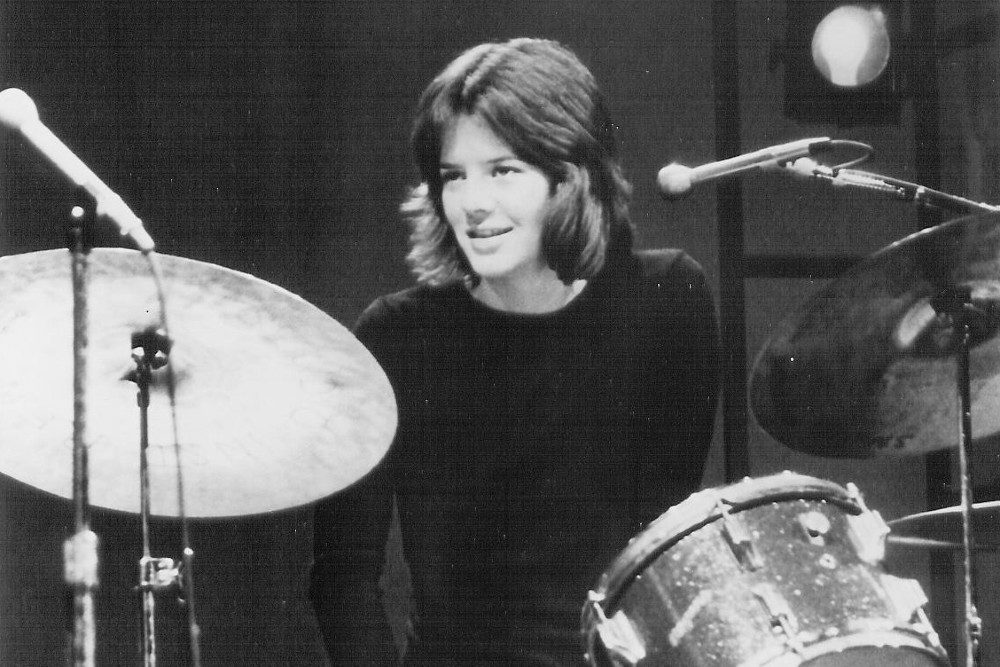
Fanny: The Right to Rock finally brings the story of the legendary all-female band to the big screen. Director Bobbi Jo Hart traces Fanny’s journey from the early ’60s formation of Sacramento-based band the Svelts (Filipina sisters Jean and June Millington’s first act), to their transition into Fanny by the end of the decade, the band’s breakup in the mid-1970s, and the reunion on the 2018 album Fanny Walked the Earth. The film had its world premiere in Toronto last April at the Hot Docs festival (winning the Audience Choice Award), the US premiere following in June at the FRAMELINE Film Festival in San Francisco. With more festival screenings leading up to a theatrical release scheduled for the fall, Audiofemme got the chance to talk to Alice de Buhr, Fanny’s drummer. “I thought that Bobbi Jo did a fantastic job,” she says. “It’s a good story arc, and I think she pulled it together quite nicely.”

For de Buhr, who runs the band’s official website and hosts the podcast Get Behind Fanny, the film is “another tool in my tool belt” to keep spreading the word about the group. “What I’m really looking for, is when people say, ‘Have you heard of Fanny?’ they go, ‘Oh yeah, I know them.’ That’s what I want. Instead of ‘No, I’ve never heard of them.’” de Buhr says. “I would like for Fanny to be more well-known and for people know who we were and what we did. Because I think it’s important.”

De Buhr’s path to Fanny began when she was in the second grade, in Mason City, Iowa. Her school’s band director tapped her to join the band as a drummer. De Buhr readily took to the instrument, and by high school she was playing in her first all-female band, the Women. “We played Beach Boys, Beatles, Motown — whatever was on the radio,” she recalls. “One of the first songs we learned was [Tommy Roe’s] ‘Oh Sweet Pea.’ I hate that song to this day!”

After what she describes as a “horrible coming out in a small town” experience, she and her girlfriend left for Sacramento. While looking for a band to play with, de Buhr took any job she could find. “We got a job selling Kirby vacuum cleaners, and we cleaned apartments,” she says. “Collecting pop bottles to get fourteen cents so that we could buy Kraft Macaroni and Cheese — which has taken me years to be able to eat that again.”

Eventually, de Buhr responded to an ad the Millingtons placed looking for a drummer, and, while waiting to hear back, briefly played in a band with three men. “I think everybody thought I was a guy too, with really long hair, because I was pretty flat chested for a long time,” she jokes. The Millingtons finally got in touch, and de Buhr joined the Svelts, only to leave the group with Svelts’ guitarist Addie Clement to form another band, Wild Honey.

But they soon realized how much they missed playing with the Millingtons. “June was the best rhythm guitar player I ever played with,” says de Buhr. “We were in the pocket from almost the beginning. That rhythm section that she and I created was heaven, heaven to play with her. Addie and I decided very shortly that it wasn’t going to happen with either of our bands separated. So we buried the hatchet and got back together.”

Left to Right; Jean Millington, Nickey Barclay, Brie Darling, Alice de Buhr, June Millington. Photo Credit: Linda Wolf

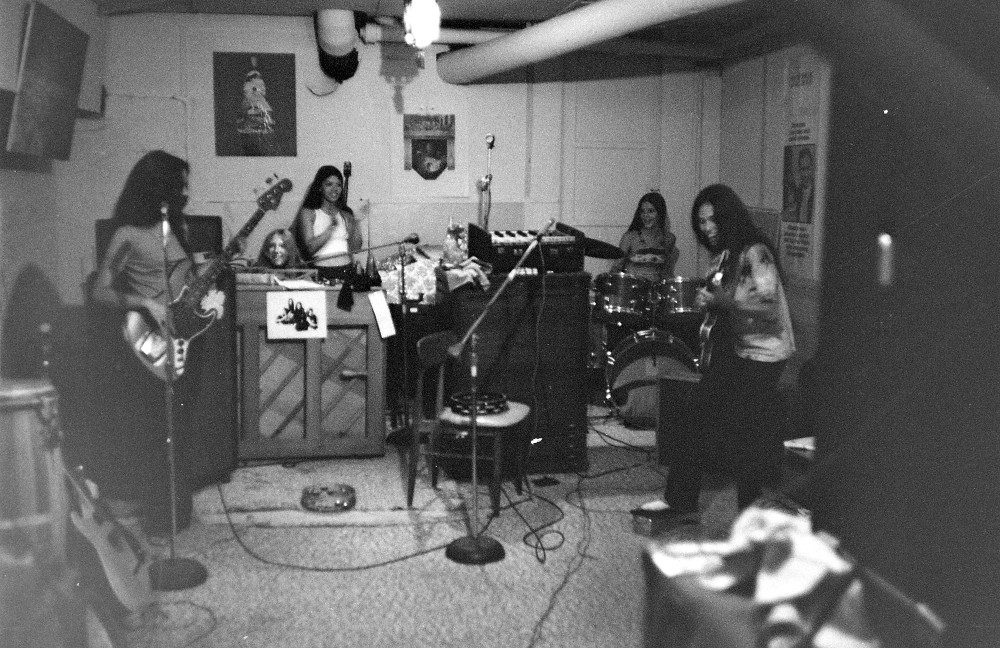
Since it isn’t a mini-series, The Right to Rock understandably condenses Fanny’s convoluted evolution. There were more lineup changes before the band signed with Reprise and renamed themselves Fanny. The film brings the excitement of this period to vivid life. When Norma Kemper, the secretary who led producer Richard Perry to the group, describes the band as “electric,” the accompanying live footage shows you exactly what captured her interest (such footage is especially crucial, as none of the band members felt their live energy was ever captured on their studio recordings).

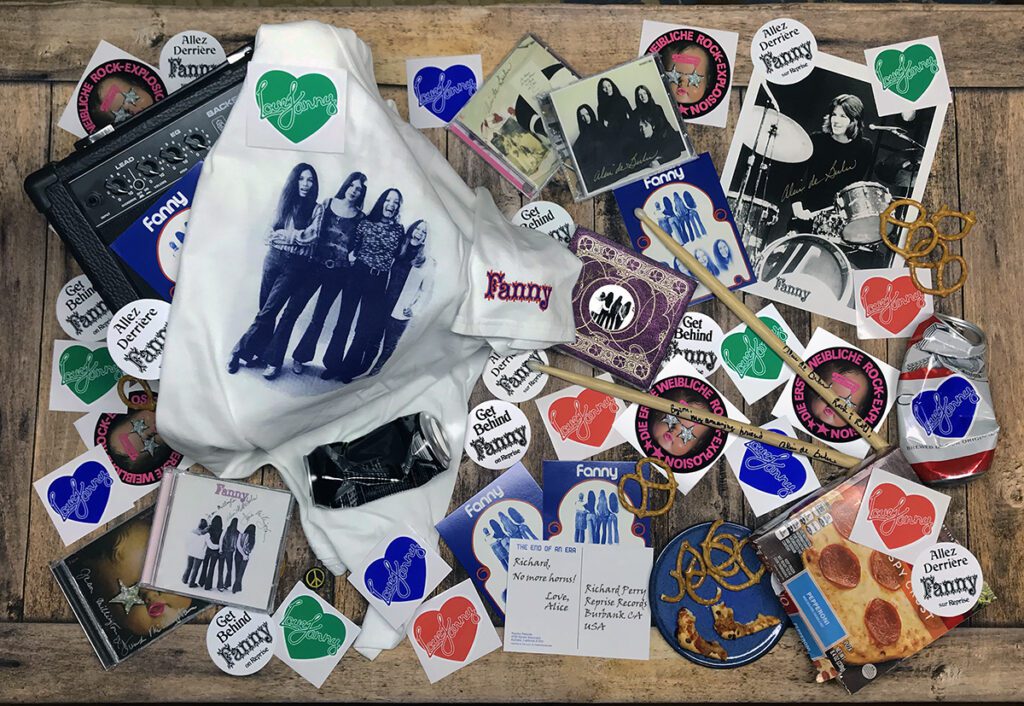
The day-to-day life at “Fanny Hill,” the band house in Laurel Canyon, is captured in all its glory in the numerous photos shot by the band’s friend, photographer Linda Wolf. De Buhr, a self-described packrat, made her wealth of memorabilia available as well; the stickers and t-shirts she designed, posters and reviews, even her journals. It all helps make The Right to Rock a richer viewing experience.

Fanny memorabilia. Photo Credit: Byron Wilkins

For the first part of the ’70s, Fanny was in constant motion. “If we weren’t touring, and if we weren’t rehearsing, and if we weren’t recording, we were trying to fit in laundry and grocery shopping, because we rehearsed ten and eleven hours a day,” says de Buhr. The band always looks like they’re having a great time as they storm through a song. But offstage, it was a bit more wearying. “It was brutally tiring,” June says in the film. “To keep giving and giving and giving in that way, was unsustainable.”

And then a depressingly familiar theme comes into play. “The suits in Hollywood, who controlled the dialogue in promotion, couldn’t wrap their heads around four young women playing kick-ass rock and roll,” de Buhr contends. “They just couldn’t do it, couldn’t figure it out. Every time we turned around, there was another door we had to knock down, or another ceiling that we had to at least crack. We’d answer the same questions over and over — what’s it like to play drums as a girl? Well, since I don’t have a dick, I can’t really tell you how it’s different from being a guy. Geez already!”

Given the cultural openness of the era, de Buhr is still surprised Fanny was so underrated and mismanaged. “You’re talking about Fanny back in the day when it was all free love and hippy-dippy,” she says. “You’d think that Fanny would have been accepted more easily. But when it came down to the nuts and the bolts of who got the money, whose record was taken to radio and what DJ was given payola for what group, the politics were male-centric always. And I don’t think that that has changed.”

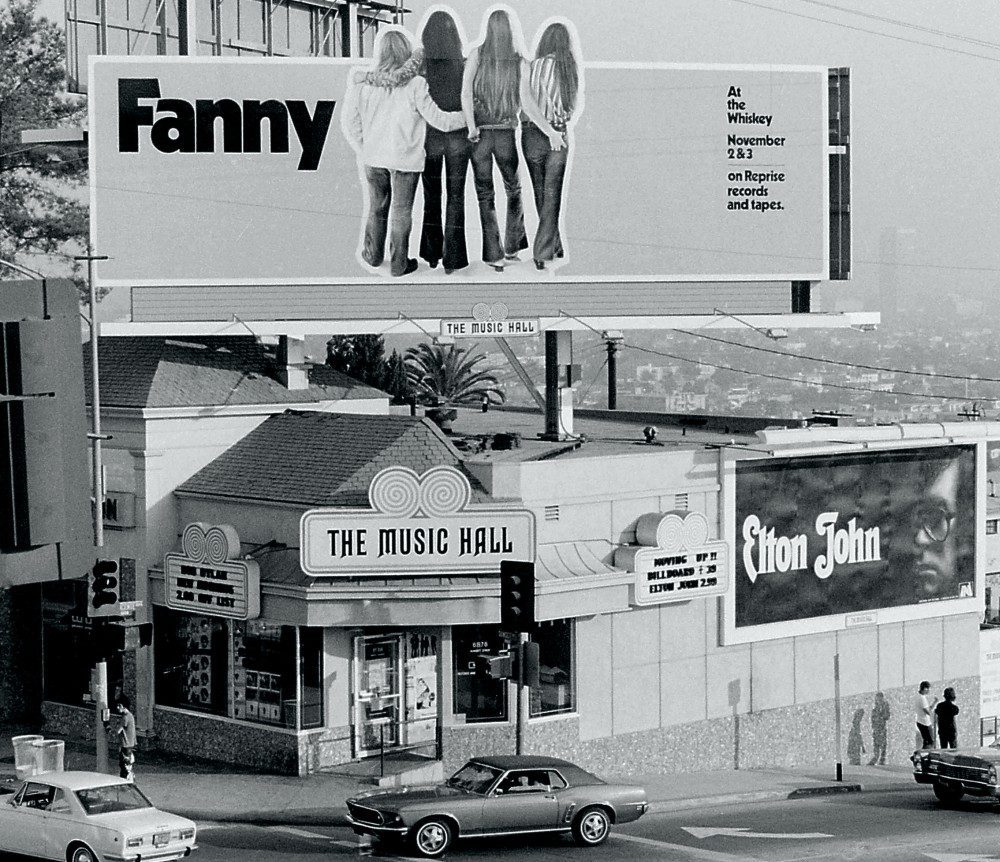
Fanny billboard in LA. Photo Credit: Linda Wolf

June was the first to leave the band, de Buhr leaving soon after (“I didn’t want to be in a band without June”). With new members, the band had a brief “glam” era before finally breaking up in 1975. After a brief turn with the Peter Ivers Band, de Buhr went into the business side of the music industry, working for a record distributor. Later, as retail marketing coordinator for A&M Records, she worked with the Go-Go’s as they promoted Beauty and the Beat, getting a gold record from the group as a thank you.

She sometimes heard her male co-workers talking about Fanny. “They’d be talking about the band just being a ‘gimmick,’ which pissed me off to no end. I didn’t say much; I didn’t let them know I’d been in Fanny,” de Buhr says. “And then I was doing an inventory at Tower Records on Sunset, and this co-worker hollered at me, ‘Hey Alice, I saw you on TV last night!’ I’m like, ‘What?’ And apparently Nick at Nite had got some of the [German TV music show] Beat-Club footage. That was back in the late ’70s, early ’80s probably. And at that point I said, you know what? What we did mattered, and I’m proud of it. And since then I’ve been trying to keep the name alive long enough to be recognized for what we created.”

The latter part of The Right to Rock focuses on the making of Fanny Walked the Earth (de Buhr made a guest appearance on “Walk the Earth”), and the unexpected health crisis that put promotional plans on hold. Footage of the group being honored at the 2018 She Rocks Awards brings Fanny’s story full circle as rock ‘n’ roll survivors acknowledged for their pioneering work, alongside testimony about their influence from such musicians as Bonnie Raitt, Joe Elliott, Kathy Valentine, Charles Neville, and Cherie Currie.

For those who discovered Fanny via clips on YouTube, Fanny: The Right to Rock fills out the rest of the story about a band of women who wanted to make a difference, and did, defying all obstacles. As de Buhr says in the film, “The conversation about women’s place is right smack dab in the middle of rock ‘n’ roll. And you’ve got this brick wall, we just start taking the bricks out from the bottom. And okay, sometimes the wall falls straight down and it doesn’t fall over. But we’ll just keep taking the bricks out.”

UPCOMING SCREENINGS:
8/6 – Two Riversides Film & Music Festival – Poland
8/13 – SAW Gallery – Ottawa, Ontario
8/15 – Jecheon Film & Music Festival – Jecheon, South Korea
8/27 – OutFest LA closing night film – Los Angeles, CA
9/12 – Musical Écran Bordeaux Rock festival – Bordeaux, France

Check fannythemovie.com for more info.

JAZZPARTY Revel In Sparkly, Seedy, Multi-Genre Glamour on Sophomore LP Nobody Gets Away

https://www.letans.com/
Photo Credit: Le Tans

When Loretta Miller’s glass-shattering, big band voice balloons from the jazzy, sax-rich funk of “Bad Dreams,” you know you’re in for a good time. On JAZZPARTY‘s recently-released sophomore album Nobody Gets Away, no dance shoes will emerge without heavily worn soles.

“We were really happy with what we did on the first record [2017’s Monday Night] and we wanted to keep going, following our love of making whatever feels good to us, whatever style and genre feels right,” explains Miller. “A lot of people get confused by our name, which is really frustrating. We’ve considered changing it, but it’s who we are. I don’t look at it like we’re a band who play jazz; we’re a band who play original music. We’re way more rock ’n’ roll and punk really.” Add to that a dash of gothic blues, doo-wop, garage rock and funk for an idea of what makes JAZZPARTY so intoxicating; with nearly five years gone since the band’s debut, the time was ripe for another release.

As with so many of Melbourne’s bands, JAZZPARTY formed after numerous loungeroom sessions at house parties, leading to residencies at city venues and national festivals. There’s been a fiercely rich culture of soul, funk, jazz and hip hop in Melbourne for decades at least, and oftentimes, the same names pop up within newly assembled bands or at the engineering and production desk. Darcy McNulty, Jules Pascoe and Loretta Miller are all former members of Clairy Browne & the Bangin’ Rackettes, and Gideon Preiss, Lachlan Mitchell, Dom Hede, Grant Arthur and Eamon McNellis have all made their names on the scene in other bands. Preiss and Pascoe played together in Husky; Pascoe is also active in Ruby Jones and On Diamond. Mitchell is best known as Laneous and from his work with Vulture Street Tape Gang, and Hede is also a member of Oscar Lush and MYRINGA.

Founder of JAZZPARTY and saxophonist Darcy McNulty immersed himself in the Melbourne jazz scene after moving from Brisbane. Finding it formulaic, his antidote was to assemble a collective of instrumentalists and vocalists to throw their assorted ideas into a big wok and fry it into something addictively tasty. It worked. Their gigs at Memo Music Hall, Howler, Melbourne Bowling Club and Builders Arms Hotel are legendary for their raucous, epic, take-no-prisoners performances. Though the band has been around for a decade or so, the core group formed from its revolving lineup approximately six years ago, though “time dyslexic” Miller can’t be certain of exactly when. “I always sang with the band, but I can’t tell you when I joined officially,” she admits.

Through various residencies, JAZZPARTY honed their eclectic sound, fortified their lineup, and garnered a fanatic following. The first of these was at the Builders Arms Hotel, where Si Jay Gould (who manages Hiatus Kaiyote and is one of McNulty’s oldest mates) was offered a month of Monday evenings to put on events; he organised poetry readings in one room, old films in another room and a New Orleans-style band space. “It was free entry, it was so popular,” recalls Miller. “We did a month-long residency there, then a month off, then we’d show up somewhere else. We had some really notable stints at Captains Of Industry, The Curtain and The Evelyn. They’re our spiritual homes, those places! There wasn’t a plan to be a full-time band at that time. Our rules were that we bring our piano, it’s gotta be free, and we don’t play on the stage. I was so into it that; I was thrilled to be a part of it.”

The title of their debut album is a nod to those early residencies (and there’s a sultry, serpentine track on Nobody Gets Away also called “Monday Night”); while other Melbourne jazz-funk bands typically name hip hop, soul and jazz icons as their major influences, there’s no denying the influence of garage punk, bossa nova, acapella doowop, and even the wild fabulosity of Screamin’ Jay Hawkins’ dark underbelly of stomping rhythm and blues on songs like the gloriously smoky, seedy single “Rock n’ Roll Graveyard.” Its closest spiritual predecessor on the latest record is its title track; Tom Waits would have felt right at home on either. If they’d made a whole second album dedicated to the same sound, nobody would have complained, but – just like wasabi with peas – sometimes you get a complete blast of your senses from something as safe-looking as a little green ball.

Miller is the wasabi, and genre is the pea, to be clear. On “Hearts Gonna Leave,” a gospel-style hymnal harmony opens the track, only for a rollicking, thunking country-style guitar to throw the barn doors open. The butter-wouldn’t-melt vocals of Miller warn her lover, “My heart’s gonna leave you soon,” the harmonies float back in, there’s a ‘60s surfer vibe to the bass, and when the brass begins… well, it’s a barnstormin’ banger.

“Darcy is the key writer and he also wrote a lot for The Rackettes. His song ‘Love Letter’ for The Rackettes was a hit here and in the States,” says Miller. “He’s an incredible songwriter and is disgracefully underrated in Australia. I’m doing more and more co-writing and trying my best. Everyone in the band is a wild, insanely talented artist in their own right. Darcy and I pre-arrange a lot; we have an idea of what we want songs to feel like, and the band are great at bringing their gifts to it. We’re super lucky, we’re a great team of freaks.”

As the only female member of JAZZPARTY, is she underestimated by fellow music industry people and the audience when it comes to her musical talent and ability?

“Yes,” she responds immediately, with a laugh. “I think it’s more [about] underestimating singers… There’s a ‘dude culture’ that thinks singing isn’t a real instrument. If you’re a singer, you need to play an instrument to be considered talented. If you’re a singer, you need to be a songwriter. I don’t agree that everyone needs to write songs. A singer’s ability to interpret music is a craft and a gift. Not everyone should be a songwriter; being able to interpret someone else’s lyrics is really important.”

“Darcy and myself bonded over the fact that we’re both drop-outs, both untrained; he’s an insanely talented songwriter but he doesn’t read music,” she adds. She’s exaggerating, in fairness. While she did drop out of high school, she graduated her final year through community school and went on to study music performance for a year afterwards. “We’ve both been underestimated by others and the music scene has been a man-scene for so, so long. Darcy has had a lot of faith in me and strengthened me, so that I feel I deserve to be here. I think some of the guys found it a bit hard when I joined, but I’ve been a driving force in a sense.”

Photo Credit: Lilli Waters // Jacket & Set Design: Anna Cordell

That sense of stepping on male egos must have been even more profound considering that soon after the band began their Monday night residencies, McNulty and Miller became an item. The various moods of the album – sometimes confident and sassy, sometimes heartbroken and vulnerable, are all true to Miller’s own experiences.

“A lot of it is very personal and, obviously, Darcy has written songs for me, with me in mind. We talk about the material and the vibe of the song while he’s writing it and we work on it together quite a bit,” she says. “It’s a relationships story, to me. There’s notes on how hard a relationship can be, but also that struggle of trying to find positives and lift the other person. Both of us were in that position. For Darcy and I, definitely working together, running a band together and having a relationship is insanely hard.”

McNulty has been her biggest cheerleader though, enabling her to feel capable of pursuing her own solo work, which she reveals is different to the JAZZPARTY sound. Still, songwriting with her professional and personal partner has had its confronting moments, where the material felt especially heavy. “It’s definitely an experience to sing those songs if you’re not in a good place,” she admits. “‘Bad Dreams’ is a song on the record that’s very much about feeling angry, upset and wanting to self-destruct because you don’t feel like you can connect; ‘Stone Gaze’ is about feeling not connected to the person you feel you should be connected to, or anybody. But on the last record, he wrote a ridiculously romantic, beautiful love song, ‘Gravity,’ so you win some, you lose some!”

Miller takes it all in stride, appreciating a musical life that’s intertwined with her personal life for what it is. “It’s been the most important working relationship, the most supportive, in my life,” she says. “It’s an emotional rollercoaster, that’s for sure. Our life has definitely had elements where I’ve thought, ‘Is this a movie or is this real?’ It’s not always good, but it’s always interesting.”

Follow JAZZPARTY on Facebook and Instagram for ongoing updates.

Lesibu Grand Sugar-Coats “Not Sweet Enough” with Remix from The Punk Cellist

“Not Sweet Enough,” the latest track from Lesibu Grand, is a journey both audibly and visually. I don’t mean the song takes you on a journey as much as the Atlanta band does, offering multiple reimaginings of the song that all serve to emphasize the same point: from the grungier, contemporary original version of the song to the new Punk Cellist remix and accompanying Victorian-inspired video (both of which premiere on Audiofemme today), the oppression and mistreatment of women is an age-old problem. 

These collaborative remixes are nothing new to the band, having recently released a snappy Pls Pls remix of single “Hot Glue Gun.” As far as “Not Sweet Enough” goes, they originally wrote the song in response to draconian abortion laws drafted by the Georgia state legislature. “We thought it was perfect timing to speak out against that whole mindset,” explains frontwoman Tyler-Simone Molton. Their original take was more aligned with the band’s audible punk aesthetic, but they soon discovered a cello cover of the song on social media by Berklee College of Music student Ian Legge, who has been posting string versions of his favorite punk songs to YouTube over the past year as The Punk Cellist (he also takes requests via Patreon). Lesibu Grand reached out to him to collaborate, and from there this remix was born.

“The idea of doing it in a different genre and taking it kind of old school, but it’s still relating to a problem that’s very relevant today, is [an intentional] juxtaposition,” Molton says. The genre-spanning across centuries, from pop punk to a more classical style, is a means to drive home the agelessness of the problem itself. 

The video follows the same path. The original is a corn-syrup-soaked romp akin to Celebrity Deathmatch or Robot Chicken. Molton shapeshifts from her real physical body to a Barbie version of herself, imagery so fraught with societal expectations of women that the metaphor borders on satirical. She ruthlessly kills all the (action figure) men – “Obviously we’re not going around slaughtering men,” she says – that stand in her way. 

In the updated concept, she’s dressed in Victorian garb, almost like a character in an opera. “I’m supposed to embody a very proper, well brought up young woman who’s looking at the content of the video,” she explains. In a meta sort of way, watching the video is meant to radicalize her long in the past, and the realization that she “has this oppressive angst that she wants to get out” awakens.

In a recent interview with Afropunk, Molton said, “We call out the lawmakers, specifically in Georgia where we live, and warn them of our resistance – although they write state law and want to use it to control our bodies, women and their allies can organize, speak our minds, energize popular opinion which is still pro-choice, and ‘bring them doom’ by voting them out of office.”

Until then, she’ll keep revamping the fiery songs she directs at them so that they are constantly reminded of what’s coming for them.

Follow Lesibu Grand on Facebook and Instagram for ongoing updates.

PREMIERE: Monique DeBose Marries Motivational Speech with Soulful Singing on “Human Condition”

Photo Credit: Lift Consciousness

Monique DeBose has graced the world many times over with music that has a social message. From empowering singles aimed at celebrating women to her 2018 one-woman musical Mulatto Math: Summing Up the Race Equation in America, she infuses the passion for social justice that informs her career as a leadership coach and diversity consultant into her music. In her latest single, “Human Condition,” she spreads her work’s central message of self-love with an eclectic mix of genres and vocal styles.

Collaborating with motivational speaker and coach Preston Smiles, DeBose created a song that doubles as an inspirational sermon. Using electric bass, piano, drums, and synthesizer, the track combines the warm, comforting sound of a show tune with the catchiness and dance-ability of modern pop. She also brought in a choir, which surprisingly only consists of three people whose voices were recorded multiple times.

“It feels insane/But you stay in the game/It takes all you got,” DeBose opens. “You run away/and look to blame/emotions got you caught.” The verses mix theatrical notes and keys with energetic electronic beats, escalating to the choir powerfully belting the chorus, positioning the daily self-love struggle as “part of the human condition.” During an interlude, Smiles speaks about self-confidence: “Today’s transmission is a reminder of how powerful, how beautiful, how amazing you are.”

The song is about “owning all the parts of ourselves,” says DeBose. “So often, we are presenting what we think people want to see of us, what we think will get us approval, and much to the dismay of our full humanity, we don’t get to express all of who we are. That’s been a big part of my life, trying to be for others what I thought would be acceptable… [but] the things we may feel embarrassed or ashamed or sad about are also things that make us more fully expressed.”

In accordance with the therapeutic aim of the song, DeBose is offering a complimentary accompanying three-day Human Conditions course, where she’s teaching people how to embrace themselves as they are. She also created a fun lyric video, premiering today on Audiofemme, featuring illustrations of herself, Smiles, and the choir.

A rich and varied educational and professional background gives DeBose her unique sound and perspective. She got a degree in mathematics at UC Berkeley, which inspired the premise of her show Mulatto Math. “I have math equations I made up about beauty — what does blackness mean in the US? — and the equation gets more complicated throughout the play,” she explains. “You can’t define it — you have to define blackness for yourself.”

DeBose opened Mulatto Math with her latest single “Brown Beauty,” a body-positive love letter to women of color. This song spawned a video featuring women from across the globe who shared images of themselves, as well as a social media movement where DeBose shares some of these photos and pays homage to women of color who inspire her. The song was inspired by DeBose’s own experience learning how to take up space as a mixed-race woman. “It takes such complex navigation to be a black woman or a woman of color in the world we’re in because we’re navigating double consciousness and navigating code switching,” she says. “It’s a celebration: I see you, I love you, I know you’re doing the work and I don’t want you to go unrecognized.”

“Human Condition” and “Brown Beauty” are included on DeBose’s upcoming LP You Are the Sovereign One, set for release in late August. She describes it as a celebration of women owning their full selves. Over the course of 16 songs, she sings about “owning that part of yourself that you’ve hidden in the dark, that part of yourself that you’re ashamed to bring out, owning the parts of yourself that you’ve been embarrassed or afraid wouldn’t be well received.” It’s been recorded over the course of the past three years; some songs were written over 15 years ago, some within the last few months.

DeBose also started a podcast this summer called MORE with Monique that aims to help women find true satisfaction in different areas of their lives, from their relationships to their careers. “So often, as women in our society, we are really asked (or kind of told) from a very young age to put our needs to the side, to put our desires to the side, to put what we want to really help us live the most full thriving life to the side,” she says. This was also the idea behind her 2020 single “More,” a jazzy ode to women going after what they want.

This is the magic of DeBose’s work: she takes a concept and turns it into so many things, from art to self-help to education. She ascribes this ability to reach people in many different ways and communicate about challenging topics to her cultural background. “I call mixed people bridge people,” she says. “That’s always been my lens and my focus: diversity, inclusion, equity, being wiling to have hard conversations by default, actually being willing to be in uncomfortable situations, and growing the nervous system to be able to be in that space. It naturally lends itself to that work, and it naturally lends itself to the music I write, too. All the things I do. I can’t do things not based on my own life. I cannot.”

Follow Monique DeBose on Facebook and Instagram for ongoing updates.

Juliana Hale Finds the Silver Lining in “Chill (So Serious)”

Photo Credit: Shania Houchens

Juliana Hale maintains a daily gratitude list, taking the time to write down what she’s grateful for. The practice reflects her ability to find the positive in life’s bleakest moments, a mindset she carries over into her latest single, “Chill (So Serious).” 

Hale learned how to find her silver linings through songwriting. By the age of nine, she had taken up guitar, flute and piano (and has since mastered the bass and ukulele), and relocated to Nashville with her family to pursue a career in country music, the young star performing her original songs in the local honkytonks by age eleven. Inspiration from then-new artist Taylor Swift and Hale’s parents’ divorce led her to songwriting, the powerful art form also lending itself as an outlet for her emotions when she began struggling with gastroparesis, a disease where severe acid reflux destroyed her vocal chords. During her multi-year battle with gastroparesis, the singer-songwriter was awarded more than $600,000 worth of scholarships to study pre-med in college, with the initial goal of becoming a gastroenterologist. But deep within, Hale knew that music was her true passion, so much so that she felt a shift from country music toward a growing interest in the organic pop and Americana realm. While going through vocal therapy to heal her voice, she often found herself turning to songwriting for support.

“It was a big outlet for me as far as an escape to really get through those times. To have my voice and then have it taken away from me suddenly was definitely a big thing to go through. My songwriting and my singing has changed as my voice has begun to heal and get better, so it’s a big growth process,” Hale tells Audiofemme. “It was a lot of sad songwriting about feeling like I couldn’t really control things and I feel like I’ve become more of a control freak in a way because of that. ‘Chill’ was a big reminder for me to just let go and let things happen. In a weird way, it affected my songwriting to write positive songs because I was always trying to find the silver lining in the things [that] were happening, because there’s always a silver lining. I feel like once my voice did heal, it ended up being more unique than it was before, so that’s the big silver lining I tried to hold on to was it made me grow in a certain way.” 

Through “Chill,” Hale managed to find the light during a time of darkness. Co-written over Zoom with Earl Cohen, Calvin Gaines and Andrew Thomas in the midst of the COVID-19 pandemic last year, the 21-year-old entices listeners, with upbeat, breezy lyrics: “Come and vibe with us/We got no stress/Kicking back like jokers/Serious bad days are over.”

“I was super stressed, as everybody was, and I realized sometimes you just have to be thankful for being alive,” she explains of the song’s inspiration. “It’s a big song to try to tell myself to let go, because that’s one thing I’ve also been trying to do musically – not be such a perfectionist, and not be so hard on myself and just chill out.”

While the first verse originated from Hale’s experience dating a guy who was coming on too strong early in the relationship, the song began to take on a life of its own as she and her co-writers moved toward a celebratory mindset. The second verse finds her abandoning her insecurities, dancing like no one’s watching and encouraging listeners to do the same, while the personal bridge gets to the heart of what she hopes to convey in the song. “Toast to the life/Every day’s a celebration/We’re still alive/That’s a special occasion,” Hale sings.

“I feel like that encapsulates what I was trying to get across with the song – that every day can be a celebration and there’s always something to smile about. We’re alive and that’s a gift. I feel like everything happens for a reason and we’re all here. Life is a celebration,” she reflects. “I was trying to share the message that even in these tough times, I’m always trying to find the silver lining. So it’s good to chill.”

Things are looking up for Hale lately – she stars in the upcoming film And You Call Yourself a Christian, set for release on Amazon on September 19, and she’s releasing a new song each month for the remainder 2021, with plans to release them all together as an EP at year’s end. But the intent with every piece of music she offers is to gift others with a hopeful mind and open heart. “I want to bring a positive, different aspect to people. I want to bring something real, and my main goal with music is to connect with people,” she shares. “My favorite part of music is playing shows and meeting people afterwards and having those conversations, so I hope that I make people feel understood and that they connect to me and they take away something good from it.” 

Follow Juliana Hale on Instagram, Twitter and Facebook for ongoing updates.  

Pony Hunt Explores Endless Variables in a Fluid Universe with VAR! LP

California-born, Chicago-raised Jessie Antonick, a.k.a. Pony Hunt, recorded her newest album VAR! in New Orleans, but inspiration came from light years away. Its title is a reference to the scribbled note of astronomer Edwin Hubble in 1923, upon realizing that what he’d previously identified as nebulae in the Milky Way were, in fact, something else. He’d identified a variable from another galaxy, which would lead him to discover the Andromeda galaxy, expanding our knowledge of the universe.

There is a sense when listening to Pony Hunt of being immersed in a universe of Antonick’s own construction. The many layers of instrumentation, and the intermingling melodies and atmosphere demand attention. In this way, VAR! is meditative and healing, especially when inhabiting an imagined time and place provide respite from our pandemic-affected lives.

“I hope that my music transports people into a feeling or a space,” Antonick confirms. “When I’m writing songs, I feel all-consumed by what I’m doing. The goal is to create space or an environment that wraps around a listener.”

On first single “Stardust,” there’s layers of ‘60s psychedelia and harmonic doo-wop vocals, the raw, steely sound of surfy guitars, and the contained fury of drums that want to become savage but remain firmly leashed. Atop it all, Antonick’s gorgeous, soulful voice teeters on the edge of being haunting in its romantic perfection. Her formative influences in Chicago punk, pop music of the ‘90s (Nine Inch Nails, Wilco) and ‘60s R&B, soul and rock reveal themselves in the layers of sound, and the tools used during recording.  

“We used a lot of vintage equipment,” she explains. “The AMPEX 351 [Reel To Reel Tape Recorder] is from the 1950s, I think, and we used a handful of vintage microphones as well in different places on the album. We used ‘60s tube amps for the electric guitar, and there was an older organ in the studio from the ‘60s and ‘70s that we used pretty consistently as well. We also used a Rhodes, for a vibey, dreamy sound. I really love the sound of that electric piano; it’s unique, different, beautiful. I had one song with violin and cello, also.” The violin and cello show up on “Who Are You,” recorded with a friend from New Orleans – strings player and vocalist free feral.  It’s a lovely, doomed love story cushioned in a waltzing melody. 

VAR! was recorded in home studios, with a number of engineers, Antonick says. “I recorded with a couple of my bandmates, Sam Doores and Duff Thompson. They had a little studio set up in the Holy Cross neighborhood of New Orleans, so we did a lot of recording on their AMPEX 351 reel-to-reel, then I took those base recordings and added to them. I had friends in Colorado do some overdub, I recorded some in my apartment, and we pieced it together over a couple of years.”

Since releasing her debut Heart Creak in 2016, VAR! has been in varying stages of creation. In the intervening period between albums, Antonick moved from her houseboat home in Oakland, California to Louisiana, New Orleans. “When I lived in Oakland, mostly I lived on a sailboat in a marina because a friend offered me a place to stay, which happened to be his houseboat. It was a run-down marina that was also a really fantastic artists’ community, so I was surrounded by musicians and artists of all kinds and the water, of course, that was beautiful. I was working as a sail-maker, so I was sailing a lot and working in the trades, a unique trade. I think all of that conspires to inspire my music,” Antonick says, and that’s certainly true of the fluidity, movement and tidal rhythms on Heart Creak; water, the tides and physical connection to nature underlie the themes of the album. The constant movement of living on the water and the sense of being carried in any direction, at any time, are central to Pony Hunt’s nature.

On VAR!, Antonick explores a different kind of fluidity. “Gender is definitely always coursing through my investigation in life,” she says. “I grew up classified as a tomboy. In pictures of myself as a teenager, I look like a 16-year-old boy. I was lucky enough to grow up in a family where I wasn’t pushed into a gender role; I only felt that in societal and cultural systems. Those questions have gotten more complicated as I’ve gotten older and experienced the world a lot more. Society really wants to push me into being a woman, being female, having sex with a male, all these things women are supposed to have. I’m gender-fluid, or gender-queer, but it’s something where I don’t feel satisfied when I say those things. I haven’t figured that quite out yet.”

Now 36, she says, “I feel like those things weren’t on the table when I was growing up. Later in life after being called ‘she/her’ all this time, I get to be called what I want? I’ve never had that before. I sexually identify as queer, but I remember, when the only things on the table were being a lesbian or bisexual, I cringed. When ‘queer’ landed on the table, I went, ‘I am totally that!’ It gives me breathing room to be what I want to be at any moment.”

Whatever else she may be, she is undisputedly channeling the formative sounds she grew up with. Chicago’s DIY punk scene awoke in her a sense of freedom to challenge ideas of womanhood, work, and identity. “When I was a teenager, I had older siblings who were really into the punk scene in Chicago, so that’s the music I was introduced to and loved being part of. It’s loud, abrasive, energetic and just so good… that was the first music that lit me up,” she remembers.

The undeniable element of roots and country in her music was the result of a very different Chicago band. “I remember listening to Wilco – the local Chicago band that everyone loved when I was growing up, and they were my gateway to more Americana-style music. My influences on VAR! are very much 1960s rock, R&B and soul influenced. The Velvet Underground are huge for me; they’re vibey in all the right ways. Irma Thomas – when I hear her sing, she’s just the Queen of New Orleans soul for a reason.”

Steeped in the culture of a historically musical, artistic city – one that is rich with stories, blood and tears – yet addressing very modern concepts of fluid gender identity speaks to the juxtaposition between vintage and new that Pony Hunt embodies. It’s fitting that the album was the first to be released on Antonick’s new imprint, Wing And Wing, on July 23.

“I’m a co-owner; it’s myself and a woman named Lindsey Baker who runs Wolfie Vibes [PR]. Lindsey is also a wonderful musician [and plays in] Guts Club. We met through the New Orleans music scene, playing some shows together,” Antonick says. “We wanted to shine a light on queer-owned, female business, overlooked musicians. There’s a lot of really amazing queer musicians out there.”

Follow Pony Hunt on Instagram for ongoing updates.

Rozzi Takes Down Gaslighters with Video Premiere of “Mad Man”

Photo Credit: Oscar Ouk

Most women have had the experience of apologizing when they didn’t need to — or, in fact, when the other person should have been sorry. That’s why the first verse of pop singer-songwriter Rozzi’s latest single “Mad Man” is so relatable: “Damn right I’m upset/Why am I apologizing/You’re the one that fucked up/But here I am compromising.”

Rozzi wrote the song in collaboration with Liz Rose (Taylor Swift, Nelly Furtado, Jewel) and Jamie Kenney (Miranda Lambert, David Archuleta) about an experience with a man she worked with who would call her hysterical or tell her to calm down when she got mad. “The only way I could get what I wanted or get my opinion heard was if I cloaked my frustration or anger in a sweetness or innocence or a softer voice,” she says. “I found it exhausting because I wasn’t a raging bitch; I was frustrated for a justifiable reason.” In the song’s soulful chorus, Rozzi belts her reaction to the criticism: “No I’m not a monster/Sometimes I get mad man/And I won’t speak softer/Just cause I’m a girl and you don’t think a girl should get mad.”

“Mad Man” originally started off as a poem, which Rozzi saved until she could work with Rose, which had been a dream of hers. Kenney produced the demo and played keys, and a number of producers in London and New York worked on the track. “The song had a few lives and went through a few different iterations before we found it,” says Rozzi.

The song reflects the typical soul influences driving Rozzi’s music, using minimal production and a 6/8 mid-tempo in order to leave room for long notes. “I wanted to make sure we left space so we could hear my voice,” she says. “I wanted it to feel very musical and very soulful and really raw.”

In the video, premiering today via Audiofemme, Rozzi plays to women’s collective rage fantasies: she sits at a dinner table full of men, pleadingly singing to them, then jumps up on the table and knocks everything down. From a lover to an authority figure, all the men represent someone who has treated her as lesser over the course of her life.

“I was acting out this emotion I’ve felt a hundred times over,” she says. “It’s a feeling women, especially women in the music industry, have felt — a certain belittling feeling that someone’s not really listening to you — and I got to enact it on a really animalistic level. I felt anger while I was shooting, and it was really cathartic, and I hope it comes across as an artistic expression of the feeling women feel all the time.”

Her goal is that the song and video help others who have experienced gaslighting feel free to feel whatever they feel. “I would hope it makes them feel like their emotions are not wrong and their emotions are not shameful,” she says. “They are human, and there are plenty of reasons we should be mad, and that’s okay.”

Rozzi was discovered by Adam Levine at age 19, becoming the first artist signed to his label 222 Records in 2012 and touring with Maroon 5, as well as a number of well-known acts such as Owl City. She released her first EPs Space and Time in 2015, followed by her 2018 debut album Bad Together. She plans to release her third EP Hymn for Tomorrow on July 30, followed by an album featuring the seven songs on the EP plus seven more songs later this year.

The Hymn for Tomorrow EP deals with vulnerability, strength, and their interplay, asking the questions: “Does love have to be hard? Does love have to be painful? And in order to feel passion, do you also have to feel unsafe?” Rozzi doesn’t think so, and she made that the mission statement of her EP. “There is such a thing as passion and butterflies and sexiness while feeling safe and secure and really loved in a relationship,” she says. “I liked ending it on that note because there’s enough darkness in the world, and I like to give hope.”

She’s currently wrapping up the creation of her next album and gearing up for some live shows later in the year. She’s also recently been expanding her creative ventures into writing, publishing several pieces in Spin magazine on her own life as well as artists who inspire her. She also co-hosts the podcast Ugh! You’re so Good!, where she interviews people about what makes them good at what they do.

The key to her own success has largely been her ability to write from her heart, creating raw lyrics and vocals that speak to her listeners’ emotions. “I write very personal songs — I don’t know any other way,” she says. “I’ve tried to write songs I don’t connect to on a deep personal level, and I never succeeded, so all the songs are really personal, really intimate, really raw, and I think being vulnerable is one of the strongest things you can do.”

Follow Rozzi on Instagram and Facebook for ongoing updates.
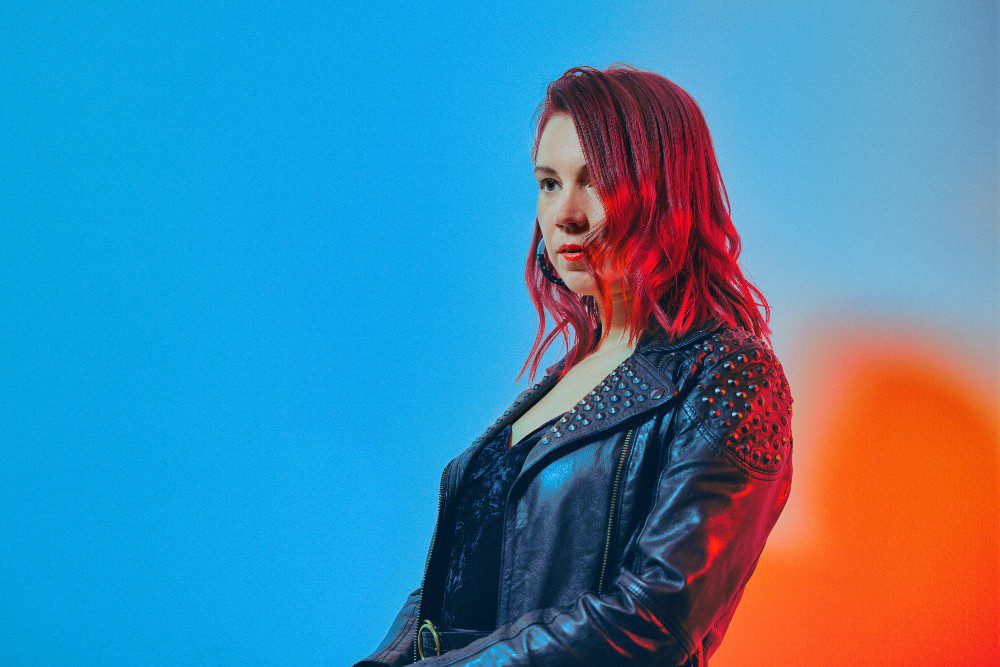
Anika Vents Pent-Up Pressure (and Sings for the Birds) on Sophomore Solo LP Change

Photo Credit: Sven Gutjahr

In Berlin, Annika Henderson, better known to listeners as Anika, was accustomed to seeing “these groups of gangster birds that try and eat your sandwich out of your hands.” Nature was different, though, when she temporarily moved from the city to the countryside to make her latest album, Change, released via Sacred Bones Records on July 23.

The ones here are a little bit nicer and they don’t do that,” she says on a recent call from the small German town where she relocated in late 2019. Plus, there were a lot of birds. At least, that’s what Anika thought until her landlady mentioned that the population was decreasing. That conversation, plus Rachel Carson’s landmark 1962 book Silent Spring, informed the song “Never Coming Back.” 

“There are things that are happening and we don’t really notice,” says Anika. “When it’s gradual, you don’t notice and then, suddenly, you wake up and look outside and there are no birds. Maybe now we can do something, but, by then, it’s too late and then it’s like the Dodo.”

In a deep, languid voice, Anika sings, “I saw the signs, I chose to ignore them/I saw all the warnings.” If it sounds like a love song, well, that’s by design. “It’s kind of written like a love song, but it’s about other things,” she says. “It’s never about one thing. It’s always about many things. The main thing is about birds.”

The tell-tale lyric comes when Anika sings, “I found your body on the windowsill/lying on the grassy floor.” She says, “Either I just murdered my boyfriend or whatever and he’s lying on my windowsill or it’s the birds or it’s a slight reference to the Shaggy song.”

Several years earlier, Anika, who is also known for her collaborations with British band >BEAK, as well as artists like Tricky and Dave Clarke, had considered quitting music. A friend had invited her to Mexico, but she couldn’t afford to travel there without a gig and she didn’t have a band. Anika found a group of musicians in Mexico and they gelled so well that the group evolved into Exploded View, who released albums in 2016 and 2018. “It’s always when you totally give up that something happens and you think, oh, it’s just why I’m alive,” Anika says. 

Exploded View kept Anika busy enough to delay working on the follow-up to her 2010 self-titled release, so moving to the countryside seemed like the antidote to a busy life on the road. “I thought, great, I have a place so that I can chill out and it would be a contrast of extreme touring and then chilling out,” she says.

But her plans took a change of course after the COVID-19 pandemic struck early in 2020. “It wasn’t really just corona. Corona was a side note to what was going on in my personal life, where basically everything was so extreme in so many different ways,” says Anika. The situation, she says, was “complicated,” but Change kept her going.

“I think, just before corona, I was considering maybe I should quit,” she says. “This happens every so often and then some crazy thing happens where I have no choice but to continue.” But, Anika clarifies that “no choice” doesn’t mean anyone was forcing her to make the album. Rather, it’s “no choice in that it suddenly makes sense and it’s this massive liberation, or life jacket, and in this weird time.”

True to its title, the concept behind the Change morphed, too; Anika had been working with an entirely different idea for the album prior to the pandemic. “The script changed in so many ways, in terms of the actual lyrics, the music, the way I could record it, who I could work with and it just became something totally different,” she says. “But I’m really happy for the way it did turn out.”

For one thing, the situation prompted Anika to handle a lot of the album’s components herself. She was ultimately able to bring in friend and collaborator Martin Thulin, from Exploded View, as a co-producer for change Change. “He definitely wasn’t pitching any agenda,” she says of the collaboration. “He was there to help achieve what I wanted to and that was nice, but it was definitely a challenge to get him there.”

Change became a release for Anika. “The whole album is so much pent-up stuff,”she says. “ In the situation that I was in at the time, I wasn’t really able to say much or do much and it was a very difficult situation.”

On top of that were recent global events. “That added to things going on in the world, where it feels like you don’t have a voice. All this stuff is going on and how can I actually have an effect to stop this stuff from happening or how can I have a say?” Anika says. “There’s stuff going down and I want to speak up. Social media doesn’t really cut it when you want to have an opinion on something or actually make a change.”

Anika channels personal and universal sentiments into a collection of psychedelic synth songs that capture the global melancholy and frustration of 2020. “The songs were a way to get all of this out,” she says. “I have so much frustration and I hope it’s a vehicle for other people to have the same experience.” 

Noting that she suspects others have the same feelings and are asking the same questions she is, Anika adds, “I think that’s why it’s important to keep doing music that’s from the heart.”

Follow Anika on Instagram for ongoing updates.

MUSIQUE BOUTIQUE: Dolphin Midwives, Anika, Olivia Newton-John in Toomorrow

Welcome to Audiofemme’s monthly record review column, Musique Boutique, written by music journo vet Gillian G. Gaar. Every fourth Monday, Musique Boutique offers a cross-section of noteworthy reissues and new releases guaranteed to perk up your ears.

The new Dolphin Midwives album, Body of Water (Beacon Sound) is a transcendent, magical work that defies ready categorization, encompassing voice, harp, percussion, and electronics courtesy Portland, Oregon sound artist Sage Elaine Fisher. Experimental, ambient, neo-classical, sonic manipulation — the album encompasses elements of each of these, yet stands as a singular, distinctive work in its own right.

It’s bookended by two widely differing pieces. The opener, “Hyperobject,” starts as a simple series of percussive beats paired with a light “ha-ha-ha” vocal melody, both of which become increasingly fragmented until they merge in a swirling cascade of intense sound. At the other end, “Sunbathing” is a gentle number played on the harp, lyrical and soothing, though there’s a slight twist in the final minute, when there’s a sonic hiccup, a kind of stumble. Sage’s processed voice provides an ethereal sheen. “Hummingbird-i” begins with a stuttering vocal that seemingly emulates the rapid wings of the bird. The mesmerizing “Clearing” has a crystalline lead voice winding around murmured backing vocals and a pulse running underneath as steady as a heartbeat. In “Capricorn,” Sages sings in counterpoint to a somewhat clipped keyboard line, her vocal harmonizing turning back on itself in a never-ending cycle. Body of Water is a remarkable work of great depth, an intriguing album that casts a spell, drawing you into its mysterious realm.

British-born, Berlin-based musician Anika (Annika Henderson) first made her name with her 2010 self-titled debut, which offered fractured reworkings of songs like Yoko Ono’s “Yang Yang” and Ray Davies’ “I Go to Sleep.” She’s since worked with numerous other musicians and artists, as well as forming the band Exploded View (based in Mexico City), but hasn’t released another solo work until now.

Anika pithily describes her new album, Change (Sacred Bones) as “a vomit of emotions, anxieties, empowerment, and of thoughts like — How can this go on? How can we go on?” Perfectly reasonable questions to ask during a pandemic, which is when this album was recorded, Anika co-producing alongside Exploded View’s Martin Thulin (who also played bass and drums). The first track, “Finger Pies,” opens with the kind of melodic, ’60s-era sound (thudding bass, poppy melody) that brings to mind the best of Motown, but that’s just the jumping off point. Anika has the kind of cool, deadpan delivery that inevitably gets compared to Nico. But there’s a sly humor at work, as in “Critical,” when she solemnly intones she’ll give her man what he deserves, only to reveal that the “little gift” might just be cyanide. Among the electronic beats, rhythms, and synths, you’ll find some heart and soul, and no small measure of determination; as she urges in “Rights”: “Feel your power/Show me power.”

In the summer of 1978, Grease was the word, and if the radio wasn’t playing “You’re the One That I Want,” it was playing “Hopelessly Devoted to You.” But little did most of those enjoying Olivia Newton-John’s turn as Sandy in the musical blockbuster know that it wasn’t her first time before film cameras. In 1970, she appeared in Toomorrow, as a member of an aspiring rock band who get beamed up to a UFO, where some visiting extra-terrestrials beg them to voyage to their home planet, because Toomorrow’s music is so cosmically conscious it will help their species survive. Gee, and all Toomorrow wanted was a record contract!

Due to various legal complications, the film had poor distribution and was little seen, making it an obvious contender for cult film status, especially after Newton-John became a hit recording artist. Now, the film’s soundtrack has been rescued from obscurity by ace reissue label Real Gone Music. The songs are light, tuneful pop; think the Cowsills or the Partridge Family. Newton-John gets the lead in “Walkin’ on Air,” and her voice rings through on the group numbers. The film is good kitschy fun, and can be found on DVD (or you can watch it in its entirety below, thanks to intrepid YouTube users).

New Zealand’s Georgia Lines Makes Directorial Debut with “Call Me By My Name” Video

Photo Credit: Nicole Brannen

“Once the tide has changed for us/Will you swim out and hold me up/No pressure,” sings New Zealand artist Georgia Lines on her latest single, “Call Me by My Name.” In a stylized split-screen video (her directorial debut), she stands knee -deep in the crystalline waters of the West Auckland beachfront, at turns playful, expectant, and unsure, reflecting the conflicted emotion held within the song. She tells Audiofemme that the song “is about the frustration I had felt trying to find my feet in a relationship, wondering if what the current landscape of the relationship was how it was always going to be.” She sings, “You’re under my skin/But that’s what I would miss from you,” a familiar emotion of dread in an uneasy relationship.

Georgia Lines teamed up with producer Djeisan Suskov to write the track; the two also worked together on her previous single, “No One Knows.” Though the pair worked through “many different versions” of the song, they eventually landed on the original demo version created the day the song was written. “[That] was actually one of our first sessions together back in 2019 after coming out of the NZ COVID lockdown,” she remembers. “The day before sending it off to mixing, Djeisan had reworked and added some more textural sounds and percussion to the chorus.” These last minute additions, she adds, really made the song come alive.

With the help of funding from NZ On Air, the video for “Call Me by My Name” came to fruition. “NZ On Air makes it possible for artists like myself to actually be creating music [and] videos,” Georgia explains. “This was my first time directing; I loved it! I think my inner bossy 12-year-old self came out when I was swiveling around in the chair, piecing all the footage together. I really enjoy the creative process with releasing music and it was really exciting to be a part of that process in the video too.”

Georgia has always put emphasis on tapping into universal experiences and emotions as a means of connecting with people. With her usual busy schedule, her empathetic nature pulls her in a million different directions, without hitting the brakes. Just before the pandemic hit, Georgia Lines released a self-titled EP, but as New Zealand entered lockdown, creativity took a bit of a backseat. “I had every intention, having all this time, [but] I didn’t have it in me [to be] musically be creative. I was sleeping and teaching online. I was baking every day – my processing was baking,” she says. But coming out of lockdown – which, luckily for New Zealand, was not as prolonged as much of the rest of the world due to low case numbers – that feeling of being in limbo changed, and Georgia felt herself moving forward once more.

“Coming out of that space, I had a lot of time to think and reflect,” she reveals. “You’re kind of stuck with your thoughts. It captures something a little bit deeper. Not that I’m afraid of digging deeper… but permission to articulate something deeper. [I have] a bunch of singles coming out this year. I was able to capture myself creatively.” She adds that she has more videos planned, too. “At some stage I’ll be working towards an album, but for now I am loving releasing singles,” she says.

She’s also excited about her upcoming tour with Deva Mehal, and will be playing a few headlining shows as well. She may not have a detailed map of where she is going, but that is part of her creative process.

“I feel like it was a combined of a bunch of little moments. In every creative industry, there’s no exact pathway to a career in creativity,” she says, noting that at first, pursuing a career in music felt daunting. “It took me a while to figure that out. Deep down inside me [I knew], if I don’t do this, then I’m not doing what I’m supposed to be doing. It was a trusting of the internal conversation. I don’t know exactly what I’m doing, but I love the whole entire process – the initial ideas when you’re writing, and pulling everything together that you need for the release. It’s so fun, [and] I get to do this all the time.”

Follow Georgia Lines on Facebook and Instagram for ongoing updates.

New Orleans Piano Paragon Laura Fisher Premieres Solo Dreampop Single “Fiction”

Photo Credit: Daniela Dawson

Laura Fisher was planning a trip to Europe when everything fell apart. As a touring musician (and someone who travels for work generally) Fisher had been monitoring the oncoming pandemic since the beginning of 2020, and though it happened a bit earlier for her than for most other Americans, a panic set in that prompted her to check a few things off her creative bucket list before it was too late.

First, she compiled a bunch of her early work, spanning approximately 2008 to 2018 and recorded across New Jersey, Philly, New York, and her current hometown, New Orleans, and released them via Bandcamp as a retrospective entitled Tracing Our Veins in Spherical Time. Then, she set her sights on recording an album of short piano works inspired her rigorous neoclassical training with celebrated childhood mentor Meral Guneyman. The studio where close friend and collaborator Adam Keil worked was closing, and the beloved piano that many of the songs were written on was going back to its owner, so in the fall of last year, Keil and Fisher recorded most of what would become APOPHENIA (referring to humans’ tendency to see patterns and meaning in random information); it was released (also via Bandcamp) in February 2021.

Somewhere along the way, Fisher found time to revisit two songs she’d written some twelve years ago, and let Keil (also her bandmate in New Orleans math rock outfit Matron) give them the production she’d often imagined would bring them to life, though neither had collaborated in this way before. “He’s somebody who’s definitely influenced my taste in music – we’re just super close friends. For the last few years it’s really sort of shifted my listening habits, among other things, to more electronic pop and dreampop and a very particular sound that I’ve always loved, but it’s sort of taken over my scope,” Fisher explains. “For the most part he just kind of rolled with it. I was there for all the steps but I really just wanted somebody else to take the lead on it and I feel like the sounds of bands that we really love, like Broadcast and Warpaint and Blonde Redhead, just sort of naturally infused into these tracks in particular.” The songs will be released on 7″ via New Orleans imprint Strange Daisy Records on September 10th, with the a-side, “Fiction,” premiering today via Audiofemme. The physical 7″ will come in a variety of randomized colors; it’s the first time Fisher has ever had her music pressed to vinyl.

Those who have followed Fisher’s previous work – like Matron, or her now-dissolved grunge quartet Tranche – might be surprised by Fisher’s new approach to singing. “I’m historically more of a belter, and leaning into the power of singing,” she admits, “but I’m more interested now in a softer and dreamier approach.” That style lends itself well to the lyrical themes of “Fiction,” in which Fisher sings, “Stick around for long enough/Maybe I’ll become someone you want to love.” Imagining herself as a variety of inanimate objects, she flickers in and out of focus, all in the service of somehow making herself more desirable for a romantic partner who doesn’t seem quite as interested. Fisher calls it a “classic pining-for-somebody song,” and even her delicate vocal delivery can’t conceal her frustration that the feelings aren’t mutual.

“I don’t actually ever want to change who I am so that I can be something somebody would want, but I think we all go through that ‘What if?’ in our heads,” Fisher says (and she’s spot-on). The song is built around exploring a fantasy created in her mind, asking, “How do I make this thing that I want so badly real, and if I can’t, can it be real in a song?” Of course, when the song was written in her early twenties, she wasn’t as ambivalent about making her desires a reality.

“I’m still a very emotional person, but emotionally, I was very dramatic [then],” she remembers. “I feel things really intensely, so it’s easier for me to channel those things by turning them into visuals… just imagining all of the ways that you can sort of read through your emotional experience as a story or poem. It helps to create these places so that there’s somewhere where you can feel safe feeling them.”

Revisiting the song written so long ago, at the height of a now-fizzled infatuation, was “funny at first,” she says, adding that she did eventually get together with the person the song was written about, and though the relationship was “brutal,” they’re now friends again. “It’s been plenty of time so it didn’t really ignite any sort of emotional turmoil again or anything,” Fisher says. “It’s amazing how we can feel so intensely that we write a song about it or write in our journals about it or talk to our friends about it and then like a decade later just not feel that at all.”

“I think it’s part of human nature to want things so badly,” she adds. “So often it’s just in our heads. You know, I’m older now and I look back and I’ve sort of come around to the idea that sometimes the fantasy is enough. We can avoid not-great situations by not letting it play out and letting it live in a song.”

Keil’s sparse but urgent production gives the track a beguiling mix of sensuality and sadness, like all the best trip-hop songs of the mid-90s, from Massive Attack to Portishead to Radiohead’s more electronic-leaning cuts. Fans of Fisher’s new style will be pleased to learn that she’s working with Keil on a new solo EP in a similar vein, with a “local super group” that includes members of People Museum and Julie Odell as her backing band, built around a synth pop sound with drums. She’s hoping to re-record some of her own parts to reflect her new singing style. And Matron devotees needn’t worry, either; Fisher is halfway through recording the band’s debut (also slated for release via Strange Daisy) in a collaborative writing process put on pause during the pandemic.

“More recently is the first time I’ve kind of come full circle around to that, even though a lot of the solo stuff I’m doing is collaborative to some degree. It’s been an amazing experience just meeting people who I connect with in some way; we have different tastes but they overlap in some places,” Fisher says of working with Matron. “I feel like it’s just pushed me to be a better writer. I’ve gotten clearer on what I want, how writing as a process functions, and it’s just become more natural over time. And it’s retained its fun in that way – [songwriting is] this playground that sort of never really runs out of allure.”

Follow Laura Fisher on Instagram and Facebook for ongoing updates.
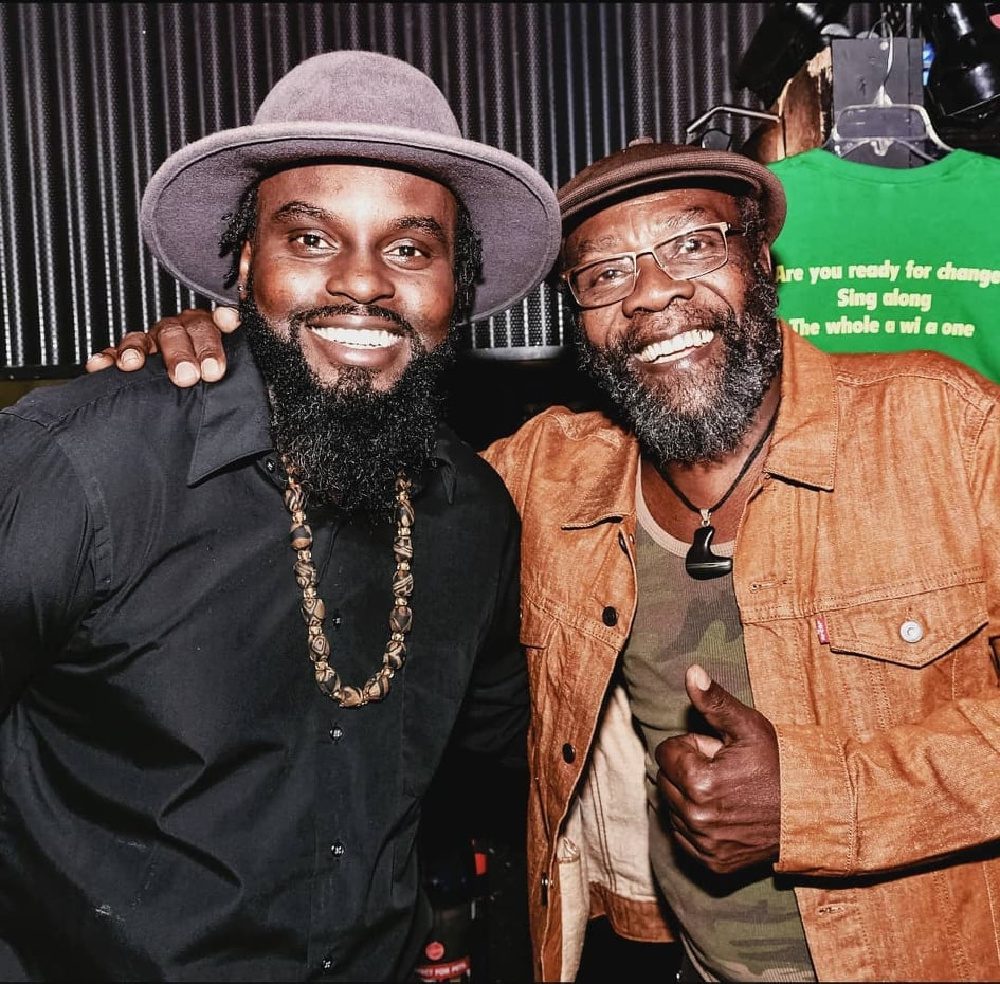
Judith Ann Warren Went From Arizona Choirgirl to LA Punk Singer to Mature Vogue Model

Photo Credit: Nina Kraft (Courtesy Judith Anna Warren)

Judith Ann Warren is experiencing the peak of success at the age of 67. In February this year, she posed nude on the digital cover of Vogue Singapore, followed by modelling pastel purple hair in the June edition of Harper’s Bazaar US. The LA-based model/singer/photographer reveals a full-throttle life that careened her from her childhood home in Arizona, to New York City punk clubs to refugee camps in Darfur, finally to land in the City of Angels with newfound recognition as an icon of beauty at any age.

Warren was the first of two girls born into an Irish Catholic family in Chandler, Arizona, to a Navy submariner father and stay-at-home mother. Money was scarce and there was not a great deal of joy at home, and music became a natural escape for a girl who knew she’d inevitably leave Arizona. The 1967 Jefferson Airplane track “White Rabbit” was one of her formative musical memories. “I was 13 and that song was so powerful to me, for some reason,” she remembers. “I didn’t understand it, but I put my own meaning to it.”
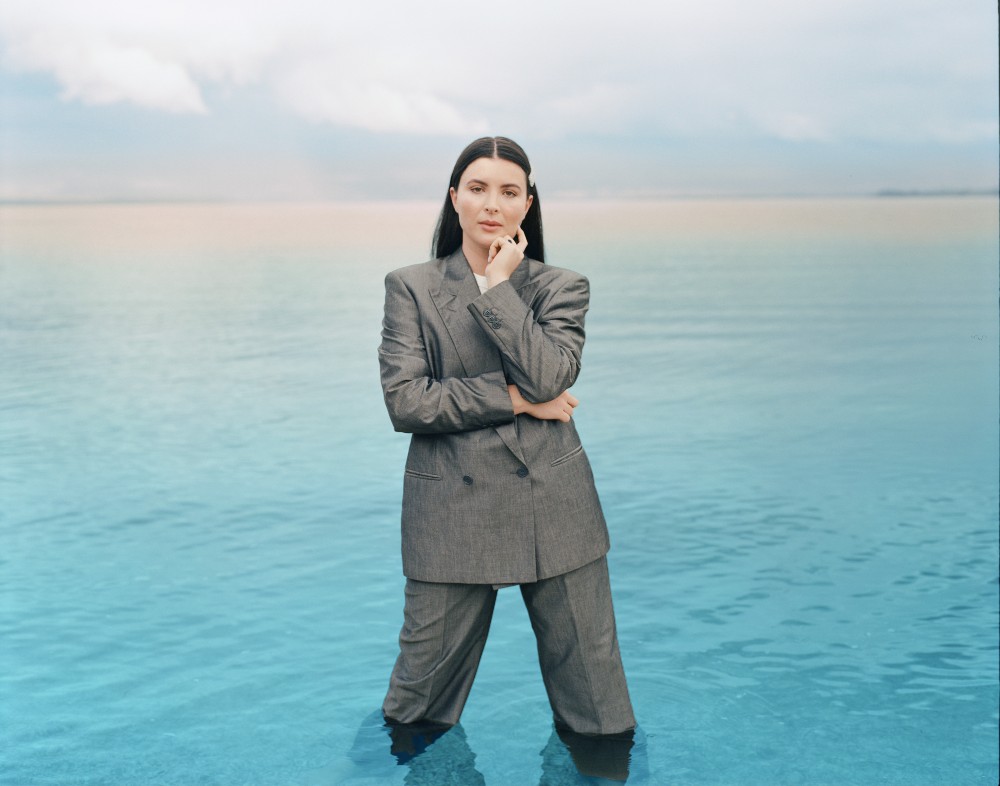
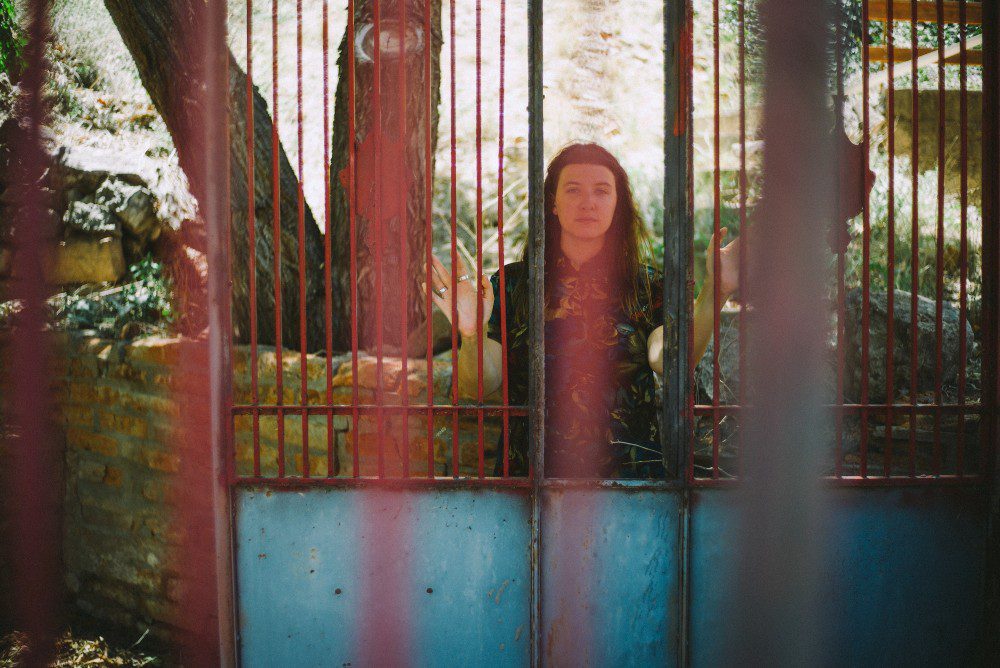
Her devout mother forced the kids to attend church every weekend, so Warren joined the church guitar group and began to sing, playing local coffee houses to entertain diners. As a naturally shy child, it was a way of making friends. In high school, she joined the choir. “We weren’t hipsters, we were the odd kids,” she recalls. “I tried out for state choir and made it both years, and as a result of that, I was able to audition for a choir that was going to tour Europe.”
The 250-voice choir (with a 200-piece symphonic orchestra and 50-piece band) flew to New Jersey, stayed on the campus of Princeton University, and held their first concert at Carnegie Hall. “At the age of 16, I was in Carnegie Hall, and it was just such an emotional thing for every kid,” Warren says. “My father flew out to see it, but my mother couldn’t afford it because we had to pay for our own travel expenses. My stepfather and my mum tried to pool what they had, and we did fundraisers.”

The choir’s next stop, in June 1970, was the White House, where they sang for Richard Nixon and Spiro Agnew at the signing of the 26th Amendment giving the right to vote to those aged 18 and up. To me, it was epic. Carnegie Hall was something you’ll never forget, but we sang ‘The Battle Hymn of The Republic’ and the arrangement was such a powerful, powerful arrangement. It was electric in that room,” Warren says.

From Nixon’s office, the choir headed to London’s Royal Albert Hall. “I’d never been out of the country – I really was an Arizona girl. I was a different human being after that. I was 16 and this was the catalyst for me. I knew I was going on a different journey than my family,” Warren says. “We travelled for a month, then came back to Arizona and in my junior year of high school I left home to save myself. I slept on the sofa of a house with a bunch of college girls and cleaned the house to pay rent. Then, when I was a senior, I rented a house with a friend. All those years, I kept singing.”

As soon as she graduated, Warren moved to California to live with her dad, his second wife and their two sons. “Los Angeles was hard for me,” she admits. “I didn’t know my dad well, and Los Angeles is a hard city to make deep, lasting friendships. I always say to newcomers to this city: don’t be frustrated, you’ll meet your people.”

She ended up working with a “really bad” cover band, Fred Moore & The Best Thing, while trying to break into the music industry. They played various Ramada Inns and Air Force bases. “Fred was a Glen Campbell lookalike who lived with his mother, wore polyester bouffant sleeves, and his mother would make crushed velvet vests and match his shoes to the vest. The keyboard player’s claim to fame was that he’d composed a song for Sonny and Cher. But I loved the guys, unemployed rockstars. Fred was the guy who got the job and paid us all, but I wanted to be like the rock guys,” Warren says.

Photo Courtesy Judith Ann Warren

After a year or so, Warren had a baby. “The father wasn’t a good choice, and he did go on a couple of legs of the tour with us, but he was jealous and had some drug and alcohol problems,” she remembers. “In my infantile world, I thought, having a baby will make us happy. I left the band and I had my son when I was 20. He was brilliant, but I was a baby raising a baby. I kept trying to sing in bands and I always held a job down, but it was hard leaving him to go to rehearsals and sometimes he’d sleep on sofas in studios, like many kids in the music industry.”

Warren had maintained work as a temp for major music executives. “As an assistant I was really fortunate to meet Cavallo Ruffalo & Fargnoli in Santa Monica, who managed Prince, Earth Wind & Fire, and Weather Report,” she says. “I worked in music publishing rights. They had a recording studio and I used to go down on my lunchbreaks and watch Wayne Shorter and the guys from Weather Report or Earth Wind & Fire. I loved it. Prince was this little, wonderful creature who was so shy and so quiet. Jaco Pastorius was brilliant, brilliant, brilliant.”

Through that job, she met Eric Eisner, who was in his 20s at the time. He was legal counsel in-house but was headhunted by David Geffen, beginning work the same week John Lennon was killed. Warren recalls meeting Geffen during a period in which she was being especially experimental with hair and makeup looks. “I was arriving at work with streaks of color or a shaved temple. David Geffen found me in the staff kitchen one morning and said, ‘I don’t get you’, and I said, ‘but you dated Cher!’ It was the best job I ever had.”

Wild hairstyles have always been Warren’s calling card (Photo Courtesy Judith Ann Warren)

She also worked at Island Records, and “met Tom Waits there, which was a dream come true for me,” and recorded vocals for 1995 rave hit “Deus” by Electric Skychurch.

Warren had begun modelling for friends in the downtown scene, including James, her roommate of six years. “He took me from cowboy boots and jeans to something I’d never imagined myself as. I was a dress-up doll for him and his friends – designers, stylists and photographers,” Warren says. “His boyfriend contracted AIDS and died a terrible death, and James discovered later that he had it too. About 20 years ago, he took his life. I lost quite a few friends.”

James preps Judith for a hair show (Photo Courtesy Judith Ann Warren)

At 28, she began dating an Englishman who had formed a punk band of three teenage boys called The Invisible Government Of The World, and recruited Warren as the singer. “Those three boys had never played instruments before this band, but they were brilliant. They were commandeered by this Englishman, and I was too,” Warren says. “It was a terrible relationship – he was abusive, and he was a Svengali. It was his ode to politics, and he really wanted to be the star of the show. But we eked out our own space.”

That’s when the former “dress-up doll” got behind the camera; Warren started taking pictures of the band and various shows. As a photographer, she also volunteered with OpUSA, a disaster relief organization, from 2004 until 2008, when she was hired to travel to Darfur with the head of InterAction, which represents most US NGOs. At the time, more than 3 million refugees were displaced and nearly half a million dead in ongoing civil war and genocide at the hands of the Sudanese government.

“We met and spoke with aid workers on their mental health within a conflict zone on what was, at that time, the world’s worst humanitarian crisis,” Warren says. “Darfur was very, very tricky and frightening. I did not have permission to take my camera into the country and you have to have permission, so I was on guard at all times. The airport was surrounded by men with machine guns. We went to Zam Zam camp with 75,000 refugees and I documented that camp and the efforts that international organizations were doing in that camp. It was heartbreaking and life-altering.”

When Warren returned to Los Angeles, she says, “I came back thinking I was going to be in the ranks of all the big photojournalists, but the recession hit. I was the first to be cut loose from the NGO.” She continued to work with non-profits as a photographer, shooting for the American Cancer Society and working with the Taproot Foundation in Louisiana, as well as doing portrait work and dabbling in fashion.

Photo Courtesy Judith Ann Warren

And that brings us to 2019, when Warren’s modelling career 2.0 took seed. “I met a woman via a Facebook page for creatives who was working with Vogue Italia and they were doing a masterclass. The top 10 would be chosen to have their editorial work in the magazine,” Warren explains. “I was partnered with a teenage girl for a theme on the span of ages. They made my hair as straight as an arrow, I had a lot of makeup on, it was the hottest day of the year. We did the shoot and I hid the photos for months. I was so mortified and embarrassed by how old I looked. Two months later the photographer wrote and said, ‘We didn’t win a spot, but I’ve sold the photographs to a magazine.’ One of my solo photos was then chosen to be on the digital platform of Italian Vogue.”

Warren was shocked, but she pulled the photos out and decided to make peace with the way she looked in them. “After that, I got a call from a young woman with the Dragonfly Agency. I walked in and 30 minutes later, walked out with a 3-year contract, and they didn’t even look at my pictures!” she says. “Almost two years later, at the end of 2020, I got the Vogue Singapore job, which came out in February this year. I’ve worked in a couple of commercials, but after Vogue Singapore my life changed in so many ways.”

Overnight, Warren’s Instagram followers went from 75 to over 1,000. She’s being courted by editors and photographers. Not only did the height of her creative career occur beyond 60, but it happened at the height of the pandemic. There’s no clear path to success, if we’re going to find the Hallmark card message here. And there’s no cut-off point at which your skills, passion and curiosity cease to open doors. Warren’s story is a woman’s story, a creative’s story, a musician’s story, and a model story.

Follow Judith Ann Warren on Instagram for ongoing updates.