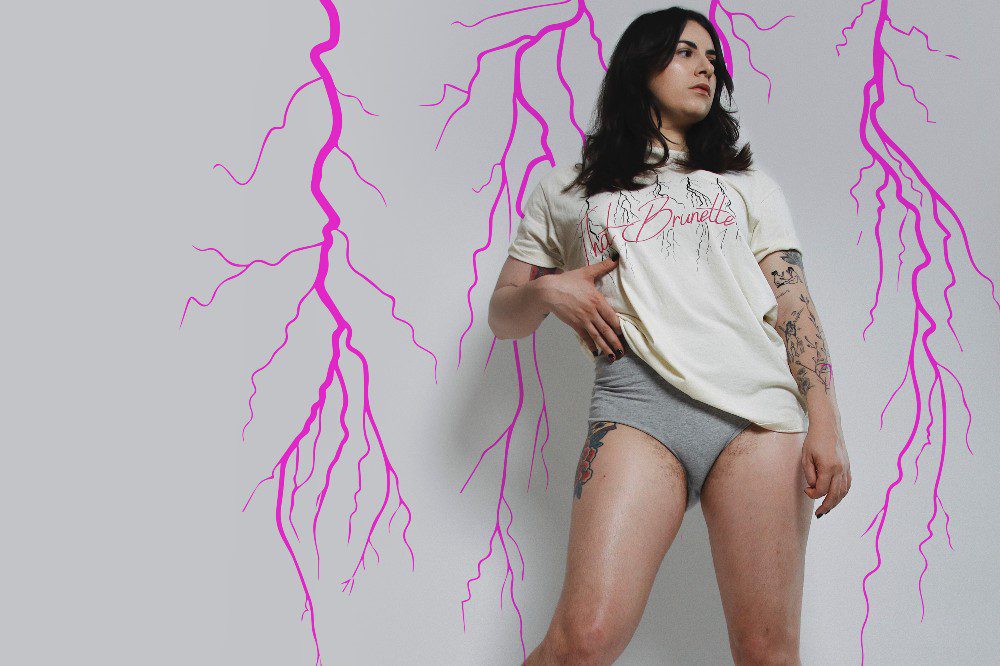
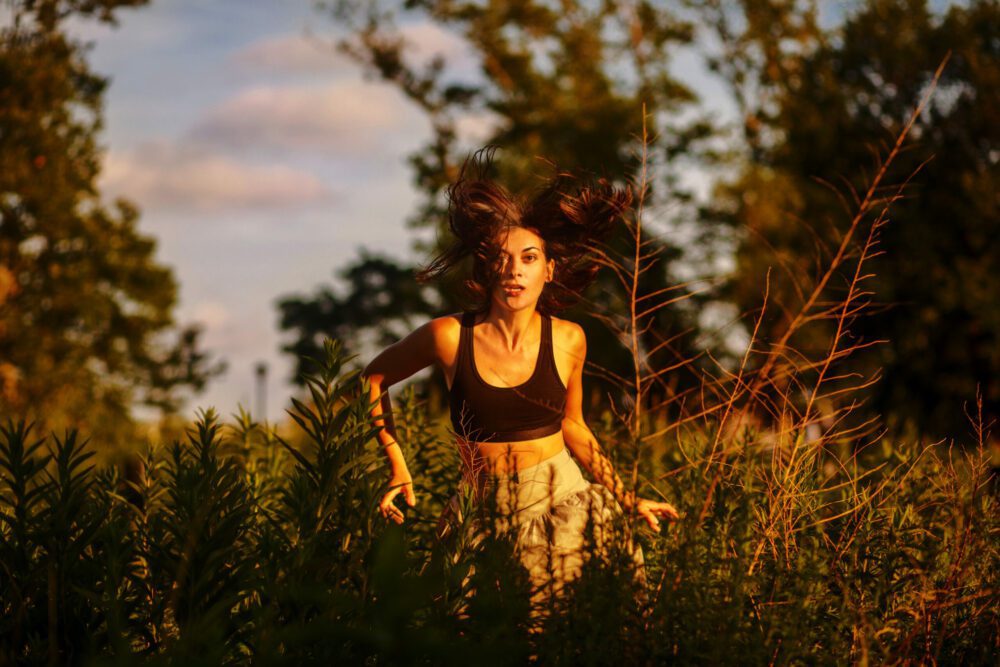
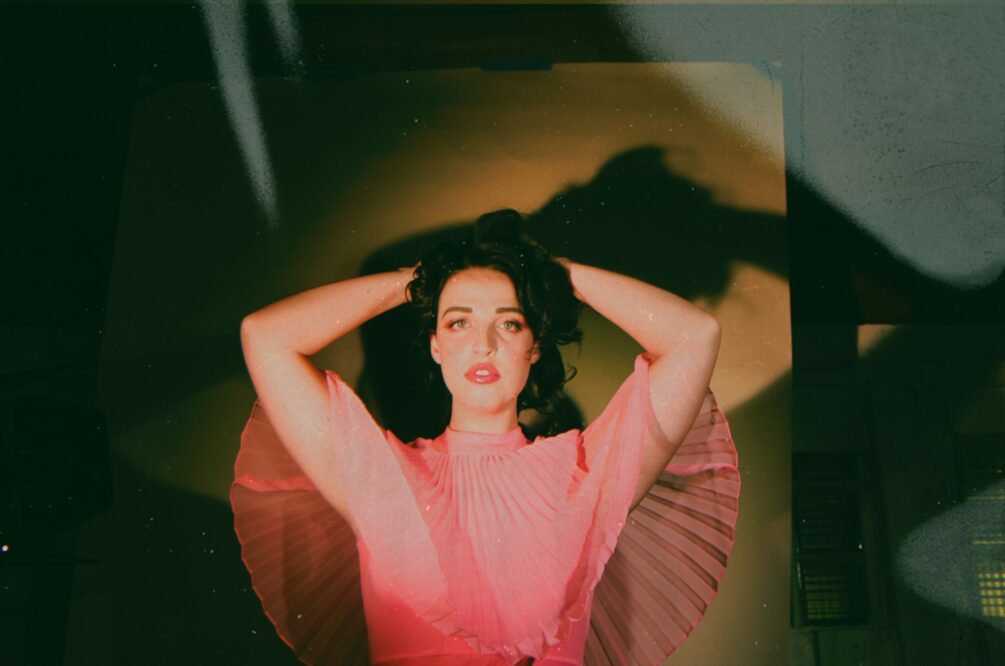
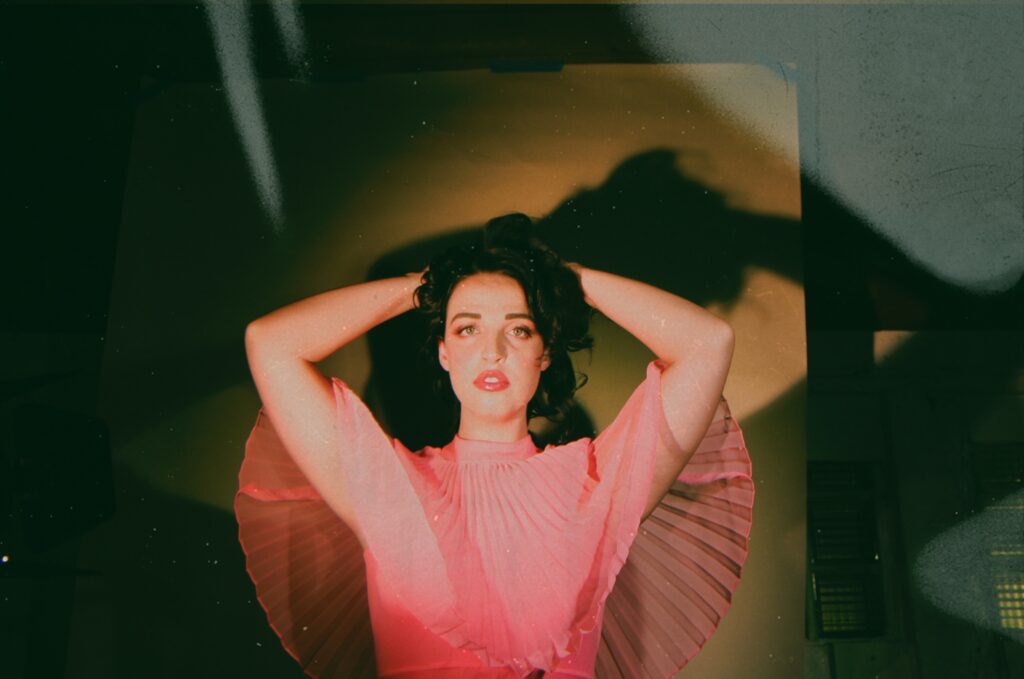
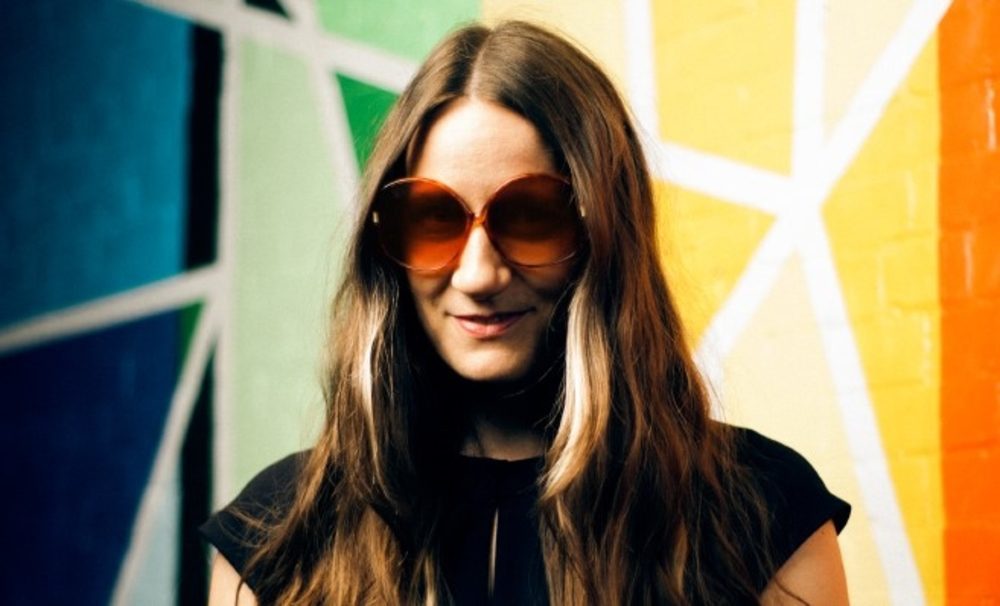
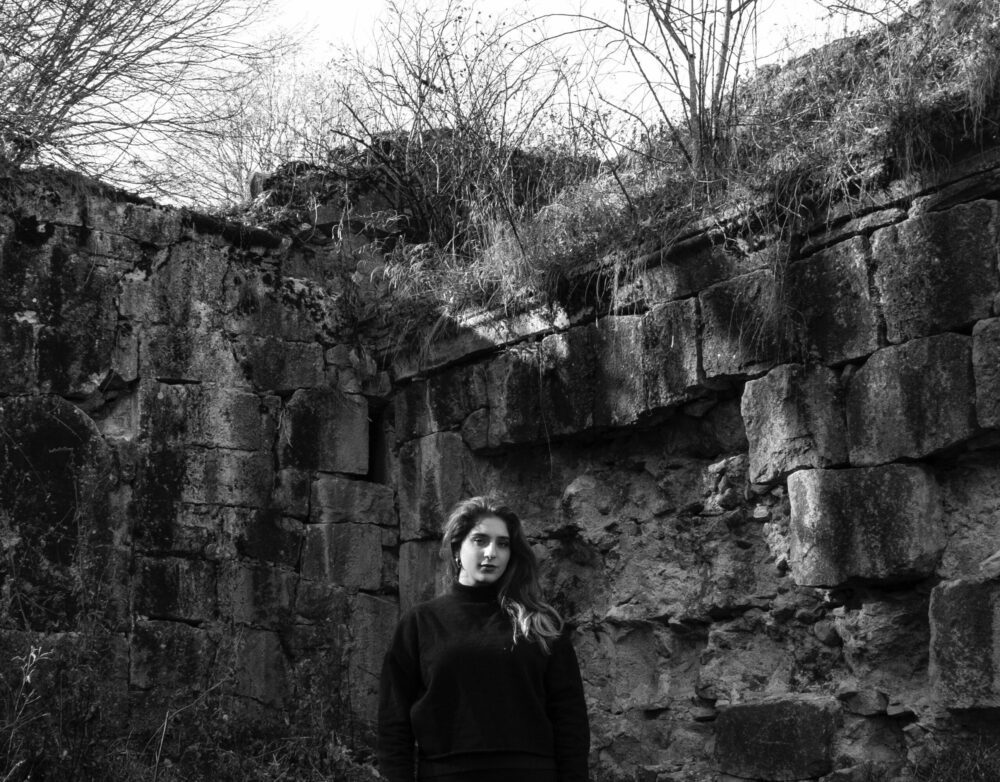
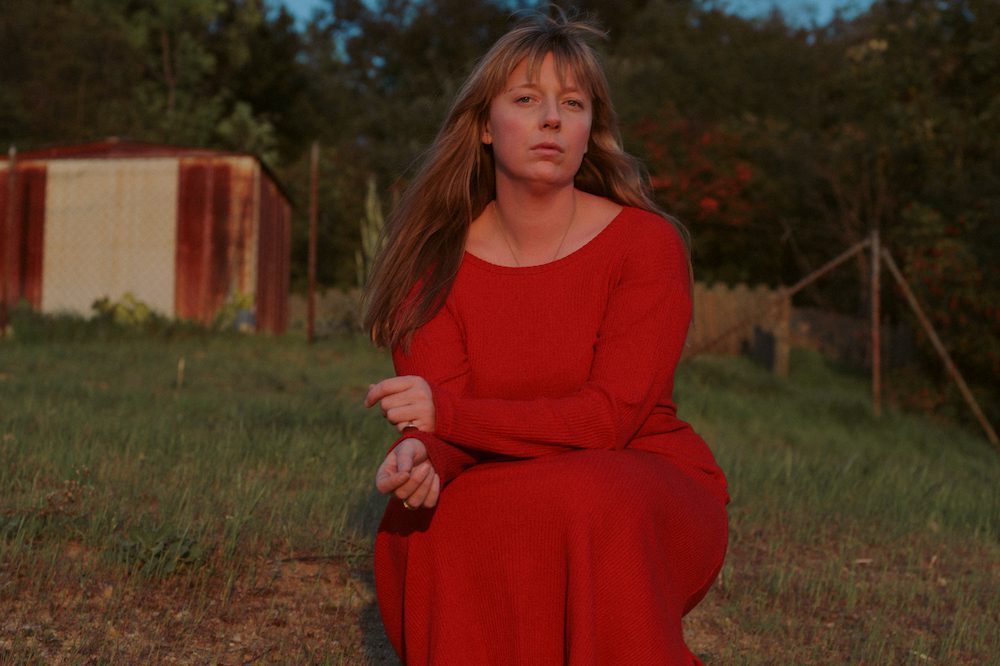
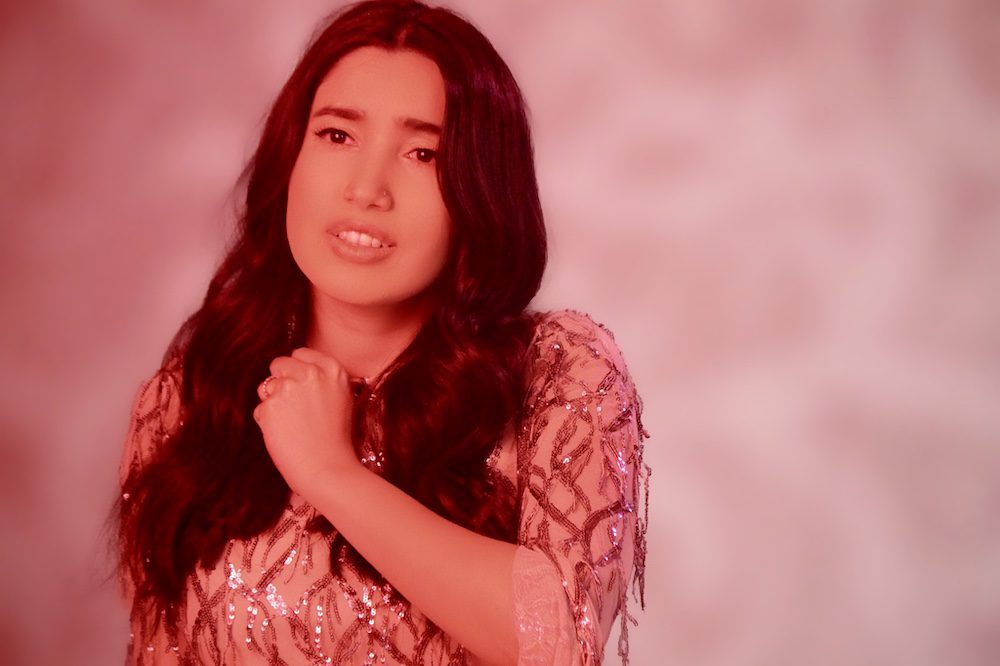
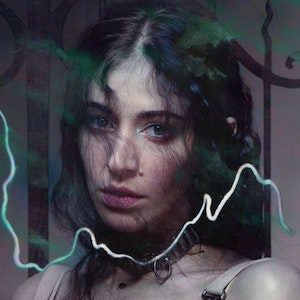
Earlier this year, That Brunette stepped into a spotlight of her own creation. She finally shed her past, discarding a previous stage name, and has since flourished in her craft. Her new song “Platonic,” premiering today, displays an artist continuing to discover her place in the alt/pop space and carve out a singular voice.
“My heart is a little bit broken/When you cheat on me with the city where I’m from/Yeah, our story was just beginning,” she sings over magical-sounding percussion built from bells, shakers, and handclaps. The song’s emotive core plays provocatively against a glistening shell, and with production courtesy of Certain Self, it’s the friendship anthem we all need right now.
Musically, the song mirrors “one of those friendships that starts explosively, like a chemical reaction, and proceeds to help you evolve as a person,” the Brooklyn artist tells Audiofemme. “I love writing about more than one kind of love, and this felt like the perfect opportunity to explore platonic love and how it can be just as profound and transformative as romantic love.”
Those xylophone-like sounds, which give the message blinding brightness, were actually created with “an untuned piano being strummed with a kitchen fork,” she notes. “Certain Self and I had fun experimenting with organic sounds in his apartment to create an eclectic rhythmic atmosphere. From there, I wanted to bring it to a more ethereal and dreamlike place with shimmery synths and angelic bells. I love how it came together.”
“You opened a part of me that was dying,” That Brunette muses later on in the song. Despite its inherent longing, writing the song was actually “a happy experience” for her. “It serves as both a lovely little time capsule of the inception of a friendship, as well as an examination of platonic love. I felt like I was honoring this friendship’s impact on me by writing a song about it and that felt good.”
“Platonic” falls quite in line with another 2020 entry called “Metro with Matthew,” in which she celebrates friends who have never left her side. “I’m so lucky to still be friends with so many people I met my freshman year of college nearly a decade ago. We’ve grown up together and seen each other at our best and worst,” she says, “and we still love to hang out and shoot the shit. I treasure those connections the most because they’ve stood the test of time.”
Coinciding with the single drop, That Brunette has crafted a line of merch for the first time in her career ─ with 100 percent of proceeds benefiting various Black drag performers in the Brooklyn scene, like The Dragon Sisters. “They are iconic and everyone needs to know about them. I’ve been friends with them since college and their ability to transform a room in under .5 seconds is breathtaking every time. Their work ethic is only rivaled by their ferocity and performance capabilities. Obsessed forever,” she says. “I also need to shout out Miz Jade who has been killing the game since before I knew the game existed. Her seamless blend of raw talent, fashion, storytelling, and comedy is truly finessed. She’s a professional who’s caused me to get my life on multiple occasions.”
The merch came together in collaboration with graphic designer Florencia Alvarado, who is also the co-editor of Women on Women, a publication of art and poetry made by LGBTQ+ women. “Florencia has been the perfect person to collaborate with on the shirts. Our aesthetics blend together in such a natural way,” says the singer.
“I want to give back to Black people in a tangible way. This allows me to give funds directly to people whose art I’ve loved and admired for years,” she explains. “Especially in a pandemic when it’s basically impossible to support Drag Queens in person at the clubs, it just feels right to continue supporting them financially in some way when I’d normally be out tipping my queens every weekend.”
Like many, 2020 completely rearranged how That Brunette thought about creativity and songwriting. “It forced me to come back to my roots of writing songs alone with just me and the piano. That was difficult in some ways because writing alone can be uncomfortable,” she reflects. “There’s no one to use as a distraction or to bounce ideas off of. That made it a little harder to move through the stickier parts of the songwriting process, but the songs I have written are very close to my heart. And I can’t wait to bring them to life.”
“Platonic” showcases That Brunette’s earnest desire to keep pushing forward, exploring with increasingly more fascinating moods and structures. “My next long form release is in a similar vein of organic production fused with pop textures. I’ve been enjoying pairing a somewhat grittier backbone of raw percussion and dirty bass synths with lush and shiny pop pads and synths. I feel like that’s the world my vocals want to live in, and it feels really authentic for me.”
Follow That Brunette on Twitter and Instagram for ongoing updates.
Relationships all have their ups and downs, but when you’re in it for the long haul, you stick around despite the challenges. NYC-based pop artist Nora Lei, a self-described “hopeless romantic” who’s been in a relationship for six years, channeled this sense of unrelenting faith and loyalty into her latest single, “Together,” an ode to unbreakable love.
The verses describe the difficulties a relationship may pose — “I can tell you’re tired/It’s alright because I am too/Been so much tension/Could cut it with a knife” — while the chorus nevertheless returns to a hopeful note: “We know we’re supposed to be together.” The production, full of electronic effects, makes the song fun and danceable, adding to the sense of optimism that overrides the hardship described in the lyrics.
Lei cites Halsey as an influence, which is audible in the way she belts the bridge, “You said it’s gonna get better/But we lost our way/Didn’t you say/So I think it’s time to go/Watch me fly away, wait.”
“I feel like everyone can relate to that,” she says. “You’re so in love with the person, they’re so in love with you, but you feel like you’re hitting this wall. But in the end, you guys are putting the wall up, and you have to kind of let that down and erase the societal norms if you’re in love with each other and be like, ‘Let’s do this and enjoy each other.'”
Though her partner is her muse, Lei also tends to imagine fictional situations that become the basis for songs, and “Together” was born from a combination of these two sources. “I create so many different scenarios in my head, so many different relationships from chatting with girlfriends and understanding what everyone goes through,” she says. “It kind of fell out of me, just holding everyone’s different experience in me, and it just bled out on paper that way.”
She first found the Polar Beats online, then wrote the lyrics around it, and producer Joe Laporta worked with her to fine-tune and mix it. The contrast between the lighthearted sound and the deep lyrics was intentional. “I imagine people dancing to it and enjoying it, even though the words are relating to a relationship in those tough times,” she says.
The 28-year-old began posting covers of songs by artists like Michelle Branch and Demi Lovato to her YouTube channel as a teenager but just began releasing music this year, having been a fashion designer and creator of the swimwear brand Perfect Peach. For a while, she’d record lines that came to her on her phone but didn’t do anything with them. Then, during quarantine, she began to get serious about turning her ideas into songs.
“As terrible as that was, it gave me so much ability to sit down and get inspired and turn all those thoughts and notes I had written down into music, so this year kicked off everything for me,” she remembers. “It’s amazing for me that I’m doing it. It’s a big passion of mine, and it’s been in my life forever. One year down, lots to go.”
While she’s still creating made-to-order pieces for her fashion brand, her focus has shifted to her music, which has already garnered a following; she has over 50,000 followers on Instagram and hundreds of thousands of streams on Spotify. To improve her songwriting, she’s begun learning piano and guitar. She’s working toward an EP but is focused on releasing singles for now.
Her very first single, the slow, rhythmic “Heroine,” is an empowerment anthem about “being your own heroine, your own inner goddess, and just doing what makes you feel great and being strong and confident,” she says. She then released the moody, atmospheric “Chemistry” and the wistful “Never Knew Why,” a reflection on the times relationships don’t go as planned.
“All my music is exactly what I’m going through and internally processing, so it can be quite emotional and relatable,” she says. “Some of my songs, I will have purely a melody and will work off of that. Other times, it’s something I absolutely have to get out of me, and I will sit down and write the song in 15 minutes, and I will build the melody around those lyrics.”
When she thinks about the future of her music career, her fans are her priority. “I really just want to be in this for the long run,” she says. “It would be great to win some awards and get more streams, but I really just want to grow a fan base and have my music really resonate with people and have them feel something. If I can keep doing that and have that happen for me, that’s my biggest goal.”
In a year without dance clubs or music festivals, New York-based DJ and producer Julia Govor wanted to do something to bring together her colleagues. Indefinite Uncertainty, which dropped November 27, is the result of that mission. A 10-track compilation from Govor’s own label, Jujuka, Indefinite Uncertainty is a broadly techno collection with a diverse roster of producers, from Detroit-based experimental collective Pure Rave to Paraguayan dance music pioneer Victoria Mussi.
Some of the artists are people Govor has known for quite a while through DJ circles. Others, she found through avenues like Bandcamp. They all have something in common. “I trust what they do,” Govor says on a recent video call from her home. Plus, she adds, “They are extremely good people with a big heart and care about others.”
For a touring DJ, being on the road is also an opportunity to hear new music, to meet people who may become collaborators and to get feedback on their own work. “When everything is shut down the part of connecting with each other through music basically disappeared, because there’s no shows,” she says. “I decided I have to do something to stay in touch with all of these brilliant musicians.”
In any other year, all these artists might have met up with each other at a gig somewhere in the world, but, without those, Govor is fostering a different kind of connection, one that’s driven by her own love of curation. “I could be connected with them through their music because music is extremely personal expression,” she says.
Govor herself was set to play Los Angeles the night before the city shutdown due to the COVID-19 pandemic, but the gig was canceled. It was a disappointment, but, she says, it also showed that the promoters cared about the safety of others. She adds, “It’s very important for me to work with people like this.”
Originally from Russia, Govor moved to New York six years ago. She’s played clubs from Germany to Brazil and festivals like EDC in Las Vegas. During this time at home, she’s worked on music that had been sitting around unfinished – and that’s led to a big breakthrough. “Quarantine actually helped me to clear my vision on the music that I wanted to do,” she says. She adds that while others in the dance music world may have focused on tracks for at-home listening, that wasn’t what she wanted to make. “I decided I am going to just clear my vision of how dance music could be,” she says. That led to some ideas for what will be her fist proper album; while Govor has been making music for a decade and released plenty of tracks and EPs, she’s yet to put out a full-length. “It was good to understand how can I be who I was before, to learn and understand how can I place myself to the new normals,” she says. “I was just looking and listening and trying to find myself.”
The year also brought a few other breakthroughs for Govor. She recently earned a residency for New York’s online radio station The Lot. Her show, called Cosmonaut, debuted late last summer. It’s an opportunity to play unreleased tracks and promos and to give people some of the background on artists making techno.
In October, her track “Shelter 909” appeared on the compilation Hot Steel: Round 2 from Trip Recordings, the label helmed by DJ Nina Kraviz. Govor had produced “Shelter 909” back in 2016 and the track was previously set for release on another label, but, that deal fell through. “I was very upset and frustrated,” she says about the situation. On a run, though, she stumbled upon a solution. Govor noticed a key on the asphalt, then looked at her phone and saw that Kraviz had sent her a message on Instagram. That’s when she realized that there was a metaphorical key to her dilemma. She asked Kraviz, who Govor knew from back when both were living in Moscow, if she’d be interested in the track. The lesson, Govor says, “If one door is closed another will open for sure.”
As for her own label, that’s been undergoing an evolution, too. Govor launched Jujuka back in 2018 to release her own music. Initially, she worked with artists to include comics within the releases, but she’s since shifted away from that model. “It’s hard to do it the proper way,” she says of fusing together the two media; Govor wanted to focus on the music. Additionally, she has expanded to release music made by other producers as well.
Curation for the label is imperative. She likes to find artists on her own and understand who they are beyond a single track. “I have to see this full vision of their artistic direction,” she says. She also wants get a feel for how they might develop as artists and if she can see herself and the artists growing alongside each other.
“It’s just so amazing to be in touch with the producers and talk about how we can make the track, or how it can be promoted,” she says. “It’s my favorite part and also the most difficult part.”
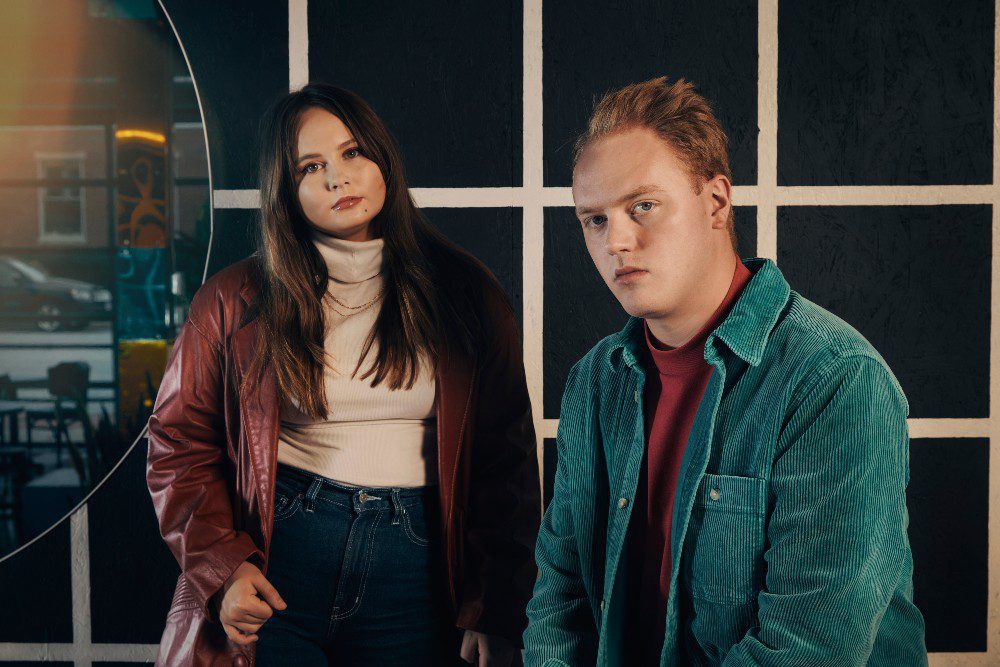
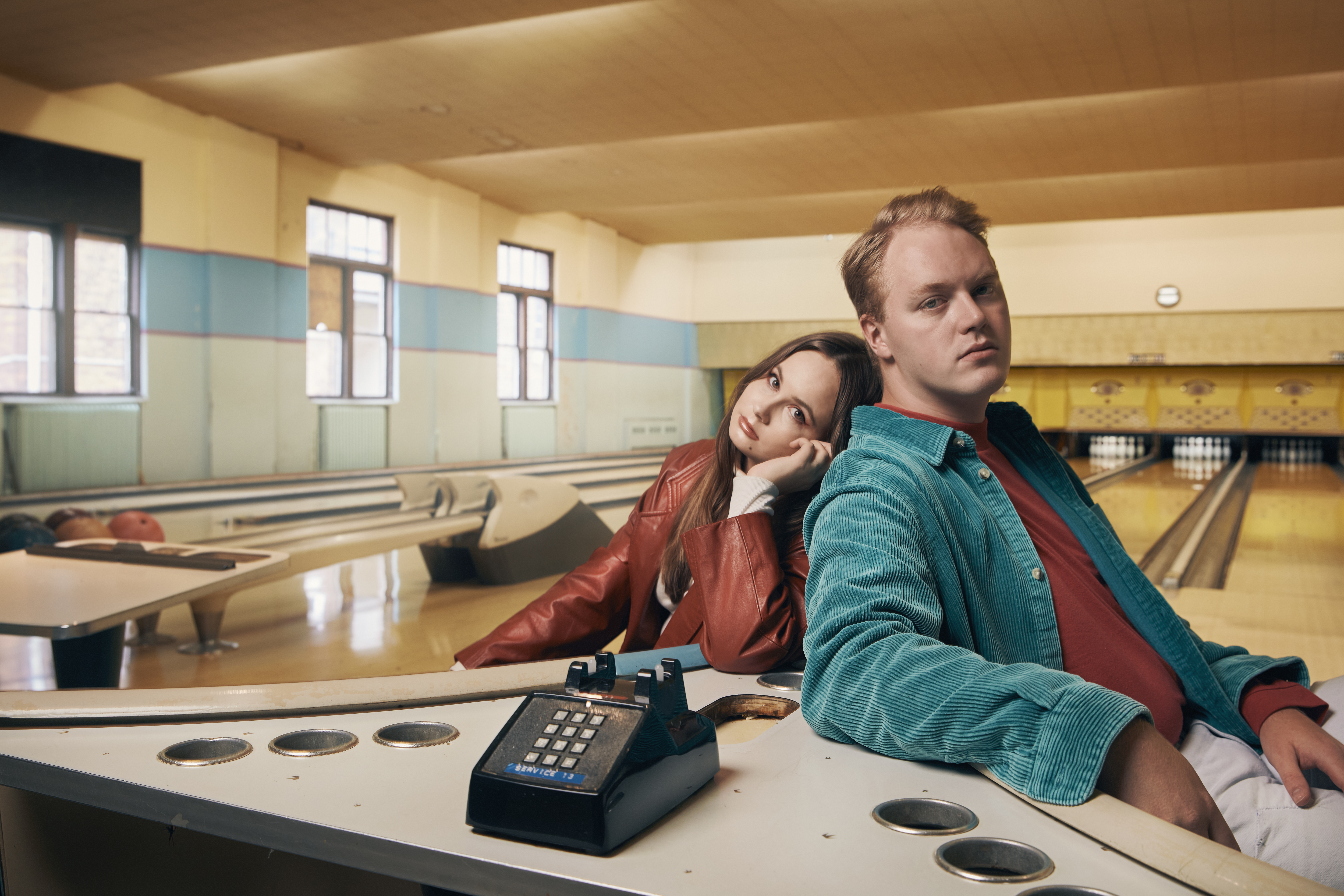
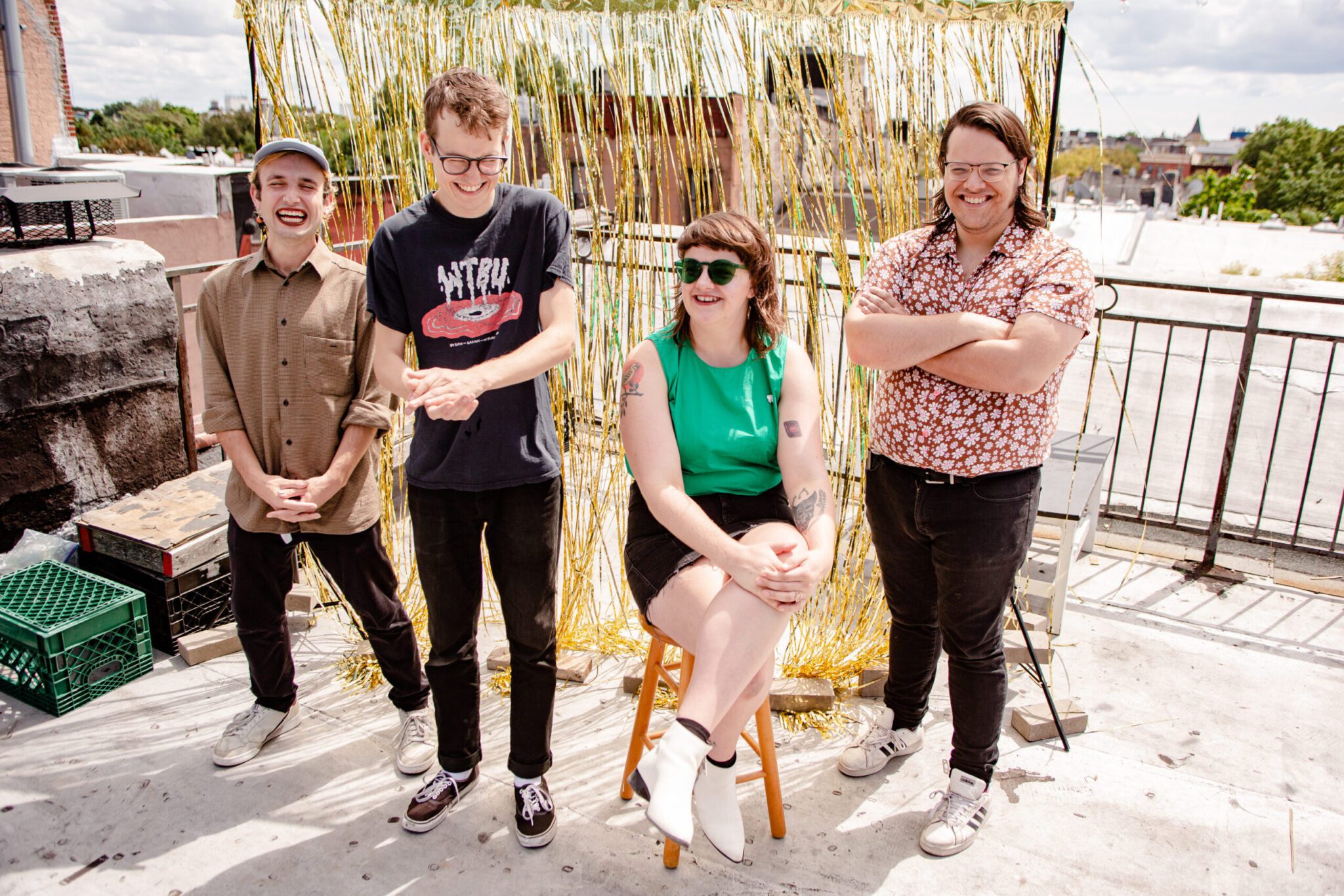
As Cincinnati heads into a cold, COVID winter, Moonbeau offers up a much-needed dose of warm, fun-loving pop music with their sophomore album, Up All Night. The duo, made up of husband and wife Christian and Claire Gough, combines dreamy synths and starry-eyed love songs that transport the listener to a time of carefree, pre-pandemic bliss.
“It was all recorded before COVID hit and when we were about to get it finally mastered and mixed, everything shut down,” Christian tells Audiofemme. “I feel like it’s kind of escapist pop music, and right now, people want to escape more than anything.”
“COVID and everything made it a little bit difficult for us to finish in the timeline that we imagined we would, but we’re happy to be able to put it out now,” Claire adds.
The 12-track effort was fronted by two easygoing singles, “All Summer” and “Radio,” the latter of which arrived with an equally fun music video that sees the pair sneaking into Central Ohio’s CD102.5 (recently relocated on the dial to 92.9) to get their single on the airwaves.
“I thought it would be kind of a funny thing to do,” Claire says of the clip. “The thing that I thought of first was us showing up on the security camera; we wanted to look like we were trying to not get caught. And when [director] Jack [Campise] reached out to us he had the idea to bring in the janitor – who was really the star of the whole video, just because he was such a great dancer.”
“I wish he would’ve been in the video more,” Christian laughs.
The couple first met in 2014, while Christian was playing in a band called The Yugos with his brother. “Christian got the opportunity to play in Arizona, and he wanted me to go,” says Claire. “We had already toyed around with the idea of playing music together – we were dating at the time. So, we got to go to Arizona for our first trip to play this festival. And then from there I was like, ‘Ok, I think I’ll do this from now on!’”
Moonbeau released their debut singles, “Are We In Love Yet?” and “In Your Lifetime,” in 2017. Their self-titled debut followed the next year. “Christian wrote our first album, Moonbeau, and most of the ideas were his,” Claire says. “But with this album, it was super collaborative, which I’m really excited about.”
Although they aren’t able to celebrate Up All Night with an in-person performance, Moonbeau will play a live-streamed set on December 4 from the Woodward Theater. Not only is it one of their favorite venues, it’s where they got married.
“It will be very different from any other live-stream that we’ve done, just because we’re gonna go all out with the lights and the background,” says Claire.
Looking ahead, Moonbeau fans can keep an eye out for remixes and acoustic versions from the album, as well.
Photo Credit: Devyn Glista
The couple jokes that they’re often asked how being a married duo affects their band chemistry, especially one that capitalizes on lyrical sweet nothings. Besides some laugh-filled banter about the foreseeable challenges, like having to massage the truth rather than bluntly reject ideas (“He’s never told me he doesn’t like my idea – I guess he’s afraid!”), or deciphering whose love song is about who (“Sometimes she’ll be like, ‘That’s not about me!’”), the band operates pretty much like any other.
“You hope for a certain level of respect and genuine care from anyone that you’re in a band with, so it really helps me feel like I can be open about certain ideas that I have and know that he won’t shut them down,” says Claire. “There’s a lot of confidence that comes with making music with someone you really care about.”
“The best way to break a habit is to call it what it is,” says Chicago-based singer-songwriter Elizabeth Moen. Over the last several months, she’s taken some time to examine her own holding patterns – especially those that have held her back – as she settles into city life, having recently relocated from Iowa City. And she has the receipts, in the form of a six-song EP, Creature of Habit, out December 11. Whether it’s falling into relationships of convenience, mindless snacking, or ordering takeout as though the world isn’t on a swift decline, Moen uses her witty, relatable lyricism to unravel the most tangled parts of her persona and braid them into something more beautiful.
So far, Moen has released the EP’s languid, minimalist title track, the twangy “Eating Chips,” and a contemplative folk ballad, “It’ll Get Tired Too.” Premiering today via Audiofemme is her latest single from Creature of Habit, “Studio Apartment,” a bluesy play-by-play of the “bad day, bored night, good timing” that leads to meeting someone at the bar and taking them home. “Oh wow, you seem just my type/Push me away if you loved me/Sure, we can head over to mine/Finish that thought in the morning, or the afternoon,” she sings, in a tone as casual as the affair she describes: “I’d like to think I know better than I do, but I do this all the time too.” She’s seemingly resigned to what’s about to happen, until she lets it all burst operatically forth in the first chorus: “No worries, I won’t fall for you/If we go back to my studio apartment/No view of the bridge or my dreams.”
It’s easier to coast when it’s so exhausting – and possibly disastrous – to want or work for something more. Potential creates complications; better to keep things simple, enclosed within four walls. While the song seems like a specific, personal glimpse into a moment of Moen’s life, we’ve all lived that same moment, felt that same feeling, down to the shit-show details in which Moen, having locked herself out, searches for a spare key while her love interest sways drunkenly in the hall.
That holds true across the entire EP – her intimate confessions make the songs easy to connect with, particularly for young women, whose ambitions and desires are often frowned on should we dare speak them aloud. But lying to yourself, Moen says, in an effort to convince yourself that everything is fine, dooms you to stay in your rut. “You can also be upset. I’m just realizing that now,” she says. “You do have to laugh at things, like, oh shit, I left my keys inside, wow that was dumb. But it’s also okay to not be okay and be mad. I feel like I, especially as a woman, never really had the space for those emotions.” And when you don’t have that emotional space, the four walls of your studio apartment can feel like they’re starting to close in on you.
For the most part, though, Moen hasn’t stayed in one place long enough to let that happen, living a nomadic life instead. She studied French and Spanish at the University of Iowa in the hopes of teaching abroad or working in international business, but also began singing covers at open mic nights. “It’d be me and my guitar, singing Johnny Cash and stuff,” Moen remembers. “Eventually, my friends were like, why don’t you write your own songs? And I was like, I can’t do that. And then one day I was just like, actually I can. You just stop telling yourself you can’t do it, and then you do it. I let go and I just started writing lyrics.” Moen finished her program, but the minute she graduated she set about learning to book shows and toured as much as possible, headlining Lincoln Hall in Chicago and supporting artists like Lake Street Dive, Margaret Glaspy, and Buck Meek.
She released three albums in as many years – her self-titled debut in 2016, followed by sophomore effort That’s All I Wanted in 2017 and A Million Miles Away in 2018. Constantly on the road to promote them, Moen crashed with random folks while touring, or friends and family if she needed an extended stay between gigs. She had another LP ready to go – a big, glossy, studio affair – and had even dropped a few singles from it (“Headgear” and “Ex’s House Party“); she was scheduled to head to SXSW and launch another tour from there in March when the pandemic took hold, dashing those plans.
For a musician like Moen, whose identity and career trajectory was wrapped up in playing live, the blow could have been devastating. But Moen took it as a sign that it was time to pause and maybe put down some roots. “Impostor syndrome is real, and the one time I’ve never felt impostor syndrome is when I’m on stage,” she says. “Quarantine has been a bit of a beautiful awakening of owning it more, [saying] you are still doing what you do, and you are more than just a show machine. It’s been kind of a necessary chapter in my life – really hard, but also, there are some things I’m thankful for, like learning more about my own brain and just being a person.”
After a brief stay in an attic room with spotty Wi-fi, Moen temporarily moved into her aunt’s basement. The two are close in age – Moen says it felt like staying with an older sister – and because her aunt is a therapist, the singer took the opportunity to learn more about the inner workings of her own mind. “She would never therapize me when I was staying with her. She’s very good about that,” she says. “But whenever I was feeling low or like, just curious about therapy, I would ask her questions. I think mental health is an important and fascinating subject, and I was living with a therapist, so I was like, well, this is a perfect person to talk to about this sort of stuff.”
Moen was also inspired by hanging out with her aunt’s three young sons, and says tender EP cut “It’ll Get Tired Too” was inspired by the way even their most ardent feelings seemed to come and go. “Their emotions are pretty straight forward – they can’t really hide their emotions yet,” Moen points out. “As a touring musician I haven’t been around kids a lot. Being with three kids during quarantine was intense, but I really got back in tune with how awesome kids are.” Moen also took long walks in the woods, examining some complex emotions of her own and staring down her most dysfunctional tendencies. Though they weren’t necessarily affecting her life in a negative way just yet, she knew that letting those habits take root could spell trouble.
“That’s what the EP is about. The song ‘Creature of Habit’ is definitely about realizing you can’t just be single, you’re always dating someone. Realizing I am so focused on finding someone else to be with [because] I’m trying to not be with myself,” she explains. “Late at night I like to drink, and I use it as an excuse to text and flirt, maybe hop on the apps. There’s nothing wrong with the apps, but it’s like, why do I have to have a couple glasses of wine before I do that, you know? I’m realizing that was a pattern.”
While “Studio Apartment” narrates a one-night stand, it’s not just about the guy she’s settled for that night, or the beer that’s just alright, or the too-cramped living quarters – it’s the life she’s settled for, the mediocrity we all settle for as we stumble toward our dreams. “A habit of mine – and I was also thinking about habits of other people too – we need quick fixes because maybe we’re scared of the real thing,” Moen says.
But Creature of Habit is also notable for the new practices Moen picked up while she was making it. She started exploring synths and keyboards; better suited for bedroom recording than guitars and amps, Moen felt more freedom to “make weird and horrible noises, alone in my headphones.” Avery Mossman, a friend who plays some additional synths on the EP, gave her some quick tutorials, and she was off to the races, noodling around and layering sounds. “I just didn’t have the mics and stuff that I felt comfortable using to track guitars and vocals at home, but with the keys and synth I borrowed, I could just plug it into my interface. I also never had an interface before quarantine!” she says. “It kind of reawakened [my creativity]. It made me feel the way I felt when I first started playing guitar.”
Ultimately, it gave the EP more electronic flourishes than her previous releases. Playing around with ProTools also taught Moen enough about engineering to be able to explain what she wanted to achieve with production and mixing when she was able to get studio time. And because she had to sing quietly so as not to wake her little cousins, Moen embraced her lower register, singing in the melodramatic style she imagined the male country stars she’d admired in the past might. When she posted an early version of “Creature of Habit” to Instagram, her friends asked why she didn’t sing that way more often.
“Sometimes I feel like as a singer, the higher I can go and the stronger I can belt that high part of my register, the more impressive it is, but actually, I think people honing that low part of their voice – particularly female voices – is cool,” she says. “I finally did that with this EP. But ‘Studio Apartment’ was definitely the one where I was like, nah, I’m still gonna belt it up there though.”
Follow Elizabeth Moen on Facebook and Instagram for ongoing updates.
Welcome to Audiofemme’s monthly record review column, Musique Boutique, written by music journo vet Gillian G. Gaar. Every fourth Monday, Musique Boutique offers a cross-section of noteworthy reissues and new releases guaranteed to perk up your ears.
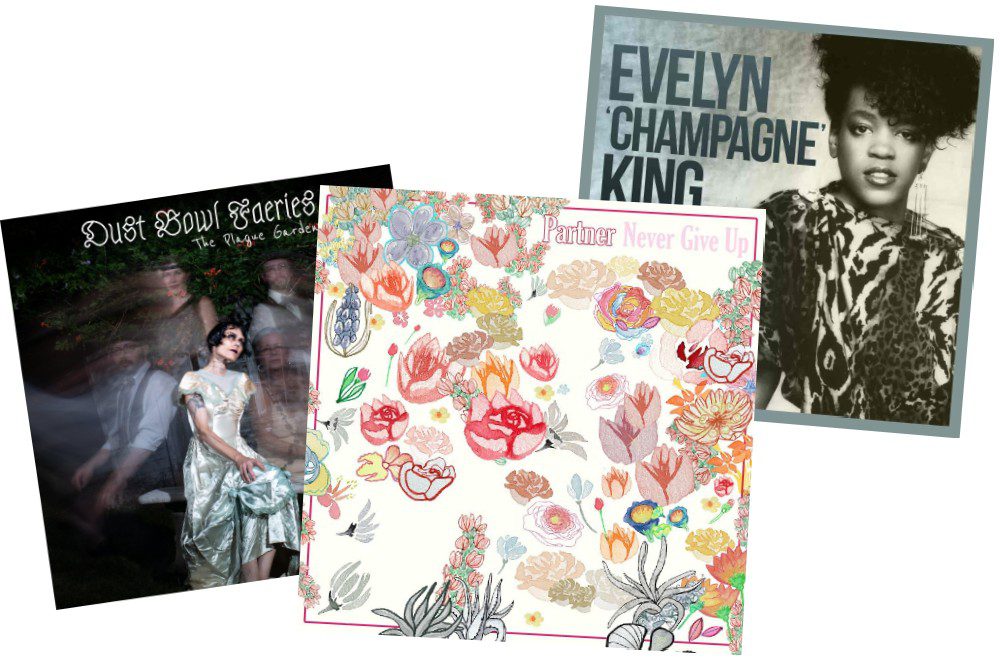
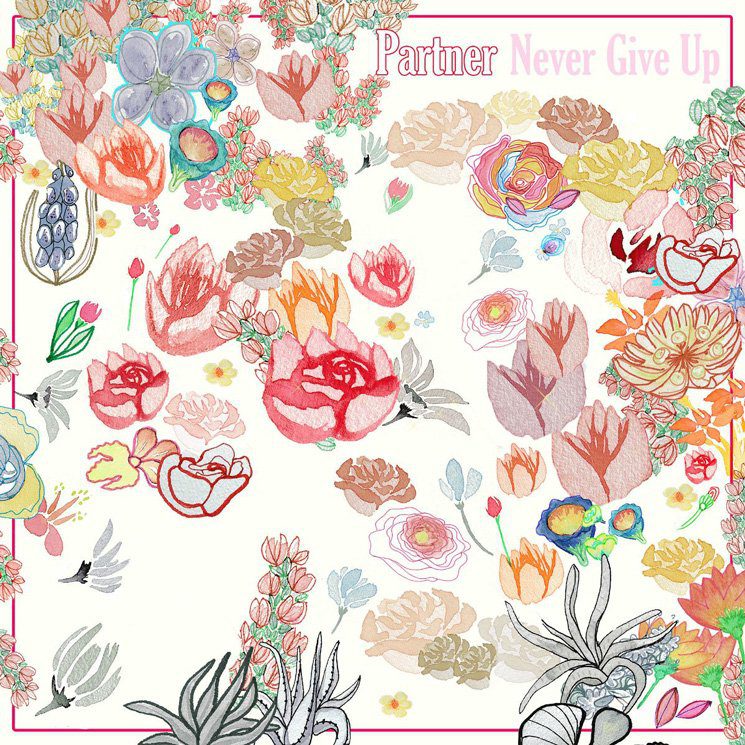
Canada’s Partner have returned with their second full-length album, Don’t Give Up (You’ve Changed Records). But perhaps the best way to be introduced to their music is by checking out their fiendishly clever videos first. The bright and sparkly “Hello and Welcome” opens the album, and the animated video transforms co-founders Josée Caron and Lucy Niles (lead and rhythm guitar, respectively, though they also play other instruments) into glam rock superstars, who enthusiastically assure you their latest work will deliver plenty of great times: “It’s really gonna be like a show you won’t have to leave your house to go!” Then they blast off into outer space and get abducted by aliens. You’ll experience that kind of playfulness throughout the record.
Or how about “Big Gay Hands,” a nice chunky rocker about finding romance at the local tavern (the singer becomes enamored by the skill with which another woman wields her pool cue), matched by a video where colorfully dressed-up hands take center stage. What’s the secret behind their thick, sweet guitar sound? You’ll find the origin story in “Honey,” a song with a monster hook, and a video that has Caron and Niles wreaking havoc in their rehearsal space, playing 10 different characters between them (Caron’s bee outfit is especially fetching).
Having worked with other musicians in the past, Caron and Nile scaled back to themselves and drummer Simone TB for this release. This is indie rock with plenty of heart and soul, whether the mood’s giddy or glum. “Couldn’t Forget” is a raucous love song that unexpectedly veers into country rock. “Good Place to Hide” was influenced by the band’s love of Rush (they’ve previously covered “Limelight”) and reveals the classic rock underpinnings that are evident throughout the album. “Roller Coaster (Life Is One)” is a contemplative piece, starting out as a piano-based number before exploding into the guitar action of the chorus, with a lyric about finding your way through troubled times. “Here I Am World” is a deceptively upbeat number about trying to understand the purpose of it all. “Crocodiles” is the dazzling closer, a song about avoiding pitfalls, that vaults from the low-key guitar strumming of the beginning to cascading walls of sound.
Above all, Partner finds salvation in rock ‘n’ roll. The cheery, propulsive “Rock is My Rock” is their manifesto, distilling all that’s great about it in a concise two minutes and 19 seconds. Partner gets right to the heart of the matter, shakes you up, and has a good time doing it.
“It’s hard to sing while wearing masks.” Welcome to the spooky, surreal cabaret hosted by the Dust Bowl Faeries, where you can expect the unexpected. Their latest LP, The Plague Garden, draws on the sounds of past to create music that has a powerful resonance in modern times.
Along with guitar, bass, and percussion, the music is given a phantasmagorical touch with the addition of a well-to-the-fore accordion, ukulele, castanets, and the quavery wailings of the “singing saw” (the latter instrument dubbed “the poor man’s theremin” by illustrator/musician Dame Darcy, whose own gothic aesthetic would fit in nicely with this troupe). The album opens with the doomy sound of Chopin’s “Funeral March,” but then ends with a laugh as the group launches into “Dust Bowl Caravan,” a number written at the beginning of the pandemic “to cheer ourselves up!” It’s certainly jaunty enough to prompt a smile. But there’s also a dark thread underscoring the merry mood, as lead singer Ryder Cooley offers the sobering reminder, “Life is short, and then you’re gone.”
But until then, there’s plenty of time to dance, and the Faeries are happy to provide the soundtrack. “Serpentine Samba” conjures up visions of the ethereal aquatic realm where the titular serpent resides. And there’s two tangos to choose from. “Vampire Tango,” inspired by a trip to New Orleans, has a decided gothic sensibility, while “Pandemic Tango” sees Ryder making the best of a dreary situation: “As people hide themselves away/The animals come out to play.” A similar ploy is used in “Candy Store,” the Faeries’ reworking of a traditional Yiddish folk song in which the protagonists find a way to make the obstacles they face go up in smoke — literally.
The song titles are as atmospheric as their music; who knows what awaits you at the “Cyanide Hotel” or in the “Forest of Breath”? The Plague Garden is a carnival of beguiling delights, ready to whirl you around the dancefloor of your mind.
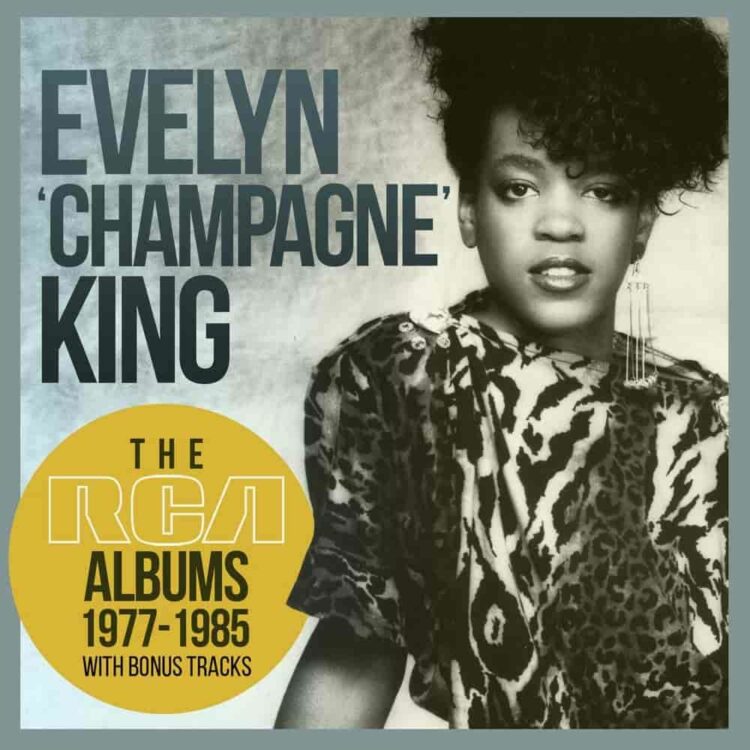
Evelyn “Champagne” King is rightly hailed as one of the most compelling singers of the disco/dance music era of the ’70s and ’80s, regularly landing records on the pop, R&B, and dance singles charts. And her new eight CD box, The RCA Albums: 1977-1985 (SoulMusic Records), gives you a great opportunity to really dig into her work. It’s the first time all eight of her RCA albums have been presented in one collection, expanded editions that feature extended mixes and non-album B-sides.
King had just turned 17 when her first album, Smooth Talk (1977) was released, featuring her first big hit, the classic dance club number “Shame,” and its successful follow up, the smooth, delectable “I Don’t Know If It’s Right.” Her cool, soulful vocals gave her songs a greater depth and maturity, and later hits like “Shake Down” (from 1983’s Face to Face) and “I’m in Love” (from the 1981 album of the same name) had her turning up the funk.
And beyond the hits, there’s much to discover. Tough, forthright tracks like “If You Want My Lovin’” and “I Can’t Take It” give I’m in Love a real potency (it’s the strongest album in this set); “Don’t It Feel Good” and “Making Me So Proud” on Face to Face (1983) are all dressed up with those heavily processed drums that were the signature sound of the ’80s; Long Time Coming (A Change is Gonna Come) has King’s heartfelt cover of Sam Cooke’s immortal song. Like her nickname, King’s music sparkles.
Elle Graham is a Melbourne transplant, having moved with her piano from Townsville, in regional Queensland, to the hub of Australian indie music. Best known as Woodes, she released her debut album Crystal Ball on November 13 – an ethereal, hypnotic, meditative exploration of inner and external landscapes.
The album was a balm for Graham’s soul after relentless touring off the back of her Golden Hour EP. She teamed up with producer Danny Harley (aka The Kite String Tangle) to co-write “Close,” a combination of flute, saxophone and anthemic vocals. Written in just three hours, Graham took the ease of its coming together as a sign that she’d write a full-length album just as quickly.
And she did – “Close” was such a powerful instigator that Graham wrote 40 songs for the album, much of it done during a three-week period in Los Angeles with Grammy-nominated songwriter/producer Scott Effman. Effman built his reputation as a producer who can defy genre boundaries to craft earworm pop music by working his magic with Akon, Kelly Clarkson, Mike Posner, Dean Lewis and Tiesto; Graham had worked with him previously for one of her favorite Golden Hour cuts, “Dots.”
“It was my first ever writing trip. I went over to play Canadian Music Week and then my publishers and management arranged for me to do a day with Scott Effman. In only two days, we were immediately on the same wavelength,” she remembers. “We work very well together, so I reached out to him to do an extended period of writing for Crystal Ball. That was a lot of fun, sometimes spending 15-hour days where all we were doing was writing and working on music and only breaking to get food.”
It was also during this period in LA that Graham wrote “Crystal Ball” with collaborator Jason Hahs. The song is inflected with Graham’s sonic tribute to the sci-fi and fantasy aesthetic and vibe that she’s long been in love with. “We both really love Game of Thrones and sci-fi,” she admits, which makes it into the playful song. “There’s lots of weird spells and sound effects, like wizards dueling. There’s about 100 layers of mandolins, vocoders and different sounds in it.”
“Writing about 40 songs for the record, there’s a lot of variety,” she adds. Electric guitar soars over Graham’s romantic promises on “How Long I’d Wait,” “Queen of The Night” reveals a dreamlike imaginary world in its curious instrumentation, and Graham revels in the melancholy sweetness of “This Is My Year.”
The last song on the album, “Distant Places” was a collaborative consequence of working with US producer Alex Somers, who had also worked on one of Graham’s favorite records, Valtari by Sigur Ros.
Between those first and last songs, “Staring At The Fire” was her paean to home. Graham was raised in Townsville, a northern Australian town where the heat and humidity are well-suited to the dreamily perfect beaches and lush mangroves. Graham’s mum is a marine biologist and her father, a park ranger. For Graham, music was as much of an obsession as nature and her childhood was immersed in both. She wrote “Staring At The Fire” on the old piano she’d brought from Townsville. It now resides in her home studio in Brunswick, a suburb in Melbourne’s inner north.
“I’ve lived in Melbourne now for seven years,” says Graham. “It’s been rough this year [with COVID19], but I love it here. All my family are American and they’re living on the West Coast. I’m an American citizen so I got to vote in the recent election. It was surreal.”
Graham moved to Melbourne to study music composition at the Victorian College of the Arts (VCA), one of Austalia’s leading arts colleges. “I worked hard to build a folio to apply there to study Interactive Composition. You’re right next to dancers, visual artists and musicians. It’s a lot about creating your own Melbourne groove,” she explains. “It’s very special because my band are all from VCA too. The students who attend VCA are dedicated to turning their practice into a job. I actually mentor and teach students there now. It brings me a lot of joy to be able to share the things I wish I’d been taught.”
While at school, Graham kickstarted her career by releasing a string of singles warmly received by radio audiences. “The Thaw” was added to full rotation on Triple J, and “Rise” received over 3.1 million streams on Spotify; they would eventually land on her self-titled debut EP. Stand-alone single “Change My Mind” was featured on fifteen international New Music Friday playlists, including from France, the UK and Vietnam, and the subsequent release of Golden Hour in 2018 officially made Woodes an artist worth watching.
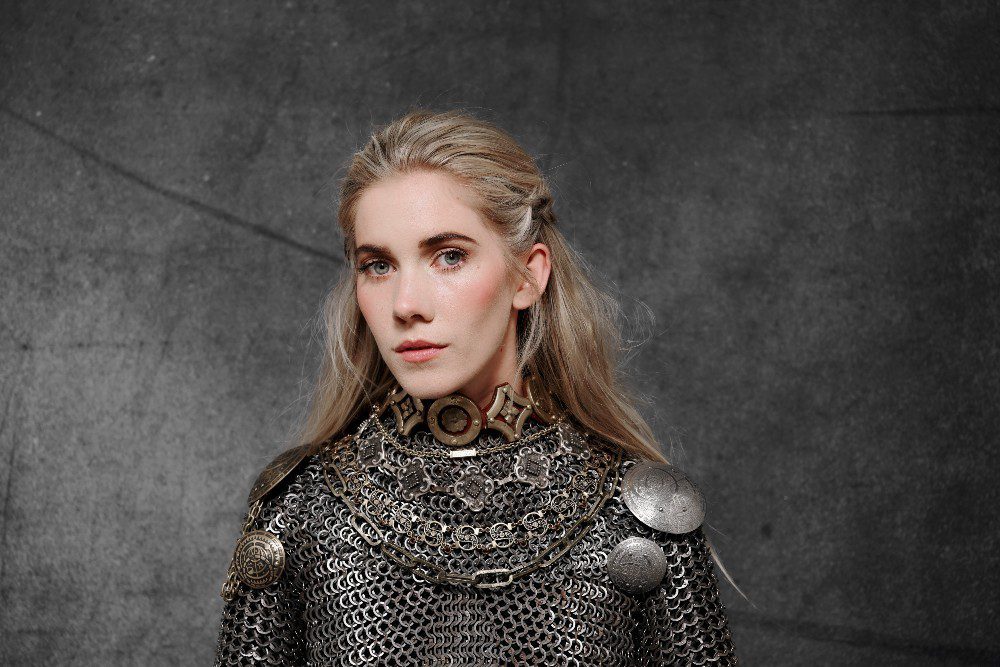
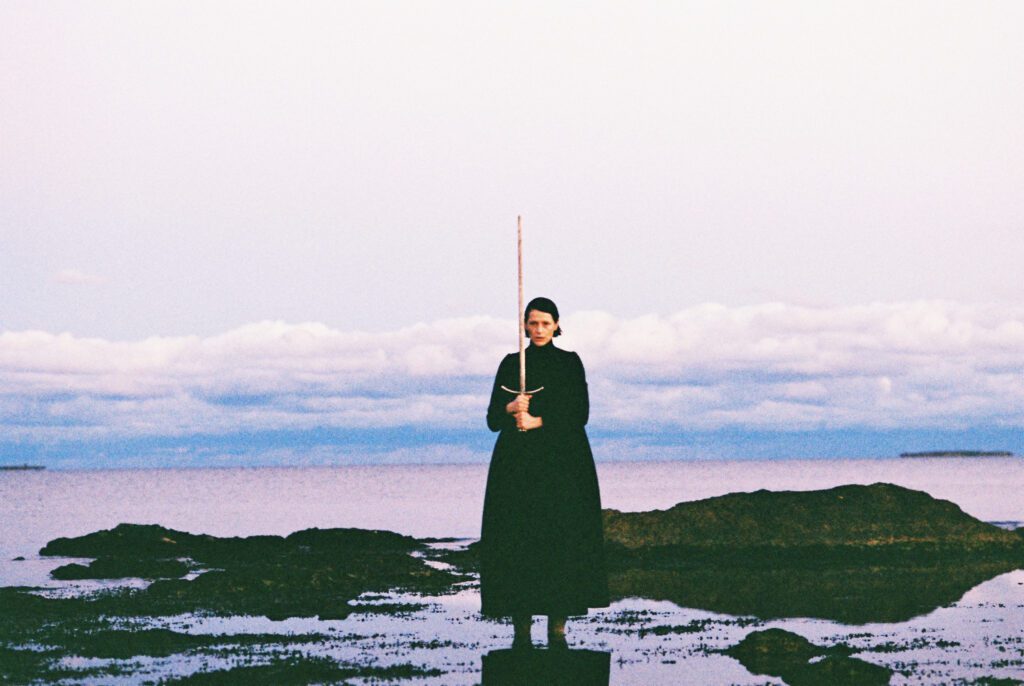
Graham wanted Crystal Ball to bring fantasy into the everyday, so walking through her suburb in armor felt like the ideal way to do this. “It takes a while to find community when you move to a new place. Brunswick is a perfect place for that… I’ve lived in a bunch of sharehouses around Melbourne and Brunswick is very close to the city, but sort of in the suburbs still,” she says. “A lot of my musician friends live around the corner. We have board game nights, dinners and gathering around the fireplace. There’s a lot of co-working spaces and studios around here.” Suffice to say, her neighbors didn’t bat an eye to see her traipsing about dressed like a Medieval warrior.
Her community provided creative connections, too. “During lockdown, Nick Mckk, who lives just down the road, dropped off camera equipment on my veranda, then he takes it away and edits it. We worked on the ‘Crystal Ball’ music video and a bunch of making of videos too,” Graham says.
But perhaps her biggest break through to date has been in a well-known virtual community – Minecraft. “All of my work has a visual element, so I’d work with directors and game developers, including with the Minecraft project. Minecraft is a very creative game, almost like The Sims; you can create your own dream house, so in mine there’s a giant train and a crystal ball in the middle of the town. You can visit each of the songs on the album via this train network,” Graham explains. “I’ve played a lot more Minecraft than I ever expected! I thought it was so cool to allow access to this place if you bought my album, so you could hear my songs for the first time in the world and interact with me by asking questions about how I made them.”
Graham is excited to finally allow the world beyond Minecraft to enter her auditory universe. From Townsville to Melbourne, via Los Angeles, the album is an amalgam of all her worlds. Now it can be ours.
“I loved digging into memory. It wasn’t intentional; memory just happened,” says Nashville-based singer-songwriter Lauryn Peacock of her time in quarantine.
Memory just happened. Many of us are finding that truer than ever in this stressful time that leaves us alone with our thoughts much more than usual. On her new single “Coming Over Me Again,” Peacock sets a place for the unshakeable familiarity of past relationships, how easily channeled the ghosts of our past are when we’re quarantined in our apartments.
Premiering today on Audiofemme, the single will see its official release December 4 as a stand-alone 7″ titled Quarantine Love. It was written back in April when Peacock was dealing with the unexpected stillness and memories her solitude had awakened. “There are a lot of loose energies right now,” she says. “I live in an old building near the hospital where everyone has died. This used to be a plantation. Then there are the energies of being in my apartment all the time.” The single precedes a full length album that Peacock plans to release in January 2021.
Given that this is her first release in five years – following 2015 LP Euphonia – “Coming Over Me Again” feels like a fitting title, and Peacock says she felt more than ready to make new music. Having written 50 songs over the past few years but being too busy earning a master’s in theology to make an album, she was eager to start recording. She found a like-minded producer in Andrija Tokic and worked to cull down the songs. But, as most things did in 2020, her plans took a sharp turn.
“Our start date was March 23, the first day that the mayor put down the stay-at-home order. I took a bunch of flak from people who wanted me to go in anyway,” Peacock remembers. “I waited until we could quarantine a little more, wear masks. We waited, and then it was July. It took a long time to get elements together. We only did one round of edits, but it took seven weeks.”
Despite these complications, she was determined to release something this year, with all those songs burning holes in her pocket. A GoFundMe campaign helped her cross the finish line, financing the singles, the album, and a short documentary on the making of the LP to follow; Peacock also plans to donate 15% of all proceeds to Gideon’s Army and tornado and COVID relief in North Nashville.
Currently working on an MFA in poetry at NYU’s low-residency program that was slated to include two weeks in France—a huge plus for the admitted Francophile—Peacock realized she’d have to trade in Paris for her apartment when the pandemic forced her classes onto Zoom instead. Peacock settled in to the unexpected lull, reading and writing poetry and curiously attending to whatever memories emerged. Whether they were happy or sad was less important than the immediacy of their all-consuming presence. “It’s about going through the healing process but also the energies that stay with you. They could be good or bad. I take the Buddhist path and say ‘How do I know what is good or what is bad?’” she explains.
In the middle of her third master’s degree and following a time living in France pre-pandemic, Peacock brings a kaleidoscope of vantages and experiences into her current songwriting. While the themes within “Coming Over Me Again’’ are apt for 2020, Peacock also wanted a ’90s feel as an homage to the decade where she came of age. She reminisces about the ’90s animatedly, remembering listening to Pearl Jam with friends and rollerblading to “Smells Like Teen Spirit.” She feels fortunate that those songs soundtracked her adolescence. “I was very lucky to be in a cool pocket of music those years,” she remembers. When writing her single, she knew she wanted a ’90s easiness to the guitar work. Her producer introduced a technique of ’90s recording: mixing the vocals lower so listeners would have to turn the song up to hear them. The ’90s vibes aren’t retro or dated, though. They lend an easy, melodic sweetness to the song, as if to remind us that memory doesn’t have to be dark or painful all the time.
As with her previous work, Peacock’s warm, high voice is the perfect vehicle for the melody. The lyrics open on a younger, earlier time, propelled by acoustic guitar strumming. The verses build into an explosive chorus that repeats the song’s title: “You’re coming over me again.” Despite the rising action of the verses, the chorus’s transcendence feels like a surprise, like another memory coming from nowhere.
“Maybe the chorus is more about how as you heal from a relationship, it visits you, and you feel that person’s energy again, and it’s like they are there,” says the singer-songwriter, adding that she thought of different people while writing the song. “Certain relationships don’t shake loose. Some things are sticky.”
Follow Lauryn Peacock on Facebook and Instagram for ongoing updates.
Long Neck is the solo endeavor of New Jerseyan Lily Mastrodimos; the name comes from Mastrodimo’s love of dinosaurs, and the band’s records serve as methodical archives of her evolution as a person and musician.
Their sophomore LP World’s Strongest Dog, which was self-released in April 2020, catalogs Mastrodimos’ triumphs, hardships and growth during her late 20s. On it, Mastrodimos is joined by John Ambrosio of drums and percussion, Kevin Kim on guitar and Alex Mercuri on bass and was recorded and mixed by Tom Beaujour.
The record’s opening track “Campfire” is an anthem to building something new, and since August Mastrodimos has been doing just that by booking weekly virtual showcases called “Around the Campfire.” Today, there’s a special Black Friday edition with about 20 artists including Oceanator, Shady Bug, The Cosmonaut Cassettes, Garden and more. We chatted with Lily Mastrodimos about her love of bats, the New Jersey music scene and how science informs her songwriting.
AF: What realizations did you come to while meditating on your late 20s during the process of writing and recording World’s Strongest Dog?
LM: I had a professor who once who told me that I get caught up in the struggle and not the process. I think, as I’ve grown older, I’ve come to understand what he meant. I used to be so debilitated by stress and anxiety and depression, but in the past few years I’ve been able to seek help and learn how to manage that struggle. You’ve got to manage the struggle however you can, hold yourself accountable, and be open to the things you learn on the way.
AF: How has the New Jersey music scene changed over the years?
LM: Jersey is such a small state, and I think the music scene actually benefits from that. Everyone knows each other and is so down to help each other out. Some really wonderful booking collectives have popped up (hi Beehive!), DIY venues and community centers have been established in towns that may not get a lot of musical foot traffic otherwise. Jersey has such a rich musical history, and it’s beautiful to see it continue and grow in the way that it has.
AF: Are you still working in a scientific field and has the pandemic changed anything about the work you’re doing?
LM: I still want to work in the scientific field. The pandemic has put my grad school plans on hold, and I miss being out in the field. I’ve been trying to spend as much time outside as I can. I go birdwatching on my off days, and I installed a bat house on my roof this summer.
AF: What is your favorite thing about bats?
LM: Oh God, everything! Here’s a relevant fact for the day: Did you know vampire bats will socially distance when a member of a colony is sick? Let’s learn from bats!
AF: Does your work in science ever cross over into your music?
LM: Oh absolutely. It’s easier for me to dissect my own feelings when I can relate them to ecological processes or animal behavior.
AF: We’ve listed many of your Around The Campfire Twitch streams on here over the past few months. What inspired you to start curating your own Twitch showcases?
LM: Thank you! I started Around The Campfire because I missed booking shows, and I missed going to shows, and I missed that community. I thought I would only do it for August, but the list of bands I wanted to book was just too long and I enjoyed the shows too much. I decided to keep doing it for the foreseeable future. In October we moved all of our streams to our very own website because we learned Twitch is owned by Amazon. The switch has been so perfect, though. I can archive all of our shows and the streams run so much more smoothly. It’s been amazing.
AF: What have been some of your favorite moments from your Twitch streams?
LM: Oh my goodness, it’s so hard to choose! The Diners set is up there, Tyler’s performance was just so fun and wonderful. Anjimile and Billy Dean Thomas put on such incredible shows, and getting to see them play together was wild. I’ve loved all of these sets so much and I’m thrilled that these artists get to share their art with us every week.
AF: What plans do you have for the end of 2020 and beyond?
LM: Long Neck will be releasing a music video soon, but that’s all I’ll say about that! Around The Campfire will continue for the foreseeable future – the December lineup will be announced soon and it’s a wild one. Once it’s safe for “irl” shows again, I’d like to turn Around The Campfire into a live, monthly show. All in all, we’re scheming!
RSVP HERE for Long Neck with Oceanator, Remember Sports, Sailor Boyfriend, Ben Eisenberger, Cinema Hearts, Maya ‘Moon’ Osborne, Shady Bug, The Cosmonaut Cassettes, Evan Diem, Garden Centre, Yvonne Chazal, Erica Freas, Suzie True, sodada, Soot Sprite, Adam Carpenter, Fresh, Me Rex, and Finish Flag on 11/27 at 7pm ET.
More great livestreams this week…
11/27 Girl Skin via The New Colossus Festival YouTube. 9pm ET, RSVP HERE
11/28 Making music Writing Lyrics with Paige of Irrevery via The Coop Workshop Square. 2pm ET RSVP HERE
11/28 Hinds via Moment House. 9pm ET, $12. RSVP HERE
11/28 Dinosaur Jr. via Live & Alone from Look Park. 8pm ET, $15. RSVP HERE
Singer, writer and activist Monique DeBose utilizes her rich vocals and poetic talent to create anthems for all of us to live and be inspired by. Not one for creating “bubblegum pop” regardless of how much she enjoys it, DeBose has committed herself to harnessing her music in order to help create a world in which people better understand each other and create real change. “A lot of times we think we’re supposed to be a certain way or we are only supposed to express certain things, but there’s other parts of us just as alive and just as important,” she says. “When we’re willing to acknowledge all the parts of ourselves, only then are we actually, truly free.”
Born in Los Angeles, to an Irish-American mother and African-American father, writing poetry was her way of creating her own world, one in which she could express herself. Since those formative years, her tenacity for writing has expanded into other ventures, as well as music. In 2018, DeBose released her one-woman show, Mulatto Math: Summing Up the Race Equation in America, which unpacked her experiences as a mixed-race woman struggling to fit into black-or-white racial binaries in the U.S. “My work really supports all of us, including me, to move from seeing in black and white to actually living in full color,” she explains. “I feel like the space available for all of who we are has been so narrowed that we’re squeezing ourselves… it’s a narrative that isn’t sustainable for any breathing, living creature.” With that in mind, DeBose’s latest singles, “More” and “Rally Call” look to widen the space our identities can inhabit.
On “More,” DeBose tackles the societal constraints of womanhood, using an upbeat jazz track packed with a variety of musical elements that convey her desire for more from life. Demonstrating her captivating vocals and range that perfectly compliment the jazz track, that desire is depicted in a positive light. DeBose chooses more not because she has so little but because she wants to add to what she’s already achieved, despite what society thinks she deserves. This sentiment is highlighted in the lyrics “I’m gonna take my ovaries off the shelf and be the woman that I know I am/Why live small?/That’s not my plan.”
“I have this curiosity about all the different roles women play and I wrote it to give myself a daily dose of ‘You can do this, be courageous,’” says DeBose. She wrote the song some 14 years ago, for the women who are told they are “too much,” which she explains is “a tool that people in power – and power can mean many things on different levels – often tell women or girls. Girls are meant to be seen not heard; you’ve got to be kind and respectful. It’s definitely better than before but I think it’s still a part of the culture – you have to look kept and beautiful to be desired.”
“Rally Call” takes on a very different tale with the same emphasis on empowerment and change. A powerful blues track from beginning to end, “Rally Call” conveys DeBose’s emotions as a woman of color even as it highlights the experiences of the Black community in a wider sense. Released on the 57th anniversary of his iconic “I Have a Dream” speech, DeBose echoes the words of Martin Luther King Jr. in unforgettable lyrics as the song increases in tempo and her pitch rises.
Inspired, in particular, by the deaths of Ahmaud Arbery, Breonna Taylor and George Floyd, and the resulting Black Lives Matter demonstrations, DeBose communicates anger and pain, stressing the fact that enough is enough. “I can only speak to my experience; to me it’s devastating, it’s heart wrenching, it puts me in a space of feeling powerless, of feeling like I don’t matter,” she says. “There was a scab for many of us in this country, that is racism, and then those three murders really peeled the whole scab off again and you have this wound that isn’t healing because we’re not dealing with it in a way that is geared towards healing. We were dealing with it in a way geared towards avoiding it and ignoring it and hoping it will go away.”
This element of avoidance and how it leads to an inhumane cycle of brutality, murder, and backlash towards protests comes across in the song’s powerful music video. DeBose sings in front of a wall depicting African-American culture and history whilst images from slavery, the 1960s Civil Rights movement and modern day images of Black Lives Matter marches are woven throughout. “For people of color and people who have been oppressed, this song is really an anthem to encourage and inspire you to no longer make yourself small so you can fit into a narrative,” says DeBose. “Regarding people who don’t identify as people of color or don’t have that experience of being oppressed, it’s an opportunity to really let it wash over you. I really want people to pay attention and imagine that the world does not exist only for your benefit or for you and consider that if we are making space for everyone at the table, the table would just be that much more nourishing, creative and exciting.”
To further emphasize the message of both tracks, DeBose has created the movements #ICHOOSEMORE and #JOINTHERALLYCALL; she partnered with Color of Change on their 15 year anniversary to promote the latter. This determination to keep the message going is indicative of the thought and care that DeBose puts into her work – not just making the music, but connecting with people and bringing about vital conversations that will lead to vital change. “Music is so powerful. When people set intention with the words or instrumentation it’s definitely going to filter in because it’s just something we know,” she says. “It’s a wonderful, powerful source of shift.”
The power of owning all the parts of ourselves, good and bad, attractive and unattractive, is a thread that runs throughout everything that the singer, writer, activist does. “Every song I’ve written, I could make a movement behind, because it really does come from a place of owning yourself and expressing yourself authentically,” she says. For DeBose, the message-within-the-message is the importance of not letting anything or anyone define you. With that in mind, she plans to take her work to the next level in 2021 by creating her own podcast, putting her award-winning play Mulatto Math online, and recording a full length album that will include “More” and “Rally Call.”
If 2020 has demonstrated anything, it’s that our lives are not concrete and that they can change faster than we realize. Monique DeBose has utilized that fact to remind her listeners of the work still to be done for both women and communities of color – and that change is not only possible, but within our reach.
Follow Monique DeBose on Facebook and Instagram for ongoing updates.
Is there a better opener than “Since I Left You”? The title track of The Avalanches debut album, released in Australia on November 27, 2000, and in the U.K. and U.S. the following year, fades in like a the opening of a film. A faint cheer, a strum of a guitar, a groovy beat, traffic noise and a choir of doo-doo-doo-doos lead into the cheery greeting, “Get a drink. Have a good time now. Welcome to paradise.” Then there’s the hook: a high-pitched female voice that seems to be singing, “since I left you, I found a world so new.”
It sounds like the ultimate middle finger to an ex. At least, that’s how I always heard it. In my head, there was this story of a girl who drops the romantic baggage and ends up sipping cocktails on a beach that looks like some 1960s, jet set Mediterranean paradise. But, there’s a catch. That vocal sample is taken from “Everyday,” a 1968 song by The Main Attraction where the lyric is “Since I met you, I found a world so new.” It’s just a regular love song, but when The Avalanches pitched it up and substituted “met” for “left” in the title, it became part of a completely different story.
Since I Left You was a monumental feat in sampling that pieced together a hefty volume of bits from songs, movies and television to create an 18-track album that plays out over the course of one hour with distinct songs that segue in and out of each other like a DJ set and motifs that appear and disappear over the course of multiple tracks.
Upon its release and in the ensuing years, the sheer amount and breadth of those samples has often captured the bulk of the attention surrounding Since I Left You. Part of the hype at the time of the album’s release was that it included a sample of 1983 Madonna hit “Holiday” that was actually cleared by the singer. This past April, when The Avalanches took part in Tim’s Twitter Listening Party, Tony Di Blasi explained that it was actually a sample-of-a-sample taken from “Holiday Rap” by M.C. Miker “G” and Deejay Sven. Over time, there have been multiple attempts in YouTube videos and through the WhoSampled project to uncover everything on the album.
But it’s not the number of samples or the source material that made Since I Left You a masterpiece; it’s what the Avalanches did with it. They told a story with beats, layers of vintage recordings and relatively few words.
The title track came to my ears thanks to someone from Australia who I met through a mixtape swap in an online forum, but it would take months of lurking in Los Angeles record stores to get a copy of the full-length CD. I was hooked by the transition between “Since I Left You” and “Stay Another Season,” the vocals from the former faintly carrying over to the “Holiday” (or, rather, “Holiday Rap”) beat. Here and there, I would catch a snippet that I recognized (Is that Debbie Reynolds on “A Different Feeling”? Damn, I can’t believe they got Polyester in here). Mostly, though, the components of the album were unfamiliar to me and that didn’t matter. Unlike a lot of other sample-based music, I didn’t have a strong desire to track down the source material. I just wanted to listen to all of it like this.
Since I Left You went into the rotation in my car and it stayed there for years. I often let it lapse, listening to it a full two or three times in a row while creeping through the worst of L.A. traffic. It quickly became one of my all-time favorite albums. But, here’s the strange part about that: I’ve listened to Since I Left You on a regular basis for more than 19 years and I can’t recall many of the song titles on the album. I don’t know that I ever could do that.
I was listening to the album the same way I watched movies. Much in the same way that I can tell you what was happening in Goodfellas or Trainspotting when I hear certain songs from those soundtracks, I connect moments in Since I Left You with the images that unfolded in my head while I was listening to it. When the phrase “book a flight tonight” repeated over an electro beat, I would see someone racing through a slick, retro-futuristic airport. “Frontier Psychiatrist,” I imagined, was about flipping through TV channels at 3 a.m., probably high, probably at a key turning point for the protagonist.
When The Avalanches guided listeners through Since I Left You for Tim’s Twitter Listening Party, they tweeted about the theme of the album: “the whole album was loosely about an international search for love as we were making it…A guy following his one true love around the globe, but never quite finding her…always one port behind.”
In retrospect, that makes perfect sense. It’s also not what I heard over innumerable listens. Without that insight, the narrative of Since I Left You wasn’t so obvious. That’s what makes it so interesting too. The Avalanches gave you a story through samples, but how that story unfolded was ultimately a product of the listener’s imagination.
Lara Sarkissian at Matosavank Monastery, Armenia. Photo Credit: Margos Margossian
“I always wanted to push Armenian sounds,” says Lara Sarkissian. “I always thought of the future and how I could push Armenian sounds into the future in very experimental and untraditional ways and how that can fit within this electronic music and electronic dance music.”
Sarkissian is a San Francisco-based producer, composer and DJ, as well has one-half of the duo behind the party series and record label Club Chai. In her work, she likes to manipulate the sounds of traditional Armenian instruments, like the duduk, a woodwind made of apricot wood, and incorporate them into electronic music productions. In late October, “Fortress in the Clouds,” an intense techno track, appeared on SOS Music Vol. 1, a compilation from L.A.-based label SOS Music to benefit Transgender Law Center, Downtown Women’s Center and Women’s Refugee Commission.
“It’s interesting to experiment with these old and ancient sounds and have your take on it,” says Sarkissian. “It’s like having a conversation with it in your own way.”
On November 26, her soundscape for “Thresholds,” a collaboration with video artist Jemma Woolmore commissioned by the Institute for Sound and Music Berlin for the ISM Hexadome, will be released on vinyl. “I was really inspired by the concepts behind aural architecture. I used a lot of field recordings in Armenian churches and monasteries,” says Sarkissian of the project. “I really love how Armenian monasteries are built in a certain way to house certain kinds of sounds, like the choir with the voice and how it bounces to the ceiling and back, kind of like you’re speaking to God and the powers above.”
That inspiration suited the ISM Hexadome, a 360-degree audio-visual installation that exhibited in Berlin, Montreal and San Francisco, as well as MASS MoCA in North Adams, Massachusetts, where the recording for the release stems. “I looked at this dome structure for ISM as, in parallel, like a monastery. I thought that it would be really cool to take these samples, like these Armenian environmental sounds or these sounds that I recorded in Armenian monasteries and at my church in San Francisco, and use it in this space and create a whole contemporary electronic score around that.”
Sarkissian started out as a drummer in high school. In college, at UC Berkeley, she gravitated towards film and was making her own experimental shorts. Then she took a sound design class while studying abroad in Copenhagen and was impressed with how sound could tell a story. “I think that’s when I put the camera down and became more focused on sound and storytelling,” she says. “That’s when I started teaching myself Ableton.” She began producing her own tracks and making edits while also learning how to DJ.
She was inspired by artists of different ethnic backgrounds who were incorporating their culture into electronic music. “I’m Armenian, but I’m living in diaspora. There’s another kind of Armenian culture that exists here,” Sarkissian explains. “A part of that means being in dialogue and being around other cultures and other diasporas and learning about each other’s struggles and oppression and building solidarity and coalition from that way. I did see that there is a way that you can do that with music and I really enjoyed that.”
In 2016, she and collaborator 8ullentina launched Club Chai as a monthly event series. They started with warehouse parties bringing together San Francisco and Oakland-based artists, with an emphasis on women-identified, non-binary, LGBTQ and POC artists. Through Club Chai, they built up an international network of artists and began touring in the U.K. “I think that a lot of artists and music in general stays within our Bay Area bubble,” says Sarkissian. “Our goal is to connect that with our global audience and people who are doing similar work in other places.”
In August, Club Chai landed a residency on the popular, global online radio station NTS, where you can now hear them monthly. For the October show, Sarkissian focused primarily on Armenian music to call attention to a mounting human rights crisis. On September 27, Artsakh, an ethnic Armenian region in the South Caucuses known internationally as Nagorno-Karabakh, was attacked by Azerbaijan. That led to a six-week battle in the midst of the COVID-19 pandemic where civilian areas of Artsakh were shelled and tens of thousands of people were displaced. An agreement brokered by Russia brought the fighting to a halt, but it also transferred part of this indigenous Armenian land back into the hands of Azerbaijan, leading to further displacement of people and a growing concern for the future of Armenian cultural landmarks in the region.
For Sarkissian, who has taught in both Armenia and Artsakh, this hit close to home. “I think that I was, personally, in a really frustrated place,” says Sarkissian. She wanted to let the music community know what was happening, but wasn’t sure of how to do that. “Obviously, music brings people together and understanding stories of other people’s culture through sound is a huge thing,” she says.
The set included multiple generations of Armenian artists, as well as non-Armenian music. “I wanted to channel grief and solace and have this place where we’re allowed to sit in sadness,” she explains.
Sarkissian says that this devastating time for Armenians has shown how important it is to have artists and scholars, “people who are creating this intersectional language,” bring the ongoing conflict into the light. In the long run, she says, “I think that kind of language is what’s going to help us link with other communities.”
Follow Lara Sarkissian on Facebook for ongoing updates.
When Fancy Hagood moved to Nashville at the age of 17, he traveled across state lines with a dream. A native of Arkansas raised by parents who followed the Nazarene faith, Hagood convinced them to allow him to attend Trevecca Nazarene University in Nashville after dropping out of high school and earning his GED at 16, using it as a bartering tool for his true goal of becoming an singer. “I came here to go to college, but I had an agenda,” Hagood says.
When he arrived in Music City, Hagood began pounding the pavement, turning his dream of being an artist into reality by attending every singer-songwriter round he could find and forging connections with each person in the music industry who crossed his path. But the seedling for his artistic identity was planted almost by accident, two years into his Nashville journey, while working at Forever 21. His lavish appearance – complete with full makeup, manicures and a new hair color each day – inspired his manager to dub him “Fancy” after the popular Drake song of the same name. “It was the first time someone was calling me something while also kind of making fun of me that I actually felt empowered by,” Hagood recalls. “I was like ‘I am that, you’re exactly right.’”
The nickname stuck, not only on the floor at Forever 21, but as part of Hagood’s blossoming career. But as a young, queer artist in the South, Hagood was met with challenges. In an attempt to dissuade people from focusing solely on his sexual identity, he began billing himself under the name “Fancy,” with his first show under the alias selling out. Soon, Hagood was equipped with a record deal under Big Machine Label Group and former manager Scooter Braun and relocated to Los Angeles. Operating in an industry that was still tepid in marketing a queer artist, it didn’t take long for the mysterious name to generate buzz. Hagood built a following that included famous fans Tori Kelly and Kacey Musgraves, gaining notoriety with his debut single “Goodbye” and the follow-up bop “Boys Like You” featuring pop superstars Meghan Trainor and Ariana Grande.
While the songs captured who Hagood was in his early 20s, when he was focused on chasing chart success, his cartoonish secret identity recalled a dark time he had put behind him. “It was a weird thing where I felt hidden again,” he explains of the pseudonym. “When you come out of the closet, you don’t really ever feel like that’s going to be your life again. It was damaging to me because I felt hidden and I felt like who I was as a person and as an artist wasn’t good enough to be shown to the world. That’s something I never want to go back to.”
Staying true to this proclamation, Hagood parted ways with Braun and Big Machine, returning to Nashville with the mission of sharing his story truthfully through song. “When I was on a major label, I was told me being queer, being from the South [were obstacles]. I think leaning into those things that make me unique and make me different and finding the sounds that no one else is really experimenting with, I call that queer Southern pop,” Hagood explains. “I’m tired of apologizing for being exactly what I am, and I am queer and I am Southern and I’m a pop artist. So why not make my own lane and celebrate all these things that in my career have been obstacles.”
His newfound liberation begins with “Don’t Blink.” A stark contrast from his LA-produced work, the soothing song backed by a guitar melody was born after Hagood sparked a romance with someone an ocean away in London. Though the relationship didn’t last, it did teach Hagood about the kind of love he desires, as conveyed in the lyrics, “Oh, when you’re looking at the sky/Oh, so am I/Don’t blink or you could miss it/Oh, when you’re wishing on a star/Know I’m there in your heart.” Meanwhile, “Another Lover Says” finds him in the “difficult” position of breaking someone’s heart for the first time, serving as an anthem for moving on. The tracks symbolize a fresh start for the eclectic singer-songwriter, one forged from honesty and ingenuity that he channels into his upcoming album, Southern Curiosity.
“It felt like the first time in years I was creating something that actually made me feel fulfilled,” he says of the “candid” album. “This record and this chapter in my life is more about telling a story and showing up completely, wholly myself and allowing people to learn who I am and what my journey has been like and share my stories. Before I think I was just chasing success.When you realize you’re not chasing anything and you’re finally just creating from the heart, I feel like that is when dots start to connect and things start to move in place and it feels a little bit more free. That’s what I’m all about – feeling free.”
Freedom is the cornerstone of Hagood’s identity not only as an artist, but as a human, with “Fancy” serving as the symbol for his ever-evolving artistry. With the forthcoming arrival of Southern Curiosity, Hagood hopes that listeners find freedom in his work and view it as a “bridge” and “unifier” to change hearts and open minds. “I hope that people can hear it and be set free by anything that’s holding them back from being their true self. I’m hoping it can be liberating for people who haven’t yet been set free,” he says.
“For me, ‘Fancy’ is a state of being. It’s where my confidence comes from, knowing that no one can make the rules for me. I make the rules for myself and I show up every day as myself,” he adds, noting that there’s “shame” and “rejection” attached to birth name. “With Fancy, I don’t have that. I don’t carry that shame. I’m not worried about the things I used to worry about,” he continues. “Fancy really set me free and it helped me find who I am as a person. It’s not just a name for me, it is a lifestyle, and I’m super thankful to have been able to take a little bit of a jab and turn it into a mantra. Being fancy has nothing to do with the way I look. It has everything to do with the way I feel.”
There is something deeply comforting about Maybe Another Time, the new LP project from Oakland’s Rob I. Miller (under the name Christian Singles). Created in the wake of his father’s returning cancer diagnosis, no listener would come in expecting that — understandably so, as examining complex familial relations does not normally inspire the warm fuzzies.
Perhaps that is because MaybeAnother Time is less about pain laid bare and more about approaching it with some perspective. There are layers here – no moments of singular self-effacements or doomsday predictions. Even the hardest questions get delivered in soft packages. Take “Collapse,” one of the EP’s best tracks. It’s strangely dance-y, boasting a jumpy drum beat paired with some empty-room echoing guitars that allot a sense of undulating space to an otherwise anxious track. And indeed it is anxious; at the end of the song comes the line that feels like it may be the crux of the whole project: “Can you shake the collapse of your youth?”
Time is important on Maybe; the LP feels old without feeling outdated. There is something folky about it, but also something indie, but also — you get the picture. More than anything, it pulls up memories of listening to old Adam Schlesinger songs. A lot of the tracks on this project would fit in perfectly over a montage scene on an early 2000’s rom-com, but like, a cool one that became a cult classic. And then, years later, the song will pop up on the shuffle playlist and someone’s like, “Oh my god. I used to watch that movie every day after school.” And everyone else is like, “Me too!”
Miller — also a member of local bands Dick Stusso, Blues Lawyer, and Flex, and owner of the Vacant Stare Records label — has a diverse catalogue of experience, and used it to his advantage. He knows that no one wants to lie prone in the sludge of ennui for nine tracks, so most of them follow the footsteps of “Collapse,” using the instrumentation to create that sense of forward movement and sonic space that is so tantamount to those warm-and-fuzzy old releases. Think of — and please don’t sigh at me — “Chasing Cars” by Snow Patrol. Basically, the build up may be long, but it’s worth it. This is a move that Miller uses more than once, most obviously on “Bury” and “By Design.”
The former is short and sweet, naturally moving into fuzzy guitar distortion over a cheerful tambourine as Miller chants, “digging up the past to bury again/trying to make sense of where I am.” The latter is a bit more of a slow burn at over four minutes, but what may have otherwise been a foot-dragging track redeems itself on the second half with a more complex mixture of distortion than in “Bury.”
Miller occasionally makes the move towards more simplistic country-lite, like in “A Dream Ends Without Starting,” but his strengths definitely lie in layering as opposed to trying to carry us all over the finish line with only an acoustic guitar and the light of the trembling moon. Or whatever.
A better example of his more stripped-down work is “Rest Easy.” While a lot of the other tracks may need the context of the background to catch onto the themes, this is one of the most explicit, and this is why it works as one of the few examples of that familial pain laid bare. Like “Dream,” it stays simple throughout, but the more specific lyrics and a sense of peaceful venerability anoint it with the substance it needs to work: “I know you never really understood me,” Miller sings. “But you always tried.” With a project as personal as this, Miller might’ve fallen into the trap of forcing others to understand his perspective; on Maybe Another Time, his biggest strength is meeting us halfway.
Follow Vacant Stare Records on Facebook for ongoing updates.
LA-based indie pop singer/songwriter/multi-instrumentalist Kacey Johansing’s latest album No Better Time is mellow and soothing, a much-needed mood at the moment. Even though the songs weren’t written about the current state of the world, many of the lyrics read as words of comfort in uncertain times. “Let’s fall backwards/I need not know what comes after,” she softly sings in the delicate, calm “Fall Backwards.”
The record also includes a number of love songs, both happy — e.g. the airy, floaty opener “Make Love” — and solemn, e.g. the wistful “I Try,” a single about “feeling like you’ve tried everything to make relationships work, or to feel like you belong in a relationship, and that it’s not so straightforward for everyone based on their upbringing or past experiences,” she explains. In the video, she wanders through flowery fields, conveying a sense of “waking up from a dream and seeing something you don’t have anymore.”
The jazzy, romantic “All of Me,” another single off the album, is about overcoming issues with body image and self-esteem; it was written during a moment when Johansing was feeling insecure. “I give you my heart and my soul/and only feel big boned/Cuz they don’t make it in my size/I have no disguise,” she sings candidly. In a dream-like video incorporating holographic visuals, she looks into shimmery mirrors out in the mountains, on the beach, and amid fluorescent flowers.
“It felt cathartic working through a low point and writing an anthem about loving myself and loving and accepting my body wherever it’s at,” she says. “[When people listen to it, I hope] that they feel less alone or that they can practice self-love too. Or even, if it’s in a moment of feeling shitty about themselves, they just know they’re not the only ones and we just can pause and give ourselves a break.”
“Even a Lot Feels Like Nothing,” a simple but emotive piano-driven song that Johansing considers her favorite track on the LP, also deals with self-acceptance, as well as asking another to accept oneself. “[It’s about] asking whoever you’re with for patience as you figure it out — maybe you’ve been hurt before, your heart’s closed up, but you don’t want to give up on love,” she explains.
“I tend to really love the songs I write on piano, which I don’t write many on,” she adds. “I guess it just taps into my musical theater roots or something, and I love the string arrangements on it. I just love the arrangement all around. It feels like kind of a classic song. I worked really hard on it — its a song that took me a long time to finish, so it’s meaningful to me.”
The title No Better Time is meant to be ironic but also true, referencing the album’s release in the middle of a pandemic. “We need more music and beauty and art in our lives, even though it’s not ideal,” she says. The title track has almost an oldies vibe to it, with a cheery tune but serious lyrics about drawing boundaries within toxic relationships.
The album was recorded live in the studio with a number of instruments — among them electric and acoustic guitars, synthesizer, cello, viola, violin, flute, piano, drums bass, and even sleigh bells — and produced by Johansing and multi-instrumentalist Tim Ramsey (Vetiver, Fruit Bats) without much editing other than mixing it and layering some overdubs.
“I just wanted it to be really true to myself where I was at that time musically and with the musicians that I was collaborating with,” says Johansing, who played the guitar, piano, and synthesizer herself. “I just wanted it to feel authentic and pure and lush.”
No Better Time is Johansing’s fourth album, following 2017’s The Hiding. It utilized a different band than her past work, but she still considers it “very me,” she explains. “I always am drawn to similar ways of arranging and similar instruments.” She’s written a number of new songs recently that she hopes to record in the winter.
Johansing also runs a record label, Nightbloom Records, with her friends Jeff Manson and Alex Bleeker, representing such artists as Suzanne Vallie and Mariee Sioux. “That’s a really nice way for me to stay engaged with the musical community during COVID times,” she says.
She considers her music a way to explore questions like how to love when one’s past is full of pain, though she has by no means arrived at an answer. “The album isn’t ‘I figured it out,'” she says, “but it was part of the journey toward figuring it out.”
Follow Kacey Johansing on Instagram for ongoing updates.
Dayo Gold makes his return with his latest offering, The Eddie Kane Chronicles, Vol. 1. The six-track EP finds the Cincinnati rapper trying out a smooth flow with classic, old school beats – a stylistic choice that he says is a testament to his great-grandfather.
“My great-grandad’s real name is Ed Bendross,” Dayo told Audiofemme. “His nickname – one of my aunts always used to call him – was Eddie Kane, because he always stayed with a cane as he got older. The other reason she called him that was because he was just so smooth. You never saw him sweat, never saw him pressed, never saw him yelling, none of that. It was just a little trove in the family, and they’ve always said that I remind them of him.”
“So, once I got to sit down – with all of this quarantine stuff going on – I really just got to sit down with myself and I felt like a lot of those comparisons were similar,” he continued. “[This project] is almost like a reincarnation of him, but it’s still me… It’s almost like you’re getting a piece of both of us.”
While listeners can usually depend on Dayo’s music to set the roll-a-blunt-and-sip-some-wine vibe, the MC sounds especially at-ease over the EP’s nostalgic-sounding instrumentals.
“I feel like it was just my most natural sound at the end of the day; like the beats brought that out in me,” he said. “With this quarantine time, I’ve been experimenting to find out what my fans like, and I’m seeing that people are digging this vibe. So, I can be my real, natural self, and it still works.”
Most of the beats on the EP were provided by Dayo’s “right-hand man,” local beatsmith Trey Young, while “Old School” was produced by Eb & Flow.
“As far as anything that I drop, he’s always there giving me some input or advice,” Dayo said of Trey. “He’s always hands-on with my projects, and this one he definitely showed up big. He made a majority of the beats, and we just sat there and kind of went for a certain type of sound this time – and built upon that sound.”
Next up for Dayo will be The Eddie Kane Chronicles, Vol. 2, which he says he’s already gotten started on. The “Twang” rapper also plans to drop a video for “Old School” next month, following visuals for EP cuts “Caprice” and “A Wise Man Once Said,” the latter of which features Sax B.
“I think videos are the best way to get to the people right now,” he said. “I felt like I didn’t have enough visuals already – for my best songs. My problem was that I usually have samples and stuff, but that’s another reason I’m really proud of this tape; there’s no samples. We really did it from the ground-up.”
Although the current pause on live shows means he probably won’t be able to play The Eddie Kane Chronicles, Vol. 1 for an in-person audience anytime soon, Dayo says one silver lining of the pandemic has been the extra time to write and record new music.
“I feel like as artists, or really just anybody who’s a creative, this year has been a blessing in disguise,” he explained. “You can get more creative, and it’s a chance to see what works inside your home.”
“Being a creative, you just gotta stay flexible,” he added. “So, I’m not trying to rush anything. And being sensitive to the world as well, since there’s been a lot going on.”
Earlier this year, Dayo did get to participate in one of Mind The Method’s live-streamed performances. He’ll also be featured in Donuts N’ Akahol’s upcoming virtual cypher.
But for now, he’s celebrating his new EP.
“I feel like what made this project special is that I truly believe in it and I believe in the process as well,” he said. “I believe that this is a great foundation for what I’m doing and the direction – brand-wise and sound-wise. And I appreciate everybody that helped, whether it was visually, sonically and in any way. I just wanna keep going off of this and hopefully people like what’s going on.”
Follow Dayo Gold on Instagram for ongoing updates.
With the coronavirus limiting our ability to participate in large events like concerts, artists have had to innovate to continue bringing their fans the magic of live performances. Some have offered live-streamed concerts, while others have recorded covers of their quarantine comfort songs, and others still have performed at socially distanced venues. Meanwhile, Berlin-based alt-rock artist Laura Carbone came up with her own solution: to dig up footage from a past live performance that was near and dear to her heart and turn it into an album.
The performance in question is her 2019 show at Harmonie Bonn (in Bonn, Germany), which was broadcast on Rockpalast (Rock Palace), a German TV show that films and airs live rock performances. Carbone grew up watching Rockpalast, which has featured the likes of Radiohead, Sonic Youth, The Smashing Pumpkins, and David Bowie, so it was a dream come true for her to be counted among them.
“I grew up in Germany in a teeny tiny town where 500 people were living there, and I didn’t have much to stay in contact with the sonic world, but I knew Rockpalast,” she remembers. “I started dreaming about one day being able to play on this stage as well.” After obtaining Nirvana’s Nevermind, she became hooked on rock music and started playing the guitar, then began performing covers before releasing her first solo album, Sirens, in 2015.
She released another LP, Empty Sea, in 2018, and was planning to record a new one this spring when COVID hit. Because she was no longer able to go into the studio, the plans got cancelled. Then, Carbone got a call from her drummer Jeff Collier suggesting that they ask Westdeutscher Rundfunk, the TV station behind Rockpalast, if they could use the recording from the show. “I had so many moments when I could not think, when I was not positive toward the future, and receiving this call and idea was a no-brainer,” she recalls. “We were blessed in receiving this.”
Smack in the middle of the album, titled Laura Carbone – Live at Rockpalast, is “Tangerine Tree,” a warm, melodic song full of fantastical imagery about meeting up with someone in a dream. “Silver linings, fading rainbows/Come take my hand tonight/I’m your blackout at your sunrise,” Carbone sings against dreamy electric guitar.
“‘Tangerine Tree’ is a vivid dream inviting you to dive in and float in it for a while,” she says. “Like the comfort of familiar good feelings that keep on visiting you every now and then in your sleep. Temporary, falling for a moment, and letting go again.”
The influence of ’90s grunge is evident in Carbone’s vocal style and heavy instrumentals, but there’s also a positivity and beauty to her music that shines through in the live recordings. On “Swans,” another highlight from the album, she builds dark, almost gothic lyrics like “I’d give my blood plasma/Noise kills the silence silent” to an uplifting chorus with an enchanting melody: “It’s just a new phase/new phase of the moon.”
It was important for her to include the whole setlist on the album “to give the impression of being present at the show,” she says. “It’s so beautiful how we can feel when the band is warming up — I can hear it in my voice and how tense it was when we started — and I think it’s such a nice flow when the audience joins in and we start getting into the flow of the music.”
Another feature of the album that captures the feeling of a live performance is the interludes — a highlight for Carbone is the improvised guitar interlude between “Lullaby” and “Tangerine Tree.” She recounts, “We had so much time that was given to us and not enough songs, and so we chose to go even more with the flow in between the songs.”
In addition to songs from Sirens and Empty Sea, the album includes an unexpected cover of Aretha Franklin’s “I Never Loved a Man (The Way I Love You).” The song starts off slow with dark guitar riffs, then escalates to passionate belting and erupts into haphazard yelling, drumming, and guitar.
Despite the wide range of subject matter covered in the songs, Carbone considers the overall theme of the album to be “bittersweetness and melancholia and a beauty that’s very often reflected through what surrounds us.”
Carbone, also a photographer, is keen on letting her fans in on her process — she currently shares her music in progress, essays, and photography on her Patreon, and in response to subscribers saying they appreciated learning what happens behind the scenes of her music, she started the podcast What It Takes to Create a Record, which contains insights from her band and production team, including the last album’s mixer Scott Von Ryper, guitarist for The Jesus & Mary Chain.
She hopes her latest album can offer some relaxation to listeners during a stressful time. “They should chill the fuck out for the whole set, close their eyes, and just lead themselves to wherever they need to be in this moment,” she says. “Maybe they need to time-travel back into a live music scene, or maybe they just have to be up in space or dive into water. I just hope they take their time and pause from what’s going on. If they put it on and a shower of blissful sound is streaming through them, that would be beautiful.”
Listening to Brooklyn-based electropop artist and producer Laura Jinn’s debut EP Sick! is an experience somewhat akin to watching a dark comedy. Full of sass and detailed scene-setting, the EP covers dysfunctional relationships, paranoia, and encounters with quirky characters.
Jinn’s lyrics are simultaneously fun and incisive, playful and poetic, with an underlying theme of sickness, broadly defined. “I wrote the songs before the pandemic, so my concept of sickness has expanded a lot, but I was just thinking about what it means for someone to be considered sick,” she says. “I was thinking about the politics of sickness in general, and also, I think I’m kind of a paranoid person, so that is always oozing out.”
Each song is almost a movie with a full storyline unto itself, beginning with the nostalgic “I’m driving to Target,” where Jinn vividly describes the random shopping list one might have in mind: “Lipsticks/lipgloss/mascara tubes and crop tops/Flip-flops/knee socks/glitter glue and card stock.” Despite the ingenuous subject matter, there’s a darker undertone to the song — if you listen closely, you’ll realize it’s a glimpse inside the mind of a kleptomaniac, with lines like “I’m gonna take this lipstick and that’s just the beginning.”
“I was thinking about all these ways how, when people are considered sick, it’s often people who are on the fringe — so women in general,” she explains. “You have something like kleptomania, which is a way to pathologize a certain behavior that may be more common in women, when there might be other motivations for doing that.”
The eerily repetitive, nursery-rhyme-like, almost tropical-sounding “Memories of trees” similarly contrasts idyllic scenes from Jinn’s childhood with an unsettling darkness that colors those memories. “I was just thinking about how a lot of the things that happened, a lot of my attitudes at the time, were incredibly messed up — there was a darkness and a danger that was always present,” she says. “There was a lot of paranoia and fearfulness.”
The sardonic title track “Sick” plays on the multiple meanings of the word, imagining a conversation where someone declares that they’re sick “as in cool” but slowly reveals that they are also literally unwell. “I knew I wanted to write something fun and poppy, so I think the most natural way it came out was just this bratty, confident singer who sang ‘I’m sick,'” Jinn recounts.
The highlight of the EP, however, is “I’m beginning to think,” which narrates a series of events that sound like they’re out of a Broad City episode — “He invited me over, and when he opened the door/He was wearing an entire Adidas fit/We took an edible and he started crying/We watched 30 Rock, he kept crying” — as well as the inner dialogue of someone debating whether to stay in a relationship. The song was inspired by a short story Jinn wrote, where one character is venting to a friend with a line that became the song’s refrain: “I’m beginning to think I made a big mistake in loving him.”
“I was thinking about how dangerous it is to date a man based on statistics and how it’s so crazy that we accept that and live with that, but it is our reality of how we live with people in the world,” she explains. “I wanted to capture that dissonance of ‘I’m saying this fun thing to my friend about this guy’ and ‘I have to say this scary violent thing about this guy.'”
In keeping with the theme of sickness, she also threw in an electropop cover of Harvey Danger’s 1997 hit “Flagpole Sitta,” her version full of snappy percussion. “I just felt like in so many ways, the bratty, silly energy of the singer in the song fits with the energy I was trying to capture,” she says. “What I like about it is that the speaker is kind of reflecting on themselves and critical of themselves, and it kind of throws that critique back onto the world and is looking for someone to blame like the whole song, but it always ends in that place of ‘I’m responsible, I’m culpable.'”
She and co-producer Tatum Gale made the album almost entirely digitally, minus some acoustic drums and analog synths, while they were quarantined together in Brooklyn. “I would work during the day and then at six, I would close my work computer and we’d go into the home studio,” she remembers. “I feel like when I went into the EP, I didn’t know who I was as an artist. I was just exploring a lot of different styles and also trying to cohere them and present them in a clearer way.”
Jinn started making music just a few years ago, teaching herself how to produce on GarageBand and then working up to Logic. Genre-wise, she considers her music “electro goth pop,” incorporating dark, catchy, and electronic elements. Her sassy, flirty singing and prominent percussion tracks evoke The Blow, though she cites emo as a major influence.
By day, Jinn is a software engineer, which she says gave her the confidence to start producing. “I know that I can do hard things, and I know that I can come up against something when think I don’t understand it and work hard and understand it,” she explains. “That has helped me when I’m working on music and come up against things I don’t understand — working on Logic, starting that process, and being like, ‘How am I gonna do this?’ I can be like, well, I didn’t know how to code and now I know how to do that. And it’s a very different part of my brain I use all day. So in some ways, it’s a relief to scratch that other part while working on music.”
Follow Laura Jinn on Instagram for ongoing updates.
Something For Kate is, like black coffee and rooftop beer gardens, fundamentally part of Melbourne. The trio – guitarist/keyboardist/vocalist Paul Dempsey, drummer Clint Hyndman and bassist Stephanie Ashworth – have been performing and releasing albums since the mid-1990s. Their latest album, The Modern Medieval, arrives after an eight year hiatus to defy modern rock’s subgenre classifications, though Ashworth agrees that the band is a quintessentially Melbourne creation.
“Something For Kate has always been that way,” she says. “We’d been living overseas prior to this but we’ve always come back to Melbourne. Paul met Clint here, and formed the band here.” Dempsey and Ashworth, married with two children, have lived between Melbourne and New York for the past decade. “We moved to New York before we had kids,” she shares. “We had our first child when in New York, where half my family is from. We’d been there touring, recording and it got to the point where we just thought we should move there, so we did. Eventually, we came back to Melbourne and now we’re back and forth. We came back from Los Angeles just before COVID-19, fortunately.”
Hyndman remained in Australia, and though the distance – or even being the odd one out in a band with a married couple – might’ve broken up less tenacious bands, Ashworth assures me that the drummer is like family.
“Clint is Paul’s best friend and he’s like my brother. I talk to Clint probably more than I talk to Paul! Clint loves to chat, he loves a gossip, he’s really fun. It’s the perfect combination for a three-piece: a married couple and we’re best friends between us,” she says. “The three of us have a reputation for being a very, dark, serious band, thanks to a magazine article back in 1997, but we laugh a lot. The three of us have an absolute blast; we’re sillier than anyone would ever expect. When Paul and I moved to New York, we didn’t see Clint for eight months and yet when he walks into the room, we all laugh at the same thing. The two of them are my world and I don’t go a day without talking to either of them.”
Though they haven’t released music as Something For Kate since 2012’s Leave Your Soul To Science, the band has been busy with other pursuits. Dempsey spent late 2017 and early 2018 touring his sophomore solo album Strange Loop internationally, as well as touring Europe with David Bowie’s band in Celebrating David Bowie. In 2018, Dempsey, Ashworth, and Hyndman set aside any outside interests and committed to the writing of The Modern Medieval, their seventh album.
“The boys in the band know when I’m right into a particular song. I’m insufferable, banging on about it!” Ashworth says, noting that she’s not coy about picking favourites. “The closing song, ‘I Will Defeat You,’ is my favourite on the record. For us, it’s quite playful. We don’t often take another genre and decide to bend it, but we did with that. It’s our version of a soul, blues song. I love the fact that the subject matter of the song is so dark, but it has this almost ZZ Top bassline. I find it hard to restrain myself and play bass so minimally, but I loved doing it for that song.”
The demands of writing an album and spending 24/7 together might break some couples, or some individuals, but Ashworth gives no sense that this has been, or could be, a challenge for her marriage. “Any couple that work together are going to bring their work home,” she says. “We might have inappropriate conversations at 3am, fiery moments with business decisions and writing songs, but there’s always a level of respect that is very strong.”
Ashworth was the last member to formally join Something For Kate, replacing touring bassist Toby Ralph, who in turn had replaced original bassist Julian Carroll, after the recording of the band’s 1997 debut LP, Elsewhere for 8 Minutes. “I still have my perspective of [Paul] as a songwriter and [Something For Kate] as a band before I came along… I have an enormous respect for Paul as a musician, and I’ve never taken that for granted,” Ashworth says. “I’ve not worked with many musicians who can do what he does – he has perfect pitch, which is freakish. When I first met him, he did an eight-minute drum track, put the bass track down, the guitar track down on his solo album and watched the engineers go ‘holy crap.’ If he hears a piece of music, he can play it back to you within a minute. When you play with someone like that, it’s really intimidating because you know – I’m a very punk rock bass player compared to him.”
Much like The Slits’ Viv Albertine – who told NPR last year that without role models, there was little option other than to be self-taught, which led to more intuitive and authentic playing – Ashworth believes the lack of formal training has been an asset, one that Dempsey, too, recognised as valuable. “Paul pursued me as a bass player because he said I approach the melody in a way he hadn’t heard before. He appreciated that I haven’t had the creativity beaten out of me by a rule book,” she remembers.
Ashworth’s love affair with music began aged 10, with her ear pressed up to her brother’s bedroom door as he played 7-inch records from The Clash, The Cure, The Smiths, and Siouxsie and The Banshees. “As a 10 year-old it was intriguing to me and I was like, ‘what is that? I need to know more!’ So, I started buying 7-inches and staying up late to watch Rock Arena, buying English music magazines like Melody Maker and learning about all of these bands,” she says. “I bought keyboards and messed around with them in my bedroom, then I started sneaking into punk rock gigs in Perth as a teenager. When I moved into a sharehouse in Melbourne, aged around 19, I ended up teaching myself bass guitar because someone I knew needed a bassist at short notice.”
Ashworth has not played the game other bands of the 1990s and early 2000s have – their female members appearing in fashion and lifestyle magazines to answer questions about their skincare regime, favourite fashion labels and hairstyle tips in an effort to hopefully draw attention back to their music. “Throughout the past two decades, I was often asked to be in an article on women in music. The reason I turned those articles down was I felt like I was being treated like a novelty. Even if it was women putting these articles together for mainstream media, it felt like, ‘How cute, you’re in a band and you’re a girl!’ I felt like it was tokenistic – the whole tone of the articles would be titillating, voyeuristic, focused on women’s clothing choices,” Ashworth says. “I told my record company I wasn’t going to perpetuate the idea that I’m a novelty, a minority, and what I do is a novelty act. It’s only been the last couple of years that I’ve started talking to people about why, and I’ve seen things change. There’s a lot of women in bands now; for a long time, I felt like I was out there on my own.”
“Misogyny has been an issue,” Ashworth adds. “I definitely experienced this patronising attitude from older men, particularly when supporting international bands. Their roadies and crew would give this vibe. I didn’t acknowledge it and got on with what I was doing. Until more women are in positions of power, and there’s much more discussion than there was, there’s a lot of tokenism still happening.” She says Something For Kate have made a point of employing women as booking agents and managers, but that there’s still room for improvement in the industry. “I’d like to see more female crew – that’s an area that needs work. In America, there’s all-female crews but Australia is yet to get there. Those jobs need to get offered to women in the first place so that they can get the experience,” she says. “I’ve seen women who are incredible at their jobs, really intelligent and deserving of promotion, just get passed over for the big boys’ club. We’ve always tried to subvert that, where we can.”
Much of the press in Australia has presumptuously reported that the band had broken up, or been on holidays for the past eight years, labelling The Modern Medieval a “comeback album.” Ashworth is bemused.
“We never broke up. We don’t think of this as a ‘comeback record’ – we’ve been touring the whole time, we’ve done festivals the whole time,” she states. “Paul went over to Chicago, made a record, and toured that for two years. When I had a child, we couldn’t tour for a while. When Bowie died, his band asked Paul to sing, so we had to wait until the touring with them eased, so that we could work on the album. We had to lock Paul down – that’s why it took eight years. Children, world touring, and Bowie.”
Follow Something For Kate on Facebook for ongoing updates.
Existence130 is Dora Day, a Minnesotan multi-instrumentalist live looper and improv artist who streams three days a week on Twitch for 6-9 hours. She has been a regular music streamer for two years, honing her improvisation skills in front of her Twitch community. Dora Day “live learns” songs on stream and jams over other streamers’ tracks with guitar, ukulele, violin, bass, harmonium, and vocals. She exudes positivity, curiosity, appreciation, and always makes everyone who joins her stream feel at home. Her streams feel like the closest thing to having a friend playing live music for you in your living room. Plus, she just started freestyle rapping!
Although she has no official releases yet, you can find her collection of experimental, funk and ambient tracks on Soundcloud to give you an idea of what she’s cooking up. You can catch her streaming on Tuesdays, Wednesdays and Thursdays starting at midnight ET on Twitch. We chatted with Dora Day about her electric violin journey, connecting with her favorite artists online, and how she keeps her energy up during her marathon length streams.
AF: What are some of your inspirations that got you into live looping, improv and music in general?
DD: I have always been fond of live looping and a huge fan of artists like DubFX and Grimes who often use live looping in their performances. I have deeply admired musicians who have an experimental flair when creating and you can see the joy when they are in the zone producing their creation. When I joined twitch and started playing music, I noticed there were several twitch musicians starting to get into live looping and I admired all of them! I saw the endless possibilities of being able to live loop and deeply contemplated on what route I should go and was going between Ableton or getting a Boss RC-300 live loop station. One musician who I deeply admire is Echo Locations. He live-loops and has his sound so refined for his live performance. He came into my stream one day and encouraged me to get Ableton and showed support straight from the beginning, offering his guidance, which was incredibly encouraging, so I jumped ship and went the Ableton route when it was on sale during Black Friday. I like to create/produce music as well, so figured why not get a DAW that I can get experimental with and then turn my live looped performance into a song I can produce. The possibilities are endless! I got into improv because I want to be able to jam out with other musicians and connect with others on another level! I think improvising with others is a profound experience and it nourishes my soul. I knew if I took the time to just focus on improvisation, I would reap the benefits for the rest of my life by having a skill that can connect with others in this way. It’s a way to deeply connect with another’s essence in my opinion.
AF: How many different instruments do you play and what are you favorite instruments to improvise with?
DD: I love getting experimental and live looping with all of my instruments. The instruments I generally live loop with are the guitar, violin, bass, ukulele and keyboard. Lately I’ve been having loads of fun turning my own vocals into an instrument and either pitching it up or down, which is something I learned recently how to do in Ableton. I also have a harmonium which I love to play and want to start incorporating that into my live looped performances as well. It’s an instrument used quite a bit in India and I love the beautiful tone that comes out of it. It puts me into a lull state. My favorite instruments to improvise with are the guitar and violin. I also love improvising with cool sounding synths/sounds that I find in Ableton. I feel like a little kid in a candy store feasting off what’s created and there are always more sweets that I haven’t discovered yet.
AF: How long have you been playing the violin and is there a story about the electric violin you play on stream?
DD: I played violin in 8th and 9th grade. It was one of my favorite sounding instruments. I practiced all summer long to get into the 8th grade orchestra, and was shocked when they accepted me. I was so excited. I grew up in a family that didn’t have money to afford a violin, so I got a loaner violin from the school temporarily and then my aunt bought me one. However, in ninth grade, someone broke my violin that my aunt gifted me. It was a tragedy to me when it happened and I had to stop playing violin cause there was no way my family could afford another one. About two years ago I decided to buy an electric violin since they were ones that were decently priced – I think I got mine for 130.00 at the time. I bought it two years ago, but didn’t end up really playing it cause I couldn’t remember how since it had been over 15 years since I touched a violin. About a year and a half ago, I decided to pull it up on stream and played around with it since I had bought it. It was hilarious and embarrassing, haha. However, putting myself out there allowed some viewers who were violinists themselves to offer some suggestions that helped me grow. The knowledge started to slowly come back and I started looking up videos and reading books on how to improvise with violin and it spiraled from there. Some of the theory started to click intuitively! I was already learning how to improvise with guitar, so I knew that blues/pentatonic scales played in the same key is amazing for improvising, so I started practicing those scales with the violin too, and BAM it all started to click. I ended up jamming out over people’s requests with the violin and guitar and it sharpened my ear. It was crazy. Can’t even believe I can improvise for the most part with the violin by ear now. It was a skill I always dreamt of having and I knew that the more I practice the violin by trying to figure out the key of a song by ear, it will be ingrained in me to naturally jam out with others. Really grateful I got back into it again cause it’s one of my favorite sounding instruments.
AF: How long have you been streaming on Twitch? How has the platform changed since you first started?
DD: I’ve been streaming on Twitch for close to two years now. The platform has had some major changes especially with some recent DMCA strikes on users’ accounts which has caused streamers to change the way they do things. Many streamers used to jam over a song that a viewer requested and they would layer drums, bass, etc. over it. I used to do this as well, but have moved away from that and will jam over only royalty free music now to prevent getting a strike on my account. One thing that I have noticed on the platform is how refined these streamers are getting with their skills. It’s amazing to see their growth. I kind of look at it like a hive mind. We are all inspiring one another to grow and we also help and learn off of each other. It’s truly amazing.
AF: You usually stream for 6 or more hours. How do you keep your energy up and keep improv sets interesting?
DD: I generally stream three days per week and will stream for 6 to 9 hours generally straight. It’s quite a process just to get things set up right for the stream, so once I’m on, I’m like, why not keep going? It’s like a party hanging out with my community. The viewers will throw in sound suggestions, themes, words, etc. and we all create songs together. It’s so much fun and it really inspires creativity. Lately, I’ve been getting into freestyling singing/rapping and it’s super fun when the audience throws in words, themes or rhymes; I’ll try to bounce off of what they say in chat and create a song and it’s such a blast. I really love the creativity exchange that happens on stream and I think that’s what fills me up with a dopamine drive to go all night. I also can save all these projects that we create together and produce a song with it in the future, so it’s a lovely feeling to be able to pump out content like that when I’m in the zone. I also switch up the stream to taking requests at times from my songlist, from improv to playing party games, so I think the variety keeps me going for a long time. I just love music and prior to being a serious musician on my days off I would listen to music as my form of entertainment and try to find amazing artists and create songlists for hours.
AF: Who are your favorite Twitch streamers?
DD: I have so many favs I love to watch, but a few that are coming to mind right now are TheDapperRapper, Sarajazz, Middream_LA, Mamajoevramajoe, Echo_Locations, TheSilenceNoise, AaronGoldberg, Faezaria, Scessions, TheGreekGroover, Bort_, A_Couple_Streams, GuyCoMusic, Alicethelittlealien, MermaidUnicorn, Raquel, Songcojam, Benevolentdick, Seershamusic, Elleterese, Elizavetamusic, CalvinThomasMusic, Plasticjosh, Sharkmuffin_ and so many others! I keep discovering more and more streamers that I’m in love with. Many times when I get raided by a streamer I’ll ask them to send me an original of theirs and jam over it! Recently Sharkmuffin_ raided me haha, so I pulled up their song and was BLOWN away! I love unpacking the box and seeing what flavor is going to jump out at me! In Sharkmuffin’s case, I was so impressed by the creative and experimental punk sound that came of it. It’s not something you hear every day and I love when that happens, cause I love more underground types of sounds! Made my heart jump in excitement. I have discovered the most amazing musicians from being raided by them, so that’s why I always like to pull up their content to check out their flavor. I love the Twitch community. So many talented, creative and entertaining musicians there!
AF: Who are your dream collaborators?
DD: Oh my gosh, there are so many I would love to collaborate with! But recently I discovered that one of my favorite musicians, Phaeleh, joined Twitch and does live streams on there sometimes! I’ve been a HUGE fan of him for over 10 years, it’s amazing he’s on Twitch too. It would be a dream to collaborate with him. My heart palpated when he responded to my comment on Twitter/Instagram, hahahaha. That’s how much I deeply admire these musicians. They impacted my life in such a deep way that it makes my heart skip to even get a response from them. Also, recently, I followed another favorite of mine named Jon Kennedy on Instagram, he’s amazing and I’m obsessed with so much of his content. Now that I’m becoming more of a serious musician, I’ve started to figure out how to use socials, like Instagram and Twitter (just started using these socials a year in half ago). Being a content creator myself, I realized that if you follow others they might check you out as well – especially if you have the same interests. Well, after following him, Jon Kennedy ended up loving tons of my posts on Instagram, including my music! My heart was jumping out of my chest. After I saw he was responding/commenting on my posts, I sent him a message letting him know that I was live on Twitch and jamming out to all his content and he watched me LIVE! So freaking insane. It was an amazing feeling to basically have someone you are in deep admiration of watch you jam out to their content! I would love to collaborate with him on a song.
AF: Are you working on any original music to release in the near future?
DD: Yes! I just got my new computer all set up for streaming last night and I’m excited to start pumping out some production with it! I have hundreds of songs in the works that have been saved using Logic, but now I’m only going to be using Ableton primarily (since I switched from MAC to PC). I’m going to try to see if I can send my stems over and start some production with Ableton. I was going between the two and even using both DAWS at the same time, but I think if I really immerse myself in mastering one, it will really take me a long way. Some of my favorite artists like Grimes use Ableton as well and started using Garageband and Logic initially, so I’m taking the leap and really want to focus on getting some cool content on Spotify this year rather than just posting it up on Soundcloud! I now have the opportunity to do more production streams on twitch, cause with my new computer set up I can share my screen with the viewers!
AF: What are your plans for the rest of 2020 and beyond?
DD: This year, I plan to really hone in on my creative content and focus more on improv and technique. I really want to create some amazing content and would like to get some songs out on Spotify and really refine my live performance sound as well. Now that I’m using a full-sized desktop with a decent CPU instead of a laptop, I’ll be able to produce content without overloading my computer. I’m really excited to see where this will take me.
RSVP HERE for Existence130 streams Tuesday, Wednesday, and Thursday at midnight ET.
More great livestreams this week…
11/20 Ma Sha, Despina, Ayesha, Drummy via Elseworld. 6pm ET, RSVP HERE
In the late 2000s, Stockholm-born contemporary artist Klara Lidén began work on her Poster Paintings series; collecting colorful adverts discarded in the streets of Berlin, she glued layers of them together until they were inches thick, then pasted a plain white sheet over everything, obliterating any information underneath with her own blank slate. You can see her work on the cover of the latest El Perro del Mar EP, FREE LAND, out today; the band’s sole member, Sarah Assbring, wrote many of the songs situated beneath one of Lidén’s poster works, after the Moderna Museet in Stockholm invited her to create an album inspired by its collection. Assbring was free to roam the museum when it was closed to the public, with the expectation that she would perform works composed there by the year’s end. As the pandemic set in, plans for the performance were scrapped, but Assbring’s access to the collection became even more exclusive; as she posted up in front of Lidén’s poster series, she pondered the suspension of time, construction and deconstruction, resistance, creative freedom, and the artist’s role in a world saturated by corporate interests.
“Her work was key to when I really figured out what the album was gonna be like and what it was gonna be about. I placed myself and my instruments I sat there working and writing, and the idea kind of grew on me – retaking the dignity and the power and the meaning and the value of culture and art in society,” Assbring explains.
“With the risk of sounding pretentious, I always need to react against myself. I’ve done that with every record and that’s the reason why I sound the way I do on every different album – it’s always the fruit of a reaction towards myself, always trying to avoid becoming tired of myself,” she adds. “This album is very much a part of that. There is a kind of cheekiness in some of the songs, a couldn’t care less kind of attitude to it, I draw from Klara in that kind of clean slate way. In a way, it’s kind of like, the [middle] finger gesture towards myself.”
Sonically, FREE LAND hinges on ambient textures, but rather than floating though an endless expanse, these sounds feel contained and amplified by smooth, empty surfaces. It’s fuzzy with the white noise of a long gallery hallway; rawly reconstructed from broken pieces, but seamed together again with golden lacquer, like Kintsugi pottery. Five tracks are bookended by “Enter” and “EXIT” – Assbring invites listeners to inhabit this space with her, walk through its rooms, observe the artifacts she’s collaged together.
And yet, it’s not inaccessible; instead, the EP is purposefully imbued with the punky, DIY spirit of an artist, as she says, reacting against herself – burying her voice in distortions, delicately excavating an unnamed anger, and rejecting the idea of songs as commodified metrics. The EP itself is its own rare kind of art-piece, like the ones in the museum that inspired it; the physical release is limited to 300 hand-numbered copies, and only one single (“Dreamers change the world”) is available on streaming platforms beyond Bandcamp.
“I really wanted it to have that kind of feeling I feel about old records that I have, that I’m one of the few who owns this album. But it’s also a statement that has to do with how we value artists today,” explains Assbring. “It has a lot to do with my feelings about streaming services, such as Spotify, and the way that they pay musicians. Streaming services kill your dignity as an artist, and I’m not okay with that. It was a stand to take, a minimal way to voice that feeling and make people aware of that, to direct listeners to Bandcamp instead, where I actually feel like you have your dignity restored as a musician.” She rails against the notion that musicians should produce content every six months to a year to stay relevant: “I try to be as productive as a possibly can but it still has to consist of something, it still needs a soul,” she says. “And soul takes time, music takes time, and it needs to take time sometimes.”
Assbring confronts that most clearly on “Dreamers,” making it a poignant pick for a more traditional single release (“The Bells,” another recently released single, is a stand-alone project and does not appear on the EP). Timid piano and minimal strings swoop through sentiments that re-center the true value of art – not “triumphs,” “likes,” and “numbers,” but slow, thoughtful creation that adds beauty and meaning to those who take the time to revel in it. As she repeats the titular line, you can almost imagine her standing in the abandoned museum, its paintings come to life to sing along. A powerful video for the track, directed by longtime visual collaborator Nicole Walker, sees Assbring as the patron saint of the arts, wearing Balenciaga and wielding a sword with a fearsome feminine strength.
The image is in direct opposition to the sad, doe-eyed Swede making stripped-down pop, a characterization that’s dogged her since she released her self-titled debut in 2006 despite her moves over the ensuing fifteen years toward more experimental sounds. That album, she says, came out of a place of utter despair – it opens with the sarcastic suggestion that buying candy could be an antidote to her hopelessness – but making it propelled her into indie notoriety. “When I made my first album I was completely put in that bracket where I was that sad person, and it’s true, I was. I had been for a really long time,” she admits. “But career wise, I would not be here if I had stayed in that [frame of mind]. It would have been actual suicide to want to be back there, musically, and as a person. As I move further musically, I also have to move further as a person. And I have, and I’ve come to understand a lot of things in my life as I have grown older and that is a really wonderful thing.” On FREE LAND, she sums up that trajectory with “Life is full of rewards,” its mantras delivered in a tired-sounding deadpan, but sincere nonetheless.
“That song definitely goes right back into the core of my musicianship, from the absolute beginning of the debut album,” Assbring says. When she started writing FREE LAND, the difficulty of 2020 had put her in the same desperate state of mind. “I wanted to say, life is full of holes [but thought] I can’t sing that. It isn’t! Isn’t it really full of rewards? It’s kind of like you’re sitting in front of your lame therapist, waiting for them to turn you around,” she says. “It’s really a way for me to communicate with myself, trying to turn myself around. It’s a really nice way of writing, because it goes extremely quick and it’s really just a tapping into the way the mind works sometimes, the things that the mind tells you.”
Also therapeutic, she says, was finally collaborating with Devonté Hynes, better known as Blood Orange, on “Alone in the halls,” a ghostly take on Black Sabbath’s “Changes.” She gravitated toward Charles Bradley’s version of the classic, not realizing that it was written by Ozzy Osbourne. “From the beginning of this year, I’ve listened so much to that song, and felt like, this is exactly what 2020 feels like,” she says. “It was also what it felt like walking around in the museum, so I decided that I wanted to make a choral kind of work with it, like a very ambient feeling of just wandering and wandering through changes.” The two worked long-distance, their vocals melding to haunting effect.
But by and large, Assbring’s most essential collaborator was her partner, Jacob Haage. They’ve just relocated to a Medieval town on an island not far from Stockholm, as the pandemic made them question the sustainability of city life. But in a country that famously limited locking down even during the height of the first wave, Assbring says not much changed about the process of completing the record; she was still able to go to her studio, and working from home was made easier with a live-in co-producer. More than anything in her life – even buying herself candy – creating music has been the glue that’s held her together.
“For me it’s a way of surviving, to change, just move along with the wind or what’s happening in my life. The different intake gives different outputs,” she says. “I may be an insecure person, and unstable person, at times, [but] when it comes to my artistic and creative side, I feel so sure of what I’m doing and I never doubt it and I never question it. And I always know what I’m doing and where I’m heading.”
FREE LAND closes with a meditation, one of two audio snippets on the record (the other opens its title track; Assbring remains tight-lipped about their sources). “If you feel safe in the area you’re working in, you’re not working in the right area. Always go a little further into the water than you feel you’re capable of being in, and when you don’t feel that your feet are quite touching the bottom, you’re just about in the right place to do something exciting,” intones a genderless voice. El Perro del Mar broaches very exciting territory on FREE LAND, an island of thought separate from mainland music’s industry standards, a world of her own creation. “Waited all my life for this,” she moans over droning brass on the churning title track, staking her claim to a wild new frontier populated by dreamers and artists willing to paste over everything that came before.
Follow El Perro del Mar on Facebook for ongoing updates.
When Indian-American singer-songwriter Subhi went to LA to record a new song in March, she’d just begun hearing news about COVID-19. Tasked with improvising a song in the studio, she began offloading her feelings about the rising pandemic. The result is “Wake Me Up,” a meditative, vocoder-enhanced single about coming to terms with a rapidly changing world.
“We were in these dark times where everyone was quarantined and we were going to have to wear masks,” she remembers. “I knew that would close things up for a bit, so that was a song about what was happening around us.”
Even though the chorus — “wake me up, wake me up, wake me now/pull me out from the dark” — may sound like a plea to escape the situation, she also considers it to be a hopeful message, anticipating the process of emerging from the COVID era. “‘Wake Me Up’ is really about how these are dark times, but I also am realizing that I will wake up,” she explains.
This mixture of darkness and hope characterizes the in-progress EP on which “Wake Me Up” will eventually appear. “They aren’t feel-good, happy songs, but they are songs with a silver lining,” she says. “I’d like to believe my goal is to create meaningful songs, but songs that also have hope and shed some light on good stuff happening in the future.”
Subhi’s 2017 debut, Shaitaan Dii, is very different from her recent work, incorporating elements of Indian folk music, American pop, and jazz. It was recorded in collaboration with a jazz band, and on it, you can hear an unlikely combination of scatting and Hindi.
During this phase of her career, Subhi was leading an all-male band, and she remembers dealing with a band member who was bullying her and bossing her around. “He would try to shut me down and discredit me and discredit my songs,” she remembers. “It took me two years to figure out what was going on. [Then] I got the courage to stand up and be like, ‘This is my band, and this is the way I want to do it, and everyone needs to respect everyone.'”
After that, she went through a period where she was reluctant to collaborate with anyone out of fear that the same thing would happen again. Though her combative band member was no longer in her way, she was getting in her own way — which inspired “In My Way,” a slow, synthy single about the effects of hanging on to past hurts. Once she came to that realization, she picked herself back up and collaborated with a variety of producers and other artists, which ultimately became corrective experiences that opened her up again.
She also considers “Wake Me Up,” which was recorded with producer Taylor Sparks, a testament to this transformation. In addition to waking up from the dark times of COVID, the song is about “waking me up as an artist,” she explains. “And really, these collaborations did pull me out of the dark, so it’s really symbolic of what was happening in the outer world and what was happening with me internally.”
Subhi’s path to becoming a musician has been long and winding. After growing up in India and attending high school in the U.S., she went to college for finance and minored in music, then began working on Wall Street by day and covering Indian entertainment as a TV news reporter by night. Through the latter job, she met Indian-American filmmaker Mira Nair, who was looking for a music intern, and ended up getting the position.
“After that whole project, I realized, ‘Oh, my god, this is what I could see myself doing my whole life — music is it,” she remembers. “So, I usually say it took me three careers to realize music is my true passion.” Her husband lived in Chicago, so for a while, she split her time between there and Mumbai, working on music for Bollywood films. Soon, she realized she wanted to be a full-time artist, so she planted herself in Chicago and forged ties with its jazz scene.
In the past, she’s experienced internal conflict between her Indian and American identities, especially with regard to her music. One of the upcoming songs on her EP, “Better,” is about reconciling these differences and choosing both sides of herself. “I was dealing with this whole conflict of ‘which one do I choose?'” she says. “And now, I’m more settled, it’s kind of resolved — I’m two sides of this coin.” She’s continued to sing in both English and Hindi, and even though her new EP is primarily inspired by American pop, she considers it Indian-influenced simply because it’s inspired by her life.
“Every song on my EP is very personal to me,” she says. “There’s a story behind every song, and everything written in the EP is an observation for my own personal life. Everything is something I have personally experienced. There are a lot of different themes in the EP, and I hope people resonate with it and can take something from it. The EP in general is not happy-go-lucky, but I’d like to believe it’s meaningful, and it’s an EP with hope, where there is a silver living to everything that I’ve written about.”
Lydia Luce was listening to a podcast discussing how humans often retreat into nature to find themselves, the host pointing out that since we are made up of the natural elements of the earth, shouldn’t we go into ourselves to discover the answers?
This compelling notion draws connection to the title track of Luce’s upcoming album Dark River, arriving on February 26. The 11-track set came during a time of emotional healing after Luce left a toxic relationship and began looking inward, going to therapy to work through her own challenges, using the knowledge to form new habits that help set the course of her life moving forward. “I’ve never really been this vulnerable in my writing until this record, which feels good and scary,” she tells to Audiofemme.
Luce relies on the craft of songwriting as a mirror for what she’s experiencing internally, noting how songs have a distinct way of instilling her with valuable lessons on the other side of writing them, citing the title track as an example. “‘Dark River,’ for me, is a beautiful thing,” Luce says. “That song is about recharging yourself, fueling yourself up so that you’re able to go out and be a light in the world and be your best self.”
The song finds her declaring that she’ll no longer allow someone else to claim her power or light, demonstrated in richly poetic lyrics: “They put me on a pedestal/And I gave them everything/Now I’m waking slowly, with an empty feeling/I go down to the dark river/They can’t see me there/I’m gonna drink ’til my belly’s full/Pour it out when they need my help/Please, won’t you save some for me.”
“It took me a long time to write this record because first, I needed to settle into some of those negative tendencies and really come face to face with them and identify them and then start to dismantle them in myself,” she observes. “This year was an unveiling of interesting information about myself that I hadn’t come to terms with and then seeing how it’s affecting different areas of my life.”
The song and corresponding album was born after a Luce took a solo trip to the Pacific Northwest in 2019, Luce crediting the purity of nature in allowing for self-awareness she wouldn’t have otherwise. “Nature always cuts through lyrically, metaphorically in my songs, but also has been a source of quiet for me to be able to sort through whatever it is that I need to sort through in my own life,”she explains. “What I’m continuously learning, and a habit that’s really hard to break, is that when it’s hard to sit in struggle and there’s so many distractions around us, my tendency is to reach to that instead of sitting in the place where I’m uncomfortable, especially when it’s something like recognizing ‘that’s not good, I don’t want to be that anymore. I don’t want to do that anymore because that’s not helpful to me or other people,’” she continues. “That was the lesson that I worked through with that song.”
The theme of shedding the layers of her former self also arises in two of the album’s other key songs, “Maybe in Time” and “Just the Same.” Growing up in a Christian, conservative household in Florida, Luce has found herself straying from her family’s religious identity in recent years, yet is still able to find common ground with her loved ones. “’Just the Same’ was about me being so different from my family, but loving them just the same,” she shares, adding that she wrote the track after visiting her brother who is currently attending Bible school, the two bonding over their interpretations of the passages he shared during her visit.
The song also reflects the compassion and empathy she feels for her loved ones in spite of their opposing views, pointing to a “beautiful” and “respectful” conversation she had with her her father recently, confessing to him that she does not follow the Christian faith, her father respecting her decision and acknowledging the importance of being able to question something one doesn’t understand. “I value the things that we do have in common, but I also appreciate the respectful disagreements that we have,” Luce remarks of her family, channeling that understanding into the pair of tracks.
Creating the album was a liberating experience for Luce, one she hopes fans identify with and use as a safe space to genuinely be oneself. “For me, the writing of it has been me settling into more of who I am and being honest and open about it. I really hope that there’s some kind of freedom found in it and it’s okay to be the way you are and be proud of it and not ashamed of it,” she says. “I think the dark river is this place of serenity, where I have this place to go back to, and that is myself, and I’m finding that in myself more and more. So maybe I’m the dark river.”
People underestimate the value of women’s voices, and young women in particular are all too often looked down upon and spoken down to. 14-year-old singer-songwriter/producer Neska Rose both challenges and disproves these gender and age hierarchies with her latest single “The Repel of a Young Girl.”
The song chronicles Rose’s own journey growing into a young woman as she learns from her past mistakes and strives to make her mark on the world. “I’ve really grown confident in myself and my voice and what I have to offer to this world,” she says. “Sometimes, when you’re really young, people think you don’t really have that much to offer, but that’s not really true because that young mind has so much power. You already have a significant point of view for the world, and you have so many profound thoughts and intense feelings.”
Reflecting this theme of acknowledging and celebrating Rose’s own accomplishments, this was the first song she produced herself. She felt the best way to achieve the exact sound she wanted was to do it herself.
“It really opened a new chapter in my life, and I feel like I learned so much when I started producing, and it really expanded my confidence,” she says. “At the beginning, I never thought that I would produce and write my own songs. ‘Repel of a Young Girl’ will always be in my heart as the first-ever song that I really made by myself.”
The single spotlights Rose’s unique voice as well as her production skills, beginning with a catchy xylophone beat and energetic verses that sound almost like spoken word poetry, then escalates into an infectiously rhythmic chorus: “I want to be afraid of your radical innocence/Fever blisters on my face happened from great incidents/You get me, endlessly/Secrets of shame hide under the sea/I cannot be portrayed as your radical innocence.” She added a strong bass track to the chorus to give the single a powerful sound, and her twin sister Libby sang harmonies with her, giving off a feeling of female solidarity.
The video appears like an intimate glimpse into Rose’s life and thought process, showing her sitting up in bed looking contemplative and dancing in natural scenes, from a farm to a trail by the water. She and her mom went on a road trip around California filming it on an iPhone. “We just wanted to show me as a girl in front of the whole world, so it represents the power that I can have,” she says. “We drove for eight hours and tried to find the most beautiful locations, and we really did — it was extremely hot and dry, but it was totally worth it.”
This is Rose’s second official single, following “Done,” a song about breaking ties with a manager who was trying to get her to act like somebody she wasn’t. “It came to a point where it was like, ‘I can’t let another person decide who I want to be,'” she says. “I’m just done with those types of people. So I remember the day after I stopped working with the manager, I just sat on the couch. I was a little angry, and I just started playing, and that’s what came out.”
She recorded “Done” with her sister, who’s shown singing with her in the video. “It was actually also her manager, too, so she definitely agreed with that song and the lyrics,” she says. “She was like, ‘Yes, that’s an awesome song, and we should totally sing it together.’ And every time we sing a song, no matter if it’s a sad song or a happy song or an angry song, she gets so passionate, and that’s something I really adore about her.”
Both songs are part of an EP coming out January 22, which also includes several other songs Rose has written over the past few months. Thematically, the EP explores relationship dynamics; one song is about dealing with manipulation and gaslighting, while another is about resisting the temptation to try to fix people. “The whole EP is basically about me and the years of my life, me being 14 years old and how I see the world,” she says.
Rose was born in Israel, where she learned to play the piano at age five and the guitar at eight, then moved to LA when she was 10 and began writing songs in English. She’s currently splitting her time between music, online school, and acting; she’s been in a few commercials. Right now, she’s not only writing songs but also refining her production skills as she produces them.
“Being at the studio is the most fun thing ever,” she says. “Just getting to play around with the vocals and the guitars, too, and the whole process of it is so awesome. Seeing how I can create it from my bedroom to a fully produced song, that’s an incredible feeling.”
Follow Neska Rose on Instagram for ongoing updates.
Ticket Giveaways
Each week Audiofemme gives away a set of tickets to our featured shows in NYC! Scroll down to enter for the following shindigs.